

Why do people talk about Bitcoin, Ethereum and Solana as if they were different countries? Because blockchain networks are shared databases run by many independent computers, and each one makes different trade-offs between security, speed, cost and flexibility.
This beginner guide explains the 10 networks you are most likely to meet: how each reaches agreement (its consensus method), whether it is a base layer or built on another chain, and what people use it for.
This article is for education only and is not financial advice. Crypto assets are volatile, and nothing here is a recommendation to buy, sell or hold any token.
Related guide: How to keep your crypto safe, a step-by-step walkthrough.
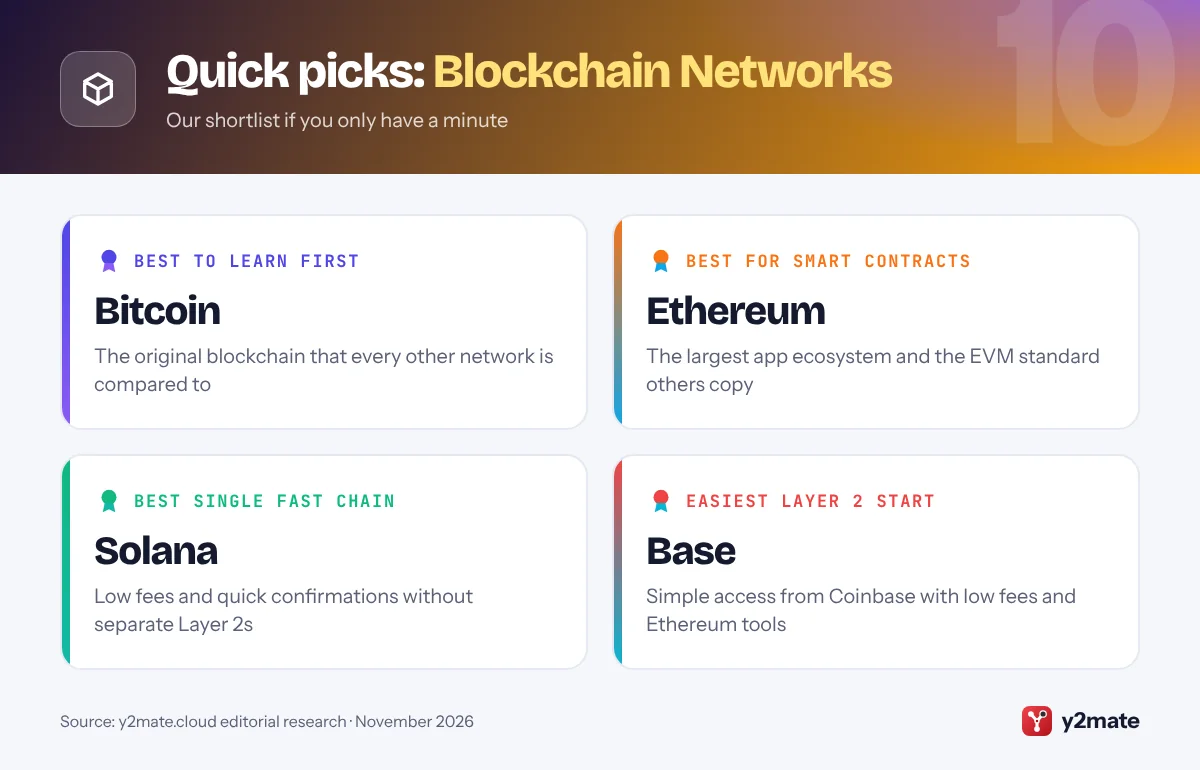
How we ranked this list
We ranked these networks by how important they are for a beginner to understand: how widely they are used and discussed, how long they have been running, the size of their developer and app ecosystems, and how clearly each shows a distinct design. We compared publicly documented technical designs, official project documentation and widely reported user and developer feedback.
We did not rank by market value or investment potential, and we include no market figures, because they change daily and say little about technical quality.

The Top 10 Blockchain Networks
1. Bitcoin
Best for: understanding where blockchain began
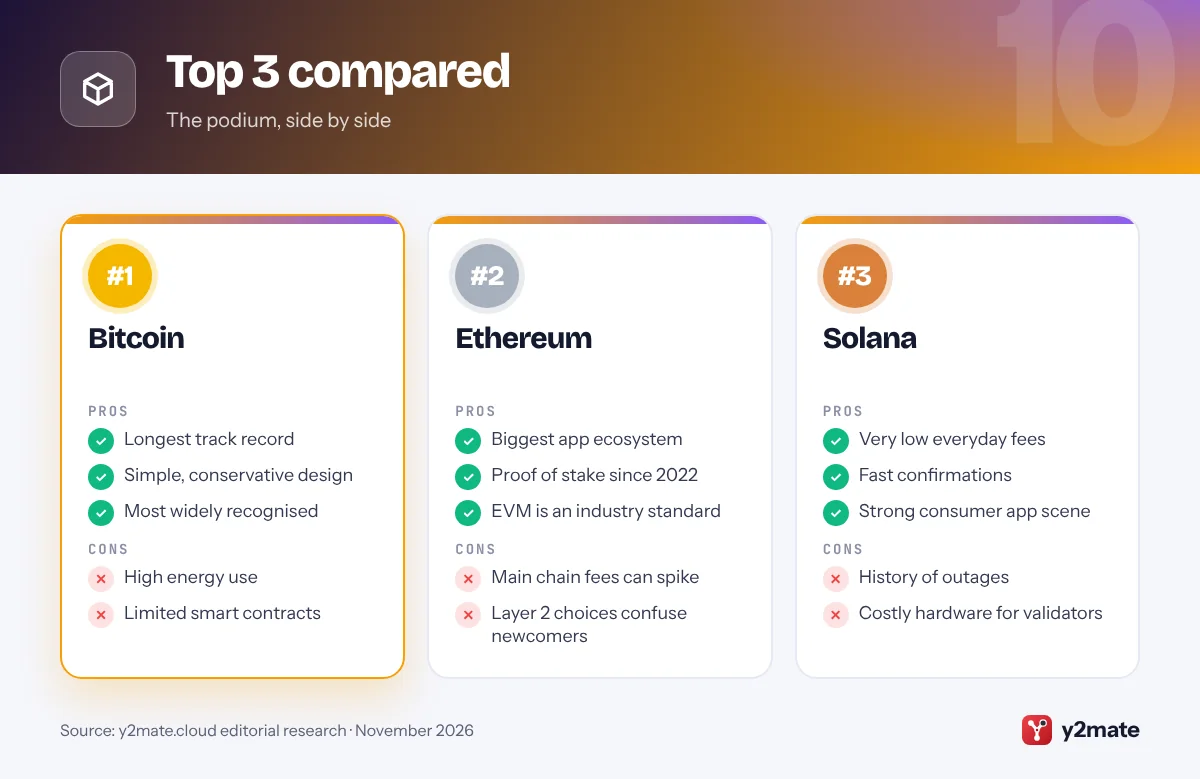
Bitcoin launched in 2009 as the first working blockchain, created by the pseudonymous Satoshi Nakamoto. Its goal is narrow but powerful: let people send value over the internet without a bank in the middle, under a supply schedule nobody can quietly change.
Bitcoin uses proof of work. Specialised computers called miners compete to solve a hard mathematical puzzle, and the winner adds the next block of transactions and earns newly issued bitcoin plus fees. This uses a lot of electricity, but it makes rewriting history extremely expensive, which is the core of Bitcoin’s security.
Bitcoin deliberately keeps its scripting language simple, so it is not built for complex apps the way Ethereum is. Most people use it as a long-term store of value or for payments, with faster small payments increasingly handled by add-on systems such as the Lightning Network. Almost every other project is defined by how it differs from Bitcoin.
Official site: Bitcoin
- Longest track record of any blockchain
- Very simple, conservative design
- Largest and most recognised network
- Proof of work uses a lot of energy
- Limited support for apps and smart contracts
2. Ethereum
Best for: smart contracts, DeFi and stablecoins
Ethereum, launched in 2015, turned the blockchain into a programmable computer. Developers write smart contracts, small programs that run exactly as written, and those contracts power lending apps, exchanges, stablecoins, NFTs and more. The Ethereum Virtual Machine (EVM) it introduced has become a standard copied by many other chains.
Since a 2022 upgrade known as the Merge, Ethereum runs on proof of stake. Validators lock up ETH as collateral and take turns proposing and confirming blocks; if they cheat, part of their stake can be destroyed. This cut the network’s energy use dramatically compared with proof of work.
The main chain prioritises security and decentralisation over raw speed, so fees can rise when it is busy. Its long-term plan is for Layer 2 networks, such as Arbitrum and Base, to handle most everyday activity while settling back to Ethereum. For beginners, it is the place to understand decentralised apps.
Official site: Ethereum
- Largest smart contract ecosystem
- EVM is an industry-wide standard
- Strong security from many validators
- Main chain fees can spike when busy
- Layer 2 options can confuse newcomers
3. Solana
Best for: fast, low-cost apps and trading
Solana launched its mainnet beta in 2020 with a clear goal: handle a very large number of transactions on a single chain, quickly and cheaply, without relying on separate Layer 2 networks. That makes it popular for trading apps, payments, games and consumer apps where small fees matter.
Solana uses proof of stake combined with proof of history, a cryptographic clock that timestamps events so validators can agree on transaction order faster. Validators need powerful hardware, which helps throughput but raises the cost of running a node.
Solana does not use the EVM. Its programs are usually written in Rust, so developers coming from Ethereum need a different toolset. The network had several well-publicised outages in its earlier years, and its developers have since worked on reliability, including additional independent validator software. Solana is the clearest example of the “one fast chain” approach to scaling, as opposed to Ethereum’s layered approach.
Official site: Solana
- Very low fees for everyday use
- Fast confirmation times
- Busy consumer and trading app scene
- Past outages hurt its reputation
- Validators need expensive hardware
4. BNB Chain
Best for: low-cost EVM apps tied to Binance
BNB Chain is the blockchain ecosystem associated with Binance, one of the world’s largest crypto exchanges. Its main smart contract network, BNB Smart Chain, launched in 2020 and is EVM compatible, so apps and wallets built for Ethereum usually run on it with few changes.
It uses proof of staked authority (PoSA). A relatively small set of validators, chosen based on the BNB staked with them, produce blocks. Fewer validators means faster blocks and lower fees, but also a more centralised network than Ethereum or Bitcoin. That trade-off is the key thing to understand about BNB Chain.
In practice, people mostly use it for decentralised exchanges, games, token launches and cheap transfers, especially where Binance is widely used. Because of its close ties to one company, its fortunes are linked to that company’s reputation and regulatory situation. It shows how a chain can trade some decentralisation for convenience and low costs.
Official site: BNB Chain
- Low fees and quick confirmations
- EVM compatible with familiar tools
- Easy access for Binance users
- Small validator set, more centralised
- Closely tied to one company
5. Cardano
Best for: a research-first, cautious approach
Cardano launched in 2017 and is known for its academic, research-driven style. New features are typically described in peer-reviewed papers before they are built, which makes development slower but more methodical than on many rivals.
It runs on Ouroboros, a family of proof of stake protocols. ADA holders can delegate their coins to stake pools run by independent operators without giving up custody, and those pools take turns producing blocks. This delegation model is beginner-friendly and has helped Cardano keep a large number of independent pools.
Smart contracts arrived in 2021. They use a different design from Ethereum, the extended UTXO model, and are written in languages such as Plutus and Aiken, so Ethereum apps cannot simply be copied across. Cardano has also focused on on-chain governance, giving ADA holders a formal say in how the network evolves. Its app ecosystem is smaller than Ethereum’s or Solana’s, but it remains widely discussed.
Official site: Cardano
- Peer-reviewed, methodical development
- Simple staking without lock-ups
- Formal on-chain governance
- Smaller app ecosystem
- Not EVM compatible by default
6. Avalanche
Best for: custom chains and fast finality
Avalanche launched in 2020 around the idea that many blockchains can run side by side. Its best-known chain, the C-Chain, is EVM compatible, so Ethereum developers and wallets can use it easily. Organisations can also launch their own custom chains, now called Avalanche L1s, with their own rules.
Avalanche uses its own family of proof of stake consensus protocols. Instead of every validator talking to every other, each one repeatedly samples a small random group and adjusts its view until the network settles on an answer. Transactions typically reach finality, meaning they cannot be reversed, within seconds.
That flexibility has made Avalanche popular with games, institutions experimenting with tokenised assets, and projects that want their own chain without building security from scratch. The main downside is that activity is spread across many chains. Avalanche shows how one network can act as a launchpad for many specialised, independently run blockchains.
Official site: Avalanche
- Fast transaction finality
- EVM-compatible C-Chain
- Easy to launch custom chains
- Activity spread across many chains
- Multi-chain design can be confusing
7. Arbitrum
Best for: cheaper Ethereum apps on Layer 2
Arbitrum is a Layer 2 network built on Ethereum by Offchain Labs; its main chain, Arbitrum One, opened in 2021. It processes transactions off Ethereum’s main chain, bundles them, and posts the results back to Ethereum. Users get much lower fees while still relying on Ethereum for final security.
Arbitrum is an optimistic rollup. It assumes transaction batches are valid by default, but anyone can challenge a batch during a dispute window by submitting a fraud proof. Because of that window, withdrawing to Ethereum through the official bridge takes days, although third-party bridges can be faster.
Arbitrum is fully EVM compatible, so most Ethereum apps, tools and wallets work with minimal changes. It hosts a large and active DeFi ecosystem and is governed in part by the Arbitrum DAO, where ARB holders vote on proposals. It is a good starting point for using Ethereum apps without paying Ethereum main-chain fees.
Official site: Arbitrum
- Much cheaper than Ethereum main chain
- Inherits Ethereum security
- Large DeFi app ecosystem
- Slow withdrawals via official bridge
- Sequencer still run centrally
8. Base
Best for: easy on-ramp for Coinbase users
Base is an Ethereum Layer 2 network incubated by Coinbase and opened to the public in 2023. Like Arbitrum, it is an optimistic rollup: it processes transactions cheaply off Ethereum’s main chain and posts the data back to Ethereum for security. Fees are paid in ETH.
Base is built with the OP Stack, open-source software from the Optimism project, and is part of the wider “Superchain” of networks sharing that software. Developers familiar with Ethereum can deploy on Base using the same tools and smart contracts.
Its biggest advantage is distribution. Coinbase users can move funds onto Base easily, which has helped it attract consumer apps, social apps, payments and on-chain experiments aimed at mainstream users. The trade-off is that one company plays a large role in running the network today, including operating the sequencer that orders transactions. For many beginners, it is the most approachable way to try Ethereum-style apps.
Official site: Base
- Low fees with Ethereum security
- Easy to reach from Coinbase
- Strong focus on consumer apps
- Heavy reliance on one company
- Slow withdrawals via official bridge
9. Polygon
Best for: low-cost payments and EVM apps
Polygon started as a scaling project for Ethereum, and its best-known network today is Polygon PoS, an EVM-compatible chain running since 2020. It offers low fees and fast confirmations and periodically records checkpoints on Ethereum. Its native token is POL, which replaced the older MATIC.
Polygon PoS uses proof of stake, with validators who stake tokens to produce and confirm blocks. Strictly speaking it is a sidechain with its own validators rather than a rollup, so its security does not come fully from Ethereum, even though the two are closely connected.
Polygon is known for payments and stablecoin transfers, and many well-known brands have used it for loyalty programmes and digital collectibles. The project has shifted strategy over time: it is retiring its earlier zkEVM network and focusing on Polygon PoS and the Agglayer, a system meant to connect many chains. It is a practical, low-cost EVM network.
Official site: Polygon
- Low fees for payments and transfers
- Fully EVM compatible
- Used by many mainstream brands
- Not secured fully by Ethereum
- Frequent strategy changes
10. Polkadot
Best for: connecting specialised blockchains
Polkadot, created by Ethereum co-founder Gavin Wood and launched in 2020, was designed so that many specialised blockchains could share security and talk to each other. A central relay chain coordinates the network, while connected chains (historically called parachains) handle specific jobs such as DeFi, identity or gaming.
It uses nominated proof of stake (NPoS). DOT holders nominate validators they trust, and the protocol selects an active set from those nominations. Those validators secure every connected chain at once, so a new project does not need to recruit its own. Polkadot also has a mature on-chain governance system where token holders vote on upgrades and treasury spending.
The trade-off is complexity: its architecture is harder for beginners to follow than a single chain, and its app ecosystem is smaller than Ethereum’s. For learners, Polkadot is the clearest example of a “shared security” multi-chain design, and its developers continue to upgrade it.
Official site: Polkadot
- Shared security for connected chains
- Built-in cross-chain messaging
- Mature on-chain governance
- Complex for beginners to grasp
- Smaller app ecosystem
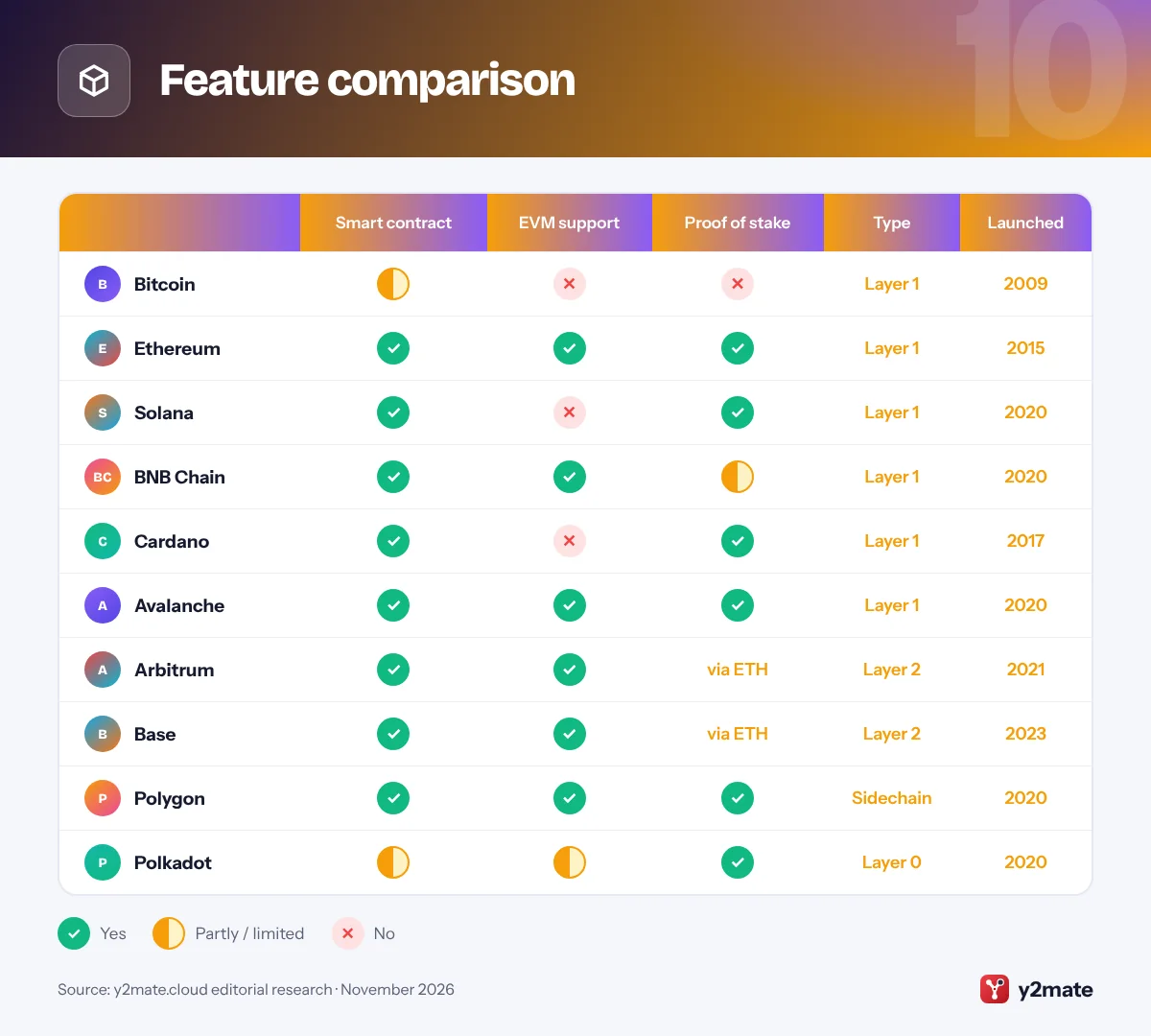
Feature comparison
How to get started with blockchain networks safely
You do not need to buy anything to learn how blockchain networks work. Block explorers let you view real transactions on any public chain, and most networks offer free test networks where you can try wallets and apps with tokens that have no value.
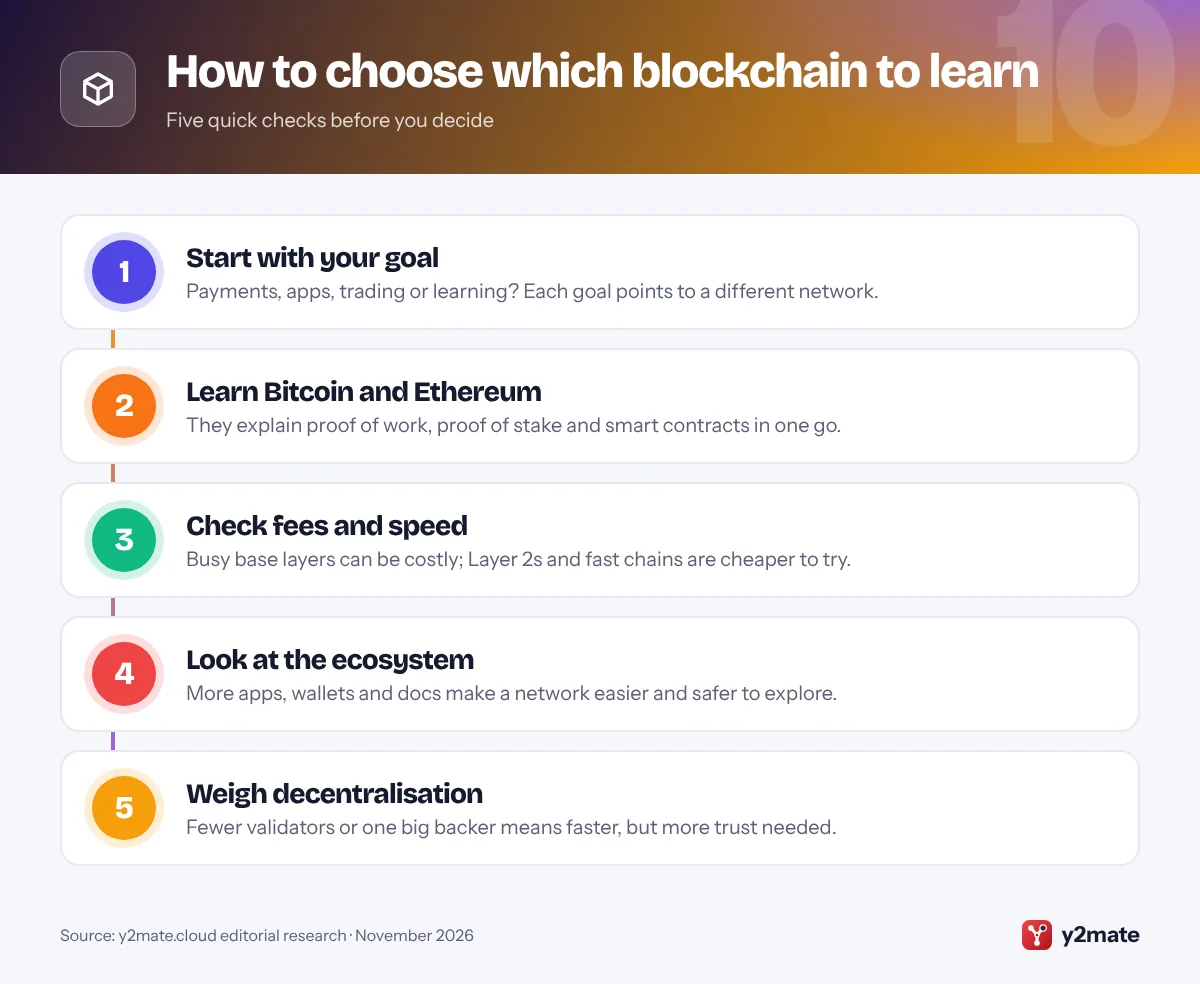
Understand the layers
Layer 1 networks such as Bitcoin, Ethereum and Solana run their own security. Layer 2 networks such as Arbitrum and Base process transactions cheaply and settle back to Ethereum. Sidechains such as Polygon PoS connect to Ethereum but use their own validators. Knowing the type tells you who you are trusting.
Use the right network in your wallet
Many tokens exist on several chains at once, and sending funds on the wrong network is a common beginner mistake. Check that sender and receiver use the same network, and send a small test amount first.
Protect yourself
- Never share your seed phrase or private keys.
- Be wary of anyone promising guaranteed returns.
- Only use official websites and well-known wallets.
- Treat bridges between chains with extra care; they are frequent hack targets.
If you do decide to hold crypto, only use money you can afford to lose, and check the rules that apply where you live. This guide is not financial advice.
Frequently asked questions
What is a blockchain network in simple terms?
A blockchain network is a shared record of transactions kept by many independent computers instead of one company. New entries are grouped into blocks, and the computers follow rules, called a consensus mechanism, to agree on which blocks are valid. Because everyone keeps a copy, it is very hard for any one party to change past records.
What is the difference between proof of work and proof of stake?
In proof of work, miners spend computing power and electricity to compete for the right to add blocks, as on Bitcoin. In proof of stake, validators lock up tokens as collateral and are chosen to add blocks, as on Ethereum and Cardano. Proof of stake uses far less energy, while proof of work relies on physical costs to make attacks expensive.
What is a Layer 2 blockchain?
A Layer 2 is a network built on top of another blockchain, usually Ethereum, to make transactions cheaper and faster. It processes many transactions on its own and then posts a compressed record back to the main chain, which provides the final security. Arbitrum and Base are popular examples that use a design called an optimistic rollup.
Which blockchain is best for beginners?
For learning, Bitcoin and Ethereum are the best places to start because almost every other network builds on their ideas. For trying apps cheaply, a Layer 2 such as Base or Arbitrum, or a low-fee chain such as Solana, is usually easier. The right choice depends on your goal, and you can learn a lot using free test networks.
Is it safe to send crypto between different blockchains?
It can be, but it needs care. Tokens on one blockchain cannot simply be sent to another; you usually need a bridge or an exchange that supports both networks. Bridges have been targets for major hacks, and sending funds on the wrong network can mean losing them. Use well-known tools, double-check the network, and send a small test amount first.
Final verdict
Each of these blockchain networks solves a slightly different problem. Bitcoin focuses on secure digital money. Ethereum is the main home of smart contracts, with Layer 2s like Arbitrum and Base making it cheaper to use. The others each take their own approach to speed, governance and connecting chains.
Our recommendation: learn how Bitcoin and Ethereum work first, then explore one fast chain and one Layer 2 on a test network. Again, this is an educational guide, not financial advice.
Sources and further reading
- SEC crypto scam alert: The SEC's investor alert describes common digital asset and crypto investment scams and the warning signs to watch for.
- exercise caution with crypto: The SEC explains the risks of crypto asset securities, including platforms that may not follow federal securities laws.
- NIST blockchain research: NIST's overview of blockchain technology, with its research and publications on how distributed ledgers work.
- Ethereum layer 2 networks: Ethereum.org explains layer 2 networks such as Arbitrum, Base and Polygon and how they scale Ethereum.

Leave a Reply