
- Tesla's Supercharger network is the most widespread fast-charging option in the USA and is now open to many non-Tesla EVs, often through an adapter or a native NACS port.
- NACS, standardized by SAE as J3400, is becoming the common plug in North America, and networks such as Electrify America, Ionna, Rivian and EVgo are adding it.
- Ionna, a joint venture of eight automakers, and Walmart's in-house network are the fastest-moving newcomers in US fast charging.
- Federal NEVI funding for highway chargers resumed under revised guidance after a 2025 pause, so new corridor stations keep opening state by state.
- Most public Level 2 networks like ChargePoint and Blink are best for top-ups at work or while shopping, not for road trips.
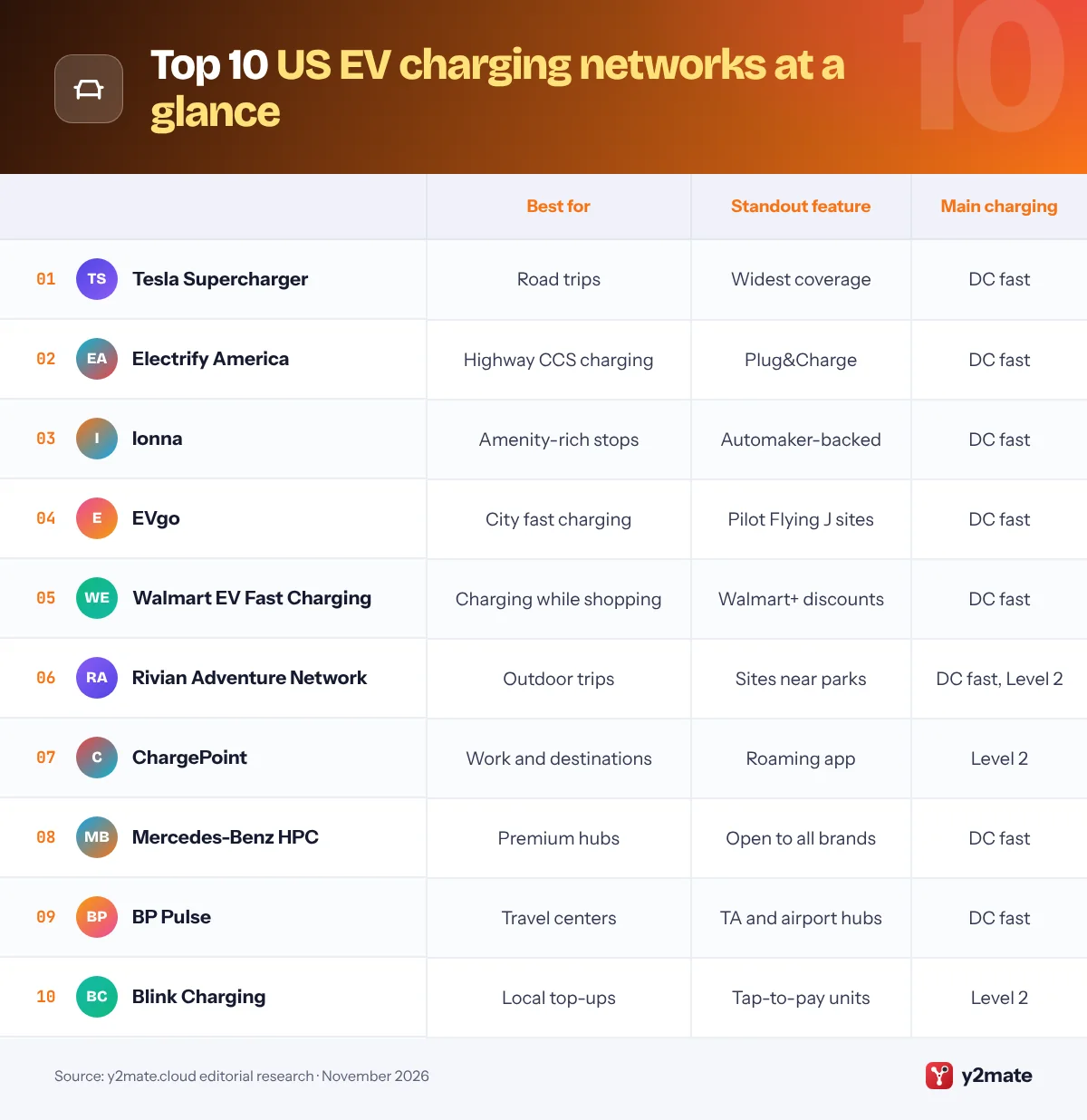
The best EV charging networks in the USA in 2026 are Tesla’s Supercharger network for sheer coverage, Electrify America and Ionna for open high-power highway charging, EVgo for city and travel-center locations, and Walmart’s fast-growing in-house network for everyday stops. Which one suits you depends on your car’s plug, where you drive and whether you mostly charge at home.
The American charging map is changing fast. Most automakers have moved to the North American Charging Standard (NACS), the plug Tesla created and SAE International standardized as J3400. Two new networks backed by big brands, Ionna and Walmart, are opening sites at a quick pace, and the federal National Electric Vehicle Infrastructure (NEVI) program is funding stations along highways again after a pause in 2025.
This list covers ten EV charging networks in the USA that matter for real drivers, what each one is best at and who should skip it. It is written for new EV owners, people planning their first electric road trip and anyone deciding which apps to install.

How we ranked this list
We compared publicly documented information from each operator: where its stations are, whether it offers DC fast charging or mainly Level 2, which connectors it supports, whether non-members and other brands can use it, how you pay and what reliability or uptime commitments it makes. We also weighed widely reported driver feedback and how quickly each network is growing in 2026.
We did not run our own charging tests, and we do not list prices, because they vary by state, site and time of day. Always check the operator’s app for live availability and pricing before you set off.
The Top 10 EV Charging Networks
1. Tesla Supercharger
Best for: nationwide road-trip coverage
Tesla’s Supercharger network is still the backbone of long-distance EV travel in the USA. Stations sit along almost every major interstate, sites usually have many stalls, and the network has a strong reputation for working first time. Tesla owners simply plug in and the car handles payment.
The big change is access. Because most automakers have adopted the NACS plug, owners of many Ford, GM, Rivian, Hyundai, Kia, Mercedes-Benz and other EVs can now use Superchargers, either through an approved NACS-to-CCS adapter or through a native NACS port on newer models. Non-Tesla drivers usually start and pay through the Tesla app, and Tesla offers an optional membership for lower rates.
There are trade-offs. Some older stations were designed around Tesla’s charge-port location, so cables can be short for other cars and you may need to park awkwardly or take two stalls. Not every non-Tesla model is enabled yet, so check Tesla’s compatibility list and your automaker’s guidance before relying on it for a trip.
Official site: Tesla Supercharger
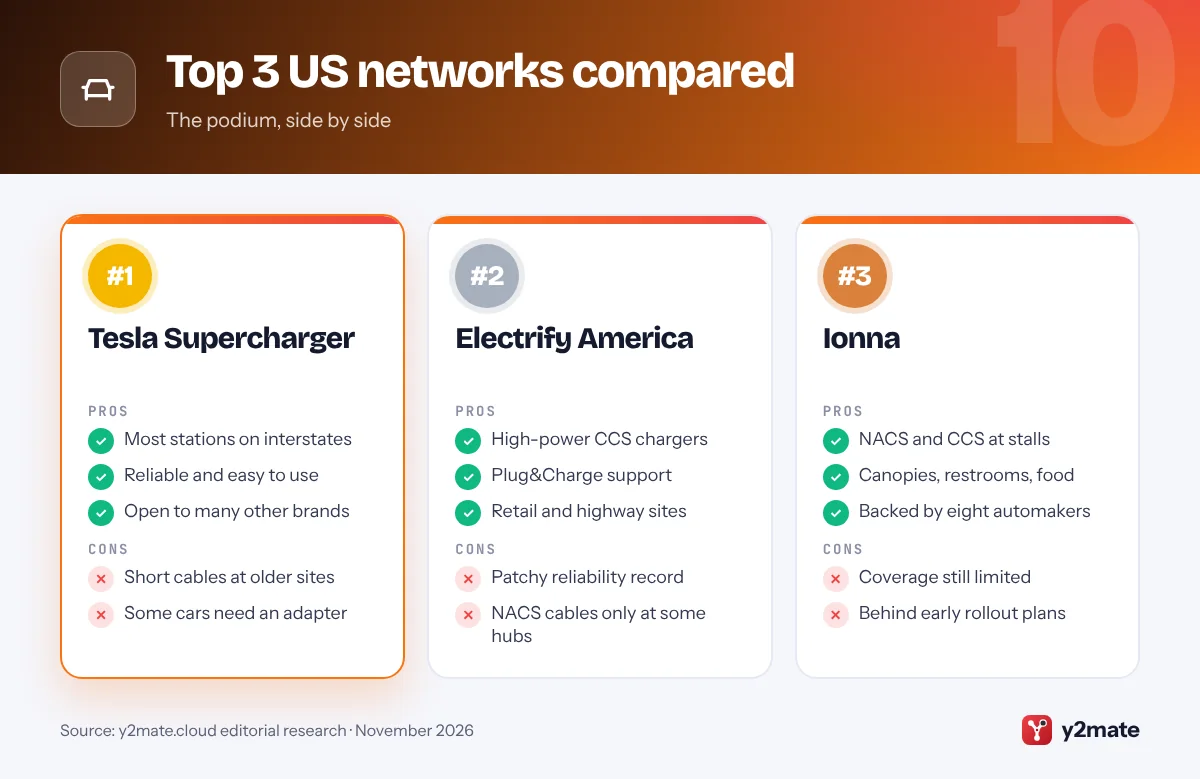
- Largest fast-charging footprint
- Strong reliability reputation
- Open to many non-Tesla EVs
- Short cables at older sites
- Some EVs need an adapter
2. Electrify America
Best for: high-power CCS charging on highways
Electrify America, owned by the Volkswagen Group, built one of the first nationwide networks of high-power DC fast chargers for CCS cars. Its stations sit along interstates and in retail parking lots in most states, often at Walmart, Target and other big stores, and many offer very high power for cars that can accept it.
The network supports Plug&Charge for compatible vehicles, so the car can authenticate and pay automatically, and many automakers bundle charging plans or credits with new EVs. In 2026 Electrify America has been converting selected stalls to NACS, starting with hubs in California and New Jersey, while keeping CCS connectors in place for older cars.
Reliability has historically been its weak spot, with drivers reporting broken or slow stalls. The company has spent heavily on replacing older hardware and publishes network updates, but it is still smart to check the app for live status before you arrive. If your car uses CCS and you drive long distances outside Tesla’s strongest areas, Electrify America is one of the most important apps to have.
Official site: Electrify America
- High-power chargers
- Plug&Charge support
- Wide interstate coverage
- Mixed reliability history
- NACS rollout still early
3. Ionna
Best for: new, amenity-rich charging stops
Ionna is a joint venture formed by BMW, General Motors, Honda, Hyundai, Kia, Mercedes-Benz, Stellantis and Toyota to build a large, open fast-charging network across North America. It calls its stations Rechargeries. Some are fully owned and run by Ionna, while co-branded sites, called Rechargery @, are hosted at convenience chains such as Sheetz, Wawa, Casey’s and Circle K.
Ionna’s pitch is a better experience than the early networks: modern high-power chargers, both NACS and CCS cables at stalls, pull-through or well-sized bays, canopies and lighting, and restrooms or food on site. Its flagship locations aim to feel more like a modern gas station than a few chargers at the back of a parking lot.
The catch is coverage. Ionna has been growing quickly in 2026, but its rollout started later than its rivals and has run behind early targets, so large parts of the country still have no Rechargery nearby. Check its app or map along your route; if one is on your way, it is often among the most pleasant places to charge.
Official site: Ionna
- NACS and CCS at stalls
- Modern sites with amenities
- Backed by eight automakers
- Still patchy coverage
- Rollout behind early targets
4. EVgo
Best for: city fast charging and Pilot Flying J stops
EVgo is one of the longest-running DC fast-charging networks in the USA. Many of its sites are in urban and suburban areas, at grocery stores, malls and parking garages, which makes it useful for drivers without home charging who need a quick top-up during the week.
EVgo also runs the chargers at a growing number of Pilot and Flying J travel centers, built in partnership with Pilot Company and General Motors. These sites target highway drivers, with pull-through bays that suit larger vehicles and towing. EVgo supports Autocharge+ on compatible cars, so you can plug in and start without tapping the app each time, and it has been adding NACS connectors at selected locations.
Older EVgo sites can have fewer stalls and lower power than newer hubs, and some locations have struggled with queues at busy times. Membership plans can lower costs for frequent users, so compare plans in the app if you charge in public regularly. For city drivers who rely on public fast charging, EVgo is often the most convenient choice.
Official site: EVgo
- Strong urban coverage
- Pilot Flying J highway sites
- Autocharge+ convenience
- Older sites can be small
- Busy sites may queue
5. Walmart EV Fast Charging
Best for: charging while you shop
Walmart launched its own company-owned EV fast-charging network in 2025 and has been expanding it rapidly through 2026, reaching its 100th store with fast charging in August 2026. This is separate from the Electrify America chargers that have sat in many Walmart parking lots for years.
The appeal is simple: Walmart stores are everywhere, including in small towns and rural areas that other networks have skipped, and you can do your shopping while the car charges. Sites typically have multiple fast-charging stalls, payment runs through the Walmart app, and Walmart+ members get discounted rates. The retailer has said it plans to keep adding stores, so coverage should keep improving.
As a newer network, Walmart’s sites are still concentrated in certain states, and it does not yet have the dense interstate coverage of Tesla or Electrify America. Hours and access depend on the store. If you already use the Walmart app or have a Walmart+ membership, it is worth adding Walmart to your list of go-to charging stops.
Official site: Walmart EV Fast Charging
- Convenient store locations
- Reaches smaller towns
- Walmart+ member discounts
- Network still young
- Limited interstate coverage
6. Rivian Adventure Network
Best for: scenic routes and outdoor trips
Rivian built its Adventure Network to support the kind of trips its R1T and R1S owners like to take, with fast chargers along highways and near national parks, trailheads and outdoor destinations. It also runs slower Rivian Waypoints chargers at hotels, parks and other places where people stay longer.
Originally the fast-charging sites were open only to Rivian vehicles. Since 2025 Rivian has opened almost the whole network to other EVs, with charging started through the Rivian app, and it has begun adding NACS connectors alongside CCS at many sites. Rivian’s own vehicles now come with NACS ports and can use Tesla Superchargers, which gives Rivian owners even more options.
The network is smaller than the big national players and its sites are spread unevenly, with clusters in places Rivian expects adventurous drivers to visit. That makes it a useful backup rather than your main plan in most of the country. If you are heading to a national park or a mountain region, check the Rivian map; a quiet Adventure Network site may be the best stop on the route.
Official site: Rivian Adventure Network
- Sites near outdoor destinations
- Now open to most EVs
- Adding NACS connectors
- Smaller network
- Uneven geographic coverage
7. ChargePoint
Best for: Level 2 charging at work and destinations
ChargePoint is one of the largest charging platforms in the USA, but it works differently from most networks on this list. ChargePoint mostly sells chargers and software to businesses, cities, apartment buildings and employers, who then own the stations and set their own prices and access rules. The result is a huge number of mainly Level 2 chargers at offices, hotels, shopping centers and parking garages.
For drivers, the ChargePoint app is the main tool. It shows ChargePoint stations plus many partner networks through roaming agreements, lets you start sessions and supports waitlists at busy locations. Many workplaces use ChargePoint, so it is often the network you use most without thinking about it. There are some ChargePoint DC fast chargers too, and its newer hardware supports both NACS and CCS cables.
Because each site owner sets its own rules, the experience varies: prices, time limits, idle fees and maintenance standards can differ widely between two stations a mile apart. ChargePoint is best for daily top-ups, not as your primary road-trip network.
Official site: ChargePoint
- Huge Level 2 footprint
- Useful app with roaming
- Common at workplaces
- Mostly slower Level 2
- Prices and rules vary by host
8. Mercedes-Benz High-Power Charging
Best for: premium charging hubs open to all
Mercedes-Benz High-Power Charging is the carmaker’s own fast-charging network, and in North America it is open to drivers of every brand, not just Mercedes owners. Its hubs are built with both CCS and NACS cables, so most modern EVs can plug in without an adapter.
The network focuses on comfort and convenience. Many hubs are placed at retail or travel-center locations with food and restrooms, including a partnership with Buc-ee’s in parts of the South. Mercedes owners get extras such as the ability to reserve a charger through the Mercedes me app, while other drivers can start and pay through the network’s own app or by card where supported.
The main limitation is size. The network is still small compared with Tesla, Electrify America or EVgo, and its sites are concentrated in particular regions. Mercedes has announced plans for many more hubs across North America, but treat those as plans until a site opens near you. If one is on your route, it is often a calm, well-designed place to stop.
Official site: Mercedes-Benz High-Power Charging
- Open to all brands
- CCS and NACS cables
- Comfortable hub locations
- Small network so far
- Coverage regionally limited
9. BP Pulse
Best for: travel centers and airport hubs
BP Pulse is the electric charging brand of energy company BP. In the USA it has been building fast-charging sites at TravelCenters of America locations, which BP owns, along with urban hubs such as its large site near Los Angeles International Airport that serves ride-hail drivers and travelers. It has also announced charging hubs at Simon shopping malls and Waffle House restaurants.
Newer BP Pulse sites offer high-power DC chargers, and the travel-center locations are well placed along interstates with fuel-station amenities, food and restrooms. BP also runs large fleet-charging operations, which gives it experience with high-utilization sites.
On the downside, BP Pulse’s public US footprint is still modest and has grown more slowly than its earlier targets suggested. You will not find it everywhere, and site quality varies between older and newer locations. Use it as part of your road-trip toolkit, especially if a TA or Petro travel center is a natural stop on your route.
Official site: BP Pulse
- Interstate travel-center sites
- High-power newer hubs
- Food and restrooms on site
- Modest US footprint
- Growth slower than targets
10. Blink Charging
Best for: Level 2 top-ups at local businesses
Blink Charging operates and sells EV chargers across the USA, with a large number of Level 2 stations at retail centers, parking garages, hotels, municipal lots and workplaces. Some Blink stations are owned and run by Blink itself, while others are owned by the property host, which affects pricing and maintenance.
For most drivers, Blink is a destination-charging network: you plug in while you shop, eat or work and come back to a partly charged car. The Blink app lets you find stations, start sessions and pay, and many stations also accept tap-to-pay or RFID cards. Blink has added some DC fast chargers, but they make up a small share of its network.
Blink has faced criticism over the reliability of older units, so check recent check-ins on the app or on third-party maps before depending on a specific station. It is a handy network to have in your app collection, especially in suburbs and cities where its Level 2 chargers are common, but it is not built for long-distance travel.
Official site: Blink Charging
- Many Level 2 locations
- Tap-to-pay at many units
- Common in cities and suburbs
- Few fast chargers
- Older units can be unreliable
US charging network features compared

How to pick EV charging networks in the USA
Most EV drivers in the USA do the bulk of their charging at home, so public networks matter most for road trips and for people who live in apartments. Start with your car’s charging port. If it has a NACS (SAE J3400) port, Tesla Superchargers and the growing number of NACS stalls at other networks are open to you without an adapter. If it has a CCS port, you can use Electrify America, EVgo, Ionna and most others directly, and many Superchargers with an approved adapter.

Think in layers
- Road trips: Tesla, Electrify America, Ionna, EVgo at Pilot Flying J, and BP Pulse at travel centers.
- Everyday fast charging: EVgo, Walmart and local Electrify America sites.
- Destination and work charging: ChargePoint and Blink Level 2 stations.
What NEVI means for you
The National Electric Vehicle Infrastructure program gives states federal money to build fast chargers along designated highway corridors. It was paused in early 2025, then restarted under revised federal guidance, and states have been approving plans and awarding contracts again. NEVI-funded stations must meet federal minimum standards for things like uptime, payment options and open data, so new corridor sites should be easier to use than some older chargers.
Before you go
Use a route planner that understands your car, keep at least two backup networks on your phone, and check recent driver check-ins. Charging speed depends on your car, the battery’s temperature and its state of charge, not just the charger’s rating.
Frequently asked questions
What is the best EV charging network in the USA?
For most drivers, Tesla's Supercharger network is the best overall because it has the most fast-charging sites along US highways and a strong reliability record. Many non-Tesla EVs can now use it with a NACS port or an approved adapter. CCS drivers should also install Electrify America, EVgo and Ionna, which add coverage in areas where Superchargers are busy or far apart.
Can non-Tesla EVs use Tesla Superchargers?
Yes, many can. Most major automakers have agreements with Tesla, so their EVs can use Superchargers either through a native NACS charging port on newer models or through an approved NACS-to-CCS adapter on older ones. You usually start and pay through the Tesla app. Check Tesla's site and your automaker's guidance to confirm that your specific model is enabled.
What is NACS or SAE J3400?
NACS stands for North American Charging Standard. It is the compact charging plug Tesla designed and opened to other companies. SAE International standardized it as J3400, and most automakers selling EVs in North America have adopted it. Charging networks are adding NACS cables alongside the older CCS plug, so both will coexist for several years.
What is the NEVI program?
NEVI, the National Electric Vehicle Infrastructure program, is a federal program that gives states funding to build public fast chargers, mainly along designated highway corridors. It was paused in 2025 and restarted under revised guidance from the Department of Transportation. Stations built with NEVI money must meet federal minimum standards covering reliability, payment and data sharing.
Do I need a membership to use EV charging networks?
Usually not. Most US networks let you charge as a guest through their app, and many newer stations accept credit card tap-to-pay. Memberships or subscriptions are optional and can lower your cost per session if you charge in public often. Some automakers also include free or discounted charging plans on specific networks with new vehicles.
Final verdict
For most drivers, the best combination of EV charging networks in the USA is Tesla Superchargers for coverage, plus Electrify America or Ionna for high-power open charging and EVgo or Walmart for everyday fast top-ups. Add ChargePoint for workplace and destination Level 2 charging and you will rarely be stuck.
The shift to NACS and the restart of NEVI funding mean the US charging map will look noticeably better by 2027. Until then, plan your route in advance, keep a backup network in mind and check live charger status before you arrive.
Sources and further reading
- AFDC station locator: The US Department of Energy's map of public EV charging stations, filterable by network, connector type and charging level.
- Charging stations explained: The Department of Energy's plain-language guide to Level 1, Level 2 and DC fast charging and the connectors each uses.
- FHWA NEVI program: The Federal Highway Administration's official page for the National Electric Vehicle Infrastructure program, its guidance and state plans.
- Joint Office of Energy and Transportation: The federal office supporting EV charging deployment, with resources on standards, reliability and the national charging network.

Leave a Reply