
- Tesla, InstaVolt, Gridserve, Osprey and MFG EV Power are among the most useful rapid charging networks for UK journeys in 2026.
- The Public Charge Point Regulations 2023 require contactless payment on new chargers of 8kW and above, a 99% reliability target for rapid chargers, open data and a free 24/7 helpline.
- Gridserve has told the competition regulator it will not enforce exclusive motorway service contracts after 2026, opening those sites to rival operators.
- Shell Recharge's ubitricity lamp-post network and LEVI-funded council schemes are key for drivers without a driveway.
- Pod, now owned by EDF, and Fastned add useful coverage at supermarkets and busy roadside hubs.
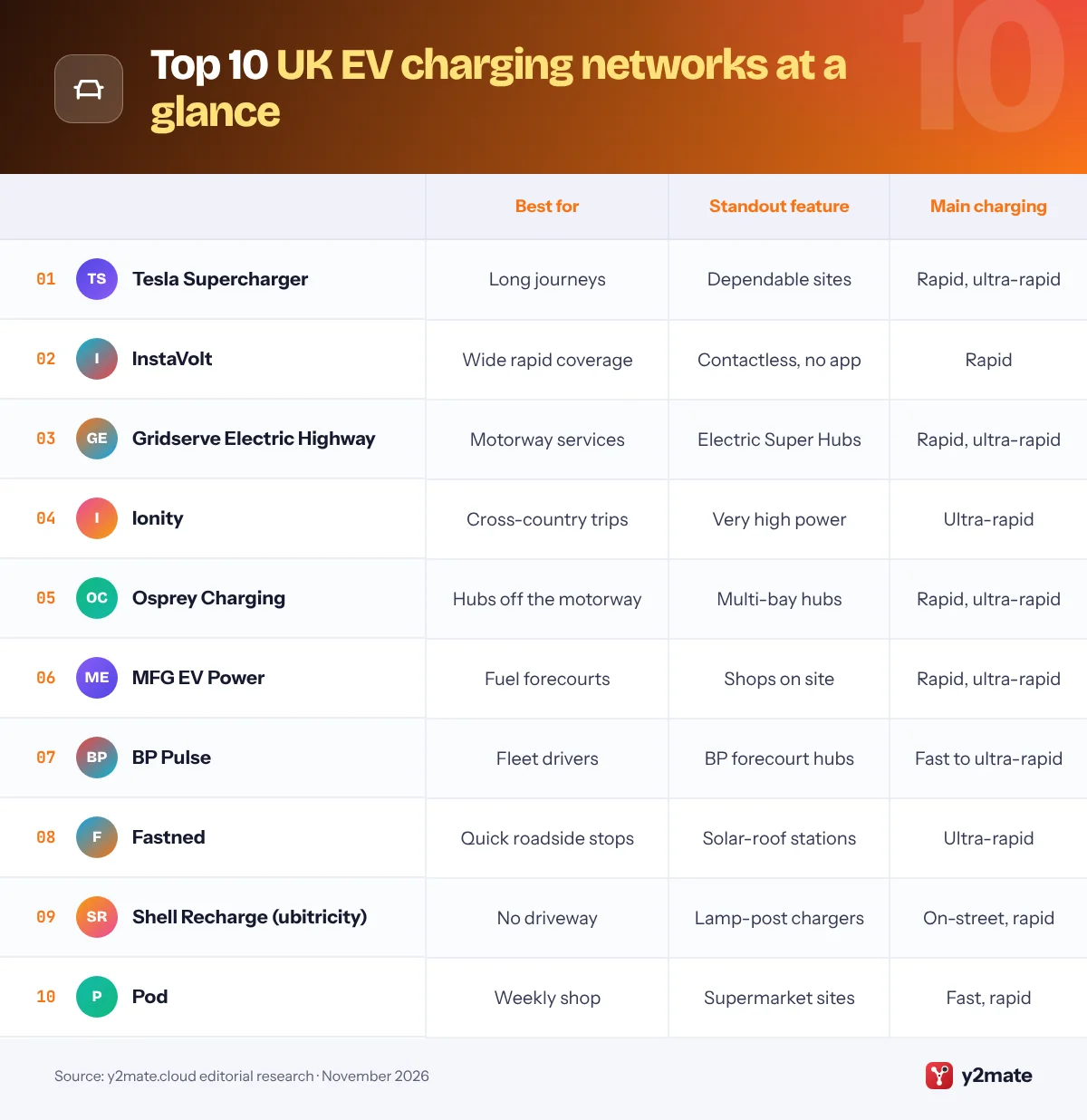
The best EV charging networks in the UK in 2026 are Tesla’s Superchargers and InstaVolt for widespread rapid charging, Gridserve for motorway services, Ionity and Fastned for very high-power hubs, Osprey and MFG EV Power for forecourt-style stops, and Shell Recharge’s ubitricity for on-street charging. The right mix depends on whether you have a driveway, how often you travel long distances and where you live.
Public charging in Britain has improved noticeably since the Public Charge Point Regulations 2023 came into force. They require contactless payment on new public chargers of 8kW and above and on existing rapid chargers, set a 99% reliability target for rapid chargers, make pricing clearer and force operators to share live data openly. Competition is also opening up at motorway services, where one operator has long held exclusive deals.
This guide ranks ten EV charging networks in the UK that matter most for everyday drivers, explains what each does best and who might be better served elsewhere.

How we ranked this list
We compared publicly documented information from each operator and from official sources: geographic coverage, the mix of rapid, ultra-rapid and slower chargers, payment options including contactless, compatibility with all EVs, and how each network meets the requirements of the Public Charge Point Regulations 2023. We also considered widely reported driver feedback and each operator’s 2026 expansion plans.
We did not carry out our own charging tests, and we do not quote prices because they change often and vary by site and membership. Check the operator’s app or a live map such as Zapmap before you travel.
The Top 10 EV Charging Networks
1. Tesla Supercharger
Best for: reliable long-distance rapid charging
Tesla’s Supercharger network remains one of the most dependable ways to charge on a long UK journey. Sites usually have plenty of stalls, sit close to major roads and have a strong reputation for chargers that simply work. Tesla drivers plug in and the car handles payment automatically.
Tesla has opened a large share of its UK sites to other makes of EV. Non-Tesla drivers use the Tesla app to find open sites, start a session and pay, and an optional monthly membership lowers the per-kWh rate. Because UK cars use the CCS2 connector, which Tesla’s newer Superchargers also use, most modern EVs can plug straight in without an adapter.
There are caveats. Not every site is open to other makes, so filter the map in the Tesla app before you set off. At some older sites the bay layout suits Tesla charge-port positions, which can mean awkward parking for other cars. Membership only pays off if you use Superchargers often, so consider how much of your charging happens on the road before signing up.
Official site: Tesla Supercharger
- Very dependable sites
- Many sites open to all EVs
- CCS2 so no adapter needed
- Not every site is open
- Best rates need membership
2. InstaVolt
Best for: widespread rapid charging with no app
InstaVolt is one of the UK’s largest rapid charging networks and is known for keeping things simple. Its chargers accept contactless payment, so you can tap a bank card and start charging without downloading an app or registering, although an app is available if you want to track sessions.
The network is spread widely across England, Scotland and Wales, with sites at retail parks, restaurants, convenience stores and fuel forecourts. InstaVolt has also opened larger hubs, including its flagship superhub near Bournemouth, and it has agreed to take on a large number of sites from the GeniePoint network, which further extends its reach. It publishes the reliability data required under the Public Charge Point Regulations on its website.
Many InstaVolt sites are smaller than the newest hubs, so you may find only a couple of chargers at a location, and older units deliver lower power than ultra-rapid rivals. Even so, its sheer coverage and the ease of tap-and-go payment make it one of the most useful networks for UK drivers, especially away from motorways.
Official site: InstaVolt
- Contactless on every charger
- Wide UK coverage
- Publishes reliability data
- Many small sites
- Older units are slower
3. Gridserve Electric Highway
Best for: motorway service area charging
Gridserve Electric Highway is the main charging network at UK motorway services. Gridserve took over the old Ecotricity Electric Highway and replaced its ageing units, and it now runs high-power chargers at most Moto, Roadchef and Extra services, plus its own Electric Forecourt sites such as Braintree.
For long journeys this location advantage is huge: you can charge where you would stop anyway for food and toilets. Gridserve has been expanding busy services into Electric Super Hubs with many more bays, and in early 2026 it reported its fastest start to a year for new hubs. Its chargers accept contactless payment.
Competition is coming. Gridserve has told the Competition and Markets Authority it will not enforce exclusivity in its motorway service contracts after 2026, which should allow other operators to install chargers at those sites. For now, Gridserve can be busy at peak holiday times, and older single-unit locations offer less choice. Check the app for live status before your stop, especially on bank holidays.
Official site: Gridserve Electric Highway
- At most motorway services
- Expanding Super Hubs
- Contactless payment
- Queues at peak times
- Some sites still small

4. Ionity
Best for: ultra-rapid charging on cross-country trips
Ionity is a pan-European ultra-rapid network owned by a joint venture of carmakers including BMW, Ford, Hyundai, Mercedes-Benz and the Volkswagen Group. In the UK it focuses on high-power chargers at motorway services, trunk roads and its own hubs, and it has expanded its UK footprint quickly.
Ionity’s chargers are among the most powerful in the country, which matters if your EV can accept very fast charging. Many carmakers bundle Ionity subscriptions or discounted rates with their cars, and Ionity sells its own optional subscription. Contactless card payment is available, and the network works for EV drivers who also travel in Europe, since one account covers sites across the continent.
The downside is that Ionity’s pay-as-you-go pricing can be on the higher side without a subscription, and sites are clustered along key routes rather than in towns. If you drive a newer EV capable of fast charging and regularly cover long distances, Ionity is worth adding; if you mostly drive locally, it is less essential.
Official site: Ionity
- Very high-power chargers
- Carmaker subscription perks
- Works across Europe too
- Pay-as-you-go can cost more
- Few town-centre sites
5. Osprey Charging
Best for: modern hubs off the motorway
Osprey Charging is a British rapid charging operator that has shifted from scattered single chargers to larger hubs, often with many ultra-rapid bays under one roof. Its hubs sit at retail parks, roadside stops and services across England, Scotland and Wales, with newer openings such as Twyford Services in the Midlands in 2026.
Osprey was one of the first UK networks to make contactless payment standard, and it supports an app and roaming cards too. Its hubs are designed to be easy to use: drive-in bays, clear signage and enough chargers that you are less likely to wait. Osprey has secured significant funding to keep building these hubs, so coverage should continue to improve.
Older Osprey locations can still be small, and hub coverage varies by region, with some areas much better served than others. Check the map for hub sites specifically if you want a stress-free stop. For drivers who prefer to charge near a supermarket or café rather than at a motorway service area, Osprey is one of the best choices.
Official site: Osprey Charging
- Contactless from early on
- Multi-bay modern hubs
- Easy, well-signed sites
- Older sites are small
- Regional coverage varies
6. MFG EV Power
Best for: charging at familiar fuel forecourts
MFG EV Power is the charging arm of Motor Fuel Group, one of the UK’s largest independent forecourt operators. It installs rapid and ultra-rapid chargers at its petrol stations, many of which carry brands such as BP, Esso, Shell, Texaco or Jet, and it has become one of the largest rapid charging networks in the country.
The forecourt format suits drivers who are used to petrol stations: sites are on main roads, open long hours, and usually have a shop, toilets and coffee. MFG has been building larger EV hubs with canopies at selected forecourts, and its chargers support contactless payment as required for rapid units under the 2023 regulations.
Because the network is spread across many existing sites, the number and power of chargers varies a lot from location to location. Branding can also be confusing, as the forecourt brand on the canopy may not match the charging operator. Use the MFG EV Power app or a live map to check what is available before you go, then enjoy the convenience of charging at a familiar fuel stop.
Official site: MFG EV Power
- Lots of forecourt sites
- Shops and toilets on site
- Contactless payment
- Charger numbers vary
- Forecourt branding can confuse
7. BP Pulse
Best for: BP forecourts and fleet drivers
BP Pulse is BP’s charging brand. In the UK it runs rapid and ultra-rapid chargers at BP forecourts, retail sites and dedicated hubs, along with a large number of older slower chargers inherited from Chargemaster, the company BP bought to start the network.
BP Pulse offers pay-as-you-go via contactless or its app, plus an optional subscription for regular users that unlocks lower rates. It also serves many company car and fleet drivers through business charging cards and home charging, so it is common in fleet policies. Newer BP Pulse hubs, sometimes alongside M&S Food or Wild Bean Cafe at BP sites, provide multiple high-power bays.
The mix of old and new hardware is BP Pulse’s weakness: older slower units can feel dated, while the best sites are excellent. Its reliability and coverage have improved, but check live status before relying on a single location. If you drive a fleet car or pass BP forecourts regularly, BP Pulse is an easy network to fit into your routine.
Official site: BP Pulse
- Ultra-rapid forecourt hubs
- Strong fleet offering
- Contactless and app options
- Older units feel dated
- Quality varies by site
8. Fastned
Best for: fast, simple roadside stations
Fastned is a Dutch charging operator known for its distinctive yellow canopies and solar roofs. In the UK it has been building ultra-rapid stations at roadside and retail locations, focusing on fewer, larger sites with very high-power chargers rather than scattered single units.
Fastned’s stations are designed for speed and simplicity: drive in, plug in, tap a contactless card or use the app, and leave. Its chargers are among the most powerful you can find in the UK, so EVs that can accept high power can add a lot of range in a short stop. The company operates across several European countries, so one app works abroad too.
The UK network is still small, with stations concentrated in particular regions, so it is a welcome bonus when it is on your route rather than a network you can rely on everywhere. Sites usually have fewer on-site facilities than motorway services. If a Fastned station is nearby, it is often one of the quickest and least stressful places to charge.
Official site: Fastned
- Very high-power chargers
- Simple, quick stations
- App works across Europe
- Small UK network
- Fewer facilities on site
9. Shell Recharge (ubitricity)
Best for: on-street charging without a driveway
Shell Recharge’s ubitricity network is the UK’s largest provider of on-street charging, built mainly into lamp posts and small kerbside units. It is a lifeline for drivers who live in flats or terraced streets without off-street parking, particularly in London and in council areas that have partnered with ubitricity.
These chargers are slow compared with rapid networks, which suits overnight charging near home. In 2026 ubitricity took over FM Conway’s SureCharge network, extending its reach across more local authorities. Many councils are adding further on-street chargers through the government’s Local Electric Vehicle Infrastructure (LEVI) fund, and ubitricity is one of the operators bidding for and delivering this work.
Shell also runs rapid chargers at Shell forecourts, which you can use with contactless payment or the Shell Recharge app. The main limitation of lamp-post charging is speed and availability: if neighbours use the same posts, you may not always find a free one. Check your council’s EV charging page to see which on-street operator serves your area.
Official site: Shell Recharge (ubitricity)
- Huge on-street footprint
- Ideal without a driveway
- Shell forecourt rapids too
- Lamp-post charging is slow
- Bays not reserved for you
10. Pod
Best for: charging during the weekly shop
Pod, previously called Pod Point, is a UK charging company now fully owned by EDF after the energy firm completed its takeover in 2025. Pod is best known for home chargers, but it also runs a large public network, much of it at supermarkets, retail parks, leisure centres and other destinations where people park for a while.
Many of Pod’s public chargers are fast AC units that suit topping up while you shop, though it also operates rapid chargers at selected sites. Some supermarket locations have historically offered low-cost or promotional charging, so check the current terms in the Pod app. Being part of EDF gives Pod access to energy expertise and investment, which may help it expand.
Pod’s public chargers are generally not what you want for a quick motorway stop, and the mix of slower units means you need to plan around how long you will be parked. For drivers who combine charging with errands, though, Pod is a convenient network to have on your phone.
Official site: Pod
- Lots of destination sites
- Good for shopping trips
- Backed by EDF
- Many slower units
- Few motorway locations
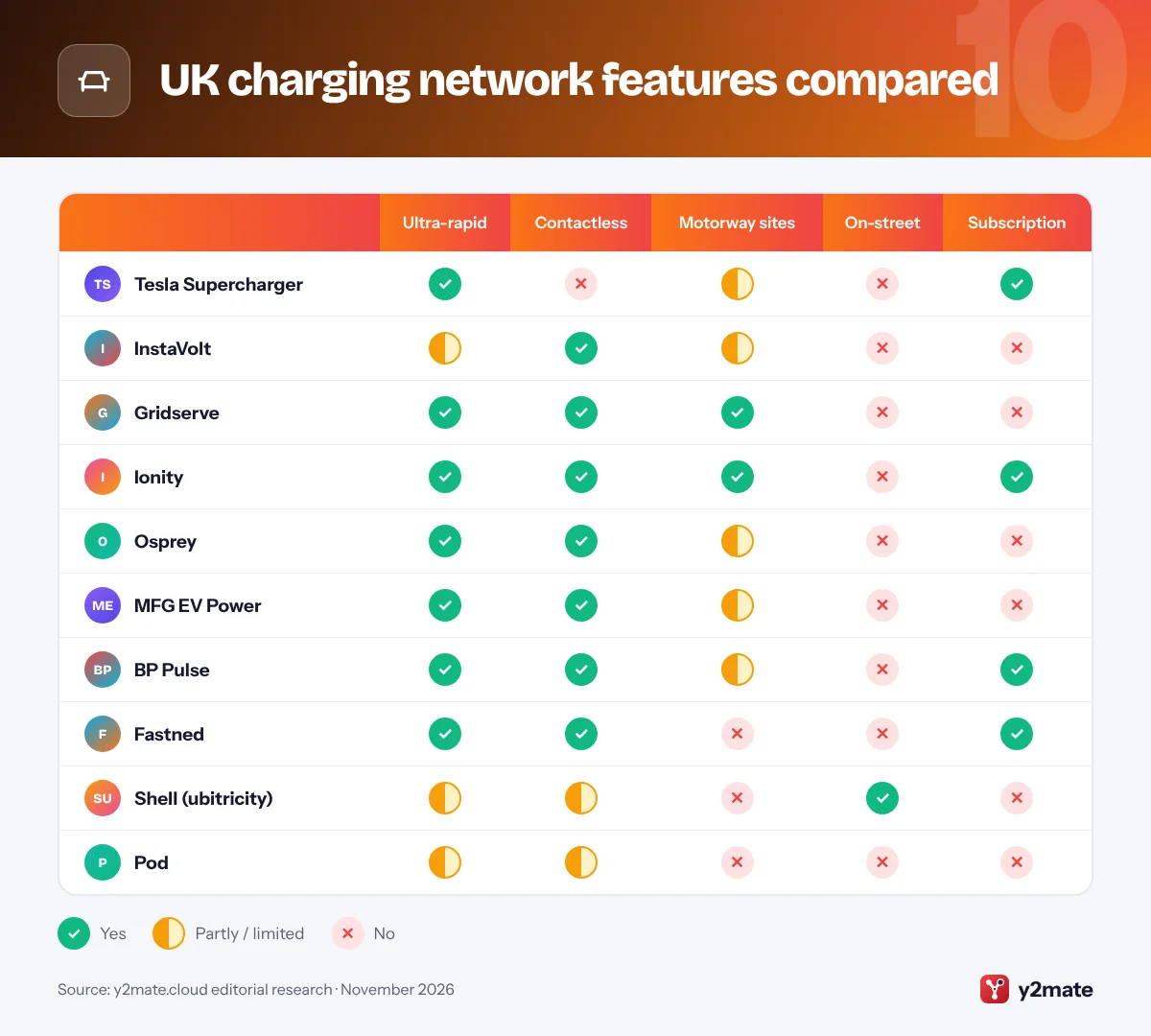
UK charging network features compared
How to choose EV charging networks in the UK
Your home situation matters most. If you have a driveway and a home charger, public EV charging networks in the UK are mainly for longer journeys, so focus on rapid networks along your usual routes: Tesla, InstaVolt, Gridserve, Ionity, Osprey and MFG EV Power. If you park on the street, look first at your council’s on-street scheme, which may be run by ubitricity or another operator, and then add a nearby rapid hub or supermarket network for quicker top-ups.

Know your rights under the 2023 regulations
- Contactless: new public chargers of 8kW and above, and existing rapid chargers, must accept contactless payment.
- Reliability: operators must meet a 99% reliability target across their rapid chargers and publish their performance.
- Clear pricing: prices must be shown in pence per kWh before you charge.
- Help when it fails: operators must provide a free, staffed helpline around the clock.
- Open data: live charger status must be shared openly, so third-party maps can show what is working.
Practical tips
Keep two or three apps installed even though contactless works, because apps can show live availability and member rates. Use a live map to check recent driver reports, avoid peak bank holiday slots at motorway services when you can, and remember that charging speed depends on your car and battery temperature, not just the charger.
Frequently asked questions
What is the best EV charging network in the UK?
There is no single best network for everyone. Tesla's Superchargers are among the most dependable for long journeys and many are open to all EVs. InstaVolt has very wide rapid coverage with simple contactless payment, and Gridserve covers most motorway services. Drivers without a driveway should also look at on-street networks such as Shell Recharge's ubitricity.
Can I use contactless at UK public chargers?
Yes, at most. Under the Public Charge Point Regulations 2023, new public chargers of 8kW and above must offer contactless payment, and existing rapid chargers had to be upgraded. Some older slower chargers, including certain on-street units, may still require an app or account, so check before relying on a bank card.
Can non-Tesla cars use Tesla Superchargers in the UK?
Yes, at many sites. Tesla has opened a large share of its UK Supercharger locations to other makes of EV. You use the Tesla app to find open sites, start charging and pay, with an optional membership for lower rates. Most UK EVs use the CCS2 connector, so they can plug in without an adapter.
What are the Public Charge Point Regulations 2023?
They are UK rules for public EV chargers that came into force in November 2023. They require contactless payment on many chargers, a 99% reliability target for rapid chargers, pricing in pence per kWh, a free 24/7 staffed helpline and open sharing of charger data. The Office for Zero Emission Vehicles sets the policy.
How can I charge an EV without a driveway in the UK?
Check your local council's EV charging page first, as many councils now offer lamp-post or kerbside chargers, often funded by the government's LEVI fund. Operators such as Shell Recharge's ubitricity run large on-street networks. You can also combine supermarket charging with occasional rapid hub visits, or ask your employer about workplace charging.
Final verdict
For most UK drivers, the best set of EV charging networks is Tesla Superchargers and InstaVolt for everyday rapid charging, Gridserve for motorway journeys, and a hub network such as Osprey, Ionity or Fastned as a fast backup. If you do not have a driveway, start with your council’s on-street provider, often Shell Recharge’s ubitricity, and add Pod or another supermarket network for top-ups while you shop.
Thanks to the 2023 charge point rules, paying by card and finding working chargers is easier than ever, and the opening of motorway services to more operators after 2026 should make long journeys smoother still.
Sources and further reading
- Regulations for public charge points: GOV.UK summary of what the Public Charge Point Regulations 2023 require, including contactless payment, reliability and open data.
- Public Charge Point Regulations 2023 guidance: Detailed official guidance for operators on each requirement of the 2023 regulations and how they are enforced.
- The Public Charge Point Regulations 2023: The full legal text of the UK regulations governing public EV charge points, as published on legislation.gov.uk.
- LEVI funding amounts: Official allocations from the Local Electric Vehicle Infrastructure fund to councils in England for on-street charging.
- Office for Zero Emission Vehicles: The UK government office responsible for EV policy, charging infrastructure funding and related announcements.

Leave a Reply