Self-driving technology in 2026 covers two very different things. On one side are robotaxis that carry passengers with nobody in the driver’s seat. On the other are driver-assist systems in cars you can buy, which can steer, brake and accelerate for you but still rely on you as the driver. Mixing the two up is one of the most common, and most dangerous, misunderstandings on the road.
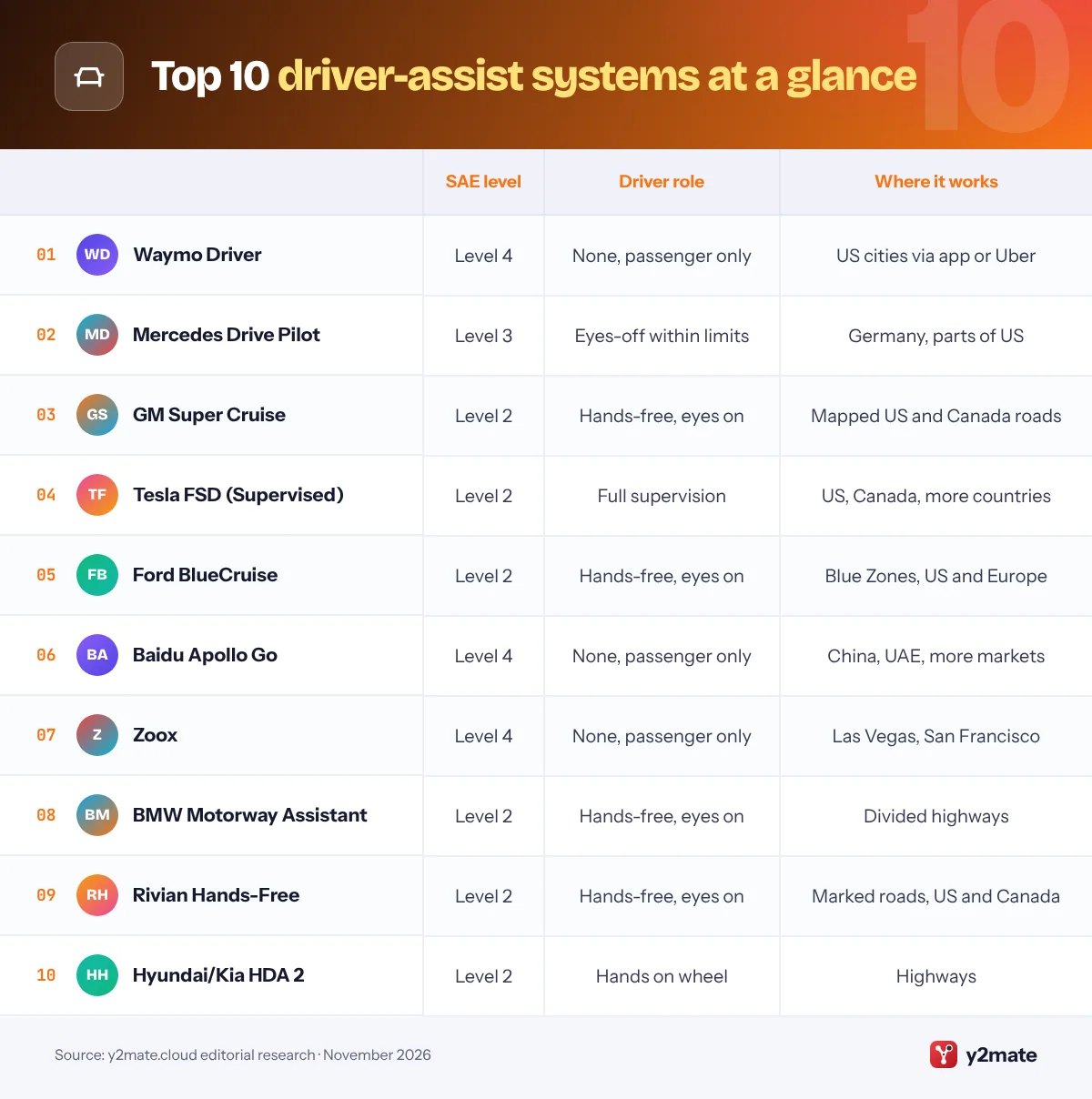
This guide ranks ten of the most significant systems, from Waymo and Baidu Apollo Go to GM Super Cruise, Ford BlueCruise and Tesla FSD (Supervised). For each one we explain its SAE automation level, whether it allows hands-free or eyes-off driving, and where it is available.
Safety note: every system in a privately owned car on this list, apart from Mercedes-Benz Drive Pilot within its strict conditions, requires you to keep watching the road at all times. Always follow the rules in your owner’s manual and on-screen prompts, and be ready to take over instantly.
How we ranked this list
We compared publicly documented capabilities from manufacturers and operators, official SAE level classifications, regulatory approvals and widely reported coverage of each system’s real-world availability. Systems that can drive without human supervision ranked higher, followed by systems that offer the most useful hands-free or eyes-off capability to everyday drivers.
We did not run our own road tests. Availability changes quickly, with new cities, countries and road networks added through software updates and regulatory decisions, so check the operator’s or carmaker’s official site for current coverage in your area.
The Top 10 Driver-Assist Systems
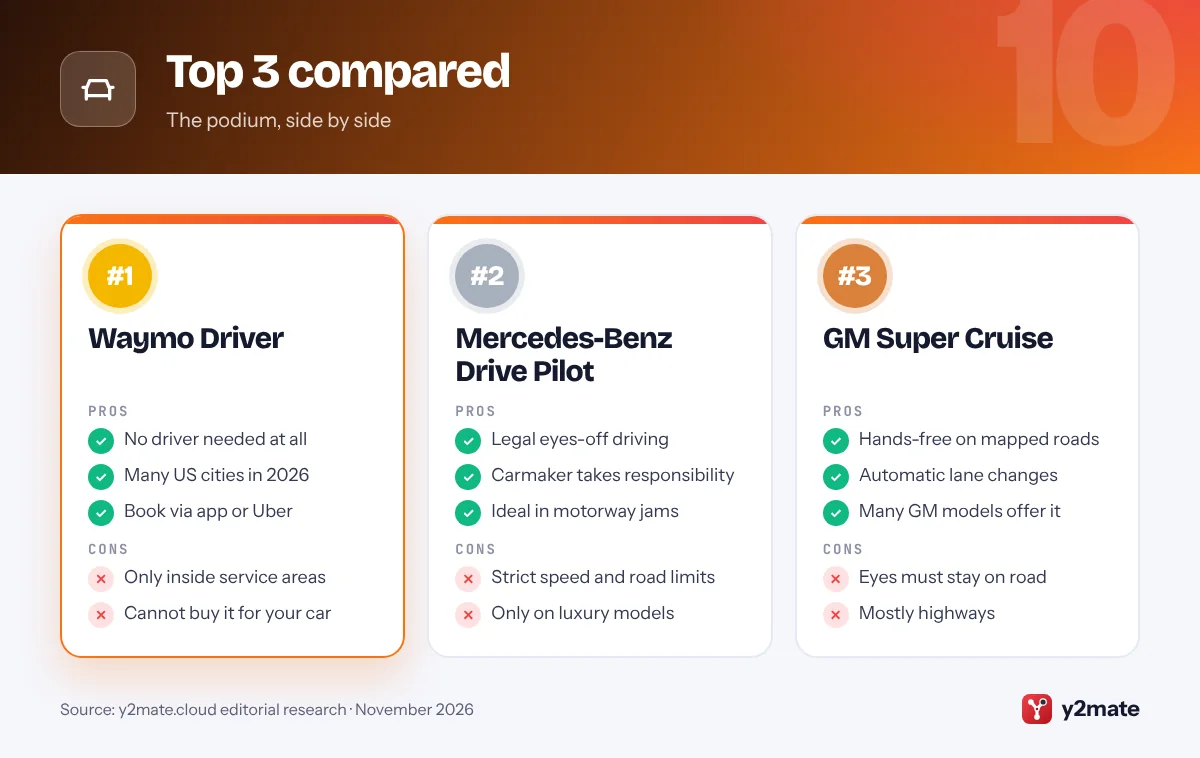
1. Waymo Driver
Best for: fully driverless rides in US cities
Waymo, which began life as Google’s self-driving car project and is owned by Alphabet, runs the most established driverless ride-hailing service in the United States. Its Waymo Driver is an SAE Level 4 system: within its mapped service areas there is no human driver at all, and passengers sit in the back while the car handles everything.
In 2026 Waymo has expanded well beyond its original Phoenix and San Francisco services, adding Los Angeles, several Texas and Florida markets and other US cities. In most of them you book rides through the Waymo app, while in Austin and Atlanta rides are offered through Uber. Waymo has also announced London as its first planned overseas market.
The catch is geography. Level 4 means the system only works inside approved zones and conditions, so you cannot take it anywhere you like, and some new cities start with limited or invite-only access. Waymo’s technology is not sold in private cars; you experience it as a passenger.
Official site: Waymo Driver
- No human driver needed
- Large and growing US footprint
- Simple app-based booking
- Limited to set service areas
- Not available for private cars
2. Mercedes-Benz Drive Pilot
Best for: legal eyes-off driving in traffic jams
Drive Pilot is the best-known SAE Level 3 system you can buy in a private car. Within its approved conditions, the car takes legal responsibility for driving, so you can take your eyes off the road and, for example, read or use approved in-car apps. You must stay in the driver’s seat, remain fit to drive and take back control promptly when the car asks.
The conditions are strict. Drive Pilot works only on approved motorways, in suitable weather and light, and at limited speeds, typically in dense or slow traffic. In Germany, regulators approved a version that works at up to 95 km/h on the Autobahn. In the US, approval has been limited to certain freeways in California and Nevada at lower speeds, and availability varies by model and year.
It is offered on top-end Mercedes models such as the S-Class and EQS. If you spend a lot of time in motorway congestion, it is the clearest example of true eyes-off driving available to private buyers.
Official site: Mercedes-Benz Drive Pilot
- True eyes-off within limits
- Carmaker accepts responsibility
- Approved by regulators
- Narrow speed and road limits
- Only on high-end models
3. GM Super Cruise
Best for: hands-free highway trips in North America
Super Cruise is General Motors’ hands-free driver-assist system, available on a wide range of Cadillac, Chevrolet, GMC and Buick models. It is an SAE Level 2 system: on compatible roads it steers, brakes and accelerates without your hands on the wheel, but you must keep your eyes on the road at all times.
A driver-facing camera watches your head and eyes and warns you if you look away for too long, eventually disengaging the system. Super Cruise works on a large network of mapped roads across the US and Canada, mostly divided highways, and can perform automatic lane changes to pass slower vehicles.
GM reports that customers have driven more than a billion hands-free miles with Super Cruise. The company has also announced plans for an eyes-off version, expected to debut on the Cadillac Escalade IQ as early as 2028. Until then, it remains a hands-free, eyes-on system and you are the driver.
Official site: GM Super Cruise
- Hands-free on mapped roads
- Strong driver monitoring
- Available across many GM brands
- Eyes must stay on the road
- Mostly limited to highways
4. Tesla FSD (Supervised)
Best for: assisted driving on city streets
Tesla’s Full Self-Driving (Supervised) is the most ambitious driver-assist system in privately owned cars in terms of where it operates. It can navigate city streets, handle intersections, stop for traffic lights and signs, make turns and drive highway sections from on-ramp to off-ramp, following a route set in the navigation.
Despite the name, it is an SAE Level 2 system. Tesla states that it requires active driver supervision, and the driver remains fully responsible for the car at all times. A cabin camera monitors attention, and the system can be withdrawn from drivers who repeatedly ignore warnings.
FSD (Supervised) is available in the US, Canada and a growing list of other countries, including several European markets following Dutch type approval in 2026, and it requires recent Tesla hardware. Tesla also runs a separate Robotaxi ride-hailing service in Austin, Texas, which is a different product from the software in customers’ cars.
Official site: Tesla FSD (Supervised)
- Works on city streets
- Point-to-point route following
- Frequent software updates
- Constant supervision required
- Name can overstate ability
5. Ford BlueCruise
Best for: hands-free motorway driving in Europe and US
BlueCruise is Ford’s hands-free driver-assist system, offered on models such as the Mustang Mach-E, F-150 and Explorer, with more models added over time. It is an SAE Level 2 system that lets you drive with hands off the wheel on pre-mapped divided highways that Ford calls Blue Zones, while a driver-facing camera checks that you are watching the road.
BlueCruise stands out for its reach in Europe. Ford says it is approved in 16 European markets with more than 135,000 km of Blue Zones, working at up to 130 km/h and allowing cross-border road trips. In 2026 Ford is extending it to more affordable European models, including the Puma, Kuga and Ranger PHEV.
Outside Blue Zones it works as a hands-on lane-centring system. Ford describes it as hands-off, eyes-on: it handles steering and speed, but you must stay alert and be ready to take over at any moment. Check Ford’s coverage maps before a long trip.
Official site: Ford BlueCruise
- Hands-free in mapped zones
- Wide European approval
- Reaching mainstream models
- Eyes must stay on the road
- Only works in Blue Zones
6. Baidu Apollo Go
Best for: driverless rides in China and beyond
Apollo Go is Baidu’s robotaxi service and one of the largest driverless ride-hailing operations in the world. Like Waymo, it uses SAE Level 4 technology: within approved areas, rides take place with no human driver, booked through an app.
Its home base is China, where it operates in many cities, with Wuhan among its best-known fully driverless markets. Baidu has pushed hard internationally, running driverless testing and operations in Dubai and Abu Dhabi, entering South Korea, and signing partnerships with Uber and Lyft to bring its vehicles to more markets in Asia, the Middle East and Europe, including plans for London subject to regulatory approval.
As with all robotaxis, service depends on local regulation and mapped zones, and international launches often start with testing or limited access before opening to the public. You cannot buy the system for a private car, and service hours and zones differ from city to city, so check the app before planning a trip.
Official site: Baidu Apollo Go
- Fully driverless rides
- Very large operation in China
- Fast international expansion
- Limited to approved zones
- Mostly China-focused today
7. Zoox
Best for: purpose-built robotaxi rides
Zoox, owned by Amazon, takes a different approach from most robotaxi companies. Instead of adding sensors to an ordinary car, it designed a vehicle from scratch with no steering wheel or pedals and seats that face each other, more like a small carriage than a car. It drives in both directions and is built only for autonomous operation at SAE Level 4.
Zoox opened its service to the public in Las Vegas, where it now serves many locations on and around the Strip, and has been offering rides in San Francisco, where access has been through a waitlist. In 2026 it announced plans to bring its robotaxis to Austin and Miami as well.
The service area is still small compared with Waymo or Apollo Go, and some locations have offered free rides while paid service ramps up. It is worth trying for the experience alone, but check the Zoox app for current coverage.
Official site: Zoox
- No steering wheel at all
- Spacious face-to-face seating
- Public rides in Las Vegas
- Small service areas
- Few cities so far
8. BMW Motorway Assistant
Best for: hands-free motorway cruising in a BMW
BMW’s hands-free motorway system, called Motorway Assistant in Europe and Highway Assistant in North America, is an SAE Level 2 feature available on many recent BMW models. On suitable divided highways it lets you drive with hands off the wheel while a driver camera checks you are watching the road. In Europe it works at up to 130 km/h.
One clever touch is gaze-confirmed lane changes. The car can suggest a lane change, and you confirm it simply by glancing at the side mirror, without touching the wheel or indicator. This keeps you engaged while reducing effort on long trips.
BMW also offered a Level 3 option, Personal Pilot L3, on the 7 Series in Germany, but 2026 reports indicate the company is moving away from it in favour of its Level 2 systems. For most buyers, the hands-free assistant is the feature that matters, and it remains a hands-off, eyes-on system.
Official site: BMW Motorway Assistant
- Hands-free on motorways
- Lane change by glance
- Widely available on BMWs
- Eyes must stay on the road
- Often part of option packs
9. Rivian Universal Hands-Free
Best for: hands-free driving beyond the highway
Rivian has moved quickly in driver assistance. Its Universal Hands-Free feature, part of the Autonomy+ package on supported vehicles, extends hands-free driving from highways to a much wider set of roads in the US and Canada, as long as they have clearly marked lane lines.
It is an SAE Level 2 system, so you must keep your eyes on the road and stay ready to take over. Rivian has been clear about its limits: at launch, it did not stop or slow down for traffic lights or stop signs, so the driver must handle those. Lane Change on Command is also included.
Rivian has said it is working towards point-to-point assisted driving and an eyes-off highway feature, with lidar planned for newer vehicles. Those features depend on hardware and regulatory progress, so judge the system on what it does today rather than on the roadmap, and read Rivian’s release notes after each update.
Official site: Rivian Universal Hands-Free
- Hands-free on many road types
- Lane change on command
- Rapid software updates
- Driver handles lights and signs
- Paid add-on package
10. Hyundai and Kia Highway Driving Assist 2
Best for: capable highway help in mainstream cars
Highway Driving Assist 2, often shortened to HDA 2, is the driver-assist system found on many Hyundai, Kia and Genesis models, including popular EVs such as the Ioniq 5, Ioniq 6, EV6 and EV9. It combines adaptive cruise control with lane centring on highways, keeping the car in its lane and at a safe distance from traffic ahead.
It is an SAE Level 2 system and, unlike the hands-free systems above, you must keep your hands on the wheel. If it does not detect your hands after repeated warnings, it switches off. A useful extra is assisted lane changing: above a set speed, you flick the indicator and the car steers into the next lane when it is clear.
HDA 2 earns its place because it brings capable, smooth assistance to affordable cars rather than luxury flagships. Kia’s EV3 system received a strong assisted-driving assessment from Euro NCAP. It is a helpful co-pilot for long journeys, not a self-driving feature.
Official site: Hyundai and Kia Highway Driving Assist 2
- Available in affordable cars
- Smooth lane centring
- Assisted lane changes
- Hands must stay on wheel
- Highways only
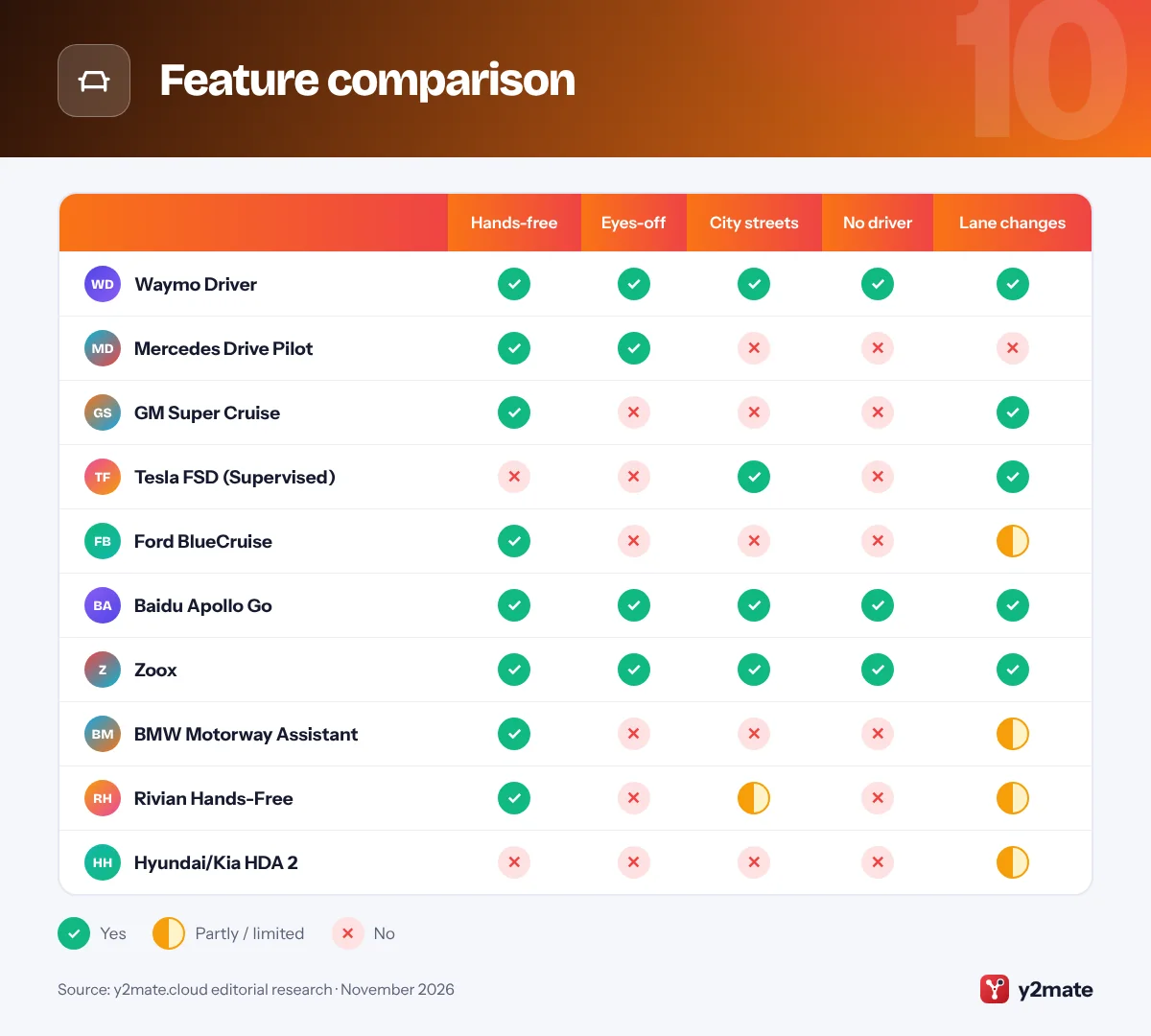
Feature comparison
How to choose between driver-assist systems
The most important thing to understand is the SAE level. It tells you who is responsible for driving, and that should guide every decision.

Know the levels
- Level 2: the car can steer, brake and accelerate, but you are the driver. Even hands-free systems like Super Cruise, BlueCruise and BMW’s assistant require your eyes on the road at all times.
- Level 3: within strict conditions, the car drives and you may look away, but you must take over when asked. Mercedes-Benz Drive Pilot is the main example.
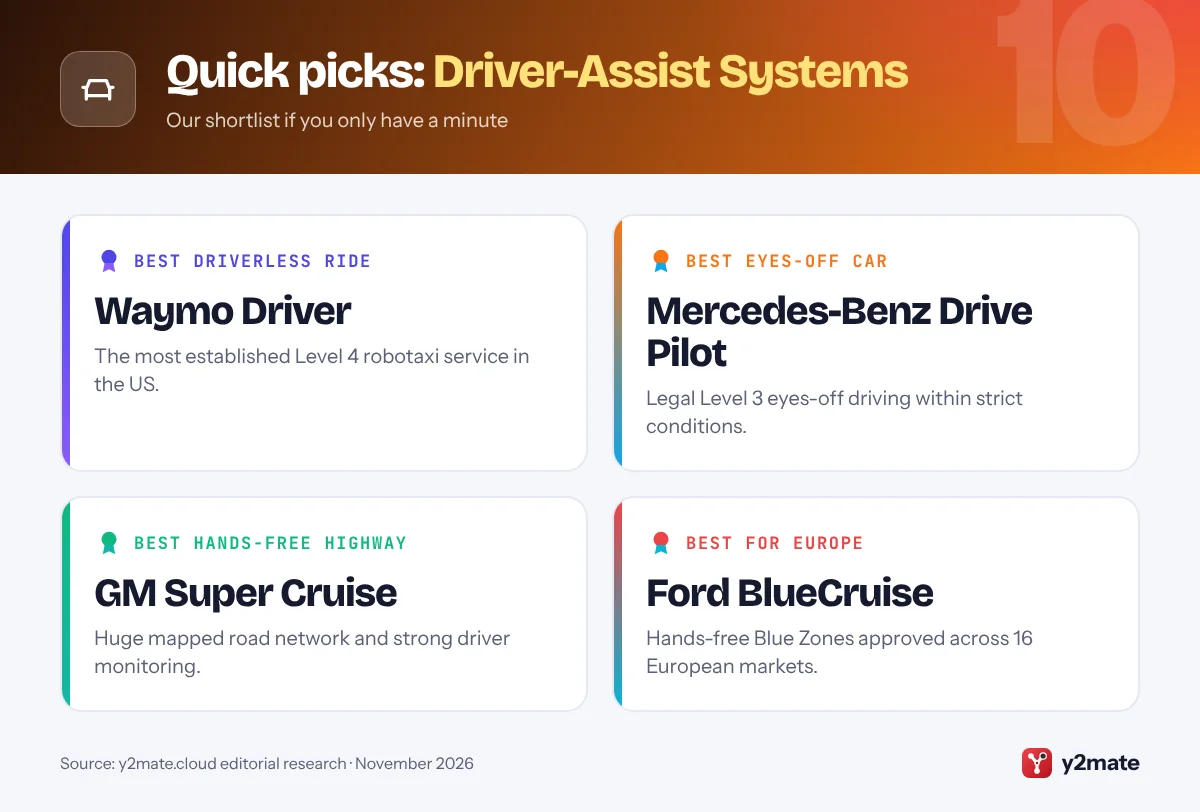
- Level 4: no human driver is needed inside a defined area. Today that means robotaxis such as Waymo, Apollo Go and Zoox.
Match the system to your driving
If you mostly drive on highways, a hands-free Level 2 system with a good driver camera makes long trips noticeably less tiring. If you sit in slow motorway traffic often, Level 3 is the only legal way to use that time for something else. If you rarely drive in cities that have robotaxis, those services are an interesting option for occasional trips rather than a replacement for your car.
Stay safe
Read the owner’s manual, learn exactly where your system works and when it hands back control, and never treat a Level 2 feature as self-driving. Keep software up to date, keep sensors and cameras clean, and follow every on-screen prompt. Driver-assist systems reduce effort, not responsibility.
Frequently asked questions
Is there a fully self-driving car I can buy in 2026?
No car sold to private buyers can drive itself everywhere without supervision. Most systems in showrooms are SAE Level 2, which means you must supervise them at all times. Mercedes-Benz Drive Pilot offers Level 3 eyes-off driving, but only on approved roads, at limited speeds and in suitable conditions. Fully driverless Level 4 rides are currently offered through robotaxi services such as Waymo, Apollo Go and Zoox.
What is the difference between hands-free and eyes-off driving?
Hands-free means you can take your hands off the steering wheel, but you must still watch the road and be ready to take over immediately. Systems like Super Cruise and BlueCruise work this way and use cameras to check your attention. Eyes-off means the car is responsible for driving within set conditions, so you can look away. That requires a Level 3 or higher system such as Drive Pilot.
Is Tesla Full Self-Driving actually self-driving?
Not in the cars Tesla sells to customers. The feature is officially called Full Self-Driving (Supervised) and is an SAE Level 2 system. It can handle city streets and highways along a navigation route, but Tesla requires active driver supervision and the driver remains fully responsible. Tesla's Robotaxi ride-hailing service in Austin is a separate operation from the software in privately owned cars.
Which cities have driverless robotaxis?
In the US, Waymo operates in a growing list of cities including Phoenix, the San Francisco Bay Area, Los Angeles, Austin, Atlanta and several Texas and Florida markets, while Zoox serves Las Vegas and parts of San Francisco. In China, Baidu's Apollo Go runs in many cities, and it has expanded to places such as Dubai and Abu Dhabi. Coverage changes often, so check each operator's app.
Are driver-assist systems safe to use?
They can reduce fatigue and help on long drives, but only when used as designed. Level 2 systems can make mistakes and may not recognise every hazard, so you must stay alert, keep your eyes on the road and follow the rules in your owner's manual. Misusing them, for example by looking at a phone, is dangerous and may be illegal where you live.
Final verdict
If you want to experience true driverless travel today, take a ride in a Waymo, Apollo Go or Zoox vehicle where they operate. If you are buying a car, the most useful driver-assist systems are hands-free highway features such as GM Super Cruise and Ford BlueCruise, while Mercedes-Benz Drive Pilot remains the clearest eyes-off option for heavy traffic.
Whatever you choose, remember that almost every system in a private car still makes you the driver. Learn its limits, follow its rules and keep your attention on the road.
Sources and further reading
- SAE J3016 standard: SAE's official standard defining the six levels of driving automation, from Level 0 to Level 5.
- SAE Levels of Driving Automation: SAE's plain-language summary of what each driving automation level means for the person behind the wheel.
- NHTSA automated vehicle safety: The US road safety agency's overview of automated vehicles, how they are regulated and what drivers should know.
- NHTSA driver assistance technologies: NHTSA's guide to driver assistance features like lane keeping and adaptive cruise control, which still need an attentive driver.
- NHTSA crash reporting order: NHTSA's rule requiring makers to report crashes involving Level 2 driver assistance and automated driving systems, with public data.

Leave a Reply