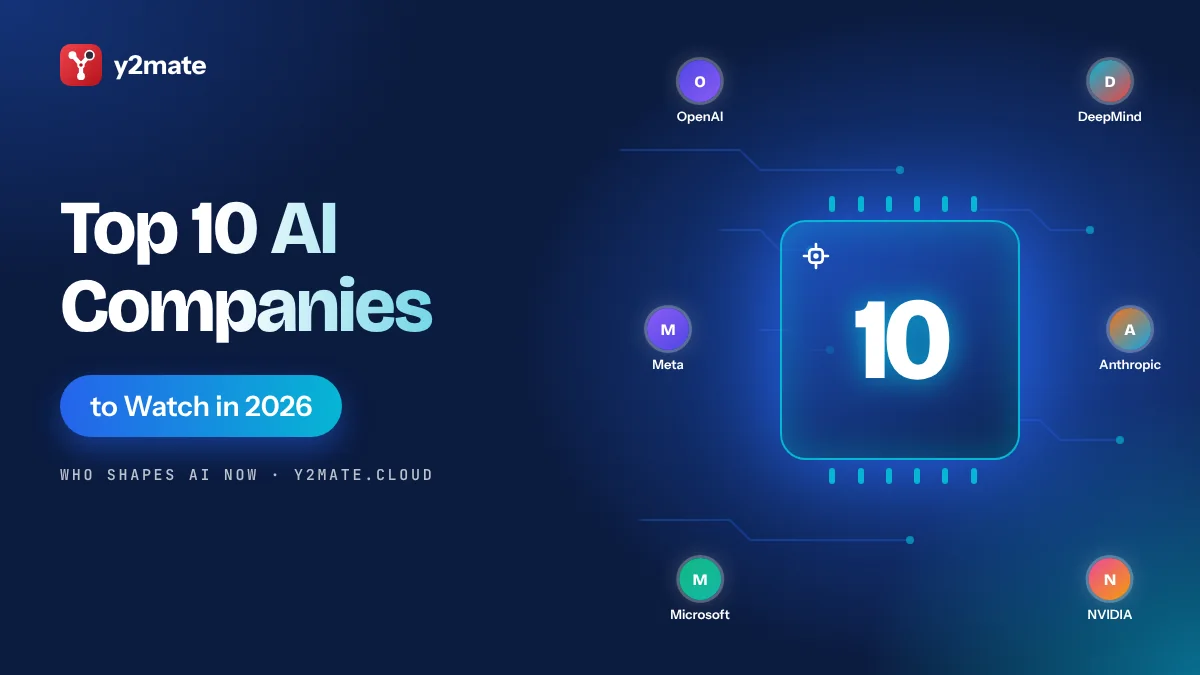
A handful of organizations now set the pace for artificial intelligence. If you want to understand where the technology is heading, these are the AI companies to watch: the labs training the most capable models, the firms supplying the chips and cloud capacity, and the open-source players making powerful AI available to everyone.
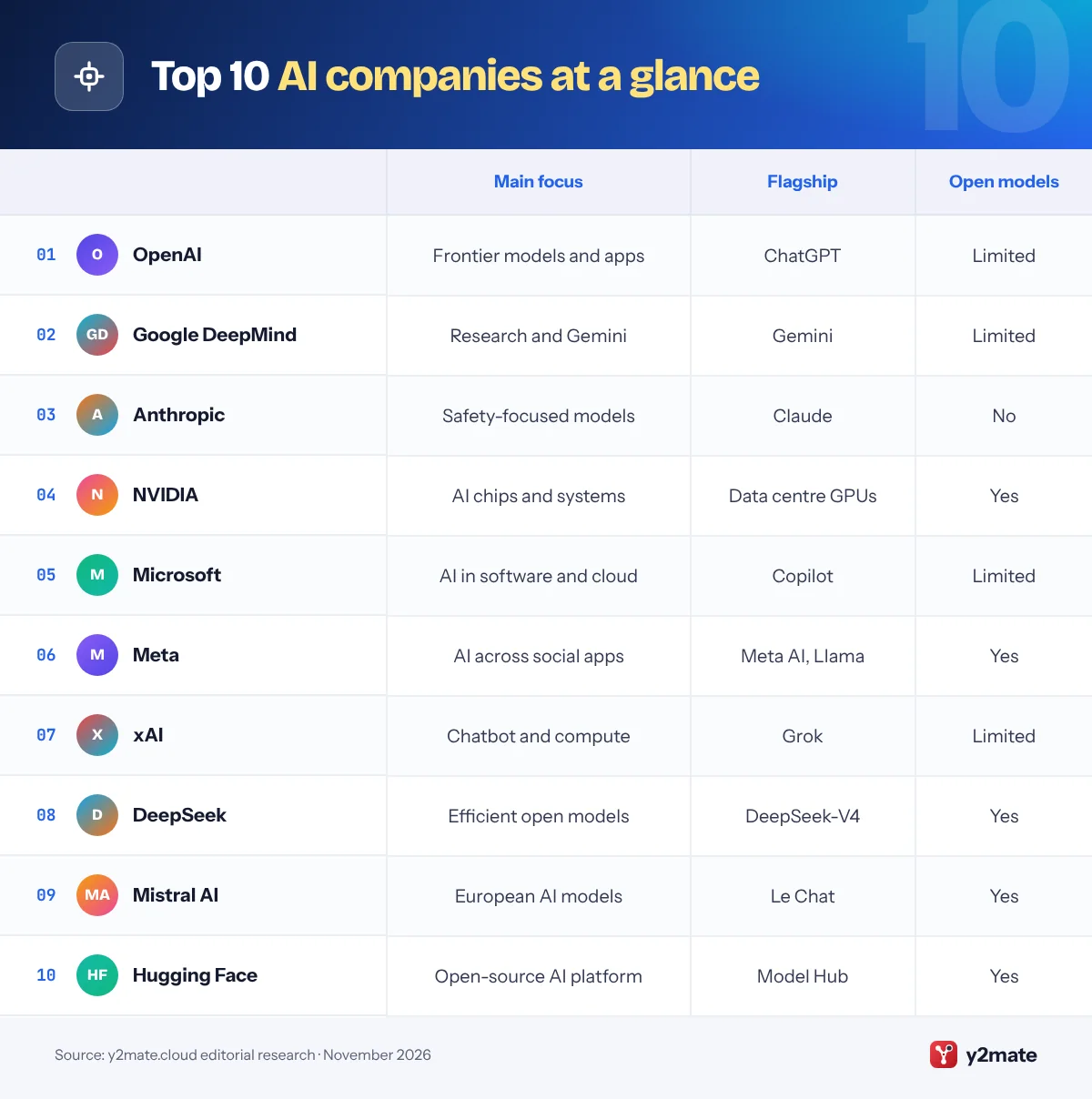
This list covers ten companies from the United States, Europe and China. For each one we explain what it builds, how it differs from rivals and why it matters heading into 2027.
It is written for general readers, students, developers and business decision-makers who want a clear map of the AI industry without the hype.
How we ranked this list
We looked at each company’s publicly documented products and research, the reach of its models and platforms, its role in the wider AI supply chain and its influence on how others build AI. We relied on official announcements and widely reported developments, not private data or speculation.
We deliberately left out valuations and funding figures, which change quickly and are often unconfirmed. The order reflects overall influence on the field in 2026, not a judgement on which company is best for any particular use.
The Top 10 AI Companies
1. OpenAI
Best for: understanding the mainstream face of AI
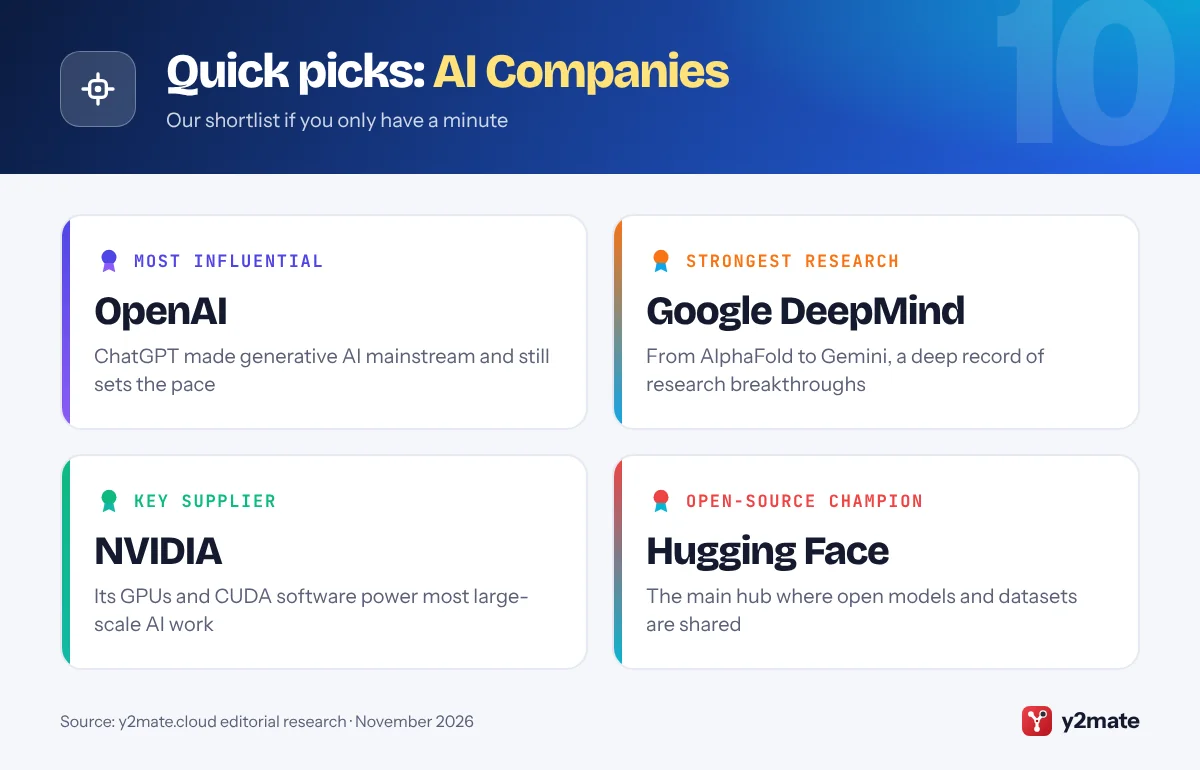
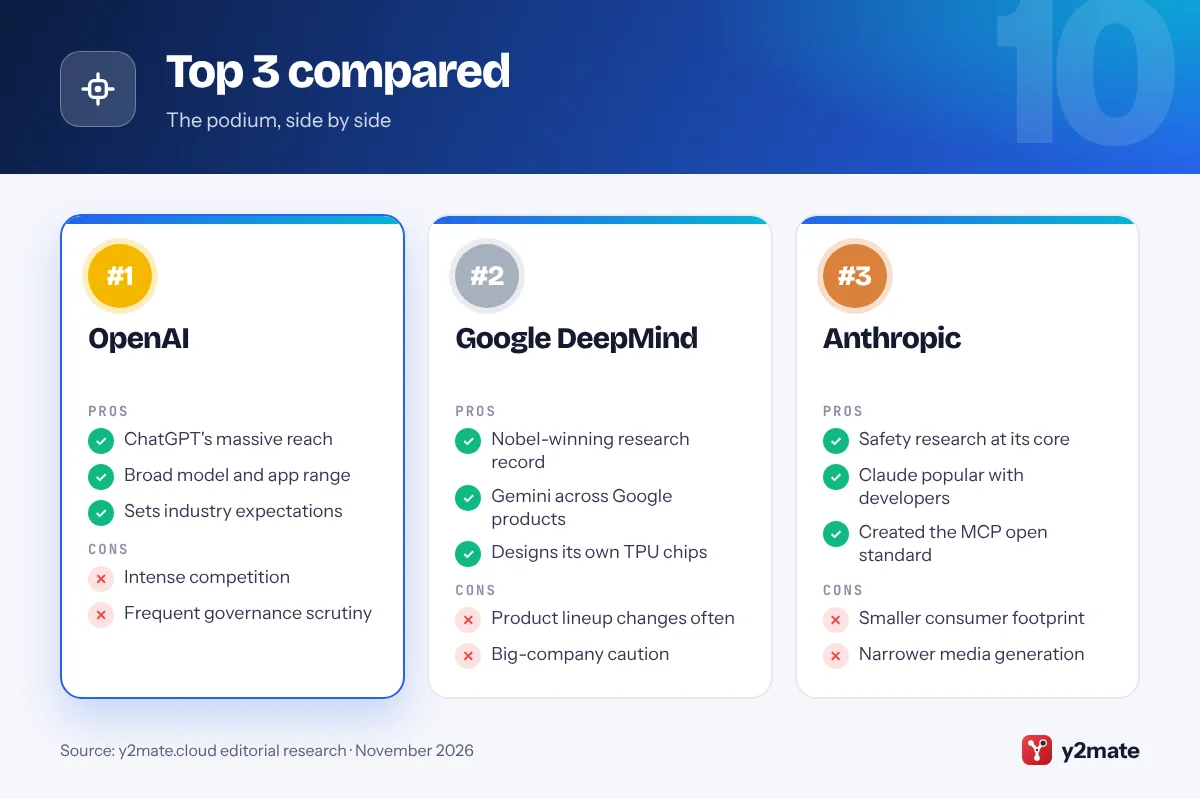
OpenAI, based in San Francisco, brought generative AI into the mainstream with ChatGPT in late 2022, and ChatGPT remains one of the most widely used AI products in the world. The company develops the GPT family of models, along with image, video and voice technology.
Its products now span consumer apps, business plans and a developer platform used by a vast number of companies. In software development, its Codex agent works across the command line, code editors, a desktop app and ChatGPT itself. OpenAI also partners closely with Microsoft, which has long been a major investor and cloud provider.
OpenAI matters because its launches tend to set expectations for the whole industry. When it ships a new model or feature, competitors often respond within months. Its decisions on safety, pricing and product design also shape public debate about how AI should be built and governed, which makes it the first company most people think of when they hear the word AI.
Official site: OpenAI
- Huge consumer and developer reach
- Broad product range
- Sets the industry's pace
- Faces intense competition
- Frequent governance scrutiny
2. Google DeepMind
Best for: research depth and AI across Google
Google DeepMind is the AI research and development unit of Alphabet, formed in 2023 by merging DeepMind, the London lab founded in 2010, with the Google Brain team. It builds the Gemini family of models that power the Gemini app and AI features across Search, Android, Workspace and Google Cloud.
DeepMind is also known for scientific breakthroughs. AlphaFold, its system for predicting protein structures, has been used by researchers worldwide, and its creators Demis Hassabis and John Jumper shared the 2024 Nobel Prize in Chemistry for that work. In 2026 Google also expanded Antigravity, its agent-first platform for software development.
What makes Google DeepMind important is the combination of top-tier research with distribution few rivals can match. Its models reach billions of people through Google products, and the company designs its own TPU chips, giving it unusual control over much of the AI stack, from custom hardware to the consumer apps people use daily.
Official site: Google DeepMind
- World-class research record
- Massive built-in distribution
- Own TPU chips
- Product lineup changes often
- Large company moves carefully
3. Anthropic
Best for: safety-focused AI and enterprise use
Anthropic was founded in 2021 by former OpenAI researchers, including siblings Dario and Daniela Amodei. Based in San Francisco, it develops the Claude family of AI models, offered in different tiers that balance capability, speed and cost.
Anthropic has made AI safety research central to its identity. It publishes work on interpretability, which tries to understand what happens inside models, and introduced approaches such as Constitutional AI and a Responsible Scaling Policy for managing risks as models become more capable. It also created the Model Context Protocol, an open standard for connecting AI assistants to tools and data that has been widely adopted across the industry.
The company has a strong position with businesses and developers. Claude Code, its agentic coding tool, has become a popular choice among software engineers, and Claude models are available through Anthropic’s own apps and API as well as major cloud platforms. Anthropic matters because it shows how a safety-first lab can compete at the frontier.
Official site: Anthropic
- Strong safety and research focus
- Popular with developers
- Created the MCP standard
- Smaller consumer footprint
- No image or video generation focus
4. NVIDIA
Best for: the hardware behind the AI boom
NVIDIA started out making graphics cards for gamers, but its GPUs turned out to be ideal for training and running neural networks. Today its data centre chips and systems are the backbone of most large-scale AI work, used by AI labs, cloud providers and enterprises around the world.
Hardware is only part of the story. NVIDIA’s CUDA software platform, built up over many years, gives developers a mature set of tools and libraries that make its chips easier to use than many alternatives. The company also sells networking equipment, complete rack-scale systems and software for robotics, self-driving cars and simulation.
NVIDIA is one to watch because demand for AI computing depends heavily on its product roadmap. Each new generation, from Blackwell to the Rubin platform, influences how fast labs can train new models. At the same time, rivals such as AMD and the custom chips built by Google, Amazon and Microsoft are trying to reduce the industry’s dependence on NVIDIA.
Official site: NVIDIA
- Dominant AI chip supplier
- Mature CUDA software ecosystem
- Full-stack data centre systems
- Supply often tight
- Rising custom chip competition
5. Microsoft
Best for: AI built into work software and cloud
Microsoft has placed AI at the centre of almost everything it sells. Its Copilot brand appears across Windows, Microsoft 365 apps such as Word, Excel and Outlook, Teams and the Edge browser, and GitHub Copilot is one of the most widely used AI tools for programmers.
The company is also one of the largest providers of AI computing through Azure, where businesses can use models from OpenAI and many other developers. Microsoft has been a major partner and investor in OpenAI for years, and it has also built its own in-house models through its Microsoft AI division, giving it more options of its own.
Microsoft matters because it controls the software many organizations use every day. When it adds AI to Office or Windows, millions of workers encounter the technology without seeking it out. How well these features actually improve productivity will be a key test for workplace AI in the years ahead.
Official site: Microsoft
- Huge enterprise customer base
- Major AI cloud provider
- AI built into everyday apps
- Heavy reliance on partners
- Mixed reception for some features
6. Meta
Best for: AI at social media scale
Meta, the parent of Facebook, Instagram, WhatsApp and Threads, uses AI throughout its apps for recommendations, advertising, content moderation and its Meta AI assistant. It also builds AI into hardware, including smart glasses made with Ray-Ban maker EssilorLuxottica.
Meta played a major role in the spread of open AI models through its Llama family, which it made available for others to download and build on. Llama models became a foundation for countless research projects and startups. In 2025 Meta reorganized its AI efforts under a new group called Meta Superintelligence Labs and recruited high-profile researchers from rival labs.
Meta is worth watching because few companies can put AI in front of so many people so quickly through apps they already use. It has also spent heavily on data centres. The big questions are how its new lab’s models compare with the frontier, and how much it continues to share openly with the wider developer community.
Official site: Meta
- Billions of users across apps
- Open model legacy with Llama
- AI in wearables
- Strategy has shifted often
- Ongoing privacy concerns
7. xAI
Best for: following Elon Musk’s AI ambitions
xAI was founded by Elon Musk in 2023 and develops Grok, a chatbot and family of AI models closely tied to the social platform X, where many people use it. Grok is also available through its own apps and an API for developers.
The company is known for building computing capacity at speed. Its Colossus supercomputer in Memphis, Tennessee was assembled quickly and has been expanded since. In February 2026, xAI merged with SpaceX, becoming part of Musk’s rocket and satellite company. Musk has argued that combining the two will help power AI with resources such as satellite networks and, eventually, computing in space.
xAI matters because of its scale, its speed and its link to a wider group of Musk companies. It is also one of the most debated players in AI, with recurring controversy over Grok’s outputs and content policies, which keeps it in the headlines and under regulatory attention.
Official site: xAI
- Very large computing build-out
- Built-in distribution on X
- Backed by SpaceX resources
- Frequent content controversies
- Tied to one founder's agenda
8. DeepSeek
Best for: efficient open-weight models from China
DeepSeek is an AI lab based in Hangzhou, China, backed by the quantitative investment firm High-Flyer. It became globally known in January 2025 when it released DeepSeek-R1, a reasoning model whose performance and openly published weights surprised the industry and briefly rattled technology stocks.
The company has continued to release large open-weight models. In April 2026 it launched DeepSeek-V4, available in a larger Pro version and a lighter Flash version, and has updated them since. DeepSeek is known for publishing detailed technical papers on how it trains models efficiently, which researchers elsewhere study closely.
DeepSeek matters because it showed that a relatively small team could produce models competitive with the best American labs while sharing them openly. That raised questions about the cost of building frontier AI and about export controls on advanced chips. It also faces scrutiny in some countries over data privacy and government access, and some agencies restrict its apps.
Official site: DeepSeek
- Strong open-weight models
- Efficiency-focused research
- Detailed technical papers
- Restricted by some governments
- Data privacy concerns
9. Mistral AI
Best for: Europe’s leading independent AI lab
Mistral AI was founded in Paris in 2023 by researchers who previously worked at Google DeepMind and Meta. It quickly became Europe’s most prominent AI model developer, releasing a mix of open-weight models anyone can download and commercial models offered through its platform.
Its products include Le Chat, a consumer and business assistant, a developer platform, coding models and enterprise tools that can run on a company’s own infrastructure. Mistral has focused on efficient models that deliver strong results at smaller sizes, including mixture-of-experts designs that only activate part of the model for each request.
Mistral matters because many European governments and companies want AI options that are not controlled by American or Chinese firms. Its emphasis on open weights, on-premises deployment and data sovereignty appeals to organizations with strict privacy and regulatory needs. How well it keeps pace with much larger rivals is one of the key stories in European tech.
Official site: Mistral AI
- Leading European AI lab
- Open-weight and on-prem options
- Efficient model designs
- Smaller scale than US giants
- Lower consumer awareness
10. Hugging Face
Best for: the hub of open-source AI
Hugging Face started in 2016 as a chatbot app before reinventing itself as the central platform for open-source machine learning. Its Hub hosts an enormous collection of models, datasets and demo apps shared by companies, universities and individual developers, including releases from Meta, Google, Mistral AI, DeepSeek and many others.
It also maintains widely used open-source libraries, most notably Transformers, which helps developers load and run models with a few lines of code. Its Spaces feature lets anyone publish interactive AI demos, and it offers paid services for businesses that want to host and deploy models. The company has also expanded into open-source robotics.
Hugging Face matters because it is the neutral meeting point for open AI. When a lab releases open weights, they usually appear on Hugging Face first, and its leaderboards and community discussions influence which models developers try. If open models keep improving, its role in the ecosystem only grows.
Official site: Hugging Face
- Home of open models and datasets
- Widely used Transformers library
- Neutral, community-driven
- Does not build frontier models
- Depends on others' releases
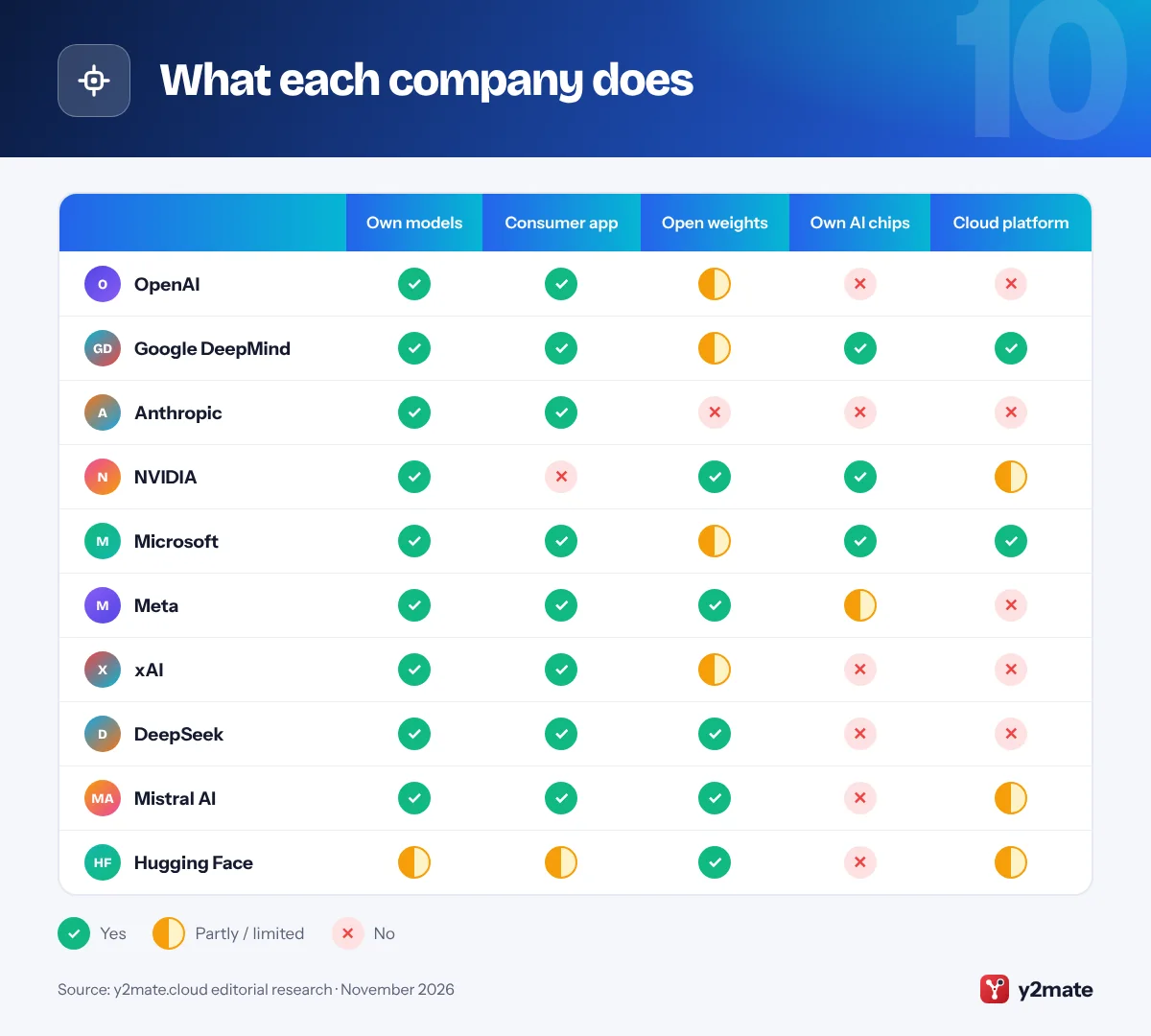
What each company does
How to make sense of the AI companies to watch
Headlines about AI can be overwhelming. A simple way to understand the industry is to group these AI companies to watch by the role they play.
Frontier model labs
OpenAI, Google DeepMind, Anthropic and xAI train the largest general-purpose models. Their releases set the benchmark for what AI can do, and they compete for researchers, computing power and customers. Meta also competes here through Meta Superintelligence Labs.
Infrastructure providers
NVIDIA supplies most of the chips used to train and run AI, while Microsoft, Google and Amazon provide the cloud data centres where that work happens. Watch these companies to understand the cost and pace of AI progress.
Open-model builders and platforms
DeepSeek, Mistral AI and Meta have released powerful open-weight models, and Hugging Face is where many of them are shared. Open models let smaller companies, researchers and governments build AI without depending entirely on a few large providers.
What this means for you
- If you use AI at work, the tools you rely on likely come from one of these firms.
- If you are a developer, it pays to try models from more than one company, since strengths differ and change often.
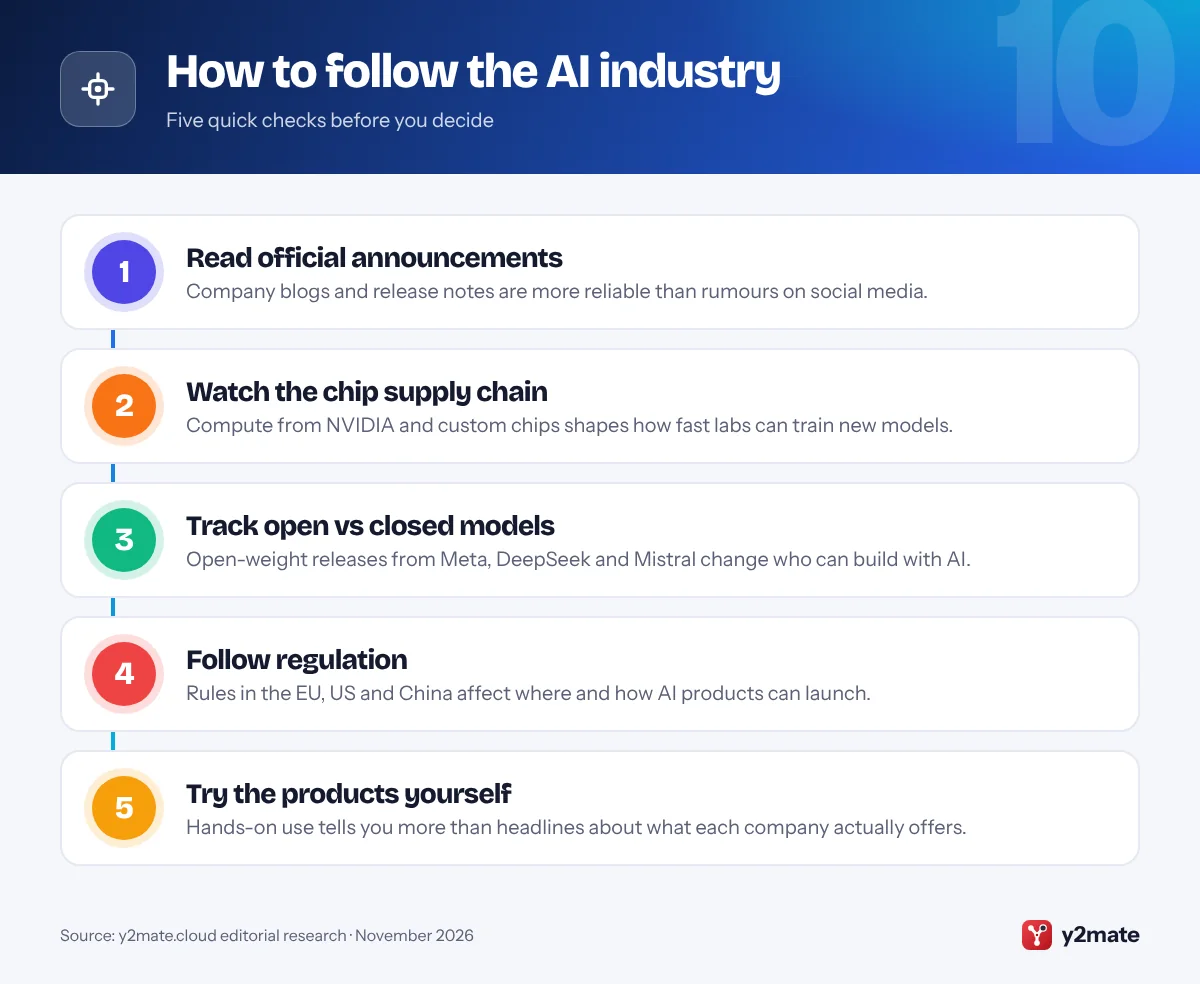
- If you follow tech news, check claims against official announcements, as rumours about new models are common.
No single company will define AI on its own. Competition between them is what drives the rapid pace of change.
Frequently asked questions
What are the biggest AI companies in 2026?
The most influential AI companies in 2026 include OpenAI, Google DeepMind, Anthropic, Microsoft, Meta and NVIDIA. The first three are best known for frontier AI models, Microsoft and Meta bring AI to huge numbers of users, and NVIDIA supplies most of the chips used to train and run modern AI systems.
Which AI companies release open-source models?
Meta, DeepSeek and Mistral AI are among the best-known developers of open-weight models, which anyone can download and run. Google, OpenAI and NVIDIA have also released some open models. Hugging Face is the main platform where these models are shared, discussed and compared by the developer community.
Is xAI part of SpaceX now?
Yes. In February 2026 Elon Musk merged xAI, the company behind the Grok chatbot, with SpaceX. xAI continues to develop Grok and operate its Colossus supercomputer, but it is now part of the wider SpaceX group. Musk has said the combination will help secure resources such as computing capacity and energy for AI.
Why is NVIDIA so important to AI?
NVIDIA makes the GPUs that most AI labs use to train and run large models, along with networking gear and complete data centre systems. Its CUDA software platform has been developed over many years and is widely used by AI developers, which makes switching to rival chips harder even as competition grows.
Are there major AI companies outside the United States?
Yes. Google DeepMind is headquartered in London, Mistral AI is based in Paris and DeepSeek is based in Hangzhou, China. Other Chinese technology groups such as Alibaba and Moonshot AI also release notable models, and many countries are investing in their own AI labs to reduce reliance on foreign providers.
Final verdict
If you only follow a few names, make them OpenAI, Google DeepMind and Anthropic for the direction of frontier models, and NVIDIA for the hardware that makes it all possible. Microsoft and Meta matter because of how many people their products reach.
Keep an eye on xAI after its merger with SpaceX, on DeepSeek and Mistral AI as proof that strong models can come from outside Silicon Valley, and on Hugging Face as the home of open AI. Together, these are the AI companies to watch as the industry heads into 2027.
Sources and further reading
- NIST AI Risk Management Framework: NIST's voluntary framework that helps organizations identify and manage the risks of building and using AI systems.
- AI RMF 1.0 publication: The official NIST publication of the AI Risk Management Framework 1.0, the main US reference for trustworthy AI.
- Microsoft's responsible AI approach: Microsoft's overview of the principles and practices it uses to build and deploy AI responsibly.
- Anthropic company overview: Anthropic's own page describing its mission, its focus on AI safety and how the company is structured.

Leave a Reply