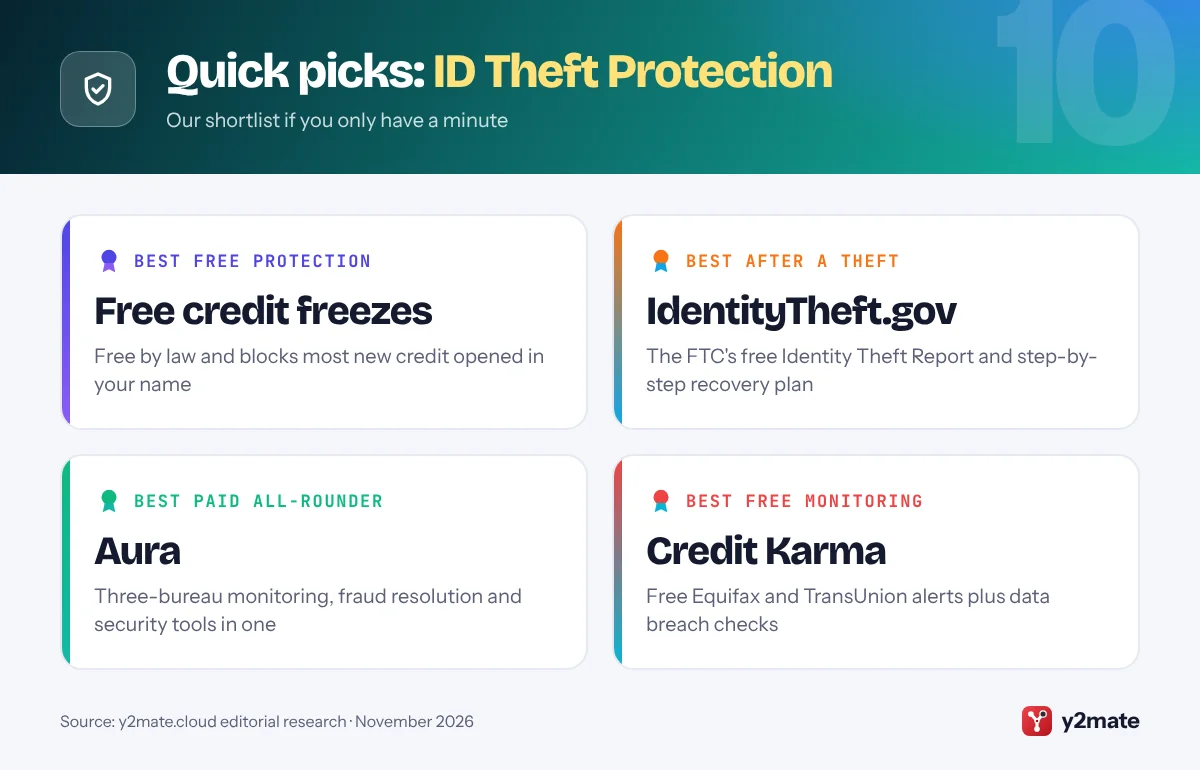
- The strongest identity theft protection in the USA is free: a credit freeze at Equifax, Experian and TransUnion stops most new credit being opened in your name.
- Anyone with a Social Security number or ITIN who can verify their identity can get a free IRS Identity Protection PIN, which blocks tax returns filed in their name without it.
- AnnualCreditReport.com lets everyone in the US check their credit reports from all three nationwide bureaus free every week.
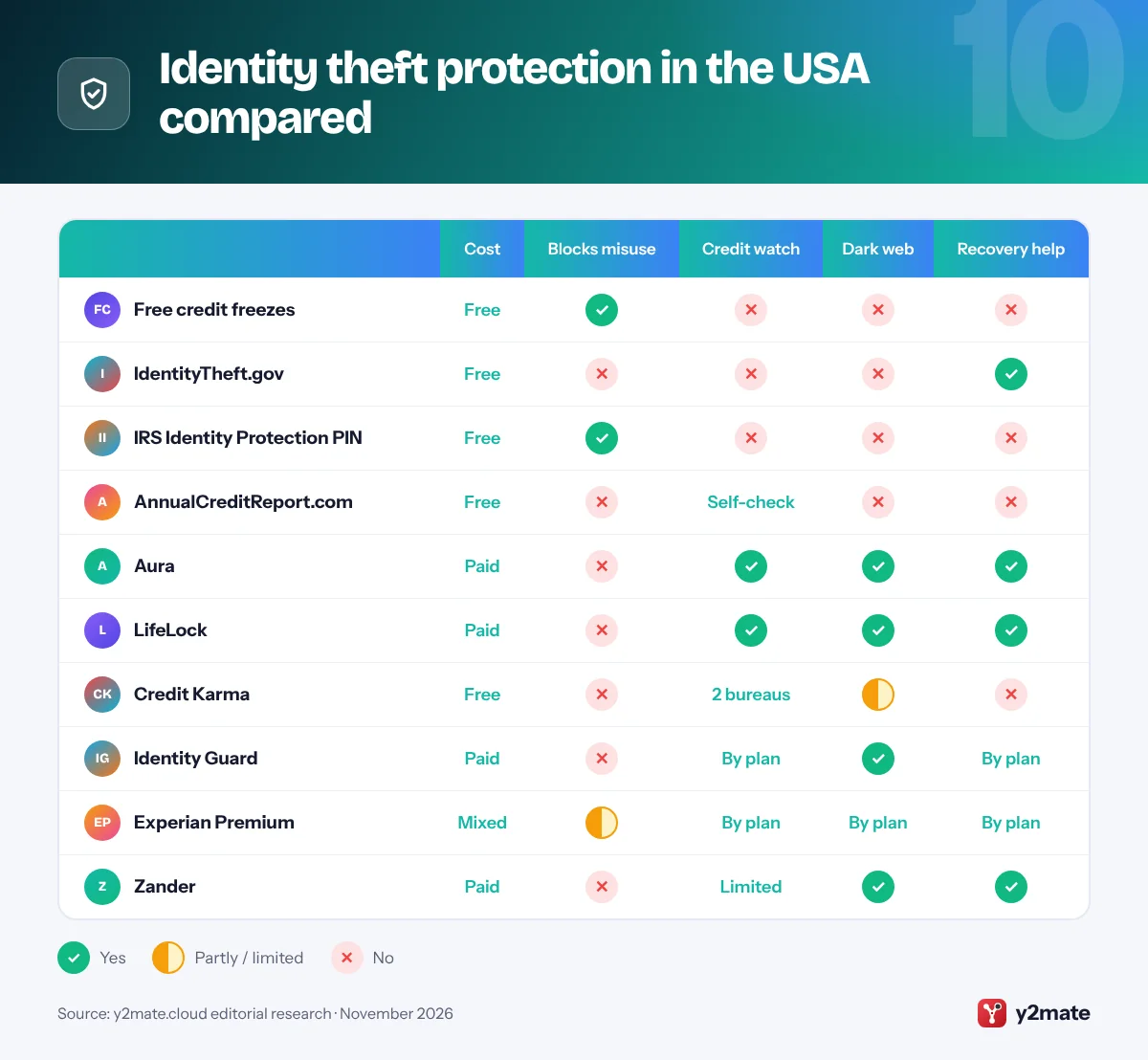
- Paid services such as Aura, LifeLock and Identity Guard mainly monitor, alert and help with recovery; they cannot block new accounts the way a freeze does.
- If your identity is stolen, report it at IdentityTheft.gov to get a free FTC Identity Theft Report and a personal recovery plan.
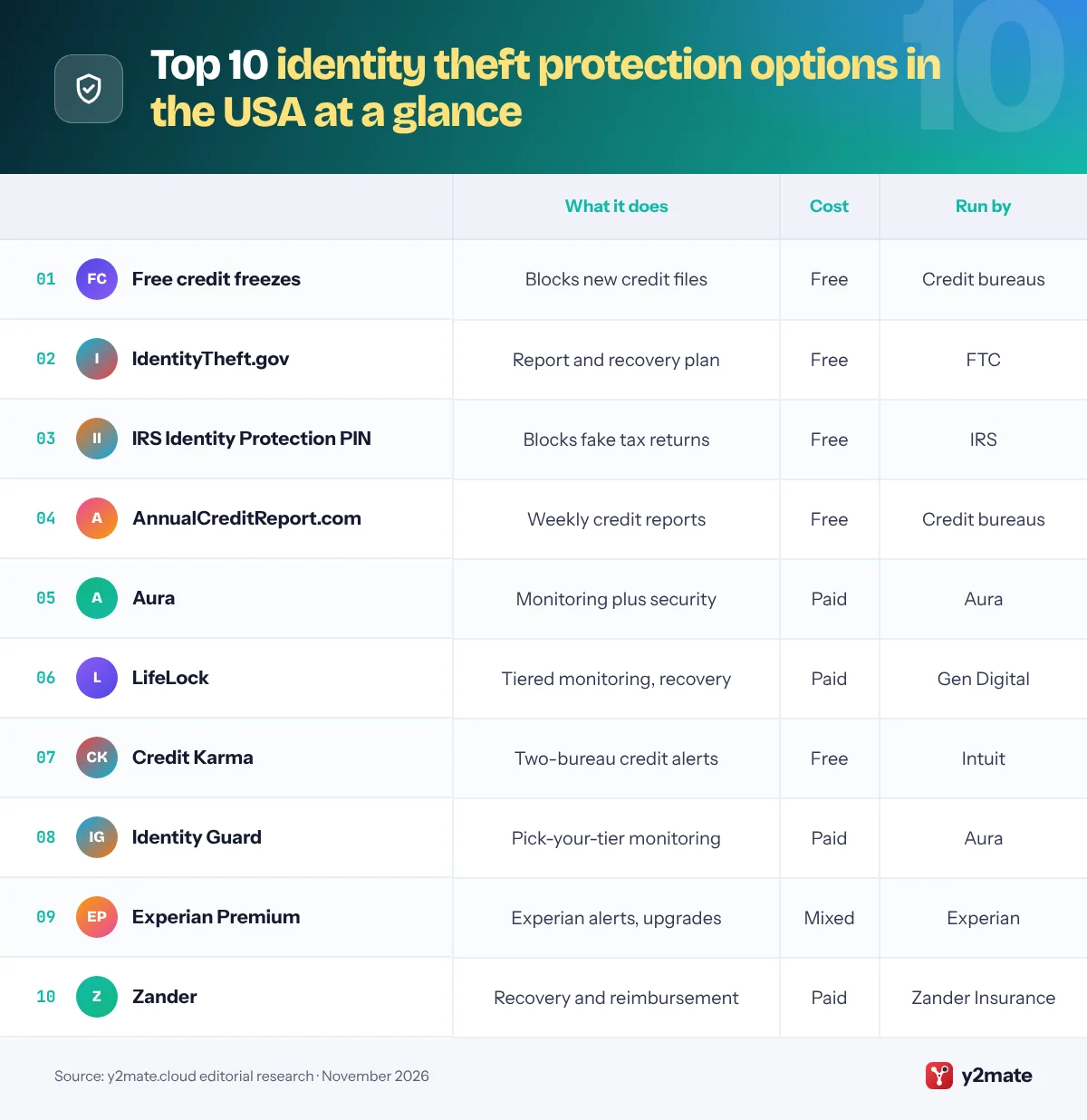
The best identity theft protection in the USA starts with free, official tools: a credit freeze at Equifax, Experian and TransUnion, the Federal Trade Commission’s IdentityTheft.gov, an IRS Identity Protection PIN and free weekly credit reports from AnnualCreditReport.com. Paid services such as Aura, LifeLock, Identity Guard, Experian Premium and Zander add monitoring, alerts and hands-on recovery help, and Credit Karma offers free alerts from two bureaus. No service can prevent every kind of identity theft, so the free tools come first.
Some plain definitions. Identity theft is when someone uses your personal information, such as your name or Social Security number, without permission, usually to open credit, file a tax return or take over an account. A credit freeze, also called a security freeze, stops most new lenders from seeing your credit report, which makes it much harder to open an account in your name. A fraud alert leaves your report visible but asks businesses to verify your identity before extending new credit. Dark web monitoring means a service scans breach data and criminal marketplaces for your details and alerts you if it finds them, but it cannot delete the data.
This list ranks ten options available to US consumers in November 2026 and shows where a paid service adds real value and where a free tool does the same job.
How we ranked this list
We ranked each option only on publicly documented criteria: what it protects or monitors, whether it is free, paid or mixed, whether it includes recovery help or identity theft insurance, and who runs it, from federal agencies and credit bureaus to private companies. Free tools that block misuse outright ranked above paid services that mostly alert you after something has happened.
We did not test these services ourselves, and we leave out prices, insurance limits and other plan details that change often. Check each provider’s current terms, including what its insurance or reimbursement actually covers, before you sign up.
The Top 10 ID Theft Protection
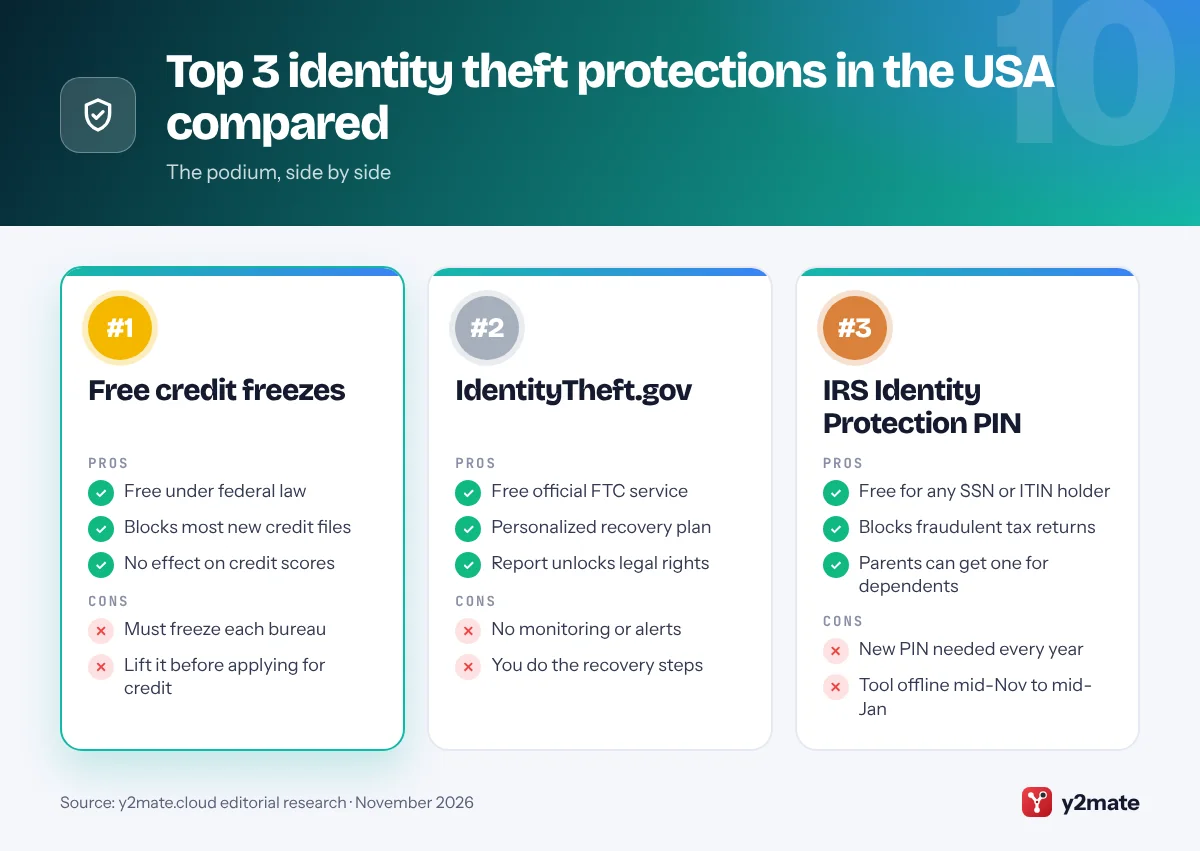
1. Free credit freezes
Best for: stopping new credit being opened in your name
A credit freeze is the most effective free step against new-account fraud in the US. Since September 2018, federal law has made placing, lifting and removing a security freeze at Equifax, Experian and TransUnion free. Because most lenders will not open an account without checking your report, a freeze makes it far harder for a thief to borrow in your name, and it does not affect your credit scores.
You must freeze each bureau separately, usually through a free online account. A bureau must place a freeze within one business day of an online or phone request and lift it within one hour when you need to apply for credit. Parents and guardians can also freeze the files of children under 16.
A freeze has limits. It does not stop misuse of accounts you already have, tax fraud or medical identity theft, so pair it with the tools below. A free fraud alert, placed through one bureau, is a lighter alternative. Skip paid credit locks: the Consumer Financial Protection Bureau (CFPB) says they are no more effective than a free freeze.
Official site: Free credit freezes
- Free under federal law
- Blocks most new credit files
- No effect on credit scores
- Must freeze each bureau
- Lift it before applying for credit
2. IdentityTheft.gov
Best for: an official recovery plan after identity theft
IdentityTheft.gov is the Federal Trade Commission’s official site for reporting identity theft and getting a free, personal recovery plan. You answer questions about what happened, and the site produces an FTC Identity Theft Report plus a checklist of next steps, such as which companies to call, how to close fraudulent accounts and how to correct your credit reports. You can also report by phone.
The Identity Theft Report matters because it unlocks legal rights. It lets you place an extended fraud alert, which lasts seven years, and ask the credit bureaus to block fraudulent information from your reports. If you create an account, the site saves your progress and can prefill letters to businesses and bureaus; if not, save your report and plan before you leave the page.
IdentityTheft.gov does not monitor anything. The FTC also warns that it never asks anyone to move money to protect it, so treat callers claiming to be from the FTC as scammers. For anyone who already suspects misuse, this is the first stop, and it costs nothing.
Official site: IdentityTheft.gov
- Free official FTC service
- Personalized recovery plan
- Report unlocks legal rights
- No monitoring or alerts
- You do the recovery steps
3. IRS Identity Protection PIN
Best for: blocking fake tax returns filed in your name
An Identity Protection PIN (IP PIN) is a six-digit number from the Internal Revenue Service that stops anyone else filing a federal tax return with your Social Security number (SSN) or Individual Taxpayer Identification Number (ITIN). An electronic return filed without the correct PIN is rejected, and a paper return faces extra fraud checks.
The program is voluntary and free. Anyone with an SSN or ITIN who can verify their identity can request an IP PIN, and parents can request one for dependents. The fastest route is the Get an IP PIN tool in an IRS online account. If you cannot verify online, you may be able to use Form 15227, subject to income limits, or book an appointment at a Taxpayer Assistance Center. Tax preparers cannot request one for you.
A new PIN is issued every calendar year, so retrieve the current one before you file. The IRS takes the online tool offline for annual maintenance from around mid-November to mid-January, so plan ahead. The IRS will never call, email or text you to ask for your IP PIN.
Official site: IRS Identity Protection PIN
- Free for any SSN or ITIN holder
- Blocks fraudulent tax returns
- Parents can get one for dependents
- New PIN needed every year
- Tool offline mid-Nov to mid-Jan
4. AnnualCreditReport.com
Best for: free weekly checks of all three credit reports
AnnualCreditReport.com is the only website authorized to provide the free credit reports you are entitled to by federal law. Equifax, Experian and TransUnion have permanently extended a program that lets everyone in the US check their report from each bureau once a week for free, online, by phone or by mail. Under separate settlements, Equifax also offers extra free reports each year until the end of 2026.
Regular checks are your early-warning system. Look for accounts, hard inquiries, addresses or names you do not recognize, and dispute anything wrong with the bureau that reports it. Because a freeze does not protect existing accounts, your reports can also reveal a thief using a card you already hold.
The reports do not include credit scores or automatic alerts, so you have to remember to look: check one bureau every few weeks, or all three after a data breach notice. The FTC warns that lookalike sites offering free reports may charge you or be scams, so type the address yourself.
Official site: AnnualCreditReport.com
- Free weekly reports from all 3
- Official, federally authorized
- Spots misuse of old accounts
- No alerts; you must check
- No credit scores included
5. Aura
Best for: an all-in-one paid identity and security bundle
Aura is the most complete paid bundle on this list, combining identity monitoring with everyday digital security. Every plan includes three-bureau credit monitoring with alerts on new inquiries at Equifax, Experian and TransUnion, dark web monitoring that warns you when your details appear in breach data, and alerts on financial accounts.
If something goes wrong, Aura’s US-based White Glove Fraud Resolution team builds a recovery plan with you and can set up three-way calls with your bank or the credit bureaus. Plans include identity theft insurance for eligible recovery costs, so read the policy to see what it pays for. Aura also bundles a VPN, antivirus, a password manager, data broker removal and spam call protection, and family plans add parental controls.
The trade-off is cost and overlap. If you already pay for antivirus or a password manager, you may pay twice, and the credit side duplicates free freezes and reports. Aura also owns Identity Guard, a more modular alternative. For households that want one app for monitoring, recovery and device security, Aura is the strongest paid choice.
Official site: Aura
- Three-bureau credit monitoring
- US-based fraud resolution team
- Security tools in one app
- Paid subscription only
- Overlaps free freezes and tools
6. LifeLock
Best for: tiered plans with US restoration specialists
LifeLock, part of Gen Digital, the company behind Norton, is one of the best-known US identity theft protection brands. In February 2026 it replaced its older plans with three tiers: Core, Advanced and Total. Core includes two-bureau credit monitoring and watches a limited number of credit, checking or savings accounts, while Advanced moves to three-bureau monitoring and covers more accounts.
Every plan includes US-based identity restoration specialists and automatic data broker removal, which asks people-search sites to delete your details. Plans come with a reimbursement package for eligible identity theft losses and expenses, and Advanced and Total add scam reimbursement for eligible financial losses. Total adds monitoring of investment and retirement accounts, home title monitoring and phone takeover monitoring. Family plans are available on every tier.
LifeLock’s strengths are its clear tiers and recovery support. Its weakness is that the entry tier skips one bureau, so compare Core and Advanced carefully. Like any monitoring service, it alerts you to problems rather than blocking new credit the way a freeze does.
Official site: LifeLock
- Restoration specialists on all
- Data broker removal included
- Scam reimbursement on top tiers
- Core tier covers two bureaus
- Paid subscription only
7. Credit Karma
Best for: free credit alerts from two bureaus
Credit Karma, owned by Intuit, is the best free monitoring option in the US. Its free credit monitoring alerts you to changes on your Equifax and TransUnion reports, such as a new hard inquiry or a new account, which is often the first sign that someone has applied for credit in your name. You also get free credit scores from those two bureaus.
Credit Karma also runs free identity monitoring. It checks whether the email address on your account appears in public data breaches and on the dark web, flags exposed passwords so you know which logins to change, and suggests next steps.
Know the limits. Credit Karma does not monitor your Experian report, so pair it with a free Experian account or weekly checks at AnnualCreditReport.com. Its breach monitoring is tied to your email address rather than your Social Security number, and it is an alert service rather than a recovery service. Credit Karma earns money by recommending cards and loans, so expect offers in the app. For anyone not ready to pay, it covers the basics well.
Official site: Credit Karma
- Free Equifax and TransUnion alerts
- Free data breach checks
- Free credit scores
- No Experian monitoring
- Alerts only, no recovery service
8. Identity Guard
Best for: paying only for the monitoring you need
Identity Guard, owned by Aura, suits people who want to choose how much monitoring they pay for. It sells three tiers. Value, the entry plan, covers dark web and identity monitoring but has no credit monitoring. Total adds three-bureau credit monitoring and bank account monitoring. Ultra adds wider financial account monitoring, social media and public records monitoring, and White Glove Fraud Resolution support.
Every tier includes identity theft insurance for eligible recovery costs, which makes even the entry plan more than a simple alert service. Identity Guard also includes a password manager and safe browsing tools, though its security toolkit is narrower than its sister brand Aura’s and it has no VPN.
The modular approach is the appeal. If you have already frozen your credit at all three bureaus, Value may be enough, because a freeze does more to stop new accounts than credit monitoring does. If you want three-bureau alerts and hands-on help, compare Total and Ultra with Aura, since the companies share an owner and some features. Confirm which tier includes which recovery service before you buy.
Official site: Identity Guard
- Insurance on every tier
- Value tier pairs with freezes
- White Glove help on Ultra
- No credit monitoring on Value
- Fewer security tools than Aura
9. Experian Premium
Best for: free Experian alerts with paid upgrades
Experian is one of the three nationwide credit bureaus, and it also sells identity protection directly to consumers. Its free Experian account gives you daily access to your Experian credit report and FICO Score, alerts when your Experian report changes and a one-time dark web scan of your email, phone number and Social Security number.
Paid memberships build on that, with Experian Premium at the top. Premium adds three-bureau credit reports and monitoring, ongoing dark web surveillance, social media monitoring, Experian CreditLock, dedicated fraud resolution specialists and identity theft insurance. Experian also runs IdentityWorks, which many companies offer free after a data breach, so check any breach letter for an activation code before you pay.
CreditLock is a paid product governed by your agreement with Experian, while a security freeze is free under federal law, so you do not need CreditLock to protect your Experian file. The free account pairs well with Credit Karma, because together they cover all three bureaus at no cost. Premium suits people who want a bureau-run service with recovery specialists.
Official site: Experian Premium
- Free Experian alerts and score
- Premium covers all 3 bureaus
- Fraud specialists on paid tiers
- Free tier covers Experian only
- CreditLock duplicates free freeze
10. Zander
Best for: low-frills recovery help and reimbursement
Zander, an insurance agency, sells a stripped-back identity theft plan for people who mainly want help if the worst happens. Rather than leading with credit monitoring, it focuses on recovery. Its US-based restoration specialists, available around the clock, take on much of the work of restoring your identity, and plans include reimbursement for eligible stolen funds and recovery expenses, with limits that depend on the plan.
Zander also runs dark web monitoring that scans for details such as your Social Security number, bank and card numbers and passport number, and alerts you if they turn up. It offers individual and family plans at two levels.
The catch is what is missing. Zander’s plans do not center on three-bureau credit monitoring, scores or security apps, so they work best alongside free credit freezes, AnnualCreditReport.com and a free monitoring app such as Credit Karma. That combination gives you prevention and alerts at no cost, with Zander as the recovery backstop. Read the plan documents to see which losses and expenses are covered.
Official site: Zander
- Recovery-focused service
- 24/7 US restoration specialists
- Dark web monitoring included
- Little or no credit monitoring
- Few extra security tools
Identity theft protection in the USA compared
How to choose identity theft protection in the USA
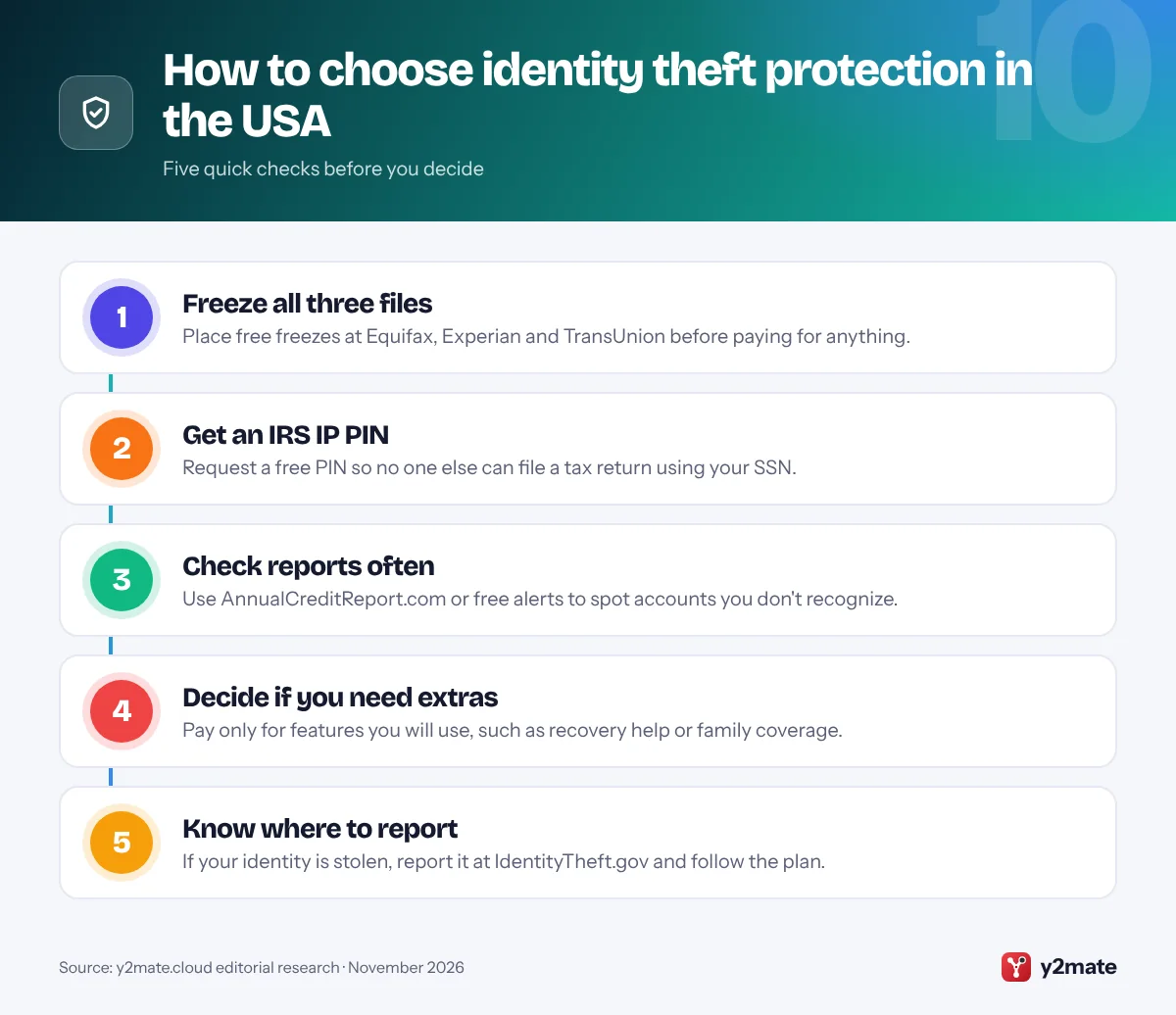
Start with the free tools, because they do the most. Freeze your credit at all three bureaus, get an IRS IP PIN and check your reports regularly at AnnualCreditReport.com or with free alerts from Credit Karma and Experian. Then decide whether a paid service adds anything you would actually use.
Credit freeze vs fraud alert vs monitoring
- Credit freeze: blocks most new lenders from seeing your report. It is free, lasts until you lift it and must be placed at each bureau.
- Fraud alert: tells lenders to verify your identity first. It is free and placed through one bureau, which must notify the other two. An initial alert lasts one year, and identity theft victims can get an extended alert that lasts seven years.
- Monitoring: watches for changes and alerts you after something happens. It does not stop an account being opened.
What paid services can and cannot do
Paid services save time. They watch more data, such as bank accounts and breach dumps, and the better ones assign restoration specialists to help with calls and paperwork. Identity theft insurance can cover eligible recovery costs, but the FTC warns that it generally does not reimburse money stolen from you, so check whether a plan adds separate stolen-funds or scam reimbursement. No service can stop every kind of identity theft, and none can remove your data from the dark web once it is there.
Data breach notices and free offers
Every US state has a law requiring businesses to tell people when certain personal data is breached, but there is no single federal breach law for most companies. Breach letters often include a free monitoring code, commonly for Experian IdentityWorks. Enroll only through the address printed in the letter, and treat unexpected emails or texts offering protection with suspicion.
Frequently asked questions
What is the best identity theft protection in the USA?
The best identity theft protection in the USA is a free credit freeze at Equifax, Experian and TransUnion, combined with an IRS Identity Protection PIN and regular checks at AnnualCreditReport.com. If you want paid monitoring and recovery help, Aura offers the most complete bundle, while LifeLock and Identity Guard offer tiered plans. Credit Karma provides free credit alerts from two bureaus.
Is paid identity theft protection worth it?
It depends on how much time you want to save. Paid services mostly monitor your information and alert you after something happens, and the better ones add restoration specialists and insurance for recovery costs. They cannot block new credit the way a free freeze can. Many people get enough protection from free freezes, free reports and free alerts, and pay only if they want hands-on recovery help.
What is the difference between a credit freeze and a fraud alert?
A credit freeze stops most new lenders from seeing your credit report, so they cannot approve new credit, and you place it at each bureau separately. A fraud alert keeps your report visible but tells lenders to verify your identity first, and the bureau you contact must notify the other two. Both are free under federal law, and you can use them together.
What is dark web monitoring?
Dark web monitoring is a service that scans breach data, criminal forums and marketplaces for your personal details, such as your email address, Social Security number or card numbers, and alerts you if they appear. It tells you which passwords to change or accounts to watch, but it cannot remove your data or stop someone using it. Credit Karma offers free breach checks for your email address.
What should I do if my identity is stolen in the USA?
Contact the fraud departments of any affected companies, then report the theft at IdentityTheft.gov to get an FTC Identity Theft Report and a personal recovery plan. Place a fraud alert or credit freeze at the bureaus, review your credit reports and ask the bureaus to block fraudulent information. If tax fraud is involved, follow the IRS identity theft steps and get an IP PIN.
Final verdict
The best identity theft protection in the USA costs nothing: freeze your credit at Equifax, Experian and TransUnion, get an IRS Identity Protection PIN, check your reports at AnnualCreditReport.com and bookmark IdentityTheft.gov in case you need a recovery plan. Credit Karma and a free Experian account together add free alerts from all three bureaus.
If you want someone in your corner, Aura is the most complete paid choice, LifeLock and Identity Guard offer flexible tiers, and Zander focuses on recovery. No service can stop all identity theft, so unique passwords, passkeys and suspicion of unexpected calls still matter.
Sources and further reading
- FTC: credit freezes and fraud alerts: The Federal Trade Commission explains how free credit freezes and fraud alerts work and how long each one lasts.
- FTC on identity theft services: The FTC describes credit monitoring, identity monitoring, recovery services and identity theft insurance, and what each can and cannot do.
- CFPB on identity monitoring services: The Consumer Financial Protection Bureau explains what identity monitoring and identity theft services offer before you pay for one.
- FTC: free weekly credit reports: The FTC confirms that AnnualCreditReport.com is the official source of your free credit reports from all three nationwide bureaus.

Leave a Reply