
- To recover from identity theft in the USA, report it at IdentityTheft.gov to get a free FTC Identity Theft Report and a personal recovery plan.
- An extended fraud alert, available to victims who have an Identity Theft Report, lasts seven years and means lenders must contact you before approving new credit.
- Under the Fair Credit Reporting Act, a credit bureau must block fraudulent information within four business days of receiving your Identity Theft Report, proof of identity and a letter listing the items.
- The IRS says to file Form 14039 only if an e-filed return is rejected as a duplicate or the IRS says you may be a victim.
- The FTC warns never to pay someone who unexpectedly contacts you promising to recover your losses for an upfront fee.
To recover from identity theft in the USA, report it at IdentityTheft.gov, the Federal Trade Commission’s free official site, to get an Identity Theft Report and a personal recovery plan. Then place a fraud alert or credit freeze, close or dispute every fraudulent account, fix any tax or Social Security problems and lock down your logins so the thief cannot get back in.
Identity theft means someone has used your personal information, such as your name, Social Security number (SSN) or account details, without permission, for example to open credit cards, file a tax return or take over your existing accounts. An Identity Theft Report is the official report IdentityTheft.gov creates from what you tell it. Businesses and credit bureaus use it to confirm the theft, and it unlocks legal rights such as blocking fraudulent debts from your credit reports.
This guide covers each recovery step, special cases such as child and medical identity theft, and the recovery scams that target victims. If nothing has gone wrong yet, our guide to freezing your credit covers prevention instead. This is general information, not legal advice.
Level: Beginner · Time needed: A few hours to start, then follow-ups
What you need
- Any letters, bills, emails or texts linked to the theft, plus statements showing the fraudulent activity
- A notebook or spreadsheet for a dated log of calls, names, case numbers and deadlines
- A government-issued photo ID and a document showing your current address
- Your SSN, date of birth and recent addresses, to verify your identity with the credit bureaus
- An email account and phone you control, ideally with a password manager
- A secure folder for saving your report, plan and letters
Step 1: Act Fast and Start a Recovery Log
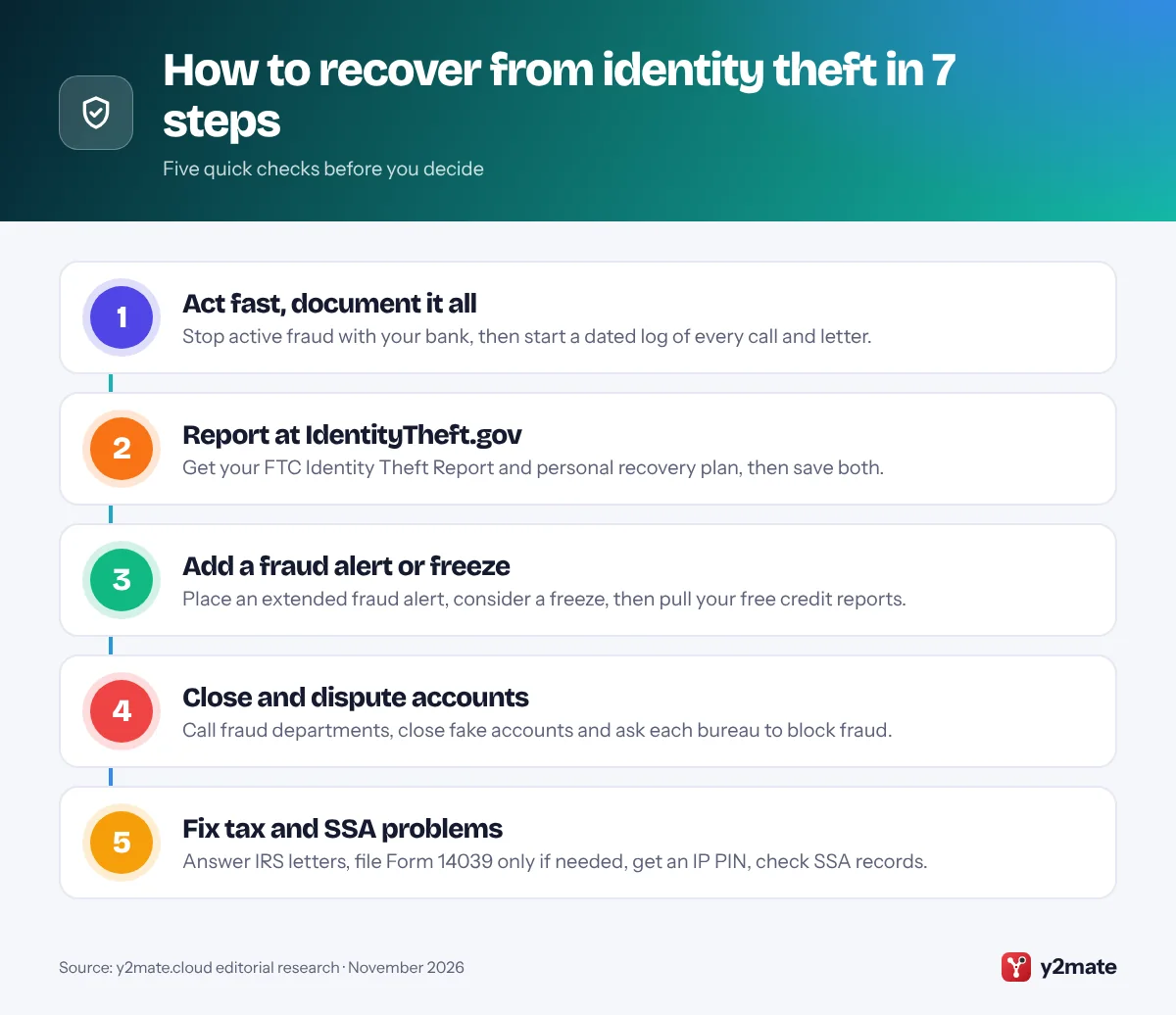
Start right away. If money is leaving an account now, call that bank or card issuer’s fraud department first, using the number on your card or its official website, and ask it to freeze or close the account.
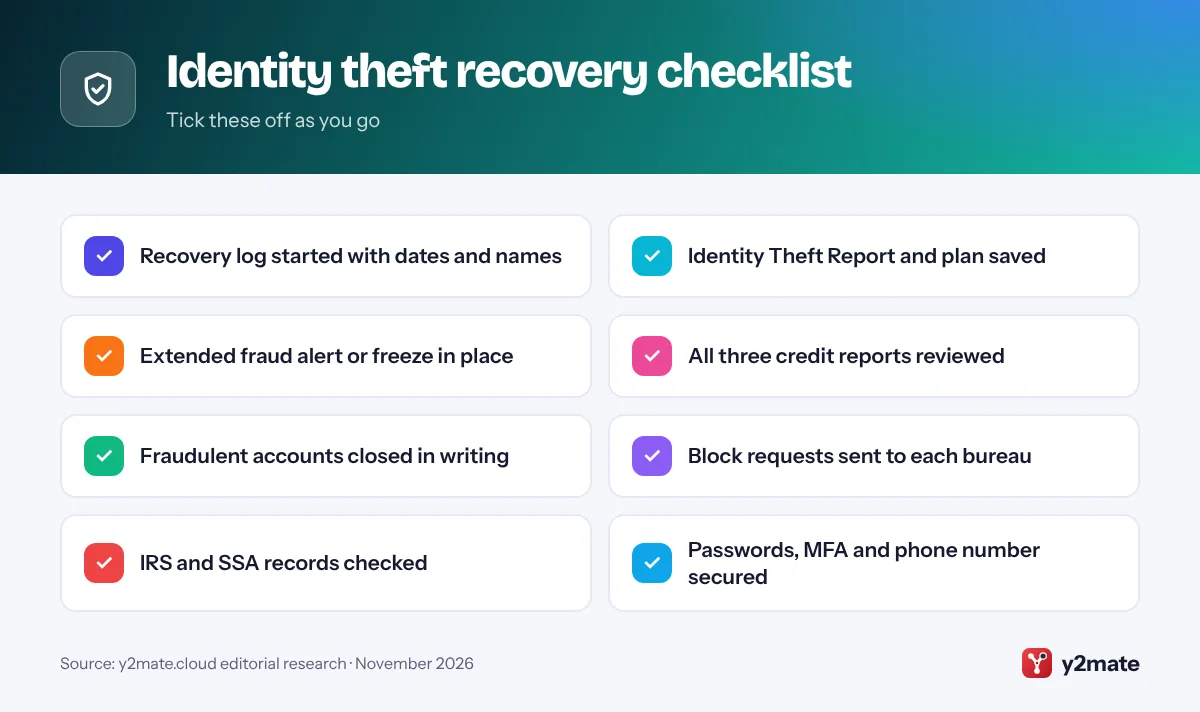
Next, gather what tipped you off, such as a letter, bill, bank alert or credit report entry, plus any linked texts or emails. Then start a recovery log. For every contact, write down:
- The date, the organization and the name of the person you spoke to
- What they agreed to do, plus any reference or case number
- Any deadline or date to follow up
Keep copies of everything you send and receive, and send important letters by certified mail with a return receipt so you can prove when they arrived. Store scans in a secure folder, not in an email account the thief may have accessed.
Step 2: Report It at IdentityTheft.gov and Get Your Recovery Plan
IdentityTheft.gov is the Federal Trade Commission’s official site for identity theft victims. Report online or call the FTC at 1-877-438-4338. Based on your answers, the site creates two documents:
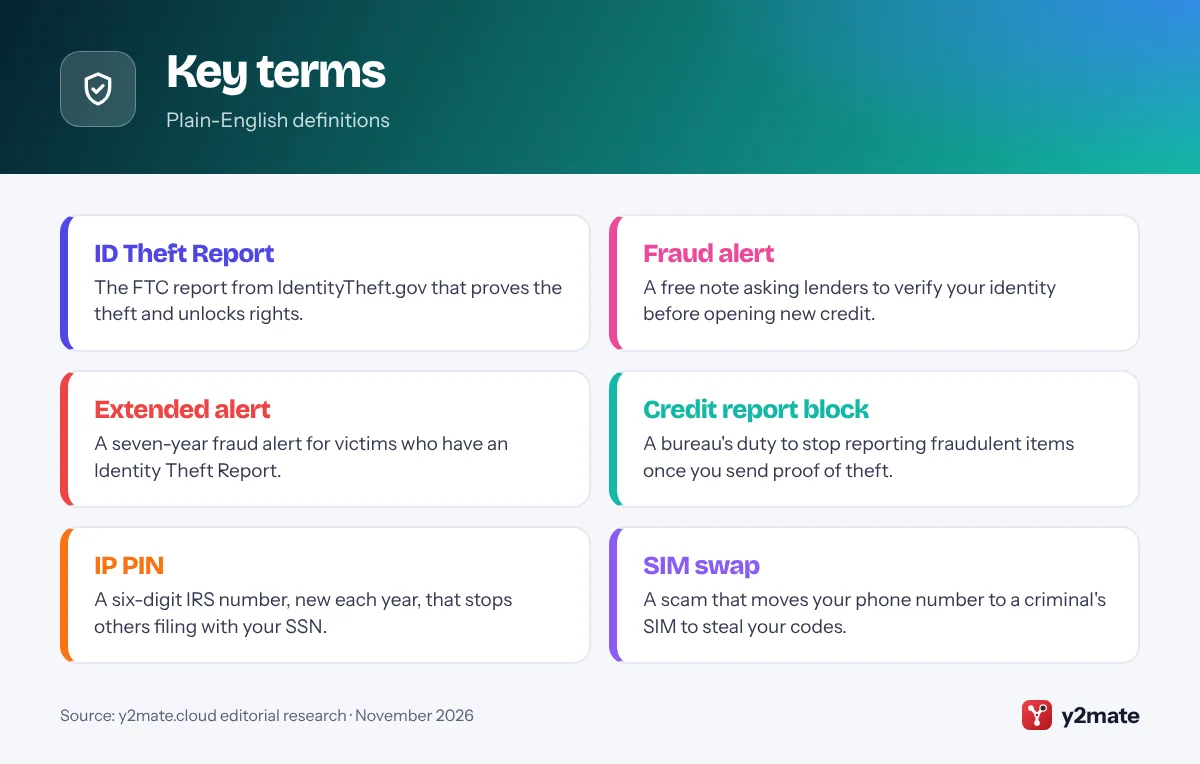
- FTC Identity Theft Report: your official statement that someone misused your information. Businesses and credit bureaus rely on it, and it gives you specific rights, such as having fraudulent information blocked from your credit reports.
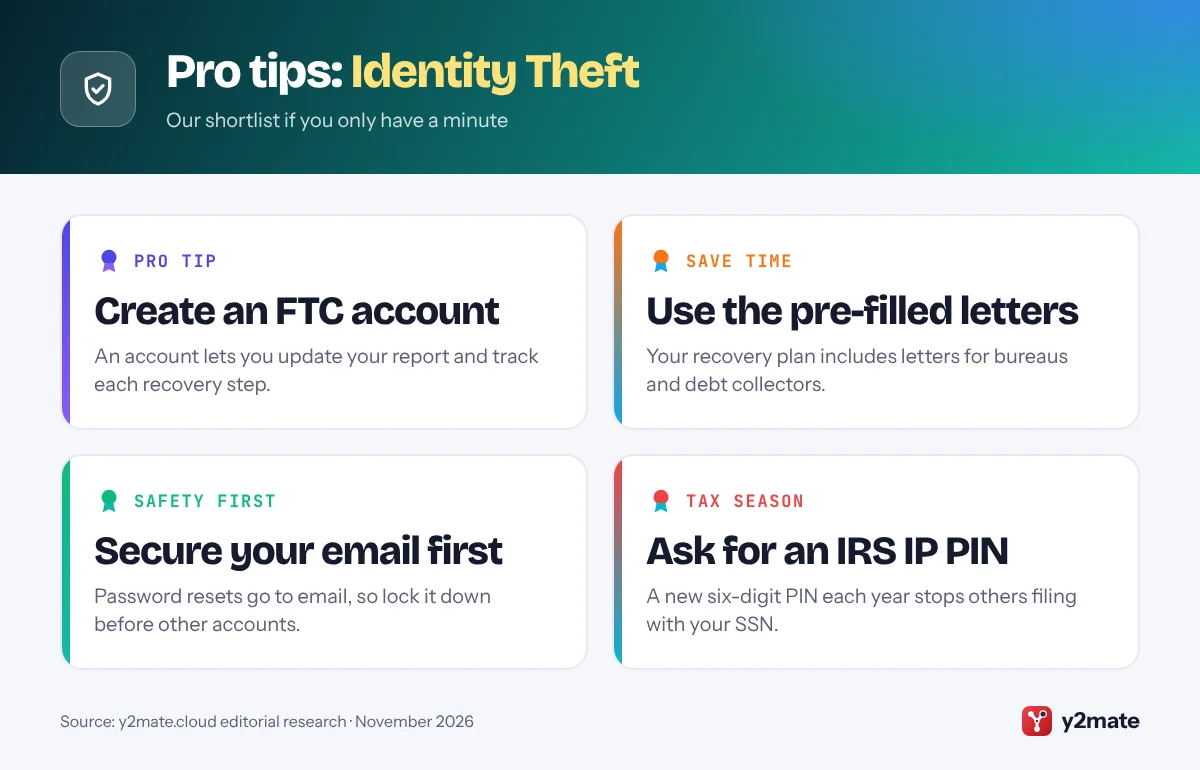
- Personal recovery plan: a checklist of next steps for your situation, with pre-filled letters for credit bureaus, businesses and debt collectors.
Create an account if you can, so you can return, update your report and track your progress. If you report without an account, print or save your report and plan before leaving the page, because you will not be able to get back to them.
Step 3: Place a Fraud Alert, Consider a Freeze and Check Your Credit Reports
A fraud alert is a free note on your credit file telling lenders to verify your identity before opening new credit in your name. Contact one nationwide bureau, Equifax, Experian or TransUnion, and it must tell the other two.
- Initial fraud alert: lasts one year and is available to anyone who suspects fraud.
- Extended fraud alert: for victims who have an Identity Theft Report. It lasts seven years, means lenders must contact you before approving new credit, takes you off prescreened credit and insurance offer lists for five years, and gives you two free reports from each bureau within 12 months.
A credit freeze goes further, stopping most new lenders from seeing your report, and you can use both. Our guide to freezing your credit in the USA explains how.
Then get your reports from all three bureaus at AnnualCreditReport.com, the official site for free credit reports, where you can check every week. Mark every account, inquiry, address or name you do not recognize for Step 4.
Step 4: Close Fraudulent Accounts and Block False Information
Call the fraud department of every company where an account was opened or misused. Ask it to close or freeze the account and to confirm in writing that you are not responsible for the charges, then follow up with the letters from your recovery plan.
The Fair Credit Reporting Act (FCRA) gives identity theft victims extra rights:
- Blocking: send each bureau showing a fraudulent item your Identity Theft Report, proof of identity and a letter listing the items. The bureau must block them within four business days of receiving these documents.
- Business records: a company must give you copies of applications and transaction records linked to the theft, free of charge, within 30 days of a written request once you prove your identity and the theft.
- No more reporting: once a company receives your Identity Theft Report at the address it specifies, it generally may not keep reporting the fraudulent information.
If a debt collector contacts you about a debt you did not create, reply in writing, say it results from identity theft and enclose your report.
Step 5: Fix Tax-Related Identity Theft and Social Security Misuse
Tax-related identity theft means someone used your SSN to file a return, claim a refund or report wages. Signs include an e-filed return rejected as a duplicate, or an IRS letter about a return, refund or employer you do not recognize. Answer IRS letters quickly, using only the contact details they give.
The IRS says most victims do not need Form 14039, Identity Theft Affidavit. File it only if your e-filed return was rejected as a duplicate, after checking your SSN for typos, or the IRS has told you that you may be a victim. If you get a Taxpayer Protection Program letter, follow its instructions instead. Keep filing and paying your taxes.
An Identity Protection PIN (IP PIN) is a six-digit number the IRS issues each year so only you can file with your SSN. Confirmed victims get one automatically, and anyone who can verify their identity can request one. The online tool usually goes offline from mid-November to mid-January.
For Social Security, check the earnings on your record through a my Social Security account and report errors to the Social Security Administration (SSA), which can also block online access to your record.
Step 6: File a Police Report When You Need One
The FTC says most identity theft victims do not need a police report, because the Identity Theft Report from IdentityTheft.gov covers most recovery steps. A local report is still worth filing when:
- You know or suspect who the thief is, such as a relative, roommate or former partner
- You have information that could help a police investigation
- A creditor, debt collector or other company insists on a police report before resolving a dispute
Contact your local police department, or the one where the theft happened, and bring a copy of your FTC Identity Theft Report, a government-issued photo ID, proof of address and any evidence, such as collection letters or statements. Ask for a copy of the report, or at least its number, and add it to your recovery log.
If a department will not take a report, ask whether you can file a miscellaneous incident report instead. Your state attorney general’s office can also explain local options.
Step 7: Secure Your Accounts and Watch for Follow-On Scams
Start with your email, because password reset links go there, then your bank, phone and other accounts:
- Change passwords and PINs, using a unique password for each account, stored in a password manager.
- Turn on multi-factor authentication (MFA), which asks for a second proof such as a code or security key, or use passkeys where offered. Our guide to setting up passkeys explains how.
- Check recovery emails, phone numbers, forwarding rules and signed-in devices, and remove anything you did not add.
Protect your phone number too. A SIM swap is when a criminal persuades your carrier to move your number to a SIM card they control, so your calls and one-time codes go to them. Ask your carrier about a port-out PIN or a number lock feature.
Expect follow-on scams from callers posing as your bank, the FTC or the IRS. The IRS does not start contact by email, text or social media to ask for personal information, and the FTC never asks you to move money. Our list of the top scams in the USA shows the common scripts.
Special Cases: Child, Medical, Deceased Relative and Data Breach Identity Theft
- Child identity theft: warning signs include bills, collection calls or IRS notices in your child’s name. Ask each bureau whether your child has a credit file, report misuse at IdentityTheft.gov and consider a free freeze, which a parent can request for a child under 16. Teens aged 16 or 17 can request their own.
- Medical identity theft: someone uses your details to get care or file insurance claims. Read every Explanation of Benefits (EOB) statement from your health plan, get copies of your records and ask providers in writing to correct entries that are not yours.
- A deceased relative: the executor or another person with legal authority should send each bureau the death certificate, following its instructions, and ask for the file to be flagged. Make sure SSA knows about the death, and report any misuse at IdentityTheft.gov.
- Data breach notices: a notice means your data was exposed, not necessarily misused. Check what was taken: change exposed passwords, call your card issuer about exposed cards, and consider a fraud alert or freeze if your SSN was involved.
What Not to Do When You Recover From Identity Theft
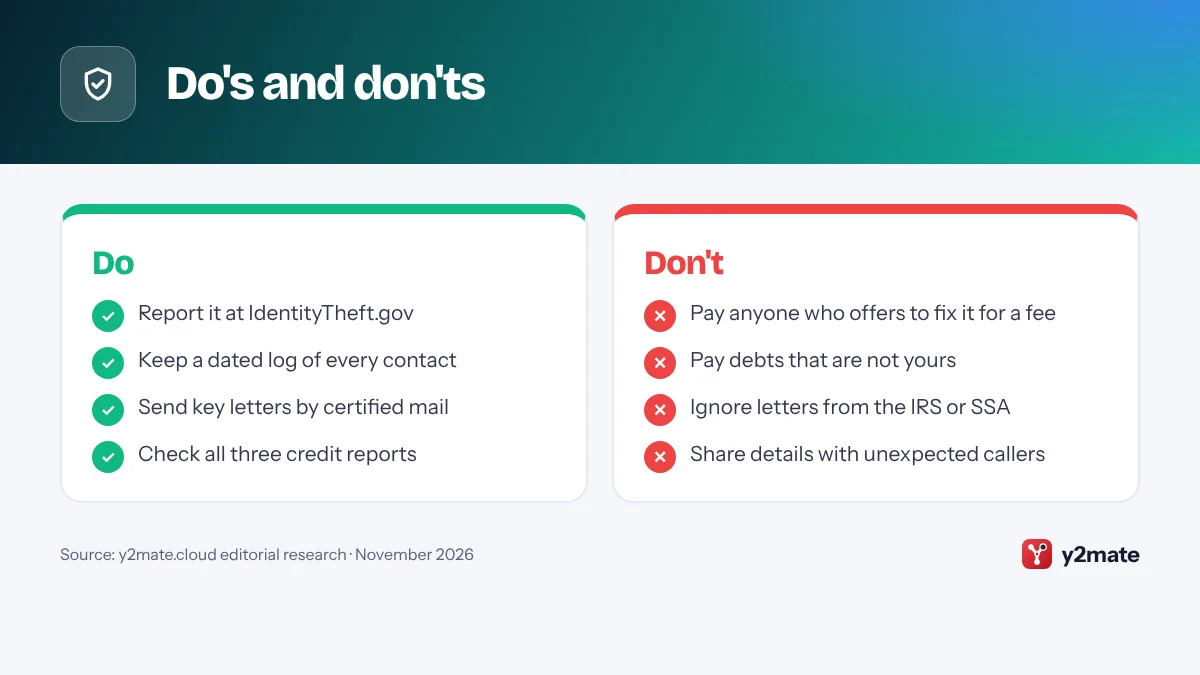
Recovery scams target people who have already been victimized. Callers may pose as a government agency or law firm and offer to clear your name or get your money back for an upfront fee. The FTC’s advice is clear: do not pay someone who unexpectedly contacts you promising to recover your losses. Reporting at IdentityTheft.gov is free, and government agencies do not ask for payment by gift card, wire transfer or cryptocurrency.
Avoid these mistakes too:
- Do not pay a debt that is not yours just to stop collection calls. Dispute it in writing with your Identity Theft Report.
- Do not ignore IRS or SSA letters, even if they look like mistakes.
- Do not rush to get a new SSN. SSA considers one only after you have done all you can to fix the misuse and someone is still using your number, and a new number does not guarantee a fresh start.
- Do not throw away paperwork once an account is fixed, because problems can resurface.
Do's and don'ts
Key terms
Troubleshooting
A credit bureau will not block a fraudulent item
A bureau can decline a block in limited cases, such as a request it believes was made in error, and it must tell you. Check that you sent your report, proof of identity and a clear list of items, then resend it or dispute the item with the company that reported it.
A company still says you owe the debt
Request the application and transaction records for the account and send a written dispute with your Identity Theft Report. If a financial company still will not fix it, submit a complaint to the Consumer Financial Protection Bureau.
The IRS online IP PIN tool is unavailable
The IRS usually takes the tool offline for annual maintenance from mid-November to mid-January. Confirmed victims are enrolled automatically, so watch for IRS mail; otherwise check IRS.gov for other ways to request a PIN.
Your phone suddenly has no service
An unexplained loss of service can signal a SIM swap. Contact your carrier from another phone or in a store, ask it to restore your number and add a port-out PIN, then change passwords for accounts that send codes to that number.
Frequently asked questions
How long does it take to recover from identity theft?
There is no fixed timeline. A single misused card may be fixed with one call to the issuer, while new accounts, tax-related or medical identity theft can take longer because several organizations are involved. Reporting at IdentityTheft.gov first helps, because your Identity Theft Report triggers legal rights, such as the bureaus' duty to block fraudulent information within four business days.
Do I need a police report for identity theft?
Usually not. The FTC says most victims can use the Identity Theft Report from IdentityTheft.gov instead. A local police report is worth filing if you know who the thief is, have information that could help an investigation, or a creditor, debt collector or other company insists on one.
Should I place a fraud alert or a credit freeze after identity theft?
You can do both. A fraud alert keeps your credit report visible but tells lenders to verify your identity first, and an extended alert for victims lasts seven years. A credit freeze stops most new lenders from seeing your report at all, but you must place it at Equifax, Experian and TransUnion separately and lift it when you apply for credit.
Can I get a new Social Security number after identity theft?
Only as a last resort. The Social Security Administration considers a new number only if you have done everything you can to fix the problems caused by the misuse and someone is still using your number. SSA warns that a new number does not guarantee a fresh start, so work through the other recovery steps first.
Is IdentityTheft.gov free and safe to use?
Yes. IdentityTheft.gov is the Federal Trade Commission's official site for reporting identity theft and getting a recovery plan, and it does not charge for either. Type the address yourself rather than following links in messages, and be wary of anyone who calls claiming to be from the FTC or offering to fix your identity theft for a fee.
Wrapping up
To recover from identity theft, work through the steps in order: stop active fraud and document everything, report it at IdentityTheft.gov, add an extended fraud alert or freeze, close and block fraudulent accounts, fix any IRS or Social Security problems, file a police report if needed and secure your accounts.
After that, keep checking your credit reports and statements, because problems can resurface. A credit freeze makes the next attempt harder; see our guide to freezing your credit in the USA, and our Top 10 Ways to Protect Your Online Accounts for everyday habits.
Sources and further reading
- Report identity theft to the FTC: The FTC's official site where victims report identity theft and get an Identity Theft Report and a personal recovery plan.
- FTC identity theft basics: The Federal Trade Commission explains the warning signs of identity theft and how to protect yourself and report it.
- CFPB summary of identity theft rights: The official summary of rights the Fair Credit Reporting Act gives identity theft victims, including fraud alerts and blocking fraudulent information.
- IRS Identity Theft Central: The IRS hub for tax-related identity theft, including when to file Form 14039 and how to get an Identity Protection PIN.
- SSA: report a stolen SSN: The Social Security Administration explains what to do if someone is misusing your Social Security number.

Leave a Reply