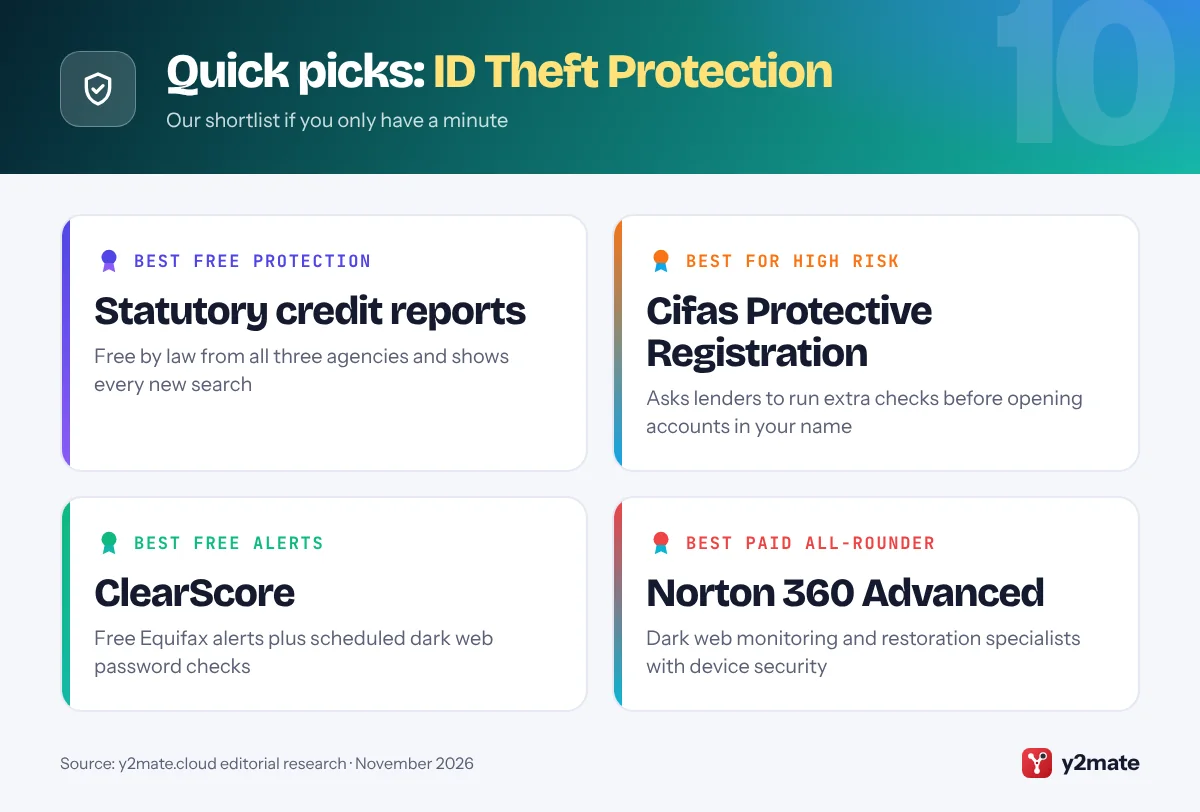
- The strongest identity theft protection in the UK is free: you can check your statutory credit reports from Experian, Equifax and TransUnion at no cost.
- The UK has no legal credit freeze, so Cifas Protective Registration, a paid two-year flag that asks lenders to make extra identity checks, is the closest equivalent.
- Report Fraud replaced Action Fraud as the place to report fraud in England, Wales and Northern Ireland, while people in Scotland should call Police Scotland on 101.
- Free apps such as ClearScore and Credit Karma UK alert you to changes on your Equifax and TransUnion files.
- Paid services add web monitoring, credit locks or restoration help, but no service can prevent all identity fraud.
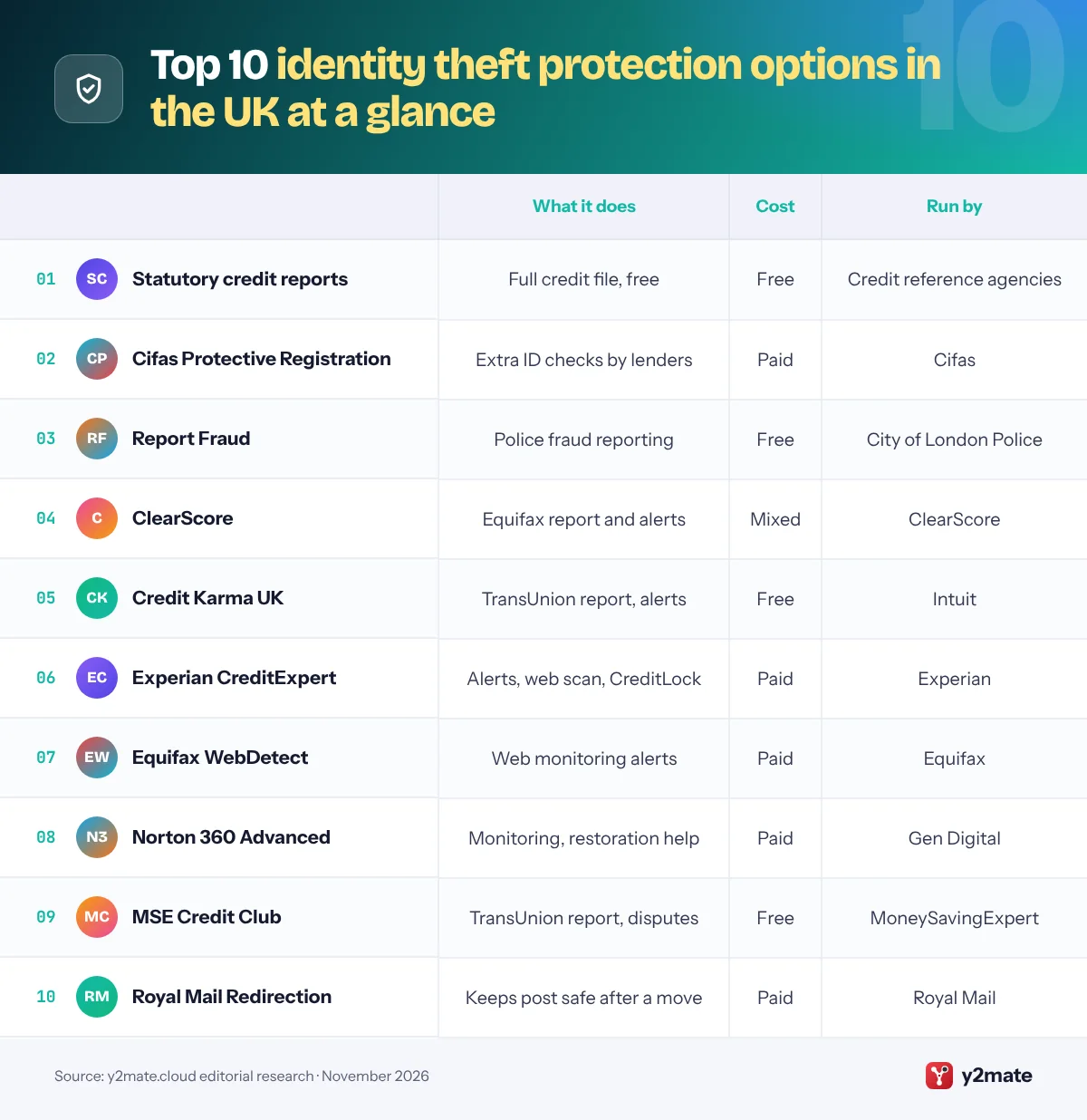
The best identity theft protection in the UK starts with free and official tools: your free statutory credit reports from Experian, Equifax and TransUnion, Cifas Protective Registration if you are at high risk, and Report Fraud, the police service that replaced Action Fraud. Free apps such as ClearScore, Credit Karma UK and MSE Credit Club add alerts, while paid services such as Experian CreditExpert, Equifax WebDetect and Norton 360 Advanced add web monitoring and recovery help. No service can stop all identity fraud.
Some plain definitions. Identity theft is when someone steals personal details such as your name, date of birth, address or bank details, and identity fraud is when they use them to open accounts, take out credit or buy goods in your name. A credit file is the record a credit reference agency keeps of your borrowing and applications. The UK has no legal credit freeze like the one in the US; the nearest options are Cifas Protective Registration, which asks lenders to make extra checks, and Experian CreditLock, a paid tool that blocks most applications using your Experian file. Dark web monitoring means a service scans breach data and criminal marketplaces for your details and alerts you if they appear, but it cannot delete them.
This list ranks ten options available in the UK in November 2026.
How we ranked this list
We ranked each option only on publicly documented criteria: what it protects or monitors, whether it is free, paid or mixed, whether it includes recovery help or insurance, and who runs it, from the police and not-for-profit Cifas to the credit reference agencies and private companies. Free legal rights and official services ranked above paid monitoring that mainly alerts you after something has happened.
We did not test these services ourselves, and we leave out prices and other plan details that change often. Check each provider’s current terms, including free trial conditions, before you sign up.
The Top 10 ID Theft Protection
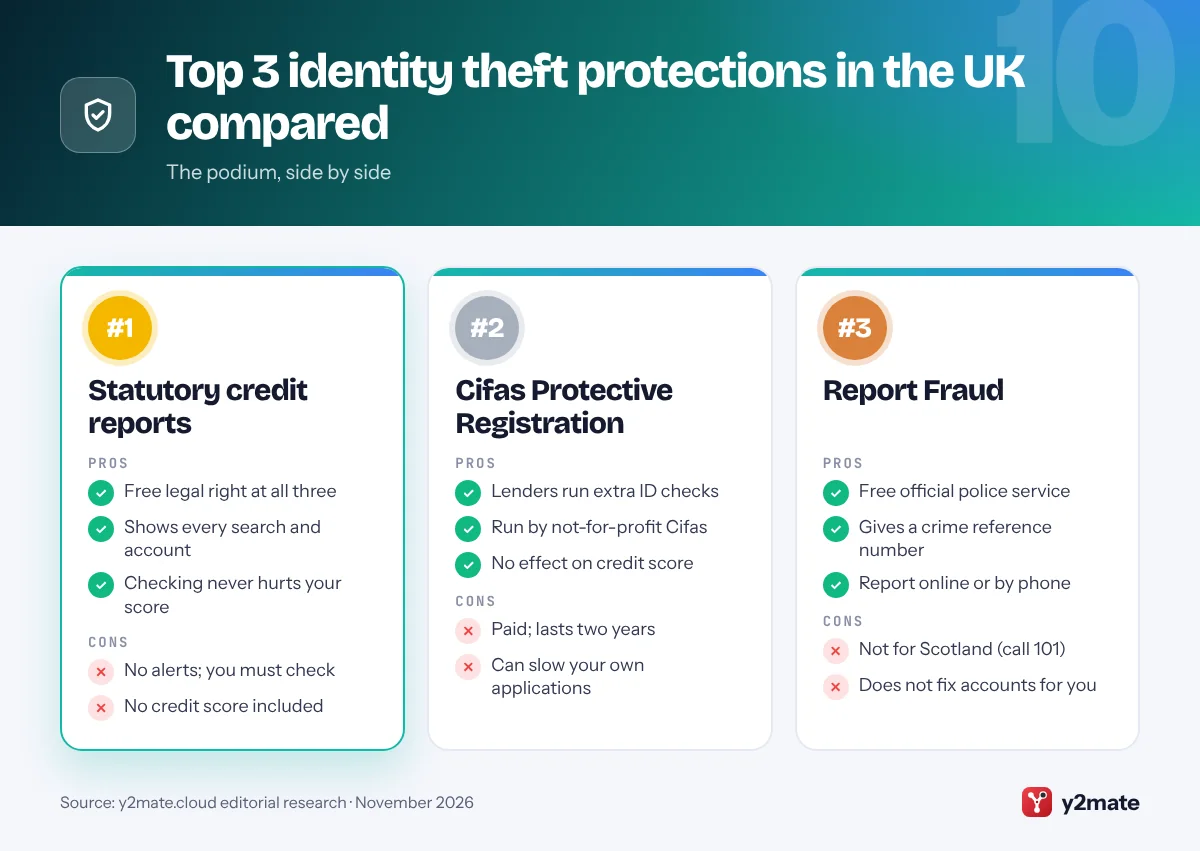
1. Statutory credit reports
Best for: spotting accounts opened in your name
Your statutory credit report is the full credit file a credit reference agency holds on you, and you have a legal right to see it free of charge from each of the three main agencies: Experian, Equifax and TransUnion. TransUnion says the right comes from the Consumer Credit Act and UK GDPR, and that you can request yours as often as you like. It does not include a credit score, but it shows everything that matters for spotting fraud.
Look for accounts, credit searches, addresses and financial associations you do not recognise. Unexpected searches can mean someone has applied for credit in your name, even if the application failed. Lenders do not always report to all three agencies, so check every file. If you find something wrong, raise it with the agency, which will contact the lender.
The UK has no free legal credit freeze, so regular checks are your main free defence. Request reports only through each agency’s official website, and be wary of any supposedly free report that asks for card details, which usually means a paid subscription.
Official site: Statutory credit reports
- Free legal right at all three
- Shows every search and account
- Checking never hurts your score
- No alerts; you must check
- No credit score included
2. Cifas Protective Registration
Best for: people at high risk after stolen ID or post
Cifas is a not-for-profit fraud prevention organisation that runs the National Fraud Database shared by banks, lenders, phone companies and other members. Protective Registration places a warning flag against your name and details on that database. When anyone, including you, applies for a product or service using your details, member organisations see the flag and carry out extra checks to confirm the applicant is really you.
It is designed for people whose identity is at heightened risk, for example after a lost or stolen passport or driving licence, stolen post or a data breach that exposed key details. You apply online, each person at an address needs their own registration, and it lasts two years unless you ask for it to be removed. There is a fee, and Cifas says the registration does not affect your credit score.
Know the trade-offs. Genuine applications can take longer while checks are made, the flag does not cover card payments on existing accounts, and Cifas will not email you when it expires. It is not insurance, so keep checking your credit reports. For high-risk situations, it is the closest UK equivalent to a credit freeze.
Official site: Cifas Protective Registration
- Lenders run extra ID checks
- Run by not-for-profit Cifas
- No effect on credit score
- Paid; lasts two years
- Can slow your own applications
3. Report Fraud
Best for: reporting identity fraud to the police
Report Fraud is the national service for reporting fraud and cyber crime in England, Wales and Northern Ireland. Run by the City of London Police, it replaced Action Fraud in December 2025, with a full public launch in January 2026. You can report online or on the same phone number Action Fraud used, and you receive a crime reference number. If you live in Scotland, report to Police Scotland on 101 instead.
Report identity fraud as soon as you discover it, for example when a loan, phone contract or bank account appears in your name. A crime reference number helps when you ask lenders to close fraudulent accounts or ask credit reference agencies to correct your file.
Report Fraud does not monitor your details or fix accounts for you, so contact your bank first if money is at risk, and call 159 to reach your bank safely if you are unsure whether a call is genuine. Report a lost or stolen passport to HM Passport Office through GOV.UK so that it is cancelled and cannot be used to impersonate you.
Official site: Report Fraud
- Free official police service
- Gives a crime reference number
- Report online or by phone
- Not for Scotland (call 101)
- Does not fix accounts for you
4. ClearScore
Best for: free Equifax alerts plus breach checks
ClearScore is a widely used free way to watch your Equifax credit file. It is not a credit reference agency itself, but it shows your Equifax-based report and score free of charge and flags important changes, such as a new account opened in your name, which can be an early sign of fraud.
Its ClearScore Protect feature adds free dark web monitoring for leaked passwords linked to your sign-up email address. The checks run on a schedule rather than live, so an alert arrives at the next scan after a breach is found. A paid upgrade, Protect Plus, scans more often and looks for more details, including your address, phone number, National Insurance number and driving licence.
The limits are clear. ClearScore covers only Equifax, so pair it with a TransUnion-based app and your Experian statutory report. Like every dark web service, it cannot remove your data once it has leaked, and it is an alert service rather than a recovery service. ClearScore earns money when you take out products it shows you, so expect credit card and loan offers.
Official site: ClearScore
- Free Equifax report and alerts
- Free dark web password checks
- Paid upgrade watches more data
- Covers Equifax only
- Scans are not live
5. Credit Karma UK
Best for: free weekly TransUnion alerts in an app
Credit Karma UK, owned by Intuit, gives you free access to your TransUnion credit report and score. It is not a credit reference agency, but it pulls your TransUnion file, updates it weekly and highlights important changes through its Credit Monitor, asking whether you recognise each new item.
That makes it a simple early-warning system for fraud on your TransUnion file, such as a new credit search or an account you did not open. Checking your report through Credit Karma shows only as a soft search, so it never affects your credit score. If you spot an error or a fraudulent entry, you raise it with TransUnion, either from within Credit Karma or directly.
Credit Karma covers only TransUnion, so combine it with ClearScore for Equifax and your Experian statutory report for full coverage. It is an alert service rather than a recovery service, and it makes money by showing credit card and loan offers. For anyone who wants free, regular TransUnion alerts without paying for monitoring, it does the job well.
Official site: Credit Karma UK
- Free TransUnion report
- Weekly updates and alerts
- Soft searches only
- Covers TransUnion only
- Product offers in the app
6. Experian CreditExpert
Best for: close watch on your Experian file
Equifax and TransUnion data powers free apps such as ClearScore and Credit Karma, but Experian keeps its fraud alerts inside paid plans, so CreditExpert is the main way to watch your Experian file closely. New customers get a free trial, after which it is a paid monthly subscription. It adds daily updates to your Experian report and score, alerts to important changes and web monitoring that scans for selected personal and financial details and warns you if they appear.
CreditExpert also includes Experian CreditLock, which blocks most applications that use your Experian credit file until you unlock it, plus UK-based support. If you care only about fraud, Experian Identity Plus is a lower-cost, identity-focused plan with CreditLock, fraud alerts, web monitoring and fraud support. The free Experian account shows your score and report monthly but has no fraud alerts or web monitoring.
CreditLock only covers Experian, so lenders that check Equifax or TransUnion are unaffected. Experian notes that its web monitoring is not regulated by the Financial Conduct Authority. Cancel during the trial if you decide you do not need it.
Official site: Experian CreditExpert
- Web monitoring and fraud alerts
- CreditLock for your Experian file
- Free trial for new customers
- Paid after the trial
- CreditLock covers Experian only
7. Equifax WebDetect
Best for: web monitoring of many personal details
WebDetect is Equifax’s identity monitoring feature, included in its paid Equifax Credit Report & Score subscription. It watches websites that fraudsters use to trade personal information and alerts you if your details appear there. You can add email addresses, phone numbers, bank account and card numbers, plus your driving licence and National Insurance numbers.
The subscription also gives you your full Equifax report, daily score updates when you log in and alerts when there are key changes to your file. New customers get the first month free, and Equifax’s Family and Friends plan covers several UK adults under one subscription. Equifax also offers a free Equifax Basic account with a monthly score update and a separate identity-focused plan called Identity Watch.
Because ClearScore already gives you a free Equifax-based report with change alerts, the main reason to pay is the broader web monitoring. As with every dark web service, an alert tells you to act, for example by cancelling a card or changing a password, but it cannot remove your data or stop it being used. Check what fraud support is included before you subscribe.
Official site: Equifax WebDetect
- Monitors many personal details
- Daily alerts on key changes
- First month free
- Paid after the trial
- Overlaps free ClearScore alerts
8. Norton 360 Advanced
Best for: device security plus restoration help
Norton 360 Advanced, from Gen Digital, is the top Norton security suite sold in the UK and the closest local equivalent to the LifeLock identity plans sold in the US. Alongside antivirus, a VPN and a password manager, it includes Dark Web Monitoring, which watches for details such as email addresses, physical addresses, bank and card numbers and driving licence numbers, and alerts you if they appear.
The key difference from monitoring-only services is Identity Restoration Support. If you become a victim, Norton’s restoration specialists advise you on next steps and the calls to make, during UK business hours on weekdays. Advanced also adds Social Media Monitoring, which watches supported accounts for takeovers and risky activity, although on some platforms it only checks for account takeover.
Norton says no one can prevent all cyber crime or identity theft. If you already have antivirus you like, Norton also sells Identity Advisor Plus, a standalone identity service with restoration specialists. For households that want device security and identity help in one subscription, Norton 360 Advanced is the strongest paid all-rounder in the UK.
Official site: Norton 360 Advanced
- Identity Restoration Support
- Dark web and social monitoring
- Antivirus and VPN included
- Restoration on weekdays only
- Paid subscription only
9. MSE Credit Club
Best for: a free TransUnion report with easy disputes
Credit Club is MoneySavingExpert’s free credit tool. It shows your TransUnion credit report and score, plus an Eligibility Rating and tools that estimate your chances of being accepted for cards and loans without leaving a hard search on your file. MoneySavingExpert says it is completely free and that it is paid only if you take out a product it rates and are accepted.
For identity protection, the useful part is simply seeing your full TransUnion file in a clear layout. Check it for searches, accounts and addresses you do not recognise. If something is wrong, the Raise a dispute button on the credit report tab lets you contact TransUnion, which can take it up with the lender for you.
Credit Club uses the same TransUnion data as Credit Karma UK, so most people only need one of them. Choose Credit Club if you also want its eligibility tools, or Credit Karma if you prefer regular alerts in an app. Either way, add ClearScore for Equifax and your Experian statutory report so all three files are covered.
Official site: MSE Credit Club
- Free TransUnion report and score
- Built-in dispute button
- Eligibility tools, soft search
- Same data as Credit Karma UK
- No dark web monitoring
10. Royal Mail Redirection
Best for: keeping your post safe when you move home
Post is still a common route to identity fraud. Bank statements, new cards and official letters sent to an old address can give a criminal much of what they need to impersonate you. Royal Mail’s Redirection service, a paid service you set up when you move, forwards your post to your new address, and Get Safe Online warns that not redirecting your mail puts you at risk of identity theft.
Royal Mail runs security checks on applications and may ask extra questions, and it says applying for a redirection fraudulently may be a criminal offence. If post suddenly stops arriving, or you discover a redirection set up in your name without your knowledge, contact Royal Mail straight away through its help centre, tell your bank and card providers, and report it to Report Fraud.
Redirection is not a monitoring service, so combine it with the free tools above. Update your address with banks, HMRC, the DVLA and other organisations as soon as you move, and check your credit file a few months later for applications you do not recognise.
Official site: Royal Mail Redirection
- Keeps post from your old address
- Security checks on applications
- Report misuse to Royal Mail
- Paid service
- No monitoring or alerts
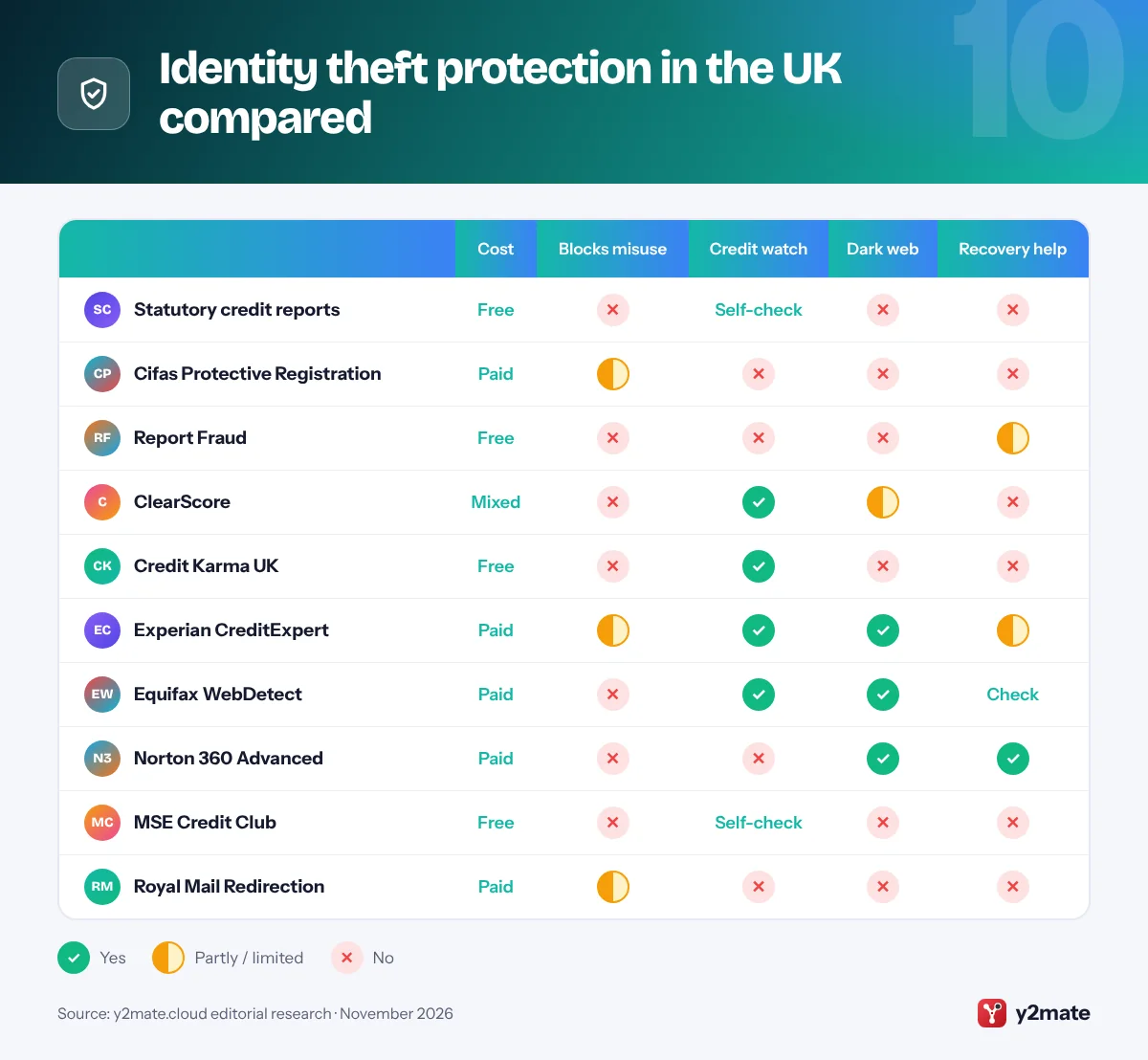
Identity theft protection in the UK compared
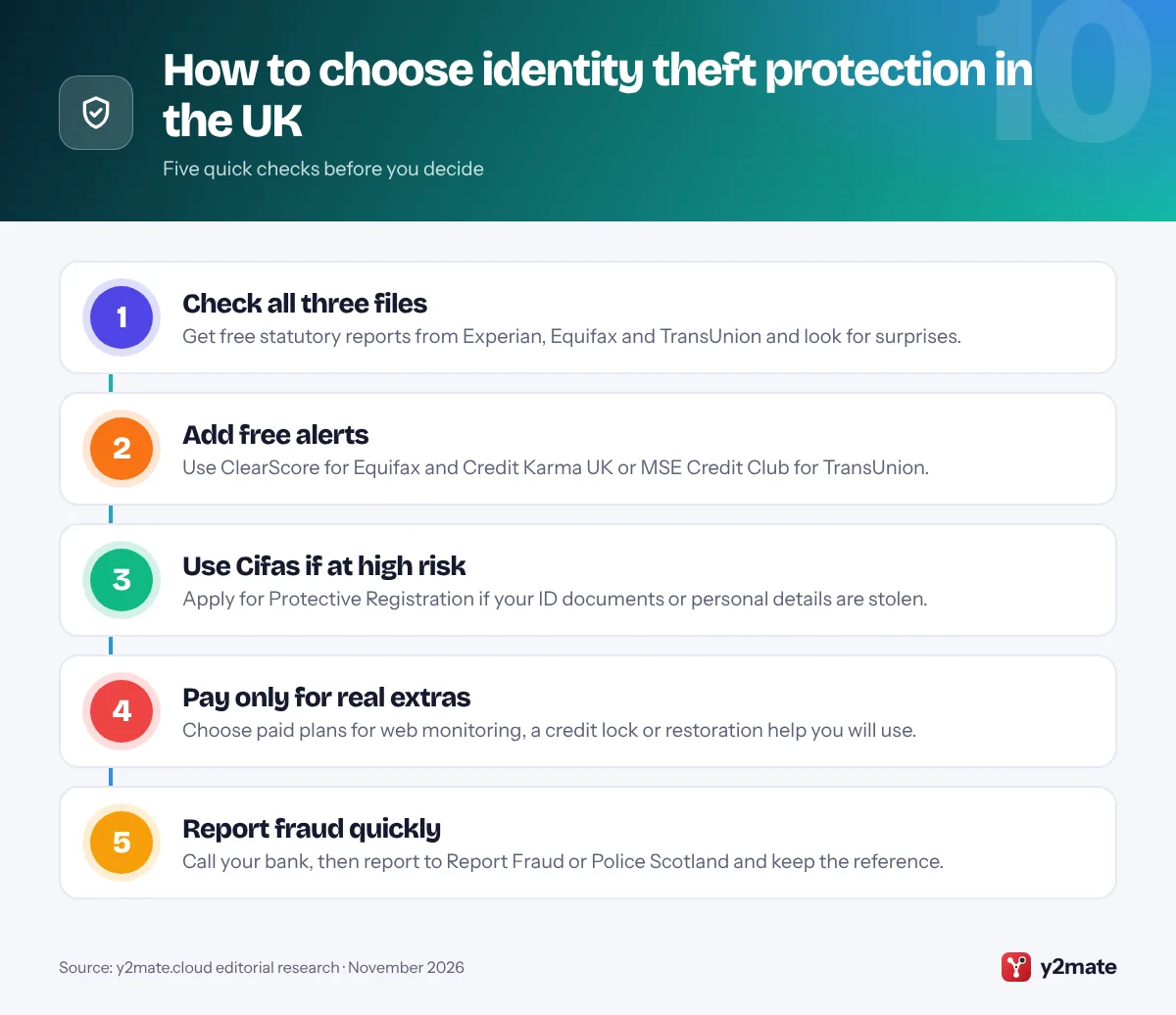
How to choose identity theft protection in the UK
Start with the free tools. Request your statutory reports from Experian, Equifax and TransUnion, then set up free alerts with ClearScore for Equifax and Credit Karma UK or MSE Credit Club for TransUnion. Pay only for features you would actually use.
No credit freeze, but strong alternatives
- Cifas Protective Registration: asks Cifas members to make extra identity checks for two years. It is paid and best for people at high risk.
- Experian CreditLock: blocks most applications that use your Experian file. It is part of paid Experian plans and covers Experian only.
- Regular checks: free statutory reports and app alerts help you spot fraud early.
What paid services can and cannot do
Paid services watch more data, such as leaked card numbers and licence or passport details, and some add restoration specialists who guide you through recovery. None can stop every kind of identity fraud, block every lender or remove your data from the dark web.
Data breaches and your rights
Under UK GDPR, organisations must report a personal data breach that poses a risk to people to the Information Commissioner’s Office (ICO), where feasible within 72 hours, and tell affected people without undue delay when the risk is high. Breach notices should explain what happened and how to protect yourself. If you are unhappy with how an organisation handled your data, raise it with the organisation first and then complain to the ICO.
Frequently asked questions
What is the best identity theft protection in the UK?
The best identity theft protection in the UK is free: check your statutory credit reports from Experian, Equifax and TransUnion, and use free apps such as ClearScore and Credit Karma UK for alerts. If you are at high risk, Cifas Protective Registration adds extra checks by lenders. For paid monitoring with restoration help, Norton 360 Advanced is the strongest all-rounder.
Can I freeze my credit in the UK?
Not in the way Americans can, because the UK has no free legal credit freeze. The closest options are Cifas Protective Registration, a paid service that asks lenders to carry out extra identity checks for two years, and Experian CreditLock, part of paid Experian plans, which blocks most applications using your Experian file but not files held by Equifax or TransUnion.
Is Cifas Protective Registration worth it?
It is worth considering if your identity is at heightened risk, for example after your passport, driving licence or post was stolen or your details were exposed in a data breach. Member lenders run extra checks before opening accounts in your name. It costs a fee, lasts two years and can slow your own applications, so it is less useful if your risk is low.
What is dark web monitoring and does it stop identity theft?
Dark web monitoring scans breach data and criminal marketplaces for details such as your email address, passwords, card numbers or National Insurance number, and alerts you if they appear. It does not stop identity theft or remove your data, but an early alert lets you change passwords, cancel cards and watch your credit file. ClearScore offers a free basic version.
What should I do if my identity is stolen in the UK?
Contact your bank and any affected companies straight away, then report the fraud to Report Fraud online or by phone, or to Police Scotland on 101 if you live in Scotland. Check your credit files at all three agencies and dispute anything you do not recognise, consider Cifas Protective Registration, change your passwords and report lost or stolen ID documents.
Final verdict
The best identity theft protection in the UK starts with free checks: request your statutory reports from all three credit reference agencies and add free alerts from ClearScore and Credit Karma UK or MSE Credit Club. If your details have been stolen, Cifas Protective Registration and a prompt report to Report Fraud are the most useful next steps.
Paid services such as Experian CreditExpert, Equifax WebDetect and Norton 360 Advanced add web monitoring, a credit lock or restoration help, but none can stop all identity fraud. Redirect your post when you move, and use strong passwords and two-step verification.
Sources and further reading
- ICO advice on identity theft: The Information Commissioner's Office explains how to check your credit file and when to apply for Cifas Protective Registration.
- Stop! Think Fraud: stolen identity: The government's fraud campaign sets out what to do if your identity has been stolen, including checking all three credit files.
- ICO steps after a data breach: The ICO lists practical steps to take if an organisation tells you your personal data has been breached.
- Report Fraud on application fraud: Report Fraud explains how criminals use stolen details to apply for credit in your name and how to report it.
- GOV.UK: the Report Fraud service: GOV.UK announces Report Fraud, the City of London Police service that replaced Action Fraud for reporting fraud and cyber crime.

Leave a Reply