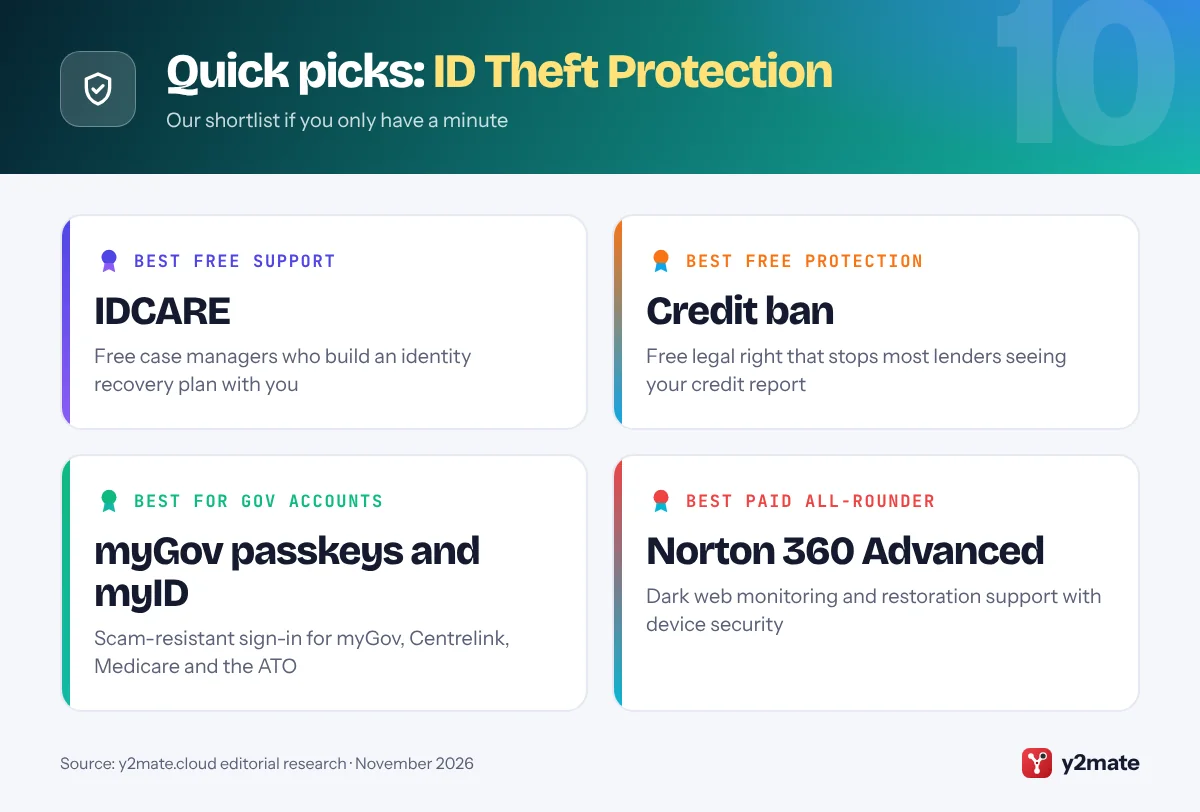
- The strongest identity theft protection in Australia is free, led by IDCARE's case managers, credit bans and free credit reports.
- Anyone who reasonably believes they are, or are likely to be, a victim of fraud can ask a credit reporting body for a free credit ban, which lasts twenty-one days at first and can be extended.
- Australians can get a free credit report from each credit reporting body every three months, and credit information illion held may now be available through Experian, which bought illion in 2024.
- Services Australia recommends securing myGov with a passkey, and its Scams and Identity Theft Helpdesk can help if your account is compromised.
- Paid services such as Norton 360 Advanced and Equifax Identity Protect add dark web monitoring and recovery help, but none can prevent all identity theft.
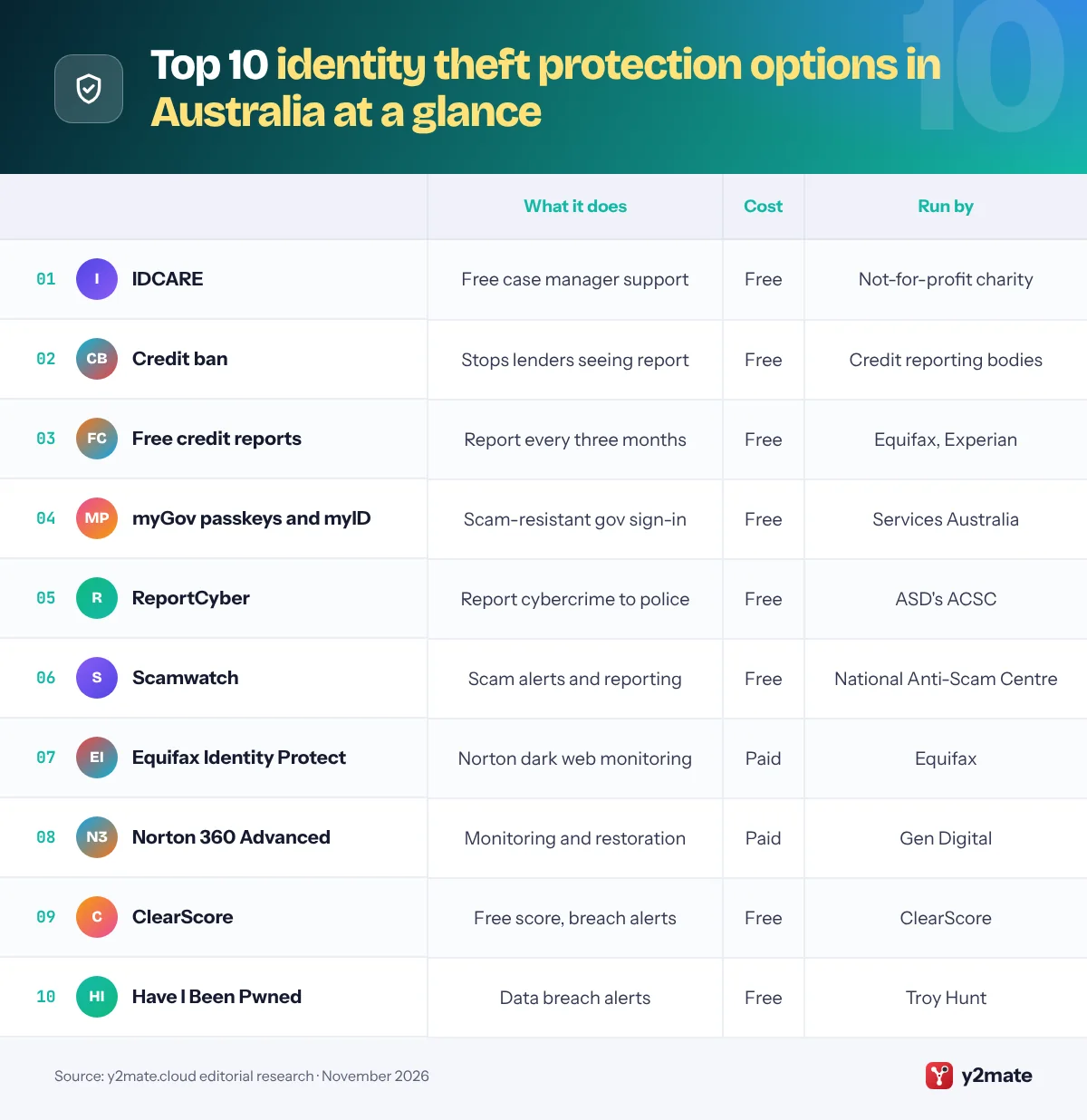
The best identity theft protection in Australia is mostly free: IDCARE, the national identity and cyber support service, a credit ban at the credit reporting bodies, free credit reports, passkeys and myID on myGov, and official reporting through ReportCyber and Scamwatch. Paid services such as Equifax Identity Protect and Norton 360 Advanced add dark web monitoring and restoration help, while ClearScore and Have I Been Pwned offer free breach alerts. No service can stop all identity theft.
Some plain definitions. Identity theft is when someone steals your personal information, such as your name, date of birth, driver’s licence or Medicare details, and uses it to pretend to be you, often to open credit, take over accounts or claim payments. A credit ban is Australia’s version of a credit freeze: a free, legal request that stops a credit reporting body sharing your credit report, so most lenders cannot approve new credit. Dark web monitoring means a service scans breach data and criminal marketplaces for your details and alerts you if they appear, but it cannot delete them.
This list ranks ten options available in Australia in November 2026, with free government and not-for-profit services first.
How we ranked this list
We ranked each option only on publicly documented criteria: what it protects or monitors, whether it is free, paid or mixed, whether it includes recovery help or insurance, and who runs it, from government agencies and a not-for-profit charity to credit reporting bodies and private companies. Free legal rights and official services ranked above paid monitoring that mainly alerts you after something has happened.
We did not test these services ourselves, and we leave out prices, insurance limits and other plan details that change often. Check each provider’s current terms before you sign up.
The Top 10 ID Theft Protection
1. IDCARE
Best for: free expert help after identity misuse
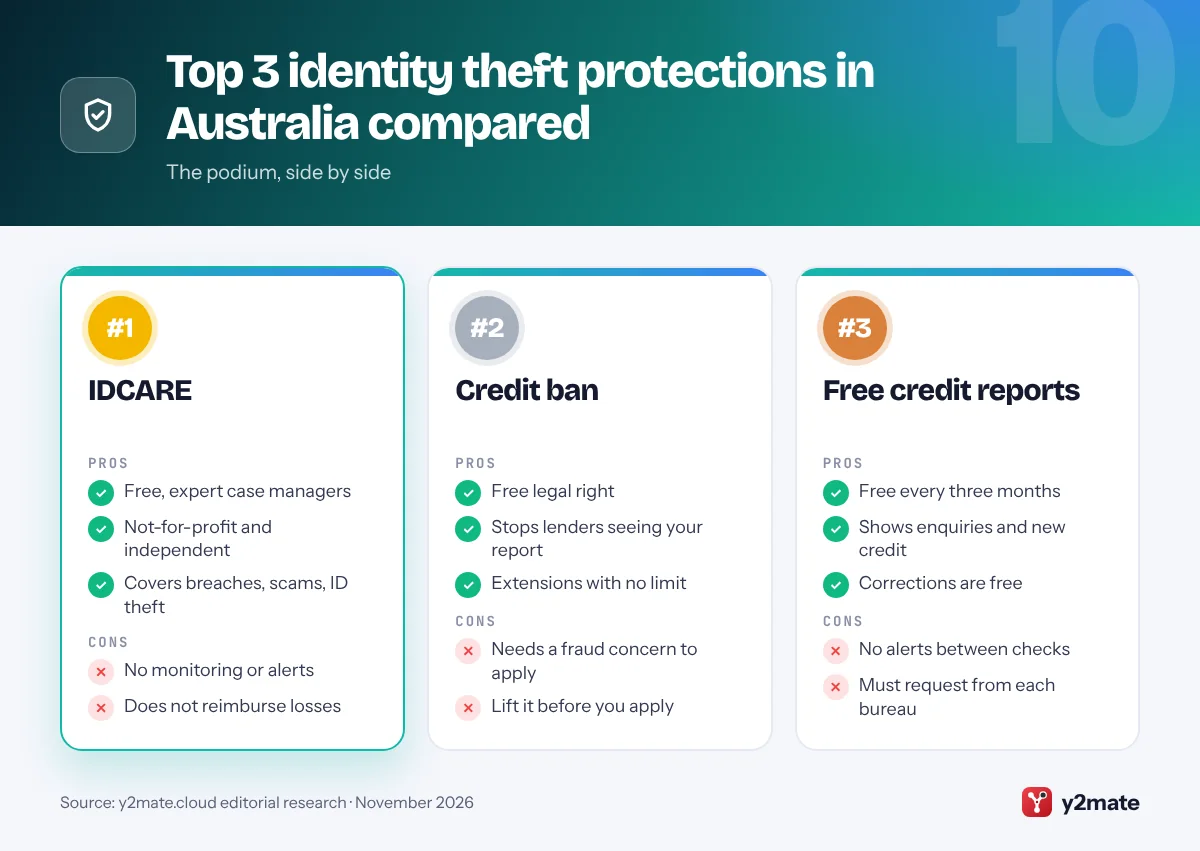
IDCARE is Australia and New Zealand’s national identity and cyber support service, and it should be your first call if your identity is misused or exposed. It is a not-for-profit charity, and its core support is free for individuals. Its case managers listen to what happened, assess your risk and build a response plan with you, covering steps such as securing accounts, replacing documents and dealing with lenders and agencies.
IDCARE helps with identity theft, data breaches, scams and cyber security concerns. Government services, including Services Australia and the Australian Signals Directorate (ASD), point people to IDCARE, and many organisations refer customers to it after a data breach. You can call its national helpline on 1800 595 160 or start online, and its website has guides for common situations.
IDCARE does not monitor your details, reimburse losses or reverse transactions, so contact your bank first if money is at risk. What it offers is expert, independent guidance from people who handle identity crime every day, which is much of what paid services sell. That is why it ranks first.
Official site: IDCARE
- Free, expert case managers
- Not-for-profit and independent
- Covers breaches, scams, ID theft
- No monitoring or alerts
- Does not reimburse losses
2. Credit ban
Best for: blocking new credit after suspected fraud
A credit ban is Australia’s strongest free tool for stopping new credit in your name. Under the Privacy Act and the Privacy (Credit Reporting) Code, if you believe on reasonable grounds that you have been, or are likely to be, a victim of fraud, you can ask a credit reporting body to ban the use and disclosure of your credit report. While the ban is in place, a lender that asks for your report is told a ban applies, so most will not approve new credit.
An initial ban lasts twenty-one days. The credit reporting body must tell you at least five business days before it ends, and you can ask for an extension if you are still concerned, with no limit on how many times it can be extended. You can ask one bureau to pass your request on to the others, although the OAIC still suggests contacting each one. The current code also requires bureaus to offer a free ban notification service that tells you when a lender asks for your report during a ban.
Lift the ban before applying for credit yourself, and remember it does not protect existing accounts.
Official site: Credit ban
- Free legal right
- Stops lenders seeing your report
- Extensions with no limit
- Needs a fraud concern to apply
- Lift it before you apply
3. Free credit reports
Best for: checking for credit you never applied for
Every Australian can get a free copy of their credit report from each credit reporting body once every three months, and also after being refused credit recently. Checking regularly is how you spot loans, credit cards or credit enquiries you never applied for, which are often the first sign of identity theft.
Equifax and Experian are now the main consumer credit reporting bodies. Experian bought illion in 2024, so credit information illion held may now be available through Experian. Because each bureau can hold different information, the Office of the Australian Information Commissioner (OAIC) recommends checking all of them. Request your report through each bureau’s official free-report page, and take care not to sign up for a paid product by mistake, because the bureaus also sell subscriptions.
If you find something wrong, ask the bureau or the credit provider to correct it, which is free. Pair regular checks with a credit ban if you suspect fraud, and with free alerts from an app such as ClearScore between checks. Your report will not tell you if your details appear in a data breach.
Official site: Free credit reports
- Free every three months
- Shows enquiries and new credit
- Corrections are free
- No alerts between checks
- Must request from each bureau
4. myGov passkeys and myID
Best for: locking down your government accounts
Your myGov account links to Centrelink, Medicare, the ATO and other services, which makes it a prime target for identity thieves. Services Australia describes myGov as the most impersonated government website in the country, so securing it is one of the most useful free steps you can take.
The strongest option is a passkey, which uses your device’s fingerprint, face or screen lock instead of a password and which Services Australia describes as more secure and scam resistant. It recommends creating a passkey and then turning off your password, and myGov’s security review gives you a personalised list of actions. myID, the Australian Government’s Digital ID, is the only Digital ID you can use with myGov, and the ATO calls it the most secure way to prove who you are online.
If you think your myGov account or identity has been compromised, call the Services Australia Scams and Identity Theft Helpdesk on 1800 941 126. Staff can check your records for suspicious activity and add extra security. The ATO says it will never send an unsolicited text or email with a link asking you to sign in.
Official site: myGov passkeys and myID
- Free, scam-resistant passkeys
- Helpdesk for compromised IDs
- Protects ATO and Centrelink
- Only protects government accounts
- No credit or dark web alerts
5. ReportCyber
Best for: reporting identity theft to police
ReportCyber is the Australian Government’s official way to report cybercrime, including identity theft, to police. It is run by ASD’s Australian Cyber Security Centre (ACSC) at cyber.gov.au, and reports are referred to the relevant state or territory police for assessment. If you are unsure what to do, ASD’s hotline, 1300 CYBER1, is open around the clock.
Reporting matters even when police cannot get your money back. A report creates an official record you can give to banks, lenders and agencies, and it helps authorities connect cases. ASD’s guide to recovering from identity theft walks you through securing your finances and accounts, checking your credit report, applying for a credit ban and replacing stolen documents. It also explains the Commonwealth Victims’ Certificate, which a magistrate can issue to help you prove you were a victim of Commonwealth identity crime.
ReportCyber is a reporting and guidance service, not monitoring or insurance, and ASD says it cannot provide technical support or recover lost money. Use it alongside IDCARE for one-on-one support, and contact your bank immediately if money has left your account.
Official site: ReportCyber
- Official police reporting
- Around-the-clock ASD hotline
- Step-by-step recovery guide
- Cannot recover lost money
- No monitoring or alerts
6. Scamwatch
Best for: spotting the scams that lead to ID theft
Scamwatch is run by the National Anti-Scam Centre, part of the Australian Competition and Consumer Commission (ACCC). Many identity thefts start with a scam, such as a fake myGov, bank or delivery message that tricks you into handing over login details or ID documents, so Scamwatch is where to learn the warning signs and report what you saw.
You can report any scam to Scamwatch, even one you avoided, and the information helps the National Anti-Scam Centre warn the public and work with banks, telcos and digital platforms to disrupt scams. Its alerts cover the latest impersonation scams, and its Stop, Check, Protect advice is a simple routine: do not rush, check by contacting the organisation through official channels, and act quickly if something feels wrong.
Scamwatch is not a recovery service and will not chase lost money for you. If you lost money or personal information, contact your bank, report to police through ReportCyber and call IDCARE. Think of Scamwatch as the early-warning part of your identity protection: knowing current scams makes you far less likely to hand over the details thieves need.
Official site: Scamwatch
- Free official scam alerts
- Report even scams you avoided
- Simple Stop, Check, Protect
- Not a recovery service
- No personal monitoring
7. Equifax Identity Protect
Best for: bureau-backed dark web monitoring
Equifax, generally regarded as Australia’s primary credit bureau, sells identity monitoring directly to consumers. Equifax Identity Protect uses dark web monitoring powered by Norton, which watches private forums and the dark web for details you add, such as email addresses, phone numbers, bank account and card numbers, your driver’s licence number and your mother’s maiden name. It starts by monitoring only your email address, so add your other details after signing up.
The plan also includes Norton social media monitoring for supported platforms. Equifax Credit & Identity Protect bundles identity monitoring with credit features such as alerts when your Equifax file changes, monthly credit score updates and identity theft insurance. After some large data breaches, affected companies have offered customers free Equifax subscriptions, so check any breach notice before you pay.
Equifax’s own materials say dark web monitoring cannot stop your information being stolen and only gives early warning. The credit alerts cover only your Equifax file, and a free credit ban does more to stop new credit than any alert.
Official site: Equifax Identity Protect
- Norton-powered dark web scans
- Social media monitoring
- Bundle adds Equifax alerts
- Paid subscription
- Monitors email only by default
8. Norton 360 Advanced
Best for: device security plus restoration support
Norton 360 Advanced is Gen Digital’s top security suite in Australia, combining antivirus, a VPN and a password manager with identity protection. Its Dark Web Monitoring starts with your email address when you sign up, and you can add details such as phone and card numbers so Norton can alert you if they appear in breach data or criminal forums.
What sets it apart from monitoring-only tools is Identity Restoration Support. If your identity is stolen, a restoration specialist helps investigate what happened, works with financial institutions and guides you through recovery. The Australian plan also lists credit report and score features and identity theft insurance for qualifying identity-related losses and expenses, so read the policy to see what is covered.
Norton is clear that no one can prevent all cyber crime or identity theft, and monitoring cannot remove data from the dark web. For households that want device security, monitoring and restoration help in one subscription, it is the most complete paid option in Australia and the closest local equivalent to the LifeLock plans sold in the US.
Official site: Norton 360 Advanced
- Identity Restoration Support
- Dark web monitoring
- Antivirus and VPN included
- Paid subscription only
- May duplicate your antivirus
9. ClearScore
Best for: free Experian score with breach alerts
ClearScore gives Australians free access to their Experian-based credit score and report, with no trial or subscription. It is not a credit reporting body itself, and it makes money by showing credit cards, loans and other products you might apply for.
For identity protection, the useful extra is ClearScore Protect, included free for customers with a verified email address. It uses partner cyber security providers’ data to check the dark web for usernames and passwords linked to your email, and alerts you if it finds them. The checks run on a schedule rather than live, so an alert arrives at the next check after a breach reaches the partner’s database. You can opt out in your Protect settings.
ClearScore covers your Experian data, so combine it with a free Equifax report every three months for fuller coverage. It is an alert service rather than a recovery service, and it cannot remove data from the dark web. As a free way to keep an eye on your Experian file and catch leaked passwords, it is a sensible addition to a credit ban and IDCARE’s support.
Official site: ClearScore
- Free Experian score and report
- Free dark web password checks
- No trial or subscription
- Covers Experian data only
- Scans are not live
10. Have I Been Pwned
Best for: free alerts when your email is breached
Have I Been Pwned is a free data breach notification service created and run by Australian security researcher Troy Hunt. Type in your email address and it shows which known data breaches it appears in, along with the kinds of data exposed, such as passwords, phone numbers or dates of birth.
Its free Notify me feature emails you if your address turns up in a future breach loaded into the service, once you confirm your address through a verification link. A companion tool, Pwned Passwords, checks whether a password has appeared in breach data, and some Australian government agencies have used the service to monitor their own domains.
Have I Been Pwned only knows about breaches that have been loaded into it, and alerts can come long after a breach happens, so treat it as one signal among several. It does not watch your credit file, monitor government ID numbers or offer recovery help. Pair it with a credit ban, IDCARE and myGov passkeys, and change any password it flags straight away, using a password manager to keep each one unique.
Official site: Have I Been Pwned
- Free breach checks and alerts
- Built by an Australian expert
- Pwned Passwords tool
- Only breaches it has loaded
- No credit or ID monitoring
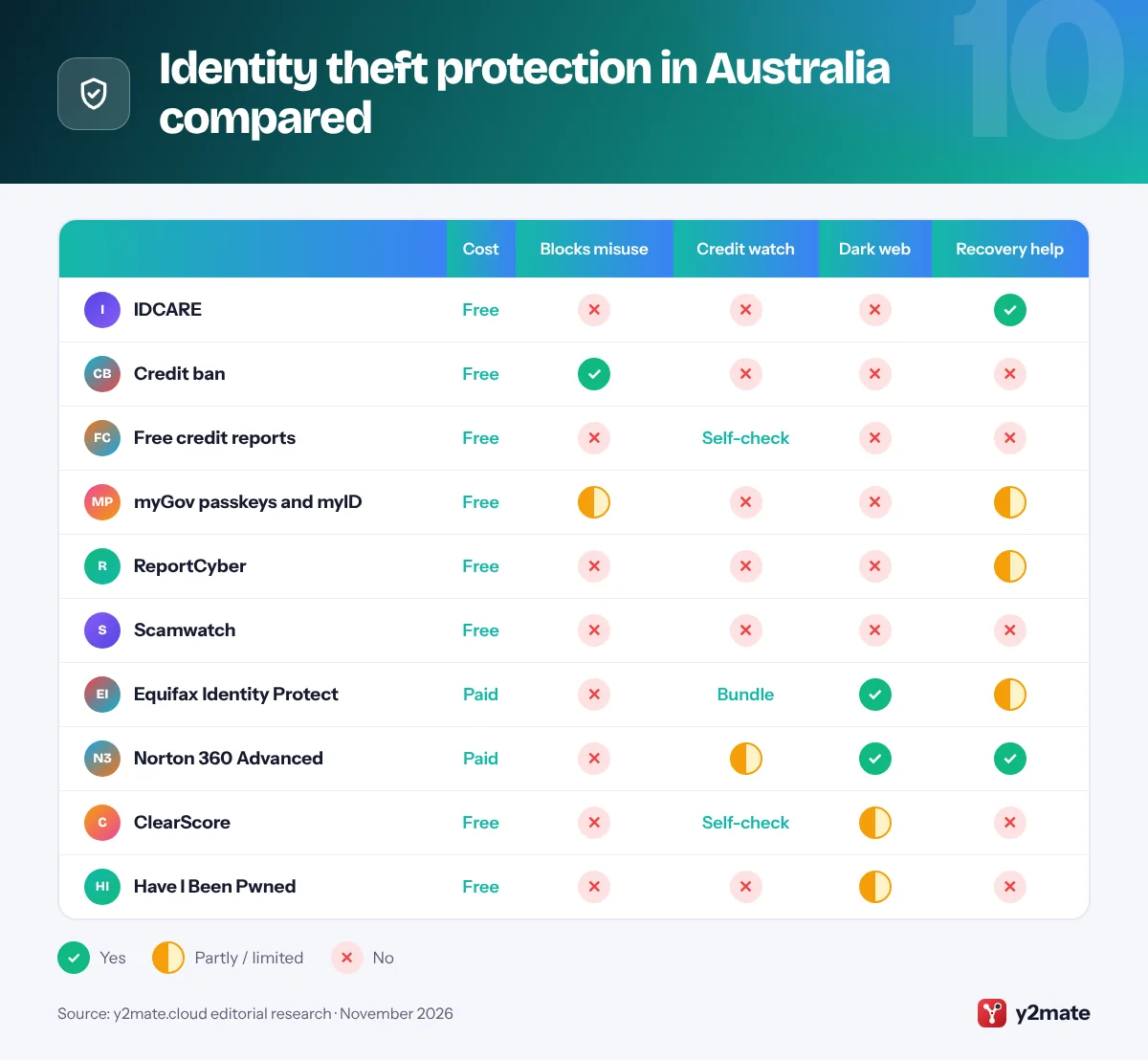
Identity theft protection in Australia compared
How to choose identity theft protection in Australia
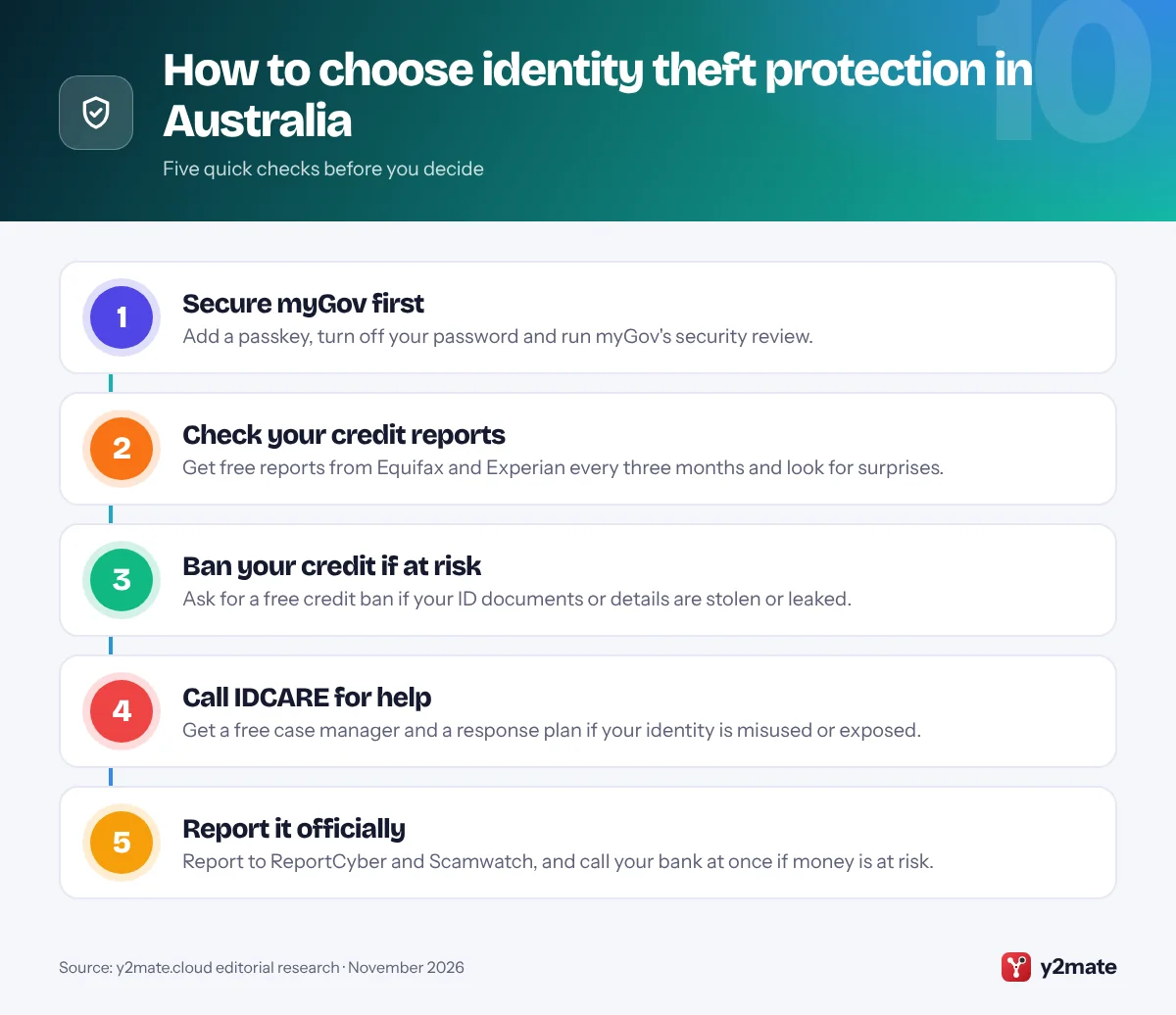
Start with the free services, because they cover most of what paid plans sell. Secure myGov with a passkey, check your credit reports every three months, keep IDCARE’s number handy and request a credit ban as soon as you suspect fraud. Then decide whether paid monitoring adds anything you need.
Credit bans explained
- Who can ask: anyone who believes on reasonable grounds that they are, or are likely to be, a victim of fraud.
- How long: twenty-one days at first, with extensions available and no limit on how many.
- Cost: free, and you can ask one bureau to pass the request on.
- Effect: lenders generally cannot see your report, so new credit stalls until the ban ends.
Data breaches and your rights
Under the Notifiable Data Breaches scheme in the Privacy Act, organisations covered by the Act must notify you and the OAIC when a breach is likely to cause serious harm. Notices should tell you what to do, which often includes asking for a credit ban. Many small businesses are exempt from the Privacy Act, so some breaches may never be reported to you.
What paid services can and cannot do
Paid plans watch more data and add restoration specialists and insurance, which can save time after a theft. None can stop every kind of identity theft or remove data from the dark web, so check exactly what is covered before you pay.
Frequently asked questions
What is the best identity theft protection in Australia?
The best identity theft protection in Australia is free: IDCARE's case managers for support, a credit ban if you suspect fraud, free credit reports every three months and a passkey on your myGov account. For paid monitoring with restoration help, Norton 360 Advanced is the most complete option, while Equifax Identity Protect suits people who want bureau-backed dark web monitoring.
How do I put a ban on my credit file in Australia?
Contact a credit reporting body such as Equifax or Experian and ask for a ban, explaining that you believe you are, or are likely to be, a victim of fraud. The ban is free and lasts twenty-one days at first, and you can extend it. You can ask one bureau to pass the request on, but the OAIC suggests contacting each bureau.
Is IDCARE really free?
Yes. IDCARE is a not-for-profit charity, and its core support service is free for individuals in Australia and New Zealand. Its case managers help people affected by identity theft, data breaches, scams and cyber security problems build a response plan. Call its national helpline on 1800 595 160 or start online, and contact your bank first if money is at risk.
What should I do after a data breach in Australia?
Read the breach notice to see what was exposed, then change any affected passwords and turn on multi-factor authentication or passkeys. If ID documents such as your licence or passport were exposed, follow the issuing agency's replacement advice and consider a credit ban. Check your credit reports, watch for scams that mention the breach and call IDCARE for free help.
Do I need to pay for identity theft protection in Australia?
Most people do not. The strongest protections, including credit bans, free credit reports, IDCARE support, myGov passkeys and official reporting through ReportCyber, cost nothing. Paid services such as Norton 360 Advanced and Equifax Identity Protect add ongoing dark web monitoring, restoration specialists or insurance, which can save time, but none can prevent every kind of identity theft.
Final verdict
The best identity theft protection in Australia is largely free: IDCARE for expert support, a credit ban when you suspect fraud, free credit reports every three months, passkeys and myID on myGov, and official reporting through ReportCyber and Scamwatch. ClearScore and Have I Been Pwned add free breach alerts.
If you want ongoing monitoring and someone to help with recovery, Norton 360 Advanced and Equifax Identity Protect are the main paid options. Neither can stop all identity theft, so unique passwords, passkeys and caution with unexpected messages remain your best everyday defence.
Sources and further reading
- ASD: recover from identity theft: The Australian Signals Directorate explains how to secure your finances, accounts and credit after identity theft and where to report it.
- OAIC: Notifiable Data Breaches scheme: The OAIC explains when organisations must notify you and the regulator about a data breach likely to cause serious harm.
- Services Australia: scams and identity theft: Services Australia explains how its Scams and Identity Theft Helpdesk can help if your myGov account or identity is compromised.
- Moneysmart on identity theft: ASIC's Moneysmart lists the warning signs of identity theft and what to do if your details are stolen.
- Attorney-General's Department: recovering your identity: The Attorney-General's Department explains identity recovery support, including the Commonwealth Victims' Certificate.

Leave a Reply