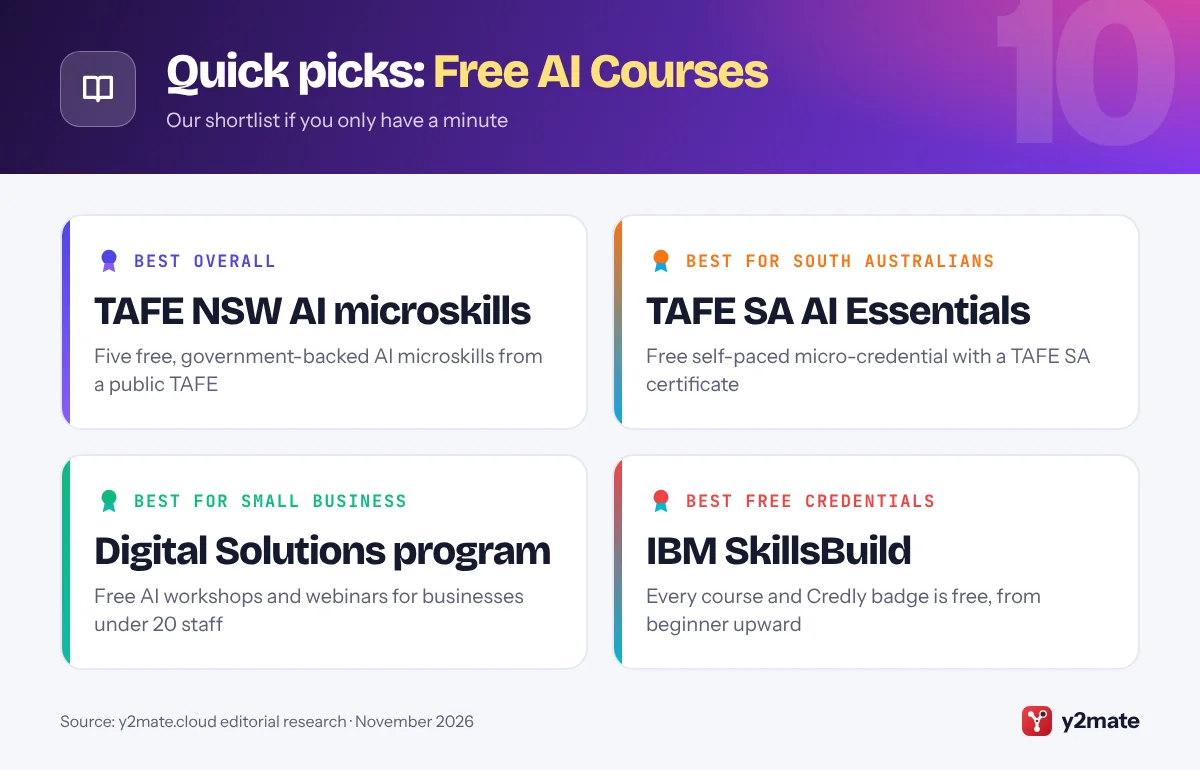
- TAFE NSW's Institute of Applied Technology Digital offers free online AI microskills, backed by fully subsidised places from the National AI Centre announced in December 2025.
- TAFE SA's free AI Essentials micro-credential, launched in September 2025, is a self-paced online course for everyday South Australians with a certificate on completion.
- Small businesses with fewer than 20 full-time equivalent employees, and sole traders, can attend free AI workshops and webinars through the government's Digital Solutions program.
- Under the National Microcredentials Framework, a microcredential is a certification of assessed learning that is smaller than an AQF award qualification.
- Most free AI courses give a certificate of completion rather than nationally recognised units, so check the course details if formal recognition matters to you.
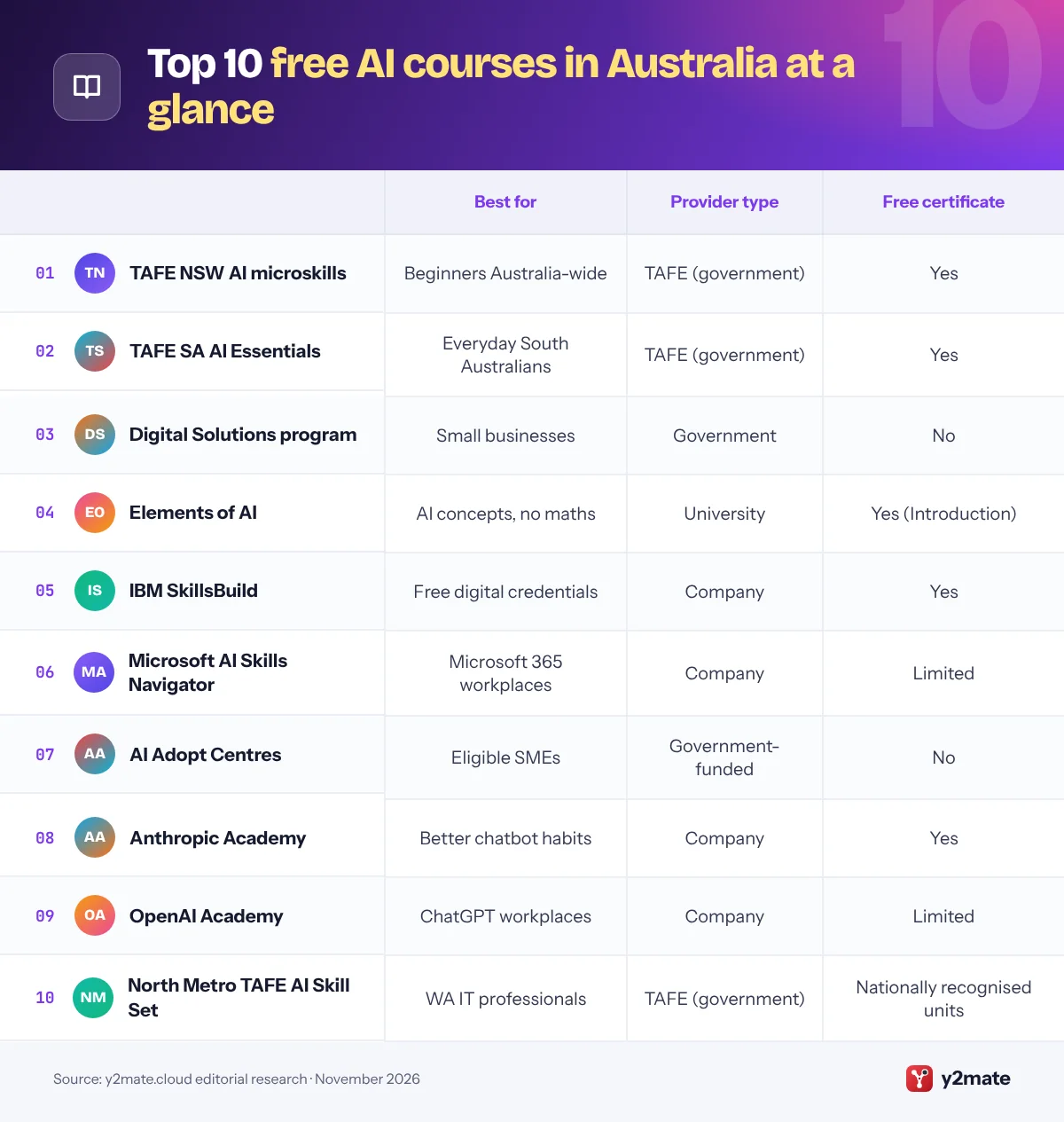
The best free AI courses in Australia in 2026 are TAFE NSW’s AI microskills, offered free with National AI Centre support, for practical beginner training, TAFE SA’s AI Essentials micro-credential for everyday learners, and the government’s Digital Solutions program for small businesses. Elements of AI, IBM SkillsBuild, Microsoft’s AI Skills Navigator, the AI Adopt Centres, Anthropic Academy, OpenAI Academy and North Metropolitan TAFE’s AI Skill Set complete the list.
A few terms first. Generative AI is AI that creates new text, images, audio or code from your instructions, called prompts; ChatGPT, Gemini, Copilot and Claude are examples. A microcredential, often written micro-credential, is a short course that certifies one specific skill. Under the National Microcredentials Framework it must include assessment and is smaller than a full qualification under the Australian Qualifications Framework (AQF), the national system that sets qualification levels from certificates to doctorates. A microskill is TAFE NSW’s name for its shortest online courses.
Free does not always mean free in every way, so for each pick we explain what is free, who is eligible and how much time it asks of you.
How we ranked this list
We ranked courses only on publicly documented criteria: who each course is for, its level, its format, whether a certificate is free, and the type of provider, whether government, TAFE, university, company or non-profit. Every pick is open to people in Australia, or to residents of a particular state where we say so, and has a free route described on the provider’s own pages in November 2026.
We did not take or score the courses ourselves, and we leave out prices, course lengths, ratings and learner numbers. Free places and eligibility rules change often, so confirm the terms on the course page before you enrol.
The Top 10 Free AI Courses
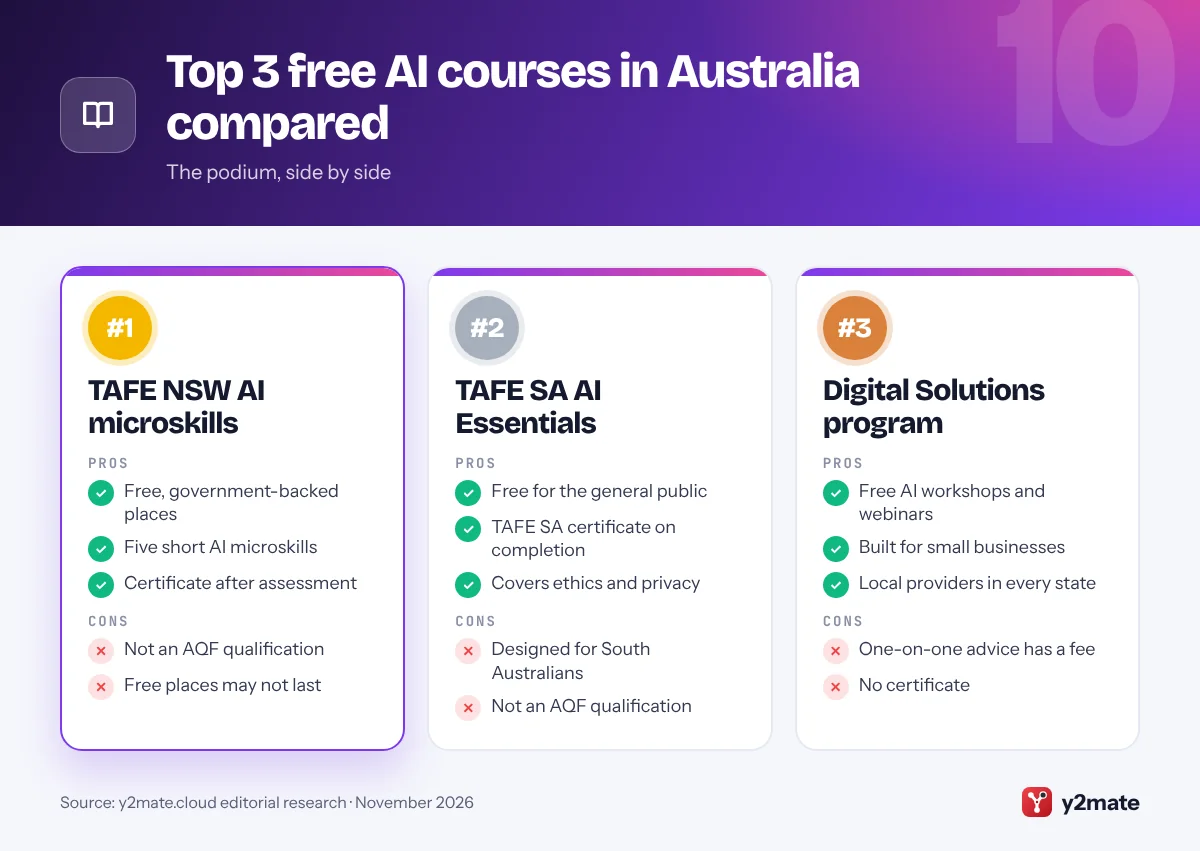
1. TAFE NSW AI microskills
Best for: a free, government-backed start in AI
TAFE NSW’s AI microskills are short, self-paced online courses from its Institute of Applied Technology Digital, a TAFE Centre of Excellence that works with Microsoft, Macquarie University and the University of Technology Sydney. In December 2025 the federal government, through the National AI Centre, announced fully subsidised places for an online AI microskill based on its Guidance for AI Adoption, and the TAFE NSW course store lists its AI microskills as free.
There are five: Getting Started with AI, a quick, non-technical start on prompting and using AI responsibly; Introduction to Artificial Intelligence, covering machine learning, computer vision, natural language processing and AI’s risks and benefits; Generative AI and its Business Applications; Responsible Artificial Intelligence, covering principles and governance; and Introduction to Agentic AI. The introductory courses need no programming, and each gives you several months of access from enrolment.
You enrol individually through the store, and TAFE NSW issues a certificate once you complete the course assessment and any other required activities. These are short courses, not full AQF qualifications. For most Australians starting out, this set is the best free place to begin.
Official site: TAFE NSW AI microskills
- Free, government-backed places
- Five short AI microskills
- Certificate after assessment
- Not an AQF qualification
- Free places may not last
2. TAFE SA AI Essentials
Best for: everyday South Australians new to AI
AI Essentials: Getting Started with Artificial Intelligence is a free micro-credential from TAFE SA, South Australia’s largest vocational education and training provider. It launched in September 2025 to give everyday South Australians, whether workers, parents, business owners or retirees, a foundation in AI, and it needs no technical knowledge.
The course is online and self-paced. It explains what AI is, how it is used in everyday life and at work, and the ethical and privacy questions it raises, with interactive activities designed to build confidence in using AI tools responsibly. You have a set window of a few months to finish after you register, and TAFE SA issues an Acknowledgement of Training certificate when you complete it successfully. TAFE SA says current visa holders are eligible.
It was designed for a South Australian audience, so people interstate should check eligibility before enrolling. Like the TAFE NSW microskills, it is a short course rather than an AQF qualification, but a certificate from a public TAFE is a credible line on a resume. If you live in South Australia and want a gentle, structured introduction, start here.
Official site: TAFE SA AI Essentials
- Free for the general public
- TAFE SA certificate on completion
- Covers ethics and privacy
- Designed for South Australians
- Not an AQF qualification
3. Digital Solutions program
Best for: small businesses and sole traders
Digital Solutions is the Australian Government’s digital advice program for small businesses, part of the Australian Small Business Advisory Services and delivered by local providers across metropolitan and regional Australia. It is open to small businesses with fewer than 20 full-time equivalent employees and to sole traders.
Workshops, webinars and self-directed tutorials cost nothing, and AI and emerging technologies is one of its core topics, alongside digital marketing, business software and cybersecurity. The National AI Centre also points small businesses to free AI learning modules developed through the program, such as Automating Repetitive Tasks in Your Business, plus modules on prompting, writing in your brand voice with ChatGPT and AI email marketing. Round 3 of the program opened in mid-2026.
One-on-one advice from a qualified business adviser is also available, but it carries a small fee. There is no certificate, because the focus is practical change in your business rather than credentials. If you run a cafe, trade business or online shop and want help applying AI to your own operations, this is the most relevant free government option.
Official site: Digital Solutions program
- Free AI workshops and webinars
- Built for small businesses
- Local providers in every state
- One-on-one advice has a fee
- No certificate
4. Elements of AI
Best for: understanding how AI works without maths
Elements of AI is a series of free online courses created by the University of Helsinki and the learning company MinnaLearn, open to Australians and learners worldwide. Its Introduction to AI course explains what AI is, what it can and cannot do, and how it affects our lives, with no complicated maths or programming required.
It complements the TAFE microskills well. Where those focus on using AI at work, Elements of AI explains the ideas underneath: how machine learning differs from traditional programming, why AI predictions involve uncertainty and how neural networks work at a basic level. That helps when you need to judge a vendor’s AI claims.
The Introduction to AI certificate is free once you complete enough of the exercises, including peer reviews of other learners’ answers. A follow-on course, Building AI, covers the algorithms behind AI and suits people with some Python; it is free to study, but its certificate may cost extra. The certificate is not an AQF qualification, but it comes from a respected European university and is vendor-neutral.
Official site: Elements of AI
- University-backed and neutral
- No maths or coding needed
- Free certificate for Intro course
- Mostly reading, little tool use
- Building AI certificate extra
5. IBM SkillsBuild
Best for: free digital badges to add to a resume
IBM SkillsBuild is IBM’s free online learning platform, open to adult learners in Australia, and everything on it is free, including the digital credentials. You create a free account and learn at your own pace, in English or several other languages, with optional free live learning events.
Two foundation courses suit AI beginners. AI Literacy is a jargon-free introduction to how AI systems learn and how people and AI work together, with practice guiding an AI assistant through a business problem. Getting Started with Generative AI covers how machines create text and images, the ethics of generative AI and an introduction to large language models. Both award a digital credential through Credly that you can share on LinkedIn or attach to job applications. Craft Precise Prompts for AI Models is an intermediate next step.
The catalogue has several similarly named AI badges, so check you have enrolled in the one you want. Some lessons use IBM’s own tools, such as its Granite models, but the skills transfer to any assistant. IBM’s badges are industry credentials rather than nationally recognised training, so treat them as evidence of initiative.
Official site: IBM SkillsBuild
- Courses and credentials all free
- Credly badges for LinkedIn
- Beginner and intermediate paths
- Similar badge names confuse
- Some IBM-specific tools
6. Microsoft AI Skills Navigator
Best for: Microsoft 365 workplaces and not-for-profits
In April 2026 Microsoft announced its largest AI skilling commitment in Australia, running to the end of 2028, and much of the learning is free. AI Skills Navigator suggests learning paths by role, drawing on Microsoft and LinkedIn Learning courses, and Microsoft highlights free courses there. Microsoft Learn, its main training site, has free self-paced modules on generative AI and Microsoft 365 Copilot. Microsoft is also a partner of TAFE NSW’s Institute of Applied Technology Digital, which runs the free AI microskills above.
Two free programs launched in Australia at the same time. Microsoft Elevate for Changemakers gives not-for-profit and social impact leaders free AI readiness credentials and practical training for responsible AI adoption. Microsoft Elevate for Educators gives teachers and school leaders free access to the AI Literacy for Educators credential, plus professional learning communities and classroom resources.
Microsoft’s Applied Skills credentials are earned through a lab-based assessment, while full Microsoft Certification exams cost extra, so check the terms before you book. The content centres on Microsoft products, so it suits workplaces that run on Microsoft 365.
Official site: Microsoft AI Skills Navigator
- Free NFP and teacher programs
- Role-based learning paths
- Strong for Copilot users
- Certification exams cost extra
- Focused on Microsoft products
7. AI Adopt Centres
Best for: eligible SMEs that want hands-on AI support
The AI Adopt Centres are federally funded centres, part of the National AI Centre’s work, that give eligible small and medium enterprises free specialist help to adopt AI responsibly. Support is for SMEs in National Reconstruction Fund priority sectors that trade interstate or internationally, such as manufacturing, agriculture, medical science and renewables.
Services include training courses, one-on-one consultations, AI adoption roadmaps, technology demonstrations and AI safety guidance. SMEC AI helps businesses in medical science, agriculture, enabling technologies and renewables through consultations, short courses and an online self-service platform. The ARM Hub AI Adopt Centre focuses on manufacturing and robotics. The Safe AI Adoption Model offers a free online hub of AI safety tools, and the Australian Regional AI Network runs free in-person education sessions across regional Australia, focusing on forestry, agriculture, fisheries and renewable technology.
This is the most hands-on free option for eligible firms, but it is not open to everyone. Retailers, hospitality venues and other businesses outside the priority sectors will usually be better served by Digital Solutions. Some services, such as ARM Hub’s AI-as-a-service model, cost extra, and there is no formal certificate.
Official site: AI Adopt Centres
- Free specialist AI support
- Training plus AI roadmaps
- Regional sessions available
- Priority sectors only
- Some services cost extra
8. Anthropic Academy
Best for: using AI chatbots carefully and well
Anthropic Academy is the free learning site from Anthropic, the company behind the Claude assistant. Its main course for non-technical learners, AI Fluency: Framework & Foundations, was created with Professor Joseph Feller of University College Cork and Professor Rick Dakan of Ringling College, and teaches practical skills for working with AI effectively, efficiently, ethically and safely.
The course is built around four skills: deciding what to hand over to AI, describing tasks clearly, judging the results critically and taking responsibility for how you use them. It includes a plain explanation of what generative AI is and where its limits lie, and the lessons apply equally to ChatGPT, Gemini or Copilot.
Registration is free with an email address, and you do not need a paid Claude plan. After the course, you can take a final assessment and receive a certificate of completion. Other Academy courses go deeper into building with Claude and suit developers. For office workers who already use a chatbot but want safer, better habits, it is an excellent short course.
Official site: Anthropic Academy
- Free certificate after assessment
- Skills apply to any chatbot
- Co-designed with academics
- Conceptual, light on tool demos
- Advanced courses suit developers
9. OpenAI Academy
Best for: workplaces that already use ChatGPT
OpenAI Academy is OpenAI’s free learning hub, with self-paced courses, livestreams and in-person events. Courses are grouped by audience: applying AI at work for knowledge workers, building with AI for developers, leading AI adoption for managers, and teaching and learning with AI for schools and universities.
Its events calendar is global. Online sessions such as ChatGPT 101 for Government Professionals and ChatGPT for Parents are open to Australians, and in-person events have included Melbourne. Many livestreams are scheduled for European or North American audiences, though, so check the time in AEST or AEDT and look for recordings among the on-demand events.
OpenAI’s help centre says eligible courses issue a certificate of completion, but this is not the same as a formal OpenAI certification, which is a separate program. You sign in to save progress, and the content naturally centres on ChatGPT and OpenAI’s tools. If your workplace already uses ChatGPT, this is the quickest way to learn its newer features from the source.
Official site: OpenAI Academy
- Free self-paced courses
- Courses by role and audience
- Some completion certificates
- Focused on ChatGPT
- Many sessions in overseas hours
10. North Metro TAFE AI Skill Set
Best for: experienced IT workers in Western Australia
North Metropolitan TAFE’s Artificial Intelligence Skill Set is the only pick here built from nationally recognised units of competency, and it is fee free for eligible residents of Western Australia. It is aimed at people who want to apply AI in their current workplace, with units such as Identify opportunities to apply artificial intelligence, machine learning and deep learning.
This is not a beginner course. Entry requires a Diploma of Information Technology (Advanced Programming) or equivalent, and classes run on campus in Perth with one weekly session across a semester, plus significant study outside class. Intakes are listed for Semester 2, 2026 and Semester 1, 2027, and some classes have filled up.
Because it uses units from the national training package, it gives you formal, nationally recognised evidence of your skills, unlike the certificates of completion elsewhere on this list. Fee-free status depends on WA residency and the state’s eligibility rules, and tuition and resource fees apply if you do not qualify. For IT professionals in Perth who want a credential employers can verify, it is the strongest free choice.
Official site: North Metro TAFE AI Skill Set
- Nationally recognised units
- Fee free for eligible WA residents
- Applied, workplace focus
- Needs an advanced IT diploma
- On campus in Perth only
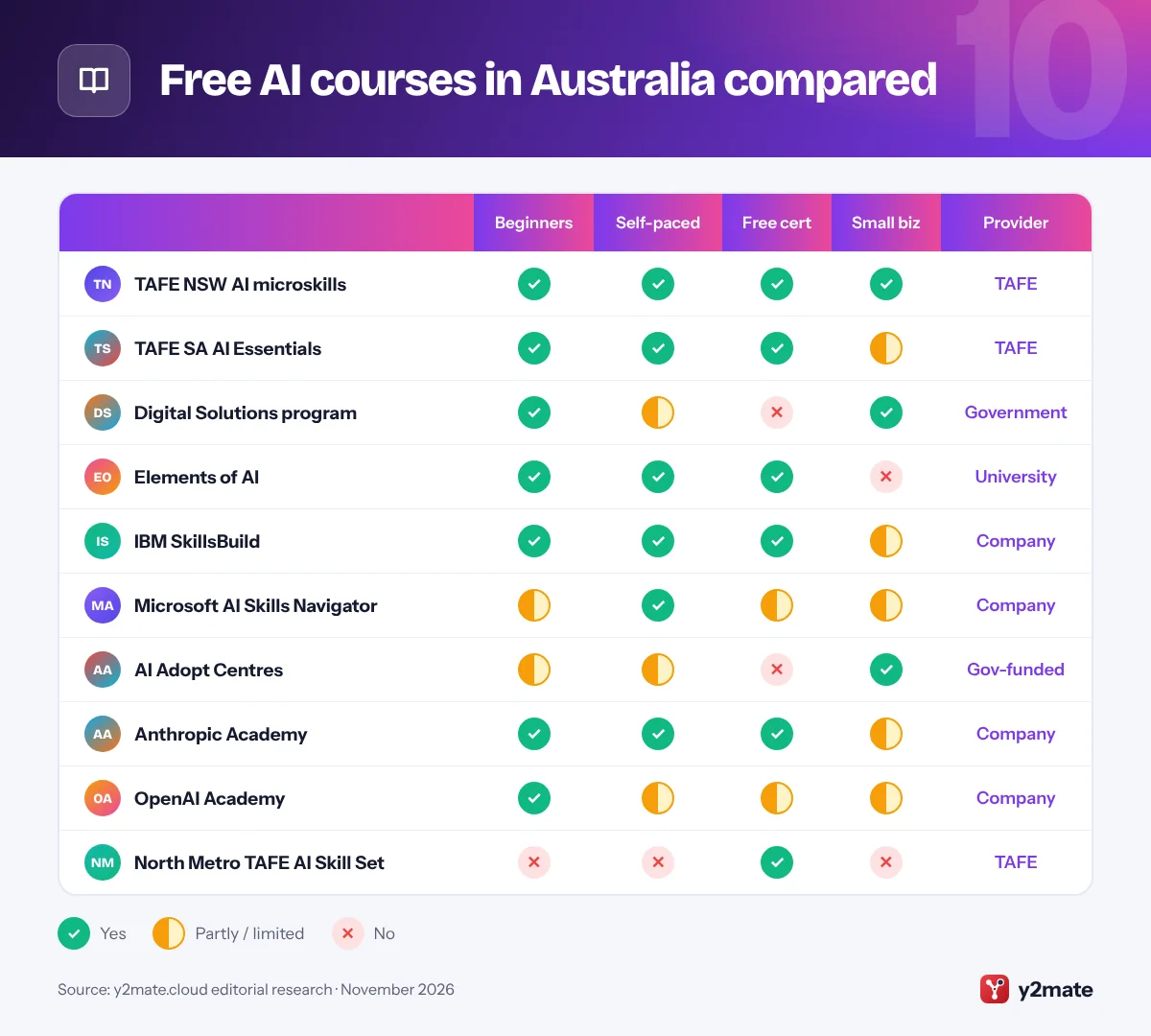
Free AI courses in Australia compared
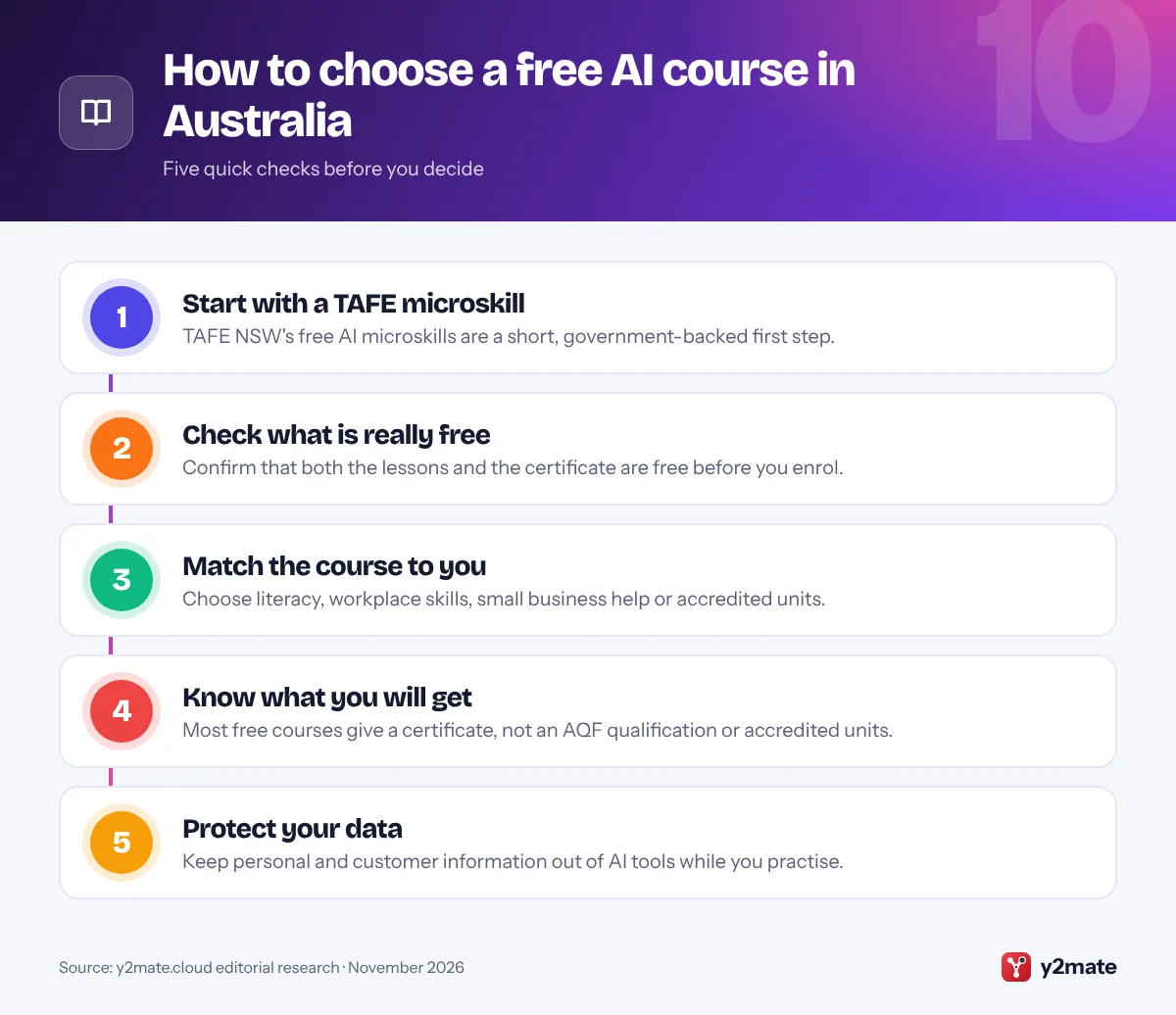
How to choose free AI courses in Australia
Start with the TAFE NSW AI microskills, which are free, short and built on the government’s Guidance for AI Adoption. If you live in South Australia, TAFE SA’s AI Essentials is an equally gentle start. Then add depth with Elements of AI for understanding, or IBM, Microsoft, Anthropic or OpenAI for tool skills and free credentials.
Certificates, microcredentials and the AQF
- Certificates of completion: most free AI courses, including the TAFE microskills, give a certificate that shows you finished the course, not an AQF qualification.
- Microcredentials: the National Microcredentials Framework describes them as assessed learning smaller than an AQF award qualification, so check whether a course includes assessment.
- Nationally recognised units: accredited skill sets, such as North Metropolitan TAFE’s, use units from national training packages and are the most formal option, but usually need prior study.
Help for small businesses
Sole traders and businesses with fewer than 20 full-time equivalent employees can use Digital Solutions for free AI workshops and webinars. Eligible SMEs in National Reconstruction Fund priority sectors can also approach an AI Adopt Centre for free training and an AI adoption roadmap.
Spot the catch
Free places can end when funding runs out, one-on-one Digital Solutions advice has a fee, and some certificates cost extra. Read the terms before you sign up, and never paste personal, customer or confidential work data into a free AI tool while you practise.
Frequently asked questions
What is the best free AI course in Australia?
For most beginners, the best free AI course in Australia is one of TAFE NSW's AI microskills, such as Getting Started with AI or Introduction to Artificial Intelligence. They are short, self-paced, built with National AI Centre support and listed as free on the TAFE NSW course store. South Australians can also take TAFE SA's free AI Essentials micro-credential, which ends with a certificate.
Does the Australian Government offer free AI training?
Yes. In December 2025 the government announced fully subsidised places for an online AI microskill through the National AI Centre and TAFE NSW's Institute of Applied Technology Digital. Its Digital Solutions program also offers free AI workshops and webinars for small businesses, and the AI Adopt Centres give eligible SMEs in priority sectors free training and advice.
Are free AI courses in Australia nationally recognised?
Mostly not. Free AI courses such as the TAFE NSW microskills, TAFE SA's AI Essentials, IBM SkillsBuild and Elements of AI give certificates or badges rather than AQF qualifications. Nationally recognised units are available in accredited skill sets, such as North Metropolitan TAFE's Artificial Intelligence Skill Set, which is fee free for eligible WA residents but requires an advanced IT diploma or equivalent.
Which free AI course is best for Australian small businesses?
The government's Digital Solutions program is the best starting point for sole traders and businesses with fewer than 20 full-time equivalent employees, with free AI workshops, webinars and self-paced modules such as Automating Repetitive Tasks in Your Business. Eligible SMEs in priority sectors can get deeper, free help from an AI Adopt Centre, and TAFE NSW's Generative AI and its Business Applications microskill is free too.
What is the difference between a microskill and a micro-credential?
Microskill is TAFE NSW's name for its shortest online courses, which give a certificate once you complete the assessment. Micro-credential is a broader term: under the National Microcredentials Framework, a microcredential is a certification of assessed learning that is smaller than an AQF award qualification. Neither is a full qualification, but both can show employers you have built specific AI skills.
Final verdict
The best free AI courses in Australia in 2026 start with TAFE NSW’s government-backed AI microskills, which give beginners a short, free and credible introduction. South Australians should add TAFE SA’s AI Essentials, small businesses should use Digital Solutions or an AI Adopt Centre, and Elements of AI, IBM SkillsBuild and Anthropic Academy offer free certificates for deeper learning.
Before you enrol, check exactly what is free, whether you meet any state or sector eligibility rules, and whether you need a certificate of completion or nationally recognised units.
Sources and further reading
- National AI Centre training: The National AI Centre lists free AI microskills and Digital Solutions learning modules for Australian workers and small businesses.
- Essential AI practices: The government's Guidance for AI Adoption sets out essential practices for using AI safely and responsibly in Australian organisations.
- National Microcredentials Framework: The Department of Education's framework defines microcredentials and explains how they relate to AQF qualifications.
- Digital Solutions Round 3: The Small Business Minister's August 2026 update on Round 3 of the Digital Solutions program, which covers AI among other digital skills.
- Digital TAFE Centre of Excellence: The Department of Employment and Workplace Relations explains the Digital TAFE Centre of Excellence led by TAFE NSW.

Leave a Reply