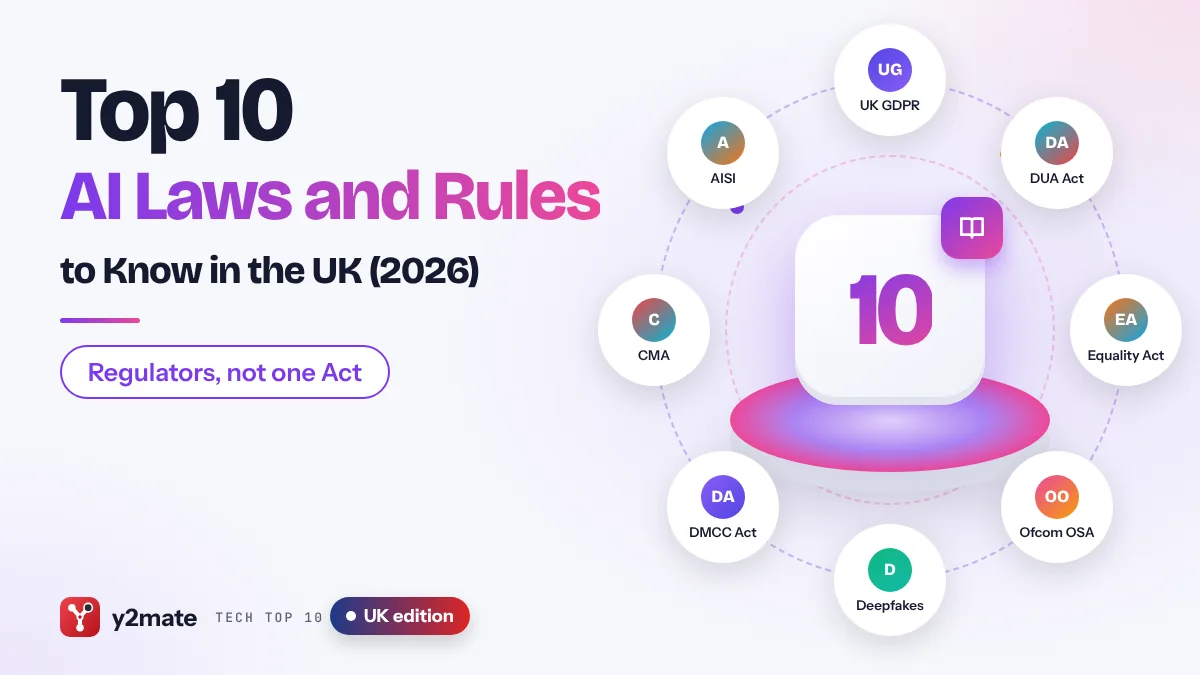
- The UK has no single AI Act; AI is regulated through existing laws such as UK GDPR, the Equality Act 2010 and the Online Safety Act 2023, applied by regulators including the ICO, Ofcom and the CMA.
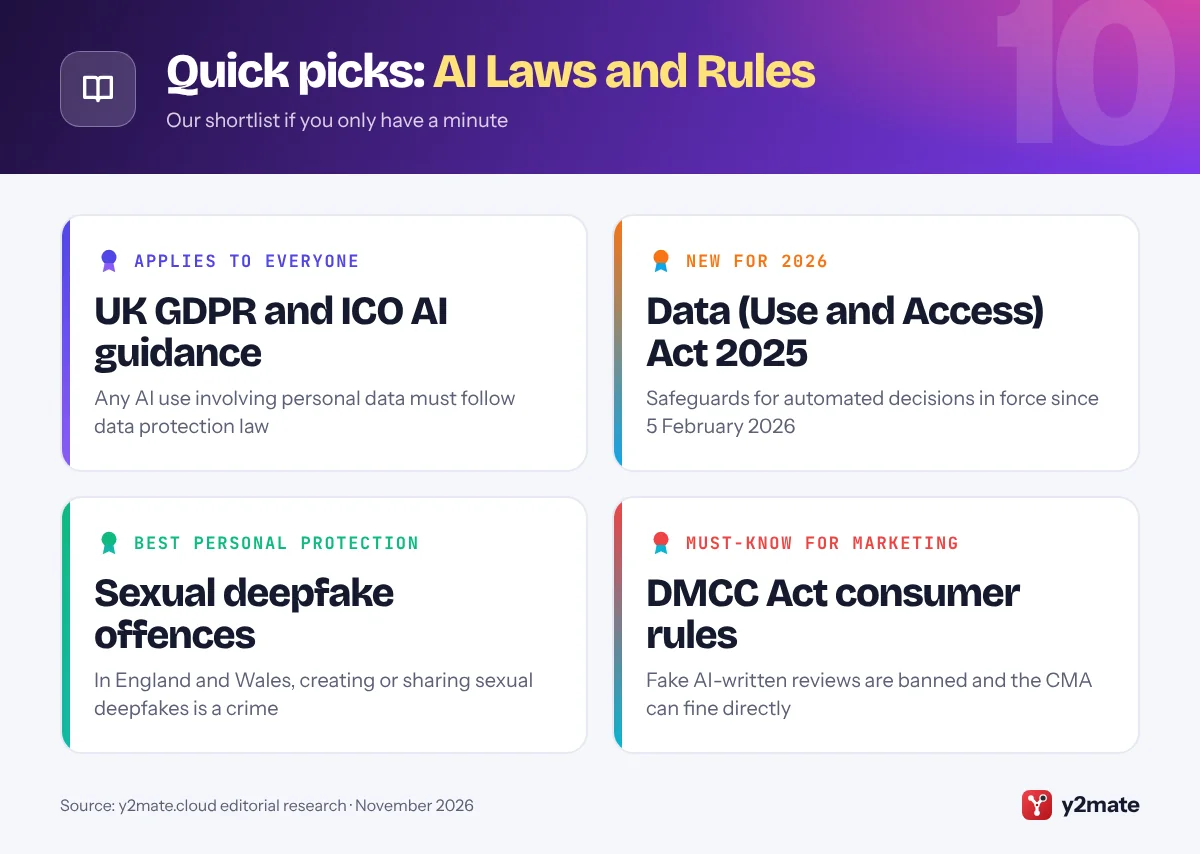
- New UK GDPR rules on automated decision-making from the Data (Use and Access) Act 2025 took effect on 5 February 2026, giving people the right to human intervention and to contest significant automated decisions.
- In England and Wales, creating or requesting a sexually explicit deepfake of an adult without consent has been a criminal offence since 6 February 2026.
- Fake reviews, including AI-written ones, have been banned since 6 April 2025, when the CMA also gained powers to fine businesses directly for breaking consumer law.
- In March 2026 the government dropped its preferred copyright exception for AI training and proposed removing special protection for computer-generated works.
The UK has no single AI law. Instead, AI laws in the UK are a mix of existing legislation, such as UK GDPR, the Equality Act 2010 and the Online Safety Act 2023, newer rules added in 2025 and 2026, and guidance from regulators including the Information Commissioner’s Office (ICO), Ofcom and the Competition and Markets Authority (CMA). The government’s approach is for each regulator to apply shared AI principles in its own area rather than to create one AI regulator.
Some plain definitions. Automated decision-making means a decision about a person made by software, including AI, with no meaningful human involvement, such as an instant credit refusal or an automatic CV rejection. A deepfake is an image, video or audio clip created or altered with AI so that it appears to show a real person doing or saying something they did not. A frontier model is one of the most capable general-purpose AI models, such as those behind the leading chatbots.
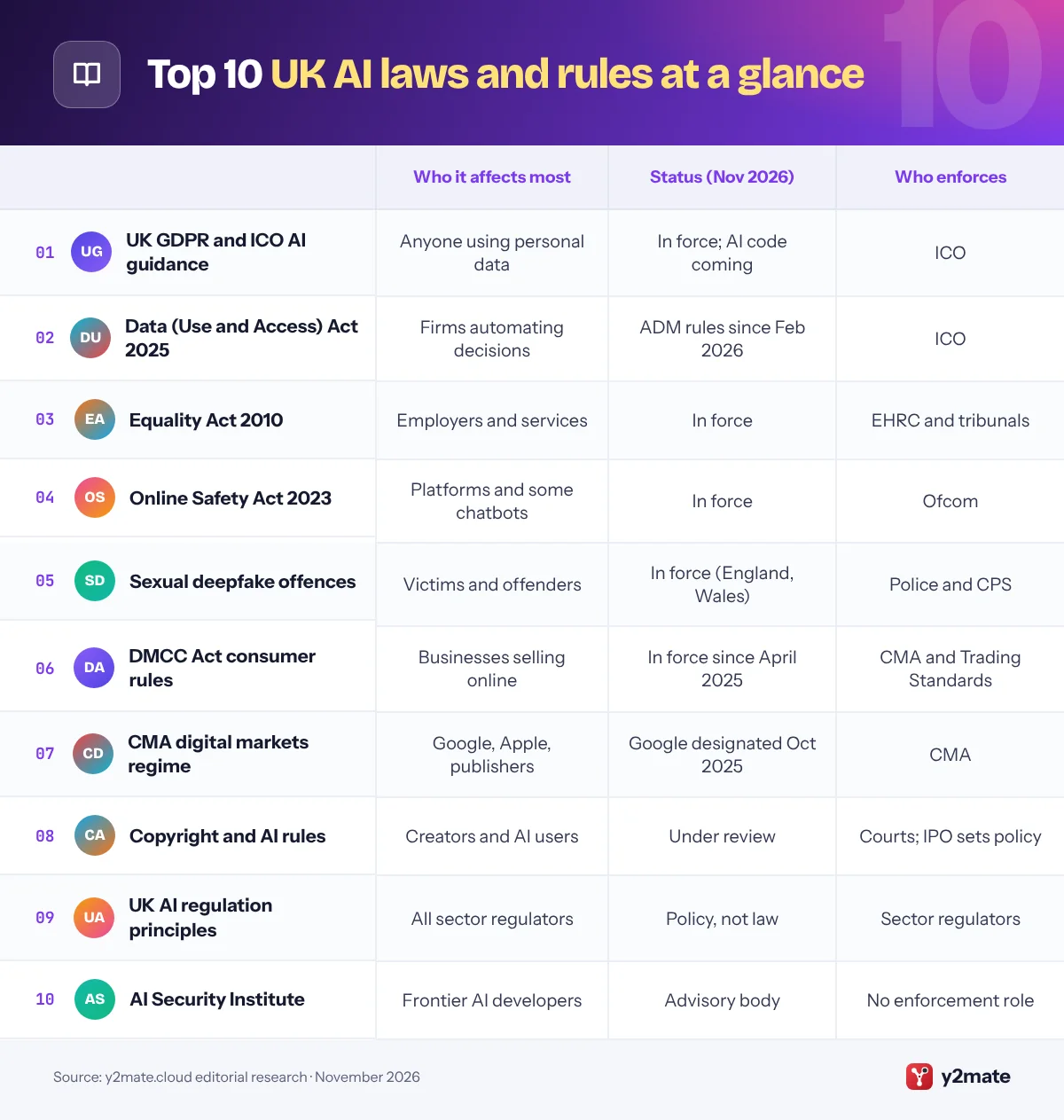
Below are the ten UK laws, rules and official bodies that matter most for everyday users and small businesses in November 2026, with their status. This is general information, not legal advice; for your own situation, speak to a solicitor or the relevant regulator.
How we ranked this list
We ranked each item by how directly it affects ordinary people and small businesses that use AI tools, putting rules already in force ahead of proposals, voluntary guidance and advisory bodies. We checked each status against official sources, including legislation.gov.uk, GOV.UK and regulators’ own publications, as of November 2026.
We did not test any AI systems and do not quote fines. Some rules apply only in England and Wales, and we say where that is the case.
The Top 10 AI Laws and Rules
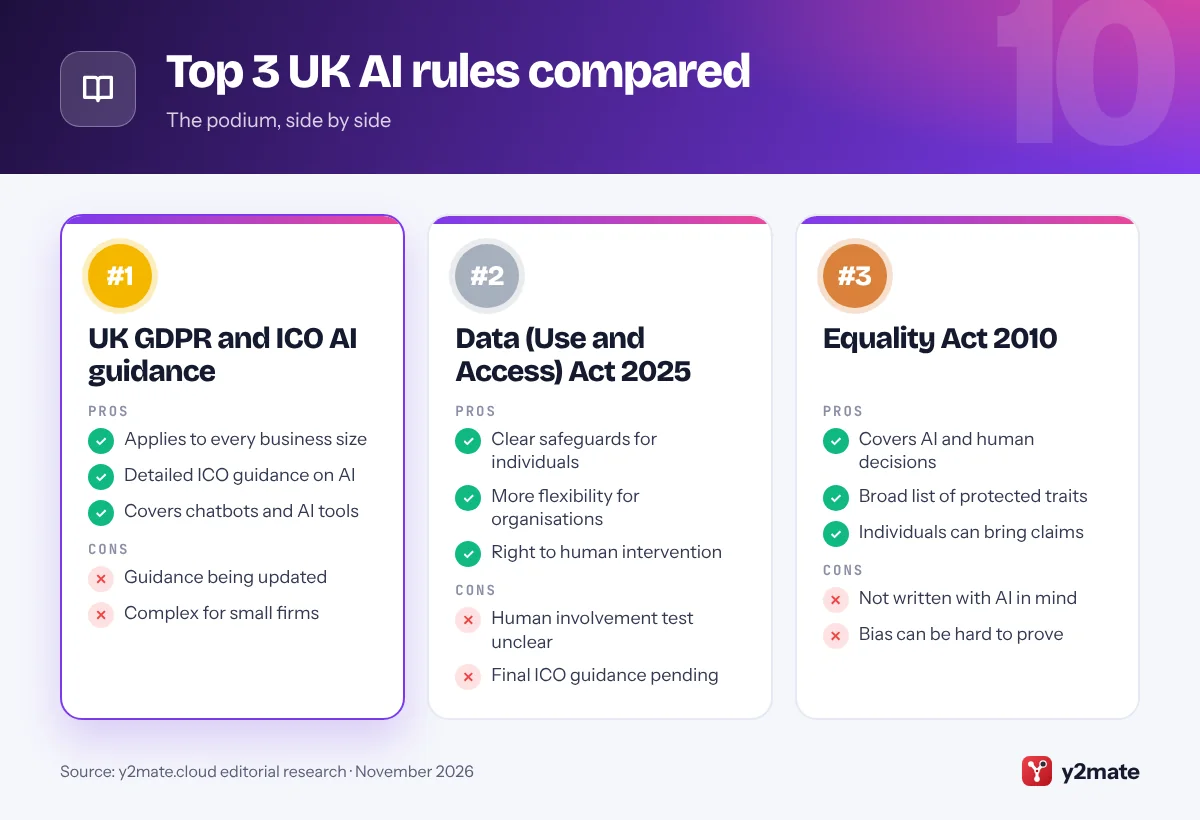
1. UK GDPR and ICO AI guidance
Best for: any business putting personal data into AI
If an AI tool processes personal data, meaning information about an identifiable living person, UK data protection law applies whatever the size of your business. UK GDPR and the Data Protection Act 2018 require a lawful basis for using the data, clear information for the people concerned, accurate and secure data, and no more data than you need. Pasting customer or staff details into a chatbot counts as processing.
The ICO explains how this works in its Guidance on AI and Data Protection and its separate guidance on explaining decisions made with AI. For higher-risk uses, such as profiling customers or screening job applicants, you will usually need a data protection impact assessment before you start.
The rules are being refreshed. Regulations in force since May 2026 require the ICO to produce a statutory code of practice on AI and automated decision-making, including guidance on children’s data, and the ICO has consulted on updated guidance to reflect the Data (Use and Access) Act 2025. Until the code is finished, the existing guidance is the best place to start, and the ICO offers dedicated support for small organisations.
Official site: UK GDPR and ICO AI guidance
- Applies to every business size
- Detailed ICO guidance on AI
- Covers chatbots and AI tools
- Guidance being updated
- Can feel complex for small firms
2. Data (Use and Access) Act 2025
Best for: firms using AI to make decisions about people
The Data (Use and Access) Act 2025 rewrote the UK GDPR rules on automated decision-making, replacing the old Article 22 with new Articles 22A to 22D. The changes came into force on 5 February 2026.
The rules cover significant decisions, meaning those with a legal or similarly significant effect on someone, such as refusing credit or a job, that are made solely by automated means with no meaningful human involvement. Organisations now have more room to make such decisions, but must put safeguards in place: tell people about the decisions, let them make representations, give them a way to obtain human intervention, and let them contest the outcome. Tighter limits remain where a decision relies on special category data, such as health, ethnicity or religion, which generally needs explicit consent or a specific legal basis.
For a small business, the key question is whether a person genuinely reviews AI recommendations before they take effect. A quick rubber stamp is unlikely to count as meaningful human involvement. The ICO has consulted on guidance explaining how to apply the new rules in practice.
Official site: Data (Use and Access) Act 2025
- Clear safeguards for individuals
- More flexibility for organisations
- Right to human intervention
- Meaningful involvement can be unclear
- Final ICO guidance still pending
3. Equality Act 2010
Best for: employers and services using AI to sort people
The Equality Act 2010 makes it unlawful to discriminate because of protected characteristics, including age, disability, race, religion or belief, sex, sexual orientation, gender reassignment, pregnancy and maternity, and marriage and civil partnership. It does not matter whether a manager or software makes the decision. If an AI tool used in hiring, lending, pricing or service delivery puts a protected group at a particular disadvantage, the organisation using it can be liable for indirect discrimination unless it can justify the practice.
That is why bias in AI tools is a legal issue in the UK, not just a reputational one. A recruitment tool trained on past hiring data can repeat old patterns, and an automated system may fail to make reasonable adjustments for disabled people, which is a separate duty under the Act. Buying the tool from a supplier does not shift that responsibility.
The Equality and Human Rights Commission enforces the Act in Great Britain, and individuals can bring claims in employment tribunals or the courts. Northern Ireland has its own equality laws. Test outputs for unfair patterns and keep a human able to override the tool.
Official site: Equality Act 2010
- Covers AI and human decisions alike
- Broad list of protected traits
- Individuals can bring claims
- Not written with AI in mind
- Bias can be hard to prove
4. Online Safety Act 2023
Best for: sites, apps and chatbots with user content
The Online Safety Act 2023 puts duties on user-to-user services, search services and sites that publish pornography, and Ofcom enforces it. Since 2025, services in scope have had to assess and reduce the risk of illegal content and, where children are likely to use them, protect children from harmful material, including through effective age checks for the most harmful content.
Ofcom has said generative AI is covered when it sits inside those services. A chatbot that lets users share AI-generated text, images or video with other users, a tool for building and sharing chatbots, and AI that searches across many websites can all be in scope, and AI material shared on a platform is treated like any other user content. A standalone chatbot that only talks to one user and does not search the web may fall outside the Act.
That gap drew attention in early 2026, when Ofcom opened an investigation into X after its Grok chatbot was used to create sexualised images of real people. The Crime and Policing Act 2026 then gave ministers a power to extend online safety duties to illegal AI-generated content, which could bring more chatbots into scope.
Official site: Online Safety Act 2023
- Covers AI content shared by users
- Strong child-safety duties
- Active Ofcom enforcement
- Some standalone chatbots excluded
- Further AI rules still to come
5. Sexual deepfake offences
Best for: anyone targeted by sexual deepfakes
In England and Wales, the criminal law now covers sexually explicit deepfakes at every stage. Since 31 January 2024, sharing or threatening to share an intimate image of someone without consent has been an offence, including images that only appear to show the person, such as AI fakes. Since 6 February 2026, under changes made by the Data (Use and Access) Act 2025, it has also been an offence to create, or ask someone else to create, a purported intimate image of an adult without their consent.
The Crime and Policing Act 2026 went further. The Crime and Policing Act 2026 also makes it an offence to make, adapt or supply a tool for generating such images, often called a nudification app. Images of children are covered by separate, long-standing offences, which apply to AI-generated material as well.
These offences sit in the Sexual Offences Act 2003 for England and Wales; Scotland and Northern Ireland have their own laws. If you are targeted, report it to the police, keep evidence, and use the Revenge Porn Helpline or the platform’s reporting tools to get images removed.
Official site: Sexual deepfake offences
- Covers creating, sharing and tools
- Includes requests to create fakes
- Clear criminal offences
- England and Wales only
- Removing copies online is still hard
6. DMCC Act consumer rules
Best for: businesses using AI in marketing or sales
The Digital Markets, Competition and Consumers Act 2024 gave the CMA power, from 6 April 2025, to decide for itself that a business has broken consumer law and to impose fines, rather than having to go to court first. A specific ban on fake reviews took effect on the same date.
Both matter for AI. Writing fake customer reviews with a chatbot, commissioning them, or publishing reviews without reasonable steps to stop fake ones is banned, and AI summaries of reviews must not mislead. More broadly, the long-standing ban on misleading actions and omissions applies to claims about what an AI product can do and to what AI chatbots tell customers on your behalf.
In March 2026 the CMA published guidance on complying with consumer law when using AI agents, making clear that existing consumer law applies in full when businesses use AI to deal with customers. If you use a chatbot for sales or support, check that it gives accurate prices and terms, does not pressure people, and hands over to a human when needed.
Official site: DMCC Act consumer rules
- Bans AI-written fake reviews
- CMA can fine without court
- Clear guidance on AI agents
- Not an AI-specific law
- Fines can be large
7. CMA digital markets regime
Best for: businesses that rely on Google Search
The same 2024 Act created a digital markets regime. The CMA can designate a large tech firm as having strategic market status (SMS) in a digital activity and then impose conduct requirements on it. In October 2025 it designated Google in general search and search advertising and confirmed that AI Overviews and AI Mode fall within the designation, while the standalone Gemini assistant does not. Apple and Google were also designated for their mobile platforms that month.
In June 2026 the CMA imposed a conduct requirement giving publishers effective tools to stop their content being used to power AI features in Google Search, such as AI Overviews, and requiring clear links crediting publishers in AI-generated results. For any business with a website, this is the first UK regime that directly shapes how AI search uses and displays your content.
Before this, the CMA had set out principles for AI foundation models, such as access, choice, fair dealing and transparency, which still guide its view of AI competition. It does not regulate everyday AI use by small firms; its role is keeping the biggest platforms in check.
Official site: CMA digital markets regime
- Covers Google's AI search features
- Gives publishers an opt-out
- Targets the biggest platforms
- No direct duties for small firms
- Changes roll out gradually
8. Copyright and AI rules
Best for: creators and firms publishing AI content
UK copyright law, mainly the Copyright, Designs and Patents Act 1988, has not yet been changed for AI. Training AI on copyright works generally needs permission from rights holders, because the UK’s text and data mining exception covers only non-commercial research. Unusually, UK law also protects computer-generated works with no human author, for a shorter period than normal copyright.
Both points are under review. After a 2024 consultation, the government had favoured a broad exception letting AI developers train on content unless rights holders opted out, but most respondents opposed it. In a report published on 18 March 2026, required by the Data (Use and Access) Act 2025, the government said this is no longer its preferred approach, that it will not reform copyright until it is confident changes will work, and that it proposes removing the special protection for computer-generated works.
For now, check your AI provider’s terms on who owns outputs, avoid prompting for close copies of protected material, and add your own creative work if you want clear protection.
Official site: Copyright and AI rules
- Strong protection for creators
- Government taking time to decide
- Unique computer-generated rule
- Rules for AI training unsettled
- Computer-generated rule may go
9. UK AI regulation principles
Best for: understanding the UK’s overall approach
The UK’s overall approach comes from the 2023 AI regulation white paper, which set five cross-sector principles for regulators to apply within their existing powers: safety, security and robustness; appropriate transparency and explainability; fairness; accountability and governance; and contestability and redress. The principles are not law in themselves, but regulators such as the ICO, Ofcom, the CMA and the Financial Conduct Authority use them when deciding how their rules apply to AI.
A single AI Act is not on the way for now. Plans for legislation on the most powerful AI models were mentioned in 2024 but have not been brought forward, and the King’s Speech in May 2026 included no AI bill. Instead it announced a Regulating for Growth Bill, which would give powers for the AI Growth Lab, a sandbox where AI products can be tested under adjusted rules. A private member’s bill in the House of Lords proposing an AI Authority has been introduced but lacks government backing.
In practice, your obligations come from whichever regulator covers your sector.
Official site: UK AI regulation principles
- Flexible, sector-by-sector approach
- Uses regulators' existing powers
- Avoids one-size-fits-all rules
- Not legally binding
- Gaps between regulators
10. AI Security Institute
Best for: following frontier AI safety testing
The AI Security Institute is a government body within the Department for Science, Innovation and Technology. It began in 2023 as the AI Safety Institute and was renamed in February 2025 to reflect a sharper focus on serious security risks, such as AI being misused for cyberattacks or to help develop chemical or biological weapons.
It is not a regulator. It cannot fine companies or block products, and it has no powers over how you or your business use AI. Instead, it tests advanced models, often before release, under voluntary arrangements with AI developers, publishes research and evaluation tools, advises the government, and works with similar institutes in other countries.
For everyday users, the institute matters indirectly. Its findings feed into how the UK understands the risks of the most capable AI systems, and into decisions about whether further rules are needed. If you want to follow UK thinking on frontier AI safety, its published research is the place to look.
Official site: AI Security Institute
- World-leading model testing
- Publishes research openly
- Advises on future rules
- No regulatory powers
- Relies on voluntary access
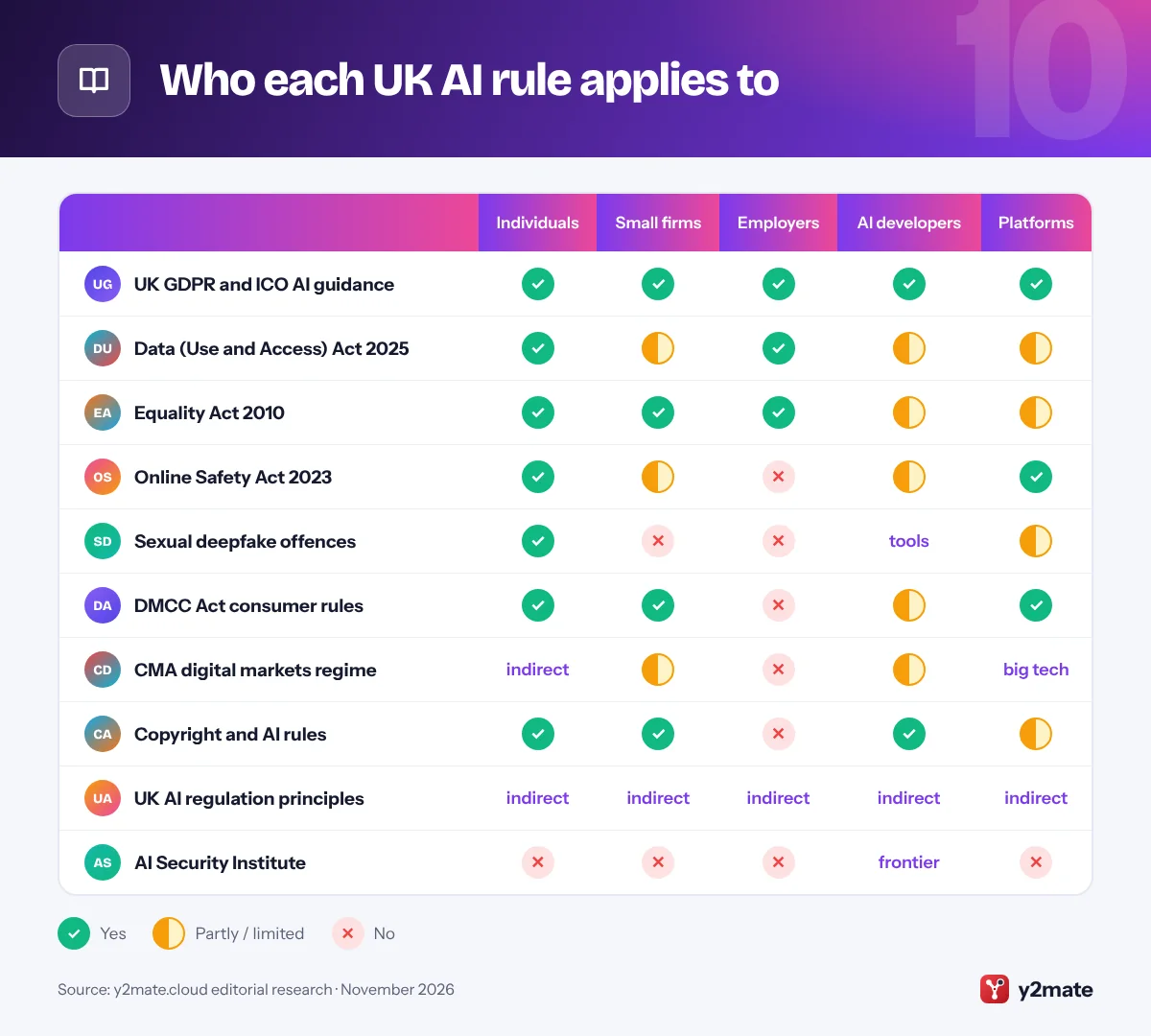
Who each UK AI rule applies to
How to keep track of AI laws in the UK
Because AI laws in the UK are spread across several regulators, the simplest approach is to start from what your AI actually does, then match each use to the rules and regulator that cover it.
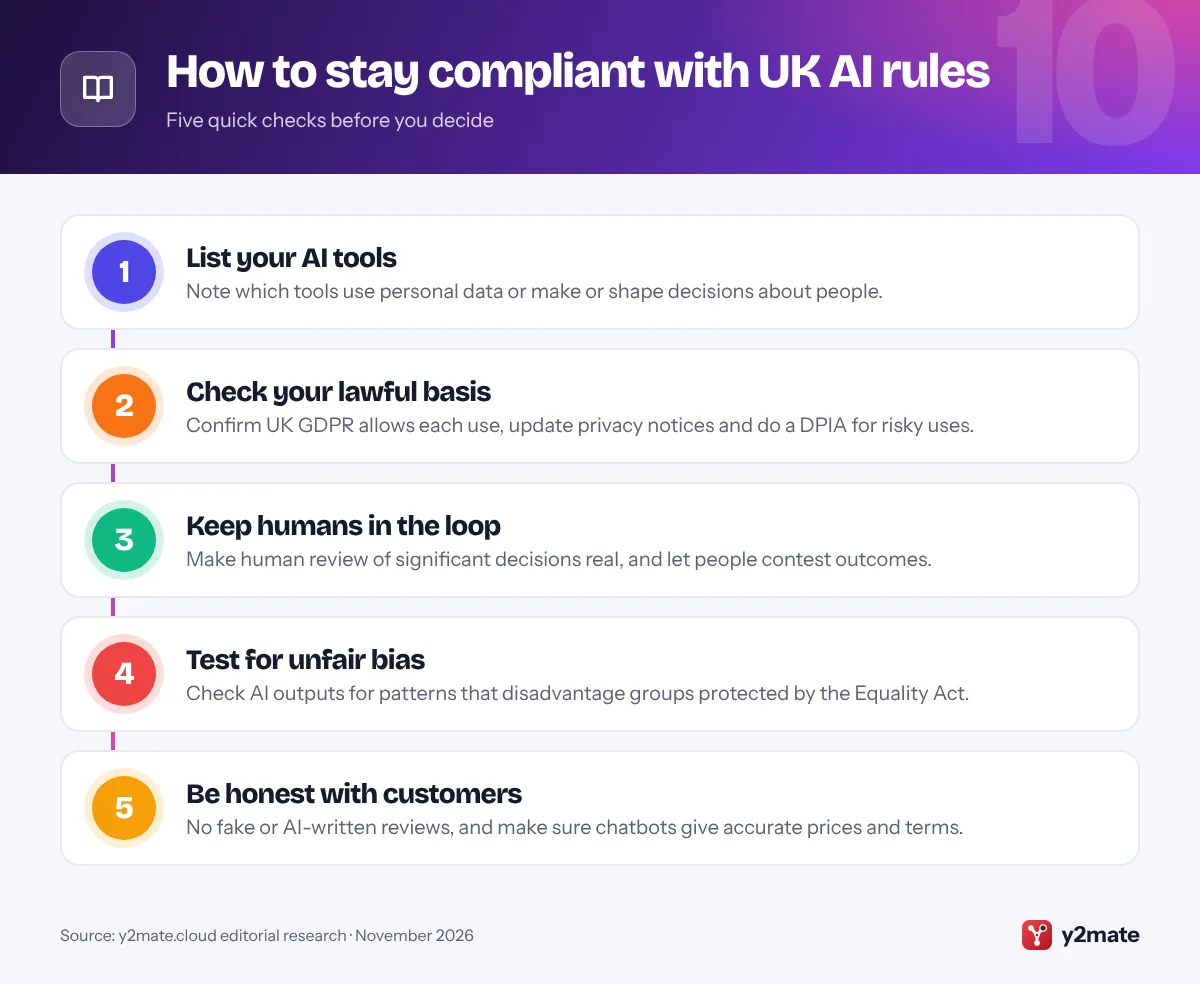
Match your AI use to the right rules
- Personal data: UK GDPR and ICO guidance, plus the automated decision safeguards for significant decisions.
- Hiring and customer decisions: the Equality Act 2010 and, for fully automated decisions, Articles 22A to 22D of UK GDPR.
- User content and chatbots: the Online Safety Act 2023 if users can share content or your tool searches the web.
- Marketing and reviews: consumer law under the DMCC Act 2024 and CMA guidance on AI agents.
- Finance and health: sector regulators such as the Financial Conduct Authority and the Medicines and Healthcare products Regulatory Agency apply their own rules to AI.
What is still changing
Watch for the ICO’s statutory code of practice on AI and automated decision-making, regulations that may bring more AI chatbots under the Online Safety Act, the next steps on copyright and AI, and the Regulating for Growth Bill’s sandbox powers. GOV.UK and each regulator’s website publish updates, and most offer free guidance aimed at small businesses.
Frequently asked questions
Does the UK have an AI Act?
No. As of November 2026 the UK has no single AI Act. AI is regulated through existing laws, such as UK GDPR, the Equality Act 2010, the Online Safety Act 2023 and consumer law, applied by regulators including the ICO, Ofcom and the CMA. The May 2026 King's Speech included no AI bill, although a bill creating AI testing sandboxes was announced.
Is it illegal to make a deepfake of someone in the UK?
It depends on the content and where you are. In England and Wales, creating or requesting a sexually explicit deepfake of an adult without consent has been a crime since 6 February 2026, and sharing one has been a crime since January 2024. Other deepfakes may break laws on harassment, fraud, defamation or data protection, depending on how they are used.
Can I put customer data into an AI chatbot?
You can, but UK GDPR still applies. You need a lawful basis, must explain the use in your privacy notice, should check where the provider stores and uses the data, and should avoid entering more personal information than necessary. For higher-risk uses, the ICO expects a data protection impact assessment before you start.
What are my rights if AI makes a decision about me?
If a significant decision, such as refusing a loan or a job, is made solely by automated means, the organisation must tell you about it and let you make representations, ask for a human to intervene and contest the decision. These safeguards come from UK GDPR as updated by the Data (Use and Access) Act 2025. You can complain to the organisation and then to the ICO.
Who owns content made with AI in the UK?
The law is unsettled. UK copyright protects human-authored work and also gives limited protection to computer-generated works with no human author, but in March 2026 the government proposed removing that protection. Check your AI provider's terms, which often say who owns outputs, and add your own creative input if you want stronger protection.
Final verdict
AI laws in the UK are built from existing rules rather than one AI Act, so the practical test is simple: use personal data lawfully, keep real human oversight of significant decisions, check AI tools for bias, be honest with customers, and never create or share sexual deepfakes. UK GDPR, the Data (Use and Access) Act 2025 and the Equality Act 2010 cover most everyday business uses.
Over the next year, the ICO’s AI code, possible new online safety duties for chatbots and the copyright review are the changes most likely to affect ordinary users and small firms.
Sources and further reading
- UK GDPR Article 22C safeguards: The legal text setting out the safeguards organisations must offer when significant decisions about people are made solely by automated means.
- ICO AI code of practice regulations: The 2026 regulations requiring the Information Commissioner to prepare a statutory code of practice on AI and automated decision-making.
- Ofcom on AI chatbots and X: Ofcom's update on its investigation into X and on which AI chatbots and AI-generated content the Online Safety Act covers.
- CMA rules for Google AI search: The CMA's announcement of a conduct requirement letting publishers opt out of their content powering AI features in Google Search.
- ICO guide to explaining AI decisions: Practical ICO guidance, produced with The Alan Turing Institute, on explaining decisions made with AI to the people they affect.

Leave a Reply