
- Tesla, Evie Networks, Chargefox, NRMA and Ampol AmpCharge are the key public fast-charging names for Australian road trips in 2026.
- Ampol agreed in October 2026 to buy Evie Networks, with completion targeted for the first half of 2027 subject to ACCC clearance.
- Many Tesla Supercharger sites in Australia are open to non-Tesla EVs with a CCS2 port through the Tesla app.
- Chargefox is an aggregator: one app reaches chargers owned by councils, motoring clubs, energy companies and state programs such as Queensland's Electric Super Highway.
- State and federal funding, including NSW fast-charging grants and the federal Driving the Nation program, is filling gaps on regional highways.
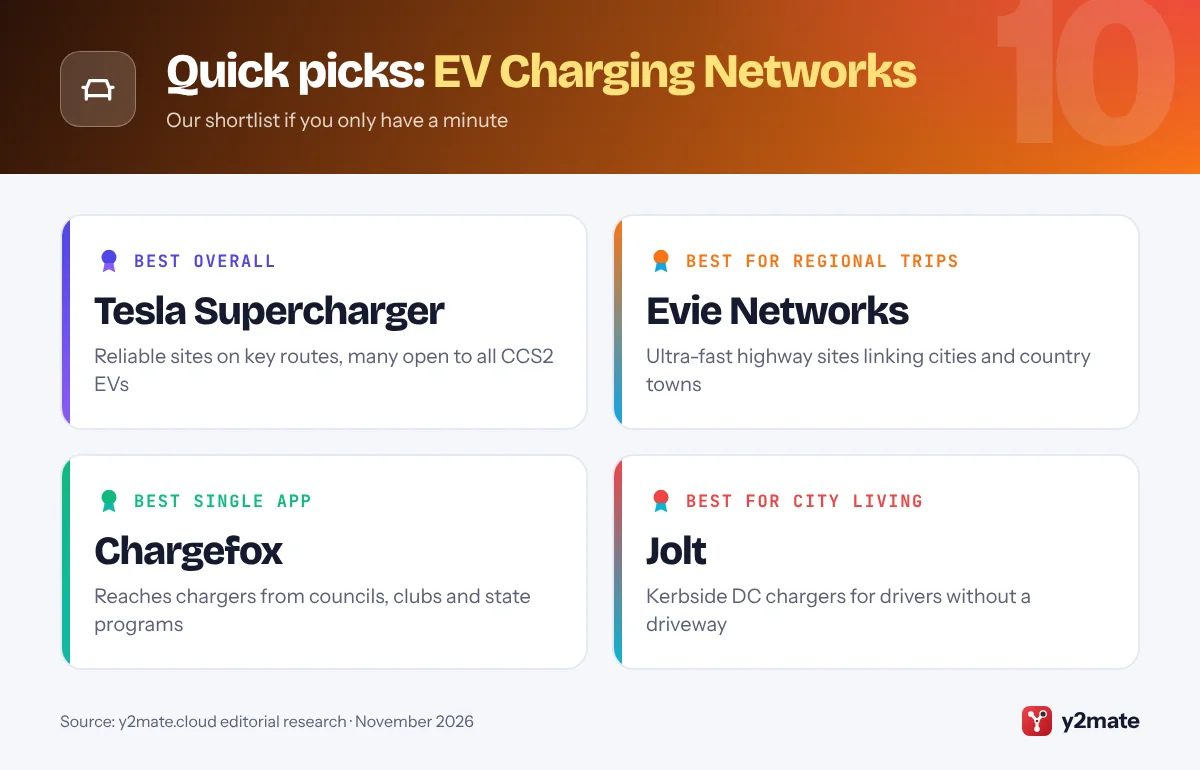
The best EV charging networks in Australia in 2026 are Tesla’s Superchargers for reliability, Evie Networks for ultra-fast highway charging, Chargefox for the widest single-app coverage, NRMA for regional New South Wales and beyond, and Ampol AmpCharge for service-station convenience. Which you need depends on where you live, how far you drive and whether you can charge at home.
Australia’s distances make public charging different from Europe or the US. Regional highways can have long gaps between towns, and popular holiday routes can see queues at peak times. Consolidation is also reshaping the market: in October 2026 Ampol agreed to buy Evie Networks, while energy companies, retailers and state governments keep adding new sites.
This guide ranks ten EV charging networks in Australia that matter for everyday drivers and road-trippers, with notes on where each is strongest and who might want to look elsewhere.
How we ranked this list
We compared publicly documented information from each operator and from government sources: where the chargers are, how many are DC fast chargers, whether non-members and all EV brands can use them, how you pay, and how each network serves regional and remote routes. We also weighed widely reported driver feedback and each operator’s announced 2026 expansion plans.
We did not run our own charging tests, and we have left out prices because they vary by site, state and membership and change often. Check each operator’s app or a live map such as PlugShare before you travel, especially in regional areas.

The Top 10 EV Charging Networks
1. Tesla Supercharger
Best for: dependable highway and city charging
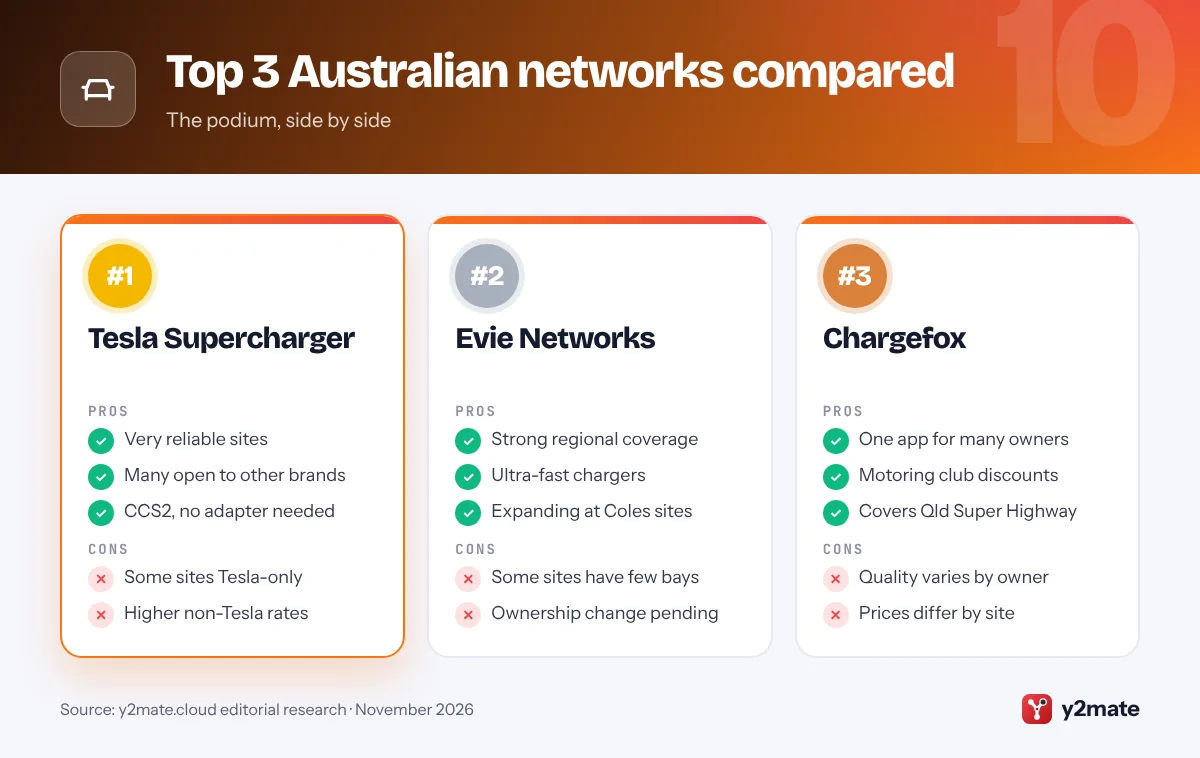
Tesla’s Supercharger network is one of the most reliable ways to charge in Australia. Sites are spread along major intercity routes such as the Hume Highway and the Pacific Highway, and in capital cities, and Tesla has been adding sites and upgrading busy older ones throughout 2026, including plans for its biggest Australian site yet.
Tesla has opened a large share of its Australian Supercharger sites to other brands. Because Australian EVs generally use the CCS2 connector, which Tesla’s local Superchargers support, most non-Tesla drivers can plug in without an adapter. You find open sites, start a session and pay through the Tesla app, and an optional membership reduces the per-kWh rate for frequent users.
The catch is that some sites, including several busy highway locations, remain Tesla-only, and pay-as-you-go rates for non-Tesla drivers are higher than for Tesla owners. Filter the map in the Tesla app before relying on a specific site. For Tesla owners, it remains the default choice; for everyone else, it is an excellent backup network.
Official site: Tesla Supercharger
- Very reliable sites
- Many open to all EVs
- CCS2, no adapter needed
- Some sites Tesla-only
- Higher rates for non-Teslas
2. Evie Networks
Best for: ultra-fast charging on regional highways
Evie Networks is one of Australia’s largest dedicated fast-charging networks, built with support from the Australian Renewable Energy Agency (ARENA) and other government programs. Its sites sit along highways linking major cities and regional towns, as well as in shopping centres and suburbs, and many offer ultra-fast chargers that suit modern EVs.
Evie has been adding sites with retail partners, including a 2026 rollout of fast chargers at Coles supermarkets. You can pay through the Evie app, and the network is open to all EVs with a CCS2 connector. Its regional sites help fill gaps on long country drives where few alternatives exist.
Big changes are coming. In October 2026 Ampol agreed to buy Evie Networks, with completion targeted for the first half of 2027 and subject to clearance by the Australian Competition and Consumer Commission (ACCC). For drivers, little should change in the short term, but expect branding, apps and pricing to be reviewed once the deal completes. Some older sites have only a couple of chargers, so check live availability on busy holiday weekends.
Official site: Evie Networks
- Strong regional coverage
- Ultra-fast chargers
- Open to all CCS2 EVs
- Some sites have few bays
- Ownership change ahead
3. Chargefox
Best for: one app for many networks
Chargefox works differently from most networks on this list. Rather than owning most of its hardware, it brings together chargers owned by councils, motoring clubs, energy companies, businesses and state programs into one app and payment system. That makes it one of the widest-reaching ways to access public charging in Australia with a single account.
Chargefox is backed by several state motoring clubs, and members of participating clubs can often get discounted charging. Its app covers everything from slower destination chargers at hotels and wineries to ultra-fast highway sites, and it is the payment platform for Queensland’s Electric Super Highway and for regional chargers that councils took over after RAC WA’s Electric Highway program ended.
Because the hardware belongs to many different owners, quality and reliability vary from site to site. Pricing also differs by location. Read recent check-ins before you rely on a remote charger. Even so, for drivers who want maximum coverage from one app, especially in regional areas, Chargefox is close to essential.
Official site: Chargefox
- Huge single-app coverage
- Motoring club discounts
- Strong regional reach
- Quality varies by owner
- Pricing differs by site
4. NRMA
Best for: regional NSW and ACT road trips
The NRMA, the motoring club for New South Wales and the ACT, has built one of the country’s most important regional fast-charging networks. Its chargers are placed in country towns and tourist destinations, often near cafés and attractions, with the aim of making regional travel practical and bringing EV tourists to local businesses.
The network has expanded beyond its home state, and the federal government has co-funded new highway sites through its Driving the Nation program. Charging was originally free for members, but the NRMA moved to paid charging, with NRMA members typically getting a discount. Check the NRMA website for current payment options and site details.
Many NRMA sites have only a small number of chargers, and some are slower than the newest ultra-fast hubs, so busy holiday periods can mean waiting. In remote areas an NRMA charger may be the only option for a long distance, which makes it valuable but also means you should have a plan B. For regional NSW trips in particular, the NRMA network is hard to beat.
Official site: NRMA
- Excellent regional coverage
- Member discounts
- Sites near towns and cafés
- Small sites can queue
- Some older, slower units
5. Ampol AmpCharge
Best for: charging at familiar service stations
AmpCharge is Ampol’s EV charging brand. It installs fast chargers at Ampol service stations in cities and along highways, so you can charge at a familiar site with a shop, toilets and food. Ampol also offers home charging, making AmpCharge a one-brand option for some drivers.
The service-station model suits Australians used to stopping at a servo on long drives: sites are on main roads, open long hours and easy to find. Ampol has been growing AmpCharge steadily, and its agreement in October 2026 to buy Evie Networks would make it one of the largest public charging operators in the country once the deal completes, subject to ACCC clearance.
For now, AmpCharge’s own network is smaller than Tesla’s or Chargefox’s, and many sites have a limited number of bays. Payment is through the AmpCharge app or other options shown at the charger. If you regularly pass Ampol sites, it is a convenient network to add, and it is likely to become much more significant from 2027.
Official site: Ampol AmpCharge
- Servo convenience
- Highway and city sites
- Set to grow with Evie deal
- Smaller own network today
- Limited bays at many sites
6. BP Pulse
Best for: fast charging at BP sites
BP Pulse is BP’s EV charging brand, and in Australia it has been installing fast and ultra-fast chargers at BP service stations in cities and on major highways. Like AmpCharge, it offers the convenience of a servo stop, with food, coffee and toilets available while you charge.
Newer BP Pulse sites typically offer high-power chargers suited to modern EVs. You can pay through the BP Pulse app, and BP also offers business and fleet charging products, which makes it common in company car arrangements.
BP Pulse’s Australian footprint is still developing, so coverage is uneven between states and regions, and you will not find chargers at every BP site. Check the app or a live map before planning around it. If a BP Pulse site falls along your route, it is usually a comfortable and practical place to stop, but it is not yet a network you can rely on alone.
Official site: BP Pulse
- Servo amenities
- High-power newer sites
- Fleet charging options
- Coverage still uneven
- Not at every BP site
7. Jolt
Best for: kerbside charging in cities
Jolt is an Australian company that builds and runs EV chargers in kerbside and city locations, often in partnership with local councils. Many of its chargers are integrated into compact street units placed in car parks and on streets, making Jolt useful for apartment dwellers and drivers who cannot charge at home.
Jolt’s chargers are typically DC units placed where people park for a short while, such as near shops and cafés, so you can add a useful amount of range during an errand. Charging is managed through the Jolt app, which also offers subscription plans for regular users. Jolt has grown its user base strongly in recent years.
Jolt is not designed for long highway trips; its sites are concentrated in metropolitan areas and charging speeds are lower than the ultra-fast highway networks. Kerbside spaces can also be taken by non-EVs or time-limited by parking rules. For city drivers without a driveway, though, Jolt is one of the most convenient ways to keep a car topped up.
Official site: Jolt
- Convenient city locations
- Good for no-driveway drivers
- Subscription plans
- Mostly metro areas
- Not built for road trips
8. Exploren
Best for: shopping centres and the ACT
Exploren is a fast-growing Australian charging network run by EVSE Australia. It grew significantly when its parent bought ENGIE’s Australian and New Zealand EV charging business, bringing chargers at major shopping centres such as Chadstone in Melbourne and Chatswood Chase in Sydney into the Exploren network.
Exploren operates a mix of public, destination, fleet and apartment charging, and it says it is the largest EV charging network in the ACT. In 2026 it announced a major investment to add many more DC fast chargers, including along regional and coastal road-trip routes in NSW. Charging is managed through the Exploren app.
Many Exploren chargers are slower AC units at destinations, so they suit shopping trips or longer stays rather than a quick highway stop. Its fast-charging coverage is growing but is not yet as broad as the biggest networks. If you live in Canberra or shop at centres it serves, Exploren is well worth having on your phone.
Official site: Exploren
- Big shopping centre sites
- Strong presence in the ACT
- Expanding DC fast charging
- Many slower AC units
- Fast coverage still growing
9. Queensland Electric Super Highway
Best for: road trips across Queensland
The Queensland Electric Super Highway is a state government program that built a chain of fast chargers along major Queensland routes, from the coast to inland towns. It is delivered by Yurika, part of the state-owned Energy Queensland group, and has been extended in stages, with the latest phase reaching further into regional and inland Queensland.
The chargers are accessed and paid for through the Chargefox app, so you need a Chargefox account before you plug in. Prices are shown in the app and vary by location. Charging on the network was free in its early years, but it has been a paid service for some time.
Sites are often small, sometimes with a single fast charger and a backup AC unit, so a fault or a queue can cause delays on remote stretches. Older units are slower than the newest ultra-fast hardware. Still, for touring Queensland, especially away from the south-east, the Super Highway often provides the only fast charging between towns, so plan your trip around it.
Official site: Queensland Electric Super Highway
- Covers regional Queensland
- Government-backed network
- Uses the Chargefox app
- Small sites, few chargers
- Some older, slower units
10. Shell Recharge (Viva Energy)
Best for: Shell servo stops in NSW
In Australia, Shell-branded service stations are run by Viva Energy, which operates fast chargers under the Shell Recharge brand. Viva has worked with the NSW Government to co-fund EV charging at Shell sites across the state, and it has been adding chargers in other states too.
As with other servo-based networks, the appeal is convenience: chargers are on main roads with a shop, coffee and toilets. Some service stations supplied by Viva also host chargers from partner networks such as Evie, so you may find more than one charging brand at a familiar servo.
Shell Recharge’s Australian footprint is smaller than the leading networks, and its rollout has been gradual, so treat it as a useful extra rather than a core network. Check current site locations and payment options in the Shell Recharge app or on a live map. If your regular routes pass Shell sites in NSW, it can be a handy addition to your options.
Official site: Shell Recharge (Viva Energy)
- Convenient servo locations
- NSW government co-funded
- Amenities on site
- Small network so far
- Gradual rollout
Australian charging network features compared

How to choose EV charging networks in Australia
Most Australian EV owners do the bulk of their charging at home or at work, so public networks matter most for long drives, regional trips and people living in apartments. For long trips, the essential EV charging networks in Australia are Tesla (where open to your car), Evie, Chargefox, NRMA and the servo-based networks such as AmpCharge, BP Pulse and Shell Recharge. City drivers without a driveway should also look at Jolt and destination chargers at shopping centres run by Exploren and others.
Plan for distance
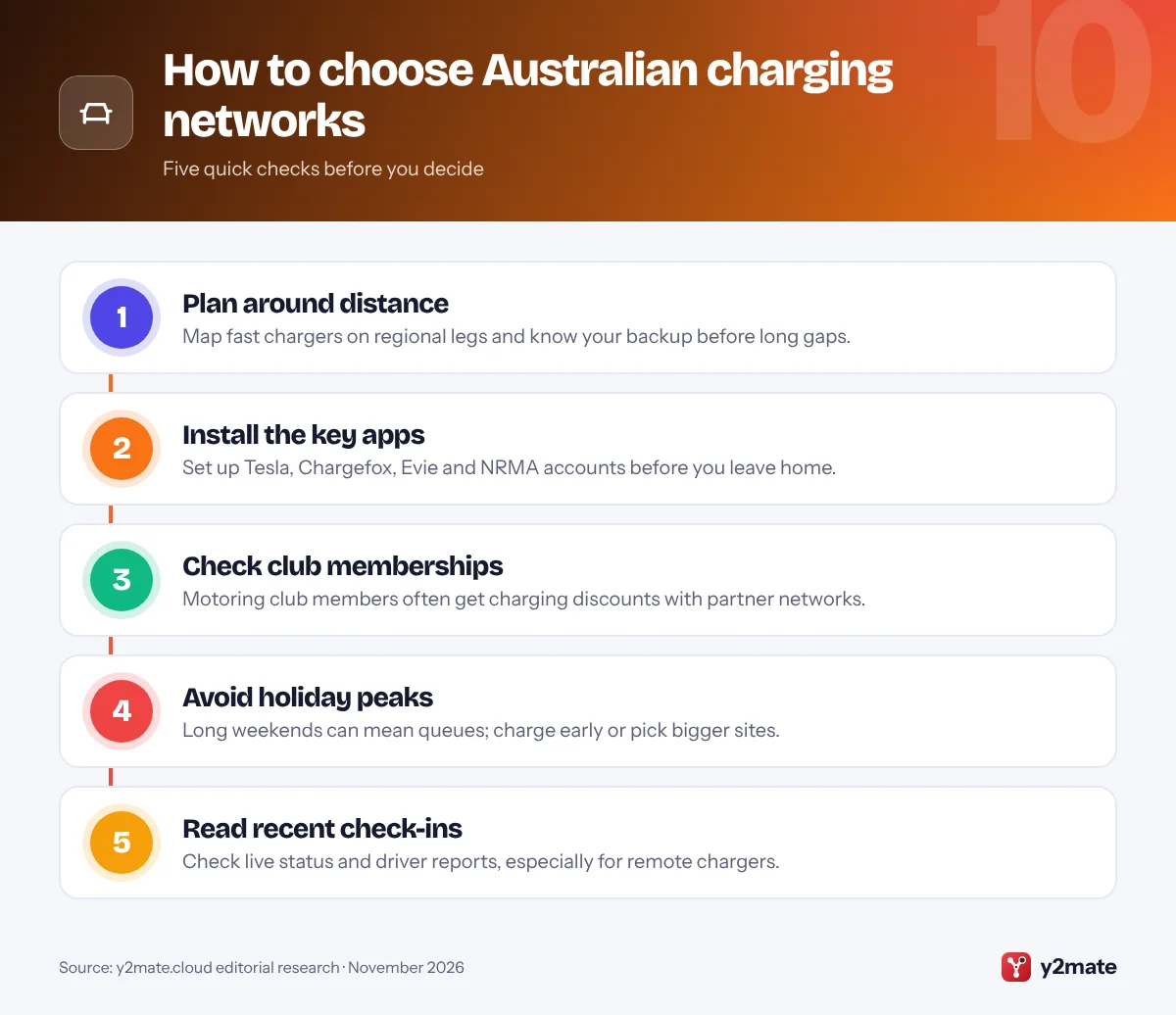
- Know the gaps: regional legs can be long, so map every fast charger on your route and note a backup.
- Arrive with a buffer: do not count on the last charger before a long stretch being free or working.
- Watch holiday peaks: Easter, Christmas and long weekends bring queues on popular coastal routes.
Government programs worth knowing
State and federal governments are funding chargers where the market alone has not delivered. The federal Driving the Nation program, run partly through ARENA, has supported highway fast charging, including NRMA sites. NSW has run several rounds of EV fast-charging grants that require regional sites alongside metropolitan ones, and Queensland built its own Electric Super Highway. Check your state government’s transport or energy website for local schemes.
Practical tips
Set up accounts before you leave, keep your motoring club card handy for discounts, and check live charger status in the operator’s app or on a community map. Charging speed depends on your car and battery temperature, not just the charger.
Frequently asked questions
What is the biggest EV charging network in Australia?
It depends how you count. Chargefox gives access to one of the largest numbers of public chargers through one app, because it aggregates chargers owned by councils, clubs and companies. Evie Networks and Tesla run large networks of their own fast chargers. Once Ampol completes its purchase of Evie, expected in 2027, AmpCharge will also become one of the largest operators.
Can non-Tesla EVs use Tesla Superchargers in Australia?
Yes, at many sites. Tesla has opened a large share of its Australian Supercharger locations to other brands. EVs with a CCS2 connector, which is standard in Australia, can plug in without an adapter. You find open sites and pay through the Tesla app, and non-Tesla drivers pay higher rates unless they buy an optional Supercharger membership.
Is Ampol buying Evie Networks?
Yes. In October 2026 Ampol announced an agreement for its subsidiary to buy Evie Networks. Completion is targeted for the first half of 2027 and depends on clearance from the Australian Competition and Consumer Commission. Until the deal completes, Evie continues to operate its own network and app, so drivers should keep using Evie as normal.
Do I need an app to charge an EV in Australia?
Usually yes. Most Australian networks start and bill sessions through an app or a linked account, such as Tesla, Chargefox, Evie, NRMA, AmpCharge or Jolt. Some newer chargers accept tap-and-go card payment, but this is not universal, so set up the main apps and add a payment card before a road trip to avoid problems at remote sites.
Are there government programs for EV charging in Australia?
Yes. The federal government has funded highway fast charging through the Driving the Nation program, partly delivered by ARENA. States run their own schemes too, such as NSW's EV fast-charging grants and Queensland's Electric Super Highway. These programs focus on filling gaps in regional areas where commercial networks alone have been slow to build chargers.
Final verdict
For most drivers, the best mix of EV charging networks in Australia is Tesla Superchargers where they are open to your car, Evie for ultra-fast regional charging and Chargefox for the broadest single-app coverage, with NRMA as a must-have in regional New South Wales. Add AmpCharge, BP Pulse or Shell Recharge for servo stops, and Jolt or Exploren if you live in the city without a driveway.
The market is consolidating quickly, with Ampol’s purchase of Evie set to reshape it in 2027, and government programs are steadily closing regional gaps. Until then, plan regional legs carefully, keep a backup charger in mind and check live status before you go.
Sources and further reading
- Queensland's Electric Super Highway: Queensland Government page on its state-funded fast-charging network, including locations and how to pay through Chargefox.
- NSW EV fast charging grants: NSW Government details of its latest fast-charging grant round, which requires regional sites alongside metropolitan ones.
- Australian Renewable Energy Agency: ARENA, the federal agency that has co-funded public EV fast-charging networks, including through the Driving the Nation program.
- National Electric Vehicle Strategy: The Australian Government's national strategy for electric vehicle uptake, including public charging infrastructure.

Leave a Reply