
- The Tesla Model Y, Chevrolet Equinox EV and Hyundai Ioniq 5 are the strongest all-round electric cars on sale in the USA in 2026.
- The federal clean vehicle tax credit is not available for EVs acquired after September 30, 2025, though some states and utilities still offer incentives.
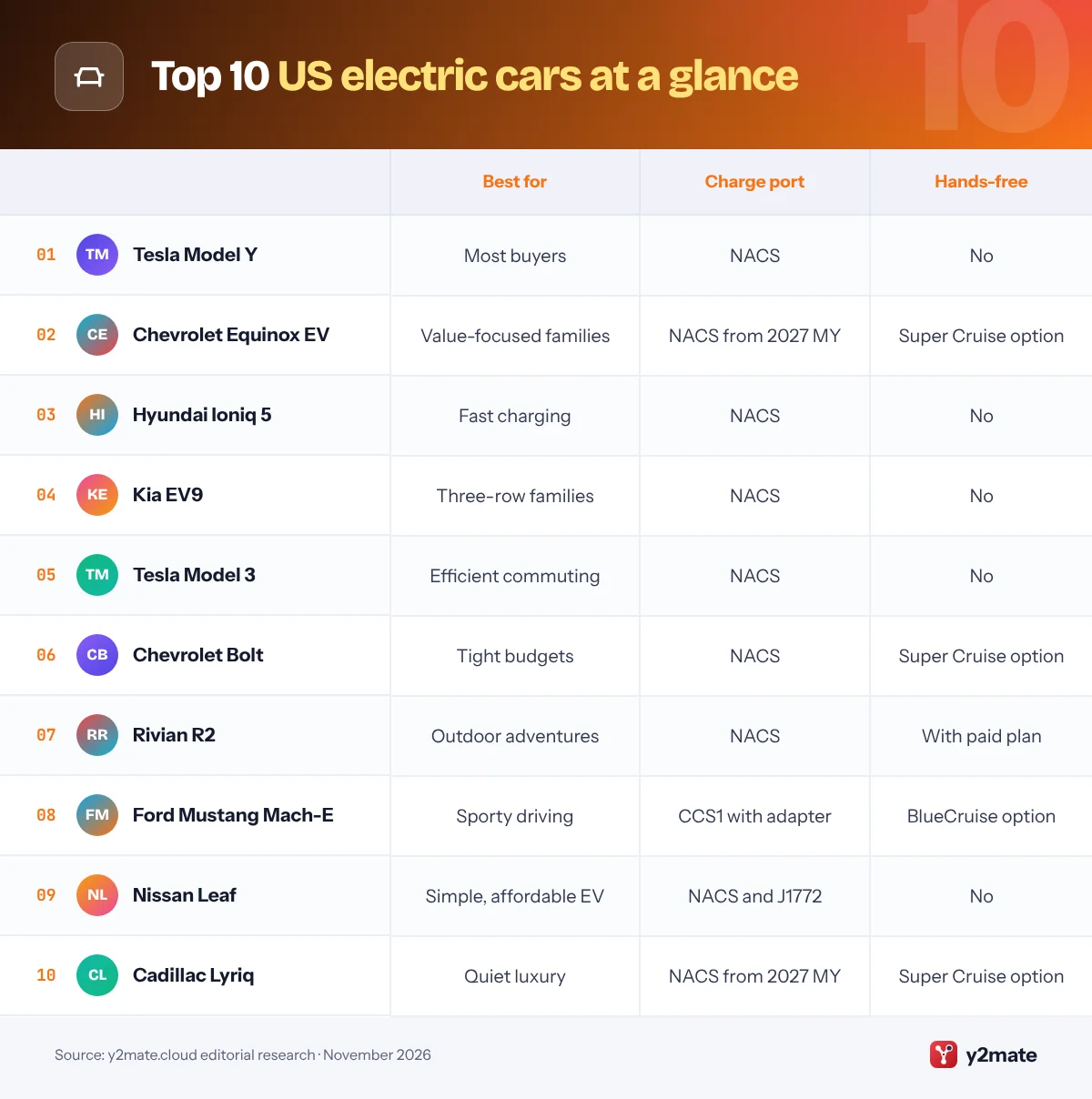
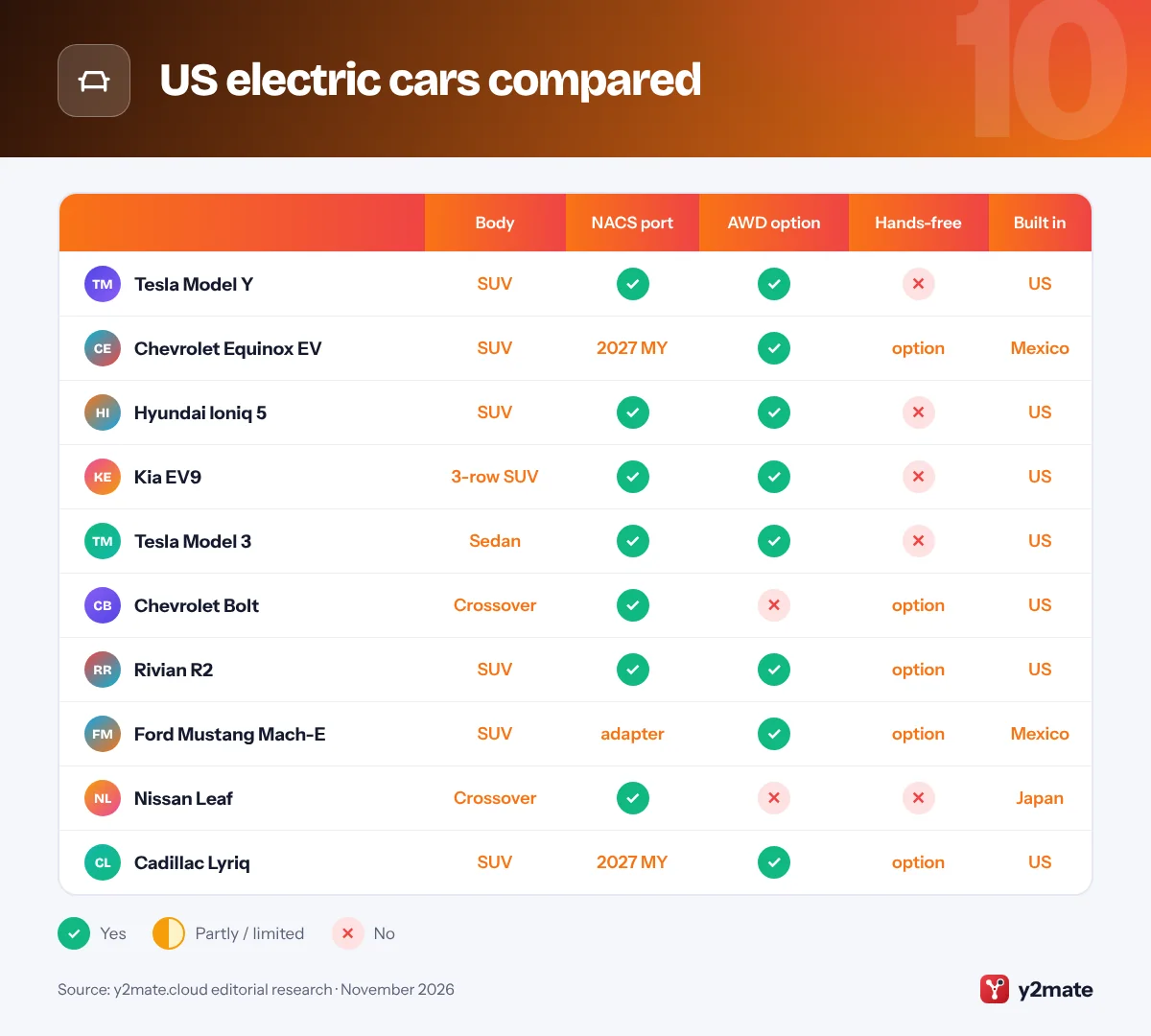
- Most cars on this list have a native NACS port for Tesla Superchargers, while the 2026 Equinox EV, 2026 Lyriq and Mustang Mach-E still need an adapter.
- EPA range estimates on fueleconomy.gov are the official US measure and the fairest way to compare models.
- GM's Super Cruise, Ford's BlueCruise and Rivian's Universal Hands-Free are hands-free but eyes-on systems, while Tesla, Hyundai, Kia and Nissan aids need your hands on the wheel.
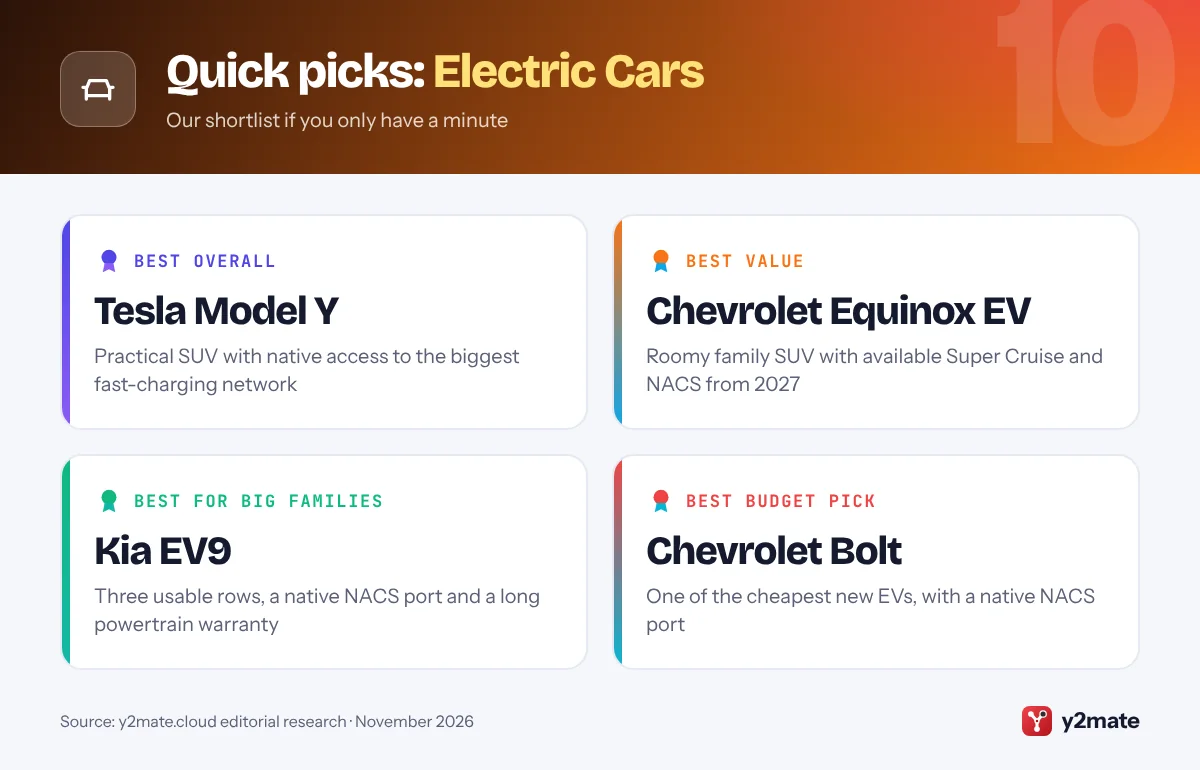
The best electric cars in the USA in 2026 are the Tesla Model Y for most buyers, the Chevrolet Equinox EV for value-focused families and the Hyundai Ioniq 5 for fast charging with a native NACS port. The Kia EV9, Tesla Model 3, Chevrolet Bolt, Rivian R2, Ford Mustang Mach-E, Nissan Leaf and Cadillac Lyriq complete the list, covering everything from a budget crossover to a three-row family SUV and a luxury cruiser.
A battery electric vehicle (BEV) runs only on electricity stored in its battery, with no gas engine, so plug-in hybrids are not included here. EPA range is the official US estimate of how far a fully charged EV can travel, shown on the window sticker and at fueleconomy.gov. DC fast charging is high-power public charging used on road trips. NACS, the North American Charging Standard that Tesla created and SAE standardized as J3400, is replacing the older CCS1 plug, so a car with a NACS port can use most Tesla Superchargers without an adapter.
Buying conditions changed in 2025. The federal clean vehicle tax credit is not available for new, used or leased EVs acquired after September 30, 2025, so each car now has to make sense on its own merits, although some states and utilities still offer help. This list ranks ten battery EVs on sale new in the US and explains who each one suits.
How we ranked this list
We compared publicly documented information only: body style and practicality, the charging port (native NACS or CCS1 with an adapter) and the DC fast-charging capability each maker describes, all-wheel-drive availability, hands-free driver assistance, warranty coverage published on official sites, and where each car is built. We checked that every model is listed on the maker’s US website. Federal credits have ended, so incentives did not affect the ranking.
We did not test the cars ourselves and do not quote prices or range figures, which vary by trim and change often. Check the official EPA estimates on fueleconomy.gov and the NHTSA and IIHS safety results for the exact version you want.
The Top 10 Electric Cars
1. Tesla Model Y
Best for: most buyers who want easy road trips
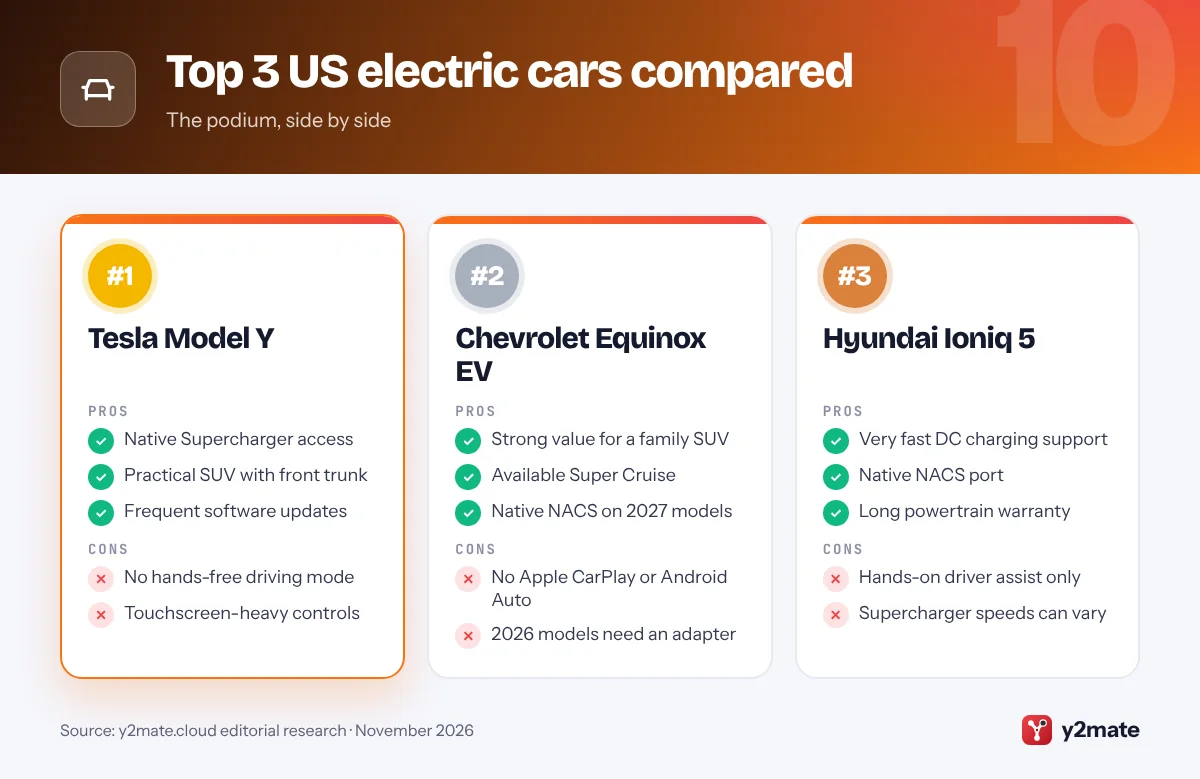
The Tesla Model Y remains the default choice for American EV shoppers because it pairs a practical midsize SUV body with the most widespread fast-charging network in the country. It charges natively through its NACS port at Tesla Superchargers, and the built-in navigation plans charging stops for you, which takes much of the guesswork out of long trips. Rear-wheel-drive and all-wheel-drive versions are offered, Tesla added lower-priced Standard trims in late 2025, and US cars are built in California and Texas.
The hatchback layout, fold-flat rear seats and front trunk make it easy to live with day to day, and Tesla has also added a longer, six-seat Model Y L to its US line-up. Over-the-air updates keep adding features.
The trade-offs are real. Autopilot and FSD (Supervised) are not hands-free systems and need your full attention, almost every control runs through the central touchscreen, and the service experience varies by location. Check the EPA range for the exact trim on fueleconomy.gov. For most buyers who want one EV that does everything well, the Model Y is the safest bet.
Official site: Tesla Model Y
- Native Supercharger access
- Practical SUV with front trunk
- Frequent software updates
- No hands-free driving mode
- Touchscreen-heavy controls
2. Chevrolet Equinox EV
Best for: value-focused families
The Chevrolet Equinox EV is a roomy compact SUV that brings mainstream GM practicality to a fully electric car. It offers front-wheel and all-wheel drive, a large touchscreen with Google built-in, and Chevrolet markets it as America’s most affordable long-range compact electric SUV. Compare its EPA estimate with rivals on fueleconomy.gov.
Charging depends on the model year. The 2026 Equinox EV uses a CCS1 port and needs GM’s approved adapter to use Tesla Superchargers, while the 2027 model switches to a built-in NACS port as part of GM’s move to NACS across its 2027 electric line-up. Super Cruise, GM’s hands-free driver-assistance system for compatible highways, is available on higher trims, though you must keep your eyes on the road.
There are drawbacks. Like other new GM EVs, it does not support Apple CarPlay or Android Auto, so you rely on GM’s own system, and it is built in Mexico, which matters to some buyers. If you want a sensible, spacious family EV from a familiar brand with a large dealer network, the Equinox EV is the best value pick in America.
Official site: Chevrolet Equinox EV
- Strong value for a family SUV
- Available Super Cruise
- Native NACS on 2027 models
- No Apple CarPlay or Android Auto
- 2026 models need an adapter
3. Hyundai Ioniq 5
Best for: fast charging with a native NACS port
The Hyundai Ioniq 5 stands out for charging. Its 800-volt electrical architecture lets it accept very high power at compatible DC fast chargers, and current US models have a built-in NACS port for Tesla Superchargers, with Hyundai including a CCS adapter for networks such as Electrify America. Charging speed still depends on the station, so the fastest stops come from high-power chargers.
The retro-futuristic body hides a long wheelbase, a flat floor and a sliding center console, so the cabin feels larger than the footprint suggests. Rear-wheel and all-wheel-drive versions are available, there is a rugged-look XRT trim, and US cars are built at Hyundai’s Metaplant in Georgia.
Hyundai’s warranty is a strong point, including 10-year powertrain and EV battery coverage for the original owner. Highway Driving Assist 2 makes long drives easier, but it is a hands-on system, not hands-free. Check the EPA range for your trim, as it varies with battery size and drive type. If you want quick road-trip stops and plenty of space, the Ioniq 5 is a superb all-rounder.
Official site: Hyundai Ioniq 5
- Very fast DC charging support
- Native NACS port
- Long powertrain warranty
- Hands-on driver assist only
- Supercharger speeds can vary
4. Kia EV9
Best for: big families who need three rows
The Kia EV9 is the go-to three-row electric SUV for families, with seating for up to seven and a boxy shape that leaves usable space in the third row. The 2026 EV9 has a native NACS port for Tesla Superchargers, and, like the Ioniq 5, it uses an 800-volt system that supports very fast charging at high-power DC stations.
Rear-wheel and all-wheel-drive versions are offered, including an outdoors-themed Land trim and a performance-focused GT. The EV9 is built in West Point, Georgia, and comes with Kia’s long 10-year powertrain and EV battery warranty for the original owner. Highway Driving Assist 2 helps on long trips, but you must keep your hands on the wheel.
It is a large, heavy vehicle, so it uses more energy than smaller EVs and can feel bulky in tight parking garages. Range also varies noticeably across the line-up, so check the EPA estimate for the exact trim and wheel size you want on fueleconomy.gov. For families moving out of a gas-powered three-row SUV, the EV9 is the most complete electric option on sale.
Official site: Kia EV9
- Usable third row for adults
- Native NACS port
- Long powertrain warranty
- Large and heavy to park
- Range varies widely by trim
5. Tesla Model 3
Best for: efficient commuting in a sedan
The Tesla Model 3 is the best electric sedan for most Americans. Its low, aerodynamic shape makes it one of the most efficient EVs on sale, which helps it travel further on each charge, and it shares the Model Y’s native NACS port, Supercharger access and automatic trip planning. Tesla offers rear-wheel-drive and all-wheel-drive versions, including a Performance model, plus a lower-priced Standard version added in late 2025.
The cabin is simple and airy, with a large central touchscreen, and the trunk and front trunk hold more luggage than the sleek shape suggests. US cars are built in Fremont, California, and over-the-air updates bring new features over time.
As a sedan, it has a smaller trunk opening and less headroom than an SUV, the ride can feel firm on some versions, and Autopilot and FSD (Supervised) still require your full attention. Check the EPA range for your version on fueleconomy.gov. If you do not need SUV space and mainly drive on highways, the Model 3 is the most efficient way into the Tesla ecosystem.
Official site: Tesla Model 3
- Very efficient on the highway
- Native Supercharger access
- Performance version available
- Less cargo flexibility than SUVs
- No hands-free driving mode
6. Chevrolet Bolt
Best for: buyers on a tight budget
The Chevrolet Bolt is back. GM revived its small EV as a 2027 model built in Fairfax, Kansas, and it is the first Chevy EV with a native NACS port, so it can use Tesla Superchargers without an adapter. It is the most affordable model in Chevrolet’s electric line-up and one of the cheapest new EVs in the US.
It keeps a compact crossover shape with a tall seating position and an easy-to-park footprint, and it uses lithium iron phosphate (LFP) battery cells, a chemistry known for long life. Super Cruise hands-free driver assistance is available, which is rare at this end of the market, though you still need to watch the road.
Like other new GM EVs, it does not support Apple CarPlay or Android Auto, and it is front-wheel drive only. Its DC fast charging is quicker than the old Bolt’s but not class-leading. Check the EPA range on fueleconomy.gov. For commuters who want a new EV at the lowest possible cost, the Bolt is the obvious place to start.
Official site: Chevrolet Bolt
- Among the cheapest new EVs
- Native NACS port
- Available Super Cruise
- No Apple CarPlay or Android Auto
- Front-wheel drive only
7. Rivian R2
Best for: outdoorsy buyers who want a smaller Rivian
The Rivian R2 is the most anticipated new EV of 2026. Production started at Rivian’s plant in Normal, Illinois, in April, and customer deliveries began in June with dual-motor all-wheel-drive launch versions, with less expensive versions due to follow. It is a two-row midsize SUV, smaller than the R1S, with Rivian’s adventure-ready design.
Every R2 has a NACS charge port, so it can use Tesla Superchargers as well as Rivian’s own Adventure Network. Rivian’s Universal Hands-Free system allows hands-free driving on roads with clearly marked lanes across the US and Canada. A trial is included at delivery, with a paid plan after that, and you must still watch the road and handle traffic lights and stop signs yourself.
As a brand-new model, the R2 has a short track record, Rivian’s service network is smaller than mainstream dealer networks, and the first versions sit at the top of the R2 line-up. Check the EPA estimate for the version you order. If you want a fun, capable SUV with access to two fast-charging networks, the R2 is worth the wait.
Official site: Rivian R2
- Native NACS port
- Hands-free on marked roads
- Compact, adventure-ready SUV
- Hands-free needs a paid plan
- Smaller service network
8. Ford Mustang Mach-E
Best for: sporty driving with hands-free highway help
The Ford Mustang Mach-E blends a sporty driving feel with crossover practicality, a front trunk and a large vertical touchscreen. Rear-wheel and all-wheel-drive versions are offered, including the high-performance GT, and Ford has opened orders for a 2027 model that makes the larger battery standard and adds a new Trail package.
Its biggest draw for highway drivers is BlueCruise, Ford’s hands-free driver-assistance system for pre-mapped divided highways. A driver-facing camera checks that you are watching the road, and BlueCruise needs a paid plan once any included trial ends. It is one of the most established hands-free systems on a mainstream EV.
The Mach-E still uses a CCS1 charging port, so you need a NACS adapter to use Tesla Superchargers, and US cars are built in Mexico. With 2026 and 2027 models on sale side by side, check which version a dealer is offering. Check the EPA range for your trim and battery on fueleconomy.gov. If you value driving enjoyment and hands-free highway assistance, the Mach-E remains a strong and well-proven choice.
Official site: Ford Mustang Mach-E
- Sporty, engaging handling
- BlueCruise hands-free option
- Front trunk storage
- CCS1 port needs an adapter
- BlueCruise needs a paid plan
9. Nissan Leaf
Best for: a simple, affordable small SUV
The Nissan Leaf, one of the first mass-market EVs, has been reinvented for 2026 as a sleek compact crossover. The third-generation model sold in the US is built in Tochigi, Japan, and has a built-in NACS port for DC fast charging at Tesla Superchargers, plus a separate J1772 port for everyday Level 2 charging. That means no adapter at most home and workplace chargers, and Nissan has added Plug and Charge for simpler payment.
The new Leaf is far more modern than before. It has a liquid-cooled battery, unlike earlier Leafs, which helps keep charging and performance consistent, plus an available dimming panoramic roof and a more upmarket cabin.
It is front-wheel drive only, and its ProPILOT Assist driver aid is a hands-on system rather than hands-free. It is smaller inside than the Equinox EV, so families should compare the two in person. Check the EPA estimate for your trim on fueleconomy.gov. For drivers who want an easy, affordable EV with two charging ports, the Leaf is a strong comeback.
Official site: Nissan Leaf
- NACS plus J1772 ports
- Liquid-cooled battery
- Compact and easy to park
- Front-wheel drive only
- Hands-on driver assist
10. Cadillac Lyriq
Best for: quiet luxury and hands-free highway driving
The Cadillac Lyriq is the most rounded luxury EV on this list, with a quiet, upscale cabin, a wide curved display and a smooth, relaxed ride. It is built in Spring Hill, Tennessee, and Cadillac currently lists both 2026 and 2027 versions. The 2027 Lyriq switches to a native NACS port, while 2026 models use a CCS1 port and need GM’s approved adapter for Tesla Superchargers.
Super Cruise hands-free highway assistance is available, rear-wheel and all-wheel drive are offered, and a high-performance Lyriq-V sits at the top of the range. Cadillac also sells the smaller Optiq if you want a similar feel in a more compact package.
It costs noticeably more than mainstream rivals, and as a large, heavy SUV it uses more energy than smaller EVs. Make sure you know which model year you are buying, because that decides whether you need an adapter at Superchargers. Check the EPA range on fueleconomy.gov and safety results from NHTSA and IIHS. If you want a refined luxury SUV with hands-free highway assistance, the Lyriq is the strongest American choice.
Official site: Cadillac Lyriq
- Quiet, upscale cabin
- Super Cruise available
- Native NACS from 2027 MY
- Pricier than mainstream EVs
- 2026 models need an adapter
US electric cars compared
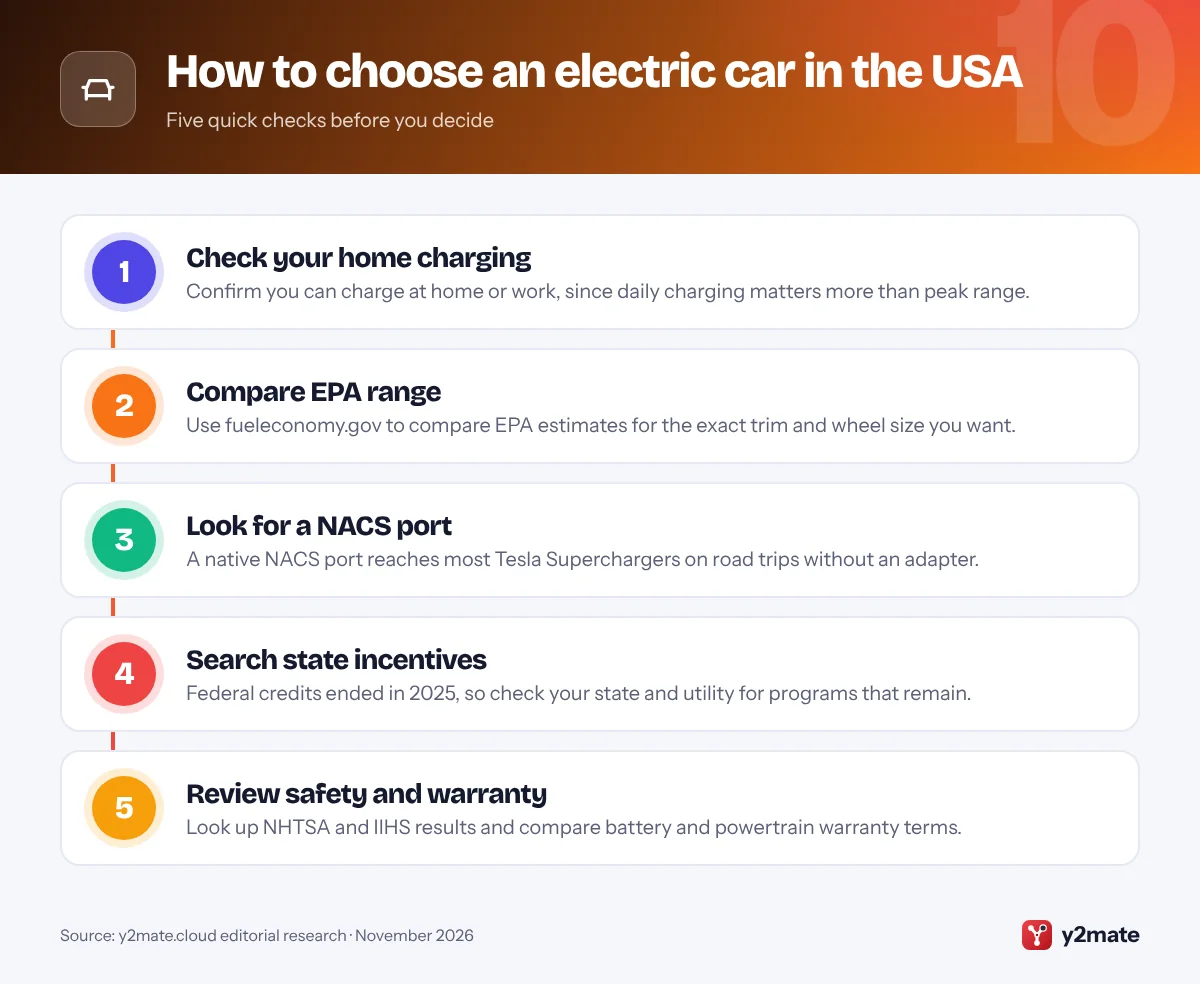
How to choose electric cars in the USA
Start with where you will charge. Most EV owners do the bulk of their charging at home or at work on a Level 2 charger, so a driveway or reserved parking spot matters more than headline range. If you rent or park on the street, check nearby public chargers before you buy.
What the end of the federal tax credit means
The IRS says the new clean vehicle credit is not available for vehicles acquired after September 30, 2025, and the used and commercial credits ended on the same date. Some states, cities and utilities still offer rebates, tax credits, discounted charging rates or carpool-lane access, while many states charge an extra annual registration fee for EVs. The Alternative Fuels Data Center lists current state laws and incentives.
Charging plugs: NACS vs CCS1
- Native NACS port: plugs straight into most Tesla Superchargers; you may need an adapter for some CCS1 stations.
- CCS1 port: works at networks such as Electrify America and EVgo, and needs an approved adapter for Superchargers.
- Model year matters: GM’s 2027 EVs switch to NACS, while 2026 versions still use CCS1.
Range, safety and warranty
Compare EPA range estimates on fueleconomy.gov for the exact trim, and expect less in very cold weather or at sustained highway speeds. Check NHTSA and IIHS results, and compare battery warranty terms, which are separate from the basic warranty.
Frequently asked questions
What is the best electric car in the USA in 2026?
For most people, the Tesla Model Y is the best all-round choice because it combines SUV practicality with native access to Tesla's Supercharger network. The Chevrolet Equinox EV is the best value family SUV, the Hyundai Ioniq 5 is the pick for fast charging, and the Kia EV9 suits families who need three rows of seats.
Is the federal EV tax credit still available?
No. The IRS says the new clean vehicle credit is not available for vehicles acquired after September 30, 2025, and the used and commercial clean vehicle credits ended on the same date. Some states, cities and utilities still offer rebates, tax credits or other perks, so check the Alternative Fuels Data Center and your utility's website before you buy.
Can non-Tesla electric cars use Tesla Superchargers?
Yes, many can. EVs with a native NACS port, such as the Hyundai Ioniq 5, Kia EV9, Rivian R2, Nissan Leaf and Chevrolet Bolt, can plug in directly at most Superchargers. Cars with a CCS1 port, such as the Mustang Mach-E and 2026 GM models, need an approved adapter. You usually start and pay for charging in the Tesla app or the car's own app.
How accurate is EPA range?
EPA range is a standardized estimate based on laboratory testing, which makes it the fairest way to compare models. Real-world range varies with speed, temperature, wheel size, load and the use of heating or air conditioning. Cold weather and long stretches at highway speed usually reduce it, so treat the EPA figure as a comparison tool rather than a guarantee.
Do electric cars cost more to register in the US?
In many states, yes. Because EV drivers do not pay gas tax, many states add an extra annual registration fee for electric vehicles to help fund roads. The amount and rules vary by state. Check your state's motor vehicle department or the Alternative Fuels Data Center for current fees and any EV incentives that still apply where you live.
Final verdict
For most buyers, the best electric cars in the USA are the Tesla Model Y for its all-round practicality and charging network, the Chevrolet Equinox EV for value and the Hyundai Ioniq 5 for fast charging. Families needing three rows should look at the Kia EV9, budget buyers at the Chevrolet Bolt and Nissan Leaf, and anyone wanting hands-free highway help at GM’s Super Cruise models or the Ford Mustang Mach-E with BlueCruise.
Before you sign, confirm the model year and charging port, compare EPA range on fueleconomy.gov, check NHTSA and IIHS safety results and look up any state or utility incentives that still apply.
Sources and further reading
- IRS new clean vehicle credit: The IRS explains that the new clean vehicle credit is not available for vehicles acquired after September 30, 2025.
- State EV laws and incentives: The Department of Energy's Alternative Fuels Data Center lists current state EV incentives, fees and regulations.
- Official EPA range estimates: Compare official EPA range and efficiency estimates for every electric car sold in the US.
- NHTSA vehicle safety ratings: Look up NHTSA crash-test results and safety ratings for the exact model and model year you are considering.

Leave a Reply