
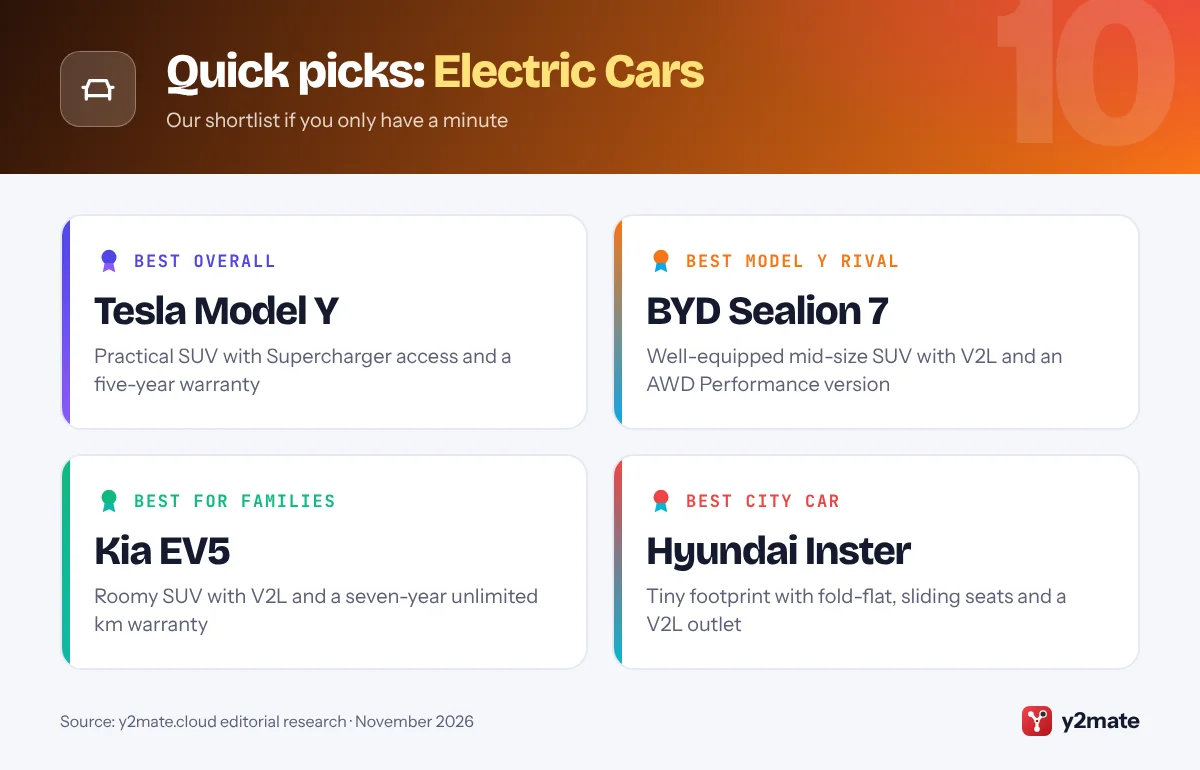
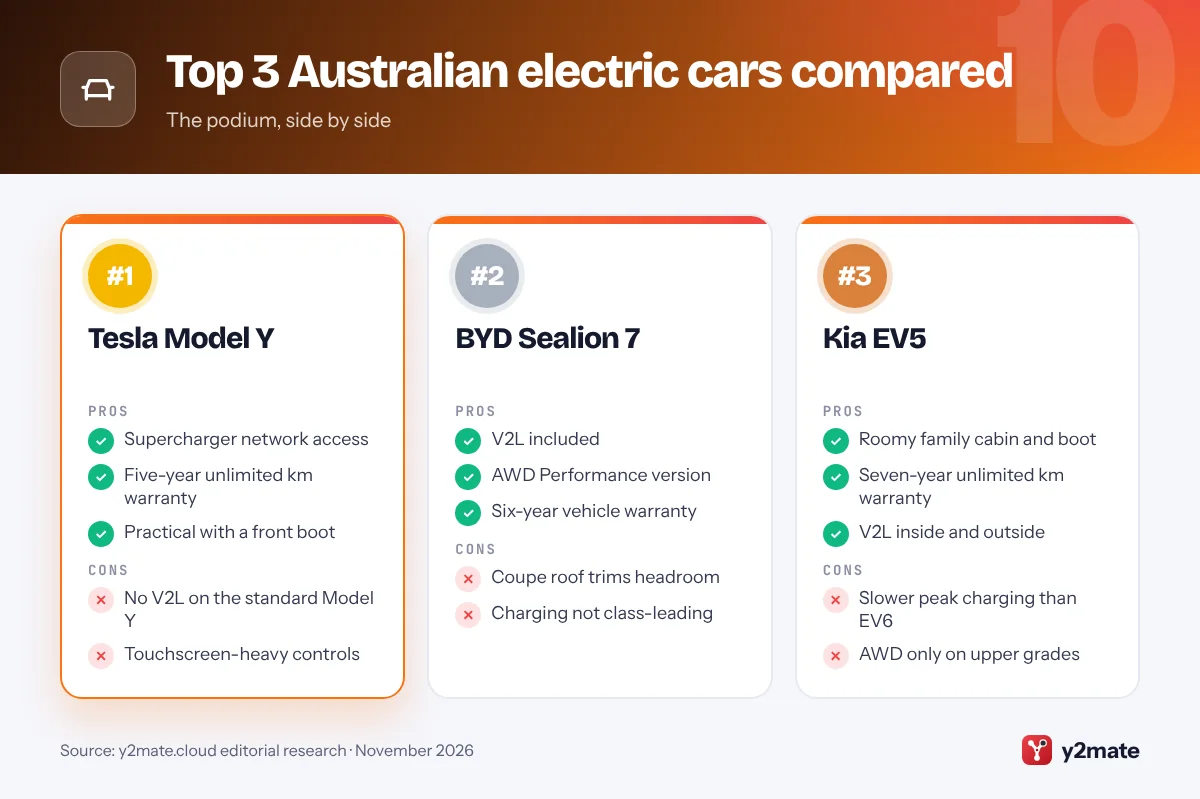
- The Tesla Model Y, BYD Sealion 7 and Kia EV5 are the strongest all-round electric cars on sale in Australia in 2026.
- Eligible EVs on novated leases are exempt from fringe benefits tax under current law, with changes announced from 1 April 2027.
- Most state EV purchase rebates have closed, so the FBT exemption is now the main national incentive.
- ADR 81/02 range figures are based on the older NEDC test and usually read higher than WLTP figures.
- Every car on this list uses the CCS2 plug, and many Tesla Superchargers in Australia are open to other brands.
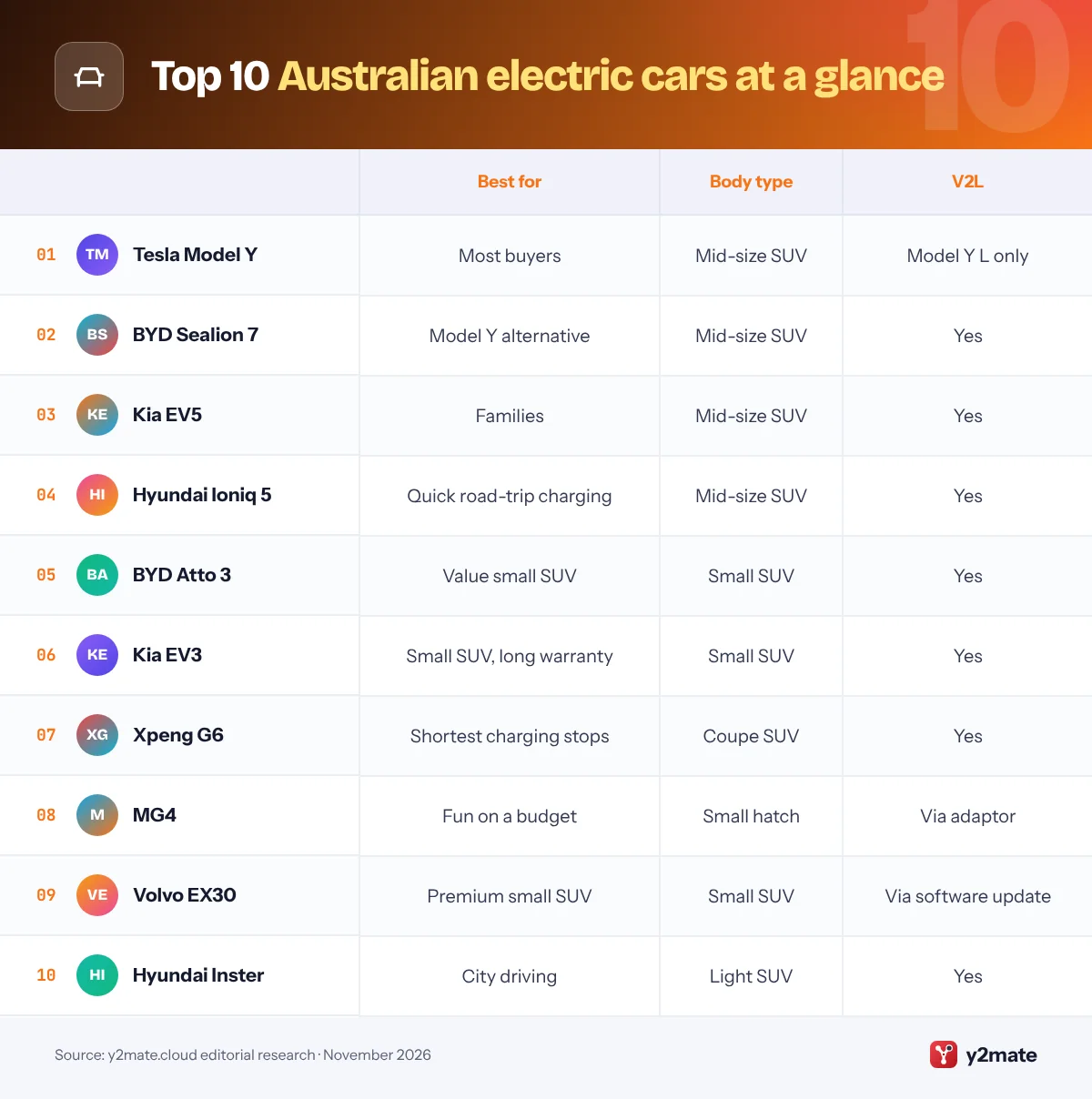
The best electric cars in Australia in 2026 are the Tesla Model Y for most buyers, the BYD Sealion 7 for a well-equipped mid-size SUV with vehicle-to-load and the Kia EV5 for families who want space and a long warranty. The Hyundai Ioniq 5, BYD Atto 3, Kia EV3, Xpeng G6, MG4, Volvo EX30 and Hyundai Inster round out the list, from a light city car to premium and fast-charging SUVs.
A battery electric vehicle (BEV) runs only on electricity from its battery, so hybrids are not included. Range claims come from different tests: WLTP is the European laboratory test many brands quote, while figures from the ADR 81/02 test are based on the older NEDC cycle and usually read higher. DC fast charging is high-power public charging for road trips, CCS2 is the standard fast-charging plug in Australia, and vehicle-to-load (V2L) lets the car power appliances.
Australia has its own rules. Eligible EVs on a novated lease can be exempt from fringe benefits tax (FBT), the New Vehicle Efficiency Standard is encouraging brands to bring in more EVs, most state purchase rebates have ended, and ANCAP publishes independent safety ratings. This guide covers all of that alongside the ten cars.
How we ranked this list
We compared publicly documented information only: body type and practicality, vehicle-to-load support, all-wheel-drive availability, the warranty published on each brand’s Australian website, and the DC charging capability each maker describes. We also considered whether each car can use Australia’s main charging networks and checked that every model is listed on the brand’s Australian site. ANCAP safety ratings exist for these models, so check the current rating for your exact variant.
We did not test the cars ourselves and do not quote prices or range figures, which vary by variant and change often. Check whether a range claim is WLTP or ADR-based, and confirm FBT treatment with your employer or lease provider.
The Top 10 Electric Cars
1. Tesla Model Y
Best for: most buyers and long-distance drives
The Tesla Model Y is Australia’s most familiar electric SUV and still the best all-rounder, thanks to its practical mid-size body, front boot and Tesla’s Supercharger network, many sites of which are now open to other brands too. Like every Tesla currently sold here, it is built in China and uses the CCS2 plug, and the navigation plans charging stops on long drives for you.
Rear-wheel and all-wheel-drive versions are available, and Tesla has added the longer, six-seat Model Y L, which is also the first Tesla here to offer vehicle-to-load (V2L) through an adapter. For cars delivered from 1 January 2026, Tesla’s Australian vehicle warranty for private buyers is five years with unlimited kilometres, with separate cover for the battery and drive unit.
The standard Model Y does not offer V2L, almost every control runs through the touchscreen, and Autopilot needs your full attention at all times. Check the ANCAP rating and the official range for your version. For buyers who want the easiest long-distance charging in a practical SUV, the Model Y remains the benchmark.
Official site: Tesla Model Y
- Supercharger network access
- Five-year unlimited km warranty
- Practical with a front boot
- No V2L on the standard Model Y
- Touchscreen-heavy controls
2. BYD Sealion 7
Best for: a well-equipped Model Y rival with V2L
The BYD Sealion 7 is BYD’s mid-size electric SUV and the most direct rival to the Model Y, with a coupe-style roofline and a long list of standard equipment. It includes vehicle-to-load, so you can power appliances or camping gear from the car, and BYD lists both NEDC and WLTP range figures on its Australian site, which makes fair comparisons easier.
Rear-wheel-drive and dual-motor all-wheel-drive Performance versions are offered, both using BYD’s Blade battery. BYD’s Australian warranty covers the vehicle for six years and the traction battery for eight years, with distance limits on both.
The sloping roof trims rear headroom and boot height compared with boxier SUVs, and BYD’s stated DC charging capability is solid rather than class-leading, so long-distance stops take a little longer than in the fastest-charging rivals. Check the ANCAP rating for the version you want. For buyers who want a feature-packed alternative to the Model Y with V2L, the Sealion 7 is the strongest challenger.
Official site: BYD Sealion 7
- V2L included
- AWD Performance version
- Six-year vehicle warranty
- Coupe roof trims headroom
- Charging not class-leading
3. Kia EV5
Best for: families who want space and a long warranty
The Kia EV5 is a boxy mid-size SUV designed around family practicality, with a roomy back seat and a big boot. Australian cars come from Kia’s factory in China, and Kia says the suspension has been tuned locally for Australian roads, which it highlights on its Australian website.
Front-wheel-drive Air versions come with a choice of two battery sizes, while Earth and GT-Line versions add dual-motor all-wheel drive. Vehicle-to-load works both inside and outside the car, and Kia’s seven-year unlimited-kilometre warranty is one of the best in the Australian market.
Unlike the EV6 and EV9, the EV5 uses a 400-volt system rather than 800 volts, so its peak rapid-charging speed is lower than those models, which matters most if you regularly drive long distances between fast chargers. Check the ANCAP rating and compare the WLTP figures for each battery option before you choose. For families who want SUV space, V2L and a long warranty, the EV5 is a standout.
Official site: Kia EV5
- Roomy family cabin and boot
- Seven-year unlimited km warranty
- V2L inside and outside
- Slower peak charging than EV6
- AWD only on upper grades
4. Hyundai Ioniq 5
Best for: quick charging on long regional drives
The Hyundai Ioniq 5 uses an 800-volt electrical architecture that lets it accept very high charging power at compatible ultra-fast chargers, which shortens stops on long regional drives when the charger allows it. Its retro-futuristic styling hides a spacious cabin with a flat floor and a sliding centre console.
Rear-wheel and all-wheel-drive versions are offered, plus the high-performance Ioniq 5 N, and vehicle-to-load is built in. Hyundai’s warranty is seven years with unlimited kilometres for passenger cars first registered from 1 June 2025 that are serviced at Hyundai dealers, and five years otherwise. Australian cars are built in South Korea.
It often costs more than similar-sized Chinese-built rivals, and charging speed still depends on the station you use, so the biggest gains come at the newest high-power sites. Check the ANCAP rating and the WLTP range for your version. If you do lots of long trips and want quick charging stops, the Ioniq 5 is one of the best tools for the job.
Official site: Hyundai Ioniq 5
- Very fast DC charging support
- V2L built in
- Spacious flat-floor cabin
- Dearer than many rivals
- Seven years needs dealer servicing
5. BYD Atto 3
Best for: a value small SUV with V2L
The BYD Atto 3 helped make electric cars mainstream in Australia, and the line-up now centres on the updated Atto 3 Evo, with the original Atto 3 Essential still listed. The Evo Premium switches to rear-wheel drive with a bigger battery, while the Evo Dynamic and the Essential are front-wheel drive.
All versions use BYD’s Blade battery, and the Evo includes vehicle-to-load for powering appliances. Removing the front motor on the rear-drive Premium frees up a storage compartment under the bonnet, and BYD’s six-year vehicle warranty and eight-year battery warranty apply, with distance limits.
There is no all-wheel-drive version on sale, and BYD’s Australian site quotes NEDC-based range figures for the Atto 3, which read higher than WLTP figures, so compare carefully with rivals. Check the ANCAP rating for the exact version, as the updated Evo differs from the earlier car. For buyers who want an affordable, well-equipped small SUV with V2L, the Atto 3 remains a smart pick.
Official site: BYD Atto 3
- V2L on the Evo
- Rear-drive Evo Premium
- Front boot on the Premium
- No AWD version on sale
- Range quoted on NEDC basis
6. Kia EV3
Best for: a small SUV with a long warranty
The Kia EV3 packs Kia’s design and technology into a compact SUV that is easy to park, and Australian cars are built in South Korea. Kia promotes the long-range version’s driving range as class-leading, so check the official WLTP figure for the exact variant you are considering.
Vehicle-to-load is available through an outlet in the second row and, with an adaptor, from the charging port outside, which is handy for camping or a blackout. Kia’s seven-year unlimited-kilometre warranty applies, and the cabin is practical for its size, with a modern dashboard and plenty of storage.
It is front-wheel drive only, and its 400-volt system means slower peak rapid charging than Kia’s 800-volt EV6 and EV9. The back seat and boot are smaller than in the EV5, so growing families should compare the two in person. Check the ANCAP rating before you buy. For couples and small families who want a compact SUV with a long warranty, the EV3 is a polished choice.
Official site: Kia EV3
- Seven-year unlimited km warranty
- V2L inside and outside
- Easy to park
- Front-wheel drive only
- Slower peak charging than EV6
7. Xpeng G6
Best for: the shortest charging stops
The Xpeng G6 is a mid-size coupe SUV from Chinese EV maker Xpeng, relaunched in Australia in mid-2026 with what Xpeng calls Australia’s first 5C battery, designed to accept extremely high charging power at a compatible ultra-fast charger. That makes it a strong option for drivers who regularly cover long distances.
Rear-wheel and dual-motor all-wheel-drive versions are offered, and it supports vehicle-to-load. For vehicles sold from 1 June 2026, Xpeng’s Australian warranty for private buyers is seven years with unlimited kilometres, with separate cover for the battery and drive components. Its XPILOT Assist driver-assistance features are designed to ease highway driving but still need your full attention.
Xpeng is a newer brand here with a smaller dealer and service network, and you only benefit from the fastest charging at chargers that can deliver that much power, which are still limited outside major routes. Check the ANCAP rating for the updated model. For drivers who want the shortest possible charging stops, the G6 is well worth a test drive.
Official site: Xpeng G6
- Extremely fast charging design
- V2L supported
- Seven-year warranty
- Smaller dealer network
- Fastest chargers still limited
8. MG4
Best for: a fun, affordable hatchback
The MG4 is one of the most affordable family-sized electric hatchbacks in Australia. It is rear-wheel drive with balanced weight distribution, which MG says makes it sharp and engaging to drive, and the XPOWER version adds a second motor and all-wheel drive for much stronger performance.
MG’s Australian warranty is seven years with unlimited kilometres as standard, and MG says it can be extended to ten years through its service-activated program. MG lists WLTP range figures on its site, which makes comparisons straightforward, and vehicle-to-load is possible through an adaptor that plugs into the charging port.
It is a hatchback rather than an SUV, so the seating position is lower, and the cabin is simpler than in some newer rivals. Battery types differ between versions, so read the specifications for the variant you want. Check the ANCAP rating for the exact version. For buyers who want rear-drive fun and a long warranty without stretching the budget, the MG4 is excellent value.
Official site: MG4
- Seven-year warranty, extendable
- Engaging rear-drive handling
- AWD XPOWER version
- V2L needs an adaptor
- Lower seating than SUVs
9. Volvo EX30
Best for: premium style in a small SUV
The Volvo EX30 is Volvo’s smallest SUV, with a minimalist Scandinavian cabin built around a single central screen and recycled and renewable materials. It suits buyers who want a premium brand in a compact, easy-to-park size, and the twin-motor versions are among the quickest small SUVs on sale.
Single-motor rear-wheel-drive and twin-motor all-wheel-drive versions are offered. Volvo has announced vehicle-to-load for the EX30 through an over-the-air software update in 2026, with an adapter sold separately, so check whether it is active on the car you buy. Volvo’s Australian warranty is five years with unlimited kilometres.
The rear seat and boot are small, and nearly every control, including some basic functions, runs through the central touchscreen, which takes time to learn. The infotainment system has Google built-in, with apps such as Google Maps. Check the ANCAP rating and the WLTP range for each version. For buyers who want premium design in a small electric SUV, the EX30 is the stylish choice.
Official site: Volvo EX30
- Premium Scandinavian design
- Quick twin-motor AWD
- Easy to park
- Small rear seat and boot
- Touchscreen-heavy controls
10. Hyundai Inster
Best for: city driving and tight parking
The Hyundai Inster is a light electric car with a tall, boxy SUV-style body, built in South Korea, and it is one of the smallest EVs on sale in Australia. All seats fold flat and the rear seats slide, so you can trade legroom for boot space whenever you need to carry something bulky.
Vehicle-to-load comes through an interior outlet as standard, with an exterior adaptor sold as an accessory, and a rugged-look Inster Cross version is offered. Hyundai’s seven-year unlimited-kilometre warranty applies when the car is serviced at Hyundai dealers, and five years otherwise.
It is front-wheel drive only, and its small size and range make it best suited to city and suburban driving rather than regular country trips, although occasional longer drives are possible with planning. Check the ANCAP rating and the WLTP range for each version. For city drivers who want an easy-to-park EV with clever, flexible space, the Inster is the pick of the small cars.
Official site: Hyundai Inster
- Fold-flat, sliding seats
- V2L outlet as standard
- Very easy to park
- Front-wheel drive only
- Best suited to city use
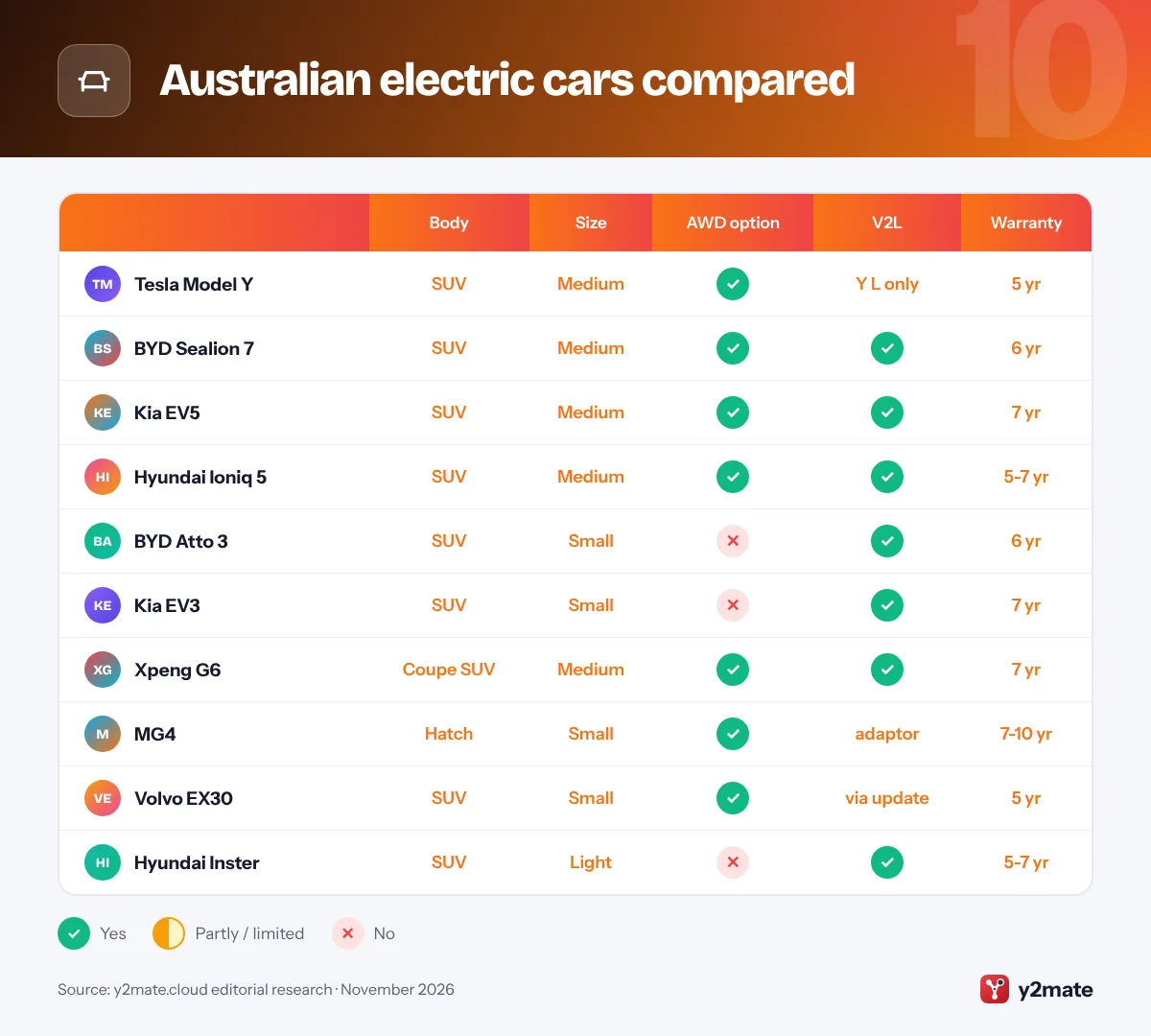
Australian electric cars compared
How to choose electric cars in Australia
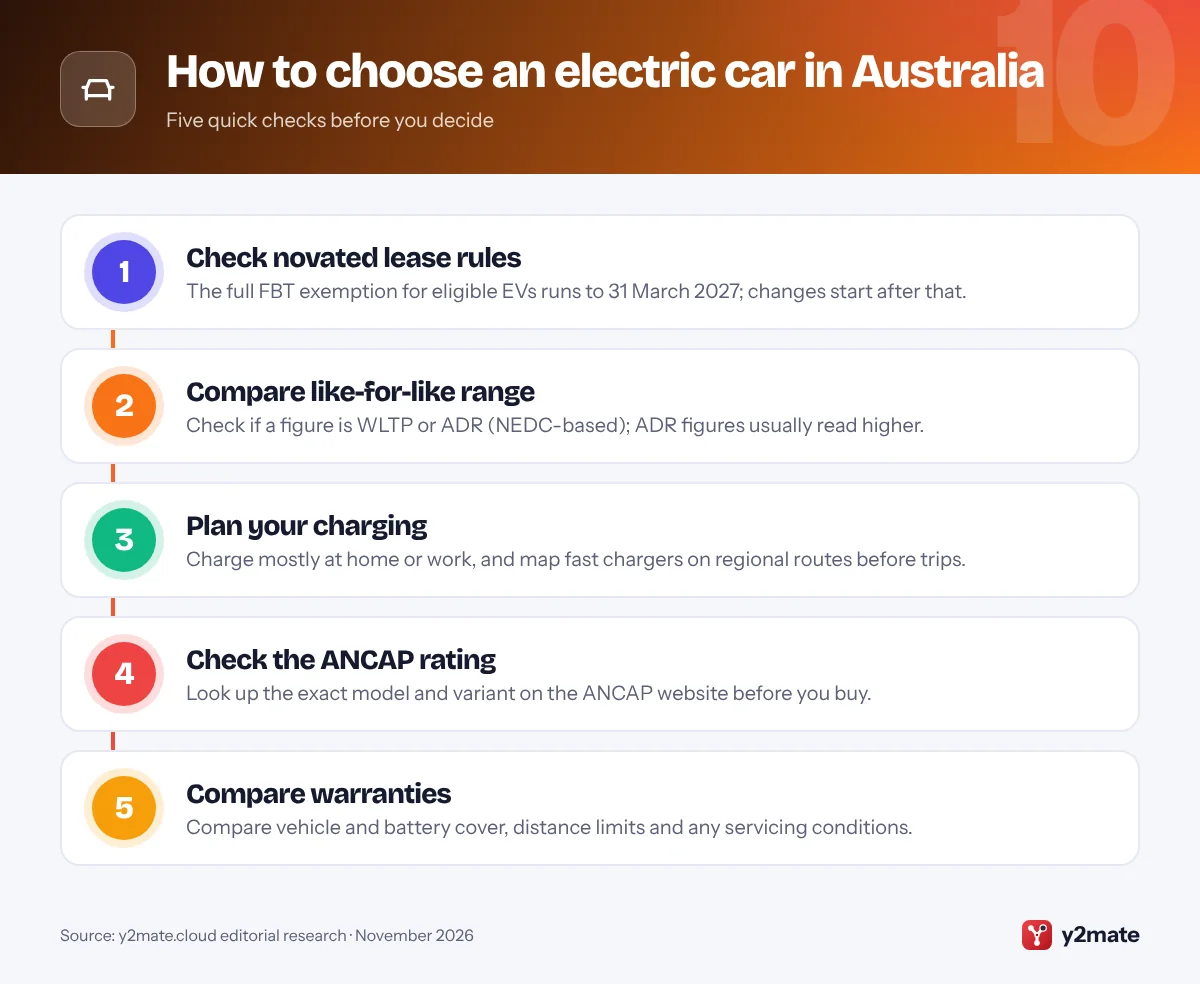
Start with where you will charge. Most owners do the bulk of their charging at home or at work, so off-street parking or a workplace charger matters more than headline range. For regional trips, map fast chargers along your route and allow for long gaps between towns.
Novated leases and the FBT exemption
Under current law, eligible battery electric cars provided through an employer, including by novated lease, are exempt from fringe benefits tax if they were first held and used from 1 July 2022 and are valued below the luxury car tax threshold for fuel-efficient vehicles. Plug-in hybrids stopped qualifying for new arrangements from 1 April 2025. In its 2026 Budget, the government announced that the full exemption continues until 31 March 2027, is then due to be limited to lower-priced EVs, and will be replaced by a partial discount from April 2029. These changes need legislation, so check the ATO and your lease provider.
Range figures, safety and incentives
- WLTP vs ADR: many brands quote WLTP, while ADR 81/02 figures are based on the older NEDC test and usually read higher.
- ANCAP: check the rating for the exact model and variant, and the year it was tested.
- NVES: the New Vehicle Efficiency Standard, in place since 2025, sets a falling CO2 target for each brand’s new cars, which encourages more EV models.
- Rebates: most state purchase rebates have closed, though some states and territories still offer registration or stamp duty concessions.
Frequently asked questions
What is the best electric car in Australia in 2026?
For most buyers, the Tesla Model Y is the best all-rounder, combining a practical mid-size SUV with Tesla's Supercharger network and a five-year warranty for cars delivered from 2026. The BYD Sealion 7 is the strongest Model Y rival, the Kia EV5 suits families who want a seven-year warranty, and the Hyundai Inster is the pick for city driving.
Are electric cars exempt from FBT on a novated lease?
Under current law, yes, if the car is a battery electric or hydrogen fuel cell car first held and used from 1 July 2022 and valued below the luxury car tax threshold for fuel-efficient vehicles. Plug-in hybrids stopped qualifying for new arrangements from 1 April 2025. The government has announced changes from 1 April 2027 that need legislation, so check the ATO website and your lease provider.
Are there still EV rebates in Australia?
Most state and territory purchase rebates have now closed, so the main national benefit is the FBT exemption for eligible EVs provided through an employer, including novated leases. Some states and territories still offer registration or stamp duty concessions, and some energy retailers offer cheaper overnight charging plans. Check your state transport or revenue office before you buy.
Why do some EV range figures look higher than others?
Brands quote different tests. WLTP is a European laboratory test that many brands use, while Australia's ADR 81/02 figures are based on the older NEDC cycle and usually read noticeably higher. The Green Vehicle Guide shows official test results. Compare cars using the same test, and expect real-world range to be lower at highway speeds and in very hot or cold weather.
Can I use Tesla Superchargers with a non-Tesla EV in Australia?
Yes, at many sites. Many Tesla Supercharger locations in Australia are open to non-Tesla EVs with a CCS2 port, which covers every other car on this list. You start and pay for charging in the Tesla app. Some sites remain Tesla-only, so check the app before relying on a particular charger during a road trip.
Final verdict
For most households, the best electric cars in Australia are the Tesla Model Y for all-round ability and easy long-distance charging, the BYD Sealion 7 for features and V2L, and the Kia EV5 for family space and a long warranty. Road-trippers should look at the Hyundai Ioniq 5 and Xpeng G6, value seekers at the BYD Atto 3 and MG4, and city drivers at the Hyundai Inster.
Before you sign, check whether range claims are WLTP or ADR-based, look up the ANCAP rating for your exact variant, and ask your employer or lease provider how the FBT exemption and its planned changes apply to you.
Sources and further reading
- ATO electric cars exemption: The Australian Taxation Office explains which electric cars are exempt from fringe benefits tax and the conditions that apply.
- New Vehicle Efficiency Standard: The federal transport department explains how the New Vehicle Efficiency Standard sets emissions targets for new cars.
- Green Vehicle Guide: The Australian Government's guide to official energy consumption, emissions and range test results for new vehicles.
- ANCAP safety ratings: ANCAP publishes independent crash-test and safety ratings for new cars sold in Australia and New Zealand.

Leave a Reply