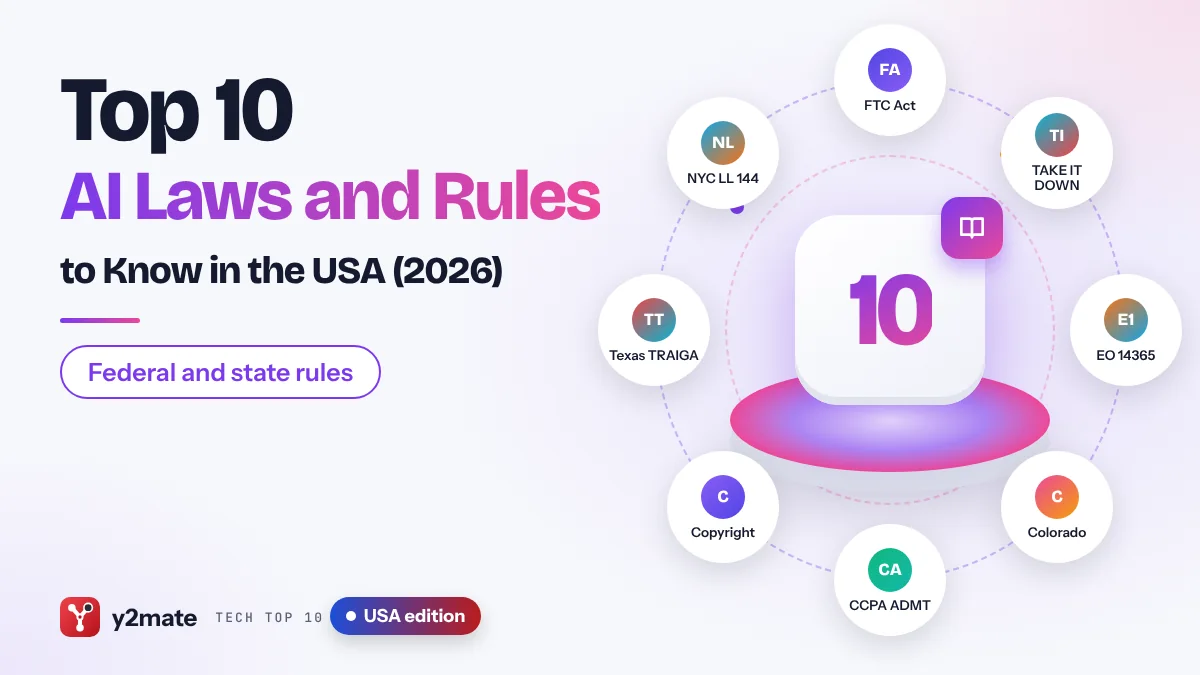
- The USA has no single federal AI law; AI is governed by existing federal laws, a few targeted new laws, executive orders and state and city rules.
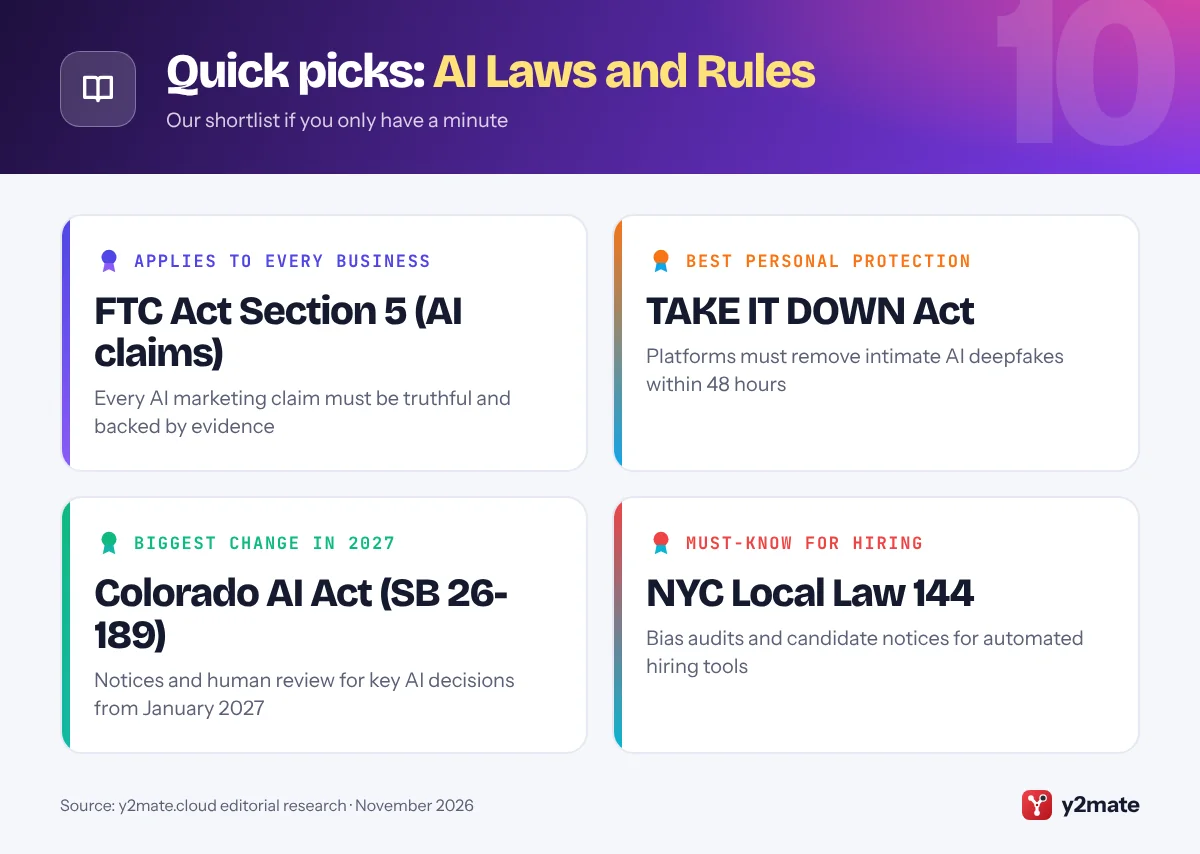
- The TAKE IT DOWN Act makes publishing non-consensual intimate images, including AI deepfakes, a federal crime, and since May 19, 2026 platforms must remove reported images within 48 hours.
- Executive Order 14365 pushes for one national AI standard, but it does not cancel any state AI law on its own.
- Colorado's replacement AI law and California's automated decisionmaking rules are both due to apply from January 1, 2027.
- The US Copyright Office says prompts alone do not make someone the author of AI output.
The USA has no single federal AI law. Instead, AI laws in the USA are a patchwork: long-standing federal rules such as the FTC Act’s ban on deceptive practices, a few new targeted federal laws such as the TAKE IT DOWN Act, presidential executive orders, and a growing set of state and city laws in places like Colorado, California, Texas, Illinois and New York City. Which rules apply depends on what you use AI for and where your customers and staff are.
Some plain definitions. Automated decision-making means using software, including AI, to make or heavily shape a decision about a person, such as whether they get a job interview, a loan or an apartment. A deepfake is an image, video or audio clip created or altered with AI so that it appears to show a real person doing or saying something they did not. A frontier model is one of the largest, most capable general-purpose AI models, trained with enormous amounts of computing power.
Below are the ten US laws, rules and official positions that matter most for everyday users and small businesses in November 2026, with their status. This is general information, not legal advice; for your own situation, talk to a qualified attorney.
How we ranked this list
We ranked each item by how directly it affects ordinary people and small businesses that use AI tools, putting rules already in force nationwide ahead of narrow or not-yet-active ones. We checked each status against official sources, such as agency announcements, legislature records and court decisions, as of November 2026.
We did not run tests of our own and do not quote fines, which vary by case. Where a rule is still being written or challenged in court, we say so.
The Top 10 AI Laws and Rules
1. FTC Act Section 5 (AI claims)
Best for: businesses that market or sell with AI
There is no AI exemption from consumer protection law. Section 5 of the Federal Trade Commission Act bans unfair or deceptive acts or practices, and the FTC uses it against companies that exaggerate what their AI can do or use AI to mislead people. In September 2024 the agency announced Operation AI Comply, a sweep that included a service marketed as an AI lawyer and schemes promising easy income from AI-powered online stores.
Enforcement has continued under the FTC’s current leadership. In 2025 it finalized an order requiring Workado to stop making unsupported accuracy claims about its AI content detector, and it sued Air AI over earnings promises made to small businesses, a case settled in March 2026.
The practical rule is simple: any claim about AI, such as accuracy, time saved or results, needs evidence before you make it, and you should not call a product AI-powered if it is not. The FTC’s rule on fake reviews, in force since October 2024, also covers reviews written by AI.
Official site: FTC Act Section 5 (AI claims)
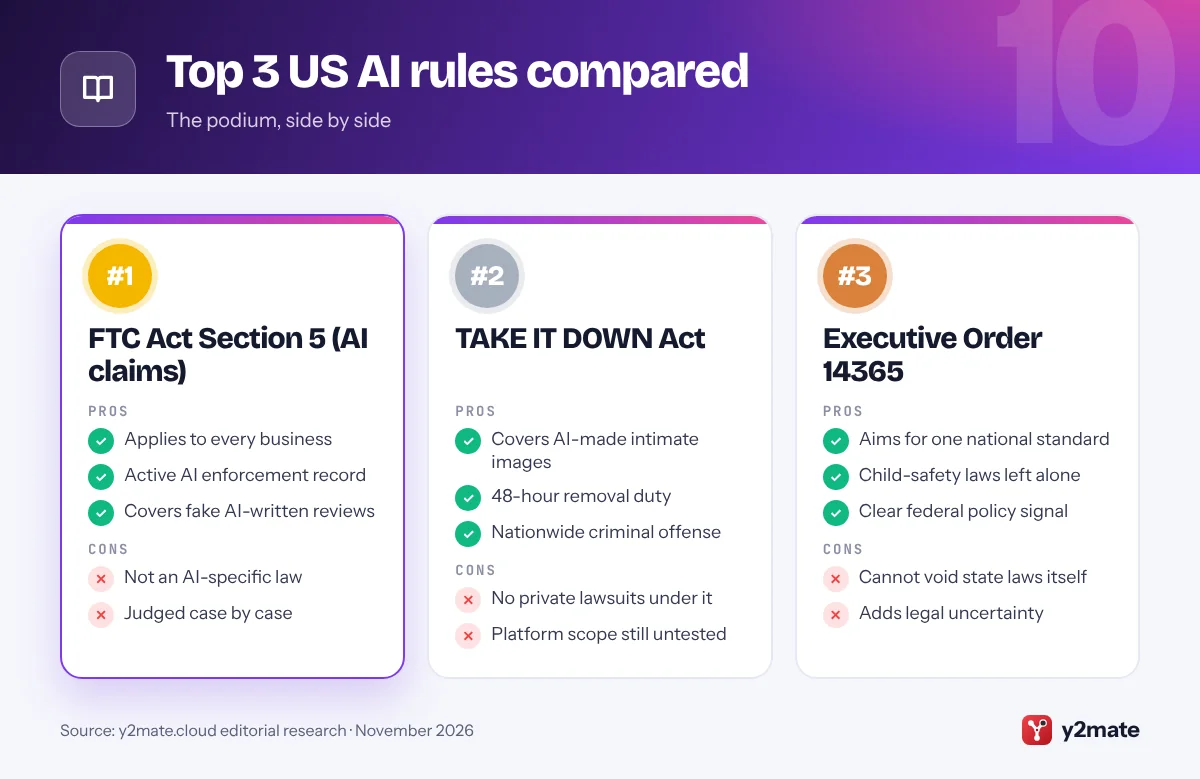
- Applies nationwide to every sector
- Active AI enforcement record
- Covers fake AI-written reviews
- Not an AI-specific law
- Judged case by case
2. TAKE IT DOWN Act
Best for: anyone targeted by fake intimate images
The TAKE IT DOWN Act, signed on May 19, 2025, is the first federal law aimed squarely at a harm that AI has made easier. It makes it a federal crime to knowingly publish intimate images of someone without their consent, including AI-generated or digitally altered images, which the law calls digital forgeries. Threatening to publish such images is also an offense, with stricter rules where minors are involved.
The second half of the law took effect on May 19, 2026. Covered platforms, meaning public websites and apps that mainly host user-generated content, must offer victims a clear removal process and take reported images down, along with known identical copies, within 48 hours of a valid request. The FTC enforces these platform duties and has launched a reporting site for people whose requests were ignored.
If you run a forum or app where users post images, check whether you are a covered platform and set up a removal process. If you are a victim, keep screenshots and links as evidence, use the platform’s removal form and consider reporting it to the police.
Official site: TAKE IT DOWN Act
- Covers AI-made intimate images
- 48-hour removal duty for platforms
- Applies nationwide
- No private lawsuits under the Act
- Platform scope still being tested
3. Executive Order 14365
Best for: tracking the federal-state AI law fight
Executive Order 14365, Ensuring a National Policy Framework for Artificial Intelligence, was signed on December 11, 2025. It sets the federal government’s position that AI should face one minimally burdensome national standard rather than a patchwork of state rules. It created an AI Litigation Task Force at the Justice Department to challenge state AI laws in court, told the Commerce Department to identify state laws it considers onerous, and directed that some federal broadband grants be tied to states’ AI rules. State child-safety laws are not targeted.
An executive order cannot repeal a state law by itself. As of November 2026, Congress has not passed a law overriding state AI rules, having dropped such language from both the 2025 budget bill and the year-end defense bill, and no court has struck down a state AI law under the order. In March 2026 the White House released a nonbinding legislative framework for Congress, and the Justice Department has joined a lawsuit challenging Colorado’s AI law.
For businesses, the safe reading is that state AI laws still apply unless a court or Congress says otherwise.
Official site: Executive Order 14365
- Pushes for one national standard
- Leaves child-safety laws alone
- Clear signal of federal priorities
- Cannot cancel state laws itself
- Adds legal uncertainty
4. Colorado AI Act (SB 26-189)
Best for: firms using AI for major decisions on people
Colorado passed the first broad state AI law in 2024, but it never took effect. After delaying it, lawmakers repealed and replaced it in May 2026 with SB 26-189, a narrower law on automated decision-making technology that is due to take effect on January 1, 2027.
It covers technology that materially influences consequential decisions about people in areas such as education, employment, housing, lending and financial services, insurance, health care and essential government services. Instead of the 2024 law’s duty of care against algorithmic discrimination, risk programs and impact assessments, it centers on transparency: telling people when such a tool is used, keeping documentation and records, and, in certain cases, letting people correct inaccurate data and get meaningful human review. Only the Colorado attorney general can enforce it; there is no private right to sue.
The attorney general is writing rules and has said he will not enforce the law until that rulemaking is finished, and a federal lawsuit by xAI, joined by the Justice Department, is pending. If you use AI to screen tenants, applicants or borrowers in Colorado, start preparing notices and review steps now.
Official site: Colorado AI Act (SB 26-189)
- Clear focus on high-impact decisions
- Narrower than the 2024 version
- Start date gives time to prepare
- Rules still being written
- Federal court challenge pending
5. California CCPA ADMT rules
Best for: larger firms using AI on Californians’ data
The California Privacy Protection Agency finalized regulations on automated decisionmaking technology (ADMT) under the California Consumer Privacy Act in September 2025. The wider rules package took effect on January 1, 2026, and businesses that use ADMT to make significant decisions about consumers must comply with the ADMT requirements from January 1, 2027.
The rules target technology that processes personal information to replace, or substantially replace, human decision-making in significant decisions, such as those about employment, lending, housing, education or health care. Covered businesses must give a pre-use notice explaining what the tool does and why, let consumers opt out in many cases or offer a human appeal instead, and answer requests about how a decision was made. Risk assessments and cybersecurity audits follow on later timelines.
The CCPA applies only to businesses that meet its size or data thresholds, so many small firms fall outside it. If you are covered, review any AI used in hiring, lending or eligibility decisions before 2027, and check that your vendors can supply what you need for notices.
Official site: California CCPA ADMT rules
- Gives consumers opt-out and access
- Clear compliance date
- Detailed official regulations
- Only for businesses above CCPA limits
- Complex for first-time compliance
6. Copyright Office AI guidance
Best for: creators and firms making AI content
US copyright law protects only works with human authors. The US Copyright Office explained how that applies to AI in Part 2 of its Copyright and Artificial Intelligence report, published in January 2025. Its view is that prompts alone do not give a person enough control over the output to count as its author, so purely AI-generated text, images or music cannot be registered.
That does not rule out protection for work made with AI. Human-written parts of a work, creative selection and arrangement of AI material, and meaningful human edits can still be protected, and using AI as a tool does not by itself block registration. When you register a work, you must disclose AI-generated material that is more than minimal and claim only the human contribution.
The courts back the rule. In March 2026 the Supreme Court declined to hear Thaler v. Perlmutter, leaving in place a ruling that a work created entirely by an AI system cannot be copyrighted. Whether training AI on copyrighted works is lawful is a separate question still before the courts.
Official site: Copyright Office AI guidance
- Clear human-authorship rule
- AI-assisted work can be protected
- Backed by court decisions
- Line between assisted and generated
- Training questions still unresolved
7. Texas TRAIGA (HB 149)
Best for: businesses serving customers in Texas
The Texas Responsible Artificial Intelligence Governance Act (TRAIGA), passed as HB 149, has been in force since January 1, 2026. It is narrower than early drafts. Rather than broad duties for every high-risk system, it bans a short list of harmful uses, such as developing or deploying AI with the intent to manipulate people into self-harm, harming others or committing crimes, with the intent to unlawfully discriminate against a protected group, or to produce child sexual abuse material and certain unlawful sexual deepfakes. State agencies face extra rules, including telling people when they are interacting with AI and a ban on social scoring.
Only the Texas attorney general can enforce TRAIGA, and businesses generally get notice and a chance to fix a problem before a lawsuit. Substantially following a recognized risk framework, such as the NIST AI Risk Management Framework, can help a company’s defense. The law also created a regulatory sandbox for testing AI products with some state rules relaxed, and a Texas Artificial Intelligence Council.
For most small businesses using mainstream AI tools, TRAIGA mainly means avoiding harmful uses and keeping records of how you use AI.
Official site: Texas TRAIGA (HB 149)
- Targets clearly harmful uses
- Chance to fix issues before suit
- Sandbox for testing new AI
- Intent can be hard to prove
- Only the attorney general enforces
8. NYC Local Law 144
Best for: employers hiring for jobs in New York City
New York City’s Local Law 144 was the first US law to regulate AI in hiring, and it has been enforced since July 5, 2023. It covers automated employment decision tools: software using machine learning, statistical modeling, data analytics or AI that substantially assists or replaces human judgment in decisions about hiring or promotion.
Before using such a tool, an employer or employment agency must have an independent bias audit done within the past year, publish a summary of the results, and tell candidates and employees who live in the city that a tool will be used and what it will assess. The audit looks for differences in outcomes by sex and by race or ethnicity. The law does not require employers to change anything based on what the audit finds.
The city’s Department of Consumer and Worker Protection enforces the law. A December 2025 audit by the New York State Comptroller criticized it for relying mainly on complaints, and the department has said it will strengthen enforcement. If your screening software ranks or filters NYC candidates, ask your vendor for its latest bias audit.
Official site: NYC Local Law 144
- Requires independent bias audits
- Candidates get advance notice
- Clear official FAQ
- No duty to act on audit results
- Enforcement criticized as weak
9. Illinois HB 3773
Best for: Illinois employers using AI with staff
Since January 1, 2026, the Illinois Human Rights Act, as amended by HB 3773, has made it a civil rights violation for an employer to use AI in a way that has a discriminatory effect on employees or job applicants based on protected characteristics. It covers decisions about recruitment, hiring, promotion, training, discipline, discharge and other terms of employment. It also bars using ZIP codes as a stand-in for protected characteristics and requires employers to notify workers when they use AI for these purposes.
The Illinois Department of Human Rights was asked to write rules on how that notice should work. It proposed draft rules in 2026 but withdrew them for further work, so the notice format is still unsettled even though the duty applies now. Complaints go through the existing human rights process.
Illinois also has an older law, the Artificial Intelligence Video Interview Act, which since 2020 has required employers to explain and get consent before AI analyzes recorded video interviews. Nationwide, federal anti-discrimination laws such as Title VII also apply to AI-assisted hiring.
Official site: Illinois HB 3773
- Covers the whole employment cycle
- Bans ZIP codes as a proxy
- Uses existing complaint process
- Notice rules not finalized
- Applies only to Illinois employers
10. California SB 53
Best for: people following frontier AI safety
California’s Transparency in Frontier Artificial Intelligence Act, known as SB 53, was signed on September 29, 2025 and took effect on January 1, 2026. It applies only to developers of frontier models, the largest general-purpose AI systems trained with huge amounts of computing power, and its heaviest duties fall on large developers with very high annual revenue. Ordinary users and small businesses have no duties under it.
Covered developers must publish transparency reports when they release new or substantially modified frontier models, and large developers must also publish a framework explaining how they assess and manage catastrophic risks. Developers must report critical safety incidents to California’s Office of Emergency Services. The law also protects employees who raise concerns about serious risks.
SB 53 matters to everyday users because the companies behind the most popular chatbots must now say publicly how they handle worst-case risks. California has also passed a companion chatbot law, in force since January 2026, and the California AI Transparency Act, operative since August 2026, which requires the biggest generative AI providers to label AI-made content and offer free detection tools.
Official site: California SB 53
- First US frontier AI safety law
- Public safety frameworks
- Whistleblower protections
- Covers only the biggest developers
- Little direct effect on users
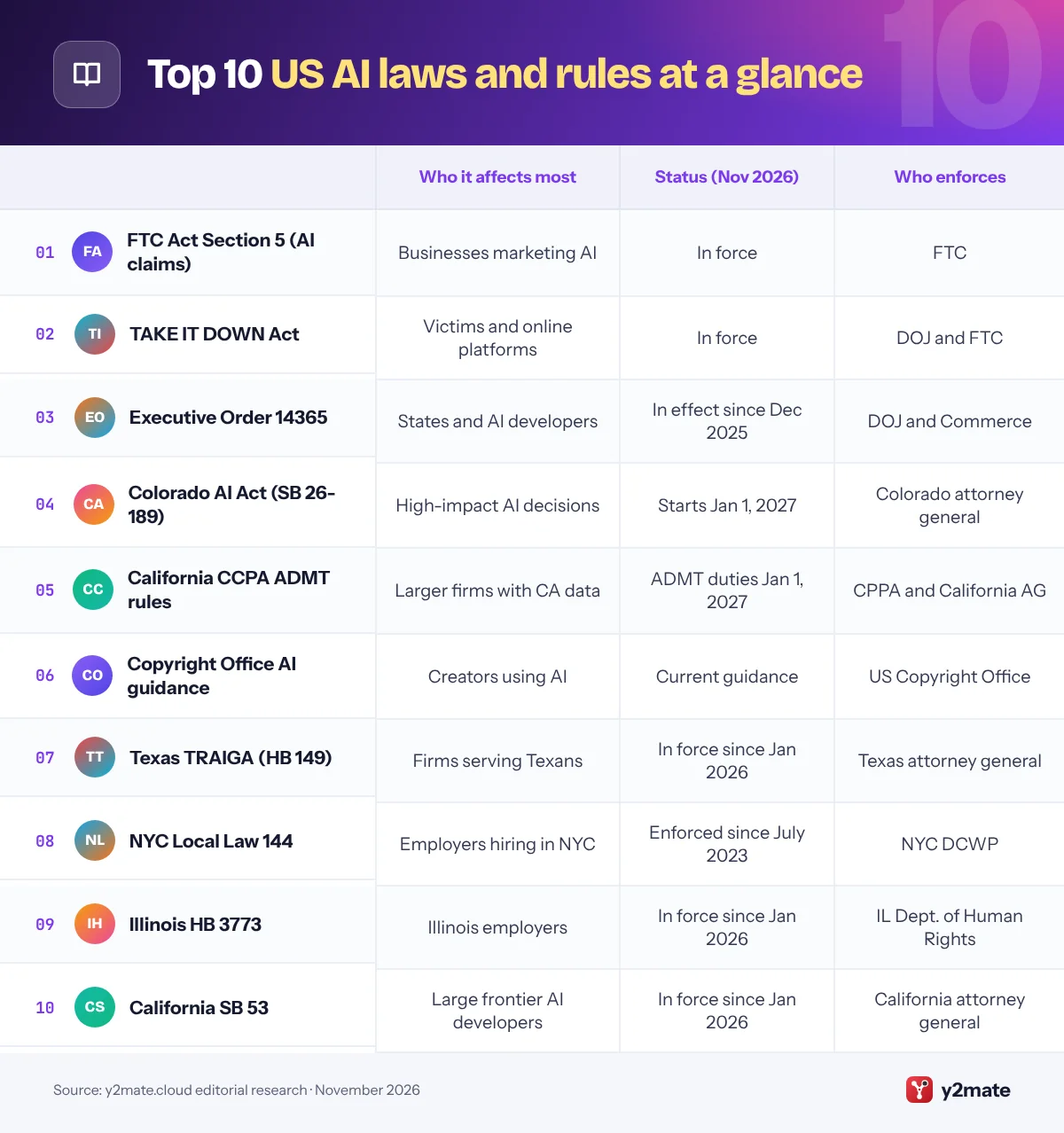
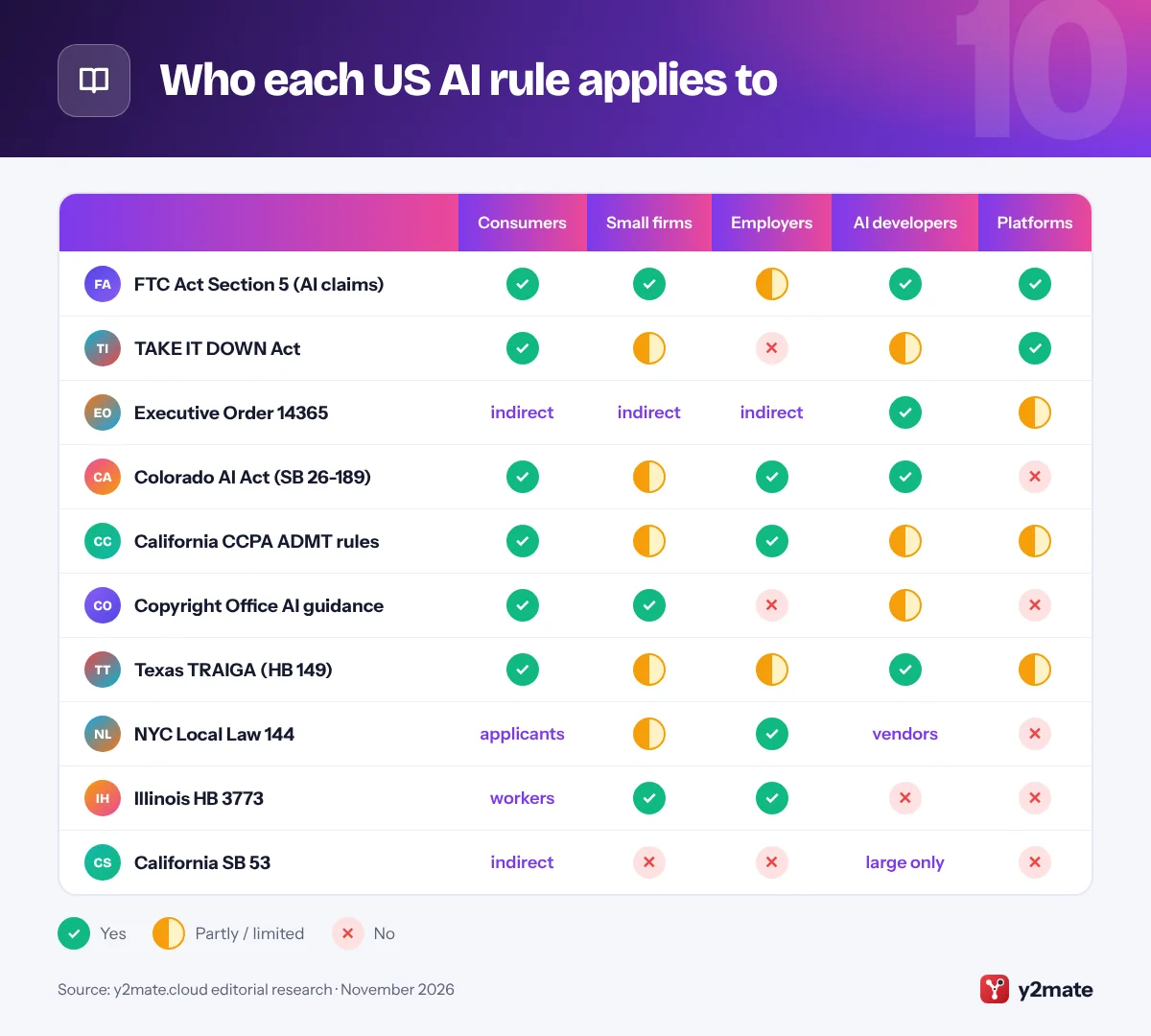
Who each US AI rule applies to
How to keep up with AI laws in the USA
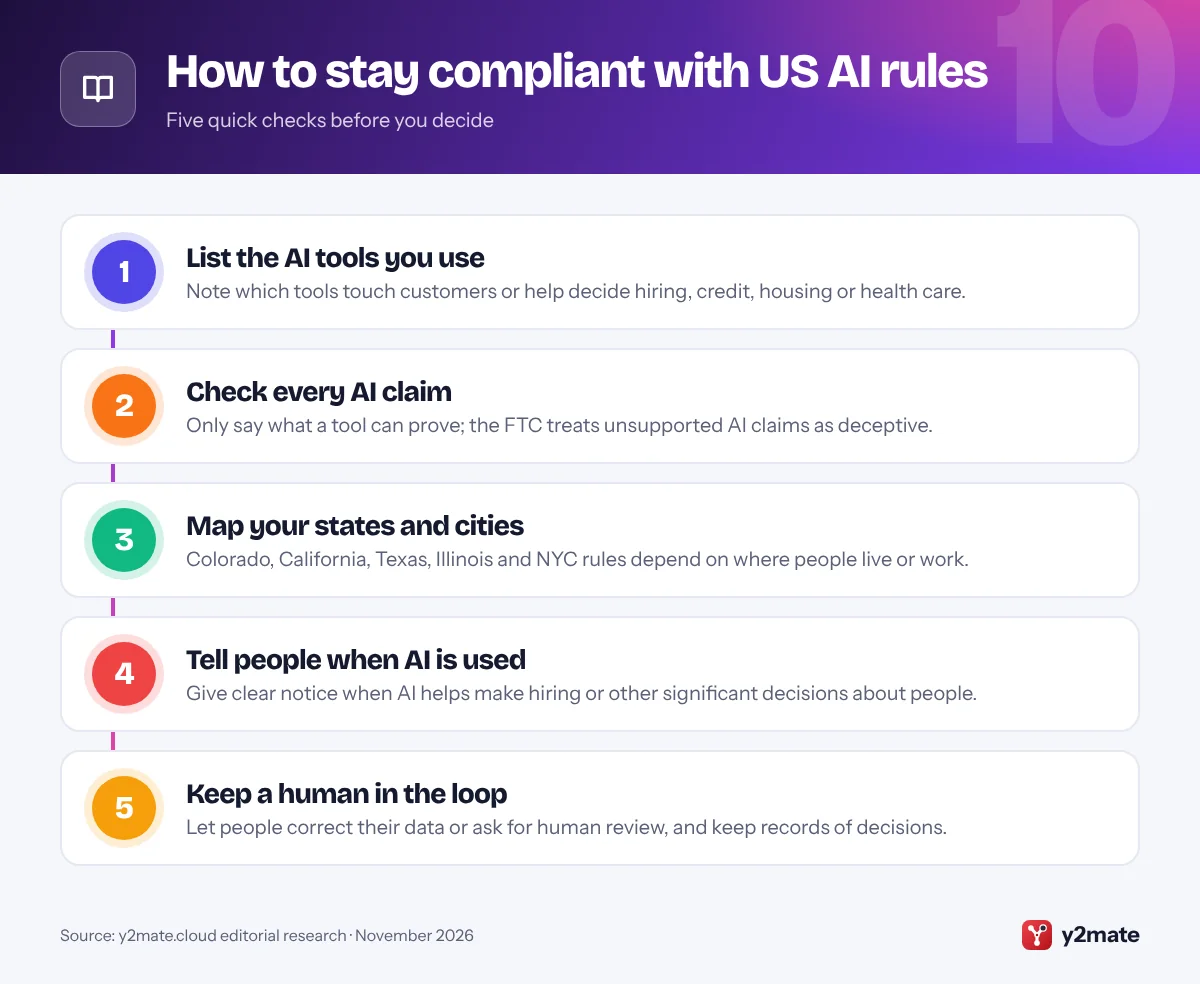
Because AI laws in the USA come from many sources, the most useful habit is to map how you use AI against the places you operate. Start with the federal rules that apply everywhere, then add the state and city rules for wherever your customers and staff are.
Rules that apply almost everywhere
- Honest marketing: the FTC Act covers every claim you make about AI, and the FTC’s rule on fake reviews covers AI-written ones.
- AI voices on the phone: since February 2024 the FCC has treated AI-generated voices as artificial voices under the Telephone Consumer Protection Act, so automated calls using cloned or synthetic voices generally need the person’s prior express consent.
- Fair treatment: federal anti-discrimination, fair lending and fair housing laws apply whether a person or an algorithm makes the decision.
State and local rules to check
Prepare for Colorado’s new law and California’s ADMT rules before January 2027, check Texas TRAIGA if you serve Texans, and follow the New York City and Illinois rules if you hire there. California’s companion chatbot law and AI Transparency Act add duties for chatbot operators and large generative AI providers. Congress has debated bills on AI chatbots and children, but none had become law by November 2026, so watch for changes in 2027.
Frequently asked questions
Is there a federal AI law in the USA?
No. As of November 2026 there is no single federal AI law. Instead, existing federal laws such as the FTC Act and civil rights laws apply to AI, the TAKE IT DOWN Act targets AI-made intimate images, executive orders set federal policy, and states including Colorado, California, Texas and Illinois have their own AI laws.
Can I copyright something I made with AI in the US?
Only the parts that reflect your own creative input. The US Copyright Office says prompts alone are not enough to make you the author of AI output, and courts have upheld the rule that copyright needs a human author. Your own writing, edits and creative selection or arrangement of AI material can be protected, and you must disclose substantial AI-generated content when you register a work.
What can I do if someone posts an AI deepfake nude of me?
Under the TAKE IT DOWN Act, covered platforms must remove non-consensual intimate images, including AI-generated ones, within 48 hours of a valid request, so use the platform's removal process and keep screenshots and links as evidence. Knowingly publishing such images is a federal crime, so you can also report it to the police, and you can complain to the FTC if a platform ignores you.
Do I have to tell job applicants that I use AI in hiring?
It depends on where you hire. New York City requires advance notice and an annual bias audit for automated hiring tools, Illinois requires employers to notify workers when AI is used in employment decisions, and Colorado's law will require notices for consequential decisions from 2027. Even where no notice law applies, federal anti-discrimination laws still cover AI-assisted hiring decisions.
Does the AI executive order cancel state AI laws?
No. Executive Order 14365, signed in December 2025, directs federal agencies to challenge state AI laws they see as burdensome, but an executive order cannot repeal a state law by itself. Only Congress or the courts can override state laws, and as of November 2026 neither had done so for a state AI law, so keep following the state rules that apply to you.
Final verdict
AI laws in the USA are a patchwork rather than a single rulebook, but the core duties are consistent: be honest about what AI does, do not use it to discriminate or deceive, and act fast on harmful deepfakes. The FTC Act and the TAKE IT DOWN Act apply everywhere, while several states and New York City add duties for decisions about people.
In 2027, watch whether Colorado’s law and California’s ADMT rules start on schedule, and whether Congress or the courts act on the push to override state AI laws.
Sources and further reading
- Copyright Office AI report, Part 2: The US Copyright Office's report on when works made with generative AI can be protected by copyright and why prompts alone are not enough.
- CRS explainer on TAKE IT DOWN: A Congressional Research Service summary of the federal law on non-consensual intimate images, including AI-generated digital forgeries and platform removal duties.
- FCC ruling on AI voices: The FCC's ruling that AI-generated voices count as artificial voices under the Telephone Consumer Protection Act, so robocalls using them need prior consent.
- NIST AI Risk Management Framework: The voluntary federal framework many organizations use to identify and manage AI risks, which Texas TRAIGA recognizes as a helpful defense.

Leave a Reply