
- The IRS treats crypto as property, so selling it, trading it for another digital asset or spending it can create a capital gain or loss that you must report.
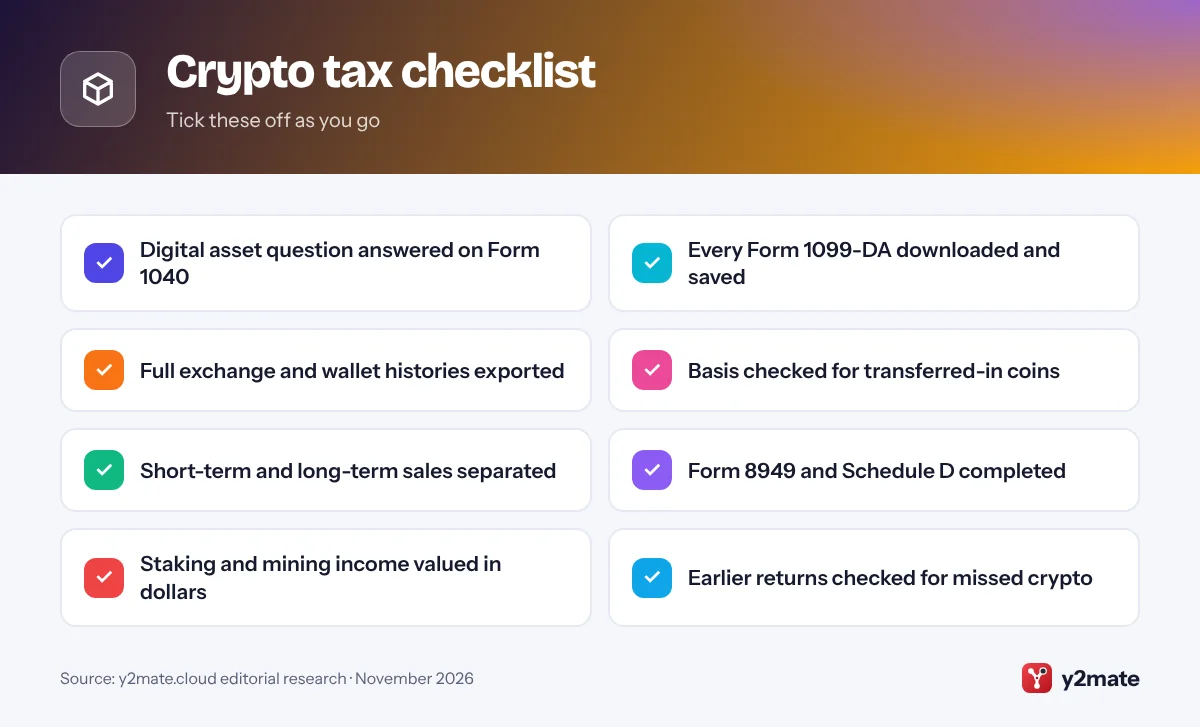
- You can generally answer No to the digital asset question on Form 1040 if you only bought crypto with dollars and held it, or moved it between your own wallets without paying a fee in crypto.
- Custodial brokers report gross proceeds on Form 1099-DA for sales from January 1, 2025, and must also report cost basis for crypto acquired after 2025 and held at the same broker until it is sold.
- Staking and mining rewards are ordinary income at their US dollar value when you gain control of them, reported on Schedule 1 or, for a business, Schedule C.
- Since January 1, 2025, cost basis is tracked separately for each wallet or account, so keep your own records even when you receive a Form 1099-DA.
To report crypto on taxes in the USA, answer the digital asset question on Form 1040, list every time you sold, swapped or spent crypto, work out each gain or loss from your cost basis, and enter the results on Form 8949 and Schedule D. Staking and mining rewards, and crypto you were paid, go on Schedule 1 or Schedule C as income. For tax year 2026, which you file in the 2027 filing season, many exchanges will also send you a Form 1099-DA.
The IRS treats cryptocurrency, stablecoins and NFTs as digital assets, which are property, not currency, so swapping coins or paying with crypto can create a taxable gain or loss. This guide for everyday holders explains each step, what the new Form 1099-DA shows and does not show, and the scams that target crypto holders at tax time.
Important: this is general information, not tax or legal advice. Rules can change, so check the IRS digital assets page before you file, and for complex situations talk to a CPA, an enrolled agent or a tax attorney.
Level: Intermediate · Time needed: 1 to 3 hours
What you need
- Every Form 1099-DA and other tax form from crypto platforms you used in 2026
- Full transaction histories (CSV exports) from every exchange and wallet
- Your records of what you paid for each coin, in US dollars, and when
- The addresses of any self-custody wallets you control
- Your 2025 tax return, to check for capital loss carryovers
- Tax software, crypto tax software or a tax professional
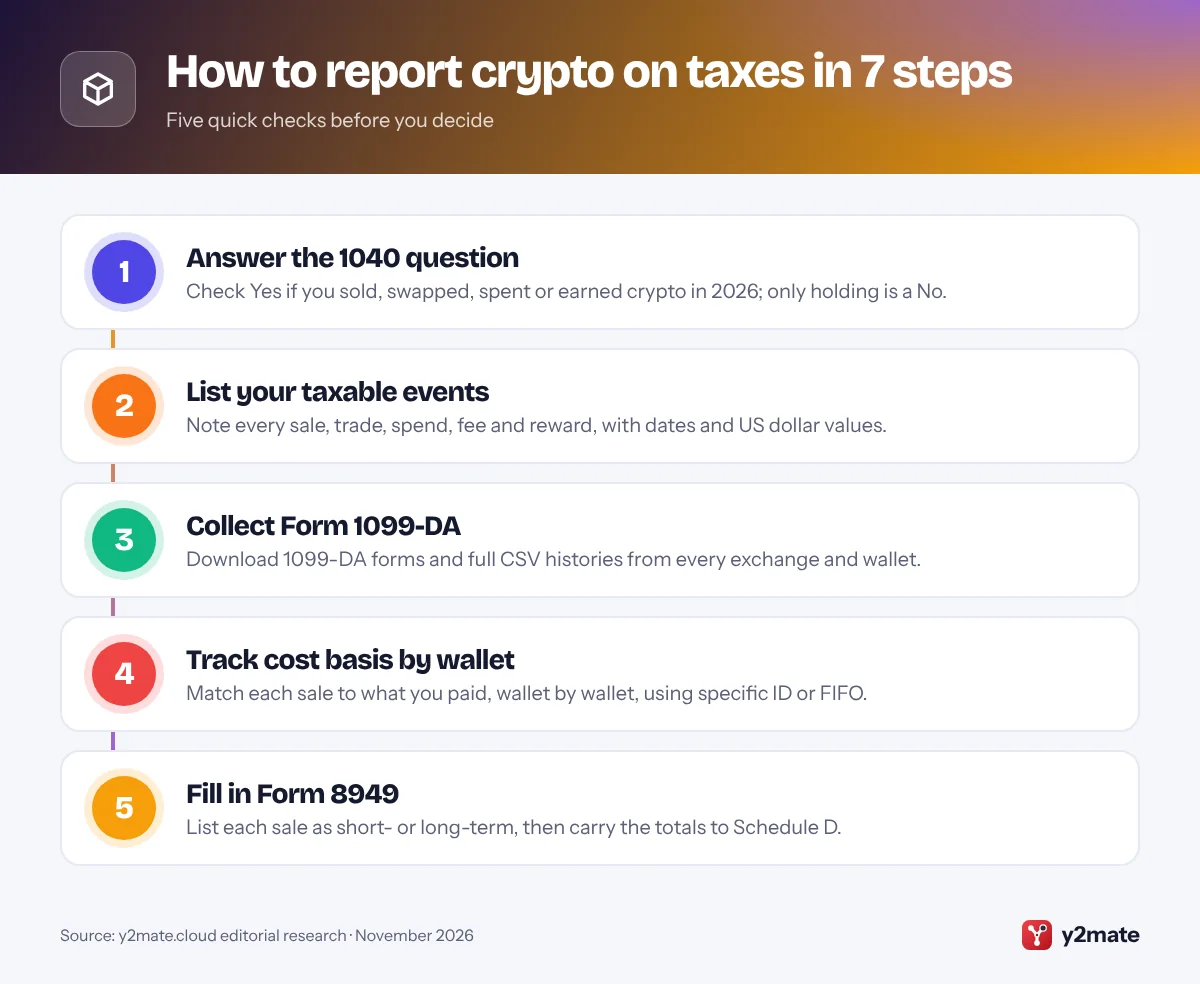
Step 1: Answer the Digital Asset Question on Form 1040
Form 1040 and Form 1040-SR ask a yes-or-no question about digital assets, and you must answer it even if you owe no tax. It asks whether, during the year, you received a digital asset as a reward, award or payment, or sold, exchanged or otherwise disposed of one.
According to the IRS, check Yes if during 2026 you:
- Sold crypto for dollars or traded it for another crypto, including a stablecoin
- Spent crypto on goods or services, in any amount
- Received crypto from staking, mining, an airdrop after a hard fork, or as pay
- Paid a transfer or network fee in crypto
You can usually check No if you only held crypto, bought it with dollars without selling, or moved it between your own wallets or accounts without paying a fee in crypto. If you are unsure, use the short questionnaire on the IRS digital assets page.
Step 2: List Every Taxable Crypto Event From 2026
Because crypto is property, each time you dispose of it or receive it as income is a taxable event. Go through every account and wallet and list:
- Sales for dollars, including cash-outs to your bank
- Trades of one crypto for another, such as bitcoin for a stablecoin
- Purchases of goods or services paid for with crypto
- Fees paid in crypto, which count as small disposals
- Income from staking, mining, airdrops or work
Buying with dollars, holding, and moving crypto between your own wallets are usually not taxable. Giving crypto as a gift has its own rules and can require a gift tax return (Form 709).
For each event, note the asset, units, date and time, and US dollar value: the IRS says you need these, plus your cost basis, to figure each gain or loss.
Step 3: Collect Form 1099-DA and Your Exchange Records
Form 1099-DA, Digital Asset Proceeds From Broker Transactions, is the new form that custodial brokers, such as trading platforms, some hosted wallet providers and crypto kiosks, use to report your crypto sales to you and the IRS. Brokers must report gross proceeds for sales from January 1, 2025, so the first forms arrived in early 2026.
For sales in 2026, brokers must also report cost basis, but only for covered securities: crypto acquired after 2025 in that account and kept there until it was sold. Coins bought earlier, or transferred in from elsewhere, are noncovered, so basis may be left blank. Brokers generally must send these statements by February 15 of the following year, or the next business day.
Decentralized platforms and self-custody wallets do not send a 1099-DA, and Congress repealed a separate DeFi broker rule in April 2025. You must still report every taxable transaction, so download full histories from every account.
Step 4: Track Your Cost Basis Wallet by Wallet
Your cost basis is generally what you paid in US dollars, including fees. For crypto received as income, it is the value you reported as income.
Since January 1, 2025, basis is tracked separately for each wallet or exchange account, not across all your holdings. A one-time safe harbor in Rev. Proc. 2024-28 let you allocate leftover basis to each wallet as of that date, with deadlines tied to your first 2025 sale and your 2025 return; if you are unsure whether you completed it, ask a tax professional.
When you sell part of a holding, the units sold are chosen by:
- Specific identification: you name the units, such as by purchase date or price, by the time of the sale.
- FIFO (first in, first out): the default, using the earliest units in that wallet or account.
For crypto held at a broker, IRS Notice 2026-20 lets you record your choice in your own books for sales through December 31, 2026. Unless that relief is extended, later sales need the choice given to the broker, for example as a standing order.
Step 5: Report Crypto on Taxes With Form 8949 and Schedule D
Each sale, trade or spend goes on Form 8949, Sales and Other Dispositions of Capital Assets, with a description, the dates acquired and sold, proceeds, basis, any adjustment and the gain or loss. Use Part I for crypto held one year or less (short-term) and Part II for crypto held more than one year (long-term).
Since the 2025 form, Form 8949 has separate checkboxes for digital assets:
- Box G or J: your 1099-DA shows basis was reported to the IRS
- Box H or K: you got a 1099-DA, but basis was not reported
- Box I or L: you did not get a 1099-DA
Do not use boxes C or F for crypto. Enter proceeds exactly as your 1099-DA shows them, use its basis if basis was reported, and make any corrections in the adjustment column with the right code. The totals flow to Schedule D and then to Form 1040. Check the 2026 instructions for any changes.
Step 6: Report Staking, Mining and Other Crypto Income
Crypto you receive as income is ordinary income at its fair market value in US dollars when you receive it, and that value becomes your cost basis in those coins.
- Staking: under Rev. Rul. 2023-14, rewards are income when you gain dominion and control over them, meaning you can sell or otherwise dispose of them, including when you stake through an exchange.
- Mining: income at its value on the date you receive it.
- Airdrops after a hard fork: income when you receive and control the new coins.
- Pay for work: reported as wages if you are an employee, or on Schedule C if you are an independent contractor.
The IRS points to Schedule 1 (Form 1040) for income from staking, mining and forks. If your crypto activity is a trade or business, use Schedule C instead; net earnings are then also subject to self-employment tax on Schedule SE.
Step 7: Keep Good Records and Fix Past Mistakes
The IRS expects records that support your return: each purchase, receipt, sale, exchange or other disposal, plus the dollar value of any crypto you received as income. Save your Forms 1099-DA, exchange CSVs, wallet addresses, transaction IDs, lot choices and any Rev. Proc. 2024-28 allocation notes. Keep basis records until the period of limitations ends for the year you sell the crypto, not just the year you buy it.
If you left crypto off an earlier return or answered the digital asset question incorrectly, you can generally file Form 1040-X for each affected year with corrected forms attached. To claim a refund, the IRS says you generally must amend within three years after filing the original return or two years after paying the tax, whichever is later. If several years are involved, speak to a CPA, enrolled agent or tax attorney first.
How Crypto Taxes Are Calculated in the US
For each disposal, your gain or loss is what you received, less transaction costs, minus your cost basis.
- Short-term gains (held one year or less) are taxed as ordinary income at your normal rates.
- Long-term gains (held more than one year) may qualify for lower capital gains rates.
Capital losses offset capital gains first. If your losses are larger, IRS Topic 409 says you can deduct up to $3,000 of the excess against other income each year ($1,500 if married filing separately) and carry the rest forward.
What is crypto tax-loss harvesting?
It means selling assets that have fallen in value to realize losses that offset gains. The wash sale rule, which blocks a loss when you buy back substantially identical stock or securities around the sale, is written for stock and securities, and the 2026 Form 1099-DA instructions mention wash sales only for tokenized securities. This area can change, so check IRS guidance or ask a professional first.
Stolen, Hacked or Scammed Crypto: Can You Deduct It?
Relief is limited. According to IRS Topic 515, since tax year 2018 individuals generally cannot deduct personal theft losses unless they are linked to a federally declared disaster; the IRS says state-declared disasters can also count from 2026. A theft loss from a trade or business, or from a transaction entered into for profit, may still be deductible on Form 4684, if the theft was illegal under state law and done with criminal intent.
A March 2025 IRS Chief Counsel memo (202511015) concluded that some victims of investment-style scams may qualify, while victims of romance or kidnapping scams cannot. That memo looked at the rules for 2018 through 2025, and the facts matter, so get professional help. Report the crime, for example to the FBI’s IC3, and keep every record.
Watch Out for IRS and Crypto Tax Scams
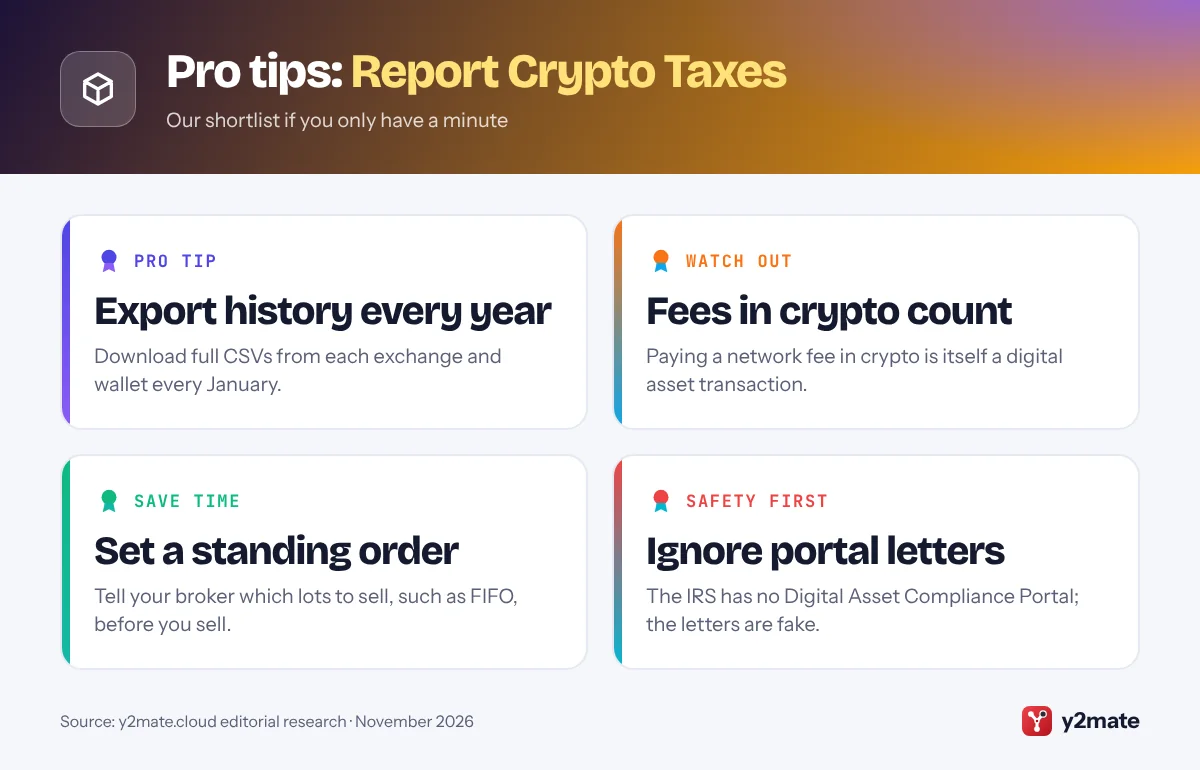
In July 2026, IRS Criminal Investigation warned about fake IRS letters telling crypto holders to scan a QR code and register on a Digital Asset Compliance Portal. The IRS runs no such portal and does not require you to register crypto; the fake site steals wallet details and exchange logins.
Know how the real IRS works:
- It normally contacts you first by US mail.
- It never sends social media direct messages, and emails or texts only if you opt in.
- A call that rushes you, threatens you or demands payment now is not from the IRS. Pay only through IRS.gov/payments, never in crypto, gift cards or wire transfers to a caller.
- Be wary of surprise letters about an unclaimed refund, a known IRS impersonation trick.
Never share a seed phrase or private key. See the IRS tax scams page and our guide on how to keep your crypto safe.
Should You Use Crypto Tax Software or a Tax Professional?
Crypto tax software imports your exchange and wallet histories, matches transfers between your own accounts, calculates basis and gains, and produces reports for Form 8949. It saves time if you have many trades, but check that transfers between your own wallets are not counted as sales. Compare options in our Top 10 Crypto Tax Software in the USA.
Consider a CPA, an enrolled agent or a tax attorney if you run a crypto business, use DeFi lending or liquidity pools, lost crypto to theft, have unreported past years, or received an IRS letter about digital assets.
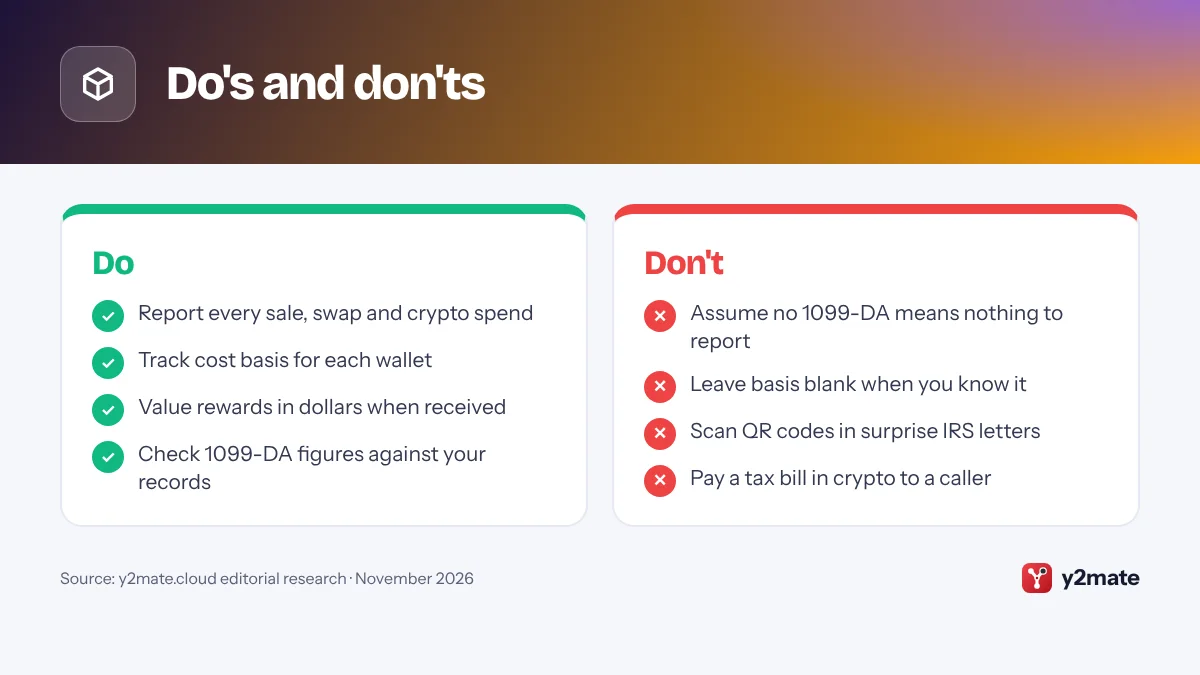
Do's and don'ts
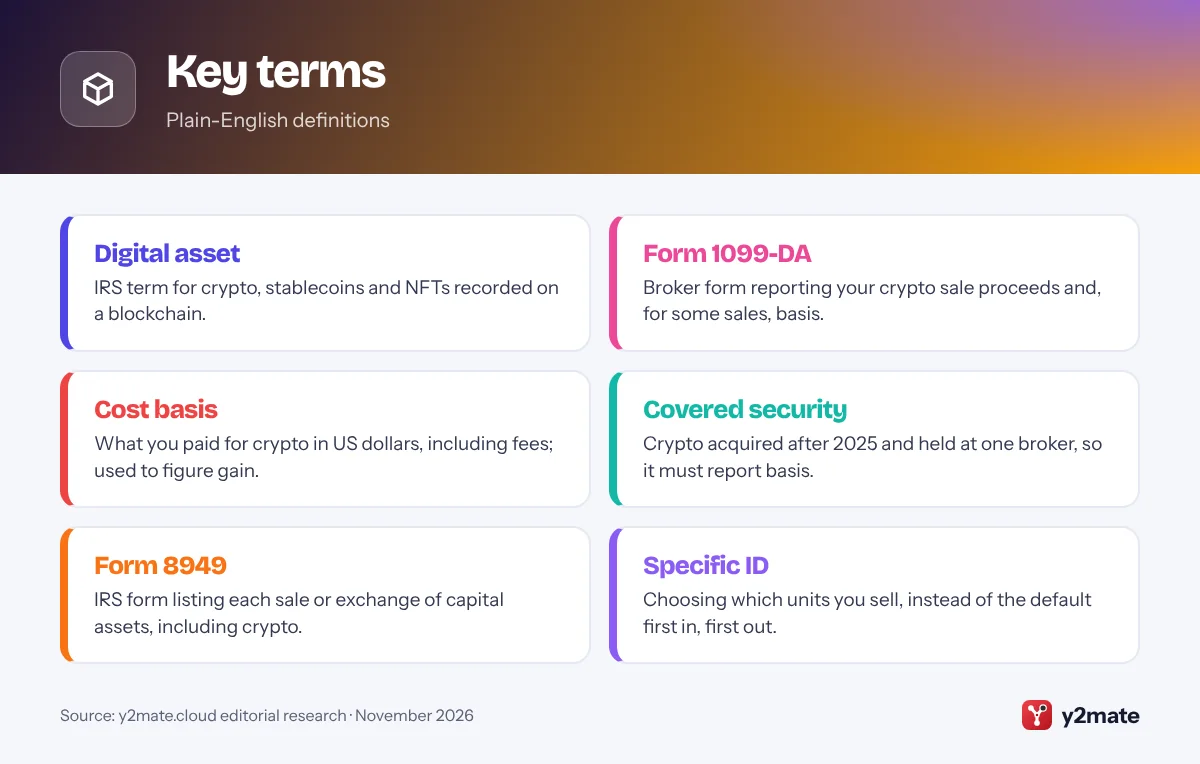
Key terms
Troubleshooting
Your Form 1099-DA shows no cost basis
This is expected for coins bought before 2026 or transferred in. Check box H or K on Form 8949 and enter your own basis; a blank basis can make the whole sale look like profit.
You did not get a Form 1099-DA
You still must report every taxable transaction. Check your exchange’s tax documents page in case the form is online only; otherwise use box I or L on Form 8949.
Your 1099-DA does not match your records
Transfers, fees and lot choices can cause differences; Notice 2026-20 notes that broker-reported basis may not match lots you identified in your own books. Report the proceeds shown, correct basis in the adjustment column and keep your evidence. If the broker erred, ask for a corrected form.
You cannot find old purchase records
Download histories from every exchange, including closed accounts, and check bank statements and blockchain explorers. If gaps remain, ask a tax professional how to document a reasonable basis.
Frequently asked questions
Do I need to report crypto on my taxes if I lost money?
Yes. The IRS says you must report digital asset transactions whether or not they result in a gain or loss, on Form 8949 and Schedule D. Losses offset capital gains, and if losses are larger, you can generally deduct up to $3,000 a year against other income ($1,500 if married filing separately) and carry the rest forward.
Do I have to report crypto I bought but did not sell?
Generally no. If you only bought crypto with US dollars and held it, or moved it between your own wallets without paying a fee in crypto, the IRS says you can answer No to the digital asset question on Form 1040. Keep your purchase records anyway, because you will need the cost basis when you sell, trade or spend it.
Is crypto reported to the IRS?
Often, yes. Custodial brokers such as centralized exchanges file Form 1099-DA with the IRS and send you a copy. It shows gross proceeds for sales from January 1, 2025, and from 2026 also cost basis for crypto bought and kept at the same broker. Self-custody wallets and DeFi platforms do not file it, but you must still report those transactions.
Where do I report crypto on my tax return?
Answer the digital asset question on Form 1040. List each sale, trade or spend on Form 8949 and carry the totals to Schedule D. Report staking, mining and airdrop income on Schedule 1 as additional income, or on Schedule C if it is part of a business. Crypto wages from an employer are reported as wages on Form 1040.
How do I report crypto mining on my taxes?
Mined crypto is income at its fair market value in US dollars on the date you receive it. If mining is not a business, the IRS points to Schedule 1 as additional income. If it is a trade or business, report it on Schedule C and figure self-employment tax on Schedule SE. The value you report becomes your cost basis in those coins.
What happens if I forgot to report crypto on my taxes?
You can generally correct it by filing Form 1040-X, the amended return, for each affected year, with a corrected Form 8949, Schedule D and any income schedules attached. If you owe more tax, paying sooner can limit interest and penalties. For several years of unreported activity or large amounts, talk to a CPA, enrolled agent or tax attorney before you file.
How are crypto taxes calculated in the US?
Each time you sell, trade or spend crypto, subtract your cost basis from what you received after transaction costs. The result is a capital gain or loss. Crypto held one year or less gives short-term gains, taxed at ordinary income rates; crypto held longer gives long-term gains, which may qualify for lower rates. Staking and mining rewards are ordinary income when received.
Wrapping up
To report crypto on taxes for 2026, answer the digital asset question, gather your Forms 1099-DA and full histories, fill cost basis gaps wallet by wallet, then report sales on Form 8949 and Schedule D and rewards on Schedule 1 or Schedule C. Start early: finding basis for older or transferred coins takes longest.
The rules are still being phased in, so check IRS.gov before you file and get professional help for anything complex. This is general information, not tax advice. Choosing where to trade? See our Top 10 Crypto Exchanges in the USA.
Sources and further reading
- IRS digital assets page: The IRS explains how to answer the digital asset question on Form 1040 and which forms to use for crypto gains and income.
- About Form 1099-DA: The official IRS page for Form 1099-DA, Digital Asset Proceeds From Broker Transactions, with the current form and its instructions.
- About Form 8949: The IRS page for Form 8949 and its instructions, including the separate checkboxes for short-term and long-term digital asset transactions.
- IRS digital asset FAQs: IRS answers on cost basis, wallet-by-wallet identification, standing orders and the Rev. Proc. 2024-28 safe harbor for transactions from 2025.
- IRS tax scams page: The IRS lists current tax scams, including fake Digital Asset Compliance Portal letters aimed at crypto holders, and how to report them.

Leave a Reply