- There is no single federal license for crypto exchanges in the USA: platforms register with FinCEN as money services businesses and need money transmitter licenses in most states, plus a BitLicense or trust charter to serve New York.
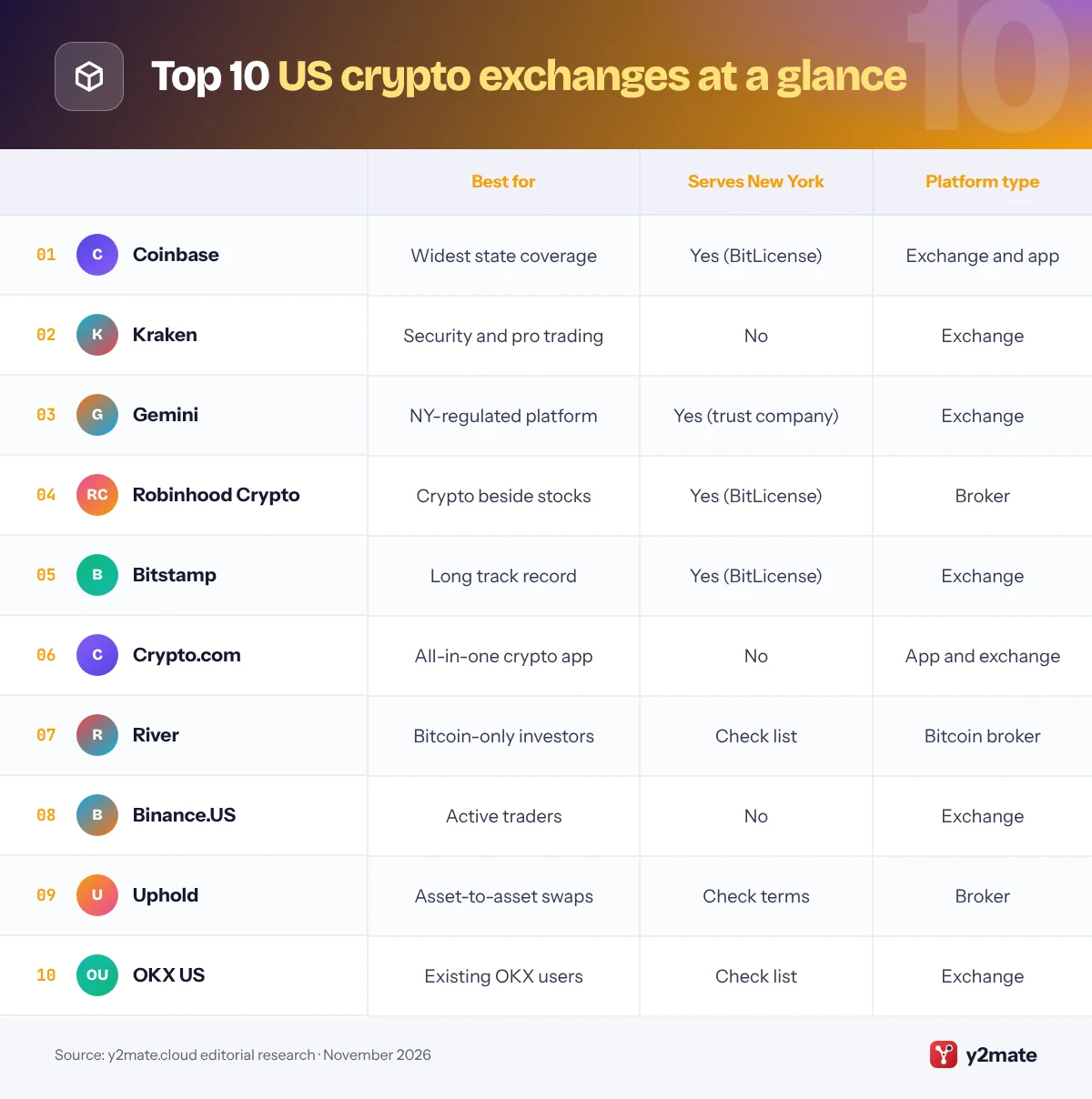
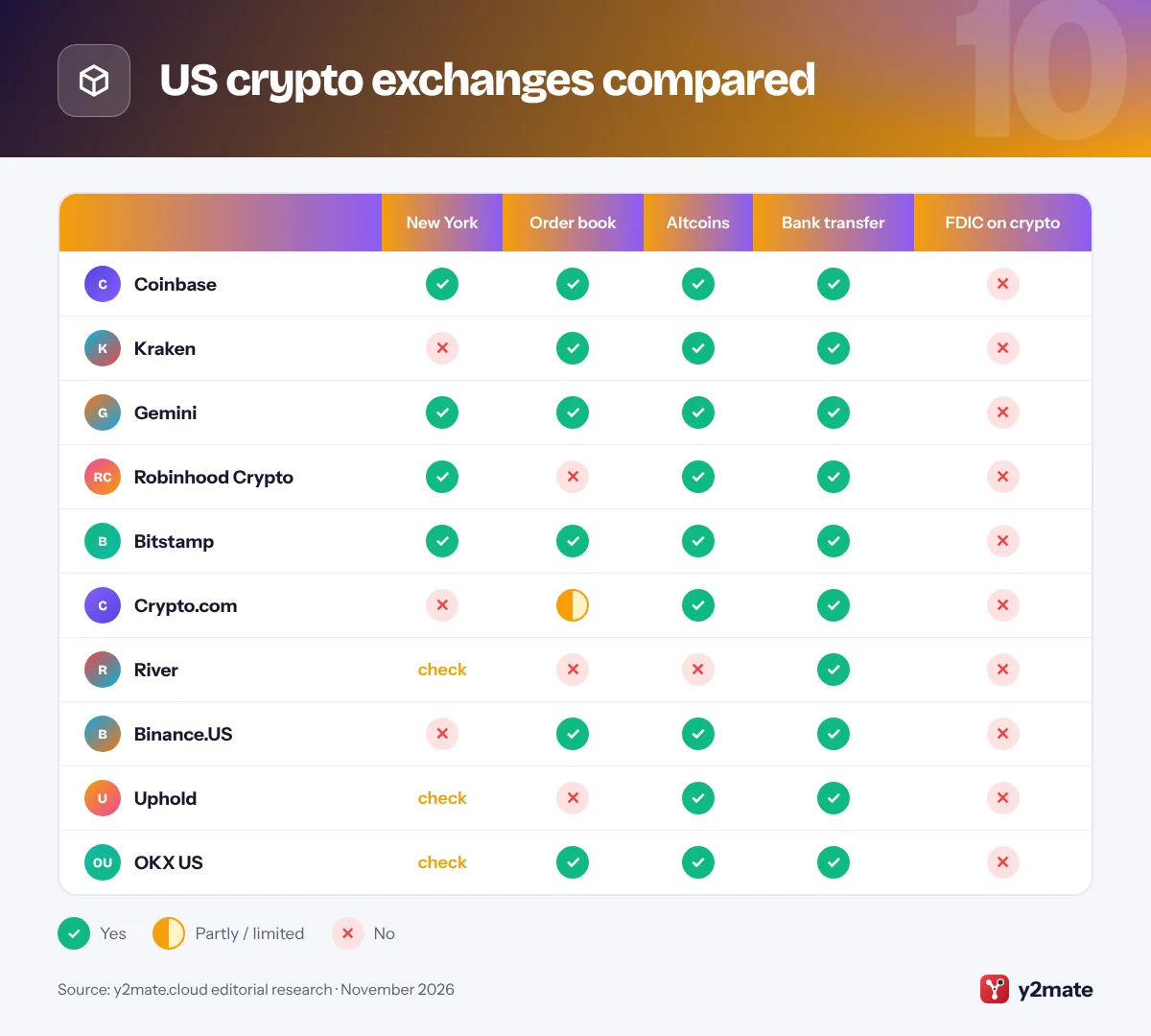
- Coinbase, Gemini, Robinhood Crypto and Bitstamp can serve New York residents, while Kraken, Crypto.com and Binance.US do not.
- Crypto held on an exchange is not covered by FDIC deposit insurance, and SIPC protection does not extend to crypto that is not a registered security.
- The GENIUS Act, signed in July 2025, created federal rules for payment stablecoins, but the broader CLARITY Act for crypto trading had not passed the Senate as of early November 2026.
- US brokers, including crypto exchanges, now send customers Form 1099-DA, and basis reporting applies to many sales made from 2026 onward.
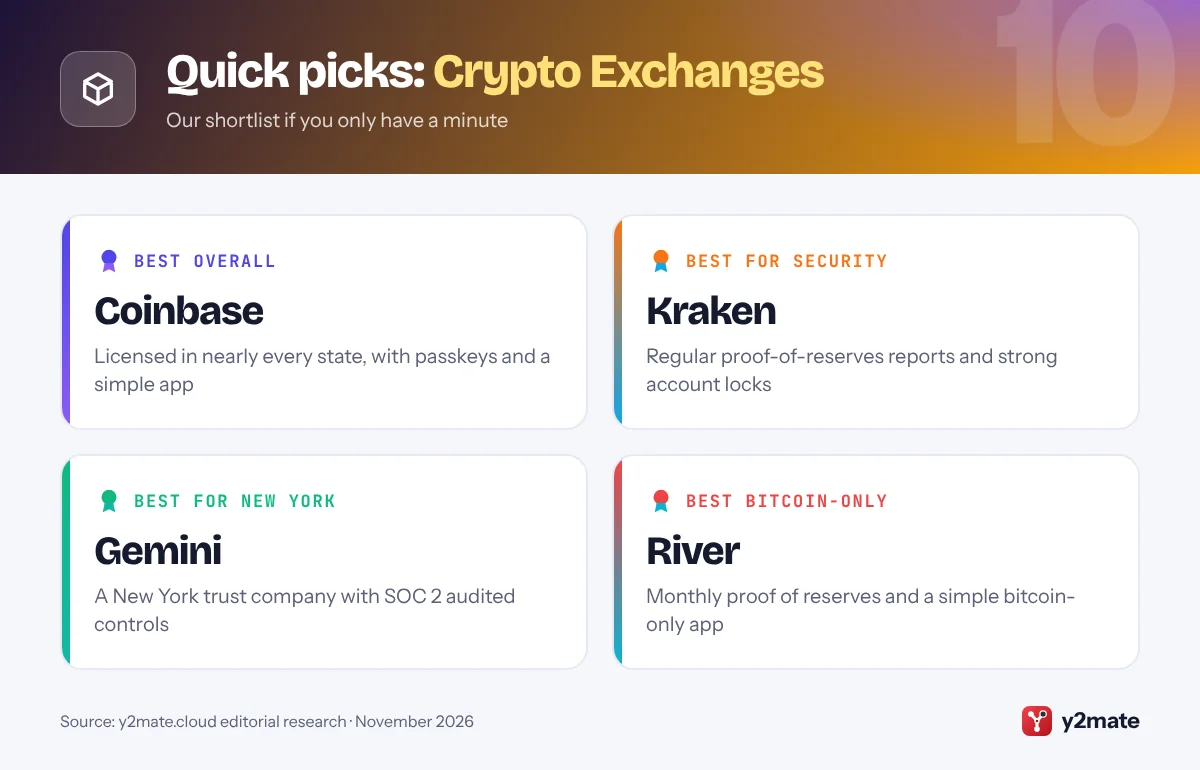
The best crypto exchanges in the USA in 2026 are Coinbase for the widest state coverage and strong account security, Kraken for its long security record and regular proof-of-reserves reports, and Gemini for a New York-regulated, US-focused platform. Robinhood Crypto suits beginners who want crypto beside their stocks, River is the pick for bitcoin-only buyers, and Bitstamp, Crypto.com, Binance.US, Uphold and OKX US each fill a narrower niche. Availability depends on your state, so always check that a platform serves where you live.
A few terms first. A crypto exchange matches buyers and sellers on an order book, while a broker sells you crypto at a quoted price and handles the trade behind the scenes. A wallet stores the keys that control your coins. When an exchange or broker holds those keys for you, that is custody: convenient, but you depend on the company’s security and honesty.
The US has no single federal license for crypto platforms. Exchanges register with FinCEN, the Treasury’s anti-money-laundering bureau, as money services businesses, and most states also require a money transmitter license. New York goes further with its BitLicense, issued by the Department of Financial Services (NYDFS). Crypto is volatile, it is not covered by FDIC deposit insurance, and you can lose money, so consider your own situation and never invest more than you can afford to lose. This article is general information, not financial advice.
How we ranked this list
We compared publicly documented information for each platform: its federal and state registrations, including whether it can serve New York, the security practices it publishes (cold storage, proof of reserves, passkeys and hardware security keys), the US payment methods it accepts, how easy its app is for beginners and experienced traders, and how customers can reach support. We also weighed recent regulatory actions, settlements and ownership changes, such as Robinhood’s purchase of Bitstamp.
We did not carry out hands-on testing, and we do not quote fees, prices or trading volumes, which change constantly. Nothing here is a recommendation to buy any crypto asset. Check each platform’s own state availability page and current terms before you sign up.
The Top 10 Crypto Exchanges
1. Coinbase
Best for: the widest state coverage and strong security
Coinbase is the largest US-based crypto exchange and a Nasdaq-listed public company, so it publishes audited financial statements every quarter. It holds a New York BitLicense and money transmitter licenses in the states that require them, which makes it available to more Americans than almost any rival, including New Yorkers. Beginners can use the simple app, while Coinbase Advanced adds an order book, detailed charts and more order types.
Coinbase supports passkeys, hardware security keys and authenticator-app verification, and says it keeps the vast majority of customer crypto in offline cold storage. You can fund an account by ACH bank transfer, wire, debit card or PayPal, and withdraw coins to your own wallet whenever you like. In 2025 the SEC dropped the lawsuit it had filed against Coinbase in 2023.
The main caution is the data breach Coinbase disclosed in May 2025: criminals bribed overseas customer support contractors to copy some customers’ personal details. Coinbase said passwords and private keys were not exposed, refused to pay the ransom demand and fired the staff involved. Products, staking and some coins also vary by state, so check what is offered where you live before you deposit.
Official site: Coinbase
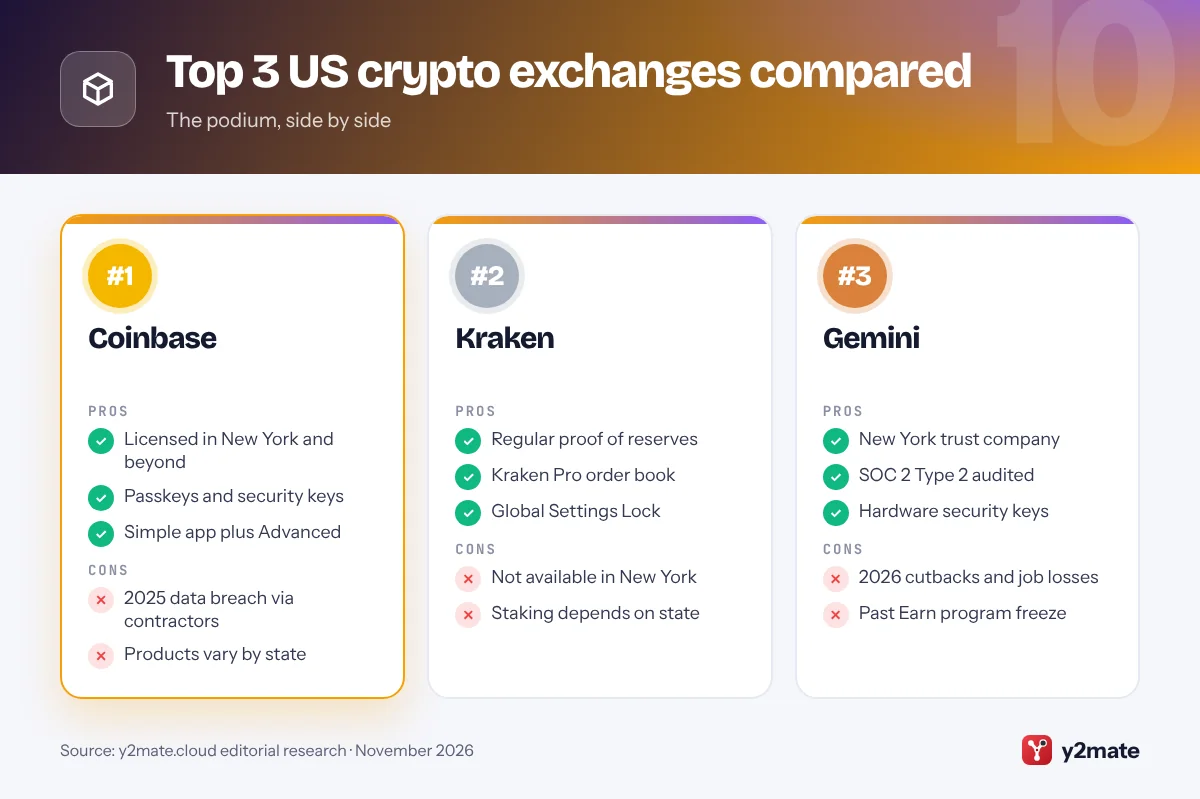
- Licensed widely, including New York
- Passkeys and security keys
- Simple app plus Advanced trading
- 2025 support-contractor data breach
- Some products vary by state
2. Kraken
Best for: security-minded investors and active traders
Kraken, founded in 2011, is one of the longest-running US crypto exchanges and has built its reputation on security. It publishes regular proof-of-reserves reports, in which an outside firm checks that the crypto Kraken holds matches what customers are owed, and you can confirm that your own balance was included. Accounts support hardware security keys, authenticator apps and a Global Settings Lock that blocks changes to sensitive settings.
The Kraken app keeps buying simple, while Kraken Pro offers a full order book, advanced order types and detailed charts. US customers can fund accounts by bank transfer, and Kraken offers round-the-clock customer support. In 2025 the SEC dropped the lawsuit it had filed in 2023 alleging Kraken operated as an unregistered securities exchange, removing a long-running cloud over its US business.
The biggest gap is New York: Kraken stopped serving New York residents in 2015, when the BitLicense took effect, and has not returned. Some products, such as staking, also depend on your state. If you live elsewhere and value published reserves and strong account protection, Kraken is the closest rival to Coinbase and a natural first choice for traders who want a professional interface.
Official site: Kraken
- Regular proof-of-reserves reports
- Kraken Pro order book
- Security keys and settings lock
- Not available in New York
- Some features vary by state
3. Gemini
Best for: a New York-regulated, US-focused platform
Gemini, founded in 2014 by Cameron and Tyler Winklevoss, operates as a New York trust company supervised by NYDFS, which means it is held to capital, custody and compliance standards similar to other regulated financial firms. It became a public company when it listed on Nasdaq in September 2025, and it was among the first crypto exchanges to complete SOC 1 Type 2 and SOC 2 Type 2 examinations, independent audits of its security and internal controls.
The Gemini app is straightforward for beginners, while ActiveTrader offers an order book and advanced charts. Gemini supports hardware security keys, accepts bank transfers and debit cards, and also offers a credit card that pays rewards in crypto. It serves New York residents.
Gemini has had a turbulent few years. Its Earn lending program froze in 2022 when its partner Genesis collapsed, although Earn users got their assets back in 2024. In early 2026 Gemini closed its UK, European and Australian operations and cut staff to concentrate on the US. That focus may suit American customers, but keep an eye on how the business develops before moving large balances.
Official site: Gemini
- New York trust company
- SOC 2 Type 2 audited
- Available in New York
- 2026 cutbacks and job losses
- Past Earn program freeze
4. Robinhood Crypto
Best for: beginners who want crypto beside their stocks
Robinhood Crypto is the crypto arm of the Robinhood investing app, so you can buy and sell crypto in the same place you hold shares and funds. It is a broker rather than an exchange: when you place an order, Robinhood routes it to trading venues and market makers instead of matching it on its own public order book. Robinhood Crypto is licensed by NYDFS, so it is available in New York as well as most other states.
The app is one of the simplest ways to start, with recurring buys and a clean interface. You can also send crypto to an outside wallet or deposit coins from one, and Robinhood offers a separate self-custody app, Robinhood Wallet, for people who want to hold their own keys. Robinhood bought the Bitstamp exchange in June 2025, which adds institutional and international experience to the group.
Remember that SIPC protection on a Robinhood brokerage account covers securities, not crypto, so your coins have no government-backed safety net. The coin range is narrower than on dedicated exchanges, and serious traders may miss order-book tools. If you already invest with Robinhood and want a small, simple crypto allocation, it is a convenient option.
Official site: Robinhood Crypto
- Crypto and stocks in one app
- Licensed in New York
- Transfers to outside wallets
- Broker, not an order book
- Narrower coin range
5. Bitstamp
Best for: a long track record and major coins
Bitstamp, founded in 2011, is often described as the longest continuously operating crypto exchange. Robinhood completed its purchase of the company in June 2025, and it now trades as Bitstamp by Robinhood while keeping its own platform. Bitstamp received a New York BitLicense in 2019, so it can serve New York residents, and it holds licenses and registrations in many other countries.
Bitstamp runs a traditional order-book exchange with a clean web platform and mobile app. It concentrates on established coins rather than listing every new token, which some investors see as a plus. US customers can fund accounts by bank transfer, and there are recurring-buy tools for people who invest a little at a time. Its institutional business serves banks and brokers, which helps explain its focus on compliance.
The US product range is smaller than in Europe, and fewer coins are available than on Coinbase or Kraken. Customer support is mainly online. Robinhood’s ownership adds financial backing, but it is still early days for the combined business. If you want an order-book exchange with a long history and a New York license, Bitstamp deserves a look.
Official site: Bitstamp
- Long operating history
- New York BitLicense
- Order-book exchange
- Smaller US coin range
- Mainly online support
6. Crypto.com
Best for: an all-in-one crypto app outside New York
Crypto.com is a global crypto app that lets US customers buy, sell, send and earn rewards on crypto from a single account, alongside a crypto-linked Visa card. It publishes the security certifications it holds, including ISO/IEC 27001 for information security, and supports two-factor authentication and withdrawal address allowlists. The SEC closed its investigation into Crypto.com in 2025 without taking action.
In February 2026 the Office of the Comptroller of the Currency (OCC) gave conditional approval for Crypto.com’s application to run a national trust bank, which would let it offer custody under federal supervision once fully approved. That does not make it a deposit-taking bank, and the charter does not change how the consumer app works today.
Crypto.com is not available to New York residents, and products vary by state. The app packs in many extras, from rewards to prediction-style markets, which can feel busy if you only want to buy and hold. It works best for people who want spending, trading and wallet tools in one place and who are comfortable switching off the features they do not need.
Official site: Crypto.com
- Wide range of app features
- Published security certifications
- Federal trust charter progress
- Not available in New York
- Busy app with many add-ons
7. River
Best for: bitcoin-only investors who value transparency
River is a US company that deals only in bitcoin, which keeps the product simple and avoids the thousands of tokens that make other apps confusing. It holds money transmitter licenses where states require them and says it serves customers in the large majority of US states, so check its list for yours. River is aimed at people who buy bitcoin regularly and plan to hold it.
River publishes a proof of reserves every month showing that it holds customer bitcoin in full, and customers can verify that their balance is included. It also publishes company financial information, which is unusual for a private firm. Proof of reserves shows the coins exist but does not show every liability, so River pairs it with those financial disclosures. Recurring buys and easy withdrawals to your own wallet are core features.
The trade-off is obvious: there are no other coins, no advanced order book and no extras such as staking. Support is online. If you have decided that bitcoin is the only crypto you want and you value clear transparency reporting, River is one of the most straightforward places to buy it.
Official site: River
- Monthly proof of reserves
- Simple bitcoin-only app
- Easy withdrawals to your wallet
- Bitcoin only
- Not in every state
8. Binance.US
Best for: active traders outside New York
Binance.US is a separate US company that licenses the Binance brand and technology. It is not the same as the global Binance exchange, which agreed to stop serving Americans after its 2023 settlement with US authorities. Binance.US offers an order-book exchange and a simple buy and sell interface, and it holds money transmitter licenses in the states it serves.
The company went through a difficult period after the SEC sued Binance and Binance.US in 2023: banking partners pulled back and US dollar deposits were suspended. The SEC dropped its case in May 2025, and Binance.US restored US dollar deposits and withdrawals the same year. It supports two-factor authentication and withdrawal address allowlists, and it publishes a list of the states where each product is offered.
Binance.US is not available in New York or in several other states, so check its supported-states list before you sign up. Its past regulatory troubles and banking disruptions are a reminder that platform risk is real. It ranks here for active traders who live in a supported state and want a large order-book exchange, but beginners will find simpler choices higher up this list.
Official site: Binance.US
- Order-book exchange
- US dollar deposits restored
- Separate from global Binance
- Not in New York and other states
- History of banking disruption
9. Uphold
Best for: swapping directly between different assets
Uphold is a multi-asset platform built around one idea: you can convert directly from one asset to another in a single step, without first selling to dollars. It acts more like a broker than an exchange, quoting you a price for each trade rather than showing an order book. Uphold has long published a transparency page showing its assets and customer liabilities, an early form of reserve reporting.
US customers can fund accounts by bank transfer and card, and Uphold supports two-factor authentication. The any-to-any conversion model is handy if you hold several assets and want to rebalance between them quickly, and you can withdraw supported coins to an outside wallet when you want to hold your own keys.
In April 2026 the New York Attorney General announced a settlement under which Uphold agreed to compensate customers who lost money in CredEarn, a crypto lending product from a company called Cred that Uphold had offered before Cred collapsed in 2020. Uphold disputed the Attorney General’s account of its role. Check whether Uphold serves your state and read its current terms. It ranks lower because of that history and its broker-style model.
Official site: Uphold
- Direct asset-to-asset swaps
- Public transparency page
- Bank transfer and card funding
- 2026 New York settlement
- Broker-style pricing model
10. OKX US
Best for: OKX users who want a US-licensed account
OKX is one of the world’s largest crypto exchanges, and in April 2025 it launched a dedicated US platform, folding in its former US brand Okcoin and opening a regional headquarters in San Jose, California. US customers get an order-book exchange plus access to OKX Wallet, a self-custody wallet that works with many blockchains.
The OKX group publishes monthly proof-of-reserves reports, letting customers check that their balances are backed, and its accounts support passkeys and authenticator apps. The US platform is rolling out state by state, so confirm that it serves where you live and which features are included.
Context matters here. In February 2025 OKX pleaded guilty in US federal court to operating an unlicensed money transmitting business, after prosecutors said it had served US customers without the required registration, and it agreed to pay large penalties. The US launch followed that settlement. OKX US now operates under state licensing, but its track record as a regulated US business is short, which is why it sits at the bottom of this list. It suits experienced users who already know OKX and want a compliant US account.
Official site: OKX US
- Monthly proof-of-reserves reports
- OKX Wallet for self-custody
- Order-book exchange
- 2025 guilty plea in US court
- Short US track record
US crypto exchanges compared
How to choose between crypto exchanges in the USA
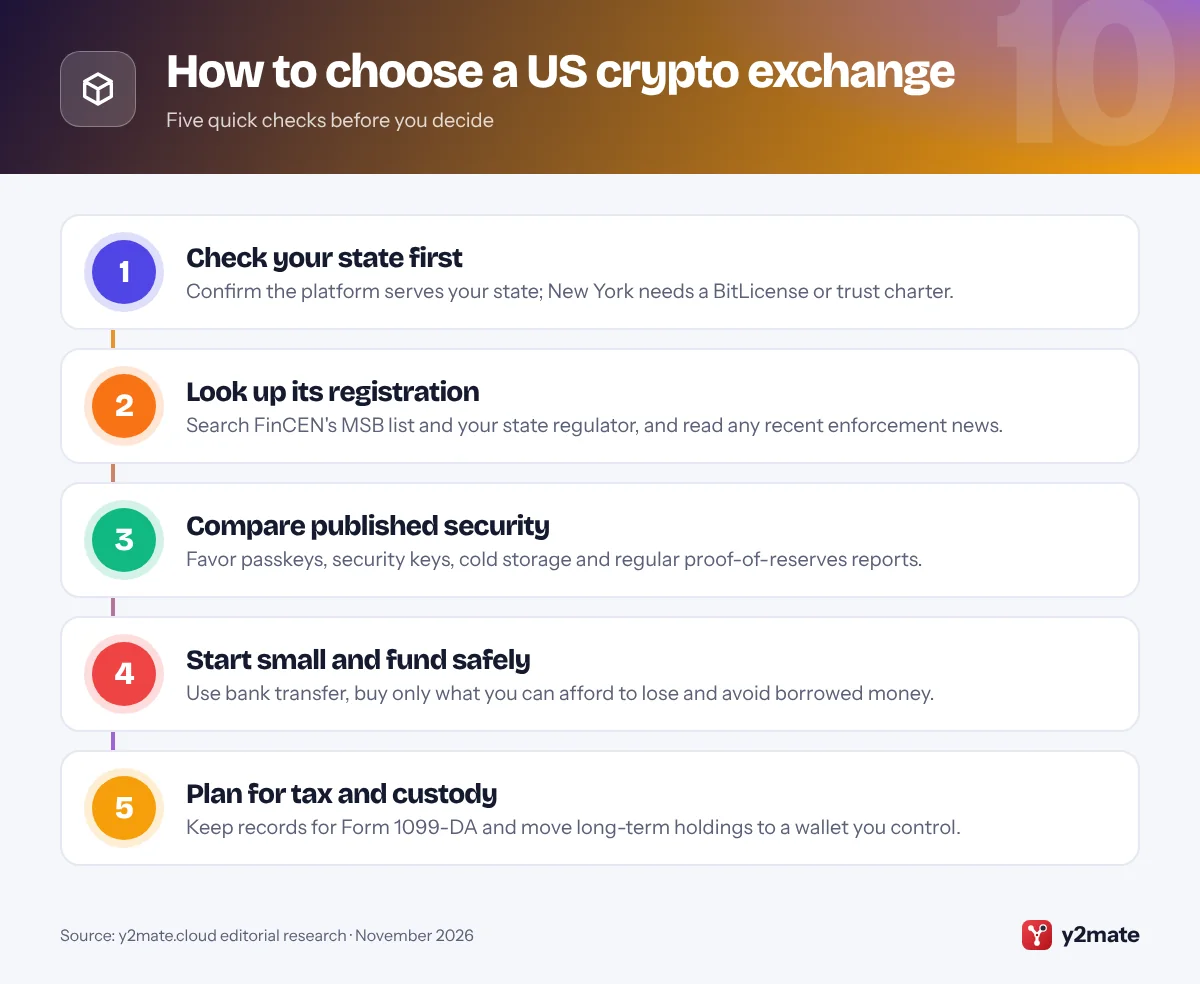
Start with where you live. Crypto platforms need money transmitter licenses in most states, so a service that works in Texas may not work in New York. Each platform publishes a supported-states list, and New York residents can only use firms with a BitLicense or a New York trust charter, such as Coinbase, Gemini, Robinhood Crypto and Bitstamp.
Understand who regulates what
- FinCEN: exchanges must register as money services businesses and run anti-money-laundering checks. Registration is not an endorsement.
- States: money transmitter licenses and, in New York, the BitLicense set rules on capital, custody and consumer complaints.
- SEC and CFTC: the SEC dropped its main lawsuits against exchanges in 2025, and the CFTC oversees crypto futures and polices fraud. A full federal market-structure law, the CLARITY Act, passed the House in July 2025 but had not passed the Senate as of early November 2026.
- Stablecoins: the GENIUS Act, signed in July 2025, sets federal rules for payment stablecoins, with regulators finishing the details before it takes full effect.
Protect yourself
- Crypto is volatile and is not covered by FDIC insurance or, unless it is a registered security, by SIPC.
- Turn on passkeys or a hardware security key, and never share codes with anyone who contacts you.
- Be wary of anyone who tells you to buy crypto to fix a problem or pay a bill: that is a classic scam.
- Keep records for tax, because exchanges now report sales to the IRS on Form 1099-DA.
This guide is general information, not financial advice. Consider your own circumstances, or speak to a licensed adviser, before investing.
Frequently asked questions
What is the best crypto exchange in the USA?
For most Americans, Coinbase is the strongest all-rounder because it is licensed in nearly every state, including New York, and supports passkeys and hardware security keys. Kraken is the best alternative outside New York, with regular proof-of-reserves reports, and Gemini suits people who want a New York-regulated trust company. Always check that a platform serves your state before you sign up.
Are crypto exchanges regulated in the US?
Yes, but in pieces. Exchanges register with FinCEN as money services businesses and need money transmitter licenses in most states, while New York requires a BitLicense or trust charter. The SEC and CFTC police fraud and certain products, and the GENIUS Act covers payment stablecoins. Congress had not passed a comprehensive market-structure law for crypto trading as of early November 2026.
Is my crypto insured on a US exchange?
Generally no. FDIC deposit insurance covers bank deposits, not crypto, and SIPC protection at a brokerage covers securities, not crypto that is not a registered security. Some exchanges hold customer cash at FDIC-insured banks or carry private insurance for certain losses, but that does not protect you if crypto prices fall or if the platform fails.
Which crypto exchanges work in New York?
New York residents can only use platforms with a BitLicense or a New York trust charter from the Department of Financial Services. On this list, Coinbase, Gemini, Robinhood Crypto and Bitstamp serve New York. Kraken, Crypto.com and Binance.US do not. Check River, Uphold and OKX US directly, because their state lists can change.
What is proof of reserves?
Proof of reserves is a report showing that an exchange holds enough crypto to cover what customers have deposited, often checked by an outside firm. Customers can usually confirm their own balance was included. It is useful but limited, because it may not show all of the company's debts. Kraken, River and the OKX group publish regular proof-of-reserves reports.
Final verdict
For most people, the best crypto exchanges in the USA start with Coinbase for broad licensing and strong security, Kraken for transparency and pro trading outside New York, and Gemini for a New York-regulated, US-focused service. Robinhood Crypto is the easy option for existing Robinhood investors, and River is the clear choice if you only want bitcoin.
Whichever you choose, check your state’s availability, switch on passkeys or a security key, start small and move long-term holdings to a wallet you control. Crypto can fall sharply in value and is not protected like a bank deposit, so only invest what you can afford to lose.
Sources and further reading
- FinCEN MSB registrant search: FinCEN's public search tool for checking whether a crypto platform is registered as a money services business.
- NYDFS virtual currency businesses: New York's financial regulator explains the BitLicense and lists the virtual currency firms it has licensed or chartered.
- FTC guide to crypto scams: The Federal Trade Commission's plain-English guide to how crypto scams work and how to report one.
- IRS guidance on digital assets: The IRS explains how crypto is taxed in the US and what you must report on your federal tax return.
- Understanding your Form 1099-DA: The IRS explains the Form 1099-DA that crypto brokers and exchanges now send to customers who sell digital assets.

Leave a Reply