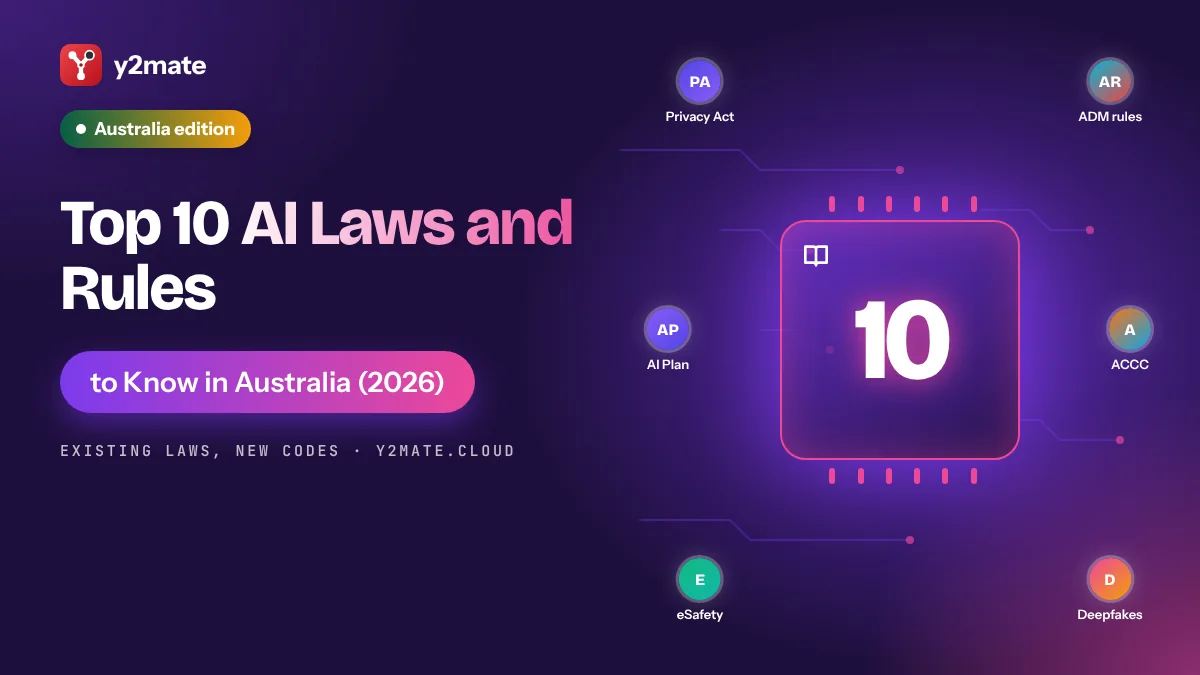
- Australia has no AI-specific Act; its National AI Plan of December 2025 relies on existing laws and regulators instead of the mandatory guardrails proposed in 2024.
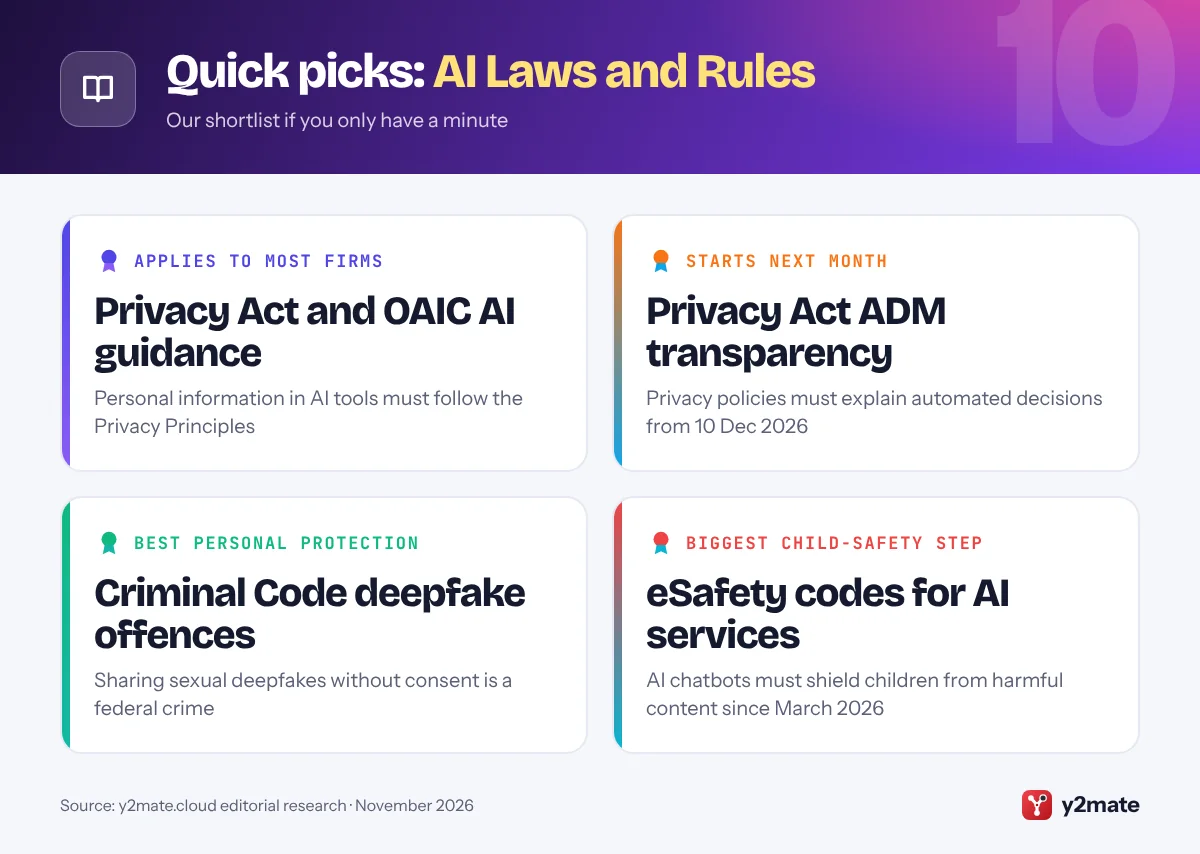
- From 10 December 2026, organisations covered by the Privacy Act must explain in their privacy policies when computer programs make, or substantially help make, significant decisions about people.
- Sharing sexually explicit deepfakes of adults without consent has been a federal criminal offence since September 2024.
- eSafety's Age-Restricted Material Codes, mandatory since 9 March 2026, require AI chatbots to protect children from sexually explicit and self-harm content.
- The government ruled out a copyright exception for AI training in October 2025 and is exploring licensing instead.
Australia has no AI-specific Act. Instead, AI laws in Australia are the existing, technology-neutral laws that already apply to everyone, such as the Privacy Act 1988, the Australian Consumer Law, the Criminal Code and anti-discrimination laws, plus newer targeted rules and online safety codes. In December 2025 the federal government’s National AI Plan confirmed this approach and set aside its earlier proposal for mandatory guardrails on high-risk AI.
Some plain definitions. Automated decision-making means using a computer program, including AI, to make a decision about a person or to substantially help a staff member make it. A deepfake is an image, video or audio clip created or altered with AI so that it appears to show a real person doing or saying something they did not. A frontier model is one of the most capable general-purpose AI models, such as those behind the best-known chatbots.
Below are the ten Australian laws, rules and official bodies that matter most for everyday users and small businesses in November 2026, with their status. This is general information, not legal advice; for your own situation, speak to a lawyer or the relevant regulator.
How we ranked this list
We ranked each item by how directly it affects ordinary Australians and small businesses that use AI tools, putting laws already in force ahead of upcoming changes, voluntary guidance and advisory bodies. We checked each status against official sources, including the Federal Register of Legislation, the OAIC, the ACCC, eSafety and the Department of Industry, Science and Resources, as of November 2026.
We did not test any AI products and do not quote penalties. State and territory laws add further rules that vary by location.
The Top 10 AI Laws and Rules
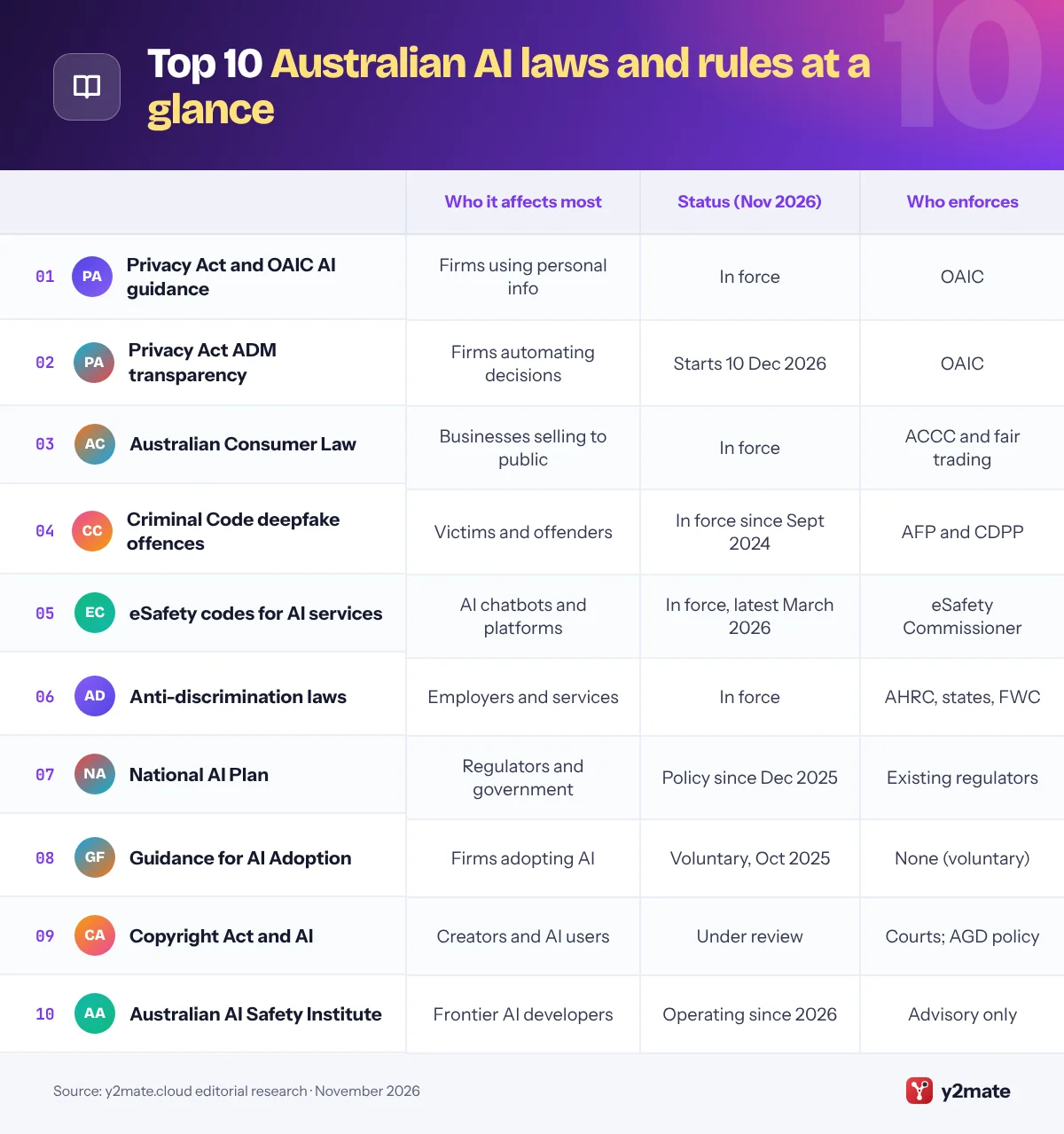
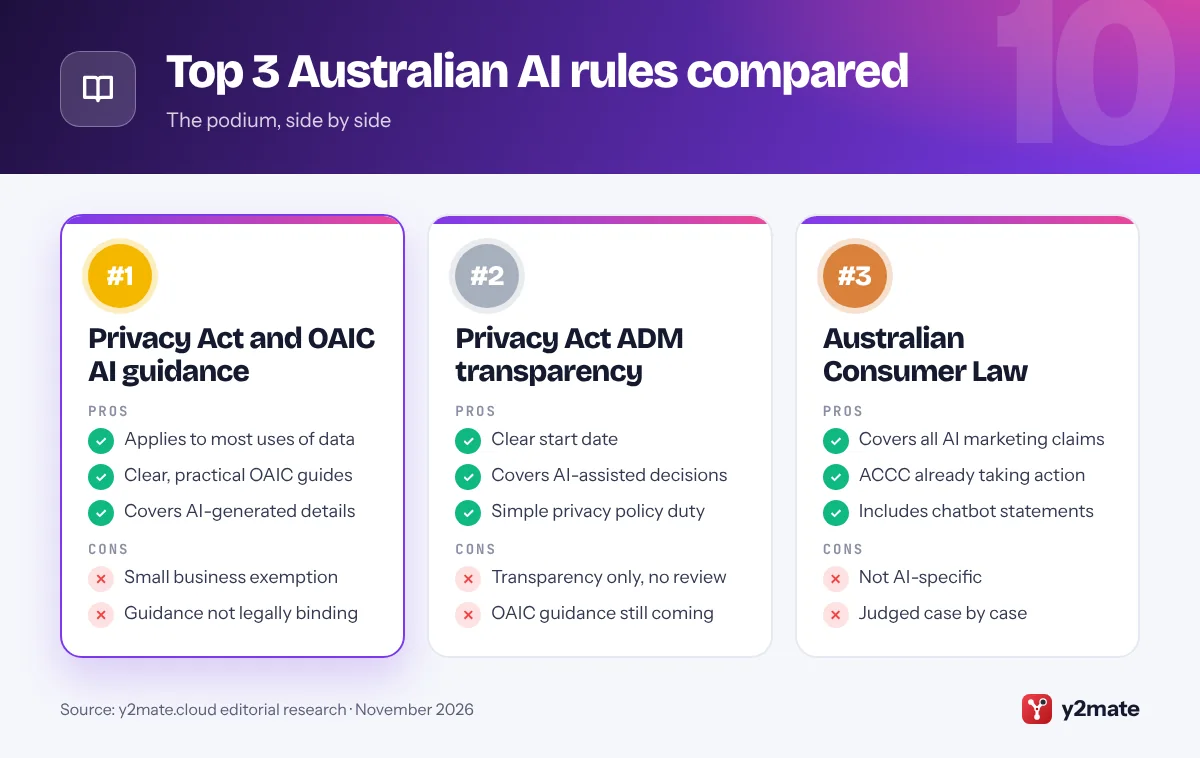
1. Privacy Act and OAIC AI guidance
Best for: any business putting personal information into AI
The Privacy Act 1988 and its Australian Privacy Principles (APPs) apply whenever an organisation covered by the Act uses personal information in an AI tool, from pasting customer details into a chatbot to using AI to infer something about a person. In October 2024 the Office of the Australian Information Commissioner (OAIC) published two guides: one on privacy and the use of commercially available AI products, and one for developers training generative AI models.
The key messages are practical. Use personal information in AI only for the purpose it was collected for, or a related purpose people would reasonably expect, unless you have consent. Be open about AI use in your privacy policy, take reasonable steps to check outputs are accurate, and remember that information AI generates about someone is still personal information. As best practice, the OAIC recommends not entering personal information, especially sensitive information, into publicly available generative AI tools.
Many small businesses below the Act’s turnover threshold are exempt, but not those that provide health services or trade in personal information, among others. If you are unsure, assume the APPs apply.
Official site: Privacy Act and OAIC AI guidance
- Applies to most uses of data
- Clear, practical OAIC guides
- Covers AI-generated details
- Small business exemption
- Guidance is not legally binding
2. Privacy Act ADM transparency
Best for: organisations using AI to make decisions
The Privacy and Other Legislation Amendment Act 2024, which received Royal Assent on 10 December 2024, added transparency rules for automated decision-making that start on 10 December 2026. From that date, organisations covered by the Privacy Act must explain in their privacy policy when they use computer programs to make decisions, or to substantially and directly assist staff to make them, where personal information is used and the decision could reasonably be expected to significantly affect someone’s rights or interests.
The policy must describe the kinds of personal information used and the kinds of decisions made by the program or with its help. That could include automated screening of credit or rental applications, insurance pricing, or software that ranks job applicants. The change is about transparency: on its own it does not ban automated decisions or create a new right to human review.
The OAIC published an issues paper in May 2026 and is developing guidance on how to comply. With the start date only weeks away, list where your organisation uses automated or AI-assisted decisions and update your privacy policy now.
Official site: Privacy Act ADM transparency
- Clear start date
- Covers AI-assisted decisions
- Simple privacy policy duty
- Transparency only, no review right
- OAIC guidance still coming
3. Australian Consumer Law
Best for: businesses making claims about AI
The Australian Consumer Law (ACL) bans misleading or deceptive conduct and false or misleading representations, and it applies to AI in two ways. First, claims about AI must be true: a business should not overstate what an AI product can do, say a product uses AI when it does not, or hide important changes to an AI-related offer. Second, a business is responsible for what it tells customers, including through chatbots that answer questions about prices, refunds or consumer guarantees.
The ACCC has shown it will act. In October 2025 it began Federal Court proceedings against Microsoft, alleging the company misled millions of Microsoft 365 subscribers by not clearly telling them about a cheaper Classic plan without the Copilot AI assistant when prices rose. The case is ongoing, and the court has not yet decided the allegations.
Consumer guarantees also apply to AI products and services you sell, and fines for breaching the ACL can be large. State and territory fair trading agencies enforce the ACL alongside the ACCC, and the ACCC publishes plain-English guidance for businesses.
Official site: Australian Consumer Law
- Covers all AI marketing claims
- ACCC already taking action
- Includes chatbot statements
- Not AI-specific
- Judged case by case
4. Criminal Code deepfake offences
Best for: anyone targeted by sexual deepfakes
The Criminal Code Amendment (Deepfake Sexual Material) Act 2024 received Royal Assent on 2 September 2024 and took effect the next day. It makes it a federal offence to use a carriage service, such as the internet or a phone network, to transmit sexual material depicting an adult without their consent, whether the material is real or has been created or altered using technology such as AI. Aggravated offences apply where the offender also created or altered the material, or has already had several civil penalty orders made against them under online safety law.
Child sexual abuse material, including AI-generated material, is covered by separate, long-standing Criminal Code offences. Several states and territories also have their own laws on creating or sharing intimate deepfakes.
Separately, eSafety’s image-based abuse scheme under the Online Safety Act 2021 lets people report intimate images shared without consent, including digitally altered ones, and eSafety can require platforms and individuals to remove them. If you are targeted, collect evidence, report to eSafety and contact the police.
Official site: Criminal Code deepfake offences
- Covers AI-made sexual material
- Tougher penalties for creators
- eSafety can order removal
- Adults only; minors covered elsewhere
- Creation alone not a federal crime
5. eSafety codes for AI services
Best for: AI chatbot and app providers, and parents
Under the Online Safety Act 2021, the eSafety Commissioner registers industry codes and sets standards that online services must follow, and several now apply directly to generative AI. Standards in force since 22 December 2024 require generative AI services that could be used to create child sexual abuse material, such as nudify services, and platforms that distribute AI models to take steps to prevent it.
The Age-Restricted Material Codes, mandatory since 9 March 2026, go further for AI chatbots and companions. Services that can generate sexually explicit, high-impact violence or self-harm content must stop it being generated for children or use appropriate age assurance, and companion chatbots must provide crisis and mental health information. eSafety has named AI chatbots as an early enforcement priority.
Australia’s social media minimum age, in force since 10 December 2025, is a separate rule aimed at age-restricted social media platforms; for AI chatbots, these codes are eSafety’s main tool. Parents can report harmful AI content and code breaches to eSafety.
Official site: eSafety codes for AI services
- Directly covers AI companions
- Protects children by design
- Clear compliance dates
- Age checks rely on providers
- Enforcement still ramping up
6. Anti-discrimination laws
Best for: employers and services using AI to assess people
Australia’s anti-discrimination laws apply to decisions made with AI just as they do to decisions made by people. Federal laws include the Racial Discrimination Act 1975, Sex Discrimination Act 1984, Disability Discrimination Act 1992 and Age Discrimination Act 2004, and each state and territory has its own equivalent. The Fair Work Act 2009 also protects employees and prospective employees from adverse action for discriminatory reasons.
The main risk with AI is indirect discrimination: a rule or tool that looks neutral but disadvantages people with a protected attribute. A hiring tool that marks down career gaps can disadvantage carers, and a tool that scores recorded interviews may disadvantage people with disability or strong accents. Using a supplier’s tool does not remove your responsibility as the employer or service provider.
The National AI Plan confirms these laws continue to apply to AI, and the government has said it is considering reforms on algorithmic bias. Complaints can go to the Australian Human Rights Commission, state anti-discrimination bodies or, for workplace matters, the Fair Work Commission.
Official site: Anti-discrimination laws
- Covers AI and human decisions
- Federal and state protection
- Several complaint pathways
- Not written with AI in mind
- Bias can be hard to prove
7. National AI Plan
Best for: understanding Australia’s overall approach
Released on 2 December 2025, the National AI Plan sets out the federal government’s approach to AI. Its central regulatory decision is to rely on Australia’s existing, technology-neutral laws, with each regulator responsible for AI harms in its own area, rather than to pass a standalone AI Act.
That was a change of direction. In September 2024 the government had proposed mandatory guardrails for AI in high-risk settings and consulted on options including a dedicated AI Act. The plan set those proposals aside. Instead it points to targeted actions: enforceable online safety codes, criminal laws against non-consensual deepfakes, a review of copyright and AI, privacy law reform, and further work on issues such as nudify apps and algorithmic bias. It also established the Australian AI Safety Institute to help regulators spot gaps.
The plan is government policy, not law, so it creates no duties for businesses by itself. Its practical message is that the laws already covering your business also cover your use of AI, and that new rules will target specific harms.
Official site: National AI Plan
- Clear national direction
- Builds on familiar laws
- Targets specific harms
- Not legally binding
- No single AI regulator
8. Guidance for AI Adoption
Best for: small businesses building AI governance
Published by the National AI Centre on 21 October 2025, the Guidance for AI Adoption is the government’s main voluntary guide for organisations using or developing AI. It updates the Voluntary AI Safety Standard released in September 2024, condensing its ten guardrails into six essential practices, and it now covers both developers and deployers of AI.
The guidance has two parts: Foundations, for organisations getting started with AI, and Implementation Practices, for governance and technical staff who need more detail. Together they cover accountability for AI use, understanding and planning for impacts, managing risks, sharing information with people affected, testing and monitoring, and keeping meaningful human control. Supporting templates and tools are published alongside it.
Following it is not compulsory, and it gives no legal protection on its own. But because it lines up with duties that already exist under privacy, consumer and discrimination law, it works as a practical checklist for small businesses that want to show they use AI responsibly.
Official site: Guidance for AI Adoption
- Free and practical
- Suits beginners and experts
- Lines up with existing laws
- Voluntary only
- No legal safe harbour
9. Copyright Act and AI
Best for: creators and firms publishing AI content
The Copyright Act 1968 has not been changed for AI. Copying protected works to train AI generally needs permission unless an existing exception applies, and Australia has no general fair use defence or broad text and data mining exception. Copyright protects works with human authors, so purely machine-generated material may not be protected at all.
In October 2025 the Attorney-General ruled out introducing a text and data mining exception that would have let AI developers train on copyright material without permission, after strong opposition from creative industries. The government instead reconvened its Copyright and AI Reference Group to look at fair licensing for AI training, more certainty about how copyright applies to AI-generated material, and cheaper ways to enforce rights, possibly through a small claims forum.
For businesses using AI tools, read the provider’s terms on ownership and indemnities, avoid prompting for close copies of protected works, and add meaningful human creativity to content you want to own.
Official site: Copyright Act and AI
- Strong protection for creators
- Clear no to free AI training
- Licensing options being explored
- AI output ownership unsettled
- Reforms still under discussion
10. Australian AI Safety Institute
Best for: following frontier AI safety testing
Announced on 25 November 2025 and confirmed in the National AI Plan, the Australian AI Safety Institute sits within the Department of Industry, Science and Resources and began operating in 2026. Its job is to monitor and test frontier AI models, assess emerging risks, and give independent technical advice to ministers and regulators, including on gaps in existing laws.
It is not a regulator. It cannot fine companies, approve or ban products, or set binding rules, and it has no direct role in how ordinary people or small businesses use AI. Regulators such as the OAIC, ACCC and eSafety keep responsibility for enforcement in their areas and can draw on the institute’s expertise. It also works with similar bodies overseas.
For everyday users, the institute matters indirectly. Its testing and advice will shape whether the government decides further rules are needed for the most capable AI systems, so it is worth watching if you follow AI safety in Australia.
Official site: Australian AI Safety Institute
- Independent technical advice
- Tests frontier models
- Supports existing regulators
- No regulatory powers
- Still building capability
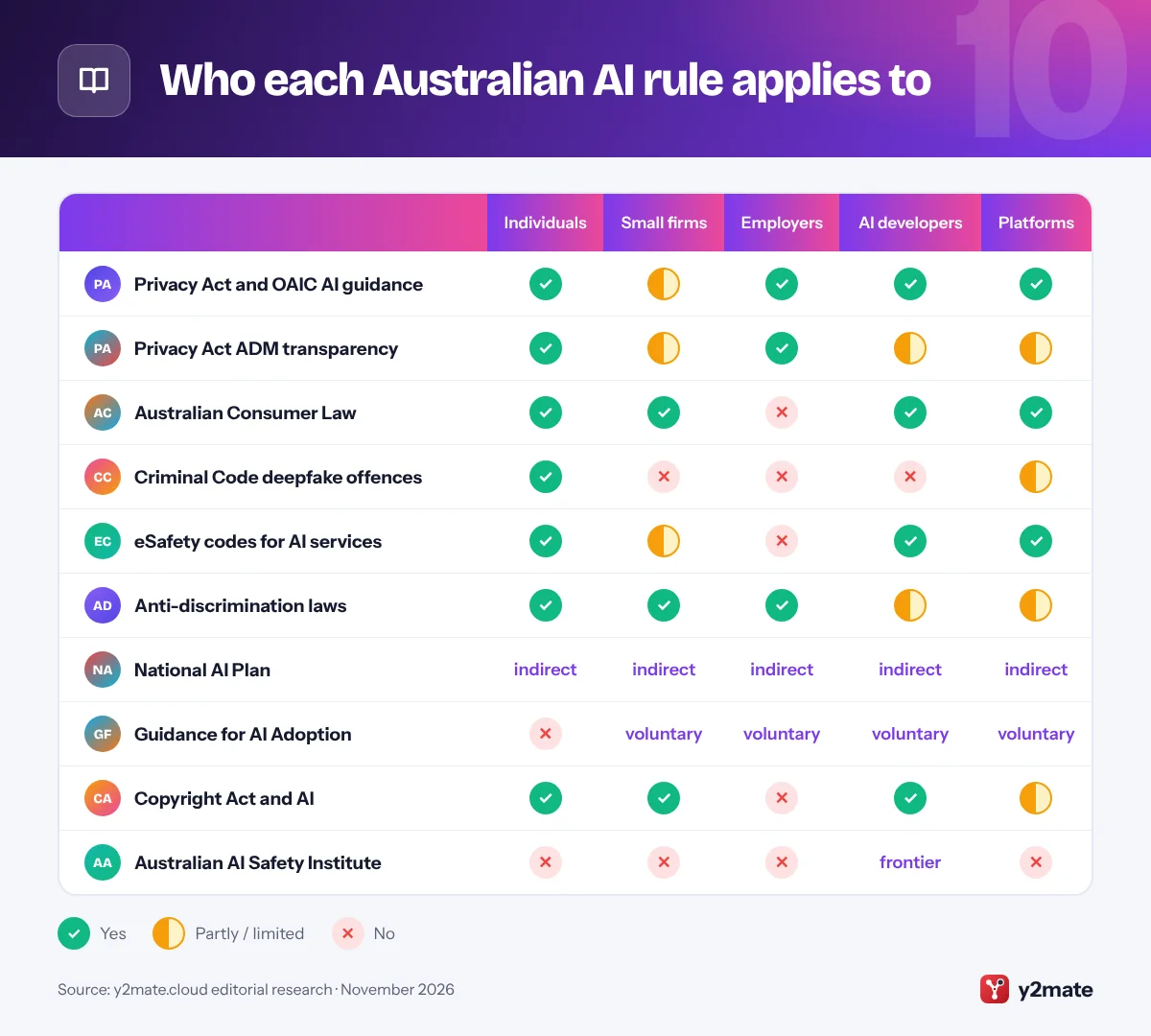
Who each Australian AI rule applies to
How to keep up with AI laws in Australia
Because AI laws in Australia are mostly existing laws applied to new technology, the best approach is to work out what your AI does and which regulator covers it, then close any gaps before the next deadline.
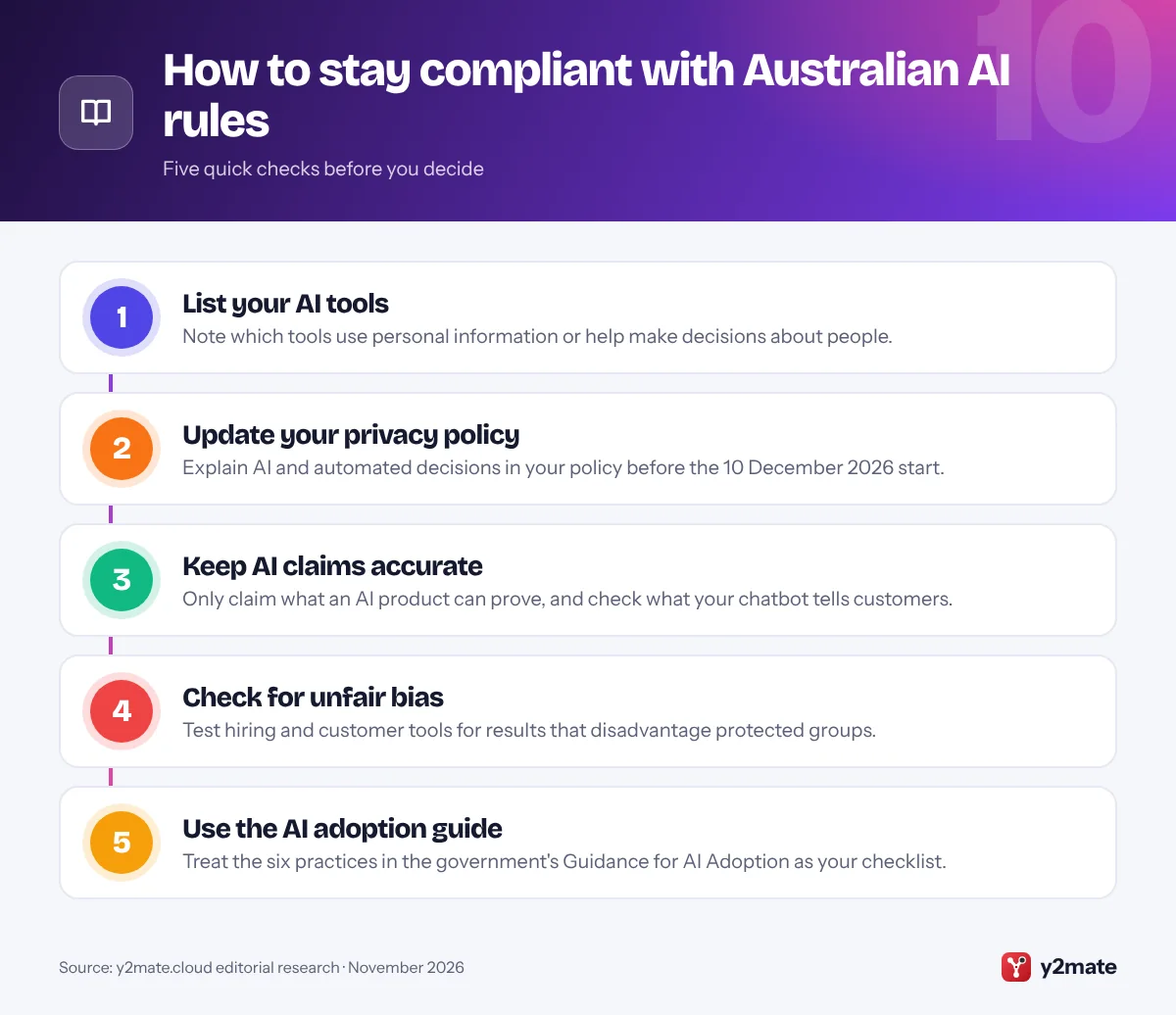
Match your AI use to the rules
- Personal information: the Privacy Act and OAIC guidance, plus the automated decision-making transparency rules from 10 December 2026.
- Marketing and customer service: the Australian Consumer Law, enforced by the ACCC and state and territory fair trading agencies.
- Hiring and service decisions: federal, state and territory anti-discrimination laws and the Fair Work Act.
- Apps, platforms and chatbots: eSafety’s codes and standards under the Online Safety Act 2021.
- Regulated industries: regulators such as ASIC, APRA and the Therapeutic Goods Administration apply their own rules to AI in finance and health.
What is still changing
Watch for OAIC guidance on automated decisions, further Privacy Act reforms, outcomes from the copyright and AI licensing talks, and any new rules on nudify apps or algorithmic bias. The National AI Centre’s Guidance for AI Adoption is a free, practical starting point for any business, and the OAIC, ACCC and eSafety all publish plain-English guidance and updates that make it easier to keep track.
Frequently asked questions
Does Australia have an AI Act?
No. As of November 2026 Australia has no AI-specific Act. The National AI Plan, released in December 2025, confirmed that AI is regulated through existing laws such as the Privacy Act, the Australian Consumer Law, anti-discrimination laws and the Criminal Code, together with eSafety's online safety codes, rather than through the mandatory guardrails proposed in 2024.
Are AI deepfakes illegal in Australia?
Sharing a sexually explicit deepfake of an adult without consent is a federal crime under the Criminal Code, with tougher penalties if the person also created it, and AI-generated child abuse material is illegal. You can report intimate deepfakes to eSafety for removal. Other deepfakes may breach defamation, consumer, fraud or state laws, depending on how they are used.
Can my business put customer details into an AI chatbot?
Only with care. If the Privacy Act applies to your business, you must use personal information only for permitted purposes and keep it secure. The OAIC recommends, as best practice, not entering personal information, particularly sensitive information, into publicly available generative AI tools. Business versions with stronger data controls and clear terms are a safer choice.
What changes for automated decisions on 10 December 2026?
From 10 December 2026, organisations covered by the Privacy Act must explain in their privacy policy when computer programs make, or substantially help make, decisions using personal information that could significantly affect people's rights or interests. They must describe the kinds of information used and decisions made. The change is about transparency and does not ban automated decisions.
Who owns content made with AI in Australia?
It is not settled. Australian copyright protects works with human authors, so material produced entirely by AI may have no copyright owner, while work with meaningful human creative input can be protected. The government is looking at how copyright applies to AI-generated material, and your AI provider's terms may also say who can use outputs.
Final verdict
AI laws in Australia rely on existing rules rather than a dedicated AI Act, so the basics apply now: handle personal information lawfully, be truthful about AI and about what your chatbot tells customers, avoid discriminatory outcomes, and never create or share sexual deepfakes. The Privacy Act, the Australian Consumer Law and the Criminal Code already cover most everyday AI risks.
The most urgent date is 10 December 2026, when the automated decision-making transparency rules begin. After that, watch eSafety’s enforcement of the AI chatbot codes and the copyright review.
Sources and further reading
- OAIC guide for AI developers: The OAIC's guidance on how the Privacy Act applies when organisations develop, train or fine-tune generative AI models using personal information.
- eSafety Age-Restricted Material Codes: eSafety's background to the codes that require online services, including AI chatbots, to protect children from age-inappropriate content.
- ACCC case against Microsoft: The ACCC's announcement of Federal Court proceedings over how Microsoft communicated Microsoft 365 plan changes after adding its Copilot AI assistant.
- Attorney-General on copyright and AI: The Attorney-General's statement ruling out a text and data mining exception and setting the next steps for copyright and AI.
- Australian AI Safety Institute announcement: The Department of Industry, Science and Resources announcement of the new institute and its role in testing and advising on AI risks.

Leave a Reply