
- Bank impersonation, investment and crypto fraud, fake parcel texts and HMRC refund messages are among the scams UK police, regulators and the government warn about repeatedly in 2026.
- If you are tricked into sending money by bank transfer, known as Authorised Push Payment (APP) fraud, your bank must usually reimburse you under Payment Systems Regulator rules if you claim within 13 months.
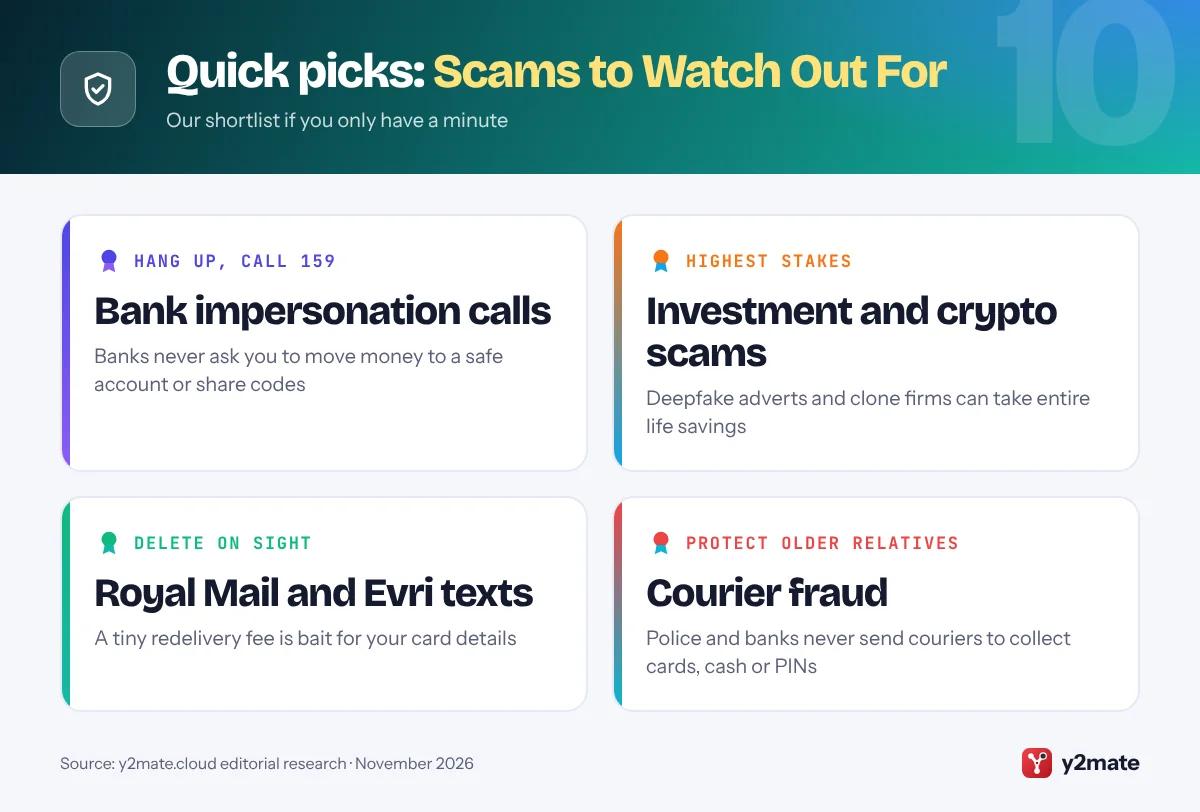
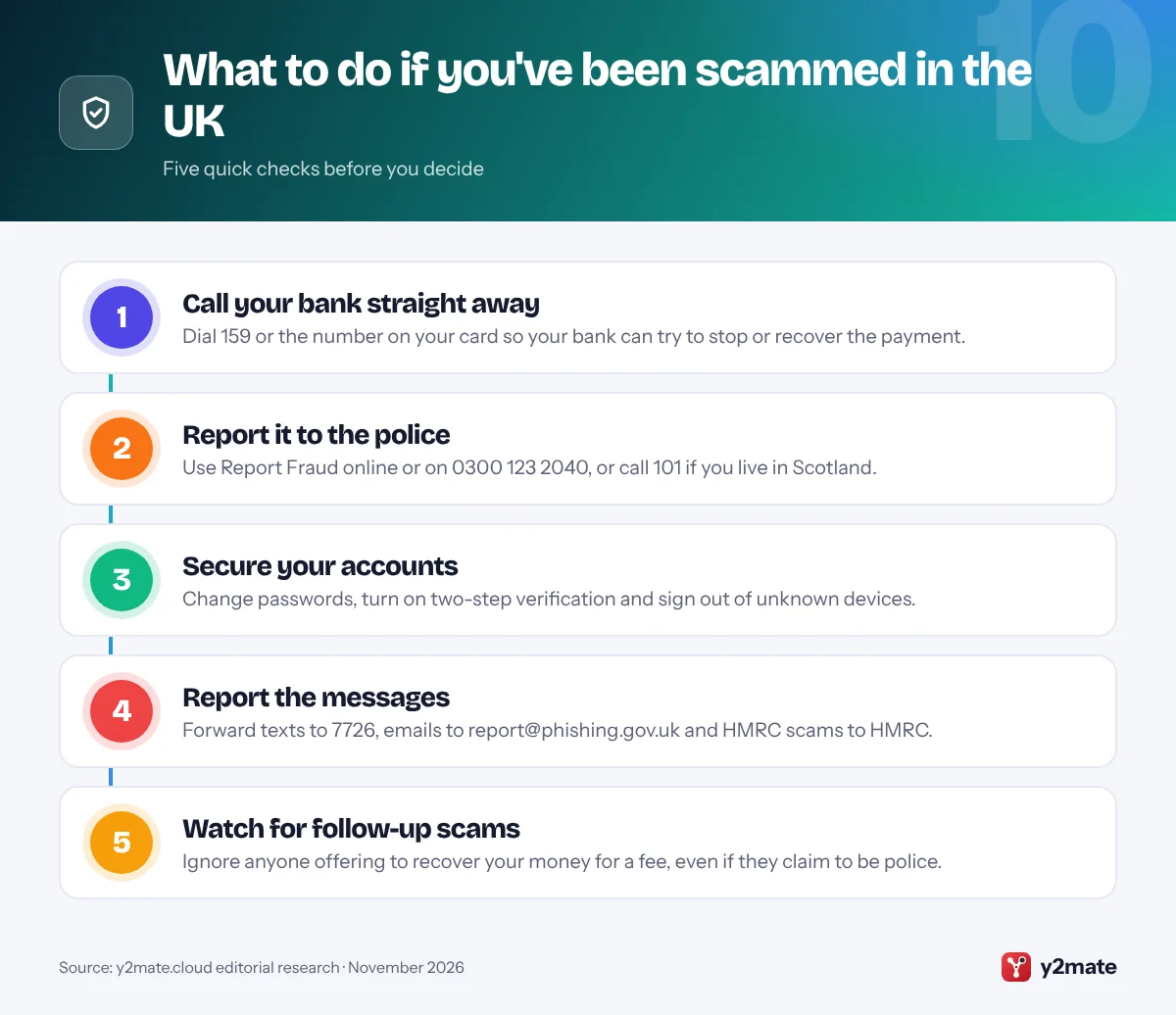
- If you get an unexpected call about your money, hang up and dial 159 to reach your bank safely, and forward scam texts free to 7726.
- Report fraud to Report Fraud, which replaced Action Fraud, online or on 0300 123 2040, or to Police Scotland on 101 if you live in Scotland.
- Banks and the police will never ask you to move money to a safe account or send a courier to collect your cash, cards or PIN.
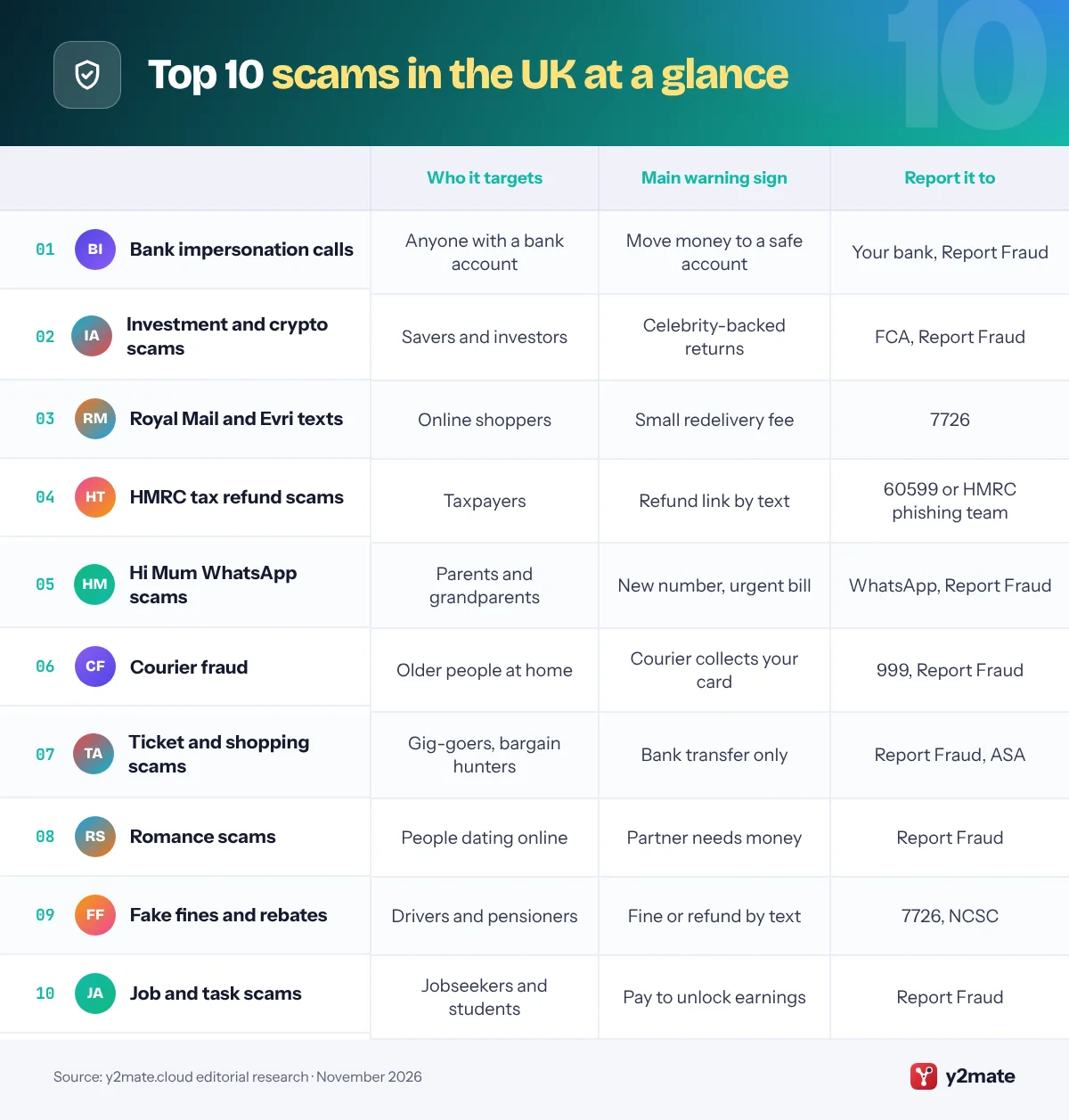
The scams in the UK that police, regulators and the government are warning about most in 2026 are bank impersonation calls, investment and crypto fraud, fake Royal Mail and Evri parcel texts, HMRC tax refund scams, Hi Mum messages, courier fraud, ticket and shopping scams, romance fraud, fake fines and rebates, and job and task scams. They tell different stories, but nearly all of them try to rush you into paying or handing over details before you have time to check.
Some plain definitions. Phishing is a fake email or message designed to steal your money or personal details, and smishing is the same trick by text. Spoofing is when a criminal disguises a phone number, email address or website so it looks like a real organisation’s. Authorised Push Payment (APP) fraud happens when you are tricked into sending money from your own account by bank transfer, as opposed to a criminal taking it without your permission.
This guide explains how each scam works, its warning signs and how to stay safe. It also covers the UK’s reporting channels: Report Fraud, which replaced Action Fraud, Police Scotland’s 101 number, the 159 bank hotline and the free 7726 spam reporting service.
How we ranked this list
We ranked these scams by how often UK bodies have warned about them in recent alerts and campaigns, including the City of London Police, which runs Report Fraud, the government’s Stop! Think Fraud campaign, the Financial Conduct Authority (FCA), the Financial Ombudsman Service, HMRC, the National Cyber Security Centre (NCSC), local police forces and councils, and by the harm those warnings describe.
We did not test or engage with any scams, and we do not quote loss figures, which are revised frequently. Criminals change their scripts quickly, so focus on the warning signs rather than the exact wording of any message.
The Top 10 Scams to Watch Out For
1. Bank impersonation calls
Best for: spotting fake fraud-team calls and safe accounts
Bank impersonation is the classic form of Authorised Push Payment fraud. A caller claiming to be from your bank’s fraud team, or sometimes the police or HMRC, says your account has been compromised and that you must move your money to a new safe account to protect it. The number on your screen may match your bank’s real one, because criminals use spoofing: in June 2026 the City of London Police warned of a spike in calls from spoofed numbers imitating police forces, banks and government agencies.
The caller may already know your name, address and recent transactions, and may ask you to read out a one-time passcode or install an app so they can help.
Your bank will never ask you to move money to a safe account or to share a passcode. Hang up and call 159, which connects you safely to most UK banks, or the number on the back of your card. If you have already sent money, tell your bank immediately: under Payment Systems Regulator rules, victims of APP fraud by bank transfer must usually be reimbursed.
Official site: Bank impersonation calls
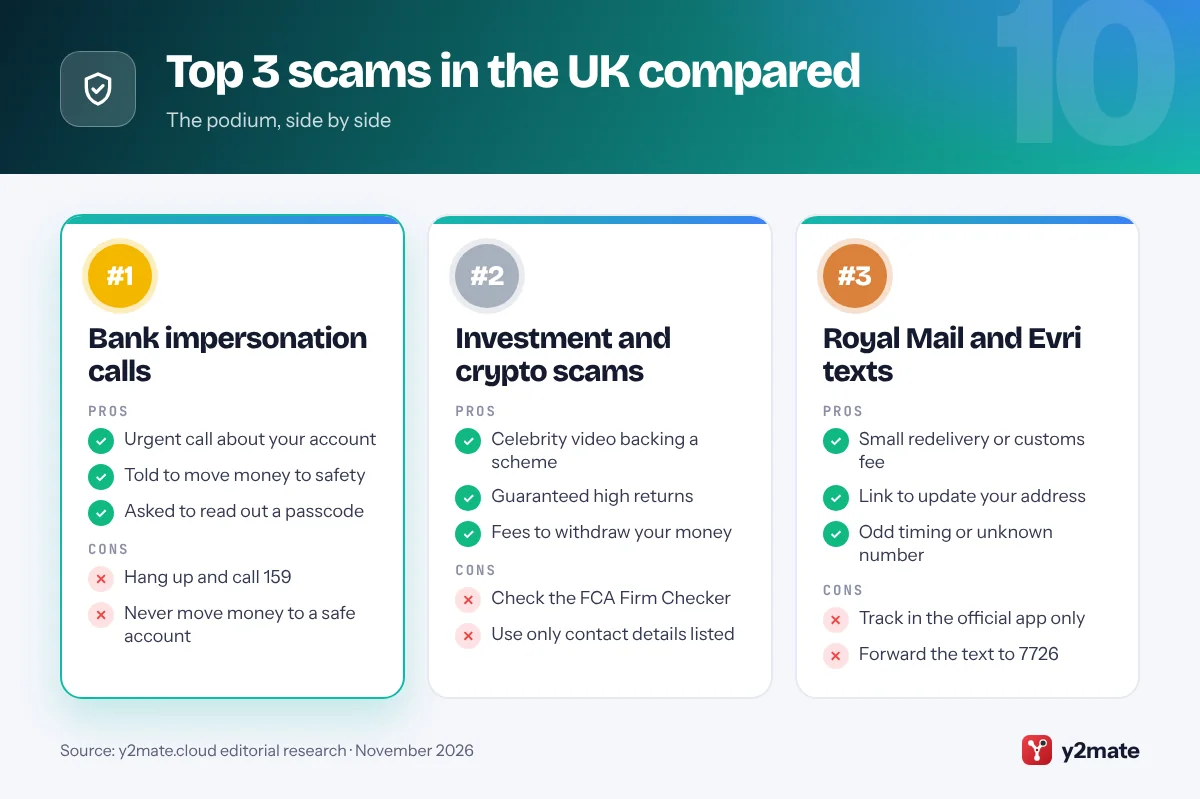
- Urgent call about your account
- Told to move money to safety
- Asked to read out a passcode
- Hang up and call 159
- Never move money to a safe account
2. Investment and crypto scams
Best for: savers tempted by online investment adverts
Investment scams promise high, steady returns from cryptocurrency, foreign exchange or AI trading platforms. Many begin with an advert on social media or a search engine showing a fake news story or a deepfake video of a well-known presenter or businessperson apparently backing the scheme. Others start in WhatsApp or Telegram groups, or with a cold call from a polished firm that copies the name and details of a genuine FCA-authorised company, known as a clone firm. In February 2026 the Financial Ombudsman Service urged people to be on high alert for online investment scams.
The fake platform shows rising profits, encouraging bigger deposits, but withdrawals trigger new fees or the site vanishes. Victims are often targeted again by recovery firms, some posing as the FCA, that promise to get the money back for an upfront fee.
Almost all firms offering financial services in the UK must be authorised or registered by the FCA. Check any firm on the FCA Firm Checker and Warning List, use only the contact details shown there, and treat any celebrity endorsement of a trading platform as fake.
Official site: Investment and crypto scams
- Celebrity video backing a scheme
- Guaranteed high returns
- Fees to withdraw your money
- Check the FCA Firm Checker
- Use only contact details listed
3. Royal Mail and Evri texts
Best for: online shoppers waiting for a parcel
Fake parcel texts claim Royal Mail, Evri, DPD or another courier could not deliver your item and that you must pay a small redelivery or customs fee, or confirm your address, through a link. The page looks authentic, but the tiny fee is bait: the real goal is your card details and personal information, which criminals may use for a follow-up call pretending to be your bank’s fraud team and warning that your card has been misused.
The government’s Stop! Think Fraud campaign lists a delivery company demanding a fee before it will deliver as a classic sign of a fake text, along with messages sent very late at night or early in the morning.
Track parcels only through the retailer or the courier’s official website or app, typed in yourself. Forward suspicious texts free to 7726 and emails to report@phishing.gov.uk. If you entered card details, call your bank on the number on your card, and expect a fake follow-up call.
Official site: Royal Mail and Evri texts
- Small redelivery or customs fee
- Link to update your address
- Odd timing or unknown number
- Track in the official app only
- Forward the text to 7726
4. HMRC tax refund scams
Best for: taxpayers expecting a refund or a tax bill
HMRC scams arrive as texts, emails, phone calls and social media messages. The most familiar pitch is a tax refund you are supposedly owed, with a link to claim it by entering your bank details or Government Gateway sign-in. The opposite version threatens you: you owe unpaid tax, a warrant has been issued and you must pay immediately to avoid arrest. HMRC repeatedly warns about these scams ahead of the Self Assessment deadline at the end of January.
HMRC is clear about what it does not do. It will never send notification of a tax rebate, or ask you to disclose personal or payment information, by text message. It does not use social media to offer refunds, and it only emails about rebates from addresses ending in hmrc.gov.uk. Caller ID can be spoofed, so a convincing number proves nothing.
Forward suspicious texts to 60599 and emails to phishing@hmrc.gov.uk, and report suspicious calls using HMRC’s online form on GOV.UK. Check what you owe or are owed by signing in to your HMRC online account or the HMRC app directly, never through a link.
Official site: HMRC tax refund scams
- Refund link by text or email
- Threat of arrest over tax
- Asks for bank or sign-in details
- Use the HMRC app or GOV.UK
- Forward texts to 60599
5. Hi Mum WhatsApp scams
Best for: parents of teenagers and grown-up children
The Hi Mum or Hi Dad scam starts with a WhatsApp message or text from an unknown number, claiming to be your son or daughter who has lost or broken their phone and is using a new number. After some friendly chat, your child needs urgent help paying a bill because their banking app will not work on the new phone, and asks you to send money to a friend’s or landlord’s account.
Police forces have kept warning about the scam in 2026, and new versions keep appearing. The government’s Stop! Think Fraud campaign also warns that criminals use AI voice cloning to impersonate people you know.
Before sending anything, call your family member on the number you already have saved, or ask the new number a question only they would know. Agree a safe phrase with close family. Report the account inside WhatsApp and block it, and forward scam texts to 7726. If you have paid, call your bank straight away, as the APP reimbursement rules can apply.
Official site: Hi Mum WhatsApp scams
- New number from a family member
- Urgent bill to pay for them
- Asks you to pay a third party
- Call their old number first
- Ask a question only they know
6. Courier fraud
Best for: protecting older relatives who live alone
Courier fraud is one of the cruellest scams police deal with, and in June 2026 the City of London Police renewed its warning, saying the crime is evolving and that people over 70 are being heavily targeted. It starts with an unexpected phone call from someone claiming to be a police officer or from your bank. They say your card has been cloned or a bank employee is under investigation, and they need your help.
You are then asked to hand your bank card and PIN, cash, gold or jewellery to a courier who comes to your door, or to withdraw cash or buy expensive goods as evidence. Criminals can keep a landline connected after you hang up, so when you dial your bank to check, you may still be talking to them.
The police and banks will never send a courier to collect your card, PIN, cash or valuables, and will never ask you to withdraw money or buy goods to help an investigation. Hang up, then call your bank or the police from a different phone, or wait several minutes first. If someone is at your door, call 999.
Official site: Courier fraud
- Caller claims to be the police
- Courier sent to collect your card
- Told to withdraw cash or buy gold
- Hang up and use another phone
- Never hand cards to a courier
7. Ticket and shopping scams
Best for: gig-goers and bargain hunters shopping online
Purchase scams, where you pay for goods or tickets that never arrive, come up again and again in UK fraud warnings. Fake websites copy real retailers or advertise in-demand products at unrealistic prices, while sellers on social media and online marketplaces take payment by bank transfer for items that do not exist. Stop! Think Fraud notes that AI helps criminals create professional-looking sites, so good design proves nothing.
Ticket fraud deserves its own warning. Police forces and Stop! Think Fraud have warned fans ahead of big concerts, festivals and football matches about fake resale posts on social media, and about fake ticketing websites. The criminals usually insist on bank transfer and send a worthless ticket or nothing at all.
Buy tickets only from the venue, the official promoter, authorised ticket agents or the event’s approved resale platform. For other purchases, use retailers you know, type their web address yourself rather than tapping an advert, and pay by credit card where possible, which gives extra legal protection for eligible purchases. Be very wary of requests for bank transfer, and report fake adverts to the Advertising Standards Authority.
Official site: Ticket and shopping scams
- Sold-out tickets on social media
- Prices far below other sellers
- Bank transfer only, no card
- Buy from official sellers only
- Pay by credit card where possible
8. Romance scams
Best for: people using dating apps and social media
Romance fraud happens when a criminal deceives someone into a fake relationship, usually online, to gain their trust and then exploit them financially. Fraudsters use stolen or AI-generated photos on dating apps, social media and gaming sites, quickly move the conversation to a private messaging app and shower their target with affection. There is always a reason they cannot meet or video call, such as working overseas, serving in the military or living on an oil rig.
Once trust is built, the requests begin: help with a medical bill, travel costs, customs fees or a business problem. Some romance fraudsters instead offer to teach their partner about cryptocurrency trading, turning the relationship into an investment scam. Victims are often encouraged to keep the relationship secret from family and friends.
Never send money, gift cards or crypto to someone you have only met online, however genuine they seem. Do a reverse image search on their photos, talk to someone you trust and report the profile to the platform. Report Fraud publishes dedicated romance fraud advice, and Victim Support offers free, confidential help.
Official site: Romance scams
- Fast, intense declarations of love
- Always an excuse not to meet
- Requests for money or crypto
- Never pay someone met only online
- Reverse-search their photos
9. Fake fines and rebates
Best for: drivers, pensioners and anyone owed a payment
This group of scams uses fake official messages about money you owe or are owed. Several councils in England warned in 2026 about texts claiming you have an unpaid parking fine, threatening court action or licence suspension and linking to a fake payment page that copies GOV.UK. Councils say they do not send Penalty Charge Notices by text: genuine parking fines are attached to your vehicle or arrive by post. Similar texts and emails impersonate the DVLA over vehicle tax refunds or failed payments.
Other messages offer money instead, such as a Winter Fuel Payment you supposedly need to apply for or an energy bill rebate, and ask for your bank details so it can be paid. The DWP has said it does not send texts or emails asking for bank details for Winter Fuel Payments, and eligible people usually receive them automatically.
Find government services by searching GOV.UK rather than following links, and remember that genuine government web addresses end in gov.uk. Do not reply; forward texts to 7726 and emails to report@phishing.gov.uk. If you paid or shared details, call your bank and report it to Report Fraud.
Official site: Fake fines and rebates
- Parking fine or tax demand by text
- Rebate that needs bank details
- Link to a lookalike GOV.UK page
- Find services via GOV.UK search
- Check the address ends gov.uk
10. Job and task scams
Best for: jobseekers and students seeking extra income
Fake job offers now arrive unprompted by text or WhatsApp, often from someone claiming to be a recruiter for a well-known brand. A widespread version is the task scam: you are paid small sums to like videos, review products or optimise apps, then told to top up your account, often in cryptocurrency, to unlock bigger earnings that never arrive. In February 2026 the Financial Ombudsman Service warned people to be on high alert for online employment scams as well as investment scams.
A more dangerous version recruits money mules. You are offered easy money for letting funds pass through your bank account, or for a so-called payment processing job. This is money laundering, and it can lead to your bank account being closed and prosecution, even if you did not know the money was stolen.
Real employers do not hire without an interview, ask you to pay to start work or ask to use your bank account. Check that the company and recruiter exist, apply through official careers pages or established job boards, and report fake offers to Report Fraud or, in Scotland, to Police Scotland on 101.
Official site: Job and task scams
- Unsolicited job offer by WhatsApp
- Pay in to unlock your earnings
- Asked to move money for others
- Never pay to start a job
- Never lend your bank account
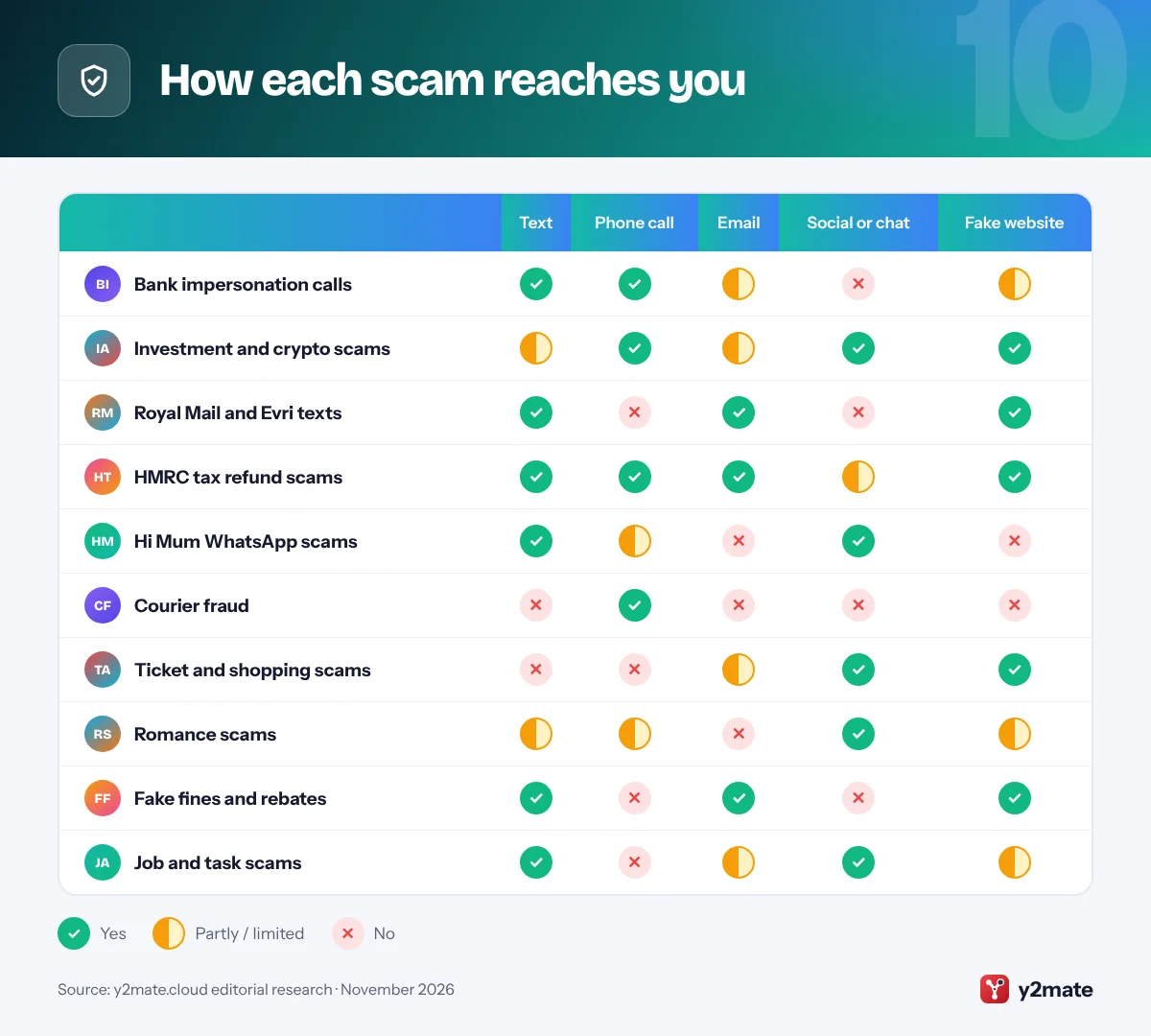
How each scam reaches you
How to protect yourself from scams in the UK
Almost every scam in the UK works by creating urgency and pushing you to act before you check. The government’s Stop! Think Fraud campaign sums up the defence: stop and break the contact, think about whether the story makes sense, and check with the organisation using contact details you already know. A genuine bank, courier or government department will not mind waiting.
Your rights if you pay a scammer
- APP fraud reimbursement: since 7 October 2024, banks and payment firms must reimburse most people tricked into sending money by Faster Payments or CHAPS, up to a cap. Claim within 13 months. You will not be refunded if you were complicit or grossly negligent, a high bar that does not apply to vulnerable customers.
- Card payments: these have separate protections, including chargeback and, for eligible credit card purchases, Section 75 of the Consumer Credit Act.
- Complaints: if your bank refuses to pay, you can complain to the Financial Ombudsman Service for free. The government has confirmed plans to fold the Payment Systems Regulator into the FCA.
Where to report scams in the UK
Report fraud to Report Fraud online or on 0300 123 2040 if you live in England, Wales or Northern Ireland, or to Police Scotland on 101. Forward scam texts to 7726, scam emails to report@phishing.gov.uk and fake adverts to the Advertising Standards Authority. If you are unsure whether a call about your money is real, hang up and dial 159.
Frequently asked questions
What are the most common scams in the UK right now?
Official warnings in 2026 focus on bank impersonation calls asking you to move money to a safe account, investment and crypto scams promoted by deepfake adverts, fake Royal Mail and Evri parcel texts, HMRC refund scams and Hi Mum messages. Courier fraud, ticket and shopping scams, romance fraud, fake parking fines and rebates, and job and task scams also feature regularly.
Will my bank refund me if I was scammed?
If you were tricked into sending money by bank transfer from a UK account, your bank must usually reimburse you under the Payment Systems Regulator's APP fraud rules, up to a cap, as long as you claim within 13 months and were not complicit or grossly negligent. Firms may deduct a small excess, but not for vulnerable customers. If your bank refuses, complain to the Financial Ombudsman Service.
What is 159 and when should I use it?
159 is a phone service run by the industry group Stop Scams UK that connects you securely to your bank. If you get an unexpected call, text or message about your bank account or a payment, hang up and dial 159 to speak to your bank directly. It works with the banks and building societies that have signed up, which include most UK current account providers.
Where do I report a scam in the UK?
Report fraud to Report Fraud, the national service run by the City of London Police that replaced Action Fraud, online at reportfraud.police.uk or on 0300 123 2040. In Scotland, call Police Scotland on 101. Forward scam texts free to 7726 and scam emails to report@phishing.gov.uk. If you have lost money, contact your bank first so it can try to stop the payment.
Can scammers fake a phone number or a family member's voice?
Yes. Number spoofing lets criminals make a call or text appear to come from your bank, the police or HMRC, so caller ID proves nothing. The government's Stop! Think Fraud campaign also warns that fraudsters use AI voice cloning to impersonate people you know. Hang up and call back on a number you trust, ideally from a different phone, and agree a safe phrase with family.
Final verdict
The scams in the UK to watch most closely in 2026 are bank impersonation calls and investment fraud, because they can cost people their savings, followed by the fake parcel, HMRC and Hi Mum messages that land on almost every phone. Courier fraud remains a serious threat to older people living alone.
The defence is the same each time: stop, break contact and check using details you already have. Use 159 for calls about your bank and forward scam texts to 7726. If the worst happens, call your bank immediately and report it to Report Fraud or Police Scotland; most people tricked into paying by bank transfer can claim their money back.
Sources and further reading
- Report Fraud service: The national fraud and cyber crime reporting service for England, Wales and Northern Ireland, run by the City of London Police, which replaced Action Fraud.
- APP fraud reimbursement protections: The Payment Systems Regulator explains who is covered by mandatory APP fraud reimbursement, the time limits and what to expect from your bank.
- How to report fraud: The government's Stop! Think Fraud guide to reporting fraud, including Report Fraud, Police Scotland on 101, 159, 7726 and the NCSC email service.
- NCSC guide to phishing: The National Cyber Security Centre explains how to spot phishing emails and texts and how to report them so scam sites can be taken down.

Leave a Reply