
- To freeze your credit in the USA, contact Equifax, Experian and TransUnion separately, because a freeze at one bureau does not carry over to the others.
- Placing, lifting and removing a credit freeze at the three nationwide bureaus has been free under federal law since September 21, 2018.
- A nationwide bureau must place a freeze within one business day of an online or phone request and lift it within one hour.
- A credit freeze does not affect your credit scores and does not protect accounts you already have.
- Parents and guardians can place a free freeze for children under 16 and for adults under guardianship.
To freeze your credit in the USA, contact each of the three nationwide credit bureaus, Equifax, Experian and TransUnion, and place a security freeze at every one, usually through a free online account. It is free under federal law, online or phone requests must be handled within one business day, and you can lift the freeze whenever you need to apply for credit.
A credit freeze, also called a security freeze, restricts access to your credit report. Because most lenders will not open an account without checking your report, a freeze makes it much harder for an identity thief to open credit in your name. It does not affect your credit scores or the accounts you already have.
This guide also covers freezes for children and dependent adults, fraud alerts and credit locks, and what to do if your identity has already been stolen. It is general information, not legal advice.
Level: Beginner · Time needed: 30 to 45 minutes
What you need
- Your full legal name, date of birth and Social Security number
- Your current address, plus recent previous addresses
- An email address and a mobile phone number you control
- A password manager or another secure place to store logins
- About 10 to 15 minutes for each bureau
- For a child or dependent adult: copies of ID and proof of your authority
Step 1: Gather What You Need Before You Freeze Your Credit
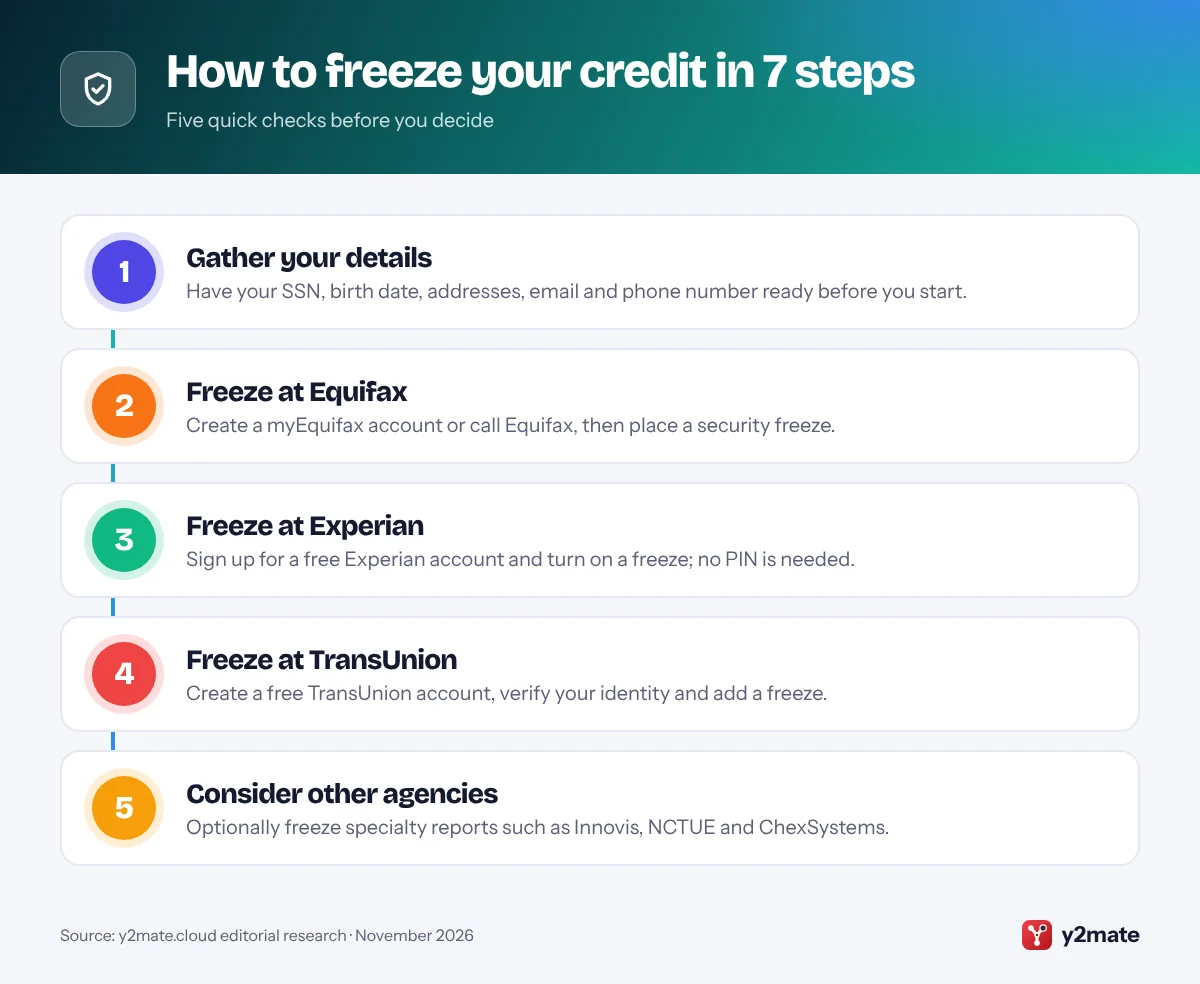
Each bureau must confirm who you are before it freezes your file, so collect your details first: full name, date of birth, Social Security number, current address and sometimes previous addresses. Online sign-ups also ask for an email address and often a mobile number.
It also helps to know what a freeze does. According to the Consumer Financial Protection Bureau (CFPB), while a freeze is in place:
- New creditors generally cannot see your report.
- Your current creditors, some government agencies such as child support agencies, and monitoring companies you hire still can.
- You can still review your own reports.
- Your credit scores are not affected.
A freeze does not stop thieves from taking over accounts you already have, so keep checking your statements. The CFPB also notes that the federal freeze law does not apply when someone requests your report for employment, tenant-screening or insurance purposes.
Step 2: Place a Security Freeze at Equifax
Go to Equifax’s official security freeze page and choose the option to place a freeze. Equifax asks you to create a myEquifax account, which you then use to place, temporarily lift or permanently remove the freeze with your username and password. You must be 18 or older to open one.
Online, the process generally works like this:
- Enter your name, address, date of birth and Social Security number.
- Complete the identity checks Equifax asks for.
- Create your login and confirm the freeze.
- Check that your account shows the freeze as active.
You can also freeze by phone, verifying your identity with a one-time PIN sent by text or by answering questions about your credit report, or by mail using Equifax’s request form. An Equifax freeze only covers your Equifax report, so carry on to the next two bureaus.
Step 3: Place a Security Freeze at Experian
Visit Experian’s Freeze Center and sign up for a free Experian account, or sign in if you already have one. Experian says you no longer need a PIN to manage a freeze: the free account is all you need.
According to Experian, online freezes and unfreezes happen in real time, and the account lets you:
- See whether your Experian file is currently frozen
- Remove the freeze until you freeze it again
- Schedule a thaw, a temporary unfreeze with start and end dates you choose
- Get alerts when your freeze status changes
Bureau websites also promote paid products such as credit monitoring and credit locks. You do not need any of them to place or manage a free security freeze, so skip offers you did not come for. Experian also accepts freeze requests by phone or mail.
Step 4: Place a Security Freeze at TransUnion
Go to TransUnion’s official credit freeze page and create a free account, or sign in to an existing one. TransUnion says creating the account and adding, removing or temporarily lifting a freeze are all free. You confirm your identity with details such as your name, date of birth, address and Social Security number.
Once the freeze is on, look for confirmation. The CFPB explains that a nationwide bureau must send written confirmation no later than five business days after placing a freeze, and tell you how to remove it. Keep it with your records.
TransUnion says it no longer requires a six-digit PIN for standard freeze changes made by phone or mail. If you still have a PIN from an older freeze at any bureau, store it safely anyway.
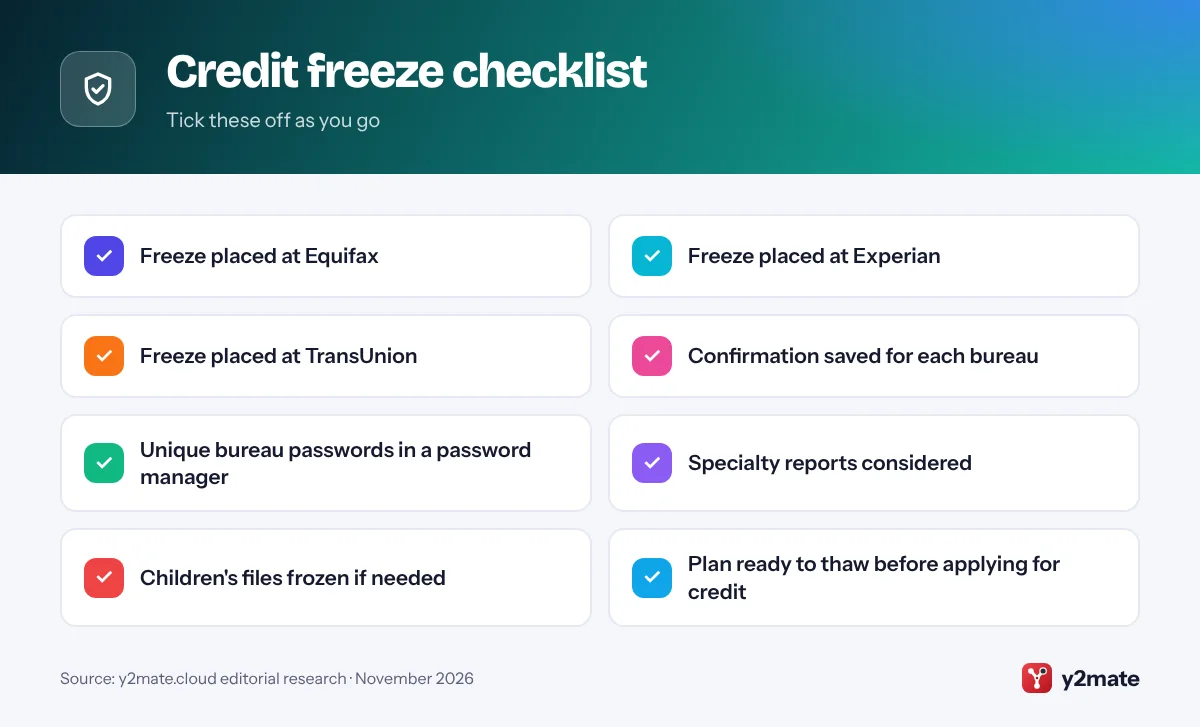
When all three accounts show your file as frozen, the core job is done.
Step 5: Consider Freezing Specialty Reports Too
The big three are not the only companies that keep files on you. The CFPB’s list of consumer reporting companies shows specialty companies that will freeze your report if you ask, including:
- Innovis: provides credit and identity verification data.
- NCTUE (National Consumer Telecom & Utilities Exchange): shares data on phone, pay TV and utility accounts.
- ChexSystems: reports on checking account applications, openings and closures.
These freezes are optional extras, not a replacement for Equifax, Experian and TransUnion. They make most sense if you want more protection against criminals opening phone, utility or bank accounts in your name, or if your details were exposed in a data breach. Use the contact details on each company’s own website or in the CFPB list, and lift the relevant freeze if a phone company, utility or bank later cannot check your history.
Step 6: Store Your Bureau Logins and PINs Safely
Your bureau accounts now control who can see your credit, so a criminal who breaks into one could lift your freeze. Protect them as carefully as your bank login:
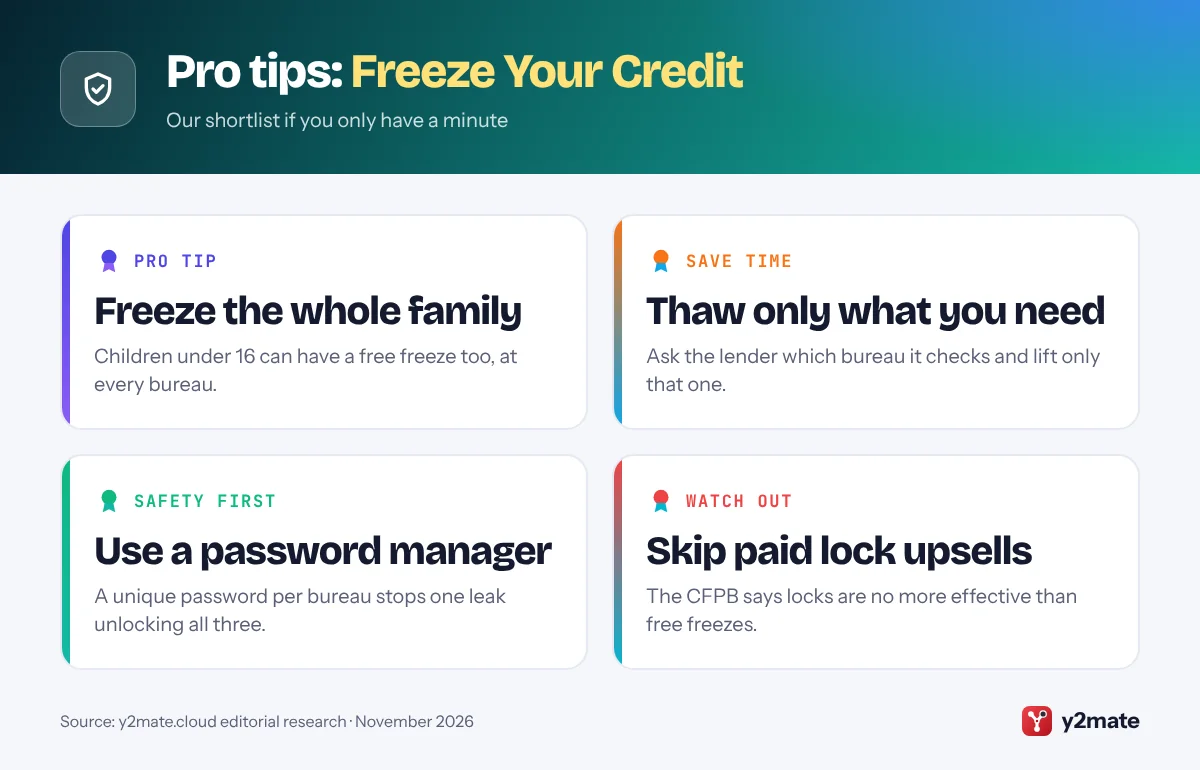
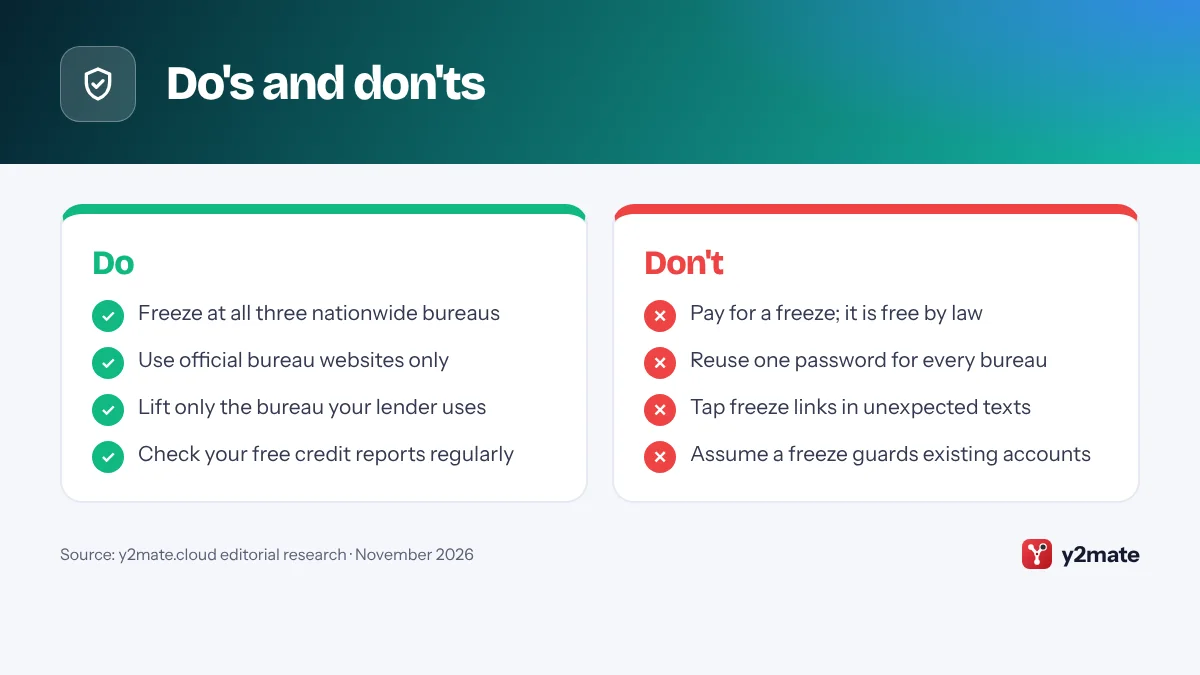
- Use a unique, strong password for each bureau, saved in a reputable password manager.
- Turn on the strongest sign-in option offered, such as one-time codes or a passkey where available. Our guide to setting up passkeys explains why passkeys resist phishing.
- Keep old PINs and confirmation letters in secure notes or a locked drawer.
- Secure your email account, because password resets go there.
- Watch for fake bureau messages. Type the bureau’s web address yourself instead of tapping links in emails or texts, and never share your login with someone who calls you.
Note which email address and phone number you used for each account, so you can still sign in after changing phones.
Step 7: Lift or Thaw Your Freeze When You Need Credit
A freeze stays in place until you remove it, so plan ahead before applying for a credit card, car loan, mortgage or anything else that needs a credit check. Each bureau gives you two choices:
- Temporary lift (thaw): unfreeze for a period you choose, after which the freeze returns on its own.
- Permanent removal: remove the freeze until you decide to place it again.
Under federal law, a nationwide bureau must lift the freeze no later than one hour after an online or phone request, or within three business days of receiving a mailed one. Both options are free.
To limit exposure, ask the lender which bureau or bureaus it will check and lift only those, for only as long as you need. If the lender cannot say, lift all three briefly. Afterwards, sign in and check that each freeze is back on.
Credit Freeze vs Fraud Alert vs Credit Lock: What's the Difference?
These three tools are often confused, but they work differently:
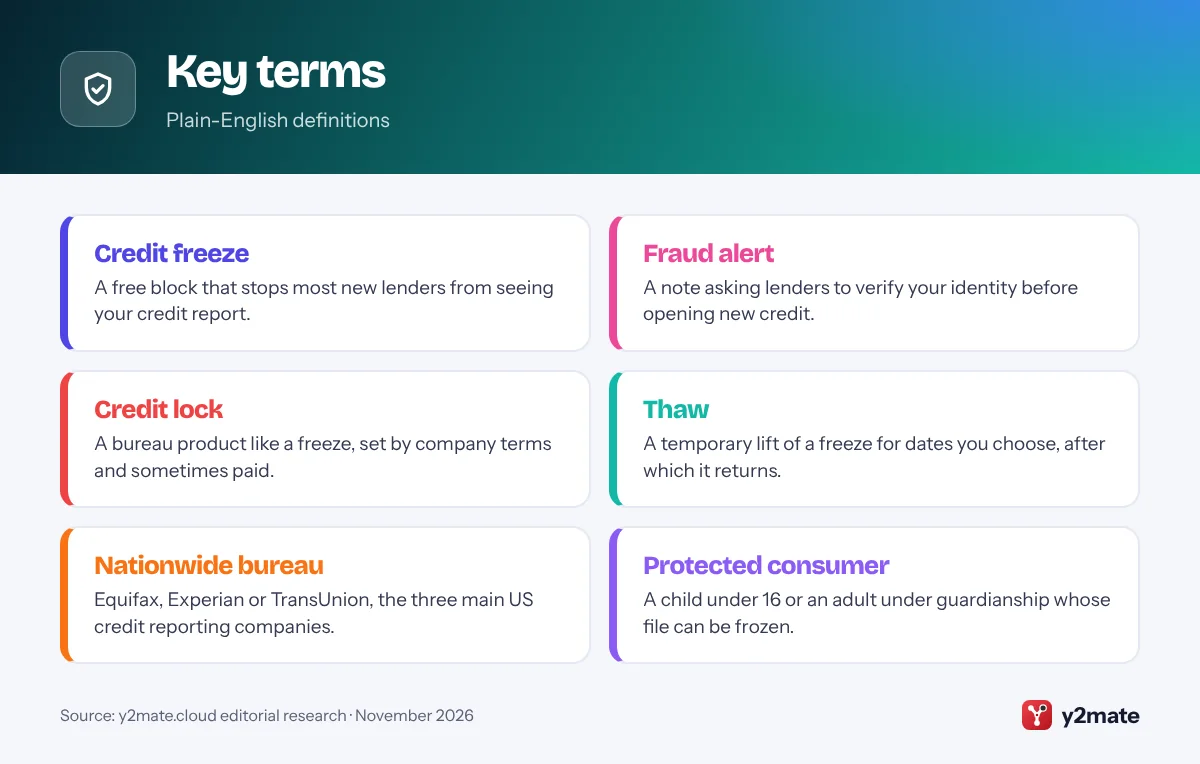
- Credit freeze (security freeze): restricts access to your credit report so most new creditors cannot check it. It is free under federal law, lasts until you remove it and must be placed at each bureau.
- Fraud alert: leaves your report visible but tells businesses to verify your identity before opening new credit. You contact one bureau, which must notify the other two. An initial alert lasts one year, and an extended alert for identity theft victims lasts seven years. Service members can add an active-duty alert.
- Credit lock: a bureau product that works much like a freeze, but its terms come from your agreement with the company rather than federal law, and some locks carry fees.
The CFPB says credit locks are no more effective than security freezes, which are free and a legal right. You can use a freeze and a fraud alert together.
How to Freeze Credit for a Child Under 16 or an Adult Under Guardianship
Federal law gives extra protection to protected consumers: children under 16, and adults who are incapacitated or have a court-appointed guardian or conservator. A parent, guardian or other person with legal authority can request a free freeze for them. If a bureau has no file on that person, it creates one just to freeze it, and that record cannot be used for credit.
Children rarely have credit reports, so misuse may go unnoticed until they first apply for credit, sometimes years later. To request a freeze:
- Gather copies of the child’s or dependent’s ID, such as a birth certificate or Social Security card.
- Gather proof of your own identity and address.
- Add proof of authority, such as a birth certificate naming you as parent, a court order or a power of attorney.
- Follow each bureau’s minor or protected consumer process, which generally works by mail.
Send copies, not originals, to all three bureaus.
What to Do If You're Already a Victim of Identity Theft
If someone has already used your information, you should still freeze your credit, but recovery comes first. The CFPB and the Federal Trade Commission (FTC) point victims to these steps:
- Contact the fraud departments of affected companies, close or freeze those accounts and change your logins.
- Report it at IdentityTheft.gov, the FTC’s official site, to get an FTC Identity Theft Report and a personal recovery plan. Save or print both.
- Add a fraud alert through one bureau, upgrade to an extended alert once you have your report, and freeze all three files.
- Ask the bureaus to block fraudulent information by sending your report, proof of identity and a letter listing the items. The CFPB says they must block it within four business days.
- File a police report if needed, for example if you know who the thief is or a company asks for one.
Be wary of callers claiming to be from the FTC: it never asks you to move money to protect it.
Do's and don'ts
Key terms
Troubleshooting
The bureau cannot verify your identity online
This can happen if you recently moved, changed your name or have little credit history. Try again by phone, or mail a request with copies of your ID and proof of address.
You forgot your bureau login or lost an old PIN
Use the account recovery option on the bureau’s official website, or call and verify your identity with your personal details. Then save the new login in your password manager.
A lender says your credit is still frozen
Ask which bureau the lender used, then check that your lift covers today’s date. Online and phone lifts must be completed within one hour, so wait and ask the lender to try again.
You see an account you do not recognize
Contact the company involved and report it at IdentityTheft.gov. Check your reports from all three bureaus for free every week at AnnualCreditReport.com, the official site for free credit reports.
Frequently asked questions
How do I freeze my credit in the USA?
Contact Equifax, Experian and TransUnion separately. The quickest way is to create a free account on each bureau's official freeze page, verify your identity and turn on the freeze. You can also call or send a request by mail. Online and phone requests must be completed within one business day, and the freeze lasts until you remove it.
Does it cost anything to freeze or unfreeze my credit?
No. Under a federal law that took effect on September 21, 2018, placing, temporarily lifting and permanently removing a security freeze is free at Equifax, Experian and TransUnion. The bureaus also promote paid products such as credit monitoring and credit locks, but you do not need any of them for a free freeze.
Will a credit freeze hurt my credit score?
No. A security freeze does not affect your credit scores, and you can keep using your existing cards and loans and check your own reports. Your score can still change while your file is frozen, because creditors keep reporting your payments. A freeze simply stops most new lenders from seeing your report.
How long does it take to unfreeze my credit?
If you ask online or by phone, a nationwide credit bureau must lift your freeze no later than one hour after receiving the request. A mailed request can take up to three business days. You can lift the freeze for a set period, after which it returns on its own, or remove it entirely.
What is the difference between a credit freeze and a fraud alert?
A credit freeze stops most new creditors from seeing your credit report and must be placed at each bureau. A fraud alert leaves your report visible but tells businesses to verify your identity first, and the bureau you contact shares it with the other two. An initial alert lasts one year. You can use both together.
Wrapping up
To freeze your credit, open free accounts with Equifax, Experian and TransUnion, place a freeze at each, store your logins safely and lift the freeze only when you apply for new credit. It takes less than an hour and makes it much harder for anyone to open credit in your name.
A freeze works best alongside strong, unique passwords, passkeys where offered and healthy suspicion of unexpected calls and texts. For more, see our Top 10 Ways to Protect Your Online Accounts.
Sources and further reading
- FTC: credit freezes and fraud alerts: The Federal Trade Commission explains how free credit freezes and fraud alerts work and how to place them at each bureau.
- CFPB on security freezes: The CFPB sets out the legal deadlines for placing and lifting a freeze and the rules for children under 16.
- USA.gov: freeze or unfreeze credit: The official US government guide to placing or lifting a security freeze online, by phone or by mail.
- Report identity theft: The FTC's official site for reporting identity theft and getting a personal recovery plan.
- CFPB steps for identity theft victims: The CFPB lists what to do right away after identity theft, including fraud alerts, freezes and blocking fraudulent debts.

Leave a Reply