
- The Ohme Home Pro, myenergi zappi and Hypervolt Home 3 Pro are the strongest all-round home EV chargers in the UK for 2026.
- Under the Electric Vehicles (Smart Charge Points) Regulations 2021, home chargers sold in Great Britain must be smart, come with default off-peak charging hours and meet security requirements.
- The EV chargepoint grant helps renters and flat owners with private off-street parking, and a separate grant covers cross-pavement solutions for homes with only on-street parking.
- Many UK homes have a PME supply, so a charger with built-in PEN fault protection usually avoids the need for an earth rod.
- Your installer must notify your distribution network operator (DNO) about a new home charger, and may need approval first if your supply is near its limit.
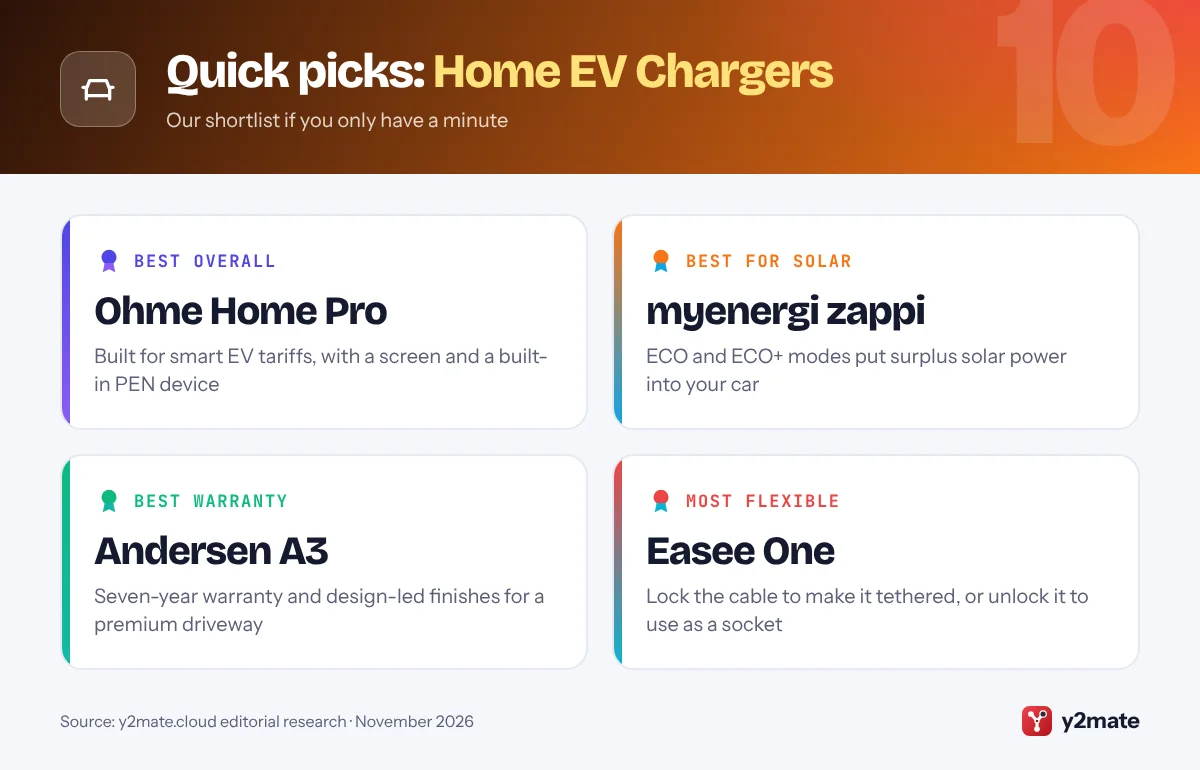
The best home EV chargers in the UK in 2026 are the Ohme Home Pro for smart tariff savings, the myenergi zappi for putting surplus solar power into your car and the Hypervolt Home 3 Pro for a well-rounded charger with built-in safety features. Andersen, Pod, Easee, Octopus, Indra, Tesla and Wallbox complete the list, covering premium design, long warranties and supplier-backed options.
A few terms first. Smart charging means the charger can schedule or adjust charging in response to prices or grid demand, and every home charger sold in Great Britain must be smart by law. A tethered charger has its cable permanently attached, while an untethered or socketed charger uses your own cable, which looks tidier and lets you choose the length. Every model here uses the Type 2 plug fitted to mainstream EVs in the UK. Solar diversion sends electricity your panels would otherwise export into the car, and PEN fault protection disconnects the car if the combined neutral and earth conductor of a PME supply fails.
Most UK homes have a single-phase supply, so your charging speed usually depends on your supply and your car rather than the charger. This list ranks ten chargers sold in the UK and explains who each one suits.
How we ranked this list
We ranked chargers only on publicly documented criteria: compliance with the UK smart charging rules, smart tariff integration, solar diversion, tethered and untethered options, built-in PEN fault protection and the warranty stated on each maker’s UK website. Every pick was offered for sale to UK homes in November 2026.
We did not test the chargers ourselves, and we leave out prices, charging speeds and power ratings. Tariff compatibility and warranty terms change often, so confirm them with the maker and your energy supplier before you buy.
The Top 10 Home EV Chargers
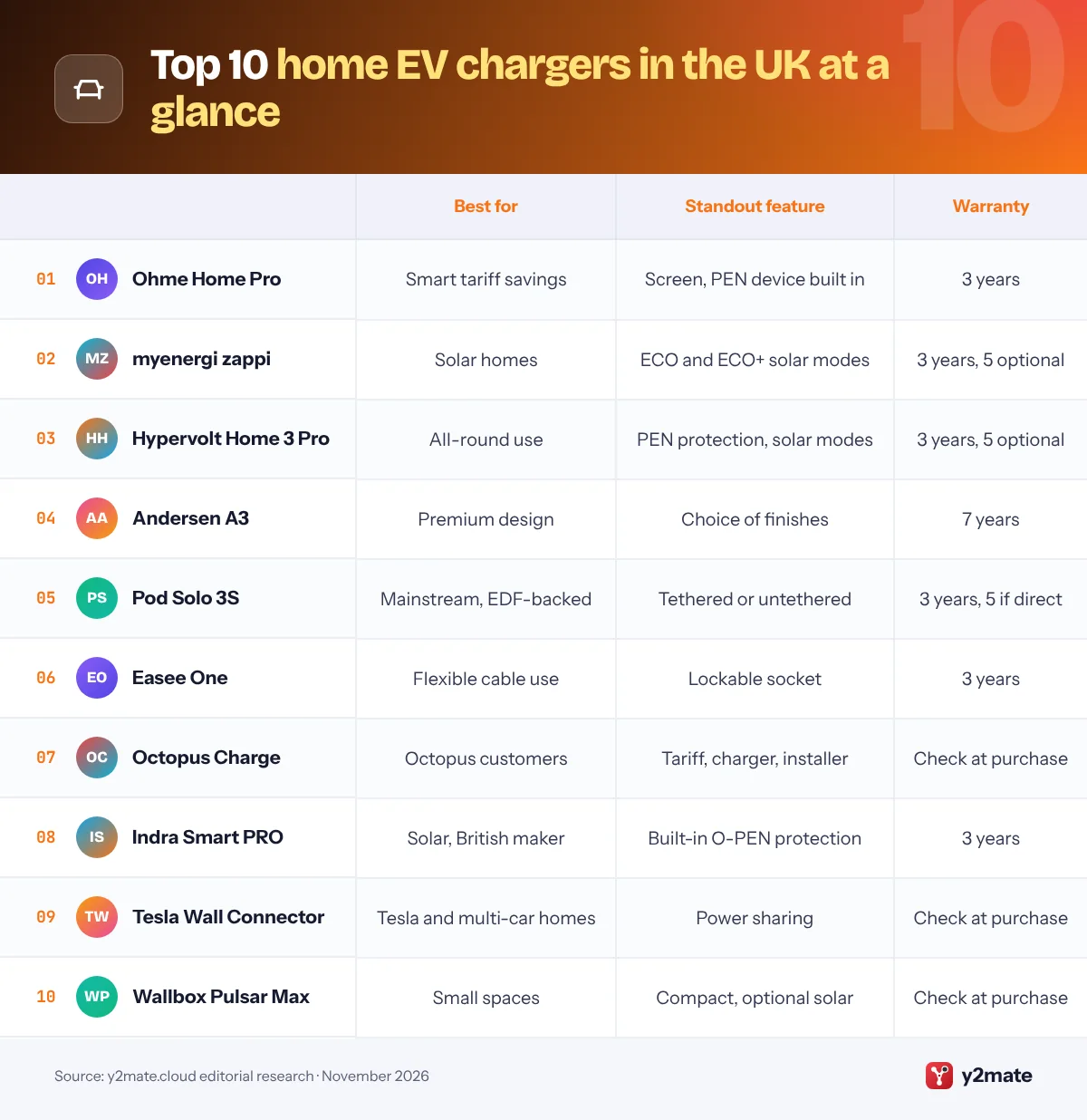
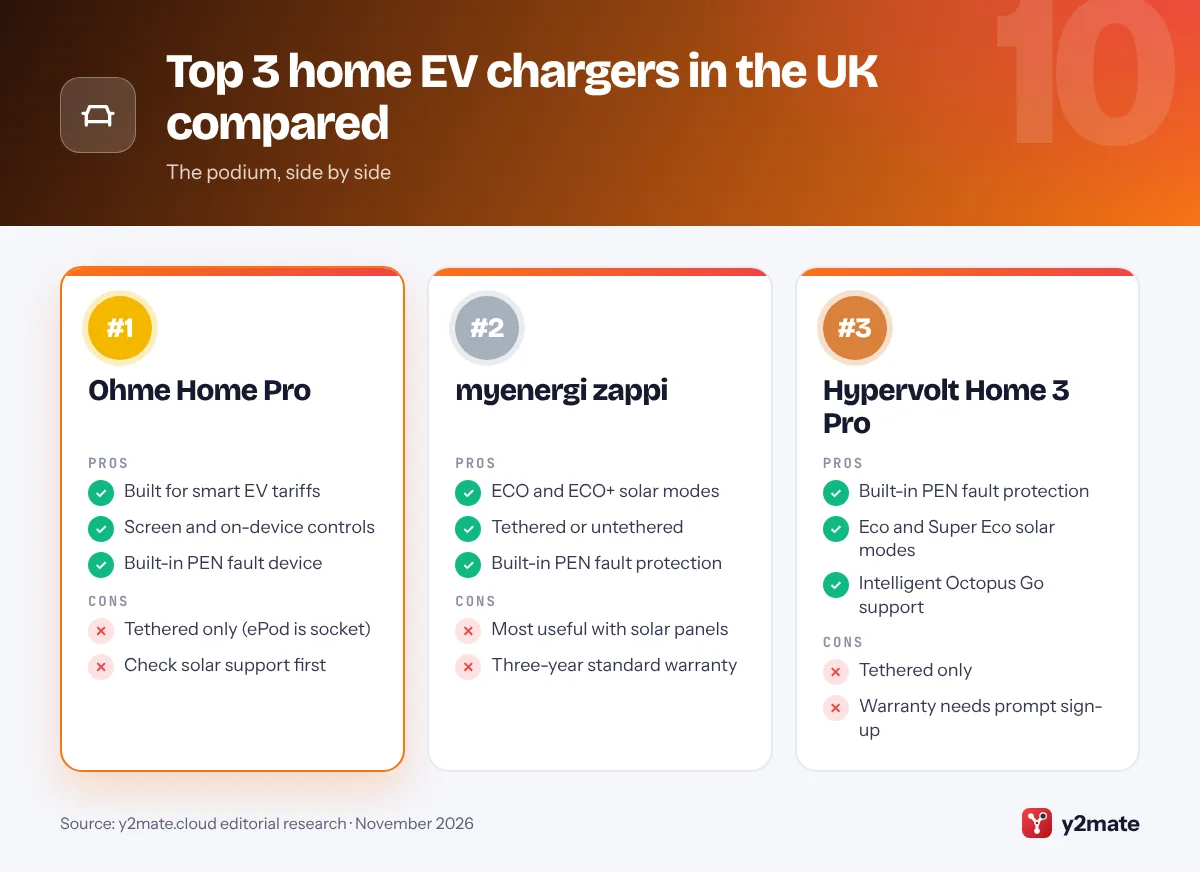
1. Ohme Home Pro
Best for: smart tariff savings with an on-charger screen
Ohme built its reputation on smart tariff integration, and the Home Pro is its flagship tethered charger. Octopus Energy says Ohme chargers are integrated with Intelligent Octopus Go, so the tariff can schedule your charging into its cheapest hours automatically, and Ohme’s app shows which other tariffs it supports. Unlike most rivals, the Home Pro has a screen and on-device controls, so you can check or change a session without reaching for your phone.
Safety and compliance are covered too. The Home Pro has a built-in PEN fault device, which removes the need for an earth rod on most PME supplies, and Ohme says its chargers are fully compliant with the UK smart charging regulations. It comes with a three-year warranty as standard.
If you prefer a socketed charger, the Ohme ePod offers the same smart charging features in a smaller untethered unit without the screen. Solar owners who want dedicated surplus-solar modes should compare it with the zappi or Hypervolt before buying. For most drivers on a smart EV tariff, though, the Home Pro is the easiest charger to live with.
Official site: Ohme Home Pro
- Built for smart EV tariffs
- Screen and on-device controls
- Built-in PEN fault device
- Tethered only (ePod is socket)
- Check solar support first
2. myenergi zappi
Best for: charging your car from surplus solar power
The zappi from British company myenergi is the best-known solar diversion charger in the UK. A clamp measures power flowing to and from the grid, and the charger offers three modes: ECO blends surplus solar with some grid power to keep charging going, ECO+ uses only surplus self-generated power and pauses when it runs low, and FAST charges like a conventional charger. That lets solar owners put energy into the car that would otherwise be exported.
It comes tethered with a Type 2 cable or untethered, has built-in PEN fault protection and runs a self-check of its safety protection before every charge. The standard warranty is three years, and myenergi’s UK warranty allows longer cover if you buy an extension. The newer zappi GLO, made in the UK, drops the screen and moves settings into the myenergi app, while the zappi 2.1 remains for people who like on-device controls.
Without solar panels, much of the zappi’s advantage disappears, and a tariff-focused charger may suit you better. If you have a solar array, it is the charger to beat.
Official site: myenergi zappi
- ECO and ECO+ solar modes
- Tethered or untethered
- Built-in PEN fault protection
- Most useful with solar panels
- Three-year standard warranty
3. Hypervolt Home 3 Pro
Best for: an all-rounder with solar modes and smart tariffs
Hypervolt is a British brand, and the Home 3 Pro packs most of what UK drivers ask for into one tethered unit. Its integrated PEN fault protection is designed to comply with Amendment 2 of BS 7671, the UK wiring regulations, so most installs need no earth rod. If the combined neutral and earth conductor is damaged or disconnected, the charger isolates all conductors to protect anyone touching the car.
For running costs, Hypervolt customers can enable Intelligent Octopus Go integration from within the Octopus Energy app, and the charger has two solar modes, Eco and Super Eco, for homes with panels. Hypervolt’s app handles schedules and charging history for everything else.
Hypervolt’s standard warranty runs for three years from installation, provided a qualified electrician fits it and you register it online soon after installation. You can extend cover to five years if you buy the extension within a month of installation. The main limitations are that it is only available tethered and that Hypervolt says it is not bidirectional, so it cannot power your home from the car. For most homes, it is an excellent all-round choice.
Official site: Hypervolt Home 3 Pro
- Built-in PEN fault protection
- Eco and Super Eco solar modes
- Intelligent Octopus Go support
- Tethered only
- Warranty needs prompt sign-up
4. Andersen A3
Best for: premium design and the longest warranty
Andersen is known for design-led chargers that look more like a piece of home decor than a utility box, with a choice of finishes to match your house. The A3 is the newer model in its range, alongside the long-running A2. Andersen’s standout is its warranty: the company says all of its charge points are protected by a seven-year warranty, the longest on this list.
Smart features have caught up with the looks. Andersen says that, as of September 2025, all A3 chargers are integrated with Intelligent Octopus Go, and A2 chargers are too, apart from some higher-power units. The A3 can also manage surplus solar from home panels to power charging sessions, and every Andersen charger can be controlled through the Andersen app.
There is some history to be aware of. Andersen’s previous owner went into administration in 2022, and EVIOS, another British charger maker, bought the business and said it would honour existing warranties. Andersen has kept trading since, including a free charging offer with Octopus in 2026. For a period home or a statement driveway, it is the most stylish option here.
Official site: Andersen A3
- Seven-year warranty
- Design-led, choice of finishes
- Intelligent Octopus Go support
- Past administration in 2022
- Check cable options by model
5. Pod Solo 3S
Best for: a mainstream charger backed by EDF
Pod, formerly Pod Point, is one of the UK’s longest-running charger brands. It rebranded in May 2025, joined the EDF group in August 2025 and bought EO Charging’s business out of administration in May 2026, which makes it one of the best-resourced names in home charging. Its current home unit, the Solo 3S, comes as a tethered charger with a Type 2 cable or as an untethered socket.
Pod sells the Solo 3S directly, through car brands and alongside EDF’s EV tariff bundles, and it also offers a subscription that covers the charger, installation and servicing for a monthly fee. Its datasheet gives a three-year product warranty as standard, while Pod’s website offers a five-year warranty on home chargers bought directly from Pod at the full retail price.
The Solo 3S is a solid, well-supported choice rather than a feature leader. Check solar and tariff support for your setup before you buy, especially if you are not with EDF, and compare the subscription against buying outright, because the better option depends on how long you expect to keep the charger.
Official site: Pod Solo 3S
- Tethered or untethered
- Backed by EDF
- Up to five years' warranty direct
- Fewer standout features
- Check tariff and solar support
6. Easee One
Best for: switching between tethered and untethered
Easee is a Norwegian company, and the Easee One is its compact home charger for the UK. Its party trick is flexibility: the unit has a Type 2 socket, and you choose whether it behaves as tethered or untethered by locking the cable in place through the Easee app. That suits households who want a cable always ready but might change cars or cable length later.
The One has integrated open PEN conductor protection designed to meet the UK wiring regulations, so most installs do not need an earth rod, although Easee’s guide says the protection only works when the unit is wired for a TN-C-S (PME) supply as described. Easee UK publishes a statement of compliance with the Electric Vehicles (Smart Charge Points) Regulations 2021, and the product sheet lists a three-year UK manufacturer guarantee.
Easee’s app handles scheduling and remote control, and UK energy suppliers including ScottishPower have partnered with Easee on charger deals. Check that your own supplier’s smart tariff supports it before you buy, and solar owners should check Easee’s solar options, because the zappi and Hypervolt offer solar modes out of the box.
Official site: Easee One
- Lockable cable: tethered or not
- Integrated PEN protection
- Compact design
- Check tariff support first
- Check solar options
7. Octopus Charge
Best for: Octopus customers on Intelligent Octopus Go
Octopus Charge is Octopus Energy’s own home charger, launched in 2025 and designed, installed and supported by Octopus itself. It comes untethered or tethered, and it is built to work with Intelligent Octopus Go and Octopus’s EV tariff bundles, which schedule charging into cheaper hours automatically.
You control it through the Octopus app, and Octopus says it works whichever energy supplier you use, so you are not locked in if you switch later. Homes with solar panels get Eco and Super Eco modes, which use electricity you generate when your home does not need it, with Super Eco pitched as the greenest option.
The appeal is having one company responsible for the tariff, the charger and the installation, which keeps support simple. The trade-off is less independence: you buy and install through Octopus rather than choosing your own installer, and the product has a shorter track record than long-running rivals such as the zappi or Ohme. Check the warranty terms with Octopus at the time of purchase. For an Octopus customer who wants the least hassle, it is a strong option.
Official site: Octopus Charge
- Designed for Intelligent Go
- Tethered or untethered
- Eco and Super Eco solar modes
- Bought and fitted via Octopus
- Newer product, shorter record
8. Indra Smart PRO
Best for: solar homes that want a British V2G pioneer
Indra is a British company best known for pioneering vehicle-to-grid (V2G) charging, and the Smart PRO is its home charger for everyday use. It has built-in O-PEN protection using Indra’s own design, and Indra’s installation guide says an extra upstream O-PEN device must not be added, so choose an installer who knows the product.
The Smart PRO handles solar charging by taking surplus solar power above a set threshold, and it offers tariff integration, smart scheduling, charging analytics and charger locking, with continuous over-the-air updates. It comes in tethered and untethered versions. Indra’s April 2025 warranty statement gives the current Smart PRO Gen 2 versions a three-year warranty.
Indra’s V2G work is a separate part of its business: in February 2026 it announced it had activated end-to-end vehicle-to-grid technology. For now, buy the Smart PRO for everyday smart and solar charging, and check that your tariff is supported. For solar owners who like a British maker with deep grid experience, it is a solid choice.
Official site: Indra Smart PRO
- Built-in O-PEN protection
- Surplus solar charging
- Tethered or untethered
- Needs installer who knows it
- Check tariff support first
9. Tesla Wall Connector
Best for: Tesla owners and multi-car power sharing
Tesla’s Wall Connector is a tethered Type 2 charger that Tesla says works with any EV that has a Type 2 port, not just Teslas. It connects to Wi-Fi for over-the-air updates, and several Wall Connectors can share power between two or more cars. With a separately sold Tesla-approved meter, Dynamic Power Management can limit charging to protect your home’s supply.
Tesla publishes a statement of compliance for its third-generation Wall Connector under the Electric Vehicles (Smart Charge Points) Regulations 2021, so it can be sold for home use in Great Britain. Tesla drivers usually set charging schedules in the car or the Tesla app, which suits anyone on a tariff that works directly with Tesla vehicles.
The Wall Connector is a simple charger rather than an energy hub. It is not marketed as a solar diversion charger, and you should ask your installer how PEN fault protection will be handled, because some retailers sell it with a separate PEN fault device. Check the UK warranty terms when you buy. For a Tesla household, or one with several EVs sharing power, it is a dependable, straightforward choice.
Official site: Tesla Wall Connector
- Works with any Type 2 EV
- Power sharing for several EVs
- Over-the-air updates
- Not a solar diversion charger
- Ask about PEN protection
10. Wallbox Pulsar Max
Best for: a compact charger with optional solar charging
The Pulsar Max is Wallbox’s compact home charger and the successor to the popular Pulsar Plus. Wallbox’s UK listing says it has integrated PEN fault protection, so no earth rod is needed, and it is sold in tethered and socketed versions. Its Eco-Smart feature can send surplus solar into the car, but only when you add a Wallbox power meter to the installation. Control runs through the myWallbox app.
There are two things to check first. In September 2026 the Office for Product Safety and Standards published a product safety report on the Pulsar Max UK, citing a low risk of fire from a manufacturing defect in the internal output terminal block of affected units, and advising owners to contact Wallbox customer support. Wallbox has contacted affected owners, is issuing a software update and will inspect units, providing repairs or replacement parts where needed. Wallbox, a Spanish company, also went through a debt restructuring in 2026.
If you are buying new, ask your installer to confirm the unit is not affected and that the PEN protection version suits your supply. For a small, tidy charger that can grow into solar charging later, it is still worth a look.
Official site: Wallbox Pulsar Max
- Compact design
- Tethered or socket versions
- Solar mode with power meter
- 2026 safety report on some units
- Solar needs extra meter
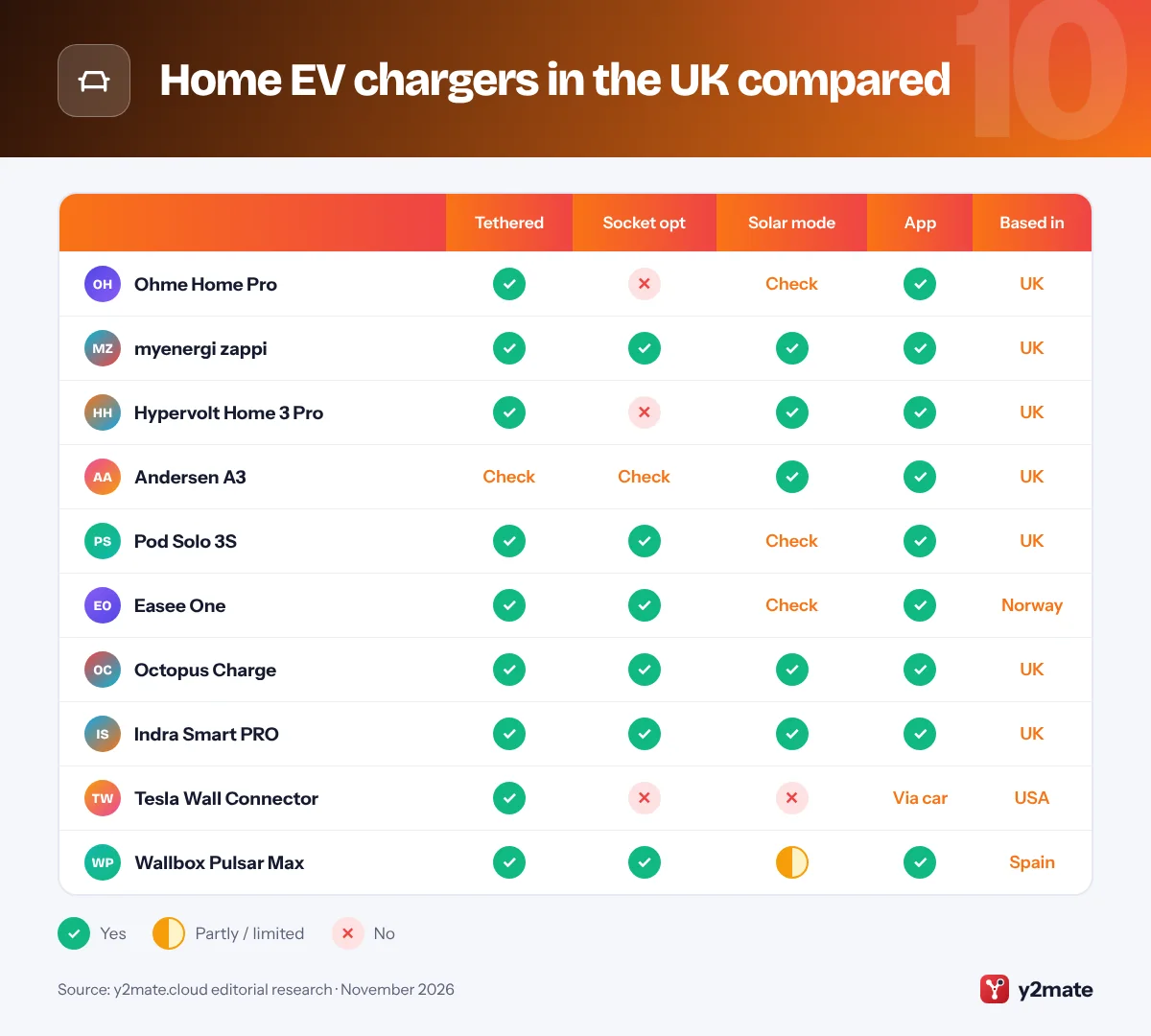
Home EV chargers in the UK compared
How to choose home EV chargers in the UK
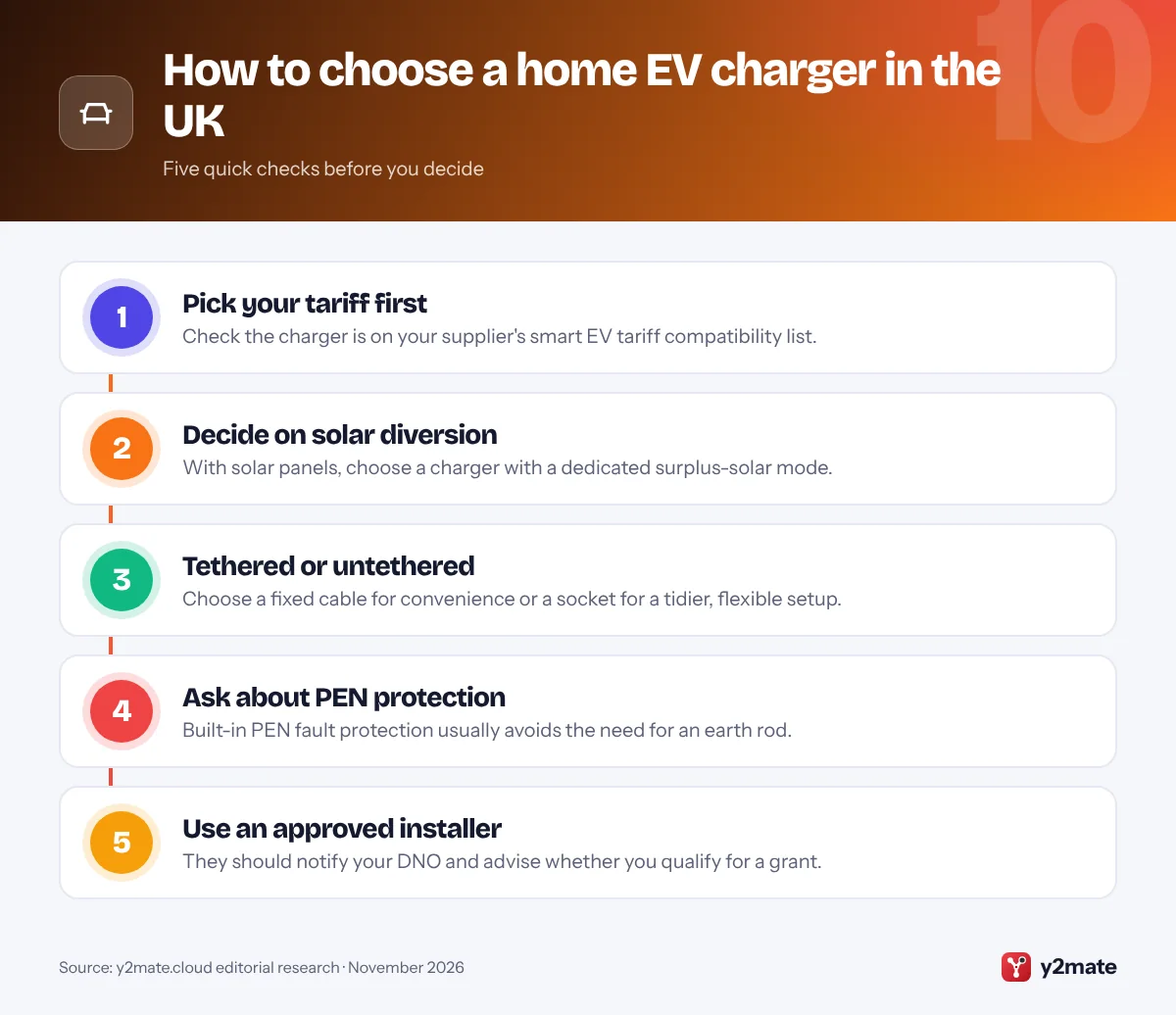
Start with your tariff and your roof. If you are on, or plan to join, a smart EV tariff such as Intelligent Octopus Go, check the charger appears on your supplier’s compatibility list. If you have solar panels, look for a dedicated solar mode such as the zappi’s ECO+ or Hypervolt’s Super Eco.
What the smart charging rules mean for you
- Smart by law: under the Electric Vehicles (Smart Charge Points) Regulations 2021, home chargers sold in Great Britain must be able to send and receive information and respond to signals.
- Off-peak default: chargers come with default charging hours outside the weekday morning and evening peaks, which you can accept, change or override.
- Randomised delay: a short random delay stops large numbers of chargers switching on at once, and you can cancel it.
- Security: chargers must meet security requirements largely based on the ETSI EN 303 645 cyber security standard.
- Supplier switching: smart features must keep working if you change energy supplier.
The government has consulted on folding these rules into new energy smart appliance regulations, so check GOV.UK for updates.
Grants, PEN faults and your DNO
The EV chargepoint grant helps people who rent, or who own and live in a flat, and have private off-street parking, with written permission from the landlord or freeholder. A separate grant helps households with only on-street parking install a cross-pavement solution. The application process changed in April 2026, so check GOV.UK for how to apply. Ask your installer whether your PME supply needs PEN fault protection, and make sure they notify your distribution network operator (DNO), or apply first if your supply is close to its limit.
Frequently asked questions
What is the best home EV charger in the UK?
For most drivers, the Ohme Home Pro is the best home EV charger in the UK in 2026, because it is built around smart EV tariffs, has a screen and includes a PEN fault device. Solar owners should choose the myenergi zappi for its ECO and ECO+ modes, and the Hypervolt Home 3 Pro is a strong all-rounder with solar modes and Intelligent Octopus Go support.
Can I get a government grant for a home EV charger?
Only in some situations. The EV chargepoint grant is for people who rent, or who own and live in a flat, and have private off-street parking, and you need written permission from your landlord or freeholder. Households with only on-street parking can get help installing a cross-pavement solution such as a charging gully. Homeowners with a driveway are not covered, and GOV.UK explains how to apply.
Should I choose a tethered or untethered EV charger?
A tethered charger has its cable fixed in place, so you simply unhook it and plug in, which suits most people charging every day. An untethered charger has a Type 2 socket and uses your own cable, which looks tidier and lets you pick a longer or shorter cable. The Easee One can do both by locking a cable into its socket through the app.
What is PEN fault protection and do I need it?
Many UK homes have a PME supply, where neutral and earth share one conductor from the network. If that PEN conductor breaks, the car's bodywork could become dangerous to touch, so the wiring regulations, BS 7671, require protection. Many chargers, including the Ohme, zappi, Hypervolt and Easee, have built-in PEN fault protection, which usually avoids fitting an earth rod. Your installer will confirm what your supply needs.
Do I need to tell my DNO about a home EV charger?
Yes. Your installer must notify your distribution network operator (DNO) about a new home charger, usually shortly after installation under the Energy Networks Association's connect and notify process. If your home's maximum demand, including the charger, would go beyond the notification limits, the installer must apply to the DNO first and wait for approval. Ask your installer to confirm it has been done.
Final verdict
The best home EV chargers in the UK in 2026 start with the Ohme Home Pro for smart tariff savings, the myenergi zappi for solar homes and the Hypervolt Home 3 Pro for an all-rounder with built-in PEN fault protection. Andersen leads on warranty and design, while Pod, Easee, Octopus, Indra, Tesla and Wallbox suit more specific needs.
Before you buy, check your tariff’s compatibility list, decide between tethered and untethered, confirm how your installer will handle PEN fault protection and DNO notification, and see whether you qualify for a chargepoint grant.
Sources and further reading
- Smart charge point regulations guidance: GOV.UK guidance on the smart functionality, default charging hours and security rules that home charge points sold in Great Britain must meet.
- Smart Charge Points Regulations 2021: The full text of the Electric Vehicles (Smart Charge Points) Regulations 2021 on the official legislation website.
- EV chargepoint grants: GOV.UK explains who can get an EV chargepoint grant, including renters, flat owners and households with only on-street parking.
- ENA connection FAQs: The Energy Networks Association answers common questions about notifying your network operator when you install an EV charger.
- IET EV charging FAQs: The IET, which publishes the BS 7671 wiring regulations with BSI, answers common questions about EV charging installations.

Leave a Reply