
- The myenergi zappi, Tesla Wall Connector and Evnex E2 Plus are the strongest all-round home EV chargers in Australia for 2026.
- Australian home chargers use the Type 2 connector, which fits the mainstream EVs sold here.
- Since 1 July 2024, EV chargers installed in South Australian homes must be capable of demand response and appear on the Technical Regulator's approved list.
- A licensed electrician must install a wall charger to the AS/NZS 3000 Wiring Rules, and some networks require approval before the charger goes in.
- Dedicated home charger rebates are rare, but NSW's Home Energy Saver program and the ACT's Sustainable Household Scheme offer loans that can include an eligible EV charger.
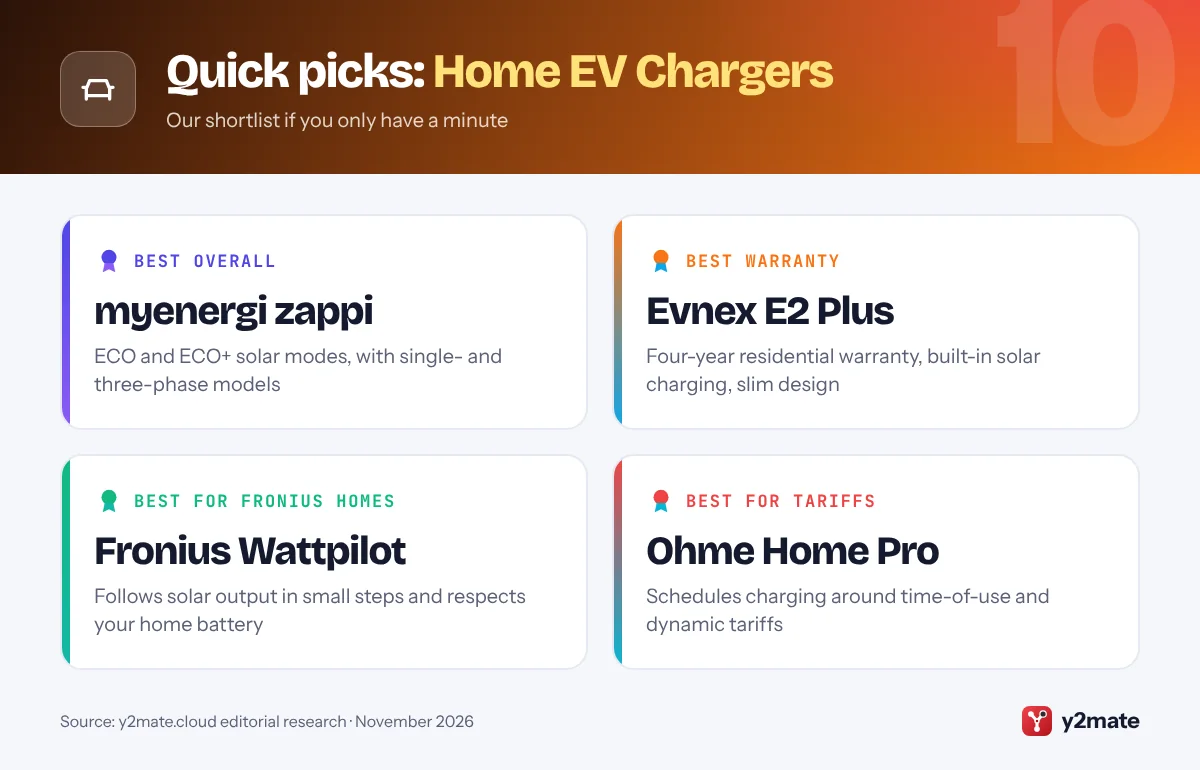
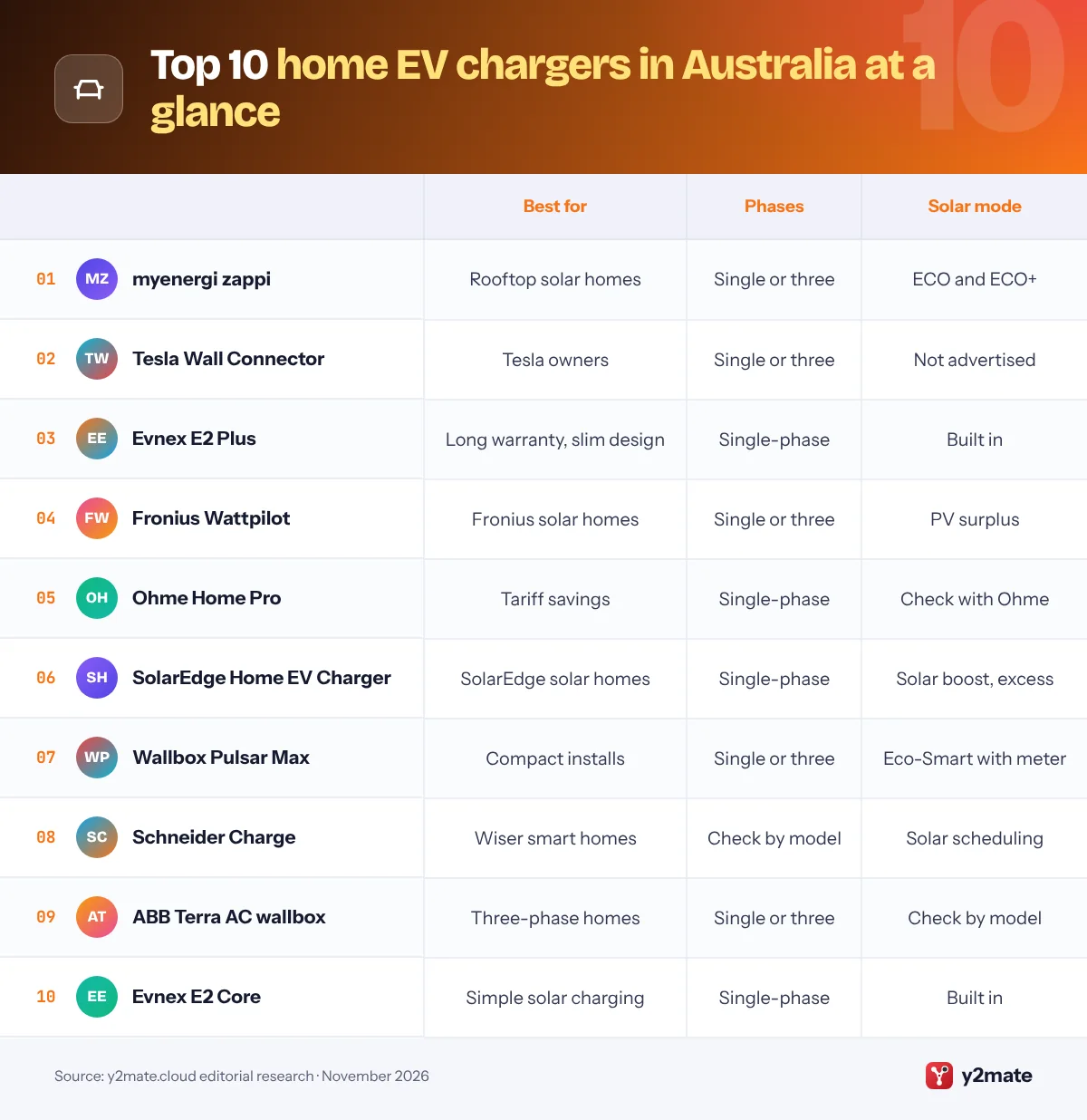
The best home EV chargers in Australia in 2026 are the myenergi zappi for soaking up rooftop solar, the Tesla Wall Connector for simple, proven charging and the Evnex E2 Plus for a slim smart charger with a four-year warranty. Fronius, Ohme, SolarEdge, Wallbox, Schneider Electric, ABB and the Evnex E2 Core complete the list, covering inverter-matched, tariff-focused and three-phase options.
A few terms first. A wall charger, sometimes called a Level 2 or AC charger, is wired into your switchboard on its own circuit, unlike the portable cable that plugs into a normal power point. Australian home chargers use the Type 2 plug. Many homes have a single-phase supply, while a three-phase supply can support faster charging if your car allows it. Solar soft-charging, or solar diversion, means the charger tracks your solar output and sends surplus power into the car instead of exporting it. Smart charging means the charger can be scheduled or controlled remotely, including by your network or retailer in demand-response programs.
Rules also differ by state. South Australia requires demand-response capable chargers, while NSW and the ACT offer loans that can cover one. This list ranks ten chargers sold in Australia and explains who each one suits.
How we ranked this list
We ranked chargers only on publicly documented criteria: solar charging features, support for single-phase and three-phase supplies, smart app and tariff features, local compliance information such as RCM marking, and the warranty stated on each maker’s Australian website. Every pick was offered for sale in Australia in November 2026.
We did not test the chargers ourselves, and we leave out prices, charging speeds and power ratings. Australian Consumer Law guarantees apply on top of any manufacturer’s warranty, so keep your invoice and your electrician’s compliance certificate.
The Top 10 Home EV Chargers
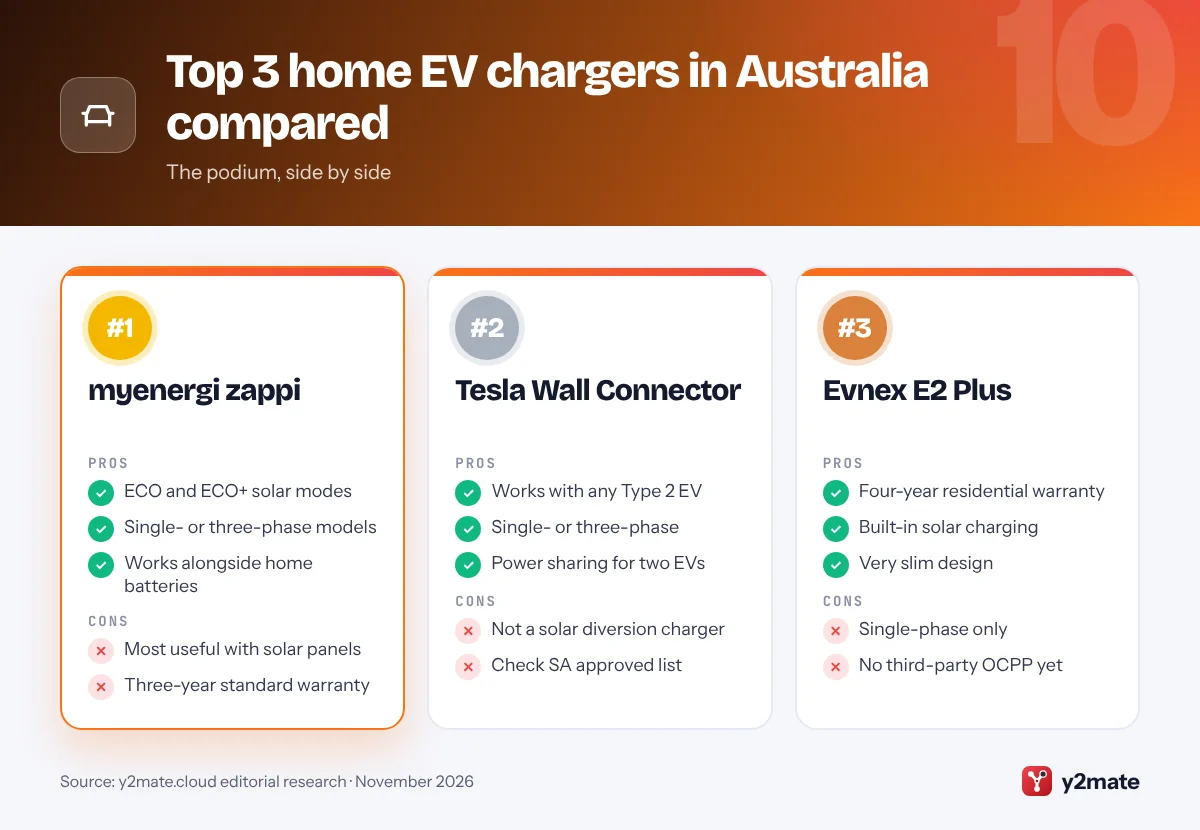
1. myenergi zappi
Best for: soaking up surplus rooftop solar
With so many Australian homes running rooftop solar, the zappi is the charger to beat for putting spare solar into your car. A clamp measures power flowing to and from the grid, and three modes let you choose how green to go: ECO blends surplus solar with some grid power to keep charging steady, ECO+ only charges from genuine surplus solar and pauses when it drops, and FAST charges like a conventional charger.
myenergi sells a single-phase model for most homes and a three-phase model for properties with a three-phase supply, both with the Type 2 connector. It also publishes guides for using the zappi alongside home batteries from brands such as Sigenergy, Tesla Powerwall, Sungrow, GoodWe and FoxESS, so you can charge the car from solar without draining the battery.
The standard warranty is three years, and myenergi’s Australian terms ask you to report a defect promptly. Without solar panels, much of the zappi’s advantage disappears, and South Australian buyers should confirm the exact model is on the Technical Regulator’s approved list. For solar homes, it remains the benchmark.
Official site: myenergi zappi
- ECO and ECO+ solar modes
- Single- or three-phase models
- Works alongside home batteries
- Most useful with solar panels
- Three-year standard warranty
2. Tesla Wall Connector
Best for: Tesla owners and simple, reliable charging
Tesla’s third-generation Wall Connector is sold on Tesla’s Australian online shop with a long Type 2 cable, and Tesla says it works with any EV that has a Type 2 port, not just Teslas. It suits single-phase and three-phase homes, so it can make the most of a three-phase supply if your car’s onboard charger supports it.
It connects to Wi-Fi for over-the-air updates, and several Wall Connectors can share power between two or more cars, which is handy for two-EV households. Tesla drivers manage charging schedules from the car and the Tesla app, which keeps everything in one place if you already own a Tesla.
The Wall Connector is a straightforward charger rather than an energy manager. It is not marketed as a solar diversion charger, so solar-focused homes may prefer the zappi, Wattpilot or Evnex range. South Australian buyers must make sure the model is on the Technical Regulator’s approved list for demand-response capability, and everyone should check the Australian warranty terms when buying. For Tesla owners, and for households that simply want dependable hardware with a long cable, it is an easy choice.
Official site: Tesla Wall Connector
- Works with any Type 2 EV
- Single- or three-phase
- Power sharing for two EVs
- Not a solar diversion charger
- Check SA approved list
3. Evnex E2 Plus
Best for: a slim smart charger with a four-year warranty
Evnex is a New Zealand company that designs chargers for Australian and New Zealand homes, and the E2 Plus is its smart all-rounder for single-phase homes. Its very slim design keeps a garage or carport wall tidy, and it uses the Type 2 connector.
Solar charging is built in. Once your panels are exporting more than a minimum threshold, the E2 Plus can divert that surplus into the car, and Evnex lists three-phase net metering among its features for homes with three-phase solar setups. The Evnex app lets you control charging remotely and shift the rest of your charging into cheaper hours.
Evnex states a four-year warranty for residential chargers, longer than most rivals here. Evnex uses OCPP, the open charge point protocol, to connect its chargers to its own cloud, but says they are not yet compatible with third-party OCPP services chosen by the user, which matters if you want another app or certain energy programs. The E2 Plus is a single-phase charger, and Evnex sells a separate model for three-phase charging. For most single-phase homes, it is an excellent all-round choice.
Official site: Evnex E2 Plus
- Four-year residential warranty
- Built-in solar charging
- Very slim design
- Single-phase only
- No third-party OCPP yet
4. Fronius Wattpilot
Best for: homes with a Fronius solar inverter
Fronius is an Austrian inverter maker with a large presence in Australia, and its Wattpilot chargers are designed to work hand in hand with Fronius solar systems. In the Solar.wattpilot app you can switch on PV surplus charging, which adjusts the charging current in very small steps so the car closely follows your solar output. You can also set thresholds for a home battery’s state of charge and for a Fronius Ohmpilot hot water controller, so the car only gets surplus once those are looked after.
The range includes Home, Go and Flex models for single-phase and three-phase homes, and the Go version is portable for owners who charge in more than one place. The Wattpilot links to Fronius’s Solar.web monitoring portal, so you can see solar, battery and EV charging together. Fronius says the Wattpilot warranty is three years for units delivered from 1 August 2024.
The Wattpilot makes most sense if you already have, or plan to buy, a Fronius inverter. With another inverter brand, the zappi or Evnex may be simpler to set up.
Official site: Fronius Wattpilot
- Fine-grained solar surplus mode
- Battery-aware solar charging
- Single- or three-phase models
- Best with a Fronius inverter
- Warranty shorter than Evnex
5. Ohme Home Pro
Best for: time-of-use and dynamic tariff savings
Ohme is a British smart charging company that launched its Home Pro in Australia in October 2024, alongside its existing ePod. The Home Pro has a screen and on-device controls, which is rare among home chargers, and it comes with a choice of cable lengths for driveways where the car parks further from the wall.
Ohme’s focus is electricity tariffs. Its app is built to schedule charging into the cheapest periods of time-of-use plans and dynamic tariffs, where prices change through the day, and Ohme says its chargers integrate with dynamic tariffs. Ohme’s Australian brochure lists the Home Pro as RCM marked and registered on the Electrical Equipment Safety System (EESS), the national register for electrical equipment.
Ohme’s Australian Home Pro listings are for single-phase models, so three-phase homes wanting faster charging should look at the zappi, Wattpilot or Tesla. If solar charging matters to you, check how the Home Pro’s solar features suit your system before buying, and confirm the warranty with Ohme or your retailer. For drivers who want to cut costs on a time-of-use or wholesale-linked plan, it is a clever, easy-to-use choice.
Official site: Ohme Home Pro
- Screen and on-device controls
- Built for tariff savings
- RCM marked, EESS registered
- Single-phase models only
- Check solar features first
6. SolarEdge Home EV Charger
Best for: homes with a SolarEdge inverter
SolarEdge makes inverters and optimisers found on many Australian rooftops, and its Home EV Charger is a Type 2 wall charger for Australia and New Zealand designed to work with them. Paired with a SolarEdge system, it offers a solar boost mode that combines grid and solar energy to charge faster than from the grid alone, and an excess solar mode that starts charging once surplus solar passes the minimum level the car needs. Excess solar charging needs an import/export meter.
Everything is managed in SolarEdge’s app alongside your solar production and, if you have one, your SolarEdge battery, so you can see your panels, battery and car in one place.
The Australian model is a single-phase charger, so it suits most homes but not owners who want three-phase charging. Its real advantage depends on having a SolarEdge inverter, and with another inverter brand the zappi or Evnex is likely a better fit. Check the warranty and the exact inverter compatibility with your installer, because some solar boost features depend on the inverter model. For SolarEdge homes, it keeps solar, battery and EV charging in one ecosystem.
Official site: SolarEdge Home EV Charger
- Solar boost mode
- Excess solar charging
- One app with SolarEdge solar
- Single-phase only
- Best with SolarEdge inverter
7. Wallbox Pulsar Max
Best for: a compact charger for single- or three-phase homes
The Pulsar Max is Wallbox’s compact home charger and the successor to the Pulsar Plus, sold through Wallbox’s Australian website and local installers. It comes in single-phase and three-phase versions with the Type 2 connector. The socket version is the easiest to buy, and Wallbox asks buyers to contact it about tethered availability.
Its Eco-Smart feature can charge from surplus solar, but only after you add a Wallbox power meter to the installation, so budget for that if solar matters. Wallbox says three-phase solar charging optimisation comes as standard on the socket version of the Pulsar Max. Control runs through the myWallbox app, which handles schedules and charging history.
Two cautions apply. Wallbox, a Spanish company, went through a debt restructuring in 2026, and one independent Australian review could not find a local support phone number, so ask your installer who handles warranty claims here. Independent reviewers also advise mounting it out of direct sun. For a neat charger that can grow into solar charging later, it is still a sensible pick.
Official site: Wallbox Pulsar Max
- Compact design
- Single- or three-phase
- Solar mode with power meter
- Solar needs extra meter
- Maker restructured in 2026
8. Schneider Charge
Best for: smart homes that use the Wiser app
Schneider Electric owns Clipsal, one of Australia’s best-known electrical brands, and Schneider Charge is its smart charger for single-family homes. It can run through the Wiser home energy app, which also controls Clipsal smart switches and energy monitoring, or through another EV charging app.
In Wiser you can monitor and control charging remotely and schedule sessions to use solar power. Schneider also builds in an anti-trip system designed to avoid overloading your home’s supply, which helps on a busy single-phase connection with air conditioning, a pool pump or a hot water system running at the same time. Your electrician commissions it in the Wiser Home app, including firmware updates and setting the maximum charging current.
The charger shines brightest in a home already built around Wiser and Clipsal products. Its solar features are built around scheduling in Wiser, so solar-first buyers who want automatic surplus diversion should compare it with the zappi. Check the warranty, the three-phase options and South Australian approval with your installer. For Wiser households, it is the most integrated choice on this list.
Official site: Schneider Charge
- Works with Wiser home app
- Anti-trip overload protection
- Solar-aware scheduling
- Best inside Wiser homes
- Check three-phase options
9. ABB Terra AC wallbox
Best for: three-phase homes wanting robust hardware
ABB is a Swiss engineering group with a long history in fast charging, and its Terra AC wallbox brings that experience to the home. It has been available in Australia through ABB’s partner network since 2020, and Australian electrical wholesalers list single-phase and three-phase versions with Wi-Fi, Bluetooth and RFID card access, some with a fixed cable and others with a socket.
ABB’s app handles setup and scheduling, and independent reviews say the charger supports load management and solar integration, although the details depend on the model and any extra hardware fitted. Reviews disagree on how open the residential version is to third-party OCPP software, so check the exact model if you want to use another app or join an energy program.
The Terra AC suits three-phase homes and owners who value commercial-grade hardware over the slickest app. It is sold through installers and wholesalers rather than direct, so ask your electrician about warranty handling and South Australian approval. Few EVs can use the highest three-phase charging rate at home, so check your car’s onboard charger before choosing a higher-power version.
Official site: ABB Terra AC wallbox
- Single- or three-phase
- Wi-Fi, Bluetooth and RFID
- Tethered or socket versions
- Sold via installers only
- OCPP openness varies
10. Evnex E2 Core
Best for: simple solar charging without the extras
The E2 Core is Evnex’s solar-focused charger for buyers who want the basics done well. Evnex markets it around charging your EV from the sun, and like the E2 Plus it can start solar charging once your panels export more than a minimum threshold, putting surplus energy into the car instead of exporting it to the grid.
It shares the slim design, Type 2 connector and single-phase supply of the E2 Plus, along with Evnex’s four-year warranty for residential chargers. Evnex positions the E2 Plus as the model with more smart features, so compare the two on Evnex’s comparison page before you decide. The Core suits owners who mainly want solar charging, while the Plus adds extras for people who want more control.
As with the rest of the range, Evnex uses OCPP only for its own cloud at this stage, so third-party apps and some energy programs may not connect. Evnex’s E2 Flex, by contrast, does not offer solar charging, so make sure you choose the right model. For a solar home that wants a long warranty and minimal fuss, the E2 Core is a sensible entry point.
Official site: Evnex E2 Core
- Solar charging built in
- Four-year residential warranty
- Slim, tidy design
- Single-phase only
- Fewer extras than E2 Plus
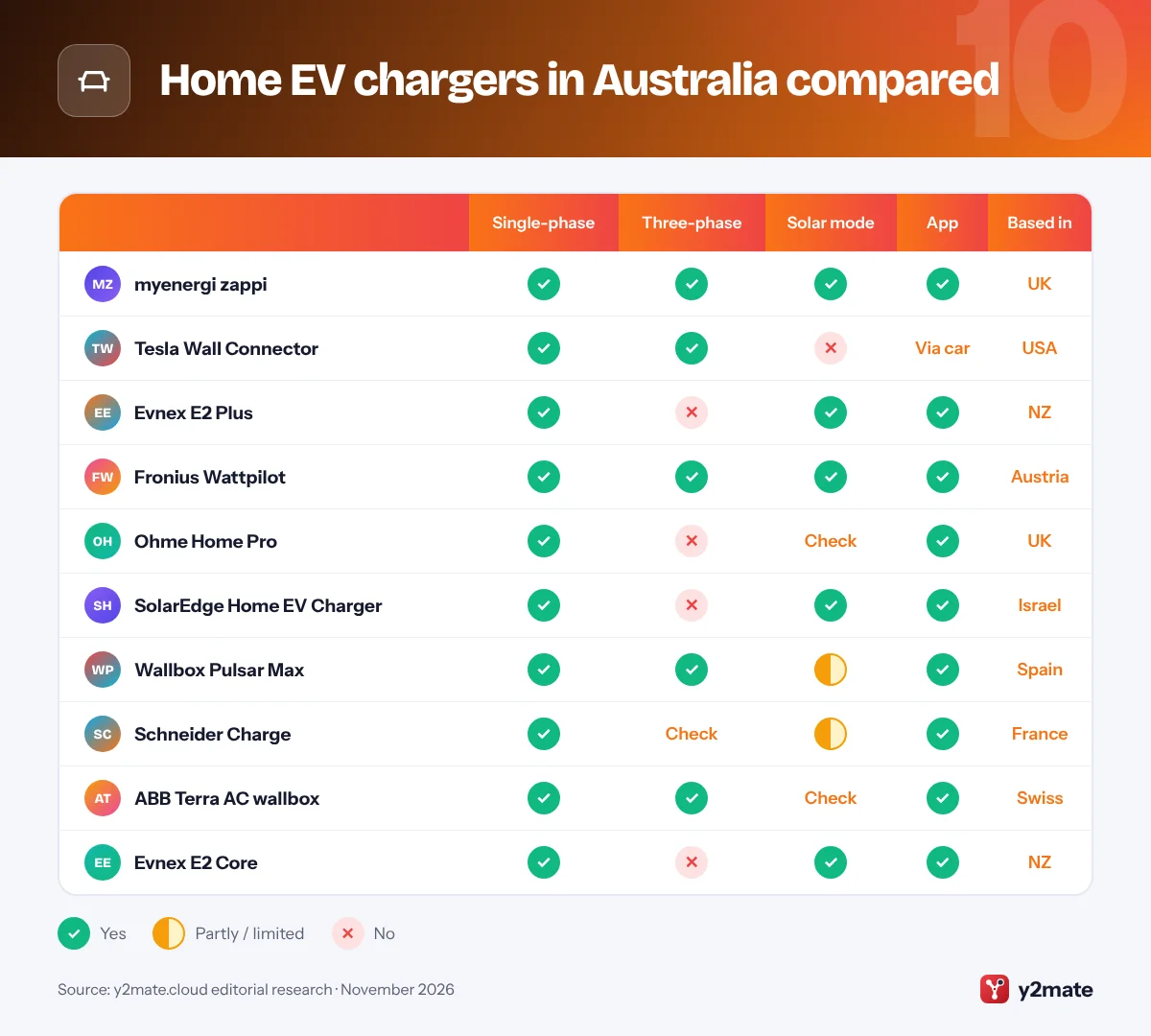
Home EV chargers in Australia compared
How to choose home EV chargers in Australia
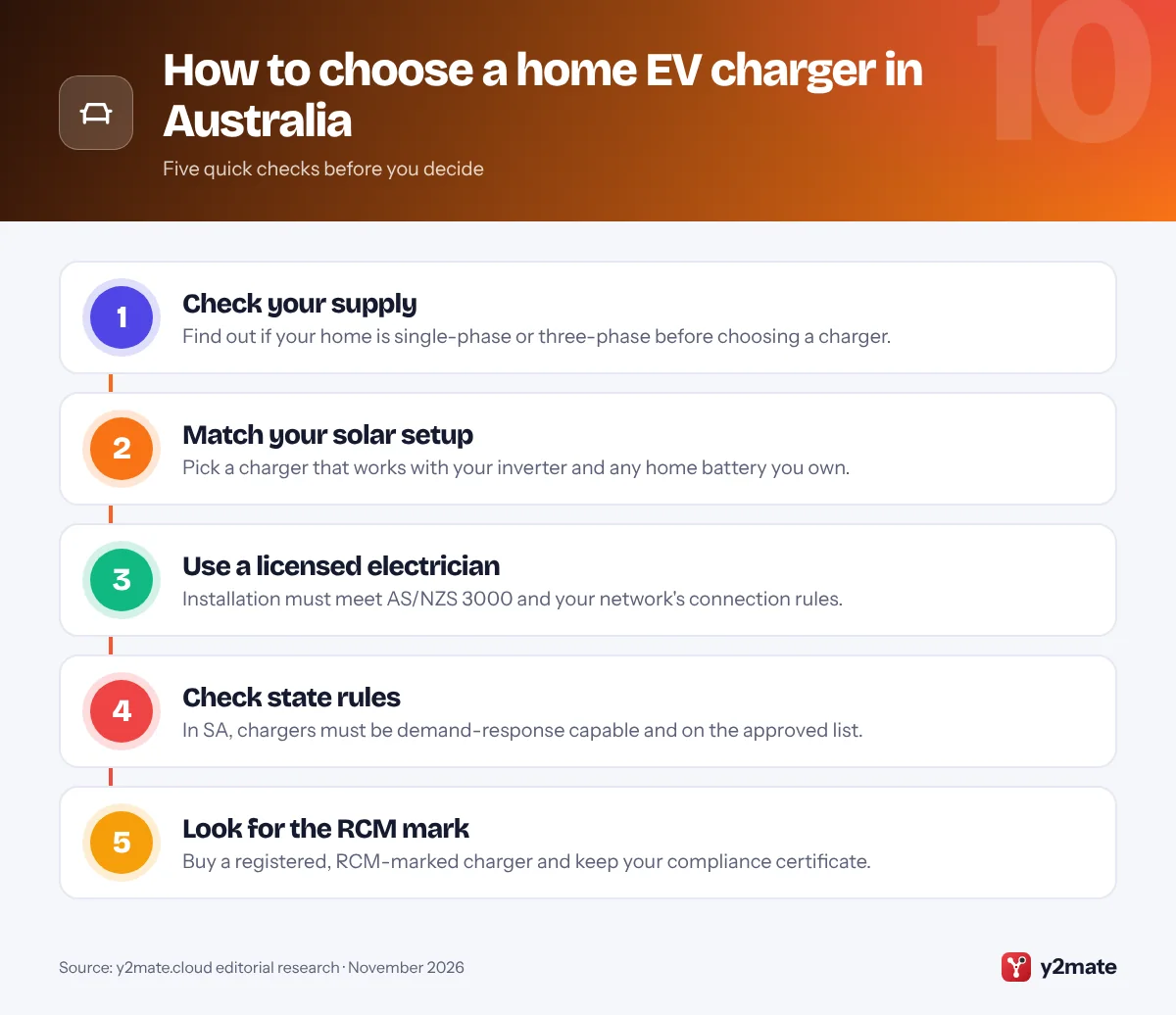
Start with your switchboard and your roof. A licensed electrician can confirm whether you have single-phase or three-phase power, how much spare capacity your supply has and whether your network needs to approve the charger first. If you have solar, match the charger to your inverter and battery, because the best solar features often depend on them.
Wiring rules and network approval
- AS/NZS 3000: the Wiring Rules set the installation standard, and only a licensed electrician should install a wall charger.
- Network rules: distribution network service providers (DNSPs) set connection rules, and some, such as SA Power Networks, need your electrician to apply before a wall charger goes in.
- South Australia: chargers installed in homes since 1 July 2024 must be demand-response capable and on the Technical Regulator’s approved list, and vehicle-to-grid chargers installed from 1 July 2026 must meet the demand-response rules too.
Rebates and loans
Most state EV purchase rebates have closed, and dedicated home charger rebates are rare. In NSW, the Home Energy Saver program offers zero-interest loans to eligible households, and discounts to eligible lower-income households, for approved upgrades that can include a home EV charger. The ACT’s Sustainable Household Scheme offers low-interest loans that can cover an eligible charger installed by an ACT licensed electrician, and in South Australia some retailers offer incentives for connecting a charger to an approved demand response aggregator. Check your state energy website before you buy, as programs change.
Your rights and a word of warning
Australian Consumer Law gives you guarantees on top of any manufacturer’s warranty, so a charger that fails early may still be covered. Choose a brand with local support: Jet Charge, for example, stopped selling its own ChargeMate charger after December 2025, although it says it continues to support existing owners.
Frequently asked questions
What is the best home EV charger in Australia?
For most solar homes, the myenergi zappi is the best home EV charger in Australia in 2026, thanks to its ECO and ECO+ solar modes and its single-phase and three-phase models. The Tesla Wall Connector suits owners who want simple, proven charging, and the Evnex E2 Plus offers a four-year residential warranty with built-in solar charging for single-phase homes.
Do I need three-phase power for a home EV charger?
No. A single-phase supply is enough for most daily driving when you charge overnight on a wall charger, and every charger on this list has a single-phase option. Three-phase power can support faster home charging, but only if your car's onboard charger can use it, so check the car's specifications first. Upgrading to three-phase involves your electrician and network, so it is rarely worth doing for charging alone.
Can a home EV charger run on solar power?
Yes. Chargers such as the zappi, Fronius Wattpilot, Evnex E2 range and SolarEdge Home EV Charger can track your solar output and send surplus power into the car, often called solar soft-charging. Some need a meter or a matching inverter to do this. The car usually needs to be plugged in at home during daylight, so pair solar charging with off-peak scheduling for overnight top-ups.
Do South Australian EV chargers need demand response?
Yes. Since 1 July 2024, EV chargers installed in South Australian homes must be capable of demand response, meaning they can adjust their charging when they receive a signal, and they must appear on the Technical Regulator's approved devices list. Your electrician must also apply to SA Power Networks before installing a wall charger. Check that the exact model is listed before you buy.
Are there rebates for home EV chargers in Australia?
Dedicated home EV charger rebates are rare in 2026. NSW's Home Energy Saver program offers zero-interest loans, and discounts for eligible lower-income households, on approved upgrades that can include a charger, and the ACT's Sustainable Household Scheme offers low-interest loans. In South Australia, some retailers offer incentives for connecting a charger to an approved demand response aggregator. Check your state energy website before you buy, as programs change.
Final verdict
The best home EV chargers in Australia in 2026 start with the myenergi zappi for solar homes, the Tesla Wall Connector for simple, dependable charging and the Evnex E2 Plus for a slim charger with a four-year warranty. Fronius and SolarEdge suit homes with their inverters, Ohme suits tariff hunters, and Wallbox, Schneider and ABB cover compact, Wiser-based and three-phase needs.
Before you buy, confirm whether you have single-phase or three-phase power, match the charger to your solar setup, use a licensed electrician who handles network approval, and check your state’s rules, especially in South Australia.
Sources and further reading
- SA EV charger standards: The South Australian Government sets out the Technical Regulator's installation and demand-response requirements for EV chargers.
- SA Power Networks home chargers: South Australia's network operator explains how electricians apply for approval before installing a home EV charger.
- ACT EV charger guide: The ACT Government's buyer's guide to home EV chargers, including eligibility under the Sustainable Household Scheme.
- ACCC consumer guarantees: The ACCC explains the consumer guarantees under Australian Consumer Law that apply alongside any manufacturer's warranty.
- Electrical Equipment Safety System: The national EESS website explains registration and the RCM mark for electrical equipment sold in Australia.

Leave a Reply