- Scamwatch, ASIC and the ATO have repeatedly warned in 2026 about fake investment platforms, online shopping scams, bank impersonation, relationship scams and texts pretending to be myGov, the ATO, Linkt or Australia Post.
- Since 1 July 2026, texts from organisations on the ACMA's SMS Sender ID Register should show their brand name, and messages sent using unregistered sender IDs are labelled Unverified.
- The ATO will never send you an unsolicited text or email with a link, including one asking you to sign in to myGov.
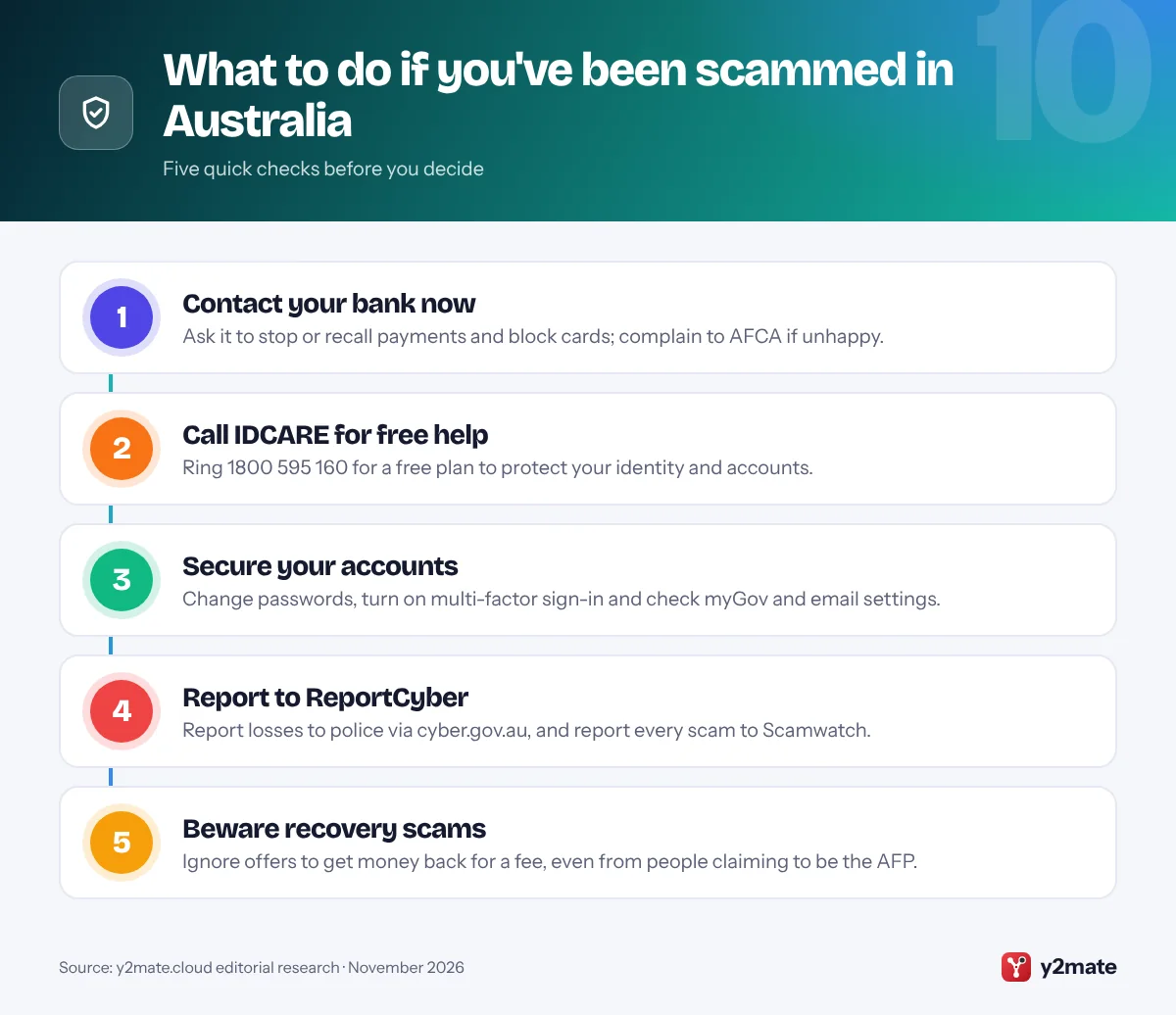
- If you lose money, contact your bank immediately, report it to ReportCyber and Scamwatch, and call IDCARE on 1800 595 160 for free support.
- Under the Scams Prevention Framework, banks, telcos and digital platforms had to join AFCA by 1 September 2026, and most of their new anti-scam obligations start on 31 March 2027.
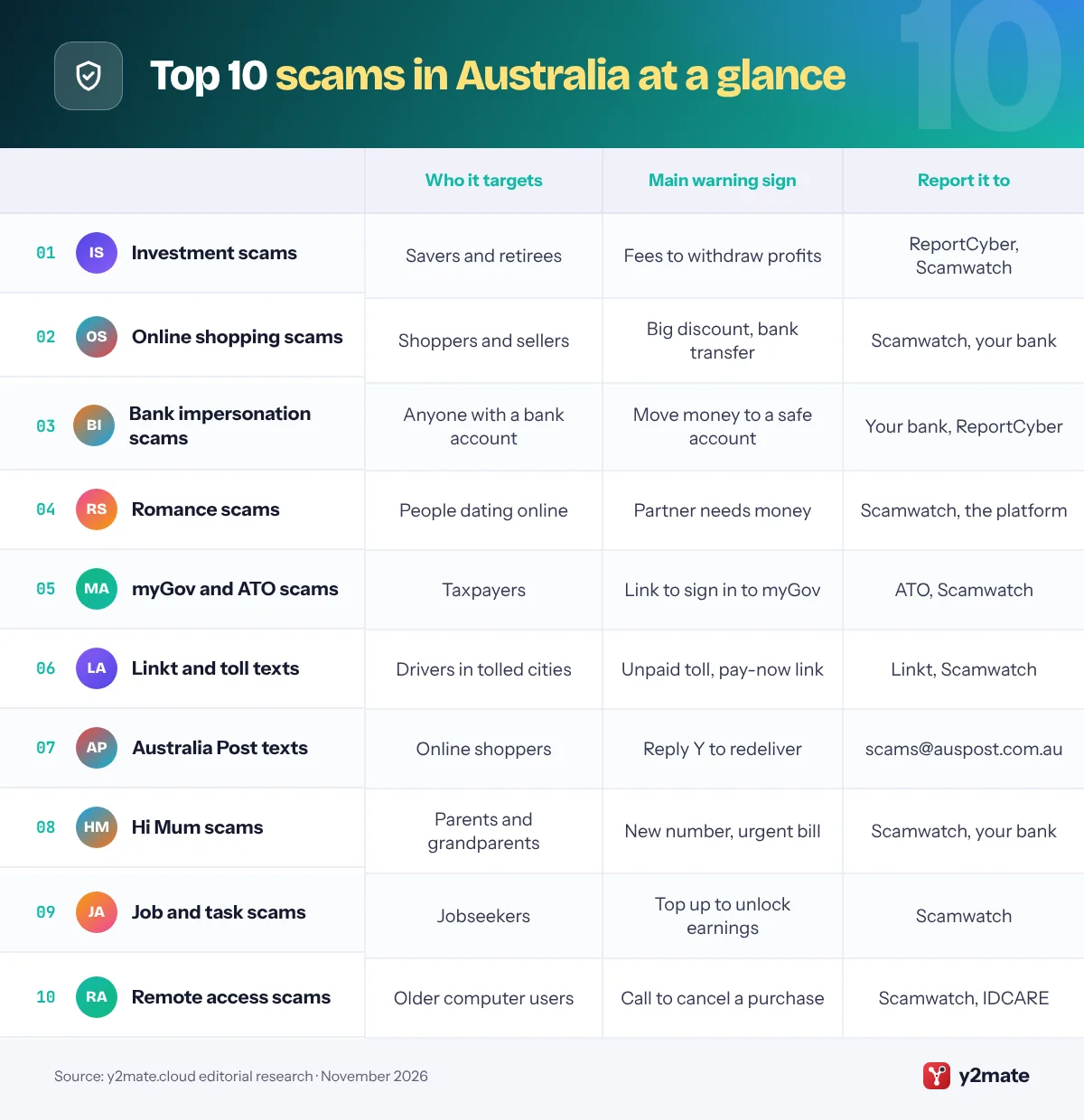
The scams in Australia that Scamwatch, ASIC and other government agencies are warning about most in 2026 are fake investment platforms, online shopping scams, bank impersonation calls, romance scams, myGov and ATO impersonation, Linkt toll texts, Australia Post delivery messages, Hi Mum scams, job and task scams, and remote access scams that begin with a fake purchase receipt. Each tells a different story, but all try to rush you into paying or handing over details before you can check.
Some plain definitions. Phishing is a fake message designed to trick you into giving away passwords, card numbers or other personal information, and smishing is phishing by SMS. Spoofing means disguising a phone number, sender name, email address or website so it looks like a trusted organisation’s. A remote access scam is one in which a criminal talks you into installing software that lets them control your computer or phone.
The rules are also changing. Since 1 July 2026, the SMS Sender ID Register has let registered organisations brand their texts, and the Scams Prevention Framework will place new legal duties on banks, telcos and digital platforms. This guide covers both, along with Scamwatch, ReportCyber and IDCARE.
How we ranked this list
We ranked these scams by how often Australian authorities have warned about them in recent alerts, including the National Anti-Scam Centre’s Scamwatch service, ASIC, the ATO, the ACMA and ASD’s Australian Cyber Security Centre, and by the harm those warnings describe, from drained savings to stolen identities. We also gave weight to impersonation of everyday Australian brands and agencies, because those messages reach the widest audience.
We did not test or engage with any scams, and we do not quote loss figures, which change every quarter. Scam scripts evolve quickly, so use the warning signs as patterns rather than expecting identical wording.
The Top 10 Scams to Watch Out For
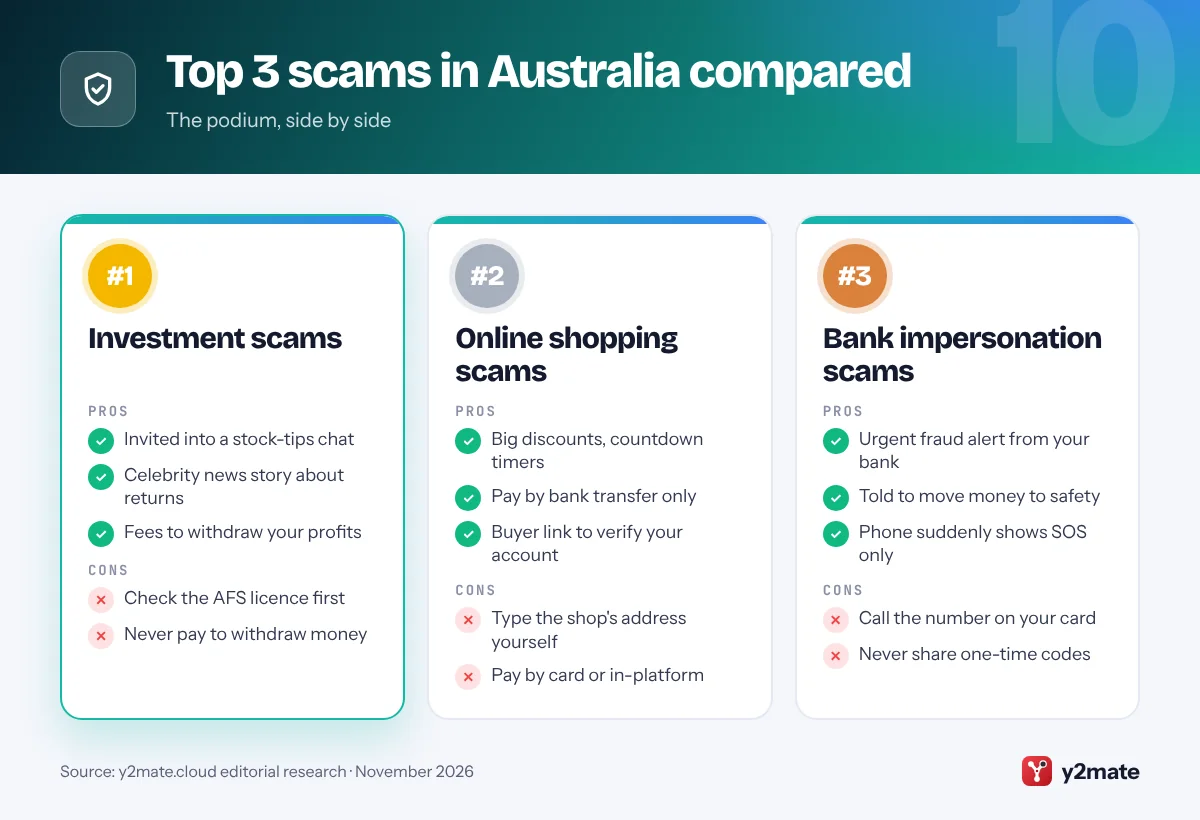
1. Investment scams
Best for: anyone invited into a share-tips chat group
Investment scams can cost people their retirement savings, and Australian regulators keep warning about them. In September 2026 Scamwatch said they are increasingly hiding in plain sight: you are added to a friendly WhatsApp group about a shared interest such as fishing or sport, where a so-called professor promotes a trading platform while other members post fake testimonials. In May 2026 it also flagged share-trading and stock-tips chat groups promoting fake crypto trading platforms.
Scammers build fake news articles too, including a copy of a Reuters page, with false celebrity endorsements. ASIC warned in August 2026 that generative AI lets scammers create whole networks of fake sites and endorsements, so a quick online search is no longer enough to prove a platform is real. The platform shows profits, but withdrawals bring demands for fees or taxes, and the money is never returned.
Before investing, check that the person or firm holds an Australian financial services (AFS) licence on ASIC’s professional register, look for the name on Moneysmart’s Investor Alert List and contact the organisation using details you find yourself. Never pay to withdraw your own money.
Official site: Investment scams
- Invited into a stock-tips chat
- Celebrity news story about returns
- Fees to withdraw your profits
- Check the AFS licence first
- Never pay to withdraw money
2. Online shopping scams
Best for: online shoppers and marketplace sellers
Buying and selling scams take advantage of everyday online shopping. In a November 2026 update, the National Anti-Scam Centre described fake car-sales websites displaying Australian addresses, phone numbers and ABNs, fake concert ticket offers that began on Facebook and TikTok before moving to WhatsApp, and fake shops built with AI-generated product images and polished designs. A familiar logo, an ABN and a convincing payment page can all be part of the disguise.
Sellers are targeted too. People listing items on marketplaces such as Vinted have received messages saying their item has sold, with a link to verify their account or receive payment. The link leads to fake marketplace, payment or bank pages that steal banking logins and one-time codes.
With Black Friday and holiday sales approaching, treat big discounts, countdown timers and requests to pay by bank transfer, crypto or gift card as reasons to pause. Visit retailers by typing their address yourself, check unfamiliar sellers through independent reviews, and pay by card or through a platform’s built-in payment system, which gives you more options if the goods never arrive.
Official site: Online shopping scams
- Big discounts, countdown timers
- Pay by bank transfer only
- Buyer link to verify your account
- Type the shop's address yourself
- Pay by card or in-platform
3. Bank impersonation scams
Best for: anyone who gets a call about a suspicious payment
Bank impersonation scams start with a text or call that appears to come from your bank’s fraud team, often from a spoofed number. They warn of a suspicious transaction or a hacked account and say your money must be moved to a safe account while they investigate. Some ask you to read out a one-time code, change banking settings while staying on the phone, or install an app. In March 2026 CommBank warned that impersonation scams are becoming more sophisticated, with criminals posing as banks and crypto providers.
A related threat is mobile number fraud. In April 2026 Scamwatch and the ACMA warned that criminals are taking control of phone numbers, or making unauthorised changes to phone accounts, so they can receive verification codes and reset passwords for banking and myGov. If your phone suddenly shows no signal or SOS only, contact your bank, then your telco.
Banks will never ask you to move money to a safe account or share a code. Hang up and call the number on the back of your card. When paying someone new, check the Confirmation of Payee name-match result in your banking app.
Official site: Bank impersonation scams
- Urgent fraud alert from your bank
- Told to move money to safety
- Phone suddenly shows SOS only
- Call the number on your card
- Never share one-time codes
4. Romance scams
Best for: people looking for love or friendship online
Scamwatch calls these relationship scams, a category that covers romance scams and fake friendships. Criminals create convincing profiles on dating apps, social media and games, often with stolen or AI-generated photos, and build an emotional connection over weeks or months, messaging constantly and moving the chat to WhatsApp or another private app. In 2026 Scamwatch ran a campaign to help people spot the signs, and the National Anti-Scam Centre has led a taskforce targeting these scams.
Eventually the scammer needs money for a medical emergency, travel, a business problem or customs fees, or offers to help you invest in cryptocurrency on a platform they control. They always have a reason they cannot meet or turn on their camera. Some victims are later asked to receive and pass on money, which can make them unwitting money mules.
Never send money, gift cards, crypto or identity documents to someone you have only met online. Do a reverse image search on their photos, talk to family or friends about the relationship and be wary if the person asks you to keep it secret. Report the profile to the platform and to Scamwatch.
Official site: Romance scams
- Fast, intense affection
- Can never meet or video call
- Money requests or crypto tips
- Reverse-search their photos
- Never pay someone met online
5. myGov and ATO scams
Best for: taxpayers expecting a refund or a tax bill
Criminals impersonate the Australian Taxation Office (ATO) and myGov all year, and especially around tax time. In June 2026 Scamwatch and the ATO reminded all Australians, including people who do not need to lodge a return, to be wary of calls, texts, emails and fake websites that use official logos and language. The messages promise a refund, warn of a tax debt or say your account needs verifying, and push you to click a link or call a number.
The aim is your myGov sign-in details and personal information, which criminals can use to commit fraud in your name. Some callers threaten arrest or deportation over an unpaid tax debt to frighten you into paying straight away.
The ATO will never send you an unsolicited text or email with a link, including one asking you to sign in to myGov, and genuine government emails come from addresses ending in .gov.au. Sign in by typing my.gov.au yourself or by using the myGov or ATO app. To check whether contact is genuine, call the ATO on 1800 008 540, and call the same number to protect your ATO account if you have shared details.
Official site: myGov and ATO scams
- Refund or debt link in a message
- Link asking you to sign in
- Sender address not .gov.au
- Type my.gov.au or use the app
- Check with the ATO on 1800 008 540
6. Linkt and toll texts
Best for: drivers on Sydney, Melbourne or Brisbane tolls
Toll texts claim you have an outstanding toll balance or overdue invoice and must pay through a link, often within hours, or face fines, penalties or extra fees. Linkt, Transurban’s toll brand in Sydney, Melbourne and Brisbane, warned in May 2026 of an increase in SMS scams impersonating toll road operators, and in August 2026 of convincing emails claiming accounts are on hold until a payment is made. Fake debt collector texts about tolls have also circulated.
The links lead to Linkt-branded fake sites that steal card and personal details. Linkt says that when it sends payment reminders, it always asks you to log in to your account.
Since 1 July 2026, texts from organisations registered on the ACMA’s SMS Sender ID Register should arrive under their brand name, while messages sent using unregistered sender IDs are labelled Unverified. Treat any Unverified toll message with suspicion. To check for unpaid tolls, open the Linkt app or type the website address yourself and search by your licence plate, or check with the toll operator in your state. Never click the link in the message.
Official site: Linkt and toll texts
- Unpaid toll and a short deadline
- Pay-now link with penalty threat
- Shown as Unverified on your phone
- Check tolls in the Linkt app
- Search by licence plate yourself
7. Australia Post texts
Best for: anyone waiting on a parcel delivery
Fake delivery messages say Australia Post could not deliver your parcel because of a missing house number, an incorrect address or an unpaid fee, and send you to a link to arrange redelivery. The fake page steals your personal and card details. Australia Post’s scam alerts page, updated in September 2026, warns of a high-volume version sent through iMessage and RCS chat rather than ordinary SMS, written as if from a delivery driver who could not find a safe place to leave your parcel.
Many of these messages ask you to reply with Y or another response. Australia Post explains that replying can trick your phone into treating the sender as a trusted contact, letting malicious links bypass built-in protections. Because these arrive as chat messages rather than standard SMS, the usual sender ID checks may not apply, so a message without an Unverified label is not automatically safe.
Australia Post says it will never call, text or email asking for financial information or a payment you are not expecting. Never reply, track parcels in the AusPost app, and email a screenshot to scams@auspost.com.au before deleting the message.
Official site: Australia Post texts
- Missing house number or fee
- Asks you to reply Y
- Arrives via iMessage or RCS chat
- Track in the AusPost app only
- Email scams@auspost.com.au
8. Hi Mum scams
Best for: parents and grandparents of young adults
The Hi Mum scam begins with an SMS or WhatsApp message from an unknown number claiming to be your child, grandchild or another relative who has lost or broken their phone. After some chat, they ask for urgent help paying a bill or replacing the phone, often saying their banking app is locked on the new device, and give you someone else’s bank details. Some ask you to delete or block the old number, so you cannot check with the real person.
The ACMA has warned of a variant in which the message appears under a name such as Mum or another relative from your contacts, making it harder to spot. Some versions escalate to claims that your relative is in danger or in debt, and AI tools mean a short voice message could also be faked.
Scamwatch’s advice is simple. Call your relative on the number already saved in your phone, or message the new number with a question only they would know the answer to. Never pay a bill for someone you cannot reach directly. If you have sent money, contact your bank immediately and report the scam to Scamwatch, which uses reports to warn others.
Official site: Hi Mum scams
- New number, lost or broken phone
- Urgent bill paid to someone else
- Asks you to delete the old number
- Call the number you have saved
- Ask a question only they know
9. Job and task scams
Best for: jobseekers looking for flexible remote work
In May 2026 Scamwatch warned of a spike in texts from criminals impersonating recruiters for well-known companies such as Amazon and YouTube. They offer flexible, well-paid work from home, such as an e-commerce assistant role or optimising product listings, and claim only a few positions are left. Once you reply, you are moved to an encrypted WhatsApp chat.
This is a task scam. You complete sets of simple online tasks, set up a cryptocurrency account and may even receive a small payment to build trust. Then you are told to top up your account with your own money to unlock the next set of tasks and your commission. Whatever you pay is gone. Other job scams ask for upfront fees for training, visas or equipment, or recruit people to move money as money mules.
Real job offers appear on legitimate recruitment sites, and real recruiters do not move you to WhatsApp or ask you to pay to start work. Contact the company directly using a phone number you have found yourself to check whether the role exists. If it sounds too good to be true, it probably is.
Official site: Job and task scams
- Recruiter text out of the blue
- Moved to a WhatsApp chat
- Top up to unlock earnings
- Check jobs on the company site
- Never pay to start a job
10. Remote access scams
Best for: anyone who gets a surprise purchase receipt
Remote access scams trick you into letting a criminal control your computer or phone. A common route in is the fake purchase callback scam, which Scamwatch warned about in July 2026. You receive a message saying you bought something you did not buy, such as a phone, security software or tickets, with a number to call to cancel it. It may imitate PayPal, Norton, McAfee or Microsoft, arrive as an Apple iMessage, a Google Meet invitation or a Shop App receipt, and even include your real name and address.
When you call, the scammer may ask for your card details to process a refund, claim they have refunded too much and ask you to send money back, or get you to install remote access software so they can help. Once connected, they can see your banking and move money. Others phone directly, claiming to be from your telco or internet provider about a problem with your connection.
Never call a number in an unexpected receipt; check purchases by logging in to the real app or website. Never give a stranger remote access. If you did, disconnect from the internet, call your bank, then contact IDCARE on 1800 595 160.
Official site: Remote access scams
- A purchase you never made
- Number to call to cancel
- Asks to install remote software
- Check purchases in the real app
- Never grant remote access
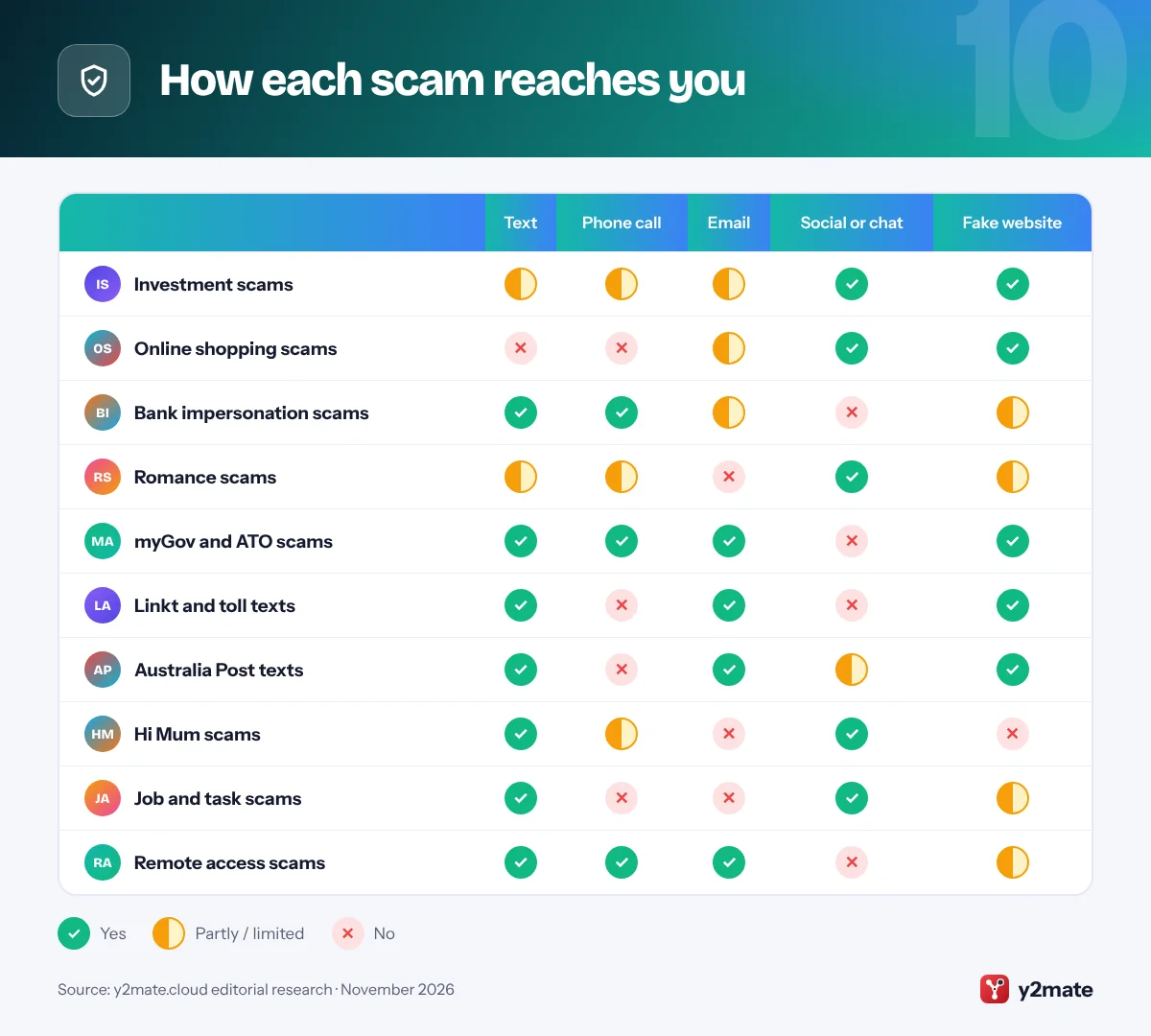
How each scam reaches you
How to protect yourself from scams in Australia
Scamwatch’s advice for every scam in Australia comes down to three steps. Stop: don’t rush, and never share passwords, one-time codes or card details with someone who contacted you. Check: contact the organisation through its official app or a phone number you find yourself, not the details in the message. Protect: act quickly if something feels wrong by contacting your bank and reporting it.
New protections in 2026
- SMS Sender ID Register: since 1 July 2026, registered businesses and agencies can send texts under their brand name, and texts from unregistered sender IDs show as Unverified. A brand name is reassuring, but scammers can still use ordinary mobile numbers, iMessage or WhatsApp, so keep checking.
- Scams Prevention Framework: banks, telcos and digital platforms such as social media and messaging services had to join the Australian Financial Complaints Authority (AFCA) by 1 September 2026, and most of their legal duties to prevent, detect, disrupt and respond to scams start on 31 March 2027.
- Confirmation of Payee: most banks now check whether the account name matches the BSB and account number before you pay someone new.
Where to report scams in Australia
Contact your bank first if money has left your account. Report financial or information losses to police through ReportCyber at cyber.gov.au, and report every scam, even ones you avoided, to Scamwatch. IDCARE offers free identity and cyber support on 1800 595 160.
Frequently asked questions
What are the most common scams in Australia right now?
Scamwatch's 2026 alerts focus on fake investment and crypto trading platforms, online buying and selling scams, bank impersonation, relationship scams and impersonation of the ATO and myGov. Texts pretending to be Linkt or Australia Post, Hi Mum messages, job and task scams and fake purchase callback scams that lead to remote access are also widespread. Most try to rush you into paying or sharing codes.
How can I tell if a text from myGov, Linkt or Australia Post is real?
Don't use the link. Since 1 July 2026, texts from registered organisations should show their brand name, and messages from unregistered sender IDs are labelled Unverified, but scammers can still use ordinary numbers, iMessage or RCS. Open the official app or type the website address yourself instead. The ATO never sends unsolicited links to sign in to myGov, and Australia Post never texts asking for unexpected payments.
Where do I report a scam in Australia?
Report scams to Scamwatch at scamwatch.gov.au, even if you didn't lose anything, so the National Anti-Scam Centre can warn others and disrupt scammers. If you lost money or personal information, also report it to police through ReportCyber at cyber.gov.au. Contact your bank immediately, and call IDCARE on 1800 595 160 for free help protecting your identity.
Will my bank refund money I lost to a scam?
Not automatically. Australia does not have a UK-style mandatory reimbursement scheme, so the outcome depends on how you paid and how your bank responds. Contact your bank immediately, because it may be able to recall a payment. If you're unhappy with its decision, complain to the Australian Financial Complaints Authority (AFCA), which will also handle complaints under the Scams Prevention Framework.
What is the Scams Prevention Framework?
The Scams Prevention Framework is a law that places enforceable anti-scam duties on banks, telcos and digital platforms such as social media and messaging services. They must take steps to prevent, detect, disrupt, respond to and report scams. Businesses covered had to join AFCA by 1 September 2026, and most obligations start on 31 March 2027, with AFCA handling complaints.
Final verdict
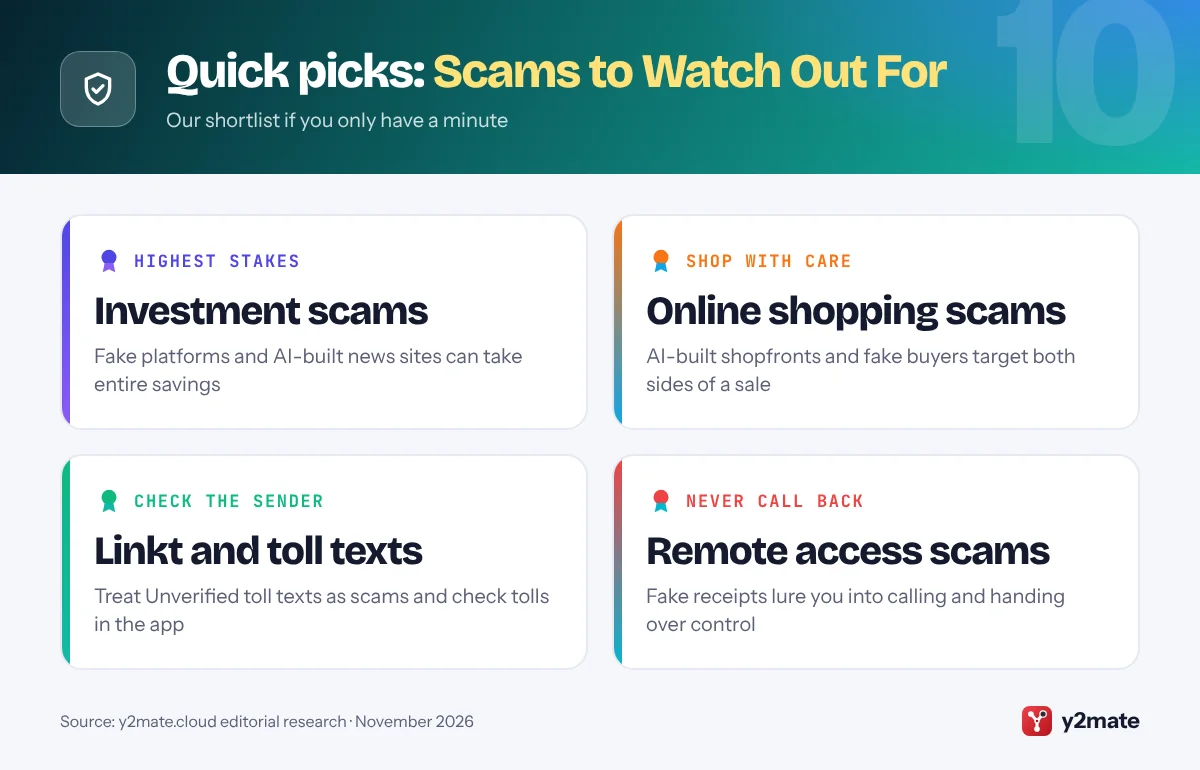
The scams in Australia to watch most closely in 2026 are fake investment platforms, which can take entire savings, and the buying and selling scams that target everyday shoppers and sellers. Bank impersonation, relationship scams and fake myGov, ATO, Linkt and Australia Post messages round out the most persistent threats.
New protections such as branded sender IDs, Confirmation of Payee and the Scams Prevention Framework help, but they cannot stop every scam. Stop, check and protect every time, and if you are caught out, call your bank, report to ReportCyber and Scamwatch, and contact IDCARE.
Sources and further reading
- What to do if scammed: Scamwatch's step-by-step guide to limiting the damage after a scam, from contacting your bank to getting help from IDCARE and AFCA.
- Report cybercrime to ReportCyber: ASD's Australian Cyber Security Centre explains how to report cybercrime and scams involving financial or information loss to police.
- IDCARE identity and cyber support: IDCARE is the national identity and cyber support service for Australia and New Zealand, offering free help to people affected by scams.
- ASIC on the Scams Prevention Framework: ASIC explains the Scams Prevention Framework duties for banks, telcos and digital platforms, including AFCA membership and the 2027 start date.
- Scamwatch on online shopfront scams: The National Anti-Scam Centre's November 2026 update on fake shops, marketplace seller scams and ticket offers, with advice for holiday sales.

Leave a Reply