
- The scams US agencies are warning about in 2026 mostly arrive by text, phone call or social media and push you to pay quickly by wire, gift card, cryptocurrency or a payment app.
- Toll agencies, state DMVs, USPS and the IRS do not demand payment through links in unexpected texts, so check your account through the official website instead.
- The FBI says government and law enforcement agencies never ask for payment by phone or text, or by prepaid card, cryptocurrency or courier.
- Scammers now use AI to clone voices and fake video, so agree a family code word and call people back on a number you already know.
- If you lose money, contact your bank or payment app at once, then report it at ReportFraud.ftc.gov and to the FBI at ic3.gov.
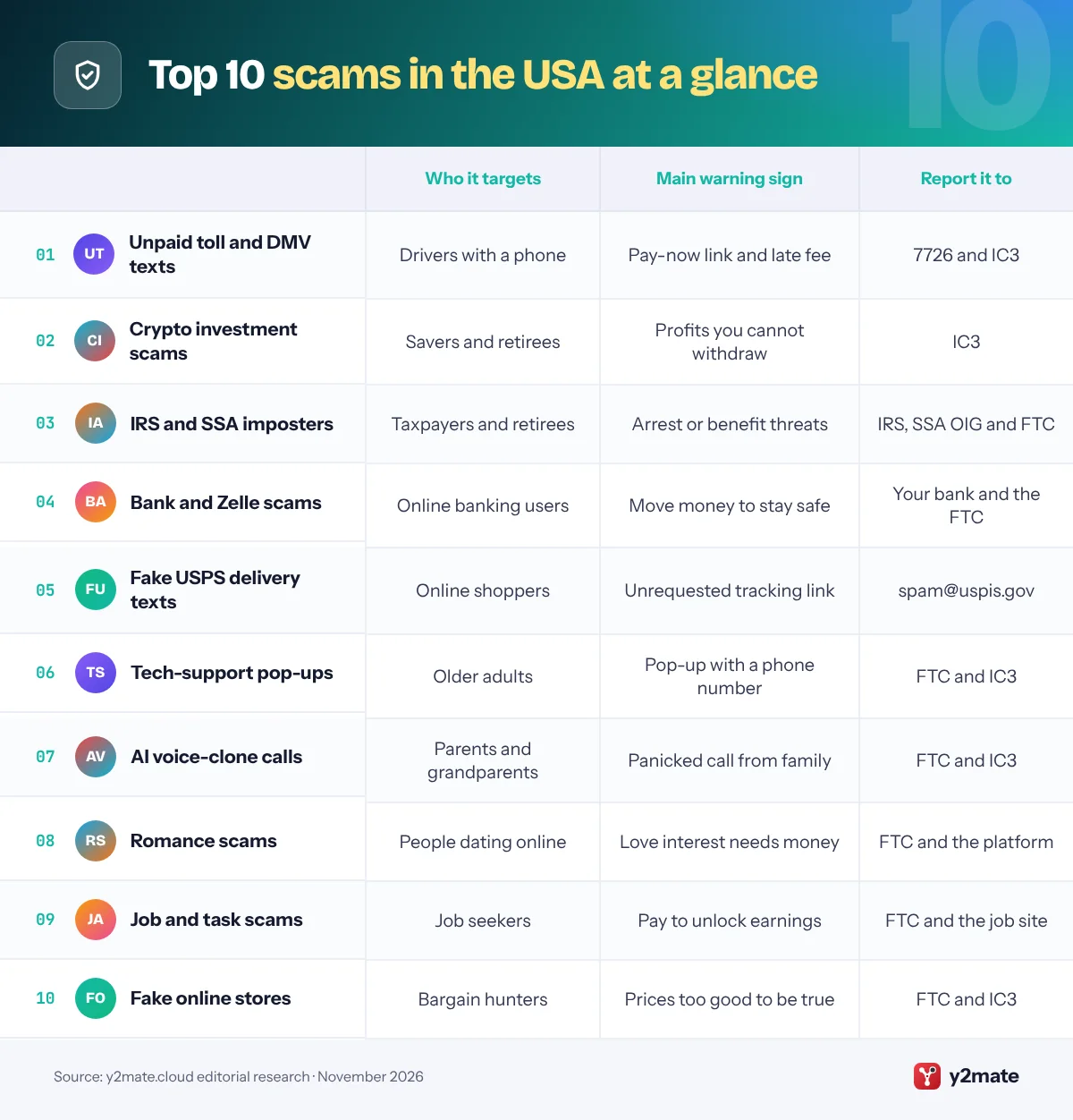
The scams in the USA that federal agencies are warning about most in 2026 are fake unpaid toll and DMV texts, cryptocurrency investment cons, IRS and Social Security imposters, bank and Zelle impersonation, fake USPS delivery texts, tech-support pop-ups, AI voice-clone calls, romance scams, job and task scams and fake online stores. Nearly all of them follow the same script: an unexpected message, an urgent problem and a demand to pay in a way that is hard to reverse.
A few terms come up again and again. Phishing is a message that pretends to come from a trusted organization in order to steal your money or personal details, and smishing is phishing by text message. Spoofing means faking a caller ID, email address or website so it looks genuine. Pig butchering is the nickname for long-con investment scams in which a friendly stranger builds trust for weeks before taking a victim’s savings.
This guide explains how each scam works, the warning signs to look for and how to stay safe, and it lists the official places to report fraud, including the Federal Trade Commission (FTC), the FBI’s Internet Crime Complaint Center (IC3) and the free 7726 spam text number.
How we ranked this list
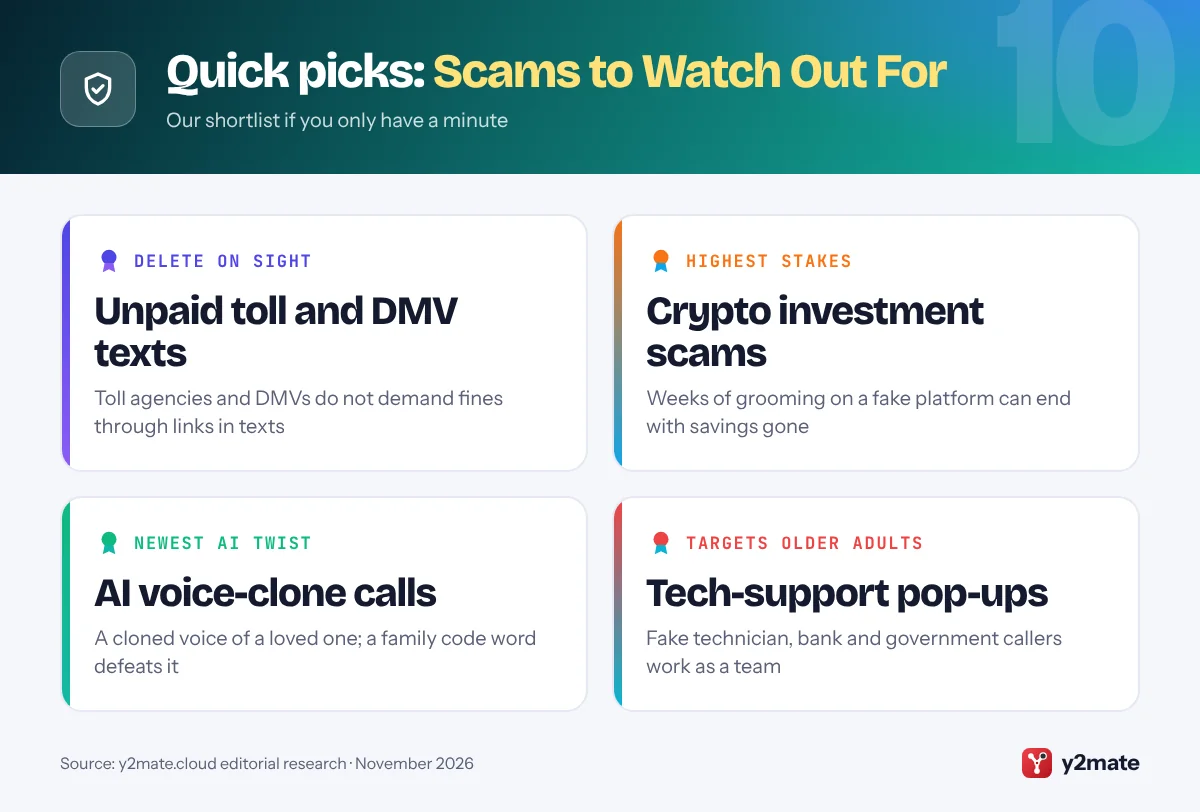
We ranked these scams by how often US authorities, including the FTC, the FBI, the IRS, the Social Security Administration’s Office of the Inspector General and the US Postal Inspection Service, have warned about them in recent public alerts, and by the harm those warnings describe, from drained savings to stolen identities. We gave extra weight to scams that reach people through everyday texts and calls.
We did not test or engage with any scams, and we do not quote loss figures, which change constantly. Criminals rewrite their scripts quickly, so treat the warning signs here as patterns rather than exact wording.
The Top 10 Scams to Watch Out For
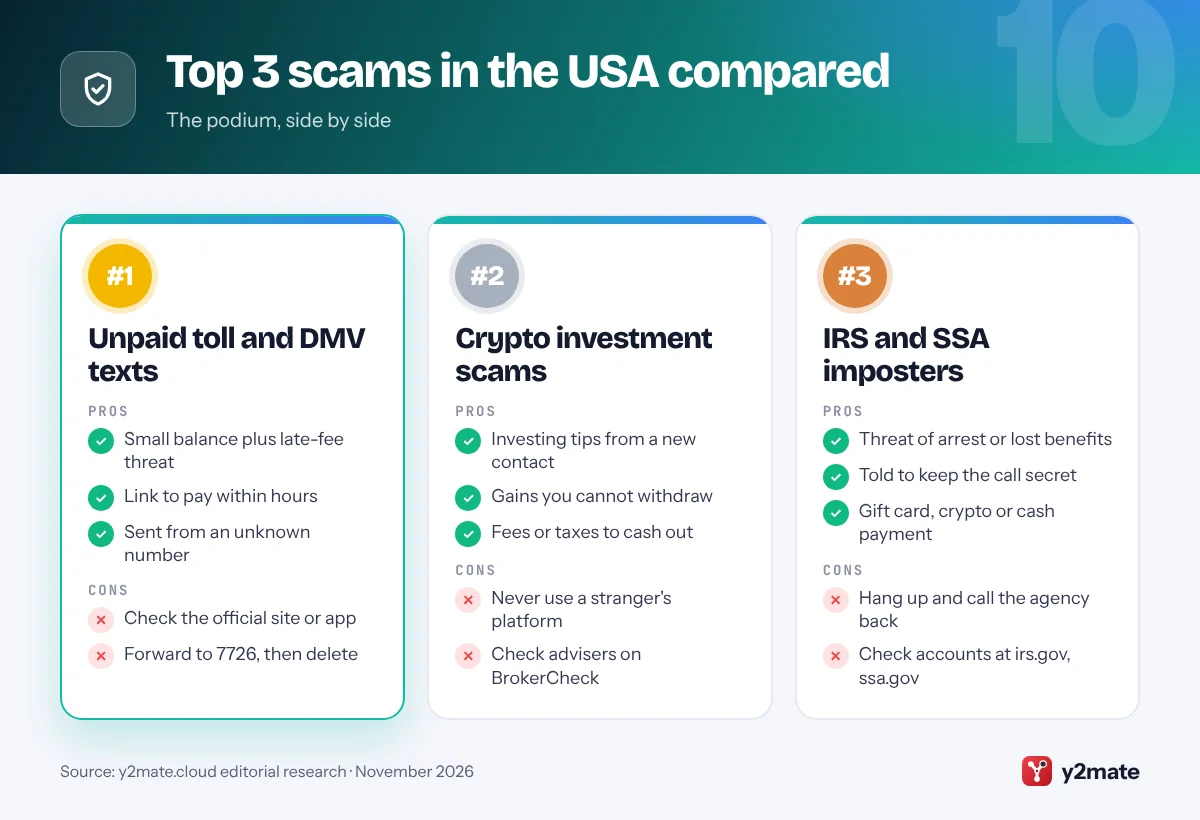
1. Unpaid toll and DMV texts
Best for: spotting fake E-ZPass and DMV payment texts
The unpaid toll text is a smishing scam that has reached phones across the country. A message claims you owe a small toll balance, sometimes naming E-ZPass, and warns of late fees unless you pay through a link today. A newer variant pretends to be your state Department of Motor Vehicles and threatens to suspend your registration or driving privileges over an unpaid traffic ticket. The FTC has warned that people receive these texts whether or not they have driven on a toll road, and state agencies, including the Texas DMV, issued fresh alerts in 2026.
The link opens a convincing copy of a toll or DMV website that collects your card number, address and other personal details. Some messages ask you to reply first, which can switch on links your phone had disabled.
Toll agencies and DMVs warn that they do not demand overdue payments through links in unexpected texts. Check your balance by typing the agency’s official website into your browser or using its app, forward the message to 7726 and delete it. If you entered card details, call your card issuer straight away.
Official site: Unpaid toll and DMV texts
- Small balance plus late-fee threat
- Link to pay within hours
- Sent from an unknown number
- Check the official site or app
- Forward to 7726, then delete
2. Crypto investment scams
Best for: spotting pig butchering before you invest
Cryptocurrency investment scams, often called pig butchering, produce some of the most devastating losses the FBI and FTC describe. They usually begin with a wrong-number text, a dating match or a friendly contact in a social media or WhatsApp investing group. Over weeks the scammer builds trust, then introduces an exclusive trading platform or app. The platform is fake, but its dashboard shows impressive gains, so victims keep adding money.
When you try to withdraw, new taxes or fees appear. In June 2026 the FBI warned that when banks question large transfers, scammers now send couriers to collect cash from victims’ homes, and federal alerts have repeatedly described victims being told to feed cash into cryptocurrency ATMs, also called kiosks.
The FBI’s Operation Level Up contacts people it believes are still talking to these scammers, so take such a call seriously, but confirm it through your local FBI field office. Never invest on a platform recommended by someone you have only met online, check any adviser on FINRA BrokerCheck or the SEC’s Investor.gov, and stop the moment you are asked to pay to withdraw your own money.
Official site: Crypto investment scams
- Investing tips from a new contact
- Gains you cannot withdraw
- Fees or taxes to cash out
- Never use a stranger's platform
- Check advisers on BrokerCheck
3. IRS and SSA imposters
Best for: knowing how real agencies contact you
Government imposters pose as the IRS, the Social Security Administration, the police or a court. The IRS put impersonation by email and text at the top of its 2026 Dirty Dozen list of tax scams, followed by phone scams that use spoofed caller ID and AI-generated voices. In February 2026 the Social Security Administration’s Office of the Inspector General warned of a surge in fake emails claiming your Social Security statement is ready.
Phone versions are more aggressive. In a September 2026 alert, the FBI described callers who claim you missed jury duty, face an arrest warrant or have an expiring license, then demand payment and tell you not to tell your family or bank. Some now appear on video calls as officials, using AI.
Real agencies do not work this way. The IRS generally contacts you by mail first and does not call to demand immediate payment or threaten arrest. Official Social Security emails come from addresses ending in .gov, and you can check your record by going directly to ssa.gov. The FBI says no government agency asks for payment by prepaid card, cryptocurrency or courier.
Official site: IRS and SSA imposters
- Threat of arrest or lost benefits
- Told to keep the call secret
- Gift card, crypto or cash payment
- Hang up and call the agency back
- Check accounts at irs.gov, ssa.gov
4. Bank and Zelle scams
Best for: protecting your checking account and payment apps
In a bank impersonation scam, a text or call appears to come from your bank’s fraud department, often with a spoofed caller ID that matches the real number. It asks you to confirm a suspicious charge, then says your account has been compromised. To protect your money, you are told to send it to a new account through Zelle, another payment app or a wire transfer, or to read out a one-time passcode so the agent can secure your login.
In late 2025 the FBI warned that criminals posing as bank or customer support staff use these tricks to take over accounts, sometimes after a fake search ad leads people to a lookalike login page.
Payment apps move money in seconds and work like cash, so a transfer you were tricked into making can be very hard to reverse. Federal rules mainly protect payments you did not authorize, although some banks refund certain imposter scams. Your bank will never ask you to move money to keep it safe or to share a passcode. Hang up, then call the number on the back of your card.
Official site: Bank and Zelle scams
- Fraud alert that asks for a code
- Told to move money to stay safe
- Caller ID matches your bank
- Call the number on your card
- Never share one-time passcodes
5. Fake USPS delivery texts
Best for: online shoppers expecting a package
Fake delivery texts claim the US Postal Service could not deliver a package because of an incomplete address or unpaid postage, and send you to a link to reschedule. The page looks like USPS.com but asks for your name, address, date of birth and card number. The trick tends to surge around holidays and big shopping events, when nearly everyone is expecting something.
The US Postal Inspection Service, the law enforcement arm of USPS, is clear about how the real service works. USPS only sends tracking texts or emails if you have asked for them using a tracking number, and those messages do not contain a link. If you did not request tracking for a specific package, do not click.
Report USPS-related smishing by copying the text into an email to spam@uspis.gov, with a screenshot showing the sender’s number and the date, and forward the text to 7726. If you already interacted with the link, even without pressing submit, contact your bank or card issuer. To check a real delivery, type usps.com into your browser or use the official USPS app.
Official site: Fake USPS delivery texts
- Unrequested text with a link
- Address problem or small fee
- Asks for your card details
- Track only on usps.com or the app
- Email it to spam@uspis.gov
6. Tech-support pop-ups
Best for: older adults who bank and shop online
Tech-support scams start with a frightening pop-up that freezes your screen, claims your computer is infected or hacked, and gives a number to call. Others arrive as a fake invoice for antivirus software or an online order you never placed, with a number to call for a refund. Whoever answers asks you to install remote access software, which lets them see and control your computer.
The FBI has warned about a three-stage version it calls the Phantom Hacker scam, which mainly targets older adults. A fake technician finds a supposed hacker, a fake bank employee confirms your accounts are at risk, and a fake government official, sometimes claiming to be from the Federal Reserve, tells you to move your savings to a safe alias account.
Legitimate security warnings do not ask you to call a phone number, and tech companies and banks do not phone out of the blue about viruses on your computer. If a pop-up appears, close the browser or restart the device. Never let a stranger connect to your computer; if you already did, disconnect from the internet, run a security scan and call your bank.
Official site: Tech-support pop-ups
- Pop-up with a phone number
- Request for remote access
- Told to move savings to safety
- Close the browser or restart
- Never allow remote access
7. AI voice-clone calls
Best for: families whose voices are posted online
Voice cloning uses artificial intelligence to copy someone’s voice from a short clip, such as a video posted on social media. Scammers use it to supercharge the old family emergency or grandparent scam: you get a panicked call from what sounds exactly like your son, granddaughter or partner, who says they have been in an accident, arrested or kidnapped and need money immediately.
The FTC warned about cloned voices in family emergency scams in 2023, and the FBI has since described criminals using AI-generated audio to impersonate relatives and, in late 2025, sending doctored proof-of-life photos in virtual kidnapping scams. The IRS also lists voice mimicry among its 2026 phone scam warnings.
Do not trust the voice. Hang up and call the person on the number you already have, or reach them through another relative. The FBI suggests agreeing a secret word or phrase with your family that a genuine caller would know. Treat any demand for a wire transfer, gift cards, cryptocurrency or cash collected in person as a scam, and consider making social media accounts that feature your voice private.
Official site: AI voice-clone calls
- Panicked call from a relative
- Plea to keep it from family
- Payment by wire, crypto or cash
- Agree a family code word
- Call back on a known number
8. Romance scams
Best for: anyone dating or making friends online
Romance scammers create attractive fake profiles on dating apps, social media and gaming platforms, or start with a wrong-number message, then build an intense relationship quickly. The FBI calls this love bombing: a flood of praise and attention designed to lower your guard. There is always a reason they cannot meet in person or turn on a video call, such as working on an oil rig, serving overseas or traveling for business, and AI-generated photos and video now make the persona more convincing.
Eventually there is a request for money: a medical emergency, customs fees, a plane ticket or help with a business problem. Increasingly, the partner instead offers to teach you to invest in cryptocurrency, which turns a romance scam into an investment scam.
The FTC’s rule is simple: an online love interest you have never met in person who asks for money is a scammer. Do a reverse image search on their photos, talk to a friend you trust, and never send money, gift cards, crypto or intimate images. If you are targeted, stop contact, keep the messages and report the profile to the platform and the FTC.
Official site: Romance scams
- Fast, intense affection
- Always an excuse not to meet
- Requests for money or crypto
- Reverse-search their photos
- Never pay someone you haven't met
9. Job and task scams
Best for: job seekers and anyone wanting a side income
Job scams have moved to text and WhatsApp. In an April 2026 alert, the FTC warned that an unexpected job offer by text is probably a scam, often from someone claiming to be a recruiter for a well-known company. A common version is the task scam: you are hired to optimize apps or rate products online, watch a balance grow, then must deposit your own money, usually in cryptocurrency, to unlock your earnings. The money never comes back.
Other job scams send you a check to buy equipment and ask you to return the extra, and the check bounces after you have paid. Some recruit people as money mules, asking them to receive and forward payments, which can leave you facing legal trouble and a closed bank account.
Honest employers do not contact you out of the blue with vague, well-paid work, and they never ask you to pay to get or keep a job. Research the company independently, apply through its official careers page, and never deposit a check for an employer and send part of the money back.
Official site: Job and task scams
- Unexpected text offering easy pay
- Pay in to unlock your earnings
- Check to deposit and send back
- Apply via official careers pages
- Never pay to get a job
10. Fake online stores
Best for: bargain hunters who shop from social media ads
Fake online stores copy the look of real brands or sell hard-to-find items at prices that seem too good to be true. They are often promoted through ads on social media and search engines, and AI tools now make polished storefronts and product photos quick and cheap to produce. You receive a poor knockoff or nothing at all.
In August 2026 the FTC published fresh advice for people who buy through social media ads. The FBI has also flagged fake websites built around big events, including spoofed FIFA sites ahead of the 2026 World Cup, and political merchandise that is never shipped around the November 2026 midterm elections.
Before buying from an unfamiliar site, search its name with words like scam, complaint or review, check for a real street address and phone number, and walk away if the seller wants payment by Zelle, wire transfer, gift card or crypto. Pay by credit card where you can, because federal law lets you dispute charges for goods that never arrive. Type a retailer’s web address yourself rather than tapping an ad.
Official site: Fake online stores
- Huge discounts on popular brands
- No real address or phone
- Asks for Zelle, wire or crypto
- Pay by credit card
- Search the store name plus scam
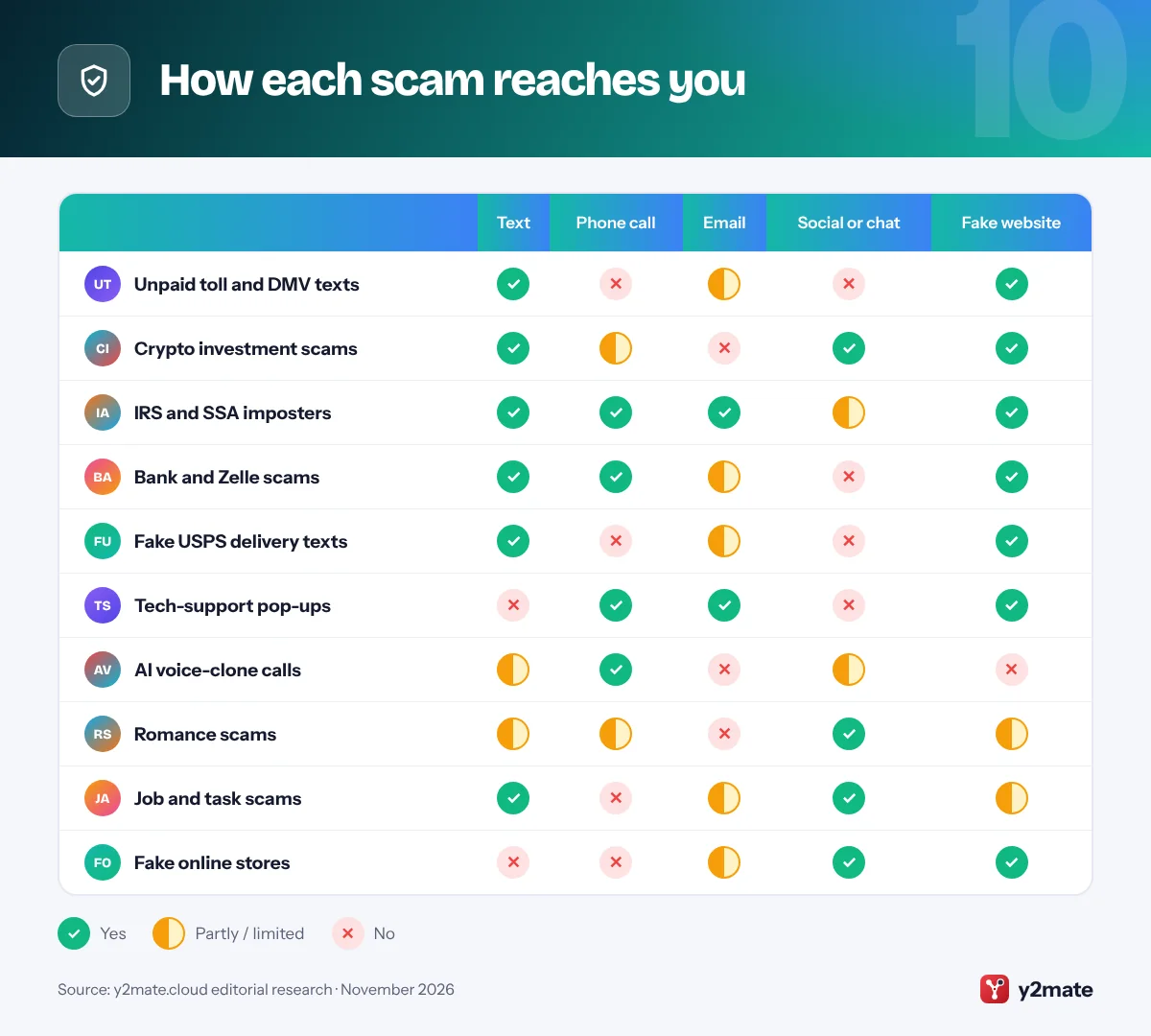
How each scam reaches you
How to protect yourself from scams in the USA
Most scams in the USA rely on the same three levers: surprise, urgency and a payment method that is hard to reverse. Build habits that remove all three. Let unknown numbers go to voicemail, never act on a link or phone number inside an unexpected message, and look up an organization’s contact details yourself before you respond. If anyone tells you to keep a conversation secret from your family or your bank, treat that as proof of a scam.
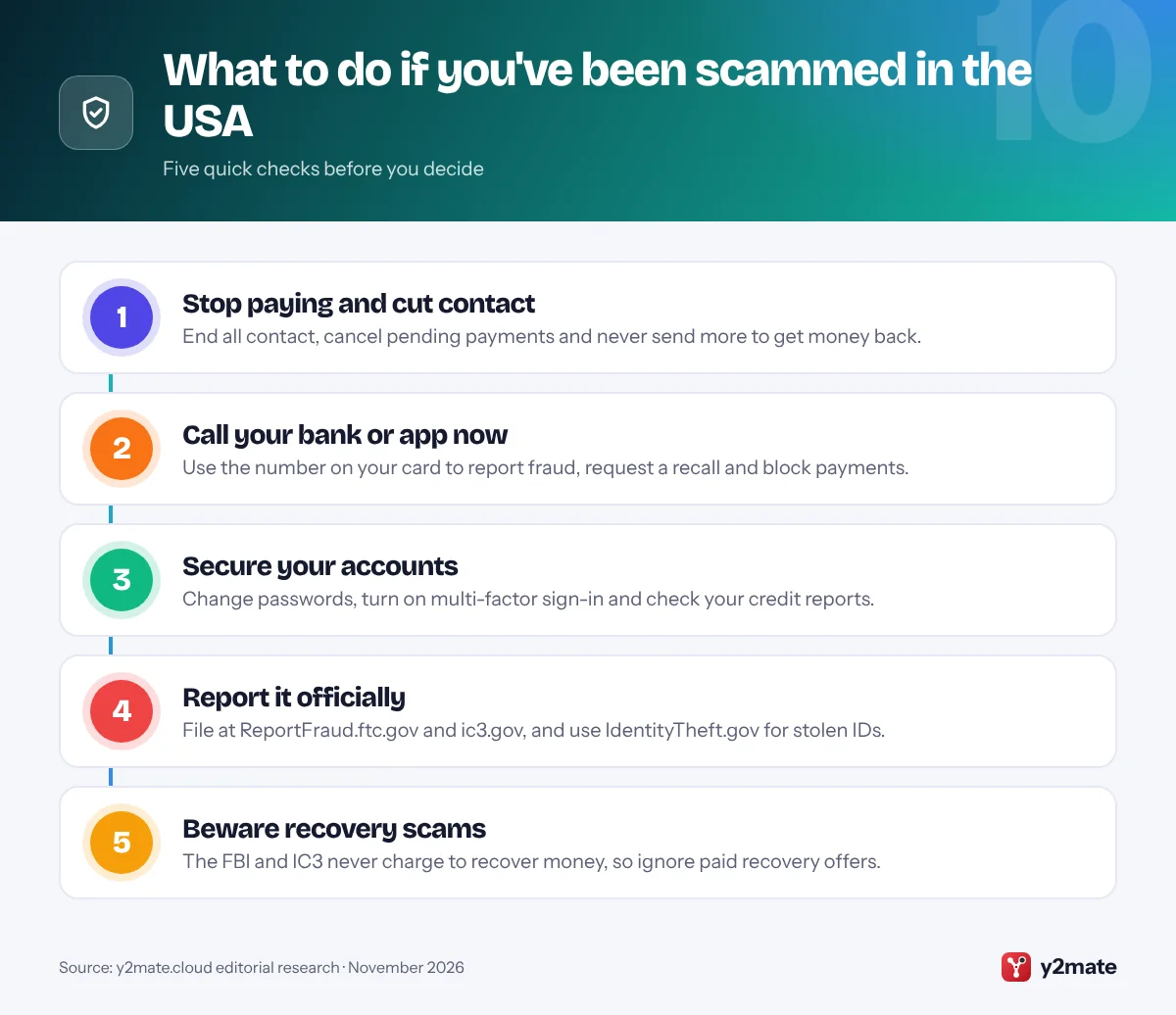
Habits that block most scams
- Verify independently: call your bank on the number printed on your card, and check toll, tax or Social Security accounts only through official websites you type in yourself.
- Protect your logins: use unique passwords, turn on multi-factor authentication or passkeys, and never read a one-time code to a caller.
- Watch the payment method: requests for gift cards, wire transfers, cryptocurrency, cash couriers or payment-app transfers to strangers are red flags.
- Look out for each other: agree a family code word and talk openly with older relatives about the scams on this list.
Where to report scams in the USA
Report fraud to the FTC at ReportFraud.ftc.gov and to the FBI’s Internet Crime Complaint Center at ic3.gov, and forward scam texts to 7726. Send USPS-themed texts to spam@uspis.gov and suspicious IRS emails to phishing@irs.gov. Your state attorney general’s consumer protection office also takes complaints. If you are 60 or older and need help, the Justice Department’s Elder Justice Hotline is 1-833-FRAUD-11.
Frequently asked questions
What are the most common scams in the USA right now?
Official warnings in 2026 focus on fake unpaid toll and DMV texts, IRS and Social Security imposters, bank and Zelle impersonation, fake USPS delivery texts and cryptocurrency investment scams that start with a wrong-number text or an online friendship. Tech-support pop-ups, romance scams, job and task scams, fake online stores and AI voice-clone calls complete the list. Most demand fast, hard-to-trace payment.
Is the unpaid toll text I received a scam?
Almost certainly. Toll agencies and state DMVs have repeatedly warned that they do not demand overdue tolls or fines through links in unexpected texts, and the FTC says people receive these messages whether or not they have driven on a toll road. Do not click or reply. Check your account through the agency's official website or app, forward the text to 7726 and delete it.
How do I report a scam in the USA?
Report it to the Federal Trade Commission at ReportFraud.ftc.gov and to the FBI's Internet Crime Complaint Center at ic3.gov, which refers complaints to law enforcement. Forward scam texts to 7726 and USPS-themed texts to spam@uspis.gov. If you lost money, call your bank or payment app first, and if your identity was stolen, use IdentityTheft.gov to get a personal recovery plan.
Can scammers really clone a family member's voice?
Yes. AI tools can imitate a voice from a short recording, such as a video posted online, and the FTC and FBI have warned that criminals use cloned voices in fake emergency and kidnapping calls. Hang up and call your relative on a number you already have, ask for a family code word you agreed in advance, and never send money because of a voice alone.
Will my bank refund money I lost to a scam?
It depends on how you paid. Federal rules give strong protection against transactions you did not authorize, and credit cards let you dispute charges for goods that never arrive. Payments you were tricked into sending yourself, by wire, Zelle or another app, are much harder to recover, although some banks refund certain imposter scams. Contact your bank immediately, because speed improves the chance of stopping a transfer.
Final verdict
The scams in the USA to watch most closely in 2026 are the ones that reach you every day: fake toll, DMV and USPS texts, calls from your bank or the IRS that are nothing of the kind, and online contacts who steer you toward cryptocurrency. AI voice cloning and fake online stores make old tricks more convincing, but the defenses have not changed.
Slow down, verify through a phone number or website you find yourself, and never pay by gift card, wire, crypto or courier because someone told you to. If you are caught out, call your bank first, then report it to the FTC and IC3 so investigators can spot the pattern and warn others.
Sources and further reading
- Report fraud to the FTC: The Federal Trade Commission's official site for reporting scams and fraud, with practical next steps based on what happened to you.
- FBI alert on fake officials: The FBI's September 2026 warning about scammers impersonating police and government officials, with protection tips and how to report to IC3.
- IRS Dirty Dozen for 2026: The IRS's 2026 list of tax scams, led by email and text impersonation and AI-enabled phone calls, with reporting addresses.
- FTC guide to spam texts: The FTC explains how to recognize scam text messages, filter them on your phone and report them by forwarding to 7726.
- FBI warning on fake IC3 contacts: The FBI warns that criminals impersonate IC3, including with deepfake videos, to target people who have already lost money to scams.

Leave a Reply