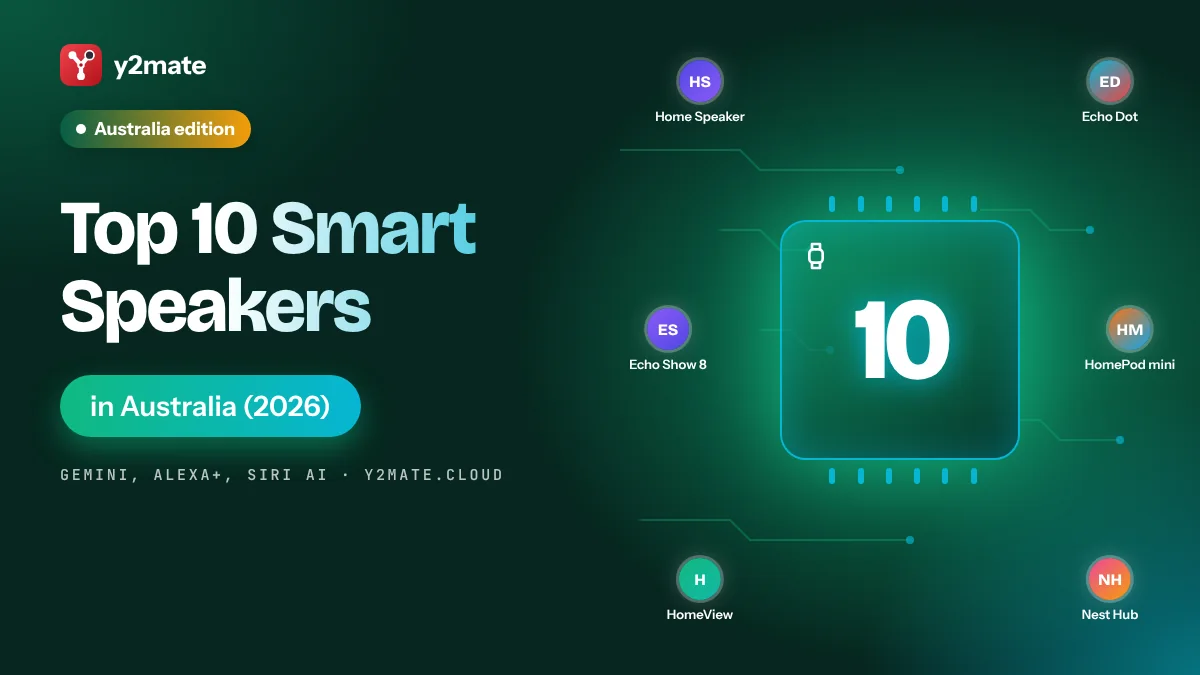
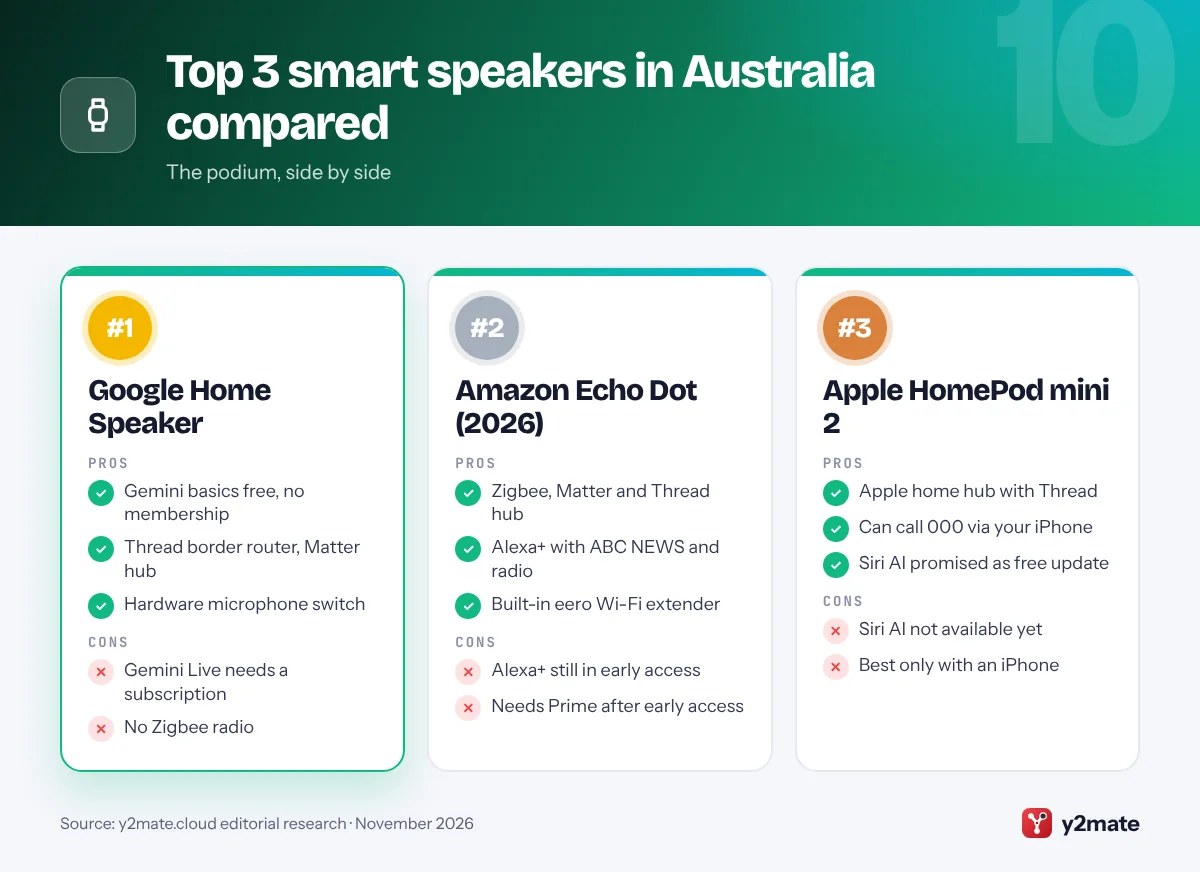
- The Google Home Speaker, the new Amazon Echo Dot and Apple's HomePod mini 2 are the strongest smart speakers in Australia for most homes in 2026.
- Gemini for Home early access reached Australia in April 2026, and Google says its basic features are free without any membership.
- Alexa+ launched in Australia through free early access in August 2026, works in English only, and Amazon says it will be free with Prime once early access ends.
- Apple HomeView went on sale in Australia on 13 November 2026 with Siri AI in English, while HomePod mini 2 is due to get Siri AI in a later update.
- Smart devices made from 4 March 2026 must meet Australia's mandatory security standards, including unique passwords and a stated security update period.
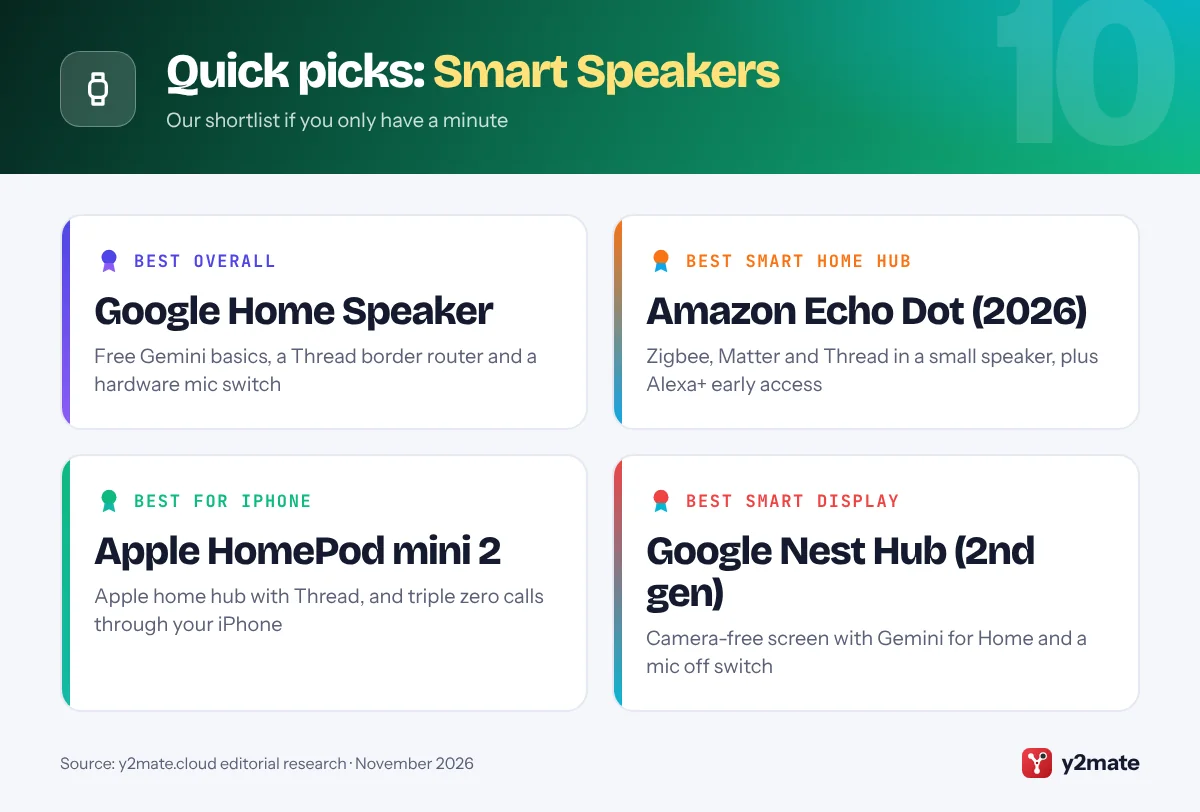
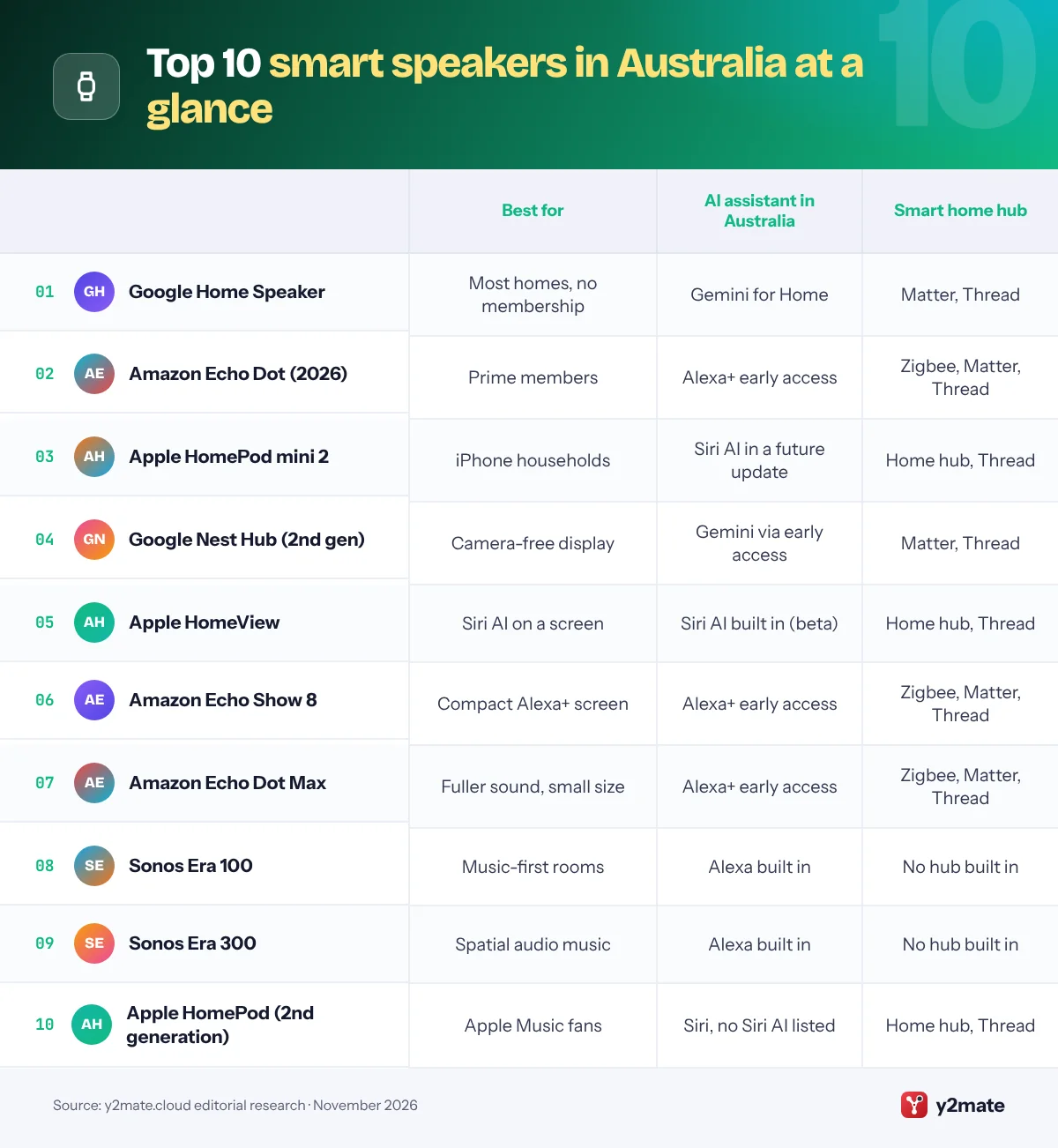
The best smart speakers in Australia in 2026 are the Google Home Speaker for most homes, the new Amazon Echo Dot for Prime members who want the strongest smart home hub, and Apple’s HomePod mini 2 for iPhone households. The Google Nest Hub (2nd gen), Apple HomeView, Echo Show 8, Echo Dot Max, Sonos Era 100, Sonos Era 300 and HomePod (2nd generation) round out the list for screens, music and Apple fans.
A few plain definitions first. A smart speaker is a Wi-Fi speaker with a voice assistant that answers questions, plays audio and controls devices around the home. A smart display adds a touchscreen and often a camera. The wake word, such as “Alexa”, “Hey Google” or “Siri”, tells the device to start sending your request. Matter is an open standard that lets certified smart home devices work across the major apps, and Thread is a low-power mesh network used by many Matter sensors and locks, which needs a Thread border router, often built into a speaker.
The deciding question in Australia this year is which AI upgrade you can actually use. Gemini for Home reached Australian early access in April 2026, Alexa+ followed in August, and Siri AI arrived on Apple HomeView in November. This guide ranks ten models sold on the makers’ Australian stores in November 2026 and explains triple zero calls, the OAIC’s role and the new smart device security standards.
How we ranked this list
To rank smart speakers in Australia, we compared publicly documented information only: which assistant each device runs, whether its newest version is available here and whether it needs a paid membership, the smart home features the maker lists (Matter controller, Thread border router, Zigbee hub), whether it has a screen or camera, privacy controls such as a microphone switch, and how the maker describes its sound. We gave extra weight to assistant upgrades that are usable in Australia today without a paid membership.
We have not tested the speakers ourselves, and we leave out prices, ratings and audio specifications because they change often. Check the maker’s Australian store before you buy.
The Top 10 Smart Speakers
1. Google Home Speaker
Best for: most Australian homes, with no membership needed
The Google Home Speaker, on sale in Australia since June 2026, is our top pick for most Australian homes. It is Google’s first speaker built for Gemini for Home, the assistant replacing Google Assistant on Nest speakers and displays, and Gemini for Home early access opened in Australia in April 2026, months before Alexa+ arrived. Adding this speaker to your home makes you eligible to switch straight away.
What tips the balance is cost of ownership rather than sound. Google says everyday Gemini features, including smart home control, timers, reminders, calendars and general questions, are free without any membership. Only Gemini Live, the free-flowing conversation mode, needs a Google Home Premium subscription, and the speaker includes a trial. Bear in mind that a home cannot return to Google Assistant once it switches.
For the smart home it is a Thread border router and a Matter hub, though it has no Zigbee radio. It plays 360-degree sound, groups with other Nest and Cast speakers, and pairs with a Google TV Streamer for home theatre audio. A hardware switch mutes the microphones, and Google promises at least five years of security updates.
Official site: Google Home Speaker
- Gemini basics free, no membership
- Thread border router, Matter hub
- Hardware microphone switch
- Gemini Live needs a subscription
- No Zigbee radio
2. Amazon Echo Dot (2026)
Best for: Prime members who want the most capable hub
Amazon’s new Echo Dot reached Australia on 28 October 2026, and it is the most capable small speaker on sale here for running a smart home. It is the first Dot with a full hub inside, supporting Zigbee, Matter and Thread, so it can connect bulbs, plugs, locks and sensors without a separate bridge, and it includes an eero extender that adds coverage to an existing eero network.
Alexa+ launched in Australia in August 2026 as an early access programme, in English only, and buying an eligible Echo such as this one gets you in straight away. Amazon says Alexa+ will be free for Prime members after early access ends, with at least 30 days’ notice, and a standalone subscription for everyone else. Amazon lists local partners including ABC NEWS, AAP, The Guardian and OpenTable, plus local radio stations.
The AZ3 chip and an extra microphone help Alexa+ follow conversations and recognise voices, and Omnisense sensors can detect room temperature to trigger the air conditioning or heating. A button turns the microphones off.
Official site: Amazon Echo Dot (2026)
- Zigbee, Matter and Thread hub
- Alexa+ with ABC NEWS and radio
- Built-in eero Wi-Fi extender
- Alexa+ still in early access
- Needs Prime after early access
3. Apple HomePod mini 2
Best for: iPhone households that want a compact hub
Apple’s HomePod mini 2 went on sale on 30 October 2026 and is the obvious choice for iPhone households. It acts as an Apple home hub and Thread border router for Matter and HomeKit accessories, has built-in temperature and humidity sensors that can trigger automations, and uses Sound Recognition to alert your iPhone if it hears a smoke or carbon monoxide alarm, although Apple warns against relying on that in an emergency.
Apple says Siri AI, its new conversational version of Siri, will come to HomePod mini 2 as a free software update, in English in Australia among other countries. It was not available at launch, and personal requests will need the home owner’s Apple Intelligence-enabled iPhone or iPad with Siri AI turned on.
It has one feature Australians should note: you can ask Siri to call 000, and HomePod places the call through your linked iPhone, relaying the audio through the speaker. Apple describes rich 360-degree sound for its size. There is no Zigbee radio and no physical microphone switch, so you turn off listening in the Home app.
Official site: Apple HomePod mini 2
- Apple home hub with Thread
- Can call 000 via your iPhone
- Siri AI promised as free update
- Siri AI not available yet
- Best only with an iPhone
4. Google Nest Hub (2nd gen)
Best for: a camera-free display for the kitchen or bedside
The Nest Hub (2nd gen) is still sold on Google’s Australian store, and it ranks highly here because it pairs Google’s free Gemini basics with a screen and no camera. It has a 7-inch touchscreen for timers, photos and smart home controls, plus a physical switch that turns the microphones off.
Google lists it among the devices that get the complete Gemini for Home experience, including Gemini Live with a Google Home Premium subscription, once your home is upgraded through Australian early access or by adding a Google Home Speaker. It is also a Thread border router and a Matter hub, so it can run Thread sensors and locks on its own.
A Soli radar sensor powers Sleep Sensing, which can follow your sleep from the bedside without a wearable, and an ambient light sensor adjusts the screen to the room. The trade-offs are age and audio. This model dates from 2021, and its small speaker is fine for voices, news and podcasts but not a replacement for a music speaker.
Official site: Google Nest Hub (2nd gen)
- No camera, mic off switch
- Thread border router, Matter hub
- Gemini for Home supported
- Older 2021 hardware
- Small speaker for music
5. Apple HomeView
Best for: Apple homes that want Siri AI on a screen
Apple HomeView went on sale in Australia on 13 November 2026, and it is the only device in this list with Siri AI working today, in English for Australian users. Apple calls it a beta, and the assistant can answer broad questions, act on what is on screen and, with a paired Apple Intelligence-enabled iPhone or iPad, use your calendar and messages to personalise answers.
HomeView is designed for a shared home. It recognises up to six people by face and voice, and it shows each person’s messages, reminders and calendar only when they are recognised and their paired iPhone or iPad is nearby and recently unlocked. Apple says the A18 chip processes the camera and microphone feeds in Secure Exclaves that neither the operating system nor Apple can access.
It works as a home hub for Thread and Matter accessories, includes a temperature and humidity sensor, and comes as a tabletop model or a wall-mounted version for a hallway. FaceTime calls use a Center Stage camera. You need an iPhone or iPad to set it up, and there is no Zigbee radio.
Official site: Apple HomeView
- Siri AI built in (beta)
- Personal views for six people
- Tabletop or wall-mounted
- Needs an iPhone or iPad
- Siri AI still a beta
6. Amazon Echo Show 8
Best for: an Alexa+ screen that fits a smaller bench
The Echo Show 8 is the Alexa display we suggest for most Australian kitchens. The 2025 model, designed for Alexa+, has an 8.7-inch HD screen with spatial audio, so it is compact enough for a bench or bedside table while still showing recipes, calendars, camera feeds and Alexa+ answers as visual cards. Buying one gives you Alexa+ early access in Australia straight away.
It is a full smart home hub. Amazon lists Zigbee, Matter and a Thread border router, which means it can run older Zigbee bulbs and sensors as well as newer Matter devices, and its touchscreen gives the household tap controls for lights, locks and air conditioning.
Plan its location with privacy in mind. The camera supports video calls and presence detection through Amazon’s Omnisense platform, and this generation has no sliding shutter. A single button turns off both the camera and the microphones, and the camera can also be switched off in the Alexa app. The larger Echo Show 11 is also sold in Australia if you want a bigger screen.
Official site: Amazon Echo Show 8
- Compact screen for benches
- Zigbee, Matter and Thread hub
- Alexa+ early access included
- No physical camera shutter
- Alexa+ needs Prime long term
7. Amazon Echo Dot Max
Best for: fuller sound from a compact Echo
The Echo Dot Max, launched in Australia in late 2025, sits between the Echo Dot and Amazon’s larger Studio speakers. Amazon gave it a separate woofer and tweeter for fuller sound than the classic Dot, which suits a study, a bedroom where you play music or a kitchen bench where you do not need a screen.
It uses Amazon’s AZ3 chip, which Amazon says improves conversation detection and wake word accuracy for Alexa+, and it qualifies for Alexa+ early access in Australia. Amazon lists Zigbee, Matter and a Thread border router, so it can be the main hub in an apartment or extend a system in a larger house. Bluetooth lets you stream directly from a phone.
The 2026 Echo Dot now matches it on smart home features, so choose the Dot Max mainly for sound. Privacy controls follow the Echo pattern: a microphone off button, a light that shows when Alexa is listening, and voice history settings in the Alexa app, where you can also choose not to save recordings.
Official site: Amazon Echo Dot Max
- Fuller sound than the Echo Dot
- Zigbee, Matter and Thread hub
- AZ3 chip for Alexa+
- No screen for visual answers
- Alexa+ needs Prime long term
8. Sonos Era 100
Best for: music-first rooms with Alexa as an option
The Sonos Era 100 is the speaker to choose if great music comes first and voice control is a bonus. It is a compact stereo speaker that joins a wider Sonos system, pairs with a second Era 100 for wider sound and tunes itself to the room with Trueplay. AirPlay 2 and Bluetooth are both supported, so guests can stream without the Sonos app.
Sonos’s Australian site lists Amazon Alexa and Sonos Voice Control, its own music assistant that Sonos says does not record or send your voice to the cloud. Sonos also notes that voice services vary by country and language, so check which ones appear in the Sonos app before you rely on them. Alexa on the Era 100 can control devices linked to your Alexa account, and a physical switch disconnects power to the microphones.
The Era 100 is not a smart home hub. It is not a Matter controller or Thread border router, so you will still need an Echo, Google or Apple device to run Thread sensors and locks.
Official site: Sonos Era 100
- Strong music focus
- Alexa built in
- Mic switch cuts power
- Not a smart home hub
- Voice options vary by country
9. Sonos Era 300
Best for: spatial audio music in a living room
The Sonos Era 300 is built for Dolby Atmos music without a soundbar. Its drivers are angled to spread sound around and above you, and Sonos designed it for spatial audio tracks from services such as Apple Music and Amazon Music. Trueplay tunes it to the room, and two can be paired for stereo or used as rear speakers in a Sonos home theatre.
Voice works the same way as on the Era 100. Sonos lists Amazon Alexa and Sonos Voice Control on its Australian product page, with a note that availability varies by country and language, and Alexa built in can control your linked smart home devices and start music hands-free. AirPlay 2 and Bluetooth are supported.
A switch cuts power to the microphones. Like every Sonos speaker, it does not act as a Matter controller or Thread border router, so pair it with an Echo, Google or Apple device if you want to run Thread locks and sensors. It is also too large for most bedside tables.
Official site: Sonos Era 300
- Dolby Atmos spatial audio
- Alexa built in
- Mic switch cuts power
- Not a smart home hub
- Large for a bedside table
10. Apple HomePod (2nd generation)
Best for: Apple Music fans who want fuller sound
The full-size HomePod (2nd generation) is Apple’s best-sounding speaker and suits iPhone owners who play a lot of music. Apple describes rich, room-filling sound with deep bass and spatial audio support, and two HomePods can be paired in stereo or used with an Apple TV 4K for home theatre sound.
As a smart home device it matches the HomePod mini 2. It is an Apple home hub and Thread border router, it controls Matter and HomeKit accessories, it has temperature and humidity sensors, and Sound Recognition can send an alert about smoke and carbon monoxide alarms. You can also ask Siri to call 000, and the call goes through your linked iPhone.
The drawback is the assistant. Apple’s HomePod (2nd generation) pages do not list Siri AI, which Apple has announced for HomeView and HomePod mini 2, so it runs the current Siri for now. If smarter conversations matter more than sound, choose one of those instead.
Official site: Apple HomePod (2nd generation)
- Apple's best-sounding speaker
- Home hub with Thread
- Can call 000 via your iPhone
- Siri AI not listed for it
- Large and best with iPhone
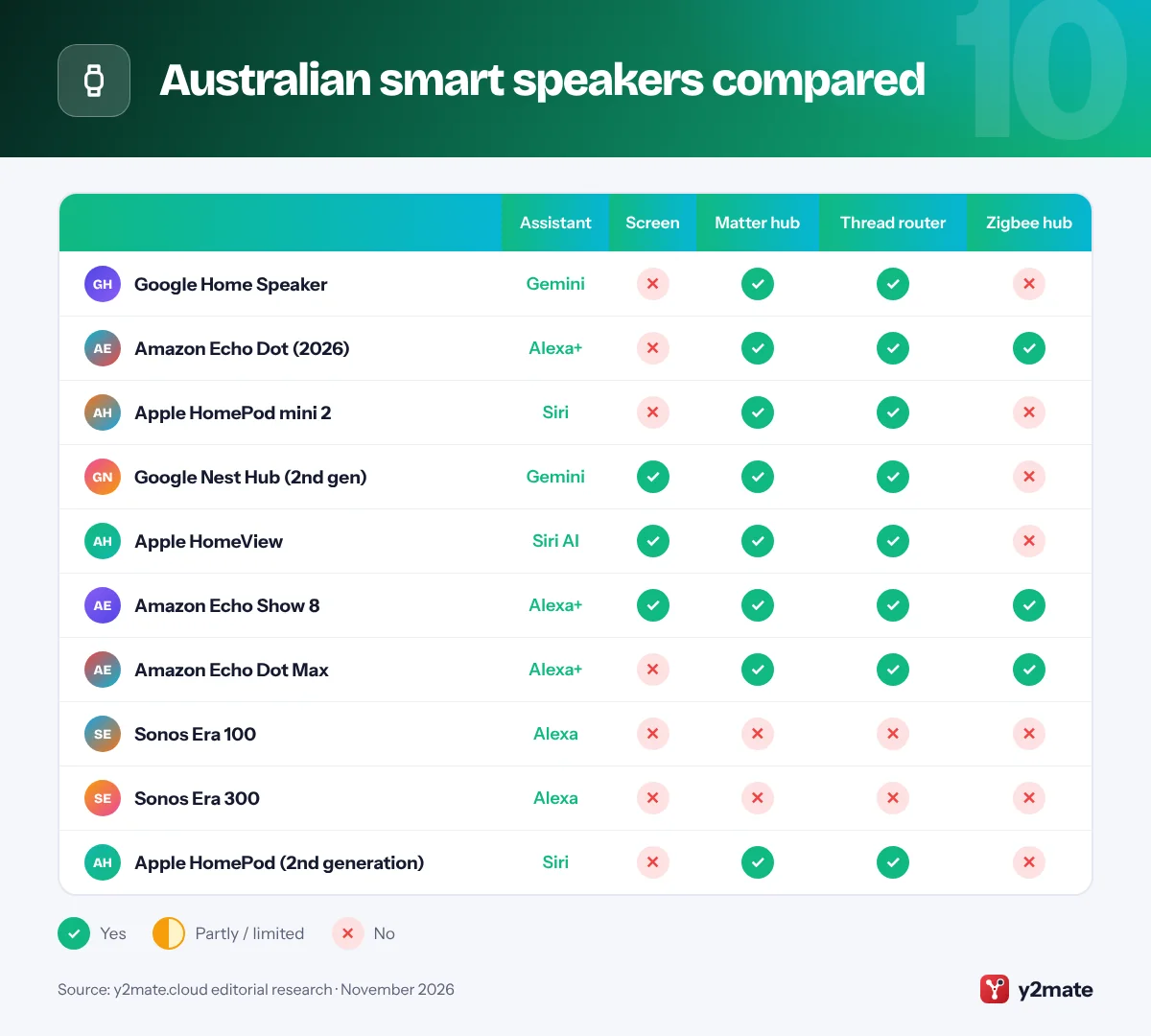
Australian smart speakers compared
How to choose smart speakers in Australia
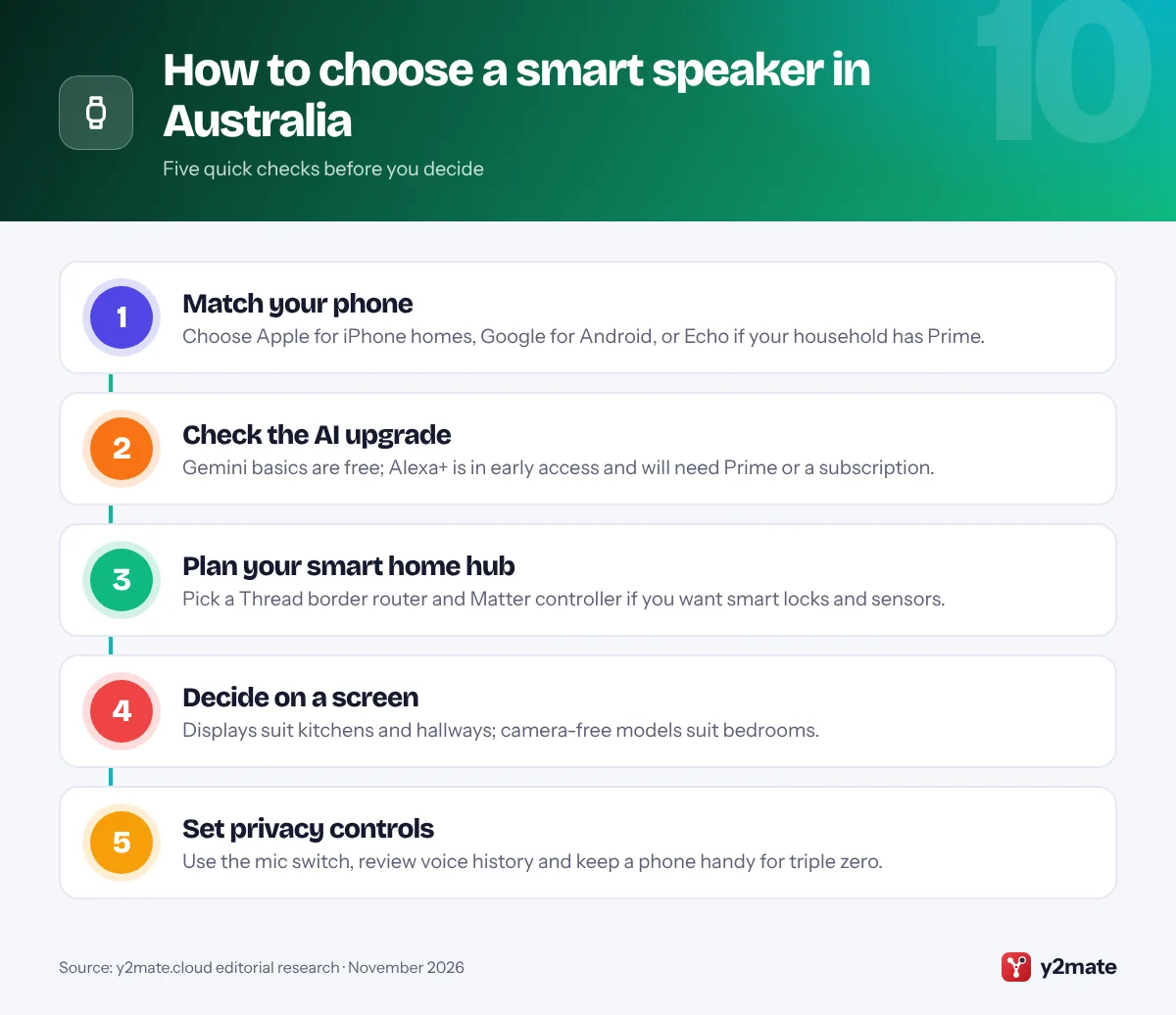
Start with the phones in your household and whether you already pay for Prime. iPhone homes get the most from HomePod and HomeView, Android homes from Google, and Prime members from Echo once Alexa+ moves out of early access. Then decide whether you want a screen, and whether a camera belongs in that room.
Which AI upgrade works here
- Gemini for Home: in Australian early access since April 2026; basic features are free, Gemini Live needs Google Home Premium.
- Alexa+: in early access since August 2026, English only; free with Prime afterwards.
- Siri AI: built into HomeView as a beta; coming to HomePod mini 2 later.
Triple zero, privacy and Australian rules
Do not rely on a smart speaker in an emergency. Alexa calling does not support emergency numbers, and Google says its speakers cannot call emergency services, while HomePod can place a 000 call through your iPhone. Smart devices made from 4 March 2026 must meet mandatory security standards, including unique or user-set passwords, a way to report vulnerabilities and a stated security update period. Amazon, Google and Apple are covered by the Privacy Act, overseen by the OAIC, so you can ask them what personal information they hold about you. eSafety’s Be Connected advice notes that many speakers have a microphone switch and suggests reviewing default privacy settings.
Frequently asked questions
What is the best smart speaker in Australia in 2026?
For most Australian homes, the Google Home Speaker is the best smart speaker because Gemini for Home is already available here and its basic features need no membership. Prime members who want a stronger hub should choose the new Amazon Echo Dot, with Zigbee, Matter and Thread built in. iPhone households should pick the HomePod mini 2 or Apple HomeView.
Is Alexa+ available in Australia?
Yes. Amazon launched Alexa+ in Australia in August 2026 through an early access programme, in English only. You can register your interest or get access straight away by buying an eligible Echo device. Amazon says that when early access ends, with at least 30 days' notice, Alexa+ will be free for Prime members and offered to others as a standalone subscription.
Is Gemini for Home available in Australia?
Yes, through early access. Google added Australia to Gemini for Home early access in April 2026, and you can request it in the Google Home app under Home settings. Adding a Google Home Speaker makes your home eligible to switch. Basic features are free, Gemini Live needs a Google Home Premium subscription, and a home cannot go back to Google Assistant afterwards.
Can a smart speaker call triple zero (000)?
Most cannot. Alexa calling does not support emergency numbers, and Google says its speakers and displays cannot call emergency services. A HomePod can place a 000 call through the iPhone linked to it, as long as that phone is available. For emergencies, always use a mobile or landline, and keep one within reach rather than relying on a smart speaker.
What do Australia's smart device security rules mean for smart speakers?
Smart devices made from 4 March 2026, including smart speakers and displays, must meet mandatory security standards set by the Australian Government. They must use unique or user-set passwords rather than a shared default, give you a way to report security problems, and state how long they will receive security updates. Check that period before buying, especially for older stock.
Final verdict
The best smart speakers in Australia in 2026 are the Google Home Speaker for most homes, the new Amazon Echo Dot for Prime members who want the strongest hub, and the HomePod mini 2 for iPhone households. The Nest Hub (2nd gen) is the pick for a camera-free screen, HomeView for Siri AI on a display, and the Sonos Era 100 or Era 300 for music.
Before you buy, check whether the assistant upgrade is free, in early access or tied to Prime or Google Home Premium, make sure the device can act as your Thread border router, set up privacy controls on day one, and keep a phone within reach for triple zero.
Sources and further reading
- Security standards for smart devices: Home Affairs explains the mandatory security standards for consumer smart devices that began on 4 March 2026.
- OAIC: Australian Privacy Principles: The OAIC sets out the privacy principles that govern how companies collect, use and give you access to personal information.
- eSafety: voice assistant privacy: eSafety's Be Connected lesson explains when smart speakers listen and how to manage their privacy settings.
- Alexa+ launch in Australia: Amazon's August 2026 announcement of Alexa+ early access in Australia, including its local partners and Prime terms.
- Gemini for Home availability: Google's help page lists the countries, devices and subscription features for its Gemini for Home voice assistant.

Leave a Reply