- ADT Security, owned by Intelligent Monitoring Group since 2023, sells a DIY alarm with Full or Lite monitoring on month-to-month plans.
- Ring's alarm system is not sold in Australia, so Ring is limited to video doorbells and cameras here.
- Australian monitoring centres can be graded against AS 2201.2, and paid alarm and CCTV installers need a state security licence, such as a Class 2C licence in NSW.
- Since 4 March 2026, new smart devices supplied in Australia must have unique or user-set passwords, a vulnerability reporting channel and a stated security update period.
- The OAIC says the federal Privacy Act generally does not cover home cameras run by individuals, so state and territory surveillance laws usually apply instead.
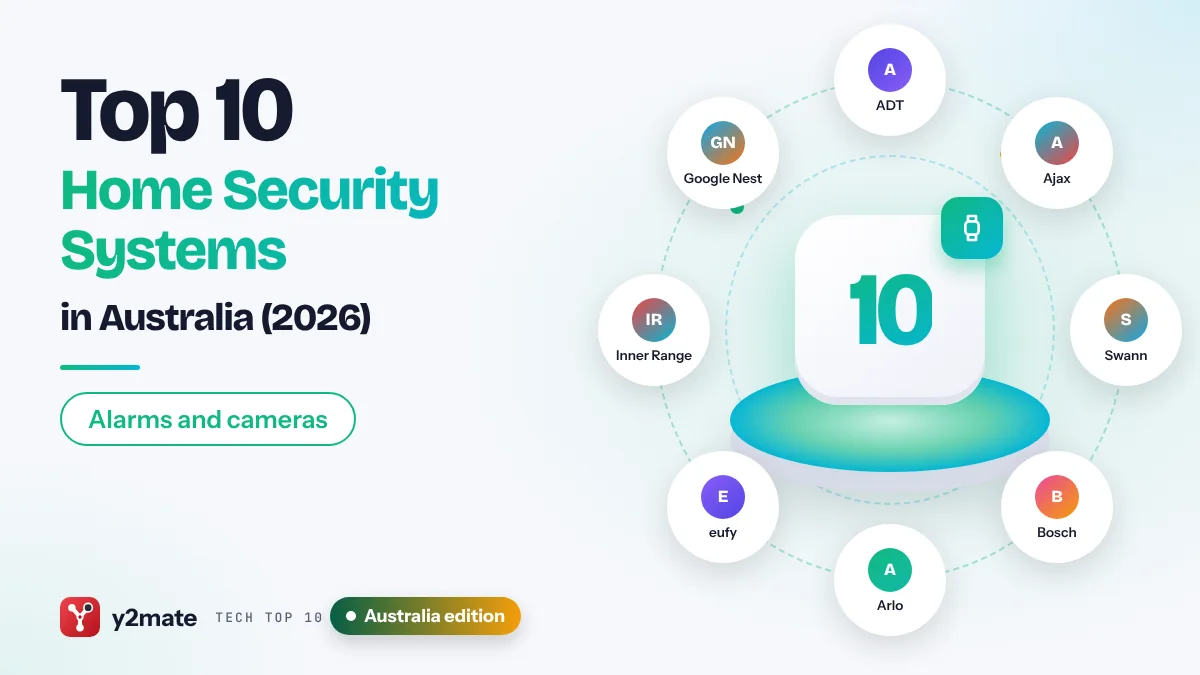
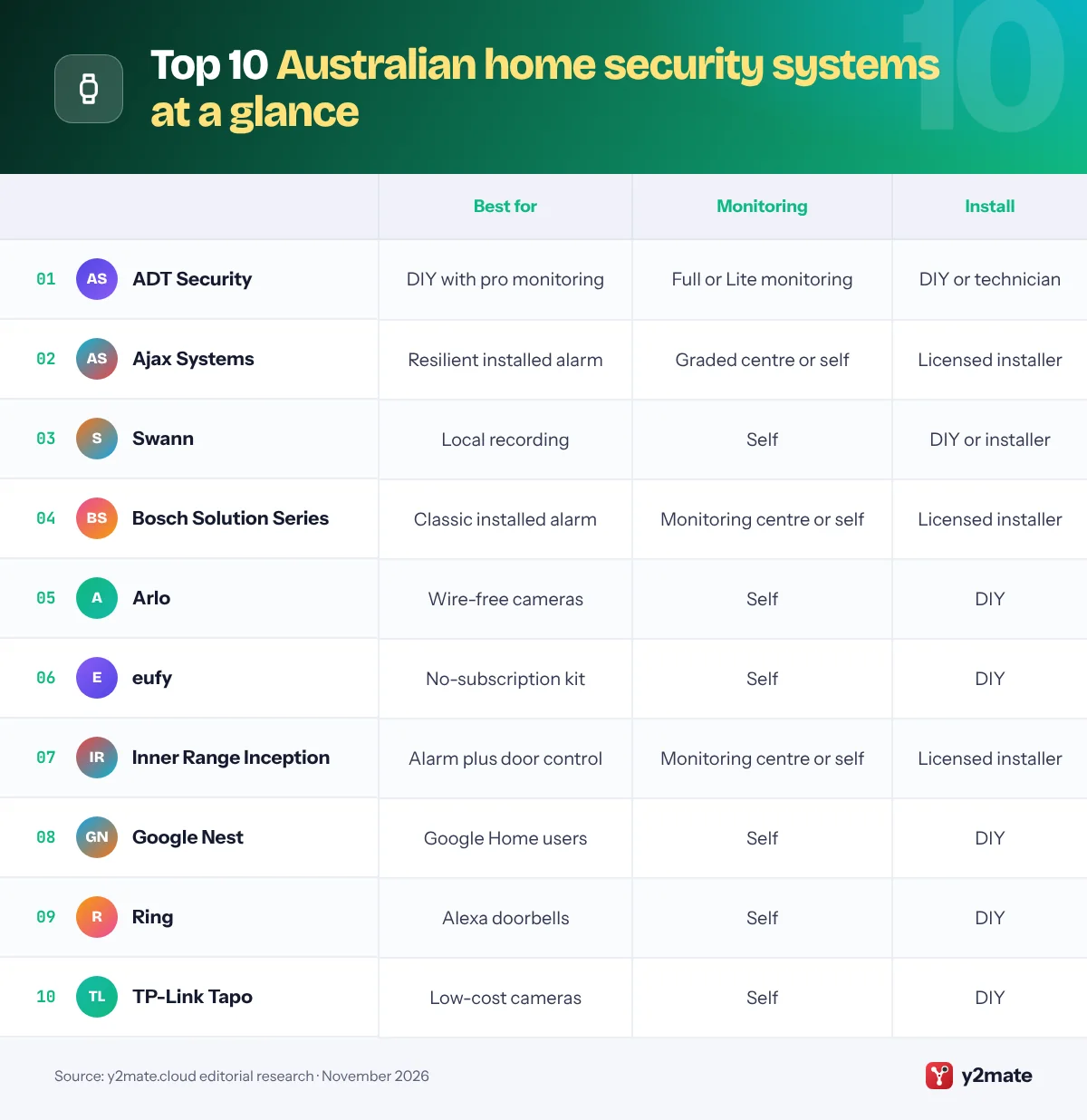
The best home security systems in Australia in 2026 are ADT Security for a DIY alarm with professional monitoring, Ajax Systems fitted by a licensed installer, and Swann for camera systems that record at home. The Bosch Solution Series and Inner Range Inception suit installer-fitted alarms, while Arlo, eufy, Google Nest, Ring and TP-Link Tapo lead on DIY cameras. Ring’s alarm kit is not sold here, so Ring appears for its doorbells and cameras only.
Professional monitoring means a monitoring centre, staffed around the clock, receives your alarm signals and can call you, send a patrol or contact police. Self-monitoring means alerts go only to your phone. Cellular backup is a built-in 4G connection that keeps the alarm reporting if your NBN service drops, while battery backup keeps it running in a blackout. Matter is an open smart-home standard that lets devices work across Apple Home, Google Home, Amazon Alexa and SmartThings, though few alarms support it yet.
Australia has its own rules. Monitoring centres can be graded against AS 2201.2, paid installers need a state security licence, new smart devices must meet national security standards from March 2026, and camera privacy is governed mostly by state surveillance laws. This guide covers all of that, plus renter-friendly options and the impact of the 3G shutdown.
How we ranked this list
We compared publicly documented features only: whether each system offers professional monitoring, self-monitoring or both; whether 4G and battery backup are built in; smart-home support for Alexa, Google Home, Apple Home and Matter; DIY versus licensed installation; contract flexibility; and privacy features such as encryption and local storage. We also considered local availability and support in Australia, widely reported customer feedback and each company’s public record on privacy.
We did not test any equipment ourselves and do not quote prices or fees, which change often. Features often depend on the plan, so confirm details with the provider or installer before you buy.
The Top 10 Home Security Systems
1. ADT Security
Best for: a DIY alarm with professional monitoring
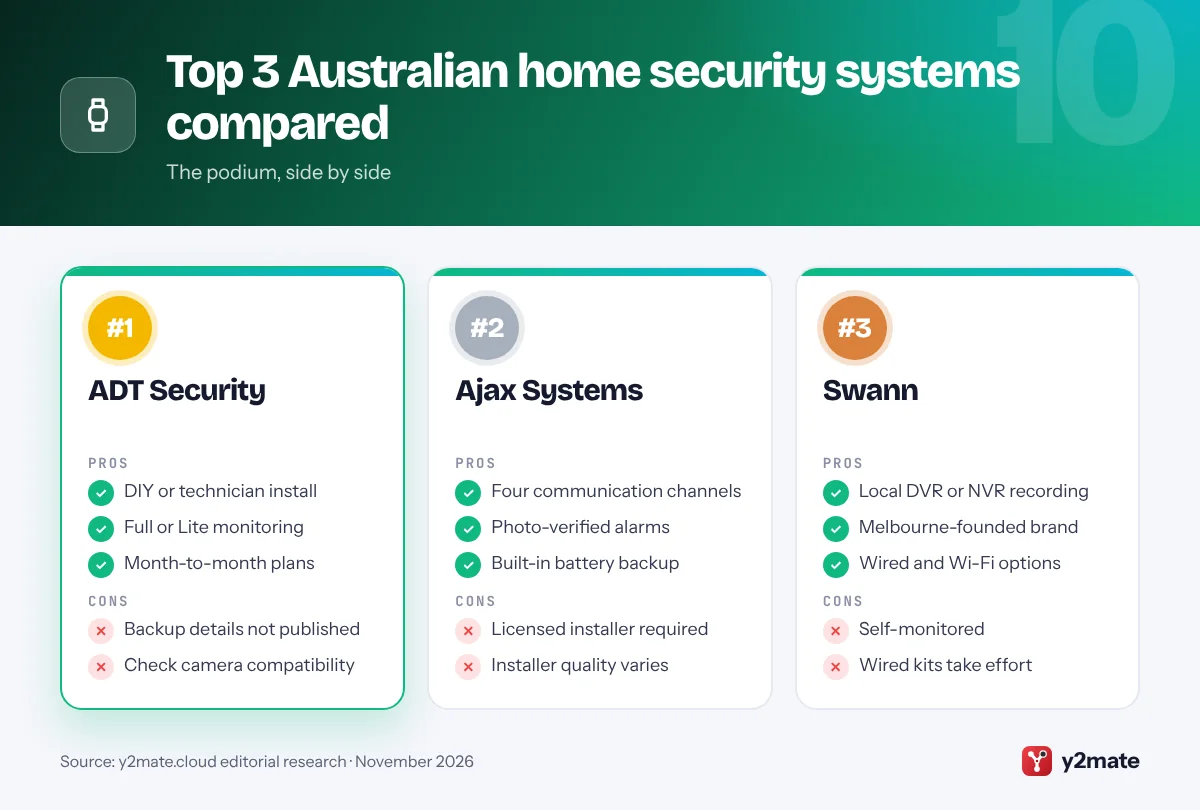
ADT Security is one of Australia’s best-known alarm monitoring companies, and since August 2023 it has been owned by ASX-listed Intelligent Monitoring Group, which bought it from Johnson Controls. Its ADT Secure Home Essential DIY Alarm System is designed for self-installation and has a local alarm built into the panel, and ADT can send a qualified technician if you would rather not fit it yourself.
ADT says all its systems come with professional monitoring, and you choose between Full Monitoring and Lite Monitoring. Either way, the Smart Connect app and web interface let you receive alerts, view live camera feeds and arm or disarm the system from anywhere. Monitoring runs month to month with no long-term contract, which is unusual for a traditional alarm company, and ADT lists security master licences for several states and territories.
ADT does not set out cellular or battery backup details on its DIY page, so ask how the panel reports to the monitoring centre during a blackout or NBN outage. If you want the backing of a major Australian monitoring company without a lock-in contract, ADT Security is the best all-round choice.
Official site: ADT Security
- DIY or technician installation
- Full or Lite monitoring options
- Month-to-month plans
- Backup details not published
- Check camera compatibility
2. Ajax Systems
Best for: an installer-fitted alarm with backup paths
Ajax Systems makes wireless and hybrid alarms that, in Australia, are sold through distributors to licensed security installers rather than as a DIY kit. Its Grade 2 wireless range is available through Australian distributors, and monitoring companies with graded control rooms, such as SMC Australia, have said they can monitor Ajax panels. The result is a modern, app-driven alarm with professional installation and monitoring.
The Hub 2 Plus has four communication channels, Ethernet, Wi-Fi and two SIM cards for mobile networks, and switches between them automatically, with a built-in battery for blackouts. That matters in Australia, where many older alarm communicators stopped reporting when the 3G networks closed in 2024, and most NBN connections stop working in a power cut. Photo-verifying motion detectors let you or the monitoring centre see what set the alarm off.
The trade-off is that you need an installer, and quality varies between companies. Ask to see their state security licence and which graded monitoring centre they use. For a resilient, modern alarm installed properly, Ajax is a top choice.
Official site: Ajax Systems
- Four communication channels
- Photo-verified alarms
- Built-in battery backup
- Licensed installer required
- Installer quality varies
3. Swann
Best for: camera systems that record at home
Swann was founded in Melbourne in 1987 and remains one of the best-known DIY security camera brands in Australia, with its local base in Port Melbourne and Australian tech support. Its range covers wired security systems that record to a DVR or NVR, Wi-Fi NVR kits, standalone Wi-Fi cameras and video doorbells, all managed in the Swann Security app.
The big advantage of Swann’s recorder-based systems is local storage. Footage is saved to a hard drive in your home rather than only in the cloud, so wired systems keep recording if your internet drops and you control who can see it. An optional Secure+ membership adds extra features, and SwannShield AI tools on newer cameras and doorbells add smarter responses to visitors and alerts.
Swann is built for self-monitoring through the app, and wired kits take real effort to install, especially in double-storey homes. In NSW and other states, anyone you pay to install cameras needs a security licence, so use a licensed installer if you do not want to run cables yourself. If you want a camera system that keeps recordings at home, Swann is the strongest local brand.
Official site: Swann
- Local recording to DVR or NVR
- Melbourne-founded, local support
- Wired and Wi-Fi options
- Self-monitored
- Wired kits take effort to install
4. Bosch Solution Series
Best for: a classic installer-fitted home alarm
The Bosch Solution 2000 and 3000 are flagship residential alarm panels designed for the Australian and New Zealand market and fitted by licensed installers. Bosch sold its security products business to investment firm Triton in 2025, the business now trades as Keenfinity, and its intrusion alarms sit under the Radionix brand while keeping the Bosch name. The Solution 3000 supports up to 16 zones, two areas, 16 wireless devices and 32 users.
You can control the panel from touchscreen keypads or the RSC+ (Remote Security Control Plus) app, and Radionix says the app, cloud connection and push notifications are all free. The panels support IP communication, which makes them NBN-ready and compatible with many Australian monitoring centres.
Radionix has also published a statement of compliance with Australia’s smart device security standards, confirming unique device passcodes, a vulnerability reporting process and openness about update support. The downside is that changes and upgrades go through your installer. If you want a proven, conventional alarm with a free app, ask a licensed installer about the Solution Series.
Official site: Bosch Solution Series
- Free RSC+ app and push alerts
- IP communication, NBN-ready
- Smart device standards statement
- Installer needed for changes
- Ownership has changed hands
5. Arlo
Best for: wire-free cameras for renters
Arlo’s wire-free cameras, floodlight cameras and video doorbells are widely sold in Australia, and many models run on rechargeable batteries, which makes them a good fit for renters who cannot run cables. Arlo’s dedicated alarm kit has been sold mainly in the US, so here you build a camera-led system managed in the Arlo Secure app.
An Arlo Secure plan adds cloud recording, smarter detection and activity zones. Without a plan you can still watch live, receive basic motion alerts and record locally when a camera connects through an Arlo SmartHub or base station with storage. Arlo cameras also work with Amazon Alexa and Google Assistant.
Because Arlo is self-monitored, nobody but you responds to an alert, and the most useful features sit behind the subscription. Battery cameras also need regular charging in busy spots. State surveillance laws often restrict recording private conversations, so think about whether you need audio on outdoor cameras. If you want premium wireless cameras with a local storage option, Arlo is the best camera-only choice.
Official site: Arlo
- Wire-free, renter-friendly cameras
- Local storage via SmartHub
- Alexa and Google support
- Self-monitored only
- Key features need a plan
6. eufy
Best for: an alarm and cameras with no subscription
eufy, Anker’s home security brand, sells cameras, video doorbells and a five-piece alarm kit through major Australian retailers. The alarm kit pairs a HomeBase hub with a keypad, motion sensor and entry sensors, and the HomeBase also connects eufy cameras, so you get a basic intruder alarm and cameras in one app. The newer HomeBase 3 offers expandable local storage.
The main appeal is that eufy works without a mandatory subscription: footage can be stored on the HomeBase or camera rather than in the cloud, and alerts arrive in the eufy Security app. That suits buyers who want to keep recordings at home and avoid ongoing fees.
There is no professional monitoring, and some alarm kits still ship with the older HomeBase 2, so check which hub you are getting. eufy was also criticised in 2022 when researchers found some camera features relied on cloud services despite its local-storage marketing, and Anker later acknowledged problems. Turn on two-step sign-in and keep firmware updated. For a self-monitored alarm and camera system with no required subscription, eufy is a strong pick.
Official site: eufy
- Local storage on the HomeBase
- No subscription required
- Alarm kit plus cameras
- No professional monitoring
- Past privacy criticism
7. Inner Range Inception
Best for: larger homes combining alarm and door control
Inner Range is an Australian security company based in Mount Waverley, Victoria, and its Inception controller combines an intruder alarm with access control in one web-based system. It is used in commercial buildings as well as residential housing and apartments, and suits larger homes that want alarm zones, door and gate control and user permissions managed together. Licensed installers handle installation and programming.
Homeowners use the SkyCommand app to arm and disarm the system, control doors and receive immediate alarm notifications. Inner Range’s SkyTunnel cloud service provides remote access without opening ports on your router, and Inception can report alarms to a monitoring centre through SkyTunnel or a dedicated communicator. Inner Range is also building video integration so footage can sit in the same app.
Inception is more than most small homes need, and its strength is flexibility rather than plug-and-play simplicity, so you will rely on your installer for changes. For a high-end home where the alarm, gates and doors should work as one system, Inception is the most capable Australian-designed option.
Official site: Inner Range Inception
- Alarm and access control in one
- SkyCommand app control
- Remote access via SkyTunnel
- More than most homes need
- Installer needed for changes
8. Google Nest
Best for: Google Home households
Google Nest cameras are the obvious match for homes that already use Google Home speakers and displays. In October 2025 Google launched a new Nest Cam Indoor and Nest Cam Outdoor that are sold in Australia, and Australia was among the first countries to get Gemini for Home, which can summarise camera events in plain language. Google’s latest wired doorbell launched in the US and Canada, so check which doorbell models are on sale locally.
Nest Aware has been renamed Google Home Premium, and a subscription adds longer video history and smarter alerts, while the newest cameras include a few hours of event history without one. Everything is managed in the Google Home app, which also controls Matter devices.
Like other camera-only options, Google Nest has no alarm panel or professional monitoring, and most smart features depend on Google’s cloud and your internet connection. Google no longer makes an alarm system of its own. If your household lives in Google Home, Nest cameras are the simplest way to add video security.
Official site: Google Nest
- Tight Google Home integration
- Gemini for Home in Australia
- Some event history included
- No alarm or monitoring
- Check local doorbell models
9. Ring
Best for: Alexa homes wanting doorbells and cameras
Ring video doorbells and cameras are sold through major Australian retailers including Bunnings, JB Hi-Fi, Harvey Norman, The Good Guys and Officeworks, and they are the natural choice for Alexa households. However, the Ring Alarm system is not sold in Australia. Its Z-Wave sensors use radio frequencies that differ by region, and Ring’s community team has advised against using imported kits here, so in Australia Ring is a camera and doorbell system.
A Ring subscription adds video history and smarter alerts. Ring’s Australian support pages describe optional video end-to-end encryption, protected by a passphrase you create, so not even Ring can view those recordings, although some features stop working when it is on.
Weigh the privacy history too: in 2023 the US Federal Trade Commission took action against Ring over employee access to customer videos and weak account protections. Use two-step verification and review shared users regularly. If you want doorbells and cameras that work closely with Alexa, Ring is a solid choice, but look elsewhere for an alarm.
Official site: Ring
- Wide retail availability
- Optional end-to-end encryption
- Works closely with Alexa
- Ring Alarm not sold here
- Key features need a plan
10. TP-Link Tapo
Best for: low-cost cameras with microSD recording
TP-Link’s Tapo range is a low-cost way to add cameras in Australia, with indoor pan-and-tilt cameras, outdoor and floodlight cameras, video doorbells and solar-powered camera kits sold through major retailers and Tapo’s Australian site. Most Tapo cameras can record to a microSD card in the camera, so you can keep footage at home without cloud storage, and the optional Tapo Care subscription adds cloud video and smarter alerts.
Tapo cameras are managed in the Tapo app alongside TP-Link’s smart plugs and other Tapo devices, and many models work with Amazon Alexa and Google Home. Some Tapo hubs can act as a local siren or chime and store footage from compatible cameras, but check Australian stock before planning around one.
Tapo is self-monitored only, with no alarm panel or professional monitoring, and it offers fewer advanced detection features than Arlo or Google Nest. Use a strong, unique password for your account and keep firmware updated. If you want inexpensive cameras with local microSD recording, Tapo is the easiest place to start.
Official site: TP-Link Tapo
- microSD local recording
- Optional Tapo Care cloud plan
- Alexa and Google support
- Self-monitored only
- Fewer advanced features
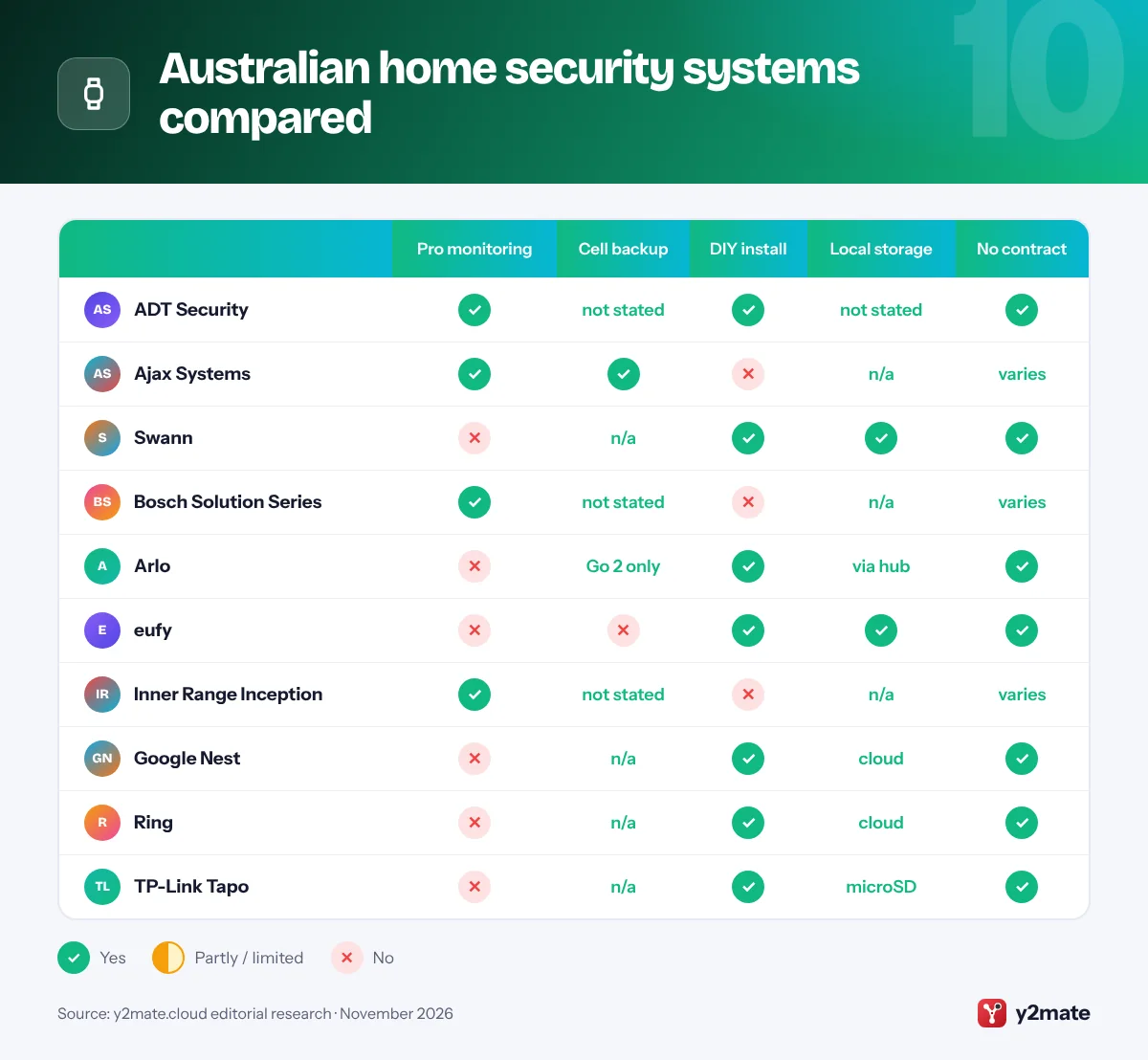
Australian home security systems compared
How to choose home security systems in Australia
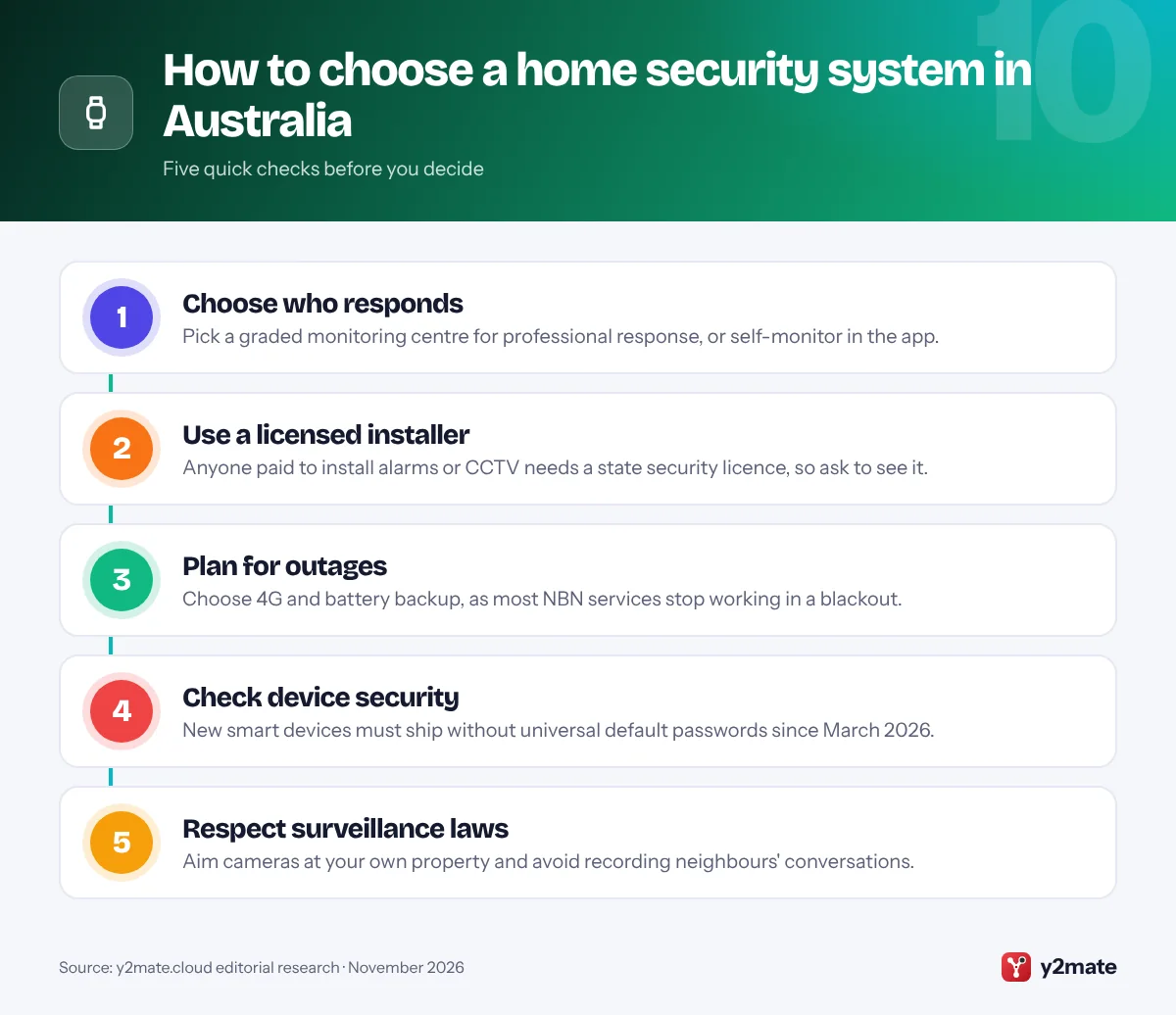
Start by deciding whether you want professional monitoring. Australian monitoring centres can be graded against AS 2201.2, the monitoring centre standard updated in 2022, so ask whether yours is, while intruder alarms are designed and installed under AS/NZS 2201.1. In NSW, anyone paid to sell, install or maintain alarms or CCTV needs a Class 2C security licence, and other states also license security installers.
Privacy and surveillance laws
- Privacy Act: the OAIC says the federal Privacy Act generally does not cover a security camera run by an individual in a private capacity, but state and territory laws may apply, and its first advice in a dispute is to talk to your neighbour.
- Surveillance devices laws: each state and territory has its own rules, and recording private conversations with audio is generally more restricted than filming your own property.
- Smart device standards: new smart devices made from 4 March 2026 must have unique or user-set passwords, a way to report vulnerabilities and a stated security update period.
Connectivity and renting
All three mobile networks had closed their 3G services by late 2024, so ask your provider to confirm an older alarm now uses 4G or IP. Renters should choose battery cameras and wireless kits and check their lease before drilling. Finally, research where your cameras come from and how long they get updates: in 2023 the Defence Minister ordered Hikvision and Dahua cameras removed from Defence sites.
Frequently asked questions
What is the best home security system in Australia in 2026?
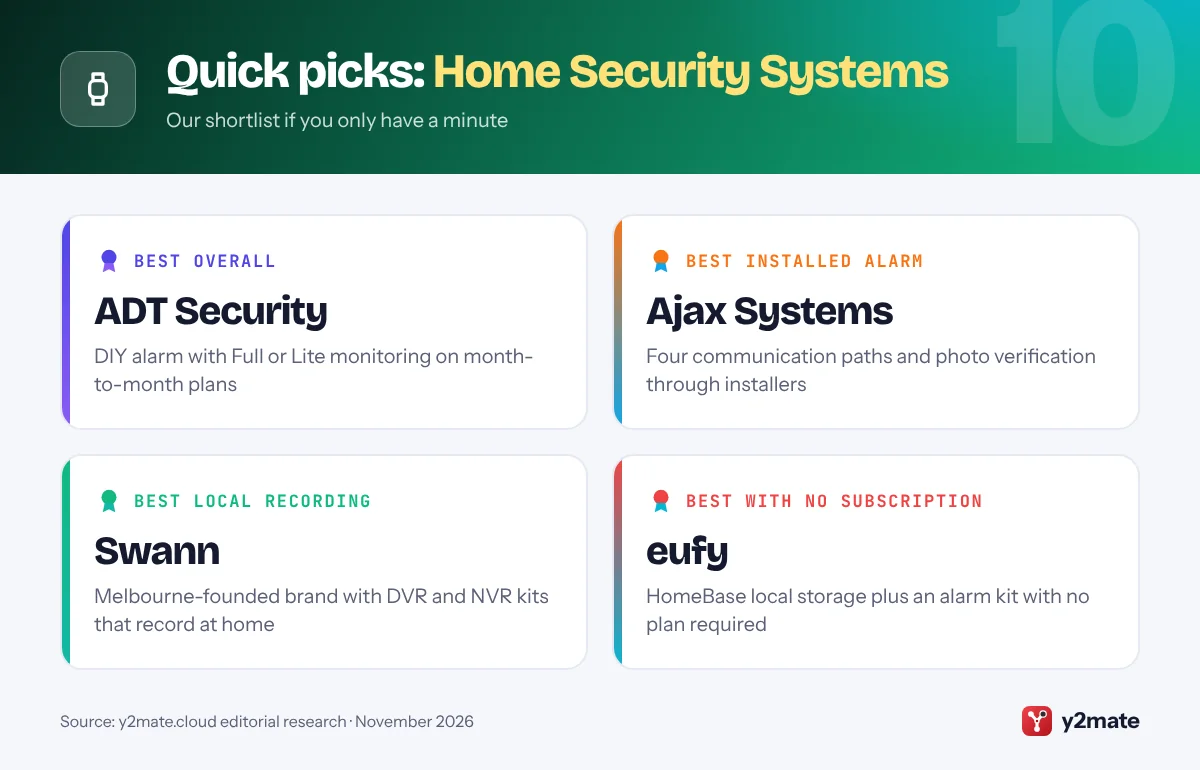
For most households, ADT Security is the best all-round choice because its DIY alarm comes with Full or Lite professional monitoring on month-to-month plans. Ajax Systems fitted by a licensed installer is the strongest installed alarm, Swann is best for cameras that record at home, and eufy suits buyers who want an alarm and cameras with no required subscription.
Can I buy Ring Alarm in Australia?
No. Ring sells its video doorbells and cameras through Australian retailers, but the Ring Alarm system is not sold here. Its Z-Wave sensors use radio frequencies that vary by region, and Ring's community team has advised against using imported kits in Australia. If you want an Alexa-friendly setup, pair Ring cameras with a separate alarm such as ADT Security or an installer-fitted system.
Do I need a licence to install security cameras in Australia?
Security licensing targets people who install for payment. In NSW, anyone paid to sell, install, maintain or advise on alarms and CCTV needs a Class 2C licence, and that includes licensed electricians. Other states have their own security licensing schemes. Setting up a DIY camera in your own home is generally treated differently, but check your state's rules before running cables.
Is it legal to point a security camera at my neighbour's house in Australia?
The federal Privacy Act generally does not apply to cameras run by individuals at home, but state and territory surveillance devices laws do, and recording private conversations with audio is usually the most restricted. A camera aimed deliberately at a neighbour's property can also lead to disputes or other legal claims. The OAIC suggests talking to your neighbour first.
Will my alarm still work after the 3G shutdown?
Telstra, Optus and Vodafone had all closed their 3G networks by late 2024, so alarms that relied on a 3G communicator may no longer reach a monitoring centre or your phone. Ask your provider or installer to confirm the panel now reports over 4G or IP, and test it. Choose a system with battery backup too, because most NBN services stop working in a blackout.
Final verdict
For most households, the best home security systems in Australia are ADT Security for a DIY alarm with professional monitoring and no lock-in contract, Ajax Systems or the Bosch Solution Series for an alarm fitted by a licensed installer, and Swann for cameras that record at home. Arlo, eufy, Google Nest, Ring and TP-Link Tapo are good DIY camera choices, but remember that Ring’s alarm is not sold here.
Whichever you choose, check that the system has 4G and battery backup, use a licensed installer for paid work, and aim cameras at your own property.
Sources and further reading
- OAIC on security cameras: The OAIC explains when privacy law covers security cameras and what to do about a neighbour's camera.
- Security standards for smart devices: Home Affairs guidance on the mandatory security standards for consumer smart devices that began on 4 March 2026.
- AS 2201.2 monitoring centres: Standards Australia's listing for AS 2201.2:2022, the standard covering alarm monitoring centres and their grading.
- NSW Class 2 security licences: NSW Police information on the Class 2 licences needed by people who sell, install or maintain security equipment.

Leave a Reply