
- Every crypto exchange that swaps Australian dollars for crypto must be registered with AUSTRAC, which since March 2026 calls these businesses virtual asset service providers.
- The Digital Assets Framework Act, passed in April 2026, will require platforms that hold customers' crypto to have an Australian Financial Services licence from ASIC once it starts in April 2027.
- Coinbase became the first crypto exchange to receive an Australian Financial Services licence directly from ASIC in April 2026.
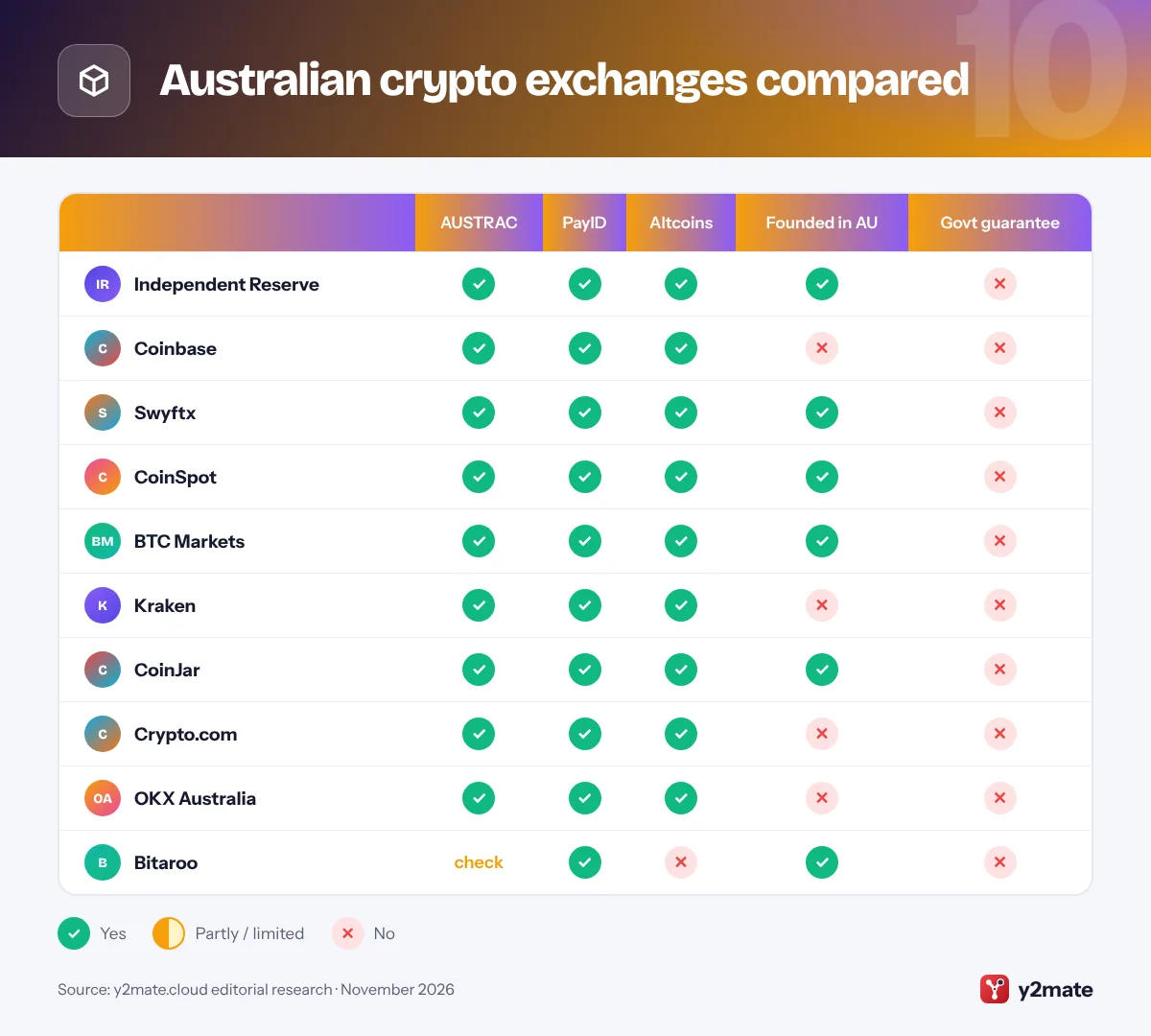
- Crypto held on an exchange is not covered by the government's Financial Claims Scheme, which protects bank deposits only.
- Gemini closed its Australian accounts in 2026, and London-listed IG Group completed its purchase of Sydney-based Independent Reserve in early 2026.
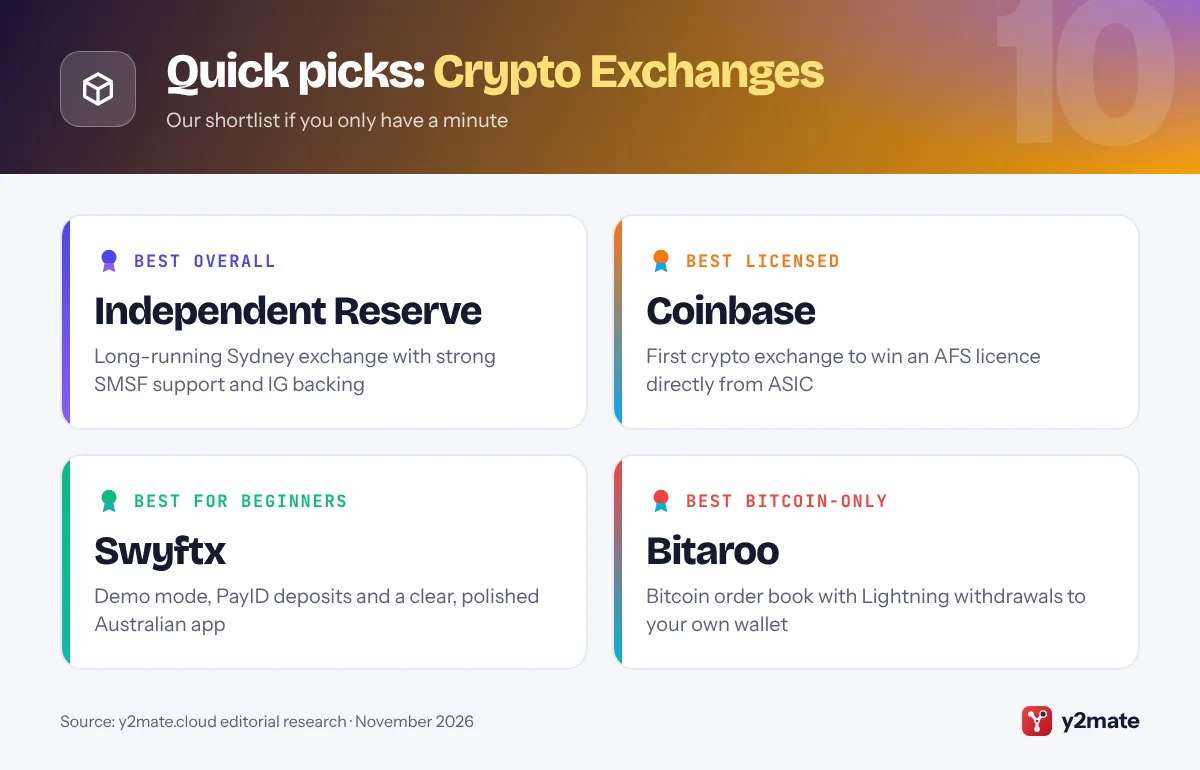
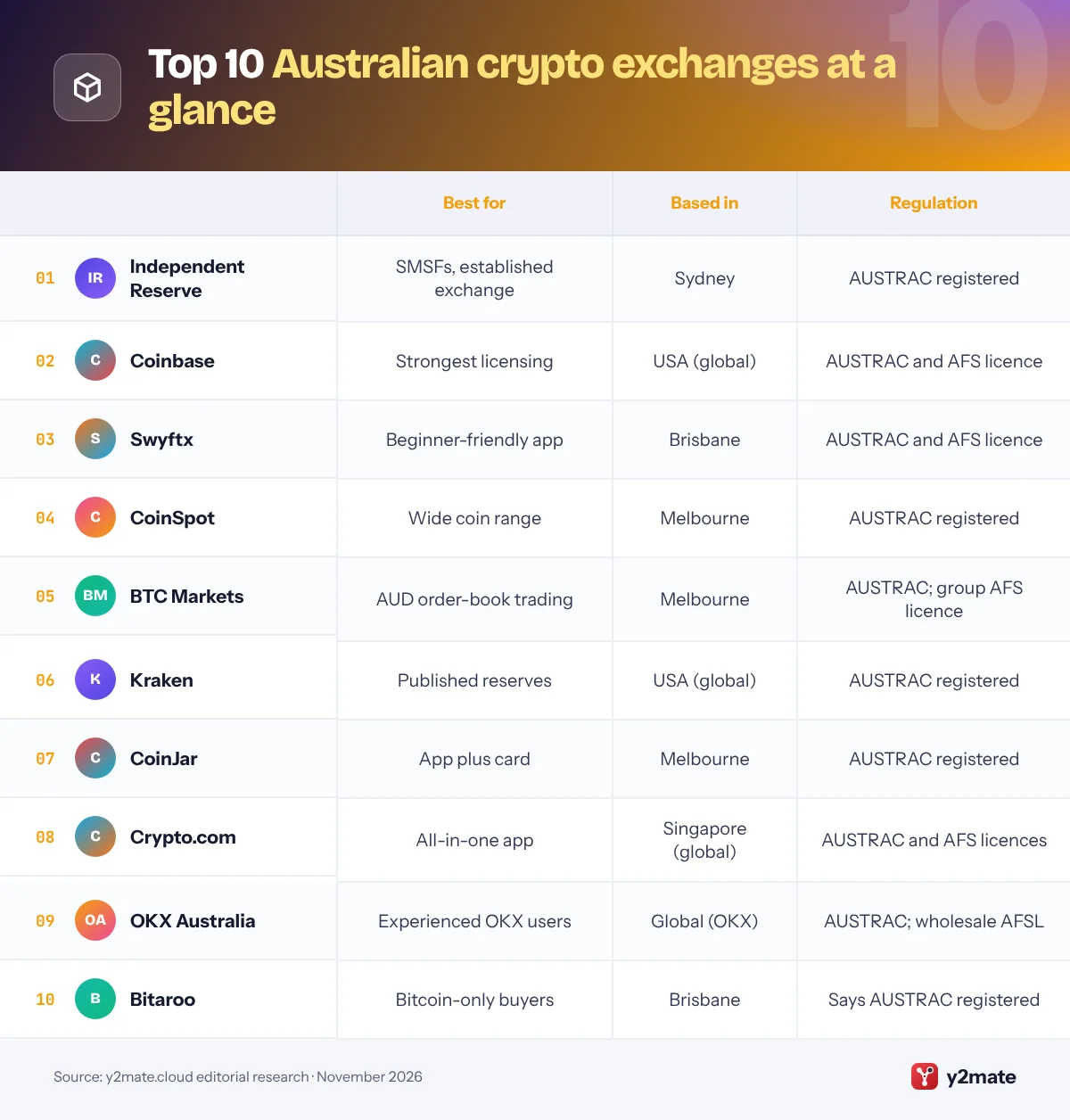
The best crypto exchanges in Australia in 2026 are Independent Reserve for a long-running Sydney exchange now backed by London-listed IG Group, Coinbase, which in April 2026 became the first crypto exchange to win an Australian Financial Services (AFS) licence directly from ASIC, and Swyftx for a beginner-friendly Australian app. CoinSpot, BTC Markets, Kraken, CoinJar, Crypto.com, OKX Australia and the bitcoin-only Bitaroo complete the list. All ten accept Australian dollar deposits through PayID.
A few terms first. A crypto exchange matches buyers and sellers on an order book, while a broker sells you crypto at a price it quotes. A wallet holds the keys that control your coins, and when a platform holds them for you, that is custody: convenient, but you depend on the firm’s security and solvency.
Australia is in the middle of a big regulatory change. Exchanges have long had to register with AUSTRAC, the anti-money-laundering regulator, and from April 2027 platforms that hold customers’ assets will also need an AFS licence from ASIC. Crypto is volatile, it is not covered by the Financial Claims Scheme that protects bank deposits, and you could lose everything you invest. Consider your own circumstances, and treat this article as general information, not financial advice.
How we ranked this list
We compared publicly documented information for each platform: its AUSTRAC registration and any ASIC licences, recent court action or regulatory orders, the security practices it publishes (cold storage, proof of reserves, two-factor authentication and security keys), the Australian payment methods it accepts, such as PayID and bank transfer, local features like SMSF accounts, ease of use for beginners and traders, and how customers can reach support. We also considered ownership changes, such as IG Group’s purchase of Independent Reserve.
We have not run our own hands-on tests, and we leave out fees, prices and trading volumes because they change so often. This ranking is not a recommendation to buy any particular coin. Check AUSTRAC’s register and each platform’s current terms before you sign up.
The Top 10 Crypto Exchanges
1. Independent Reserve
Best for: SMSFs and a long-established local exchange
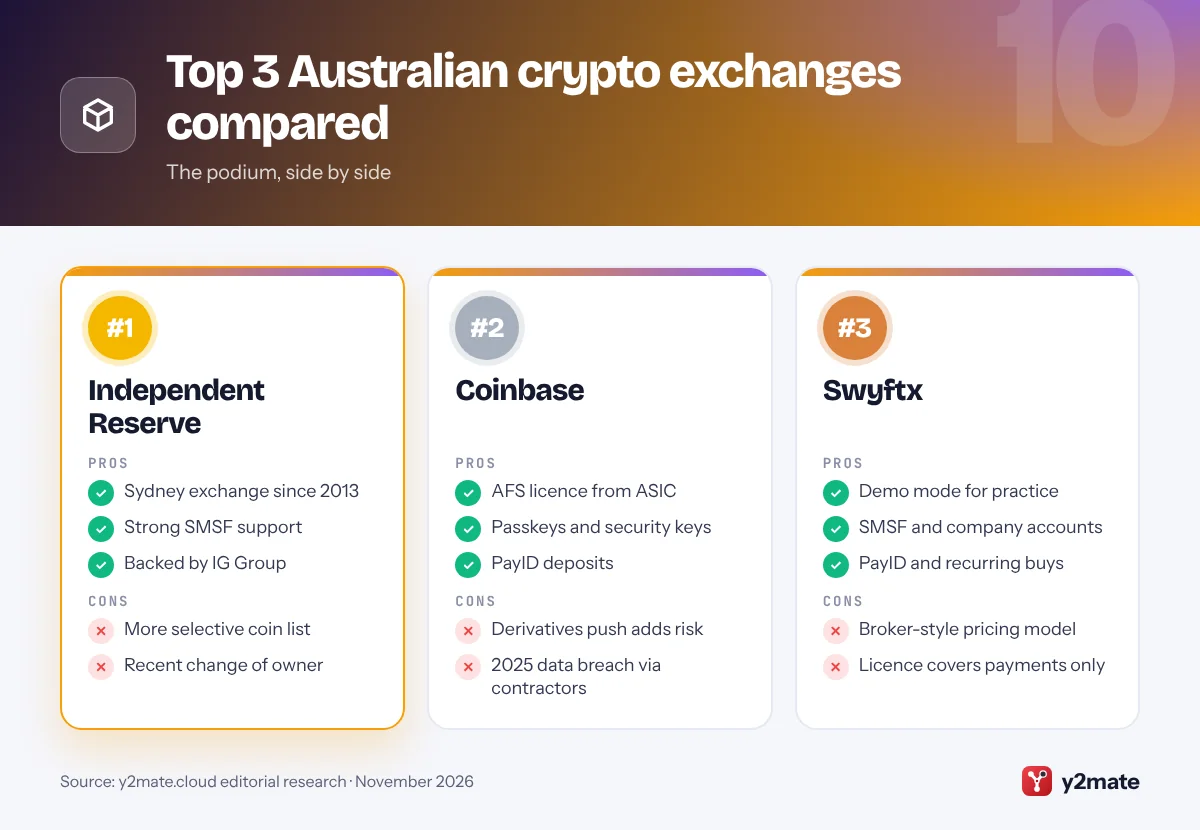
Independent Reserve was founded in Sydney in 2013 and is registered with AUSTRAC. In early 2026 IG Group, the London-listed trading company, completed its purchase of the business, with co-founder and chief executive Adrian Przelozny staying on. That gives Independent Reserve the backing of a large regulated financial group, and IG has said it plans to offer crypto to its own customers in Australia, Singapore and the UAE using Independent Reserve’s platform.
Independent Reserve runs a full order-book exchange alongside a simple buy and sell screen, so it suits both beginners and traders. You can deposit Australian dollars instantly with PayID and Osko, and it caters well to self-managed super funds (SMSFs), companies and trusts, with an over-the-counter desk for larger trades. Accounts support two-factor authentication.
Its coin list is more selective than CoinSpot’s, and the interface is functional rather than flashy. The change of ownership could also bring new products and changes to terms over time, so keep an eye on announcements. For investors who prize a long local track record and strong SMSF support, Independent Reserve is our top pick.
Official site: Independent Reserve
- Long-running Sydney exchange
- Strong SMSF and company accounts
- Order book plus simple buying
- More selective coin list
- Ownership change may bring changes
2. Coinbase
Best for: the strongest licensing of any exchange here
Coinbase Australia is registered with AUSTRAC, and in April 2026 it received an Australian Financial Services licence from ASIC, the first crypto exchange to win one directly from the regulator. Reports say the licence covers custody and market making as well as retail derivatives, putting Coinbase ahead of the April 2027 deadline for platforms that hold customers’ assets.
Coinbase is a Nasdaq-listed company, so it publishes audited financial statements, and it says it keeps the vast majority of customer crypto in offline cold storage. Accounts support passkeys, hardware security keys and authenticator apps. You can deposit Australian dollars through PayID or a BSB and account number, buy in the simple app or trade on Coinbase Advanced, and withdraw coins to your own wallet.
Coinbase plans to add derivatives such as perpetual futures in Australia. These products are complex and can lose money quickly, so most investors should steer clear. Globally, Coinbase also disclosed in May 2025 that bribed overseas support contractors had copied some customers’ personal details. Even so, for licensing and security tools, Coinbase is the benchmark among global exchanges in Australia.
Official site: Coinbase
- AFS licence from ASIC
- Passkeys and security keys
- PayID deposits
- Derivatives push adds risk
- 2025 support-contractor data breach
3. Swyftx
Best for: beginners who want a polished Australian app
Swyftx is a Brisbane-based exchange registered with AUSTRAC, and in 2026 ASIC granted it an Australian Financial Services licence covering payment services. It has grown into one of Australia’s best-known crypto platforms and expanded overseas by agreeing to buy the crypto brokerage Caleb & Brown in 2025.
Swyftx is built for newcomers. Its demo mode lets you practise trading with pretend money before you risk your own, and the app explains each step clearly. You can deposit Australian dollars instantly with PayID, set up recurring buys, and open SMSF, company and trust accounts. Accounts support two-factor authentication, and Swyftx offers education content for people learning how crypto works.
Swyftx works mainly as a broker: when you buy, it quotes you a price rather than matching you with other users on a public order book, which experienced traders may find limiting. Its licence covers payments rather than its core spot trading, which will need to meet the new platform rules from 2027, so watch for changes to its terms. For first-time buyers who want a slick local app, though, Swyftx is hard to beat.
Official site: Swyftx
- Demo mode for practice
- SMSF and company accounts
- PayID and recurring buys
- Broker-style pricing model
- Licence covers payments only
4. CoinSpot
Best for: a simple app with a very wide coin range
CoinSpot was founded in Melbourne in 2013 and has been registered with AUSTRAC since 2018, when registration for digital currency exchanges began. It is one of the most widely used crypto platforms in Australia, known for a clean app and one of the broadest coin selections available locally.
Most people use CoinSpot’s instant buy and sell screens, which quote a price and complete the trade in a tap. For more control, its Markets section offers order-book trading on popular pairs. You can deposit Australian dollars instantly through PayID, set up recurring buys and open SMSF accounts. Accounts support two-factor authentication, and CoinSpot publishes guidance on its security practices and how it stores customer assets.
A very wide coin list is a double-edged sword: many smaller tokens are highly speculative and can lose most of their value quickly, so a big menu is not a reason to buy more of them. The simplest instant trades are convenient but quoted rather than matched on an order book. CoinSpot suits Australians who want a straightforward local app and the widest choice, provided they stay disciplined about what they buy.
Official site: CoinSpot
- Very wide coin range
- Simple instant buy and sell
- PayID and SMSF accounts
- Many speculative tokens listed
- Instant trades use quoted prices
5. BTC Markets
Best for: order-book trading in Australian dollars
BTC Markets was founded in Melbourne in 2013 and is registered with AUSTRAC. It was the first Australian crypto exchange group to gain an Australian Financial Services licence, granted in 2022 to its sister company, BTCM Payments, for payment products. In 2026 it told ASIC it intends to apply for a markets licence so it can offer tokenised real-world assets, such as tokenised securities, to the public.
BTC Markets is a classic order-book exchange focused on Australian dollar trading pairs, which appeals to people who want to set their own prices with limit orders rather than accept a quote. There is also a simpler buy and sell option for beginners. You can deposit Australian dollars through PayID, and accounts support two-factor authentication. It offers SMSF, company and trust accounts, as well as tools for professional and institutional clients.
Its coin range is narrower than CoinSpot’s or Swyftx’s, and the trading screen is aimed more at experienced users than first-timers. Plans for tokenised assets are still at an early stage and depend on ASIC approval. For Australians who want a long-running local exchange with a proper order book, BTC Markets is a strong choice.
Official site: BTC Markets
- Order book in Australian dollars
- Group AFS licence since 2022
- SMSF and company accounts
- Narrower coin range
- Interface suits traders more
6. Kraken
Best for: published reserves and pro trading tools
Kraken operates in Australia through Bit Trade Pty Ltd, which is registered with AUSTRAC. Kraken, founded in 2011, is one of the world’s longest-running exchanges and publishes regular proof-of-reserves reports, in which an outside firm checks that its crypto holdings match what customers are owed. You can confirm that your own balance was included.
Account protection includes support for physical security keys and authenticator apps, plus an optional Global Settings Lock. Beginners can stick to the main Kraken app, and traders can switch to Kraken Pro for an order book and detailed charting. Australians can deposit dollars by Osko bank transfer or PayID, and Kraken offers round-the-clock support.
Kraken’s local record is not spotless. In December 2024 the Federal Court ordered Bit Trade to pay a penalty after finding, in a case brought by ASIC, that it had offered a margin extension product to Australian customers without the target market determination required under design and distribution obligations. For investors who value published reserves and strong account security, Kraken remains a good option, but weigh that history.
Official site: Kraken
- Regular proof-of-reserves reports
- Security keys and settings lock
- Osko and PayID deposits
- 2024 Federal Court penalty
- Pro tools can overwhelm
7. CoinJar
Best for: a long-running Melbourne exchange with a card
CoinJar was founded in Melbourne in 2013, making it one of Australia’s oldest crypto exchanges, and its Australian company is registered with AUSTRAC. It also runs a UK business that has been on the Financial Conduct Authority’s crypto register since 2021, so it has operated under regulators in two countries for years.
CoinJar offers a simple app for buying and selling, plus CoinJar Exchange, an order-book platform for more experienced traders. You can deposit Australian dollars instantly through PayID, set up recurring buys and withdraw coins to your own wallet. Its CoinJar Card lets you spend from your balance, and accounts support two-factor authentication.
CoinJar is smaller than the global giants, so it lists fewer coins and has fewer extras than Coinbase or Kraken. Support is mainly online, and it will need to adapt to the new platform licensing rules that start in 2027. For Australians who want an established local exchange with both a simple app and an order book, CoinJar is a dependable choice.
Official site: CoinJar
- Founded in Melbourne in 2013
- App plus order-book exchange
- PayID deposits and a card
- Fewer coins than big rivals
- Mainly online support
8. Crypto.com
Best for: an all-in-one crypto app and spending card
Crypto.com’s Australian business is registered with AUSTRAC, and the company says it holds two Australian Financial Services licences, gained through its purchases of local firms, including one that lets it issue its Visa card in Australia. The Crypto.com app lets you buy, sell, send and spend crypto from one account, and it publishes security certifications such as ISO/IEC 27001.
You can deposit Australian dollars through PayID into an AUD account in the app, then buy crypto or top up the card. Accounts support two-factor authentication and withdrawal address allowlists, and Crypto.com offers a separate self-custody wallet, the Crypto.com Onchain app, for people who want to hold their own keys. Recurring buys and rewards features round out a very broad app.
That breadth is also the main drawback: the app packs in many features and promotions, which can distract from simply buying and holding, and some products, such as derivatives, carry much higher risk. The name on the bank account you send money from must match your Crypto.com account. If you want an app and card that do a bit of everything, it fits, but switch off what you do not need.
Official site: Crypto.com
- App, card and wallet in one
- PayID deposits to AUD account
- Published security certifications
- Busy app with many extras
- Higher-risk products on offer
9. OKX Australia
Best for: experienced users who want OKX locally
OKX Australia is the local arm of OKX, one of the world’s largest crypto exchanges. OKX officially launched its Australian exchange in 2024, a year after opening a Sydney office. It is registered with AUSTRAC for spot trading and says it holds an Australian Financial Services licence that lets it offer derivatives to verified wholesale clients only. Retail customers use the spot exchange.
The OKX group publishes monthly proof-of-reserves reports, so customers can check that their balances are backed, and accounts support passkeys and authenticator apps. You can deposit Australian dollars through PayID, trade on a full order book and use OKX Wallet, a self-custody wallet that works across many blockchains, if you prefer to hold your own keys.
The wider OKX group pleaded guilty in a US court in 2025 to operating an unlicensed money transmitting business there, which is worth knowing even though it concerned American customers. The local business is younger than the Australian-founded exchanges above, and its feature set is aimed at experienced traders. If you already know OKX and want a locally registered account, it is a reasonable choice.
Official site: OKX Australia
- Monthly proof-of-reserves reports
- Order book and OKX Wallet
- PayID deposits
- Group's 2025 US guilty plea
- Younger local business
10. Bitaroo
Best for: bitcoin-only buyers who use Lightning
Bitaroo is a Brisbane-based exchange that deals only in bitcoin. That focus keeps things simple and avoids the thousands of speculative tokens listed elsewhere. It says it is registered with AUSTRAC and verifies every customer’s identity under Australia’s anti-money-laundering rules; as with any exchange, check its entry on AUSTRAC’s register before you deposit.
Bitaroo offers an order book for bitcoin against the Australian dollar, with tools such as limit, stop and recurring buy orders, so you can set the price you want or build up a holding automatically. You can deposit Australian dollars through PayID or bank transfer. It also supports the Lightning Network, a faster payment layer for bitcoin, alongside standard on-chain deposits and withdrawals, which makes it easy to move coins to your own wallet.
The trade-offs are clear: there are no other coins, no extras such as cards, and it is a much smaller business than the global exchanges on this list, with mainly online support. If you have decided bitcoin is the only crypto you want and you value Lightning withdrawals to a wallet you control, Bitaroo is a focused local option.
Official site: Bitaroo
- Bitcoin-only and focused
- Lightning Network support
- Order book with recurring buys
- Bitcoin only
- Small business, online support
Australian crypto exchanges compared
How to choose between crypto exchanges in Australia
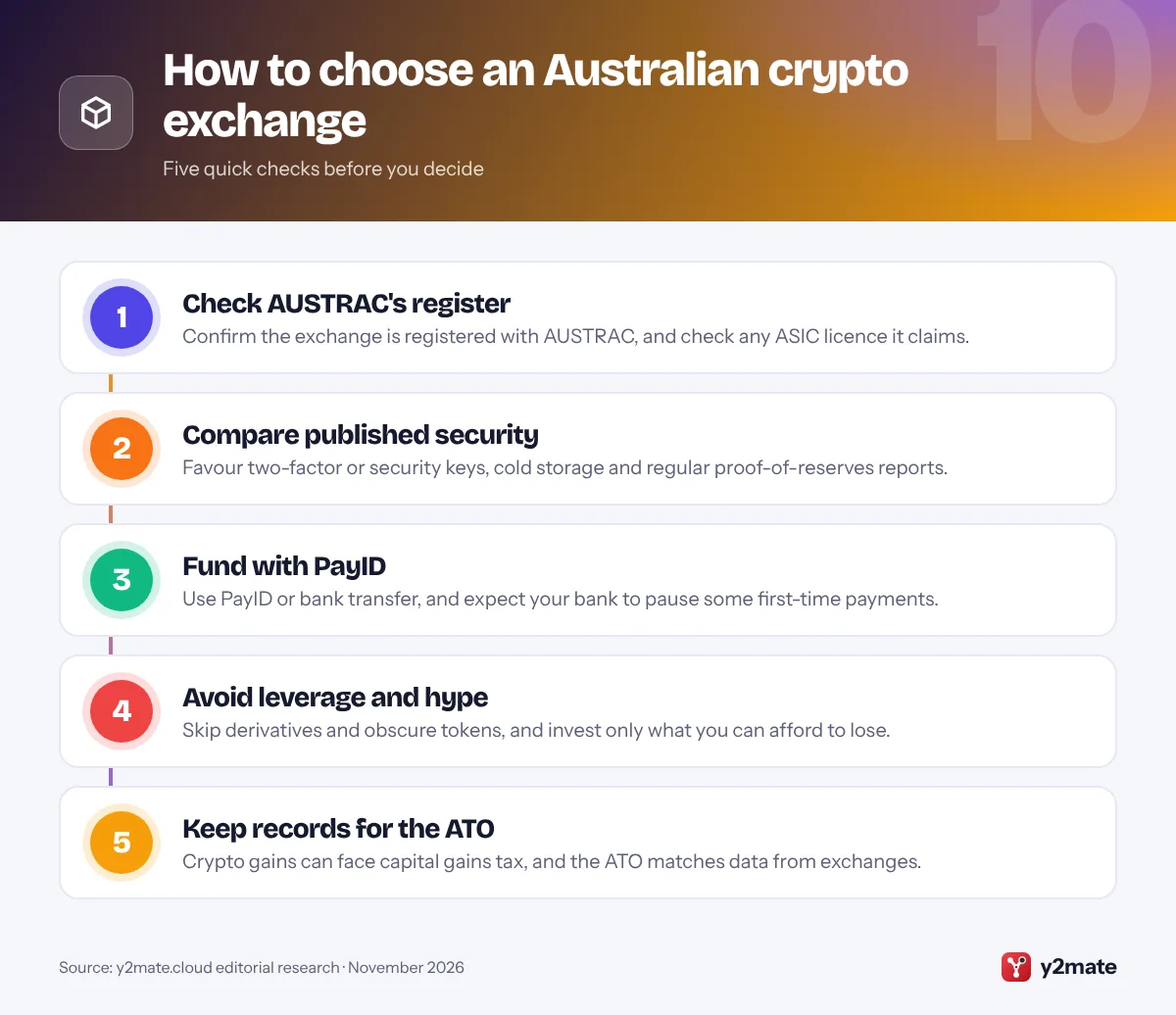
Start with registration. Any business that exchanges Australian dollars for crypto must be registered with AUSTRAC, which since 31 March 2026 has called these businesses virtual asset service providers under expanded anti-money-laundering rules. AUSTRAC registration is about stopping crime, not protecting your money, so it is the minimum standard rather than a guarantee.
Understand the new licensing rules
- ASIC guidance: in October 2025 ASIC updated its guidance (INFO 225) to explain that many digital asset products may already be financial products needing a licence.
- New law: the Digital Assets Framework Act, passed in April 2026, brings digital asset platforms and custody platforms under the AFS licence regime from April 2027.
- Complaints: AFS licensees serving retail clients must belong to AFCA, the free external dispute scheme, so a licensed platform gives you a clearer path if something goes wrong.
- Travel rule: exchanges now collect details about who is sending and receiving crypto transfers, so expect extra questions when you withdraw.
Protect yourself
- Crypto is not covered by the Financial Claims Scheme, and prices can fall sharply.
- Many banks now delay or block some payments to crypto exchanges to fight scams, so a first deposit may take longer.
- Never buy crypto because someone you met online, or a caller claiming to be from your bank, tells you to. Report scams to Scamwatch.
- Keep records for tax, because the ATO collects data from Australian exchanges.
This is general information only and does not take your personal circumstances into account. Consider your objectives and speak to a licensed financial adviser if you are unsure.
Frequently asked questions
What is the best crypto exchange in Australia?
Independent Reserve is our top pick for its long local track record, strong SMSF support and the backing of IG Group. Coinbase has the strongest licensing, as the first crypto exchange with an AFS licence directly from ASIC, while Swyftx is the friendliest choice for beginners. Whichever you consider, confirm it is registered with AUSTRAC before depositing any money.
Are crypto exchanges regulated in Australia?
Yes, but the rules are changing. Exchanges must register with AUSTRAC and follow anti-money-laundering rules, and ASIC regulates any products that count as financial products. The Digital Assets Framework Act, passed in April 2026, will require platforms that hold customers' crypto to hold an Australian Financial Services licence from April 2027, bringing stronger conduct and custody standards.
Is my crypto protected if an Australian exchange collapses?
Generally not. The Financial Claims Scheme protects deposits at banks and other authorised deposit-taking institutions, not crypto on an exchange. If a platform fails, you may become an unsecured creditor and wait a long time to recover anything. Moving long-term holdings to a wallet you control, and using exchanges that publish proof of reserves, can reduce that risk.
Can I buy crypto in my SMSF?
Yes, self-managed super funds can invest in crypto if the fund's investment strategy and trust deed allow it, and the assets are held in the fund's name, separate from your personal holdings. Independent Reserve, Swyftx, CoinSpot and BTC Markets all offer SMSF accounts. Crypto is a high-risk investment for retirement savings, so speak to a licensed adviser first.
Do I pay tax on crypto in Australia?
Usually, yes. The ATO treats most crypto as a capital gains tax asset, so selling, swapping or spending it can create a capital gain or loss that belongs in your tax return. The ATO also collects data from Australian crypto exchanges to check what people report, so keep records of every purchase, sale and transfer.
Final verdict
For most Australians, the best crypto exchanges in Australia start with Independent Reserve for its long local record and SMSF strength, Coinbase for licensing and security tools, and Swyftx for an easy first experience. CoinSpot, BTC Markets and CoinJar are dependable local alternatives, while Kraken, Crypto.com, OKX Australia and Bitaroo serve more specific needs.
Whichever you choose, check AUSTRAC’s register, switch on strong two-factor security, fund with PayID and start small. Watch how each platform adapts to ASIC licensing in 2027, and remember that crypto has no government guarantee.
Sources and further reading
- ASIC digital assets roadmap: ASIC sets out how and when it will implement the new digital asset platform and custody licensing law.
- ASIC updated digital asset guidance: ASIC's October 2025 announcement of updated INFO 225 guidance on when digital assets are financial products.
- Digital Assets Framework Bill: The Parliament of Australia's record of the bill that brings crypto platforms under the AFS licence regime.
- AUSTRAC virtual asset registration actions: AUSTRAC's record of the regulatory actions it has taken on the registrations of virtual asset service providers.
- ATO guide to crypto tax: The Australian Taxation Office explains how capital gains tax applies when you sell, swap or spend crypto.

Leave a Reply