

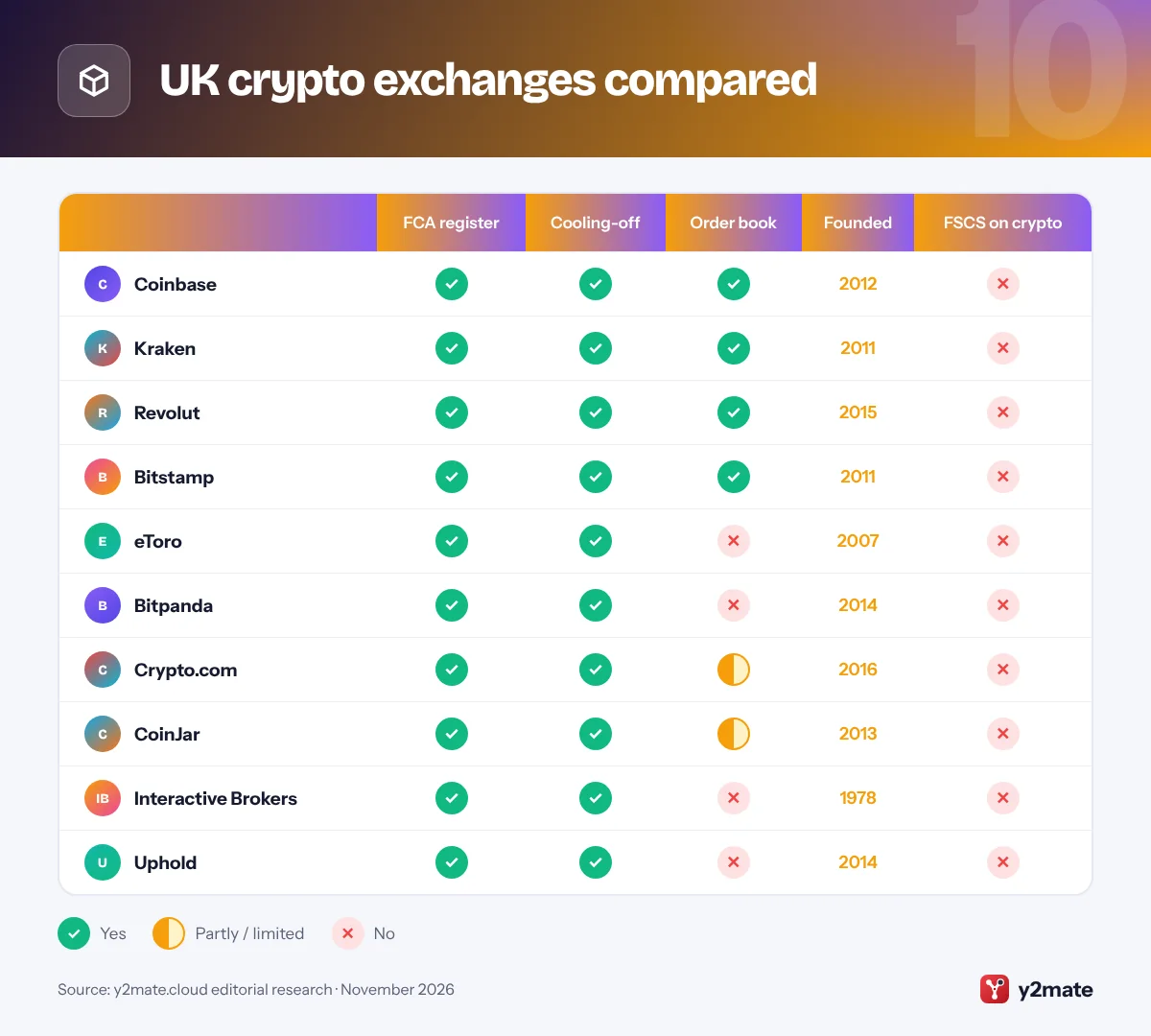
- Every crypto exchange serving UK customers must be registered with the FCA under the money laundering rules, but that registration covers anti-money-laundering checks rather than protecting your money.
- Crypto held on an exchange is not covered by the Financial Services Compensation Scheme, and the FCA says you are unlikely to be able to use the Financial Ombudsman Service for most crypto complaints.
- FCA marketing rules mean first-time customers face a 24-hour cooling-off period and an appropriateness test, and refer-a-friend bonuses for crypto are banned.
- The FCA opened applications for its new crypto authorisation regime on 30 September 2026, and the full regime is due to start on 25 October 2027.
- Gemini closed its UK accounts in 2026, while Robinhood began offering crypto to UK customers through its Bitstamp exchange in August 2026.
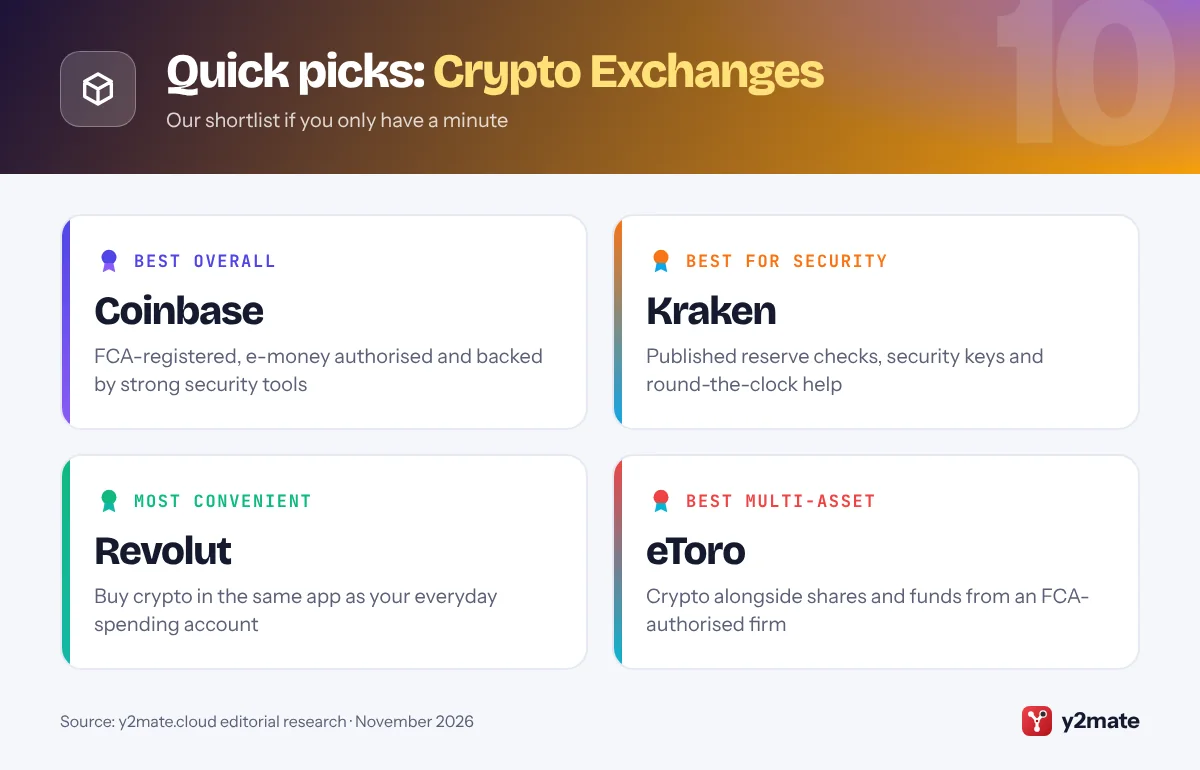
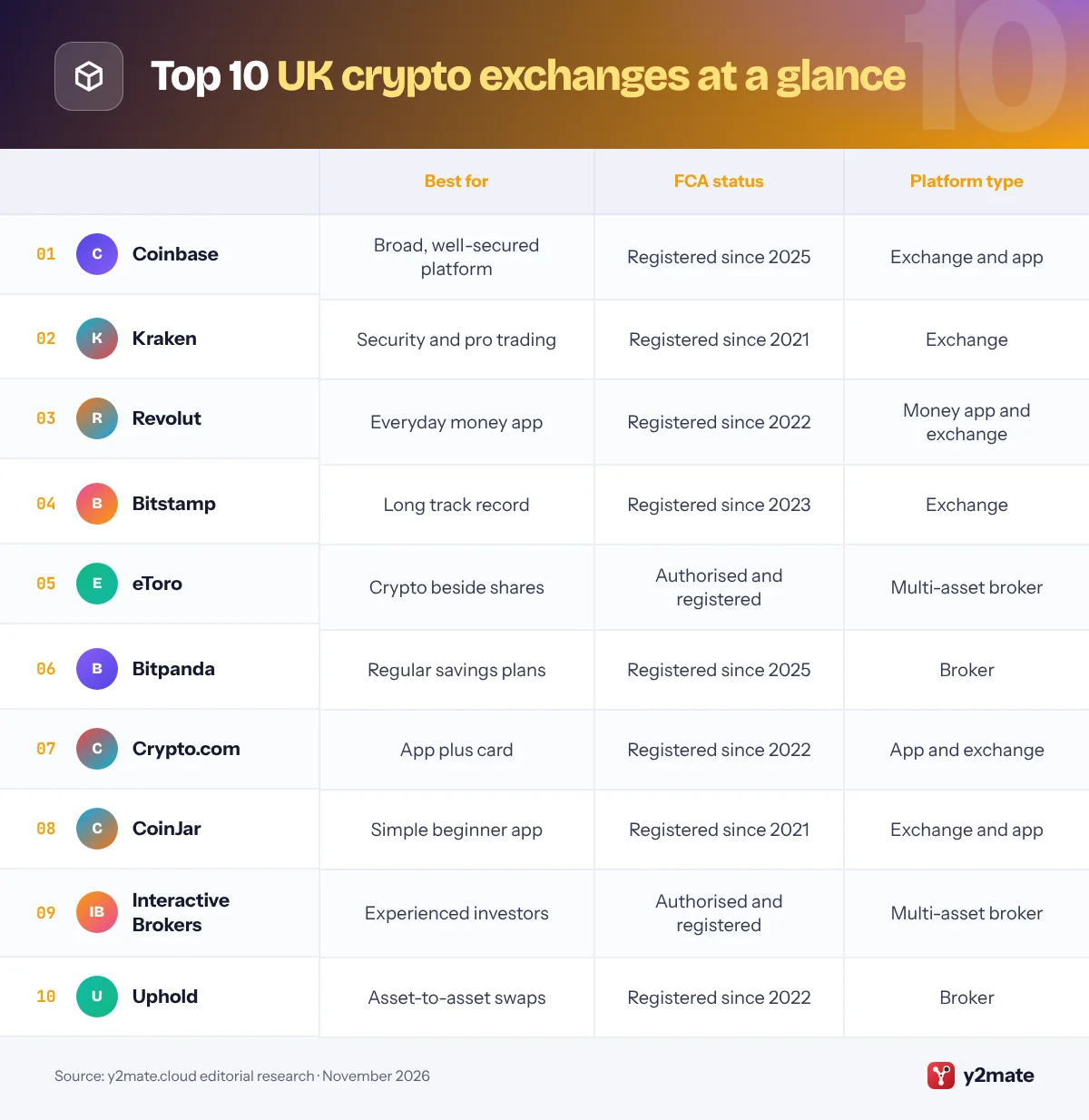
The best crypto exchanges in the UK in 2026 are Coinbase for a broad, FCA-registered platform with strong account security, Kraken for its long security record and proof-of-reserves reports, and Revolut for buying crypto inside an app millions of Britons already use. Bitstamp, which now powers Robinhood’s UK crypto trading, eToro, Bitpanda, Crypto.com, CoinJar, Interactive Brokers and Uphold complete the list. Every pick is on the Financial Conduct Authority’s (FCA) register of cryptoasset firms, the legal minimum for serving UK customers today.
Some quick definitions. A crypto exchange matches buyers and sellers on an order book, while a broker sells you crypto at a quoted price. A wallet holds the keys that control your coins, and when a platform holds those keys for you, that is custody: convenient, but you rely on the firm staying secure and solvent.
FCA registration is an anti-money-laundering check, not a seal of approval. Crypto is volatile, it is not protected by the Financial Services Compensation Scheme (FSCS), and you could lose everything you put in. Think about your own circumstances before investing, and treat this article as general information rather than financial advice.
How we ranked this list
We compared publicly documented information for each platform: its FCA registration and any other UK authorisations, recent FCA enforcement, the security practices it publishes (cold storage, proof of reserves, passkeys and hardware security keys), the UK payment methods it accepts, such as Faster Payments, how easy its app is for beginners and more experienced investors, and how customers can reach support. We also looked at ownership changes and exits, such as Robinhood’s purchase of Bitstamp and Gemini’s departure from the UK.
We did not carry out hands-on testing, and we do not quote fees, prices or trading volumes, which change often. Nothing here is a recommendation to buy any cryptoasset. Check the FCA register and each firm’s current terms before you sign up.
The Top 10 Crypto Exchanges
1. Coinbase
Best for: a broad, well-secured platform with UK payments
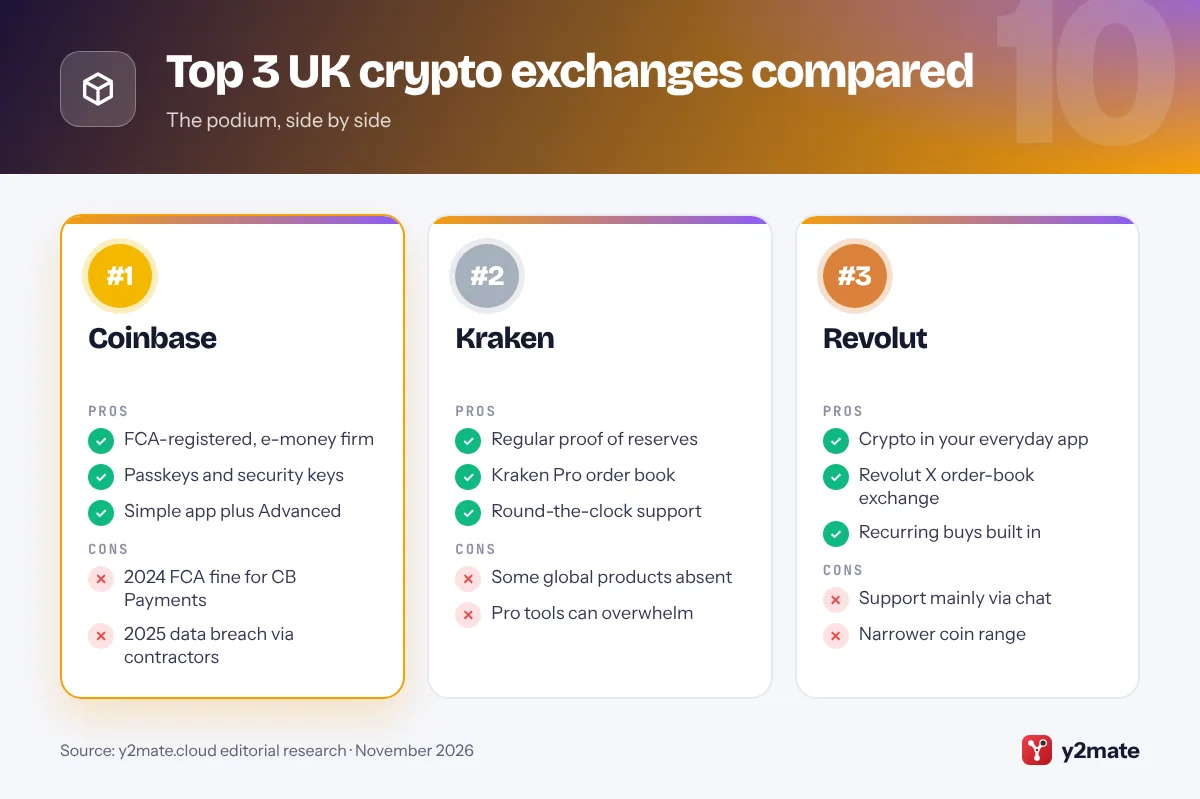
Coinbase serves UK customers through CB Payments Ltd, which joined the FCA’s cryptoasset register in early 2025 and is also authorised by the FCA as an electronic money institution to hold customers’ pounds. That lets Coinbase offer crypto services in the UK directly rather than through other group companies. Beginners get a simple app, while Coinbase Advanced adds an order book and detailed charts.
Coinbase supports passkeys, hardware security keys and authenticator apps, and says it keeps the vast majority of customer crypto in offline cold storage. You can deposit pounds by Faster Payments bank transfer or debit card and withdraw coins to your own wallet. As with every FCA-registered firm, new customers go through a 24-hour cooling-off period and a short appropriateness test before their first purchase.
Coinbase has a regulatory blemish here: in 2024 the FCA fined CB Payments for repeatedly breaching a restriction that barred it from taking on high-risk customers. Globally, it also disclosed in May 2025 that bribed overseas support contractors had copied some customers’ personal details. Even so, its UK registration, payment options and security tools make it the strongest all-round choice.
Official site: Coinbase
- FCA-registered and e-money authorised
- Passkeys and security keys
- Faster Payments deposits
- 2024 FCA fine for CB Payments
- 2025 support-contractor data breach
2. Kraken
Best for: security-focused investors and active traders
Kraken’s UK company, Payward Ltd, has been on the FCA’s cryptoasset register since November 2021, and a sister company, Payward Services Ltd, is authorised by the FCA as an electronic money institution to handle pound balances. Kraken, founded in 2011, is one of the longest-running exchanges and is known for its security culture.
Kraken publishes regular proof-of-reserves reports, where an outside firm checks that its crypto holdings match what customers are owed, and you can confirm your own balance was included. You can protect your account with a hardware security key or authenticator app, and switch on a Global Settings Lock to freeze sensitive settings. The Kraken app keeps buying simple, while Kraken Pro offers a full order book and advanced charts. Support is available around the clock.
Kraken applies the FCA’s mandatory 24-hour cooling-off period to newly verified retail accounts, and some products it sells elsewhere, such as tokenised shares, are not offered in the UK. Crypto derivatives are also off limits to UK retail customers under FCA rules. If you want published reserves, strong account protection and a professional trading screen, Kraken is the closest rival to Coinbase.
Official site: Kraken
- Regular proof-of-reserves reports
- Kraken Pro order book
- Round-the-clock support
- Some global products unavailable
- Pro tools can overwhelm beginners
3. Revolut
Best for: buying crypto inside an everyday money app
Revolut added crypto to its app in 2017 and joined the FCA’s cryptoasset register in September 2022 after operating under a temporary regime. For the many people who already use Revolut for spending and travel money, it is the quickest route into crypto: you can buy, sell and set up recurring purchases from the same app as your everyday account.
For more experienced users, Revolut X is a separate crypto exchange, launched in the UK in May 2024 and now available on desktop and mobile, with an order book and more detailed trading tools. Revolut X links to your main Revolut account, and you can withdraw many supported coins to an outside wallet. Revolut supports biometric login and in-app card and account controls.
Crypto is just one feature in a very broad app, and help comes mainly through in-app chat rather than a dedicated crypto support team. The range of coins is narrower than on specialist exchanges. As with any FCA-registered firm, crypto balances are not covered by the FSCS, even if your pounds sit in Revolut’s regulated accounts. For convenience, though, it is hard to beat.
Official site: Revolut
- Crypto in an app many already use
- Revolut X order-book exchange
- Recurring buys built in
- Support mainly via in-app chat
- Narrower coin range
4. Bitstamp
Best for: a long track record, now backed by Robinhood
Bitstamp has been running since 2011, longer than almost any other crypto exchange still in business. Its UK company, Bitstamp UK Ltd, joined the FCA’s cryptoasset register in June 2023, and Robinhood completed its purchase of Bitstamp in June 2025. Since August 2026 Robinhood has offered crypto trading in its UK investing app through Bitstamp, so you can now reach Bitstamp’s market from either app.
Bitstamp runs a traditional order-book exchange that focuses on established coins rather than every new token, with a clean web platform and mobile app. UK customers can deposit pounds by bank transfer, and recurring-buy tools suit people who invest small amounts regularly. Its long-standing institutional business, which supplies crypto trading to banks and brokers, helps explain its emphasis on compliance.
The coin range is smaller than on Coinbase or Kraken, and support is mainly online. The Robinhood link is new in the UK, so features may change as the two businesses integrate. If you want an established, FCA-registered order-book exchange, or you already use Robinhood for shares, Bitstamp is a solid choice.
Official site: Bitstamp
- Long operating history
- Order-book exchange
- Powers Robinhood UK crypto
- Smaller coin range
- Mainly online support
5. eToro
Best for: holding crypto alongside shares and funds
eToro (UK) Ltd is authorised by the FCA as an investment firm for shares, funds and other regulated products, and it is separately registered with the FCA for its crypto services. That makes eToro a natural fit for people who want crypto in the same account as their other investments. Its parent company listed on Nasdaq in May 2025.
eToro is a broker rather than an exchange, so you buy and sell at the price it quotes instead of using an order book. Its social features let you follow other investors and see how they trade, though copying anyone carries real risk. You can fund your account by bank transfer or card, and eToro offers a separate eToro Money app for moving funds. When Gemini left the UK in 2026, it chose eToro as the platform for customers who wanted to transfer their accounts.
Check which coins you can withdraw to an outside wallet before you buy, because transfers are more limited than on dedicated exchanges. The FSCS protects eligible investments such as shares at eToro, but not your crypto. If you value one account for everything, eToro is the most rounded multi-asset option.
Official site: eToro
- Crypto beside shares and funds
- FCA-authorised UK company
- Social and copy features
- Broker, not an order book
- Limited crypto withdrawals
6. Bitpanda
Best for: regular saving plans from a European platform
Bitpanda, founded in Vienna in 2014, is one of Europe’s largest retail crypto platforms. It was registered with the FCA as a cryptoasset firm in February 2025 and launched its full app for new UK customers in August 2025, after pausing UK sign-ups in 2023 when the FCA’s stricter marketing rules arrived.
Bitpanda is designed for people who build up holdings gradually. Savings plans let you buy automatically each week or month, and crypto indices spread a purchase across a basket of coins in one step. The app offers a wide range of assets, and Bitpanda says its UK crypto offering mirrors what it provides in the European Union, where it holds licences in several countries.
Bitpanda acts as a broker, so prices are quoted rather than set on an open order book, which experienced traders may find limiting. It is newer to the UK than most rivals here, so local support and UK-specific features are still developing. If you like the idea of steady, automated buying and want a long-established European firm, Bitpanda is worth comparing with Revolut and eToro.
Official site: Bitpanda
- Automated savings plans
- Crypto index baskets
- Long European track record
- Broker-style pricing model
- Newer to the UK market
7. Crypto.com
Best for: an all-in-one crypto app with a card
Crypto.com serves UK customers through Foris DAX UK Ltd, which the FCA added to its cryptoasset register in August 2022. The Crypto.com app lets you buy, sell, send and store crypto, and it pairs with a prepaid Visa card for spending. It publishes the security certifications it holds, including ISO/IEC 27001 for information security.
The app supports two-factor authentication and withdrawal address allowlists, and you can fund your account by bank transfer or card. Beyond buying and holding, Crypto.com offers rewards, recurring purchases and a separate self-custody wallet, the Crypto.com Onchain app, for people who want to hold their own keys. That makes it a broad one-stop shop for people who want spending and investing tools in one place.
The flip side is complexity: the app packs in many features and promotions, which can distract from simply buying and holding. Under FCA rules some products available elsewhere are not offered to UK retail customers, and crypto on the platform has no FSCS protection. If you want a card and an app that does a bit of everything, Crypto.com fits, but switch off what you do not need.
Official site: Crypto.com
- App, card and wallet in one
- Published security certifications
- Recurring purchases
- Busy app with many extras
- Some global products unavailable
8. CoinJar
Best for: a simple app from a long-running exchange
CoinJar was founded in Melbourne in 2013 and is one of Australia’s oldest crypto exchanges. Its UK company, CoinJar UK Ltd, became one of the first firms on the FCA’s cryptoasset register in 2021, registered as both a cryptoasset exchange provider and a custodian wallet provider. That long record of operating under regulators in two countries is its main selling point.
The CoinJar app is clean and easy to follow, which suits first-time buyers. You can deposit pounds by bank transfer, set up recurring buys and withdraw coins to your own wallet. Accounts support two-factor authentication, and CoinJar has adapted its UK service to the FCA’s marketing rules, including ending its sign-up and refer-a-friend bonuses for UK customers.
CoinJar is a smaller business than the global giants above it, so it lists fewer coins and offers fewer advanced tools in the UK. Support is online. Its UK presence is modest compared with its home market, so check that the features you want are available here. For beginners who want a straightforward app from an established, FCA-registered firm, CoinJar is a sensible alternative to the big names.
Official site: CoinJar
- Among the first FCA-registered
- Simple, beginner-friendly app
- Recurring buys and withdrawals
- Fewer coins and advanced tools
- Smaller UK presence
9. Interactive Brokers
Best for: experienced investors adding major coins
Interactive Brokers is a long-established global broker, and its UK company is authorised by the FCA for investment business and registered with the FCA for crypto. It launched crypto trading for UK clients in 2024, letting you hold a small range of major coins, such as bitcoin and ether, in the same account as shares, funds and bonds.
The crypto service works differently from the rest of this list. Trading and custody are provided by Paxos Trust Company, a New York-regulated trust company, and your crypto balance sits in a linked account that you see alongside your brokerage holdings. That suits investors who want a small crypto allocation managed with the same tools, reports and login as the rest of their portfolio.
The coin range is deliberately narrow, and moving coins to and from outside wallets is limited, so it is not the place to explore new tokens or manage your own keys. The platform is powerful but can feel complex for beginners, and the FSCS does not cover the crypto side. If you already use Interactive Brokers, it is a tidy way to add mainstream coins.
Official site: Interactive Brokers
- Crypto beside shares and bonds
- Custody by a regulated trust
- Powerful portfolio tools
- Only a few major coins
- Complex for beginners
10. Uphold
Best for: converting one cryptoasset straight into another
Uphold’s UK company, Uphold Europe Ltd, has been on the FCA’s cryptoasset register since February 2022. Uphold is built around direct conversions: you can swap one asset for another in a single step without selling to pounds first, which is handy if you hold several cryptoassets and want to rebalance between them.
For years Uphold has run a public transparency page comparing the assets it holds with what it owes customers. You can fund your account by bank transfer or card, and accounts support two-factor authentication. Uphold acts as a broker, quoting prices rather than offering an order book, and it is clear on its UK pages that its crypto services are unregulated and not covered by the FSCS.
Its US business agreed a settlement with the New York Attorney General in 2026 over a crypto lending product, from a company called Cred, that Uphold offered before Cred collapsed in 2020; Uphold disputed the Attorney General’s account. That does not affect its UK registration, but it is worth knowing. Uphold ranks last here because its broker-style model and smaller UK footprint make it a niche choice.
Official site: Uphold
- Direct asset-to-asset swaps
- Public transparency page
- Bank transfer and card funding
- Broker-style pricing model
- Smaller UK footprint
UK crypto exchanges compared
How to choose between crypto exchanges in the UK
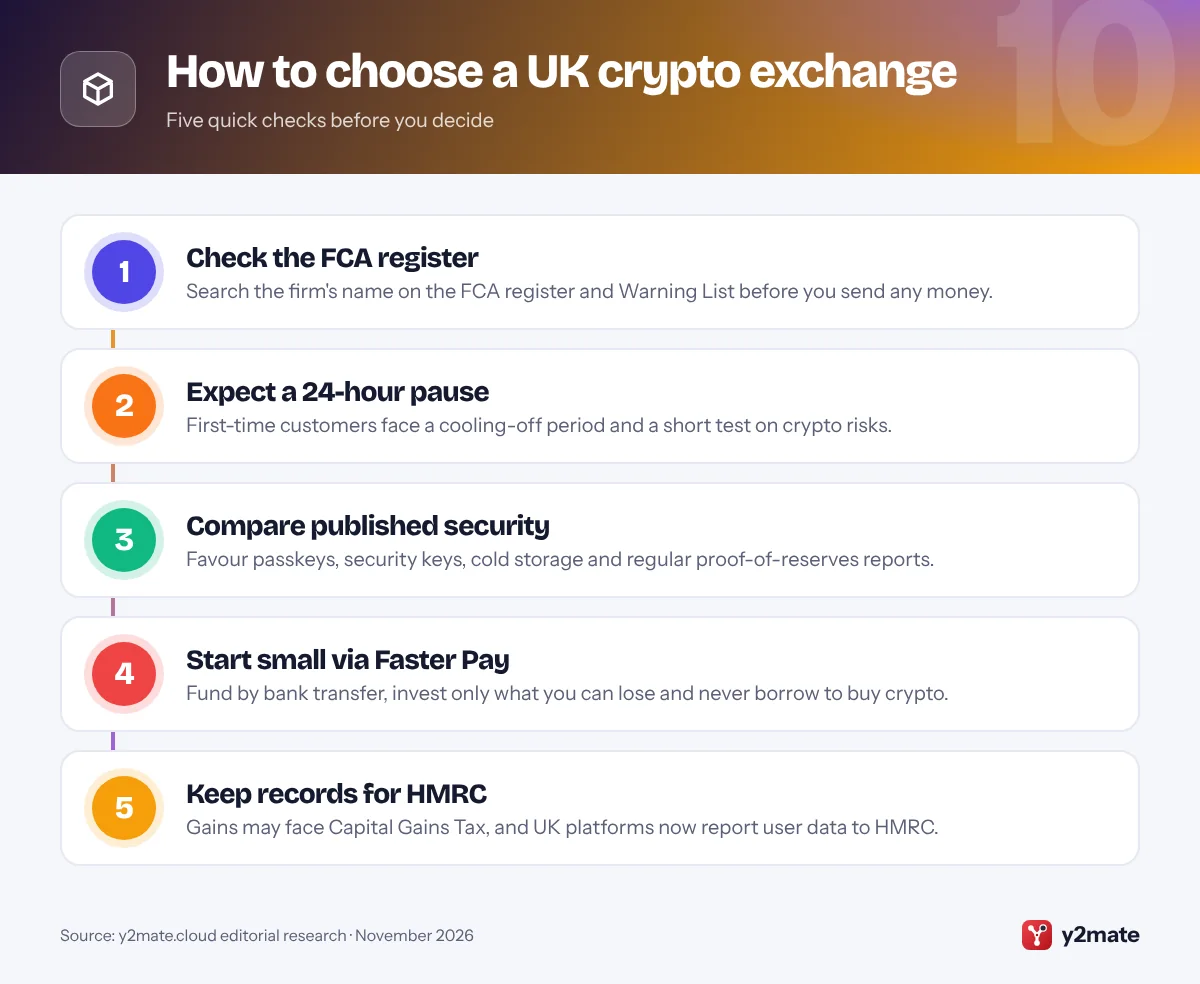
Start with the FCA register. Any firm offering crypto exchange or custody services to UK customers must be registered with the FCA under the Money Laundering Regulations. If a platform is not on the register, or appears on the FCA Warning List, do not use it. Binance, for example, is not on the register and stopped taking on new UK customers in 2023.
Know what the rules do and do not cover
- Registration: covers anti-money-laundering checks only. Most crypto activity is not yet regulated, so you have no FSCS protection and are unlikely to be able to use the Financial Ombudsman Service.
- Marketing rules: since October 2023, firms must show clear risk warnings, give first-time customers a 24-hour cooling-off period, test whether crypto is appropriate for you and not offer refer-a-friend bonuses.
- Derivatives: crypto derivatives remain banned for retail customers, although since October 2025 you can buy crypto exchange-traded notes listed on recognised UK exchanges.
- New regime: under new legislation, crypto platforms will need full FCA authorisation. The application window runs from 30 September 2026 to 28 February 2027, and the regime starts on 25 October 2027.
Protect yourself and stay on top of tax
- Switch on passkeys or a hardware security key and never share codes with anyone who contacts you.
- From 1 January 2026, UK platforms must collect your details, such as your National Insurance number, and report your transactions to HMRC from 2027.
Treat this guide as general information rather than financial advice, and consider speaking to a regulated financial adviser about your situation.
Frequently asked questions
What is the best crypto exchange in the UK?
For most people, Coinbase is the best all-rounder: it is on the FCA's cryptoasset register, authorised as an e-money firm for your pounds and offers passkeys and security keys. Kraken is the best alternative for security-minded investors and traders, while Revolut is the most convenient if you already use its app. Always confirm a firm is on the FCA register before you sign up.
Are crypto exchanges regulated in the UK?
Partly. Crypto exchanges and custodians must register with the FCA under the Money Laundering Regulations and follow FCA rules on financial promotions, but most crypto trading is not yet a regulated activity. Under new legislation, platforms must apply for full FCA authorisation between 30 September 2026 and 28 February 2027, ahead of the new regime starting on 25 October 2027.
Is crypto protected by the FSCS?
No. The Financial Services Compensation Scheme does not cover cryptoassets, so if an exchange fails or is hacked you may not get your crypto back. Some platforms hold your pounds through FCA-authorised e-money firms, which must safeguard customer funds, but that is not the same as FSCS protection. The FCA also says you are unlikely to have access to the Financial Ombudsman Service for most crypto complaints.
Why do I have to wait 24 hours before buying crypto?
FCA marketing rules introduced in 2023 require a 24-hour cooling-off period for first-time investors with a crypto firm. During that time the platform can verify your identity and ask questions to check that crypto is appropriate for you. The pause is designed to stop people buying on impulse after seeing an advert, and it applies at every FCA-registered firm.
Do I pay tax on crypto in the UK?
Usually, yes. HMRC treats most crypto as an asset for tax purposes, so selling, swapping or spending it can trigger Capital Gains Tax, while crypto received as income can face Income Tax. From 1 January 2026, UK crypto platforms must collect users' details and report their transactions to HMRC, so keep your own records of every purchase and sale.
Final verdict
For most people, the best crypto exchanges in the UK start with Coinbase for its registration, e-money authorisation and security tools, Kraken for proof of reserves and pro trading, and Revolut for sheer convenience. eToro and Interactive Brokers suit investors who want crypto alongside shares, while Bitstamp, Bitpanda, Crypto.com, CoinJar and Uphold each serve a narrower need.
Whichever you choose, check the FCA register, switch on passkeys or a security key, start small and remember that crypto has no FSCS safety net. Watch for the FCA’s new authorisation regime, which will give UK customers stronger protections from October 2027.
Sources and further reading
- FCA guide to cryptoassets: The FCA explains the risks of buying cryptoassets, how to check a firm is registered and why FSCS protection does not apply.
- FCA crypto marketing rules: The FCA's rules for firms promoting crypto to UK consumers, including risk warnings, the cooling-off period and appropriateness checks.
- FCA new crypto regime gateway: How the FCA's application window for full crypto authorisation works, with the key dates for the new regime.
- HMRC crypto user reporting: HMRC guidance on the user and transaction details UK crypto platforms must now collect and report.

Leave a Reply