
- Most US drivers who install a home EV charger choose a Level 2 unit on a dedicated 240-volt circuit, though Level 1 on a standard outlet can be enough for short daily commutes.
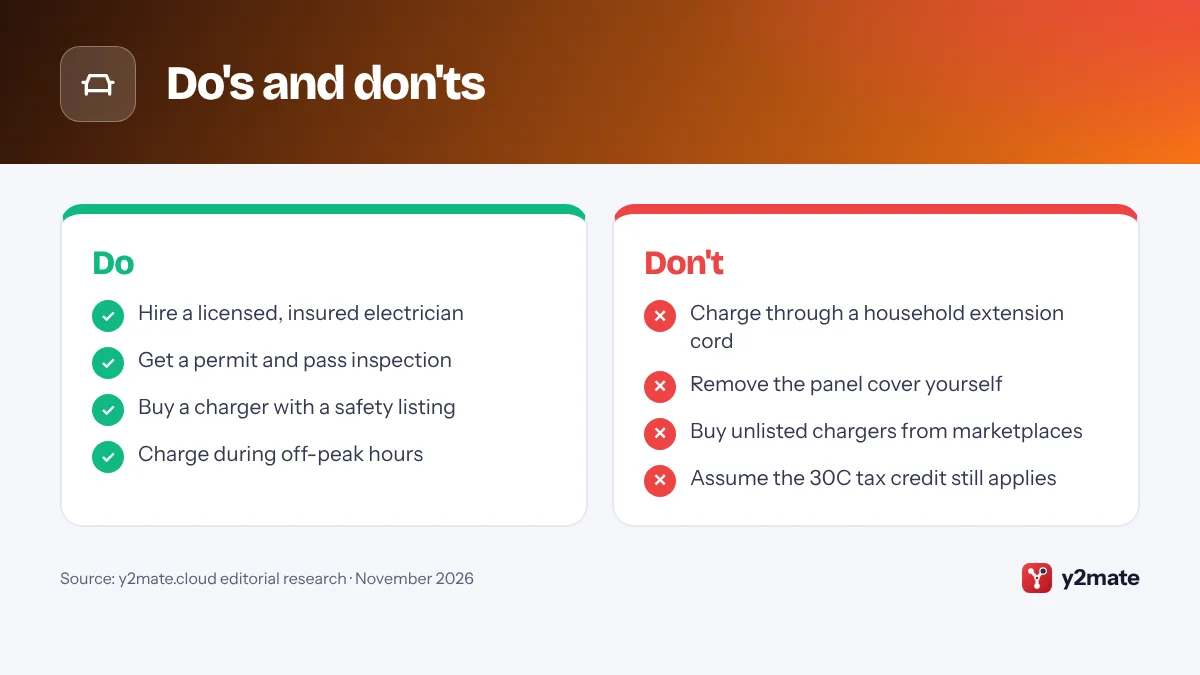
- A licensed electrician should check your electrical panel's capacity before you buy a charger, and most cities and counties require a permit and inspection for a new 240-volt circuit.
- Choose a charger listed by a nationally recognized testing laboratory such as UL, Intertek (ETL) or CSA, with the right connector (NACS or J1772) for your car.
- The federal 30C tax credit for home charging equipment does not apply to equipment placed in service after June 30, 2026, so check state and utility programs instead.
- Enrolling in your utility's time-of-use rate and scheduling charging overnight is often the simplest way to lower home charging costs.
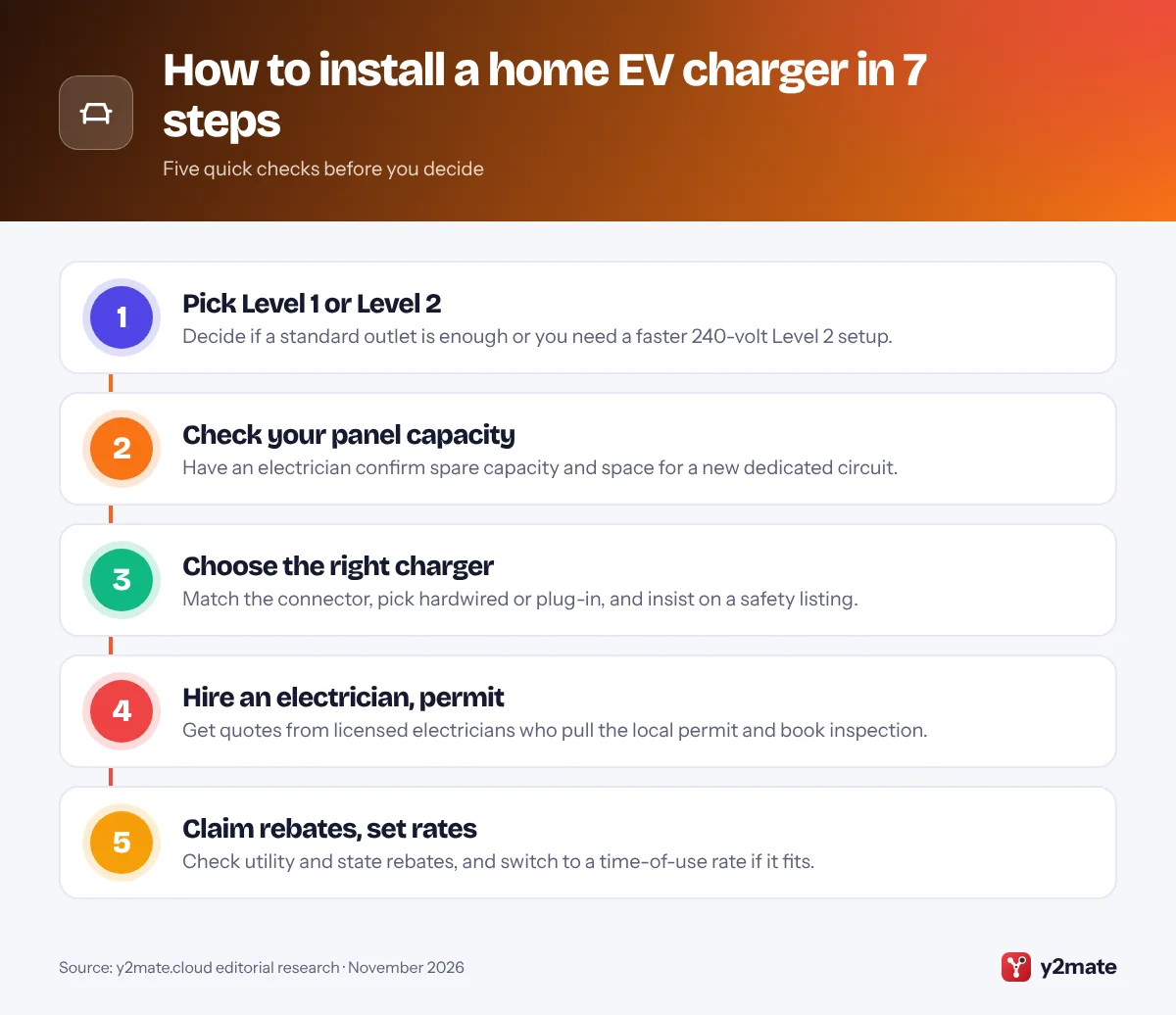
To install a home EV charger in the USA, you decide between Level 1 and Level 2 charging, have a licensed electrician confirm your electrical panel can handle the extra load, pick a safety-certified charger with the right connector, pull a local permit, and then set up the charger and your utility’s off-peak rate. This guide walks you through each of those steps in order.
Charging at home is the most convenient way to own an electric vehicle. You plug in when you get home, and the car is ready in the morning. Getting there, though, involves a few decisions that are easy to get wrong: buying a charger your panel cannot support, skipping the permit, or picking a connector that does not match your next car.
This guide is for US homeowners, and for renters who have permission from their landlord, with a garage, carport or driveway. It does not replace advice from a licensed electrician or your local building department, and rules vary by state, county, city and utility, so we point you to official sources wherever details can differ.
Level: Beginner · Time needed: 2-6 weeks (planning to install)
What you need
- Off-street parking (garage, carport or driveway) close to where a charger can be mounted
- Access to your main electrical panel and a recent electric bill (it shows your utility and rate plan)
- Your EV’s charging port type and its maximum AC charging rate, from the owner’s manual
- Landlord or HOA approval if you rent or live in a managed community
- A licensed electrician in your state, plus time for a local permit and inspection
Step 1: Choose Between Level 1 and Level 2 Charging
Before you install a home EV charger, decide how much charging speed you actually need. There are two home options in the US.
- Level 1 uses a standard 120-volt household outlet and the portable cord that comes with many EVs. It needs little or no electrical work, but it adds range slowly, often only a few miles per hour of charging.
- Level 2 uses a 240-volt circuit, the same kind of supply used by an electric dryer or range. It charges several times faster than Level 1 and can typically refill a daily commute’s worth of range overnight with time to spare.
Level 1 can be enough if you drive short distances, park at home for long stretches, or own a plug-in hybrid with a small battery. Level 2 makes more sense if you drive longer distances, have two EVs, or want the flexibility to recover from a low battery in one night.
Even if a Level 1 setup seems fine, ask an electrician to check the outlet. Charging draws power for many hours, so the outlet should be on a circuit in good condition, ideally not shared with other heavy loads. Never charge through a household extension cord.
Step 2: Check Your Electrical Panel and Capacity
Your main electrical panel (also called the breaker box or load center) decides what kind of charger you can install. A Level 2 charger needs a dedicated 240-volt circuit, which means two open breaker spaces and enough spare capacity in your home’s service.
Start by opening the panel door and noting:
- The main breaker rating, usually printed on the large breaker at the top
- Whether there are empty slots for a new double-pole breaker
- The panel’s brand and age, and any labels that are missing or unclear
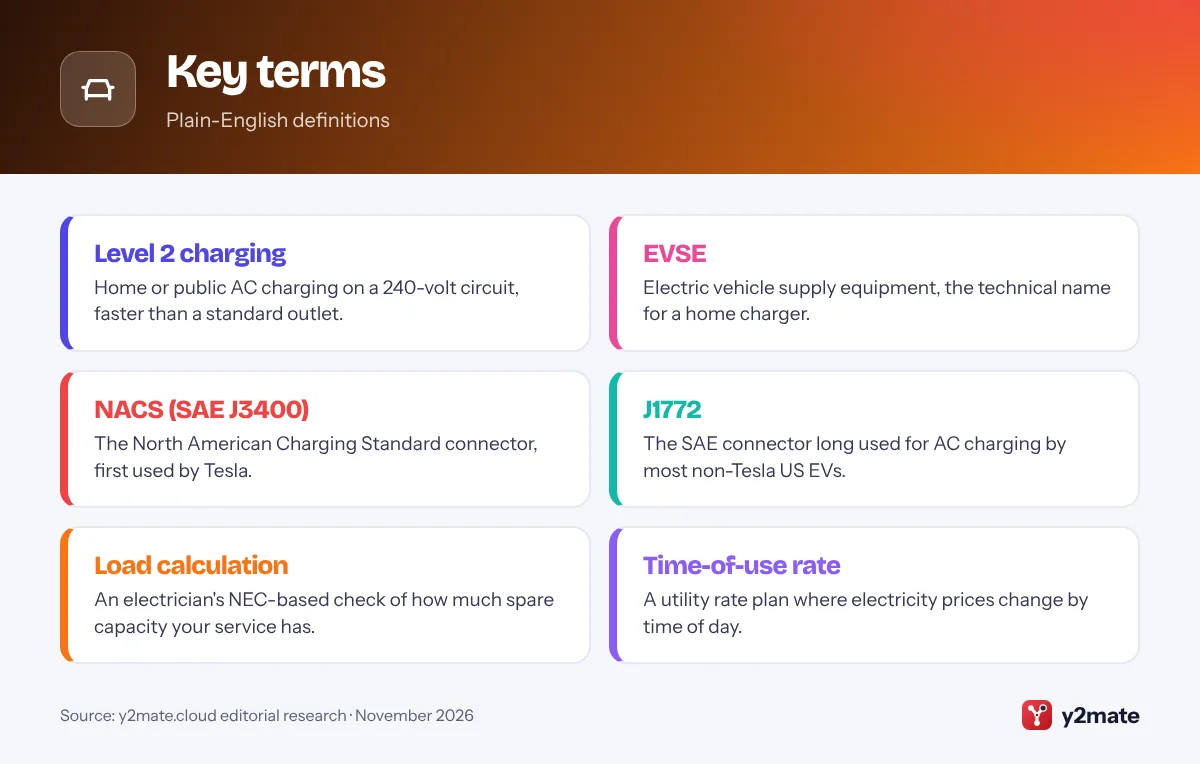
Do not remove the panel cover yourself. A licensed electrician should perform a load calculation, which follows the National Electrical Code (NEC) method to add up your existing appliances and see how much headroom remains. Your city may require this calculation with the permit application.
If capacity is tight, you still have options. An electrician may suggest a lower-amperage charger, a charger with built-in load management, a smart panel or load-management device, or a circuit-sharing setup. A full service or panel upgrade is the last resort, because it can involve your utility and take longer. Older panels from some manufacturers may need replacement regardless, so ask the electrician directly.
Step 3: Choose the Right Home EV Charger
A home Level 2 charger is technically called electric vehicle supply equipment (EVSE). Focus on four things when you shop.
- Connector. Most non-Tesla EVs sold in the US have used the J1772 connector, while Tesla vehicles use NACS, now standardized by SAE as J3400. Many automakers are moving their new models to NACS ports. Check your car’s port, and consider a charger with an interchangeable or dual-connector option, or use the adapter your automaker approves.
- Hardwired or plug-in. A plug-in charger connects to a 240-volt outlet, such as a NEMA 14-50, and is easier to move. A hardwired unit is connected directly to the circuit, which avoids wear on an outlet and can support higher power. Your electrician can recommend which suits your circuit and local code.
- Smart features. Wi-Fi or app control lets you schedule charging, track energy use and join utility demand-response programs. Some rebates require a networked or ENERGY STAR certified model.
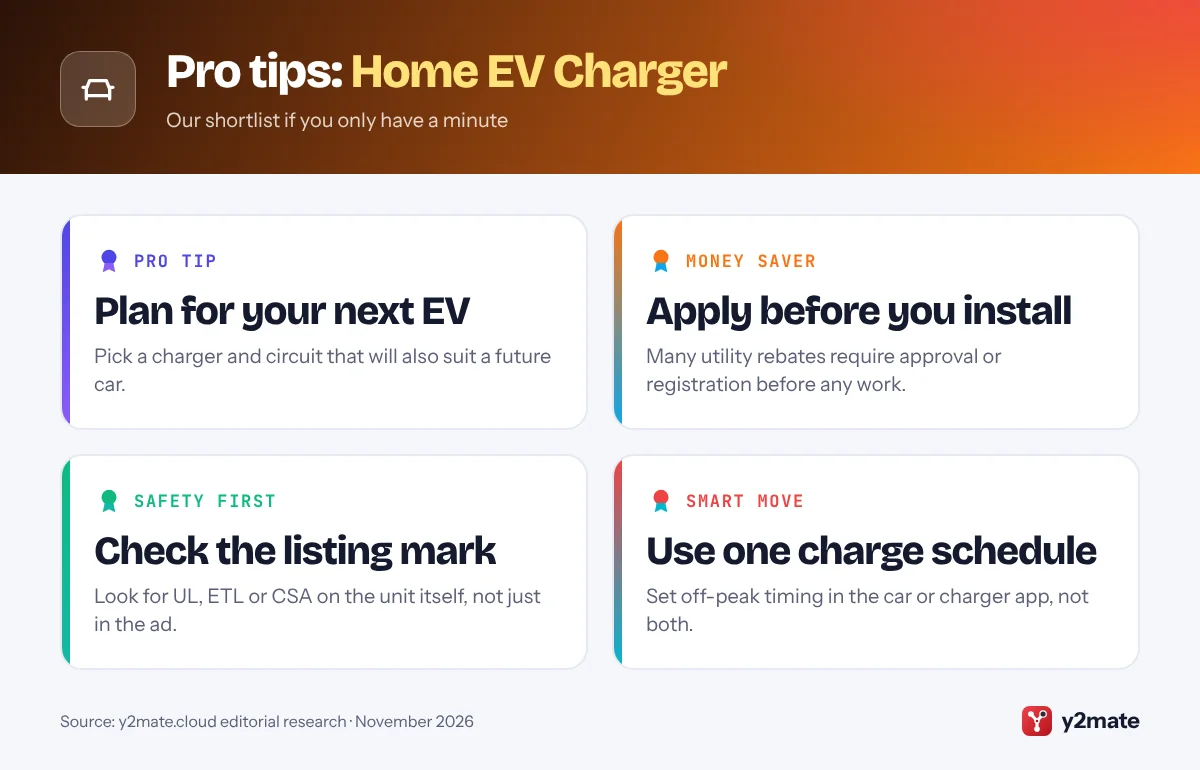
- Safety certification. Buy only a charger listed by a nationally recognized testing laboratory, such as UL, Intertek (ETL) or CSA. Look for the listing mark on the unit itself, and avoid unlisted chargers sold through marketplaces.
Also check the cable length, the weather rating if it will be mounted outdoors, and the warranty.
Step 4: Hire a Licensed Electrician and Get a Permit
Installing a 240-volt circuit is not a DIY job for most people. Hire an electrician who is licensed in your state, and ask for proof of license and insurance. Some automakers, charger brands and utilities keep lists of approved installers, which can also help you qualify for rebates.
When you request quotes, give each electrician the same details: the charger model, where you want it mounted, the distance from the panel, and photos of the panel. A good quote should state:
- The breaker size and wire gauge for the circuit
- Whether a load calculation or panel upgrade is needed
- Who pulls the permit and schedules the inspection
- Any trenching, conduit or wall repair included
Most cities and counties require an electrical permit for a new circuit, followed by an inspection. The electrician usually handles the paperwork, but confirm it in writing. Skipping the permit can cause problems with your homeowners insurance, a future home sale, or utility rebates that ask for proof of a passed inspection.
If you live in a condo or HOA community, get written approval first. Several states have right-to-charge laws for renters and condo owners, so check your state’s rules if approval is refused.
Step 5: Use Utility Rebates, Time-of-Use Rates and Tax Credits
Before the installation, check what financial help is available. Many utilities offer rebates on qualifying chargers or installation work, and some state energy offices run their own programs. Programs often require you to apply before installing or to buy a specific type of charger, so read the rules first. The Department of Energy’s Alternative Fuels Data Center keeps a searchable database of state and utility incentives.
Next, look at your rate plan. Many US utilities offer a time-of-use (TOU) rate, where electricity costs less at night, and some have a separate EV rate or a second meter option. Compare plans using your utility’s online tools, because TOU can raise costs if you use a lot of power at peak times.
On federal tax credits: the Alternative Fuel Vehicle Refueling Property Credit (Section 30C), claimed on IRS Form 8911, was cut short by the One Big Beautiful Bill Act. According to IRS instructions, it cannot be claimed for property placed in service after June 30, 2026. So a home charger installed now does not qualify for that federal credit. If your charger went into service on or before that date, check the IRS Form 8911 instructions or a tax professional about claiming it. Tax rules can change, so always confirm current rules with the IRS.
Step 6: Install a Home EV Charger and Set It Up
On installation day, the electrician will typically install a new breaker, run wire and conduit from the panel to the charger location, and either mount a 240-volt outlet or hardwire the charger. Plan to be home, clear the area around the panel and parking spot, and keep pets and kids away from the work area.
After the work is done, the local inspector checks it. Keep a copy of the permit, the passed inspection record and the electrician’s invoice, because rebates and future home buyers may ask for them.
Then set up the charger:
- Download the charger maker’s app and create an account.
- Connect the charger to your home Wi-Fi. If the signal is weak in the garage, consider a mesh node or extender.
- Confirm the maximum current setting matches the circuit your electrician installed. Many chargers let the installer set this during commissioning.
- Set a charging schedule for off-peak hours, either in the charger app or your car’s app. Use only one schedule to avoid conflicts.
- Enroll in any utility program that requires the charger to be linked.
Finally, do a test charge and confirm the car reports the expected charging mode.
Step 7: Maintain Your Charger and Stay Safe
A home EV charger needs very little maintenance, but a few habits keep it safe and reliable.
- Inspect the cable and connector every few weeks for cuts, crushed sections, bent pins or discoloration. Stop using it if you see damage.
- Store the cable properly on its holster or hook so it is not driven over or left in puddles.
- Keep the area clear of flammable items, and do not cover the charger.
- Update firmware through the app when the maker releases updates.
- Watch for warning signs such as a hot outlet or plug, a burning smell, buzzing, repeated breaker trips or charging that keeps faulting.
If you notice any of those warning signs, stop charging, switch off the breaker if it is safe to do so, and call your electrician. For plug-in chargers, the outlet itself is a common weak point, so ask the electrician to use a heavy-duty, industrial-grade receptacle. Never use adapters to plug a Level 2 charger into a dryer outlet or other outlet not intended for it unless your electrician confirms it is safe and code compliant.
Who Should Not Install a Level 2 Charger Yet
A Level 2 charger is not always the right first step. You might wait or stick with Level 1 if:
- You drive short distances and park at home long enough for a standard outlet to keep up.
- Your panel would need a full service upgrade and you plan to move soon.
- You rent without landlord approval or lack a dedicated parking spot.
- You have reliable, convenient workplace or public charging nearby.
In those cases, try Level 1 for a few weeks and track whether your car keeps up with your driving before committing to a bigger electrical project.
Do's and don'ts
Key terms
Troubleshooting
The breaker trips while charging
Stop using the charger and call your electrician. The charger’s current setting may be higher than the circuit allows, or there may be a wiring or ground-fault issue that needs inspection.
The charger will not connect to Wi-Fi
Check that your router uses a band the charger supports (many use 2.4 GHz only), move the router or add a mesh node closer to the garage, and restart the charger from its breaker if the maker’s support pages recommend it.
The car does not start charging at night
You probably have two schedules set, one in the car and one in the charger app. Turn one off. Also check that the car’s charge limit has not already been reached.
Charging seems slower than expected
Your car’s onboard charger, the charger’s current setting and the circuit size all limit speed. Check the car’s maximum AC rate in the manual and confirm the charger’s setting with your electrician.
Frequently asked questions
Can I install a home EV charger myself?
Plugging a portable Level 1 cord into an existing outlet is something most owners can do. Installing a new 240-volt circuit for Level 2 is different: it usually requires a permit, an inspection and work inside your electrical panel. For safety, insurance and rebate eligibility, hire a licensed electrician, even if your state allows homeowners to do their own electrical work.
Do I need a permit to install a home EV charger?
In most US cities and counties, yes. Adding a new circuit or a 240-volt outlet normally requires an electrical permit and a final inspection from your local building department. Your electrician typically files the permit. Keep the permit and inspection record, because utility rebate programs and future home buyers may ask to see them.
Is the federal 30C tax credit available for home chargers in 2026?
Not for new installations. The One Big Beautiful Bill Act ended the Section 30C credit for property placed in service after June 30, 2026, according to the IRS Form 8911 instructions. A charger placed in service on or before that date may still be claimable on that year's return. Check current IRS guidance or a tax professional, and look at state and utility programs instead.
Should I buy a NACS or J1772 home charger?
Buy the connector that matches the car you will charge most. Many automakers are adopting NACS (SAE J3400) ports on new models, while many existing EVs use J1772. If you have a mixed household or may switch cars, consider a charger with an interchangeable connector or a dual-cable model, and use only adapters approved by your automaker.
Is a hardwired or plug-in charger better?
Both work well when installed correctly. A plug-in charger on a quality 240-volt outlet is easier to replace or take with you if you move. A hardwired charger avoids outlet wear and can support higher charging power. Your electrician can recommend the best choice for your circuit, location and local code requirements.
Wrapping up
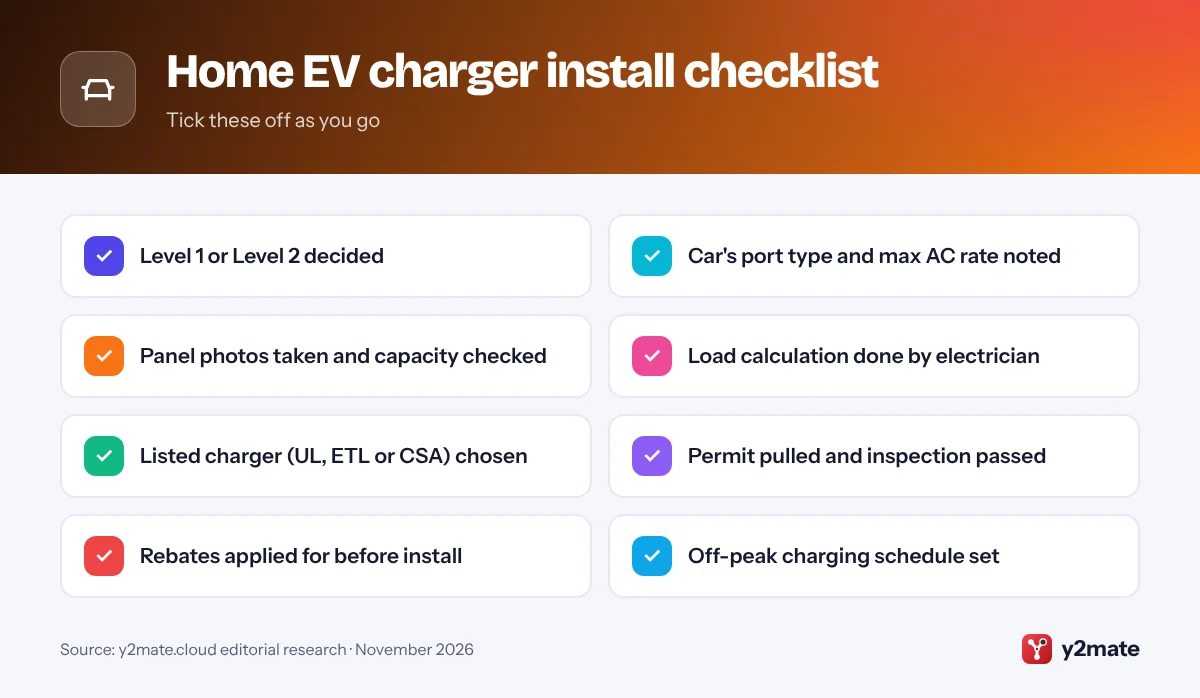
When you install a home EV charger the right way, the result is simple: you plug in at night and wake up to a car that is ready to go. Choose Level 1 or Level 2 based on your driving, let a licensed electrician check your panel and pull the permit, buy a safety-listed charger with the right connector, and claim any utility or state rebates before work begins. With the federal 30C credit no longer available for new installations, those local programs and a time-of-use rate matter more than ever.
Home charging covers most daily driving, but road trips still depend on public fast chargers. For help choosing where to charge away from home, read our list of the Top 10 EV Charging Networks in the USA.
Sources and further reading
- AFDC home charging guide: The US Department of Energy explains Level 1 and Level 2 home charging, installation steps and permit considerations.
- IRS Form 8911 information: The IRS page for the Alternative Fuel Vehicle Refueling Property Credit form and its current instructions.
- AFDC Section 30C summary: A Department of Energy summary of the federal Alternative Fuel Infrastructure Tax Credit and its eligibility rules.
- ENERGY STAR EV chargers: ENERGY STAR lists certified EV chargers and explains what certification means for home charging equipment.
- NFPA 70 National Electrical Code: The NFPA page for the National Electrical Code, which sets the US wiring rules for EV charging equipment.

Leave a Reply