
- The Tesla Universal Wall Connector, ChargePoint Home Flex and Emporia Pro are the strongest all-round home EV chargers in the USA for 2026.
- Many automakers are moving to the NACS (SAE J3400) port, so a charger sold with a NACS option, or Tesla's built-in J1772 adapter, protects you when you change cars.
- Buy only a charger listed by a nationally recognized testing laboratory such as UL, Intertek (ETL) or CSA, and check ENERGY STAR status if your utility rebate requires it.
- The federal 30C home charger tax credit cannot be claimed for equipment placed in service after June 30, 2026, so state and utility programs are now the main source of help.
- Enel X Way shut down its North American business in October 2024, so JuiceBox chargers lost their app and customer support.
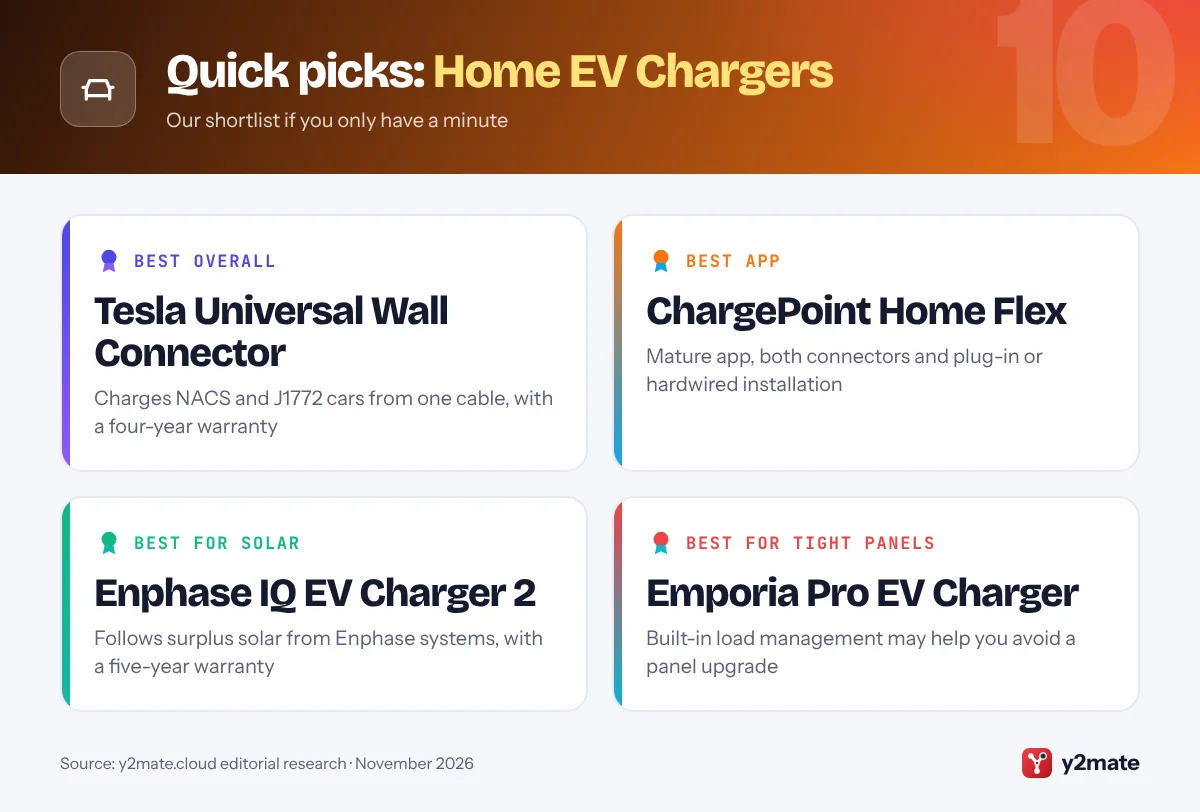
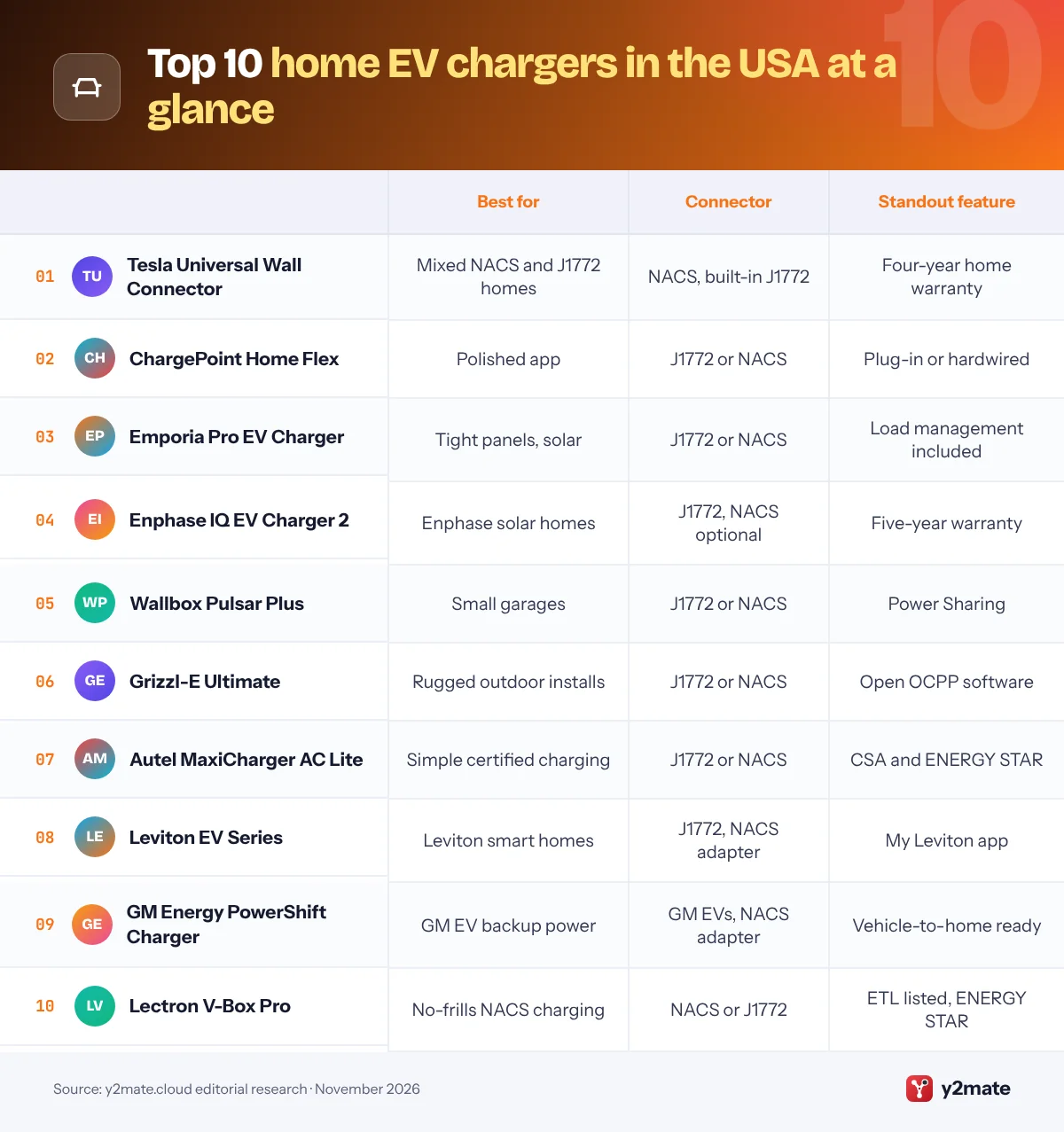
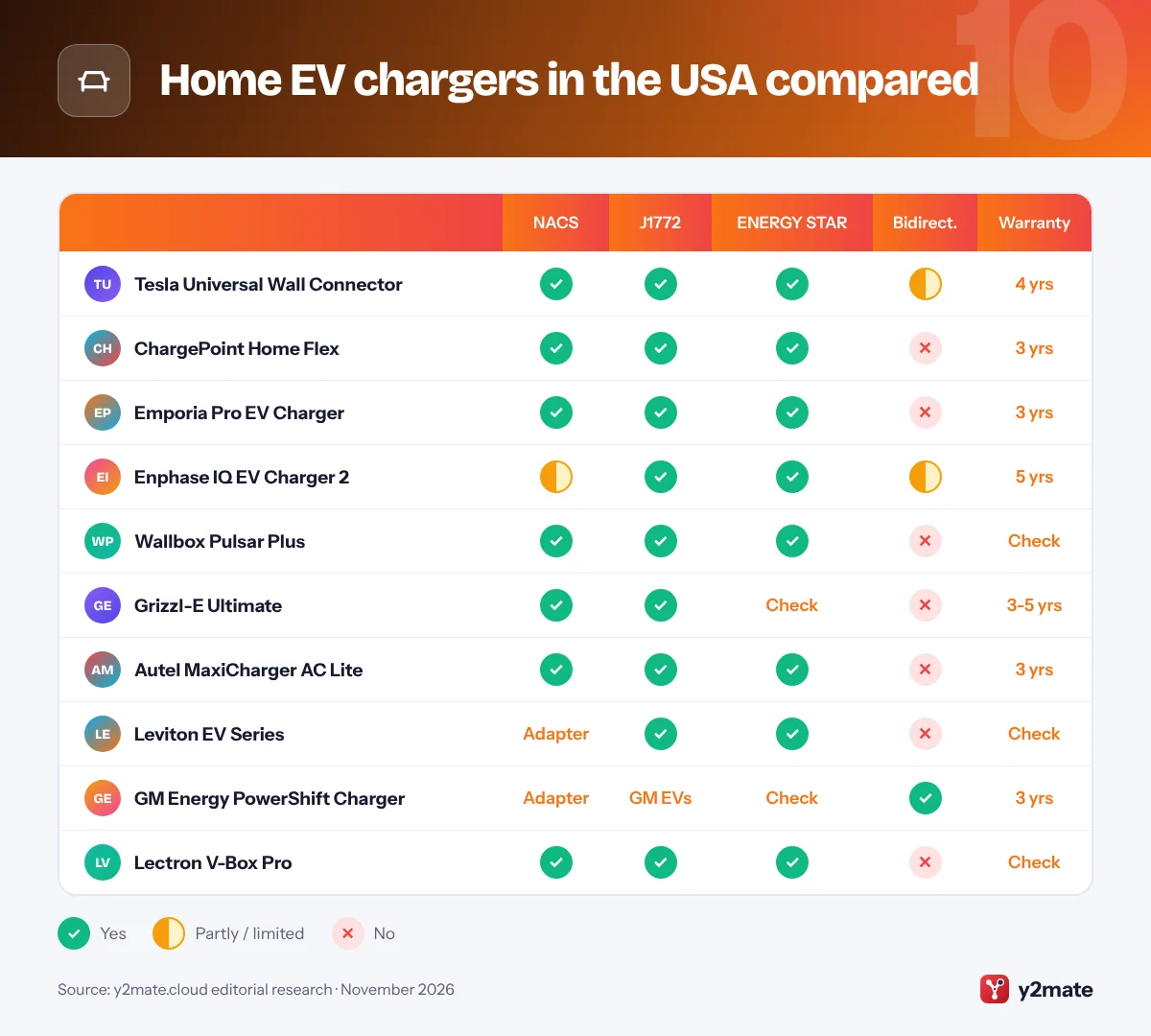
The best home EV chargers in the USA in 2026 are the Tesla Universal Wall Connector for households with both NACS and J1772 cars, the ChargePoint Home Flex for a polished app and flexible installation, and the Emporia Pro for homes with a tight electrical panel or rooftop solar. Enphase, Wallbox, Grizzl-E, Autel, Leviton, GM Energy and Lectron complete the list, covering solar-first, rugged, backup-power and no-frills options.
A few terms first. Level 2 charging uses a dedicated circuit, the same kind of supply an electric dryer uses, instead of a standard household outlet (Level 1). NACS, the plug Tesla created and SAE standardized as J3400, is replacing the older J1772 plug on many new EVs. Smart charging means the charger connects to Wi-Fi so you can schedule cheaper overnight sessions, track energy use and join utility programs. A hardwired charger is wired straight into its circuit, while a plug-in model uses a heavy-duty outlet.
The rules around buying a charger changed in 2026, most notably the end of the federal 30C tax credit for new installations. This list ranks ten chargers sold in the US today, explains who each one suits and flags the catches.
How we ranked this list
We ranked chargers only on publicly documented criteria: connector options (NACS, J1772 or both), smart features and app, solar and load management support, safety listing and ENERGY STAR certification, installation options and the warranty stated on each maker’s US website. Every pick was listed for sale on its maker’s US site in November 2026.
We did not test the chargers ourselves, and we leave out prices, charging speeds and power ratings, because what you get depends on your car, your circuit and your electrician. Specifications change, so confirm the exact model, connector and listing before you buy.
The Top 10 Home EV Chargers
1. Tesla Universal Wall Connector
Best for: households with both NACS and J1772 cars
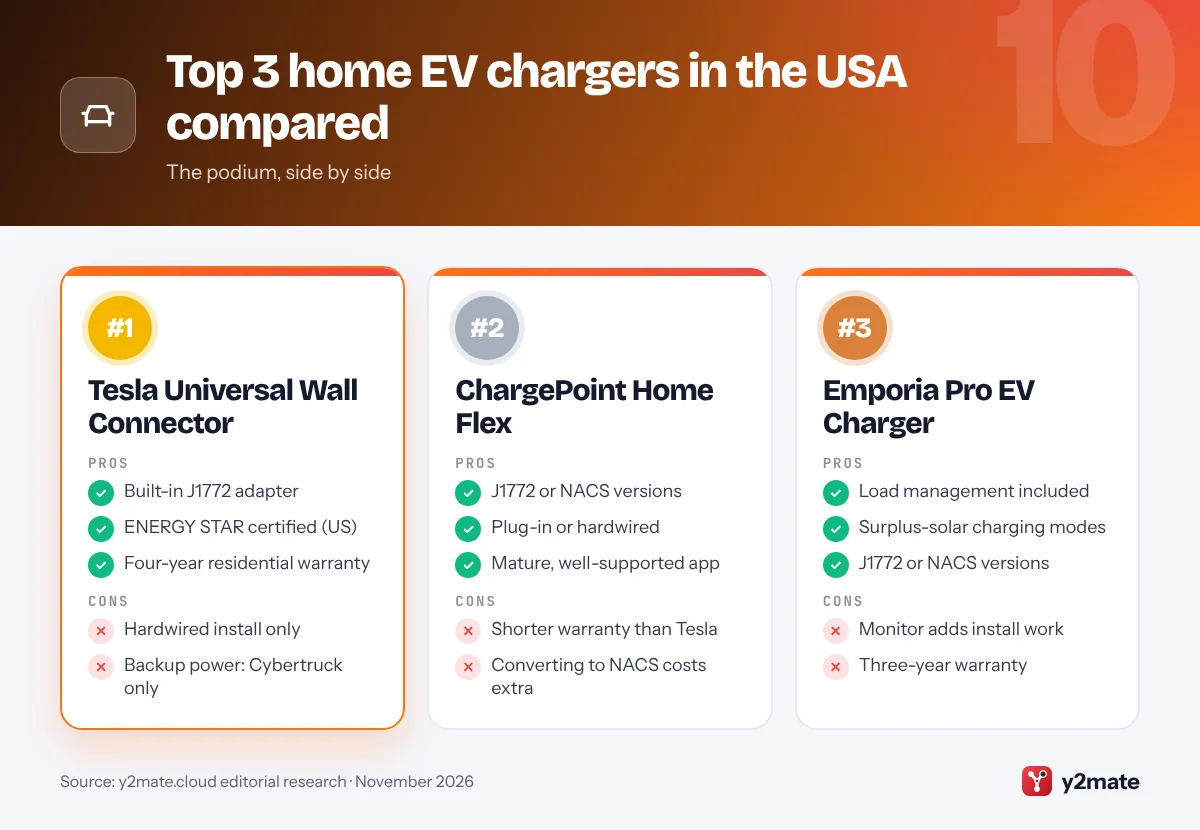
The Universal Wall Connector is Tesla’s home Level 2 charger for every brand. Its NACS (SAE J3400) cable has a built-in J1772 adapter, so one unit can charge a Tesla, a newer EV with a NACS port or an older EV with a J1772 port without a loose adapter. That makes it the safest long-term bet for a two-car household, or for anyone whose next car may have a different plug.
It is a hardwired unit with Wi-Fi for over-the-air updates, remote diagnostics and access controls, and Tesla’s datasheet lists ENERGY STAR certification for the US model. Several Wall Connectors can share one circuit, which helps if you add a second EV later. Tesla also offers Powershare home backup, which lets a compatible vehicle power the house during an outage with extra Tesla equipment, but Tesla currently lists it for Cybertruck only.
Tesla’s support pages describe a four-year warranty for residential use, longer than most rivals here. The main limitation is installation: it must be hardwired by an electrician, so it cannot simply plug into an existing outlet. For most mixed-brand households, it is the simplest charger to live with for years.
Official site: Tesla Universal Wall Connector
- Built-in J1772 adapter
- ENERGY STAR certified (US)
- Four-year residential warranty
- Hardwired install only
- Backup power: Cybertruck only
2. ChargePoint Home Flex
Best for: a polished app and flexible installation
ChargePoint runs one of the best-known public charging networks in the US, and the Home Flex brings the same app into your garage. It comes in J1772 and NACS versions, and you can choose a plug-in model for a heavy-duty outlet or a hardwired model. Its output is adjustable, so your electrician can set it to match the circuit you have, which is where the Flex name comes from.
ChargePoint lists the Home Flex as ENERGY STAR certified. The app lets you schedule charging for off-peak hours and see your energy use, and ChargePoint encourages owners to check their utility for smart charger incentives, many of which ask for a networked or ENERGY STAR model.
ChargePoint’s product pages state a three-year parts warranty, shorter than Tesla’s or Enphase’s. Converting a J1772 unit to NACS later means buying a separate NACS kit. Solar owners who want surplus-solar charging should also look at Emporia or Enphase, which advertise it. For drivers who want a well-supported app, a choice of connector and plug-in or hardwired installation, it remains one of the safest picks.
Official site: ChargePoint Home Flex
- J1772 or NACS versions
- Plug-in or hardwired
- Mature, well-supported app
- Shorter warranty than Tesla
- Converting to NACS costs extra
3. Emporia Pro EV Charger
Best for: tight electrical panels and surplus solar
Emporia is a US home energy company, and its Pro charger is built around load management. It comes bundled with Emporia’s Vue energy monitor and PowerSmart, which watches your whole home’s demand and adjusts the charging rate so the total stays within what your service can handle. Emporia pitches this as a way to avoid a costly panel or service upgrade, although your electrician still has to confirm the setup meets code.
The same monitor enables solar charging. You can set the charger to use excess solar production, or to charge only when there is enough surplus, so the car soaks up energy you would otherwise export. The Emporia Classic offers the same charging without the bundled monitor, so it needs a separate Emporia monitor before load management and solar features work.
Both models come in J1772 and NACS versions, can be hardwired or plugged into a heavy-duty outlet and carry a three-year warranty, and Emporia lists ENERGY STAR among their certifications. If your home is short on electrical capacity or you have rooftop solar, it is one of the smartest picks on this list.
Official site: Emporia Pro EV Charger
- Load management included
- Surplus-solar charging modes
- J1772 or NACS versions
- Monitor adds install work
- Three-year warranty
4. Enphase IQ EV Charger 2
Best for: homes with an Enphase solar system
Enphase makes the microinverters on many US rooftops, and the IQ EV Charger 2, which began shipping in the US in December 2025, is designed to work with them. Paired with an Enphase system through the IQ Gateway, it checks for surplus solar twice a minute and adjusts the charging rate in small steps, so more of your car’s energy comes from your own panels. With compatible Enphase solar and battery equipment, it can also keep charging during a grid outage.
The hardware is built for the long haul. Enphase gives it a five-year limited warranty, one of the longest on this list. It has load balancing to help avoid panel upgrades, RFID access control and an outdoor-rated enclosure, and Enphase lists UL and ENERGY STAR among its certifications. It also includes ISO 15118-20 hardware for future bidirectional charging, although that depends on vehicle and regional certification.
Connector choice needs care. Units ship with a J1772 cable, and selected models accept a NACS (J3400) cable that Enphase sells separately. Without Enphase solar, you lose its main advantage, and non-solar homes are better served higher up this list.
Official site: Enphase IQ EV Charger 2
- Surplus-solar charging
- Five-year limited warranty
- Load balancing built in
- NACS cable sold separately
- Best only with Enphase solar
5. Wallbox Pulsar Plus
Best for: a compact charger in a small garage
The Pulsar Plus is a compact Level 2 charger that suits a tight garage or a narrow wall beside a door. Wallbox sells it with either a J1772 connector or a native NACS connector, so Tesla owners and drivers of newer NACS-port cars do not need an adapter. It is UL listed and ENERGY STAR certified, and Wallbox notes that ENERGY STAR status can help with some utility rebates.
Setup and everyday control run through the myWallbox app, which handles schedules and charging history. Power Sharing lets two or more Wallbox chargers split one circuit, which helps households planning a second EV, and Wallbox also sells a version bundled with a power meter for whole-home load management.
The company itself is worth watching. Wallbox agreed a debt restructuring with its creditors in 2026, and reports in September said it was moving production from its Texas plant to Barcelona while keeping Texas as a North American service and logistics hub. US sales and support continue, but buyers who value long-term certainty may prefer a larger brand. For a small, tidy charger with both connector options, it is still a strong choice.
Official site: Wallbox Pulsar Plus
- Compact design
- J1772 or native NACS
- Power Sharing for two EVs
- Maker restructured in 2026
- Load management needs meter
6. Grizzl-E Ultimate
Best for: rugged outdoor installs and open software
Grizzl-E chargers are made by United Chargers, a Canadian company known for tough, metal-cased units. The Ultimate is its flagship home charger, with an enclosure rated for indoor and outdoor use, so it suits a driveway wall exposed to snow, rain or summer heat. You can order it with a J1772 or a NACS connector.
Its smart features run on OCPP, the Open Charge Point Protocol, through the Grizzl-E Connect app. OCPP matters because it is an open standard that lets compatible third-party software talk to the charger, so you are less tied to one company’s app if your needs change. United Chargers also sells simpler Classic models for buyers who want fewer features.
Grizzl-E’s FAQ says its Level 2 chargers carry a three-year or five-year replacement warranty depending on the model, and that the warranty does not change based on where you bought the charger. Keep your receipt, because claims require the original proof of purchase. The trade-offs are a plain, bulky design and smart features that depend on a good Wi-Fi signal where the charger is mounted, which can be weak on an outside wall.
Official site: Grizzl-E Ultimate
- Tough metal enclosure
- J1772 or NACS connector
- Open OCPP software
- Plain, bulky design
- Wi-Fi needed for smart features
7. Autel MaxiCharger AC Lite
Best for: a certified, no-fuss charger with load management
Autel is best known for car diagnostic tools, and its MaxiCharger range applies that engineering to home charging. The AC Lite Home is the simpler model in the range, sold with either a J1772 or a NACS connector. Autel’s US store lists it as CSA certified for safety and ENERGY STAR certified for efficiency, and it supports load management features that help it share capacity with the rest of your home.
The enclosure is rated for outdoor use, and you can choose a plug-in version for a heavy-duty outlet or a hardwired version for a higher-output installation. Autel’s warranty policy covers its home chargers for three years, but the cover is restricted to the country of purchase, so buy a US model from a US seller.
Autel’s model names can be confusing, because the AC Lite, AC Elite and older MaxiCharger Home appear across different pages. Some higher-end MaxiCharger models list OpenADR support for utility demand-response programs, so compare the exact model if your utility asks for it. For a straightforward, properly listed charger with a choice of connector, it is a solid mid-list pick.
Official site: Autel MaxiCharger AC Lite
- CSA and ENERGY STAR listed
- J1772 or NACS versions
- Load management support
- Warranty tied to country
- Model names can confuse
8. Leviton EV Series
Best for: homes already using Leviton smart devices
Leviton is a long-established American electrical brand that makes outlets, switches and smart load centers, and its EV Series chargers come from the same catalog that many electricians already know. The Wi-Fi models work with the My Leviton app, which can also control Leviton lighting and load centers, so you can manage the charger alongside the rest of your home.
In the app you can schedule charging sessions, start and stop charging remotely, check charging status, log sessions and receive fault notifications. Leviton says all of its EV charging stations are ENERGY STAR certified. You can choose a plug-in model for a heavy-duty outlet or one of several hardwired models, and your electrician should pick the right one for your circuit.
The catch is the connector. Leviton’s chargers use J1772, so NACS-port cars need Leviton’s separate NACS adapter. Leviton also does not advertise a solar charging mode. For homes with a Leviton smart panel, or anyone who wants a charger from a familiar electrical brand that installers know well, it is a sensible choice.
Official site: Leviton EV Series
- Works with My Leviton app
- ENERGY STAR certified
- Plug-in or hardwired
- J1772 only; NACS by adapter
- No advertised solar mode
9. GM Energy PowerShift Charger
Best for: GM EV owners who want home backup power
GM Energy, General Motors’ home energy business, sells the PowerShift Charger as a bidirectional home charger for compatible GM electric vehicles. Add GM Energy’s V2H Enablement Kit and the right home setup, and a compatible GM EV can power your home during an outage, with the kit safely disconnecting the house from the grid first. GM lists compatible models on its site, including recent Chevrolet Equinox EV, Blazer EV and Bolt models, and the list varies by model year.
The PowerShift is a hardwired-only unit with an enclosure rated for indoor and outdoor use, and GM Energy gives it a three-year limited warranty for normal personal use. GM’s latest warranty terms start the warranty period when the product ships rather than at purchase, so keep your delivery paperwork.
This is a specialist pick. It is aimed at GM vehicles, and GM says NACS-port GM models need its PowerShift AC Charging Adapter, sold separately. A vehicle-to-home setup also needs extra equipment and proper grid interconnection approval. If you drive a compatible GM EV and want backup power without a separate home battery, it is the most direct route on this list.
Official site: GM Energy PowerShift Charger
- Can power home in an outage
- Built for GM EVs
- Three-year limited warranty
- V2H kit and approval needed
- NACS GM models need adapter
10. Lectron V-Box Pro
Best for: NACS drivers who want a simple charger
Lectron is best known for EV charging adapters, and its V-Box Pro is a straightforward Level 2 home charger sold in separate NACS and J1772 versions. The NACS model suits Tesla owners and the growing number of other cars with NACS ports, while the J1772 model covers most older EVs.
Lectron says the V-Box Pro is ETL listed to UL safety standards, ENERGY STAR certified and rated for outdoor use. ETL is Intertek’s mark, and Intertek is a nationally recognized testing laboratory, so an ETL listing is an accepted alternative to a UL mark. The charger can be plugged into a heavy-duty outlet or hardwired.
Choose the version carefully. Only the Wi-Fi version connects to the Lectron app for scheduling and remote control; the standard version is a simpler charger without app access. The warranty terms we found differed across Lectron’s materials, so confirm the warranty for the exact model before you buy. For a no-frills NACS or J1772 charger with a recognized safety listing, it is a reasonable choice, but buyers who want solar charging, load management or backup power should look higher up this list.
Official site: Lectron V-Box Pro
- NACS or J1772 versions
- ETL listed, ENERGY STAR
- Plug-in or hardwired
- App only on Wi-Fi version
- Warranty details unclear
Home EV chargers in the USA compared
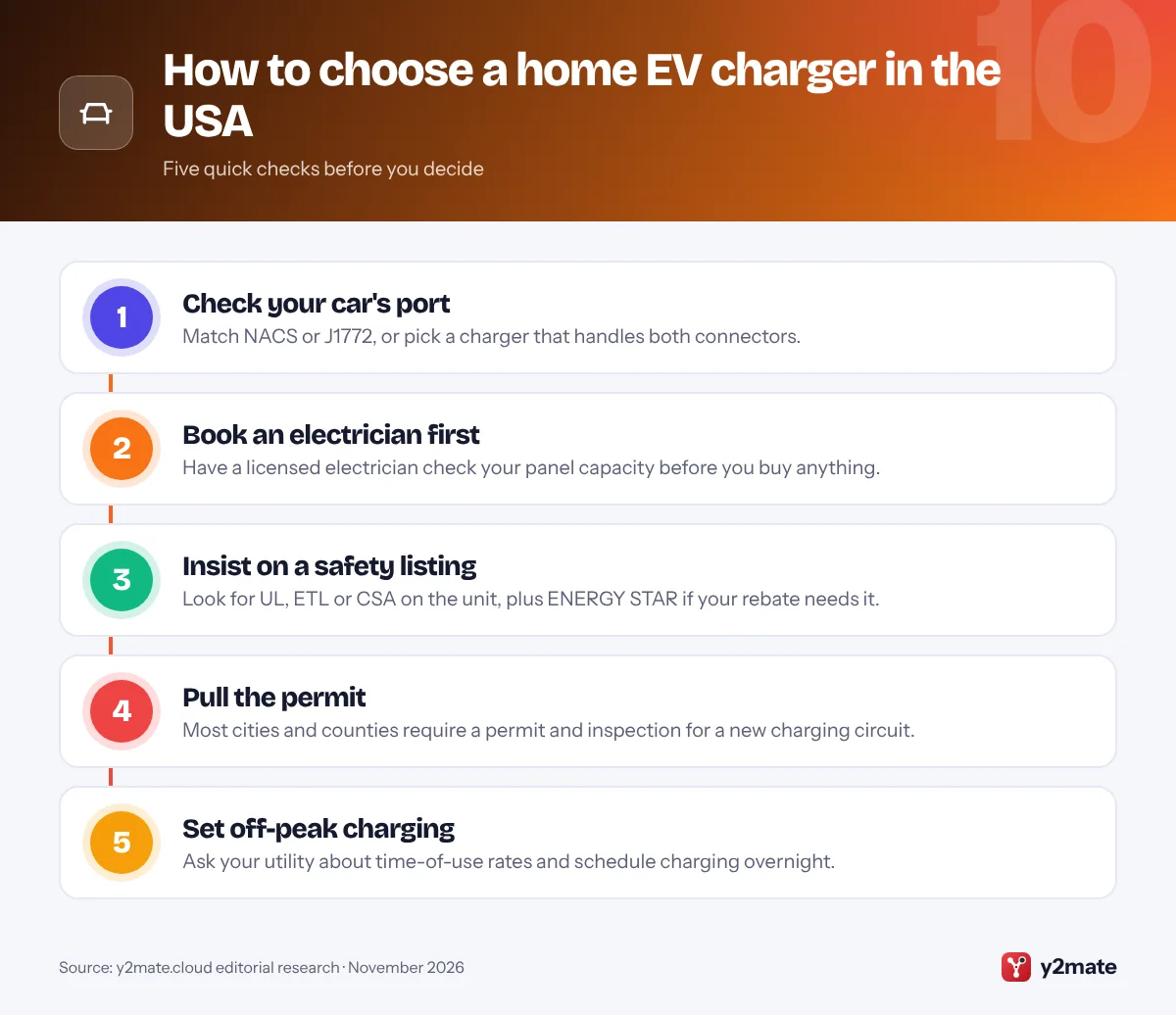
How to choose home EV chargers in the USA
Start with your car’s charging port and your electrical panel, not the charger’s spec sheet. A licensed electrician can tell you how much spare capacity your service has and whether a hardwired or plug-in unit suits your circuit. Your car’s onboard charger also limits how quickly it accepts power, so a bigger charger does not always mean faster charging.
NACS vs J1772
- NACS (SAE J3400): used by Tesla and a growing number of new models from other automakers.
- J1772: the long-standing US plug for Level 2 charging on most other EVs.
- Both: Tesla’s Universal Wall Connector covers both, or choose a charger sold with your car’s connector and use only automaker-approved adapters.
Safety, permits and the NEC
EV charging is treated as a continuous load under the National Electrical Code, and NEC Article 625 covers charging equipment. Most cities and counties require a permit and inspection. Buy only a charger listed by a nationally recognized testing laboratory such as UL, Intertek (ETL) or CSA, and avoid unlisted units sold through online marketplaces.
Rebates, tax credits and rates
The federal 30C credit cannot be claimed for charging equipment placed in service after June 30, 2026. Many utilities and some states still offer rebates, often only for ENERGY STAR or networked chargers, and some require you to apply before installation. Time-of-use rates make overnight charging cheaper in many areas. The Department of Energy’s Alternative Fuels Data Center lists current state and utility incentives.
A warning about JuiceBox
Enel X Way shut down its North American business in October 2024, ending JuiceBox app access and customer support. Existing units can still provide basic charging, but we would not buy one secondhand.
Frequently asked questions
What is the best home EV charger in the USA?
For most households, the Tesla Universal Wall Connector is the best home EV charger in the USA in 2026, because its NACS cable has a built-in J1772 adapter and Tesla offers a four-year residential warranty. The ChargePoint Home Flex is the best choice for app features and plug-in installation, and the Emporia Pro suits homes with limited panel capacity or rooftop solar.
Should I buy a NACS or J1772 home charger?
Buy the connector that matches the car you charge most, and think about your next car too. Many automakers are moving new models to NACS, standardized as SAE J3400, while many existing EVs use J1772. If your household has both, Tesla's Universal Wall Connector handles both. Otherwise, choose a charger sold with your car's connector and use only automaker-approved adapters.
Can I still get the 30C tax credit for a home EV charger?
Not for new installations. The IRS says the Section 30C credit cannot be claimed for property placed in service after June 30, 2026, because the One Big Beautiful Bill Act moved its end date forward. A charger placed in service on or before that date may still qualify on that year's return using Form 8911. Check IRS guidance or a tax professional, and look at utility rebates instead.
Does a home EV charger need to be ENERGY STAR certified?
No law requires it, but it helps. ENERGY STAR certified chargers are safety tested by a nationally recognized testing laboratory and use less energy while idle, and networked models may support utility demand-response programs. Many utility rebates only cover ENERGY STAR or networked chargers, so check your utility's rules before buying. Every charger should at least carry a UL, ETL or CSA listing.
Is it safe to keep using a JuiceBox charger?
A JuiceBox can still provide basic charging, but Enel X Way ended its North American business in October 2024, so the app, smart features and customer support are gone. Have an electrician check the unit and its circuit if you notice heat, faults or tripping breakers. When it needs replacing, choose a listed charger from a brand that still supports US customers.
Final verdict
The best home EV chargers in the USA in 2026 start with the Tesla Universal Wall Connector, which charges both NACS and J1772 cars from one cable. The ChargePoint Home Flex is the safest app-led choice, Emporia and Enphase lead on load management and solar, and GM Energy’s PowerShift Charger is the pick for GM owners who want backup power.
Before you buy, confirm your car’s port, have a licensed electrician check your panel, pull a permit, and check your utility’s rebates and time-of-use rates, because the federal 30C credit no longer covers new installations.
Sources and further reading
- AFDC home charging guide: The US Department of Energy explains Level 1 and Level 2 home charging, installation and permit considerations.
- ENERGY STAR EV chargers: ENERGY STAR lists certified EV chargers and explains what certification means for home charging equipment.
- IRS Form 8911 information: The IRS page for the Alternative Fuel Vehicle Refueling Property Credit form and its current instructions.
- AFDC state laws and incentives: A Department of Energy database of federal, state and utility incentives and laws related to EV charging.
- NFPA 70 National Electrical Code: The NFPA page for the National Electrical Code, which sets the US wiring rules for EV charging equipment.

Leave a Reply