

- The UK has five AI Growth Zones: Culham in Oxfordshire, the North East, North Wales, South Wales and Lanarkshire in Scotland.
- OpenAI paused Stargate UK in April 2026, citing regulation and the cost of energy, and no restart had been announced by November 2026.
- Microsoft ended its agreement for Nscale's planned Loughton data centre in October 2026 after grid power was not expected until the 2030s.
- Isambard-AI in Bristol and Zenith and Dawn in Cambridge give eligible UK researchers and small businesses free AI compute through the AI Research Resource.
- The government's Data Centre Covenant of 28 October 2026 offers faster grid connections to strategic data centres that meet tests on energy costs, local benefits, water use, jobs and security.
The biggest AI data centre projects in the UK in 2026 are QTS’s campus at Cambois near Blyth, the Lanarkshire AI Growth Zone in Scotland and the Isambard-AI national supercomputer in Bristol. Stargate UK, the South Wales and Culham AI Growth Zones, Nscale’s Loughton site in Essex, Google’s Waltham Cross data centre, the Zenith and Dawn supercomputers in Cambridge and the North Wales AI Growth Zone complete the list, and we explain which are running, which are being built and which have stalled.
An AI data centre is a building packed with servers designed to train and run AI models. Most of the work happens on a GPU cluster, a large group of graphics processors linked by fast networks so they act as one machine. A hyperscaler is a company such as Google, Microsoft or Amazon that runs cloud data centres at very large scale. An AI Growth Zone is a site the UK government has designated to give AI data centres planning support and better access to electricity. A grid connection is the agreement and physical link that lets a site draw power from the network; in Great Britain, the National Energy System Operator (NESO) manages the connections queue and Ofgem regulates it.
Access to power has become the deciding factor for several projects, so grid reforms and the government’s new Data Centre Covenant come up throughout.
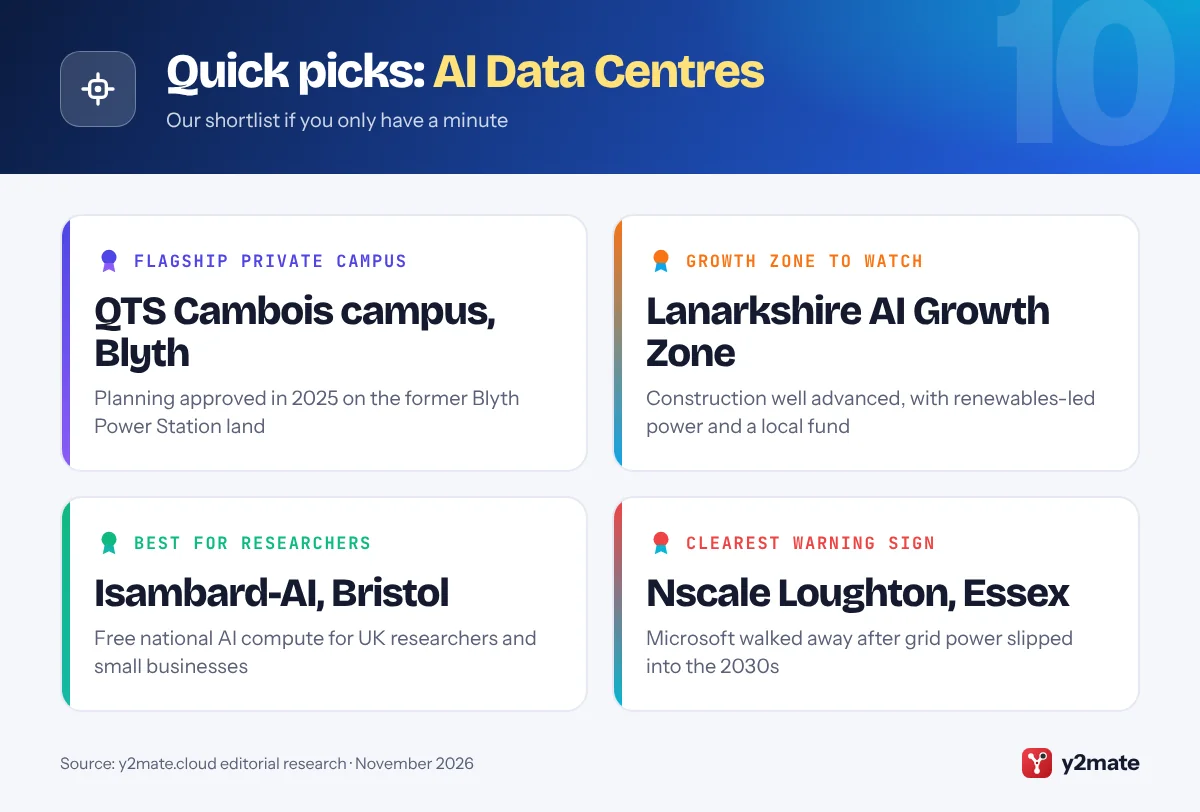
How we ranked this list
We ranked projects by how large and significant they are according to official sources, how far they have progressed and how much public debate they have generated. We used government announcements on GOV.UK, company newsrooms, council planning decisions and Ofgem and NESO publications, and we checked each status against the latest public information available in November 2026.
We did not visit the sites. We leave out investment totals, capacity figures and job estimates because they are often projections that change. Where a project’s status is unclear, we describe it as designated, proposed or paused rather than operating.
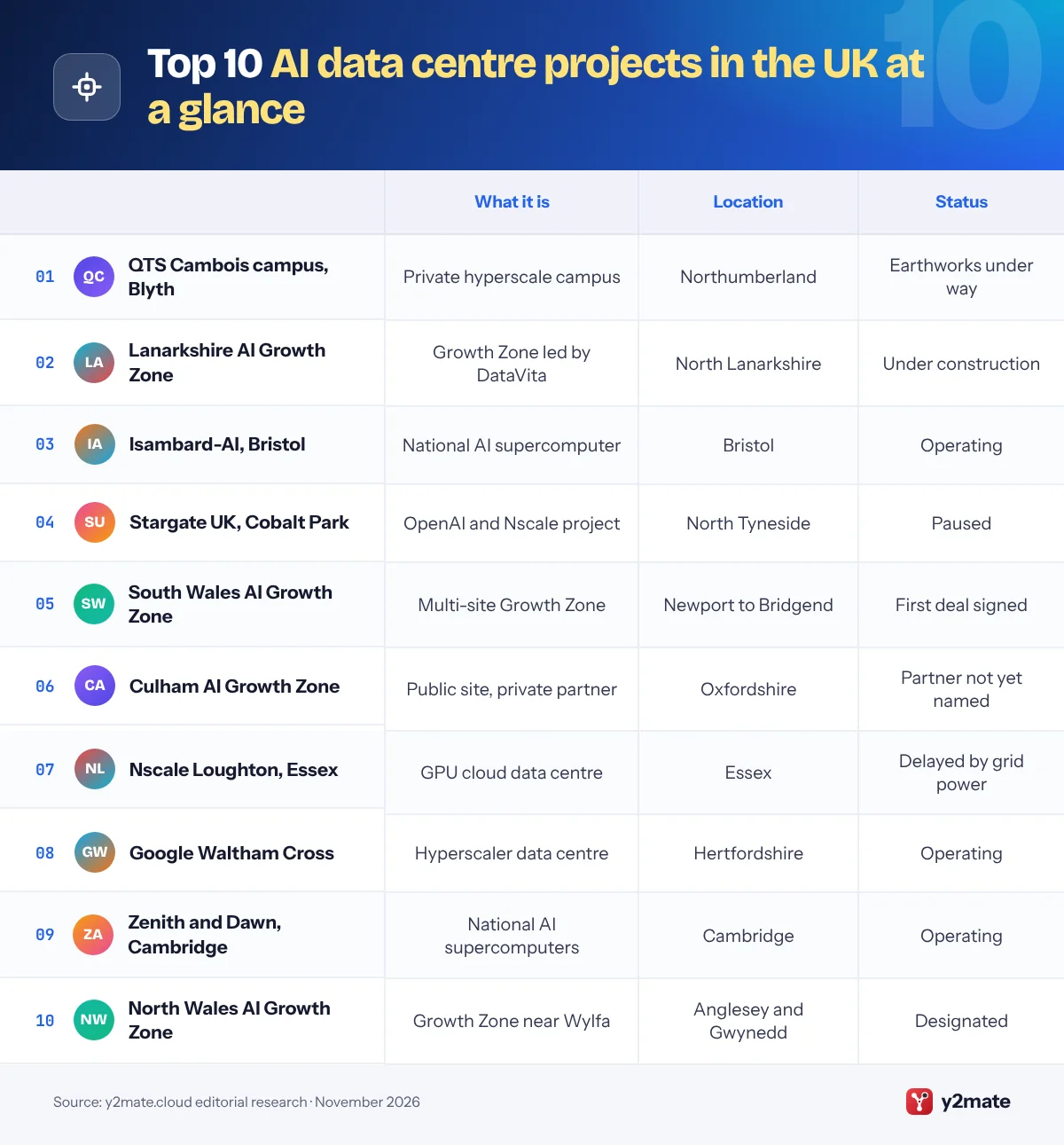
The Top 10 AI Data Centres
1. QTS Cambois campus, Blyth
Best for: seeing the scale of the North East AI Growth Zone
The QTS data centre campus at Cambois, near Blyth in Northumberland, is the flagship private project in the North East AI Growth Zone, designated in September 2025. QTS is owned by Blackstone, which has described the campus as one of Europe’s largest data centre facilities. It is being built on former Blyth Power Station land, part of which was once earmarked for the failed Britishvolt battery factory.
Northumberland County Council approved QTS’s plans on 4 March 2025. QTS says earthworks continue across the site during 2026 and that construction of the first data centre building starts this year. It plans a closed-loop cooling system to limit demand on local water supplies, and it is exploring with the council whether waste heat could warm local buildings through a district heating network.
Why it matters: Cambois shows how the government wants AI Growth Zones to work, reusing industrial land with strong grid links. The open questions are timing and tenants, because no buildings are running yet and the wider zone lost momentum when Stargate UK was paused at nearby Cobalt Park.
Official site: QTS Cambois campus, Blyth
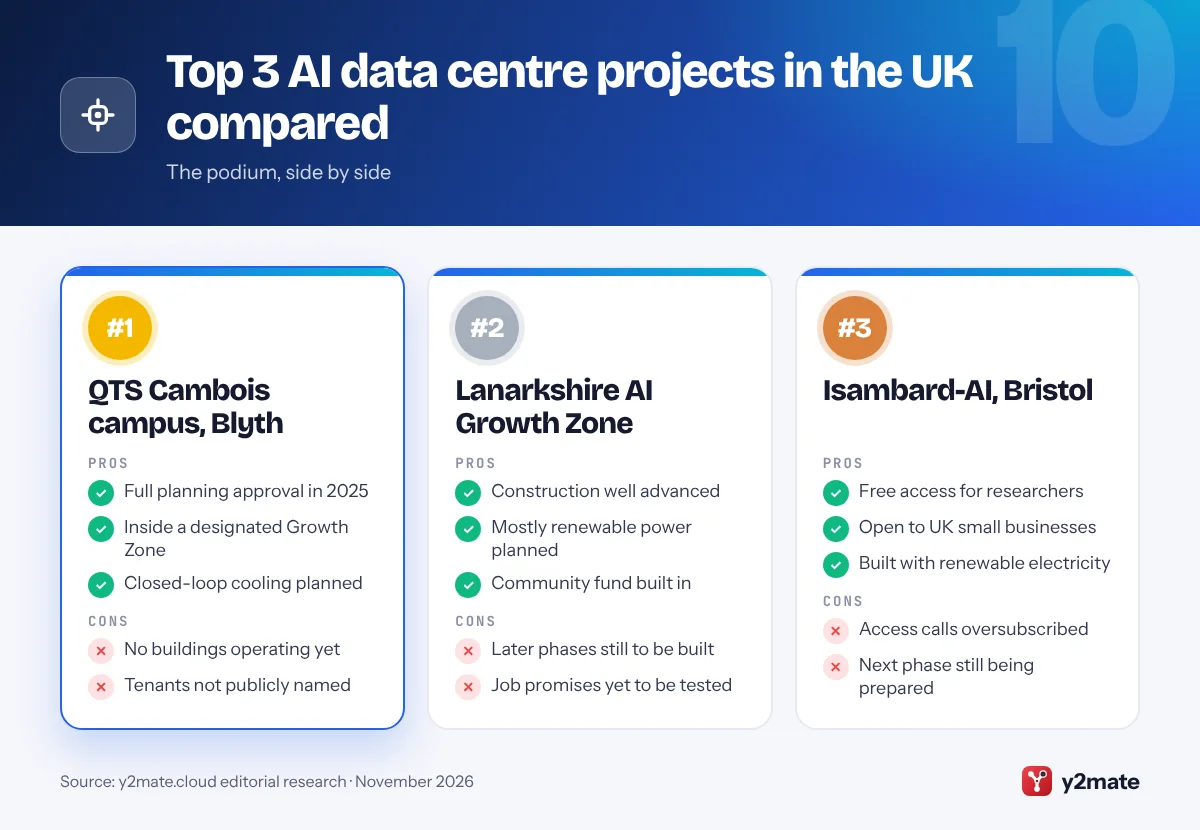
- Full planning approval in 2025
- Inside a designated Growth Zone
- Closed-loop cooling planned
- No buildings operating yet
- Tenants not publicly named
2. Lanarkshire AI Growth Zone
Best for: an AI Growth Zone already being built in Scotland
The Lanarkshire AI Growth Zone, announced on 29 January 2026, is Scotland’s first AI Growth Zone. It is built around DataVita’s existing DV1 data centre site in Airdrie, North Lanarkshire, with the AI cloud company CoreWeave as a partner, and the plans include new data centres, supporting infrastructure and a renewables park.
It is moving faster than most zones. In August 2026 the government said the National Wealth Fund had guaranteed part of a bank financing package that lets DataVita expand DV1 and build a second data centre, and that the site was on track to be among the first AI Growth Zones to have advanced AI chips installed. DataVita said work was well advanced on site, and Dell Technologies is moving its Scottish team to the zone.
The government says the site’s power will come overwhelmingly from renewables, and a community fund raised from the data centres’ income will support local skills, coding clubs and charities. The open questions are whether later phases keep pace and whether the promised local jobs appear.
Official site: Lanarkshire AI Growth Zone
- Construction well advanced
- Mostly renewable power planned
- Community fund built in
- Later phases still to be built
- Job promises yet to be tested
3. Isambard-AI, Bristol
Best for: free national AI compute for UK researchers
Isambard-AI is the centrepiece of the AI Research Resource (AIRR), the government’s network of national supercomputers for researchers, start-ups and public bodies, and the government describes it as the UK’s most powerful public compute facility. Run by the Bristol Centre for Supercomputing at the University of Bristol and built with HPE and NVIDIA, it is housed at the National Composites Centre in Bristol and was switched on in July 2025.
Unlike the commercial projects here, it is publicly funded and free at the point of use. UK-registered small and medium-sized organisations can apply through the AIRR Rapid Access route, and researchers through the Gateway route, both run with UKRI. The university says its first year supported work from dementia research to UK language models and AI safety, and that the system was built using renewable electricity.
Bristol is now preparing the next phase, including AI inference services and the Bristol AI Data Facility. The open questions are capacity and timing: every access call so far has been oversubscribed, and the wider AIRR expansion is still being procured.
Official site: Isambard-AI, Bristol
- Free access for researchers
- Open to UK small businesses
- Built with renewable electricity
- Access calls oversubscribed
- Next phase still being prepared
4. Stargate UK, Cobalt Park
Best for: understanding why big AI projects stall
Stargate UK was announced on 16 September 2025, during the US state visit, as a partnership between OpenAI, NVIDIA and the British AI cloud company Nscale. It was meant to run OpenAI’s models on sovereign UK infrastructure for public services, regulated industries, research and national security partners. Cobalt Park in North Tyneside, part of the North East AI Growth Zone, was named as one of its first sites.
On 9 April 2026 OpenAI said it was pausing the project. It said it would move forward when conditions such as regulation and the cost of energy enable long-term infrastructure investment, and that meanwhile it would keep investing in UK staff and its public services agreement with the government. The government said work on the AI Growth Zone was continuing.
No restart had been announced by November 2026. Stargate UK highlights what most worries AI data centre investors in Britain: industrial electricity prices and the time it takes to secure grid capacity. The government’s Data Centre Covenant, published in October 2026, promises faster grid connections for projects it judges strategic.
Official site: Stargate UK, Cobalt Park
- Sovereign compute for UK services
- Major named partners
- Part of a designated Growth Zone
- Paused over energy and regulation
- No restart date announced
5. South Wales AI Growth Zone
Best for: AI data centres along the M4 corridor in Wales
The South Wales AI Growth Zone was confirmed on 20 November 2025. It is made up of several sites along the M4 corridor from Newport to Bridgend, including the former Ford engine plant in Bridgend, with Vantage Data Centers and Microsoft named as partners. Vantage says its plans in the region cover Newport, Bridgend and Bro Tathan in the Vale of Glamorgan.
The first commercial deal came on 13 August 2026, when Vantage and the AI cloud company Nebius announced that Nebius would lease high-density capacity for AI training and inference at Vantage’s CWL1 campus in Newport, which has been operating since 2010. Vantage says CWL1’s electricity use is matched with certified renewable energy and that its newest buildings use closed-loop cooling, which recirculates water rather than evaporating it.
Why it matters: the zone builds on infrastructure South Wales already has, including fibre links to London and a large working campus. The open questions are newer sites such as the former Ford plant in Bridgend, which are not yet operating.
Official site: South Wales AI Growth Zone
- Builds on a working campus
- First customer deal signed
- Closed-loop cooling at Newport
- Newer sites not yet operating
- Bridgend timing unclear
6. Culham AI Growth Zone
Best for: AI compute linked to UK fusion research
Culham, the UK Atomic Energy Authority’s campus in Oxfordshire, was named as the UK’s first AI Growth Zone when the government published its AI Opportunities Action Plan in January 2025. The site is best known for fusion energy research, and UKAEA has been seeking a long-term private investment partner to develop a large commercial AI data centre there.
The first computing at the zone is public. In March 2026 the government announced funding for Sunrise, a supercomputer dedicated to fusion energy research, built with the University of Cambridge, Dell, AMD and Intel, and called it a key first step in establishing the Culham AI Growth Zone. At that point Sunrise was targeted to start operating in June 2026.
The open question is the commercial phase. We found no announcement of a chosen investment partner by November 2026, so the large private data centre remains proposed. Culham tests whether a public research site can host private AI infrastructure.
Official site: Culham AI Growth Zone
- First designated Growth Zone
- Sunrise fusion supercomputer
- Publicly owned site
- No commercial partner named
- Private data centre proposed only
7. Nscale Loughton, Essex
Best for: seeing how grid delays hit AI projects
Nscale’s planned AI data centre at Loughton in Essex was announced in September 2025 as the home of a new UK AI supercomputer with Microsoft as the anchor customer. Nscale is a British company that builds and runs GPU clusters for AI developers.
The project then hit the problem facing much of south-east England: getting enough electricity. In October 2026 Microsoft confirmed it had ended its agreement for the Loughton site after grid officials told Nscale that power would not be available until the 2030s. Microsoft said the decision related to a single site and that its partnership with Nscale continued.
Nscale said it remained committed to Loughton and the UK and was exploring alternative power sources for the site, as well as other UK sites. Loughton is now the clearest UK example of a grid connection, rather than chips or funding, deciding when an AI data centre can open. The Data Centre Covenant’s plan to reserve and reallocate grid capacity for strategic projects is designed to speed up time to power.
Official site: Nscale Loughton, Essex
- British-owned GPU cloud operator
- Nscale still backs the site
- Test case for grid reforms
- Microsoft ended its agreement
- Grid power not until 2030s
8. Google Waltham Cross
Best for: a hyperscale data centre already running
Google’s data centre at Waltham Cross in Hertfordshire was formally opened by the Chancellor on 16 September 2025, as part of a two-year UK investment plan Google announced during the US state visit. Google first announced the project in January 2024. The site supports services such as Search, Maps, Workspace and Google Cloud, which increasingly run AI features.
Google says the facility uses advanced air cooling to limit water use to domestic needs, such as kitchens and washrooms. It is designed so waste heat can be offered to nearby homes, schools and businesses, and Google set up a community fund for the area managed by Broxbourne Council.
Waltham Cross is a working example of the model the government wants more of: a hyperscaler building close to London with low water use and heat reuse designed in. It is not in an AI Growth Zone and offers no public research access. The open questions are how much of its heat is actually reused and whether the grid around London can support further expansion.
Official site: Google Waltham Cross
- Already operating
- Air cooling limits water use
- Heat reuse built into design
- No public research access
- Heat reuse needs local takers
9. Zenith and Dawn, Cambridge
Best for: AI for science on national supercomputers
Zenith and Dawn are the University of Cambridge’s systems in the AI Research Resource. Dawn, powered by Intel data centre GPUs, was one of the first AIRR systems and supports research across health, energy and climate science. Zenith, launched in June 2026 and built with AMD, Dell Technologies and the British firm StackHPC, succeeds Dawn and is described by the government as the UK’s largest AI-for-science platform, combining AI with traditional scientific simulation.
Like Isambard-AI, the Cambridge systems are funded through DSIT and UKRI and are free for eligible UK researchers and small businesses through the AIRR access routes. Cambridge’s research computing team is also helping to deliver and operate Sunrise, the fusion supercomputer for Culham.
Zenith matters because it is the newest national AI system and part of the government’s plan to expand public compute many times over by 2030. The open questions are scale and access: AIRR access calls have been heavily oversubscribed, and the next large AIRR supercomputer is still being procured.
Official site: Zenith and Dawn, Cambridge
- Free AIRR access routes
- Combines AI and simulation
- Newest national AI system
- Access is competitive
- Expansion still being procured
10. North Wales AI Growth Zone
Best for: an AI zone planned near future nuclear power
The North Wales AI Growth Zone was confirmed on 13 November 2025, the same day the government named Wylfa on Anglesey as the site of the UK’s first small modular reactor project. The zone straddles the Menai Strait, with a base at Prosperity Parc on Anglesey and another at Trawsfynydd in Gwynedd, the site of a former nuclear power station.
The long-term idea is to pair AI computing with low-carbon power, as the government hopes Wylfa’s small reactors will supply the grid from the mid-2030s. A consortium led by Stena Line, which runs Holyhead port, working with regional partners including Isle of Anglesey County Council, is behind the zone, and the government has set aside local funding for AI skills and business adoption in each Growth Zone.
The main open question is money. When the zone was announced, the government said work was under way to secure an investment partner and that construction would follow once a deal was confirmed. We found no announcement of a chosen partner by November 2026.
Official site: North Wales AI Growth Zone
- Linked to Wylfa nuclear plans
- Strong local council backing
- Two sites across Menai Strait
- No investment partner named
- Reactor power not before 2030s
UK AI data centre projects compared
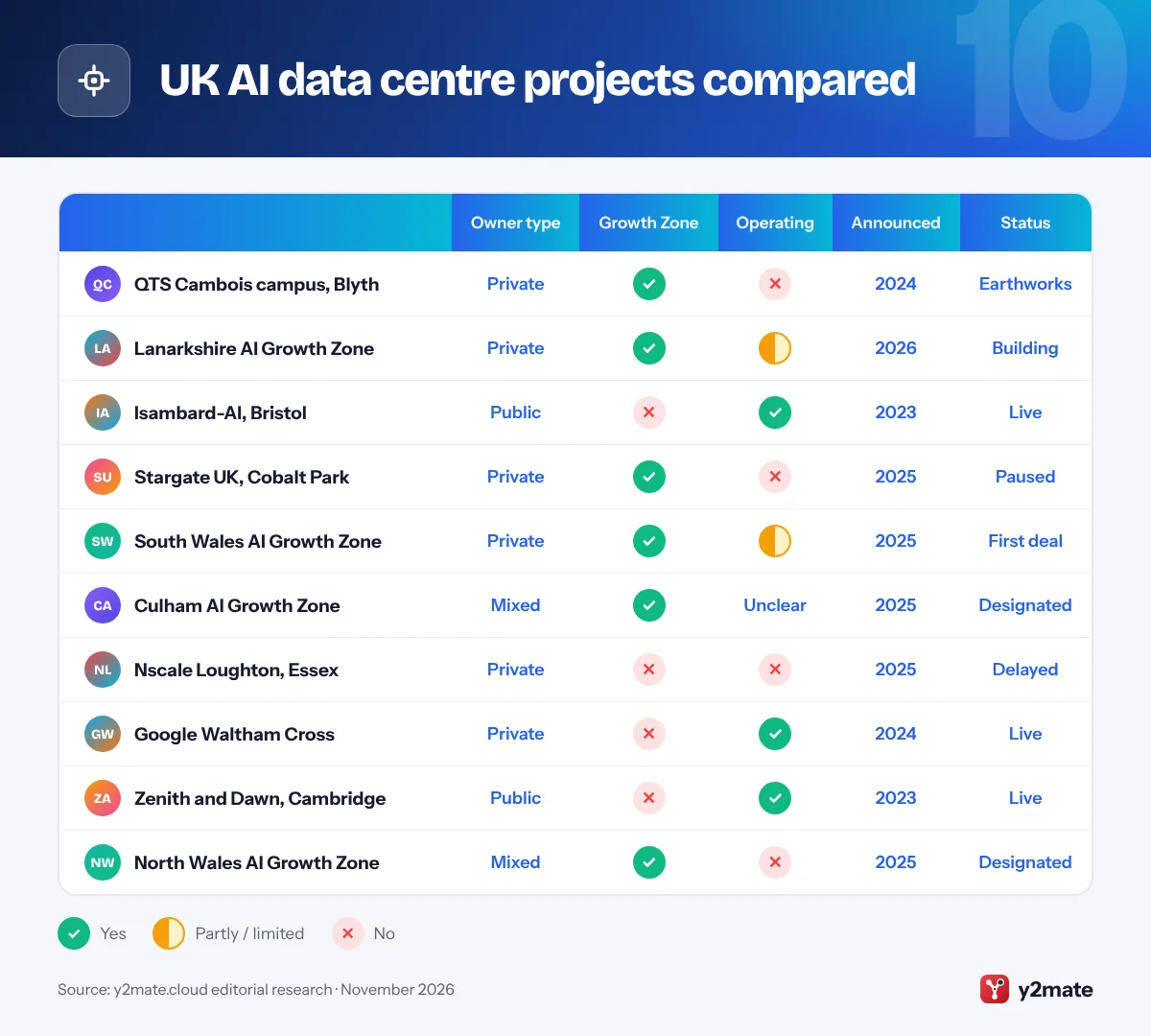
How to judge AI data centre projects in the UK
Most announcements sound alike, so focus on three things: power, planning and local benefits. A site with a confirmed grid connection and planning consent is far more likely to open on time than one backed only by a press release.
Power and grid connections
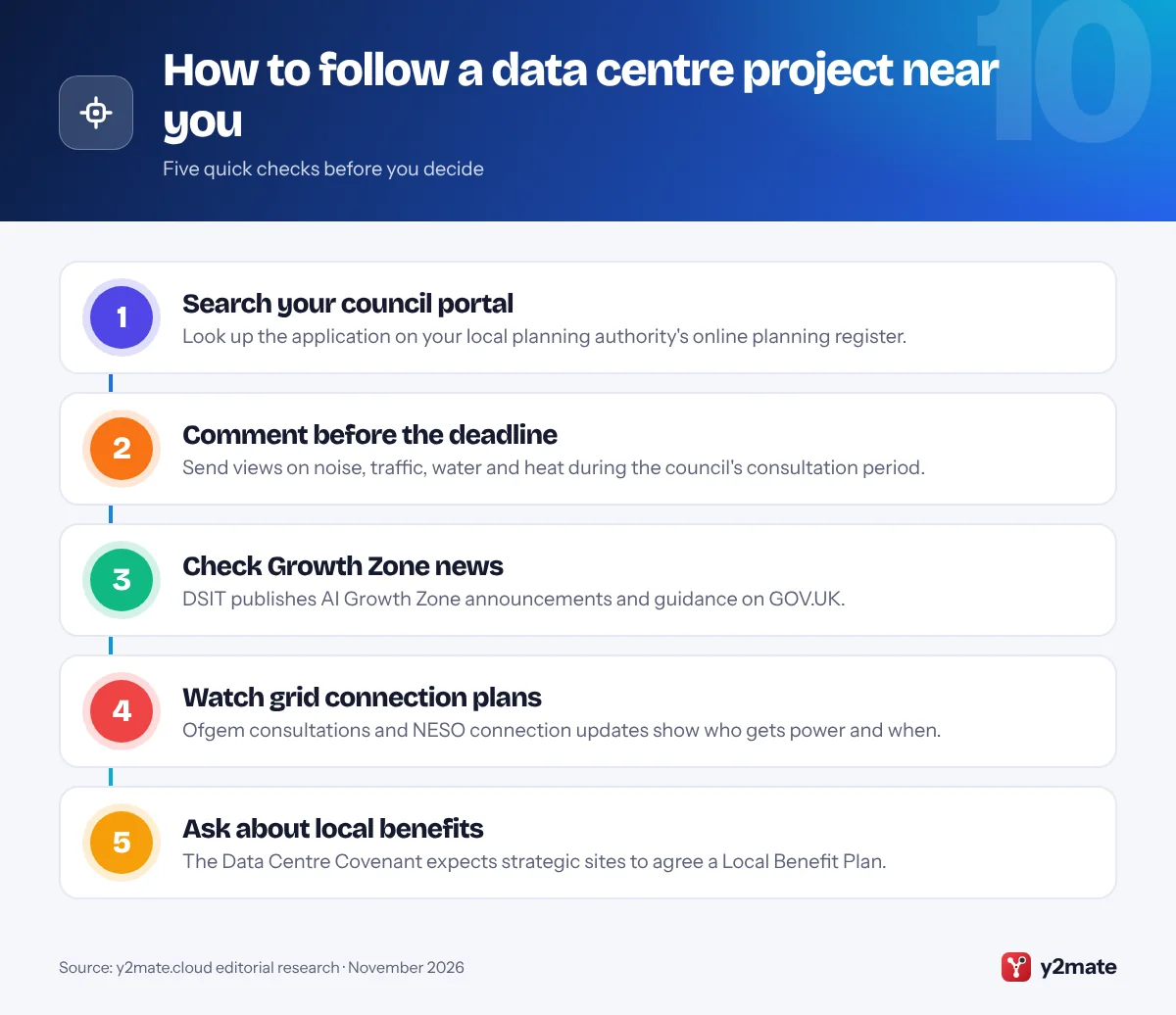
Electricity is the main bottleneck. NESO is reworking the connections queue so that projects ready to build move ahead, and in July 2026 Ofgem consulted on a commitment fee and progress milestones to clear speculative data centre applications, with a decision expected by the end of 2026. The government’s Data Centre Covenant, published with the Budget on 28 October 2026, says it will use powers in the Planning and Infrastructure Act 2025 to reserve and reallocate grid capacity for strategic data centres, overseen by a new Ministerial Control Centre chaired by the AI Minister.
Planning and AI Growth Zones
The five AI Growth Zones get planning support and priority access to available grid capacity. Data centres have been classed as Critical National Infrastructure since September 2024, and the government plans to consult on a draft Data Centre National Policy Statement for projects that seek consent through the national infrastructure planning regime.
Water, heat and communities
- Water: the Covenant asks operators to minimise use of public water supplies, for example with closed-loop cooling, and asks strategic sites to report their water and energy use every year.
- Heat: new sites should capture waste heat for nearby homes, schools, hospitals or businesses where practical.
- Local benefits: strategic projects must agree a Local Benefit Plan with the community, on top of normal planning obligations.
Frequently asked questions
What is an AI Growth Zone in the UK?
An AI Growth Zone is an area the UK government has designated to speed up AI data centre building. Zones get planning support, priority access to available grid capacity and local funding for AI skills and business adoption. Five have been named: Culham in Oxfordshire, the North East, North Wales, South Wales and Lanarkshire in Scotland. Designation does not mean a data centre is already operating there.
Why did OpenAI pause Stargate UK?
OpenAI said on 9 April 2026 that it was pausing Stargate UK and would move forward when conditions such as regulation and the cost of energy enable long-term infrastructure investment. The project was announced in September 2025 with NVIDIA and Nscale, and Cobalt Park in North Tyneside was named as one of its first sites. No restart had been announced by November 2026.
Can UK researchers and start-ups use national AI supercomputers?
Yes. The AI Research Resource offers free compute on Isambard-AI in Bristol and on Zenith and Dawn in Cambridge. UK-registered micro, small and medium-sized organisations can apply through the Rapid Access route, and researchers through the Gateway route, both via the AIRR portal run with UKRI. Projects must be carried out in the UK and aim to benefit the UK.
Will AI data centres push up electricity bills in the UK?
The government says data centres should pay a fair share of the costs they add to the energy system so households and other businesses do not pick up the bill. Its Data Centre Covenant asks strategic sites to cover the energy costs they create and support a flexible grid, while Ofgem is consulting on a commitment fee to deter speculative projects. The final effect depends on Ofgem's decisions.
How can I have a say on a data centre planned near me?
Find the application on your local council's online planning register and submit comments before the consultation deadline, focusing on planning issues such as noise, traffic, landscape, water and heat. The largest projects may seek consent through the national infrastructure planning regime instead.
Final verdict
The UK’s AI data centre map in 2026 mixes real progress with stalled ambition. Lanarkshire and the QTS campus at Cambois are moving on the ground, Isambard-AI, Zenith and Google’s Waltham Cross site are already running, and South Wales has its first customer. Stargate UK is paused, and Microsoft has walked away from Loughton because of grid delays.
If you want to follow a project, watch three things: its grid connection date, its planning status and whether it meets the Covenant’s tests on energy costs, water and local benefits. Those will decide which AI data centre projects in the UK open first.
Sources and further reading
- AI Growth Zones on GOV.UK: DSIT's collection of AI Growth Zone announcements, the application process and guidance on delivering the zones.
- The Data Centre Covenant: The government's October 2026 offer of faster grid connections and planning help for strategic data centres that meet its tests.
- Ofgem data centre connection reforms: Ofgem's consultation on a commitment fee and queue milestones to clear speculative data centre projects from the grid queue.
- NESO connections reform timeline: NESO's timeline for reordering the grid connections queue and issuing new connection offers to projects.
- AI Research Resource supercomputers: Government guidance on Isambard-AI, Zenith and Dawn, and how researchers and small businesses can apply for free compute.

Leave a Reply