- Wayve, Synthesia, PolyAI and Luminance are among the most established AI startups in the UK, and all were independent and UK-headquartered in November 2026.
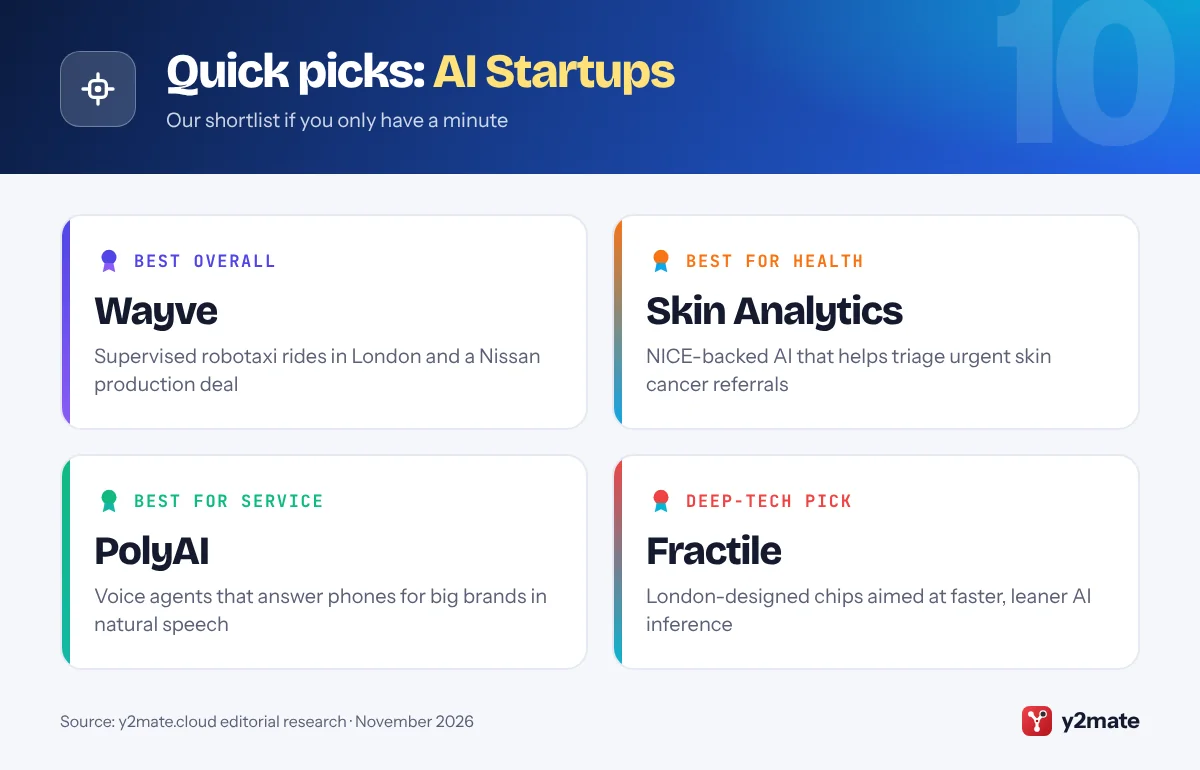
- Uber and Wayve began supervised self-driving rides for paying passengers in London in September 2026, with a safety operator on board.
- NICE conditionally recommended Skin Analytics' DERM for NHS skin cancer pathways in May 2025 while more evidence is gathered.
- Faculty agreed to be acquired by Accenture in January 2026 and Isomorphic Labs is owned by Alphabet, so neither is listed as an independent UK startup.
- The government's Sovereign AI Unit, launched in April 2026, invests in UK AI startups and gives selected companies time on national supercomputers.
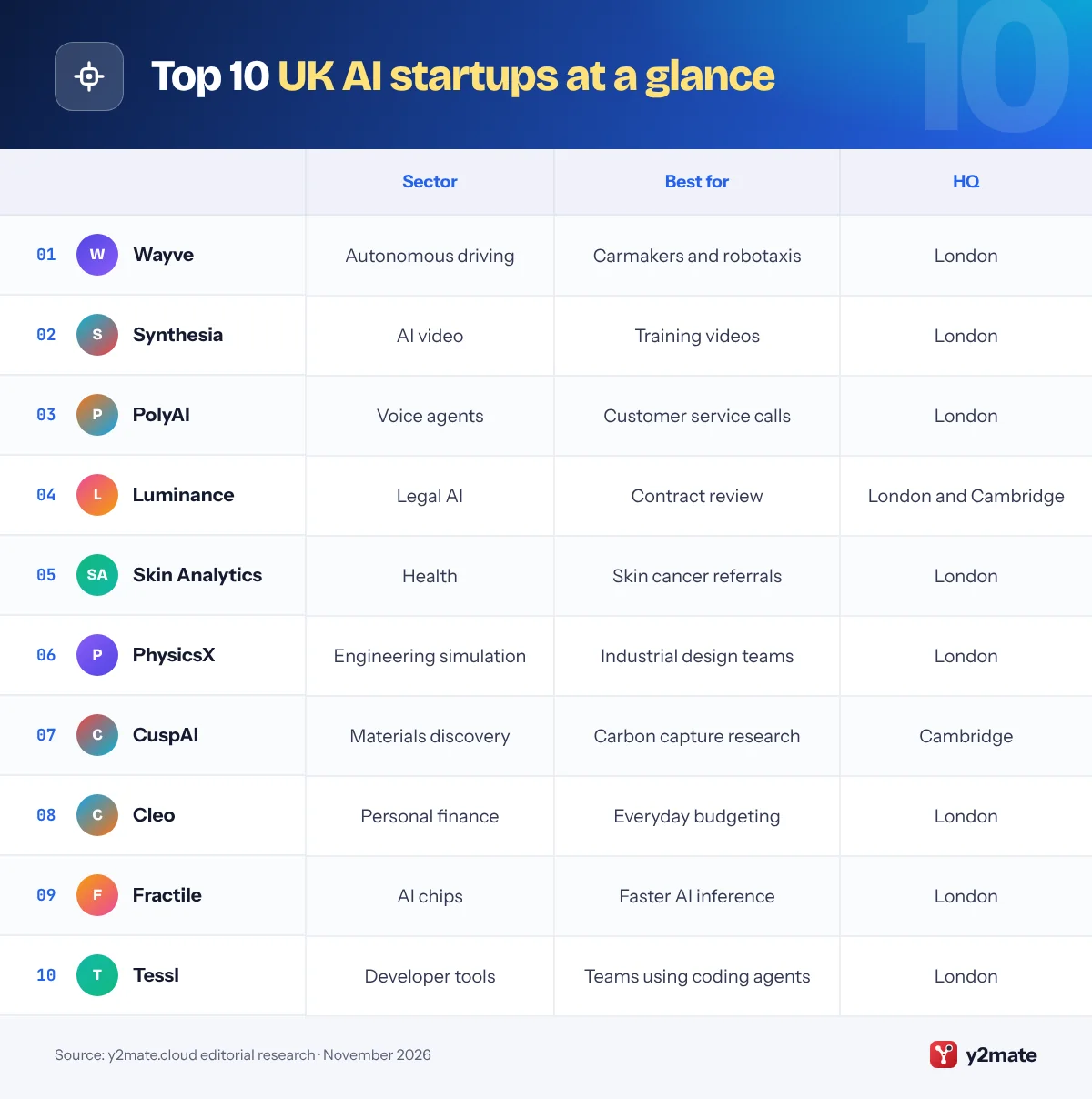
The AI startups in the UK most worth watching in 2026 are Wayve for self-driving technology, Synthesia for AI video, PolyAI for voice agents and Luminance for contract work, followed by Skin Analytics, PhysicsX, CuspAI, Cleo, Fractile and Tessl. All ten were founded in Britain and were still independent and headquartered here in November 2026, and together they span ten different sectors.
A few definitions first. A startup is a young company still proving its product and business model, while a scale-up has found paying customers and is growing quickly, often opening offices abroad; several companies here are scale-ups. A foundation model is a large AI model trained on broad data that can be adapted to many tasks, like the models behind chatbots. An AI agent is software that can plan and carry out multi-step tasks, such as rebooking a hotel or redlining a contract, with limited human input.
The list skips big labs such as Google DeepMind, which feature in our global list of AI companies to watch, and explains the British context: the AI Opportunities Action Plan, the AI Security Institute, AI Growth Zones and what they mean for users and job seekers.
How we ranked this list
We ranked companies on publicly documented criteria only: what each product does today, customers and partners the company itself has announced, regulatory milestones such as UKCA marking or NICE guidance, and how technically significant the work is. We confirmed that each company was UK-headquartered, independent and trading in November 2026. We did not test any products ourselves, and we leave out funding figures, which change quickly and say little about how useful a product is.
Some well-known names are missing on purpose. Isomorphic Labs is owned by Alphabet, Faculty agreed to be acquired by Accenture in January 2026, and Robin AI sold its managed services arm after its funding plans collapsed in 2025. ElevenLabs has a large London office that it calls its European headquarters, but it is widely described as headquartered in New York, so it is not listed here.
The Top 10 AI Startups
1. Wayve
Best for: carmakers and robotaxi services
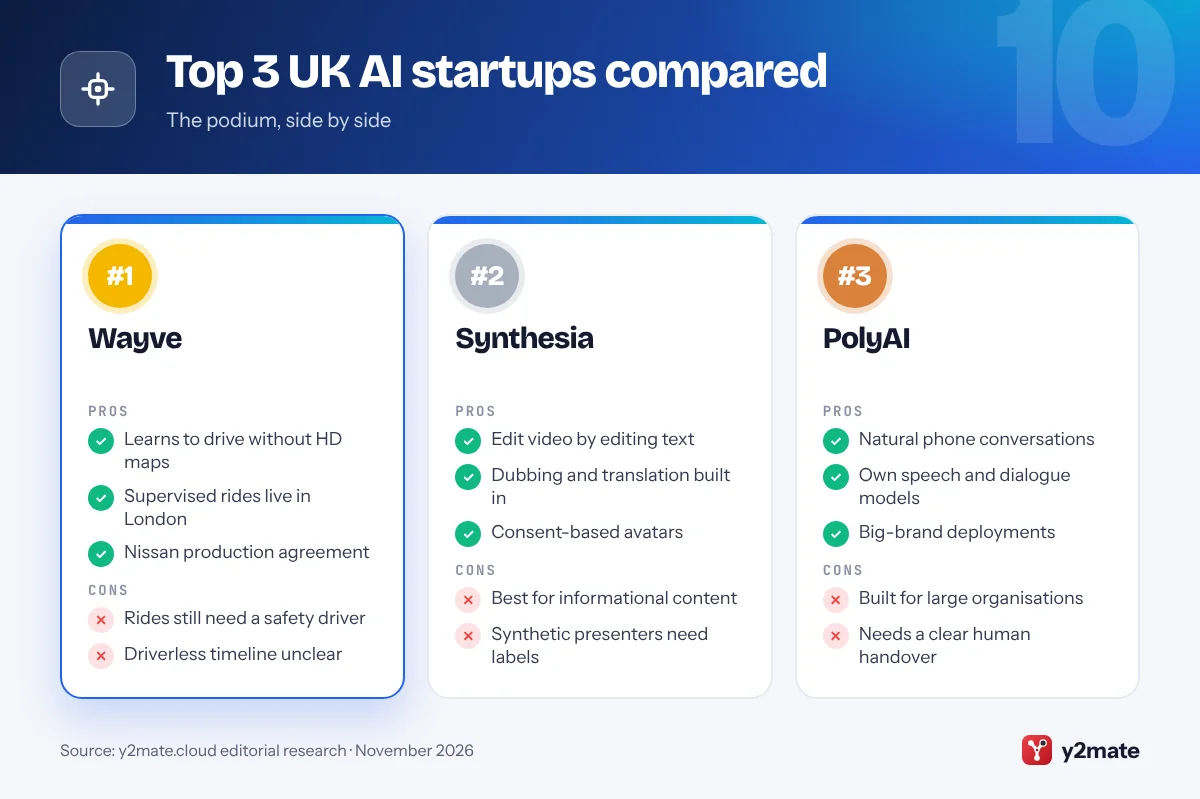
Wayve was founded in Cambridge in 2017 by Alex Kendall and Amar Shah and is now based in London. It builds embodied AI for driving. Instead of hand-written rules and detailed high-definition maps, its Wayve AI Driver learns from camera and sensor data, so the same software can adapt to new cities and vehicles.
2026 has been a breakthrough year. In September, Uber and Wayve began offering supervised self-driving rides to paying passengers in London, with a safety operator on board, under fast-tracked government pilots that run ahead of the Automated Vehicles Act 2024 coming fully into force. Wayve also signed a research-sharing memorandum with the government in May, and Nissan has signed agreements to build Wayve AI Driver into the next generation of its ProPILOT driver-assistance system, starting with models in Japan from its 2027 financial year.
Why it matters: Wayve is the clearest test of whether a learning-based approach can match rivals that depend on detailed maps. The open question is timing. Rides are still supervised, and driverless service depends on safety evidence and regulators as much as technology.
Official site: Wayve
- Learns to drive without HD maps
- Supervised rides live in London
- Nissan production agreement
- Rides still need a safety driver
- Driverless timeline unclear
2. Synthesia
Best for: companies making training videos at scale
Synthesia, founded in London in 2017, turns a written script into a video presented by a realistic AI avatar. Businesses use it mainly for training, onboarding, compliance courses and internal updates, because changing a sentence means editing text rather than reshooting. It also dubs and translates videos and offers interactive avatars for role-play, for example to help sales staff practise difficult calls.
Synthesia has made trust a selling point: avatars of real people require their consent, and the company moderates what users can generate. In June 2026 it signed a memorandum of understanding with the Department for Science, Innovation and Technology to support AI adoption and workforce upskilling, announced at London Tech Week.
Why it matters: Synthesia makes video as easy to update as a document. The limitation is the format itself. Avatar videos suit structured, informational content but can feel flat for storytelling, and viewers increasingly expect to be told when a presenter is synthetic, so organisations should label AI video clearly.
Official site: Synthesia
- Edit video by editing text
- Dubbing and translation built in
- Consent-based avatars
- Best for informational content
- Synthetic presenters need labels
3. PolyAI
Best for: busy customer service phone lines
PolyAI was founded in 2017 by researchers who met in the University of Cambridge’s dialogue systems group, and it is headquartered in London. It builds voice agents that answer the phone for large organisations, handling reservations, billing questions, account changes and call routing in natural conversation rather than press-one menus.
The company trains its own speech and dialogue models, including its Raven and RSN model families, and sells Dialog Studio, a platform for designing, testing and monitoring agents. In 2026 it opened its agent-building tools and model API to outside developers. PolyAI names hotel group Marriott, Caesars Entertainment, US utility PG&E, Volkswagen and Metro Bank among organisations that have deployed its agents, and it has expanded heavily into North America.
Why it matters: the phone is still where customers go with urgent problems, and PolyAI bets that a well-designed agent can solve them instead of deflecting the caller. The open question is how quality holds up across regional accents, noisy lines and unusual requests, so businesses should keep an obvious route to a human.
Official site: PolyAI
- Natural phone conversations
- Own speech and dialogue models
- Big-brand deployments
- Built for large organisations
- Needs a clear human handover
4. Luminance
Best for: legal teams reviewing and negotiating contracts
Luminance was founded in 2015 by mathematicians from the University of Cambridge and runs from London and Cambridge. It applies what it calls legal-grade AI to contracts: it reads agreements, flags risky clauses, compares them with a company’s standard positions and suggests changes. Its Autonomous Negotiation tool, first shown as Autopilot in 2023, can handle routine documents such as non-disclosure agreements with limited human input.
Luminance trains its own legal language models, and in 2026 it introduced Luna Crescent, the first of a model family built for contracts. In April it announced an alliance with LexisNexis to bring LexisNexis legal content and AI into its platform, and it received a King’s Award for Enterprise in International Trade. Customers it has announced recently include Ajinomoto Europe and London broadband provider Community Fibre.
Why it matters: contract review is high-volume, costly work, and Luminance extends it beyond legal teams to procurement and finance. The limitation is control: automated negotiation needs clear guardrails, and legal teams must decide which agreements are safe to leave to software.
Official site: Luminance
- Built specifically for contracts
- LexisNexis content alliance
- Automates routine negotiation
- Aimed at larger legal teams
- Automation needs guardrails
5. Skin Analytics
Best for: NHS skin cancer referral pathways
Skin Analytics, founded in London in 2012, makes DERM, an AI medical device that assesses smartphone photographs of skin lesions taken through a dermatoscope lens. In urgent suspected skin cancer pathways, it helps identify which patients need a dermatologist quickly and which lesions are benign.
Its regulatory record is unusually strong for a young company. DERM carries UKCA marking for use in the UK, and in Europe it holds a Class III CE mark covering autonomous use. In May 2025 the National Institute for Health and Care Excellence (NICE) conditionally recommended DERM through an early value assessment, allowing NHS use while more evidence is collected until 2028. NHS England asks sites to start with a second clinical read, and to keep one for patients with black or brown skin. In June 2026 the company unveiled DERM Zero, designed to work on a standard smartphone camera.
Why it matters: faster answers about worrying moles free specialists for the patients who need them most. The open question is performance across every skin type and clinical setting, which is exactly what the NICE conditions are designed to test.
Official site: Skin Analytics
- NICE conditional recommendation
- UKCA and Class III CE marks
- Already used in NHS pathways
- Evidence still being gathered
- Extra checks for darker skin
6. PhysicsX
Best for: engineers designing chips, cars and aircraft
PhysicsX was founded in London in 2019 by a team with roots in Formula One engineering and applied AI. Its AI models predict how a physical design will behave, such as airflow over a wing or heat inside semiconductor equipment, far faster than conventional simulation, so engineers can explore many more options before building anything.
The company calls its approach Large Physics Models: AI trained on large volumes of high-quality simulation data that can generalise across designs. It has worked with Siemens since 2024, using Siemens’ Simcenter software to generate training data, and its public Ai.rplane demonstrator shows aircraft design ideas being evaluated in real time. Siemens, Applied Materials and NVIDIA are among its investors, and semiconductors, industrial machinery and automotive are key markets. In 2026 it began expanding into the US and Singapore while keeping its headquarters in London.
Why it matters: near-instant simulation could speed up product development across heavy industry. The open question is trust. Engineers will want predictions validated against physical tests before relying on them for safety-critical parts.
Official site: PhysicsX
- Near-instant physics predictions
- Siemens partnership
- Works across many industries
- Needs validation for safety parts
- Industrial customers only
7. CuspAI
Best for: industries searching for new materials
CuspAI was founded in Cambridge in 2024 by chemist Chad Edwards and machine learning researcher Max Welling. It combines generative AI with physics-based simulation to search for new materials, such as sorbents that capture carbon dioxide or materials that clean water. Rather than testing compounds one by one, its models propose candidates with the properties a customer needs.
The company has a partnership with Finnish chemicals group Kemira to look for materials that remove so-called forever chemicals from water. In July 2026 it launched the AI Materials Foundry, a coalition of technology companies, industrial firms and research institutions, including Meta and NVIDIA, to speed up discovery. It is adding teams in Singapore and the US while keeping its base in Cambridge.
Why it matters: new materials are a bottleneck for carbon capture, clean energy and electronics, and CuspAI is one of the UK’s most ambitious bets on AI for science. The limitation is that discovery is only the first step. A promising material still has to be made, tested and manufactured at scale, which can take years.
Official site: CuspAI
- Targets carbon capture and water
- Kemira partnership
- Cross-industry coalition
- Lab and factory scale-up is slow
- Early commercial results
8. Cleo
Best for: young adults who want help with everyday money
Cleo is an AI money assistant founded in London in 2016. It connects to your bank account and uses a chat interface, with a deliberately cheeky personality, to help you budget, save and avoid running short before payday. It grew mainly in the US, but in February 2026 it began relaunching in the UK with a staged rollout and a feature called Autopilot, which maps out longer-term goals and helps you act on them.
Cleo’s history shows why scrutiny matters. In 2025 it settled a US Federal Trade Commission case alleging that it misled users about the size and timing of cash advances and made its subscription hard to cancel, and it agreed to clearer disclosures and simpler cancellation. In the UK, open banking access and consumer credit are regulated by the Financial Conduct Authority, so check any money app’s status on the FCA’s Financial Services Register before linking your accounts.
Why it matters: Cleo’s UK return will test whether chat-based coaching can help people under financial pressure. Before signing up, check which features are available here, what they cost and how to cancel.
Official site: Cleo
- Friendly chat-based budgeting
- Autopilot goal planning
- Relaunching in the UK
- UK rollout still staged
- Past FTC case in the US
9. Fractile
Best for: running AI models faster and more efficiently
Fractile is a London chip startup founded in 2022 by its chief executive, Walter Goodwin. It is designing processors for inference, the stage where a trained AI model actually answers questions, rather than for training. Its design performs calculations inside the chip’s memory, cutting the time and energy spent shuttling data back and forth, which is one of the main bottlenecks when large models generate text.
In 2026 it announced an expanded UK operation, including a hardware engineering centre in Bristol, and it has been taping out test chips. Its backers include the NATO Innovation Fund and Oxford Science Enterprises. Bristol is also home to Isambard-AI, one of the national supercomputers behind the government’s AI Research Resource.
Why it matters: inference demand is growing as AI agents run longer tasks, and the UK has few advanced chip designers. The obvious limitation is that chips take years to reach volume production. Fractile’s processors were not on sale in November 2026, so it is a company to watch rather than a supplier you can buy from today.
Official site: Fractile
- In-memory compute design
- Adds UK chip design capacity
- Focused on fast inference
- Chips not on sale yet
- Hardware takes years to scale
10. Tessl
Best for: developers working with AI coding agents
Tessl was founded in London in 2024 by Guy Podjarny, who previously founded developer security company Snyk. It builds tools for AI-native software development, where developers describe what they want and AI coding agents write much of the code, and it now pitches its platform as a software factory.
At its core is a registry of agent skills: reusable packages of instructions and context that teach agents such as Claude Code, Cursor, GitHub Copilot and Gemini how to use particular libraries and follow a team’s standards. Around that, Tessl offers tools to evaluate skills before and after changes, scan them for security problems, and run automated loops such as code review. There is a free tier. Tessl also runs the AI Native Dev community and held AI Native DevCon in London in June 2026.
Why it matters: coding agents often guess at APIs or ignore house rules, producing code that looks right and fails. Shared, tested context is one practical fix. The open question is whether this becomes its own product category or a feature the big coding platforms absorb. For UK developers, its free tier and events are an easy way to see where the field is heading.
Official site: Tessl
- Registry of reusable agent skills
- Works with major coding agents
- Free tier to start
- Category still taking shape
- Big platforms may copy it
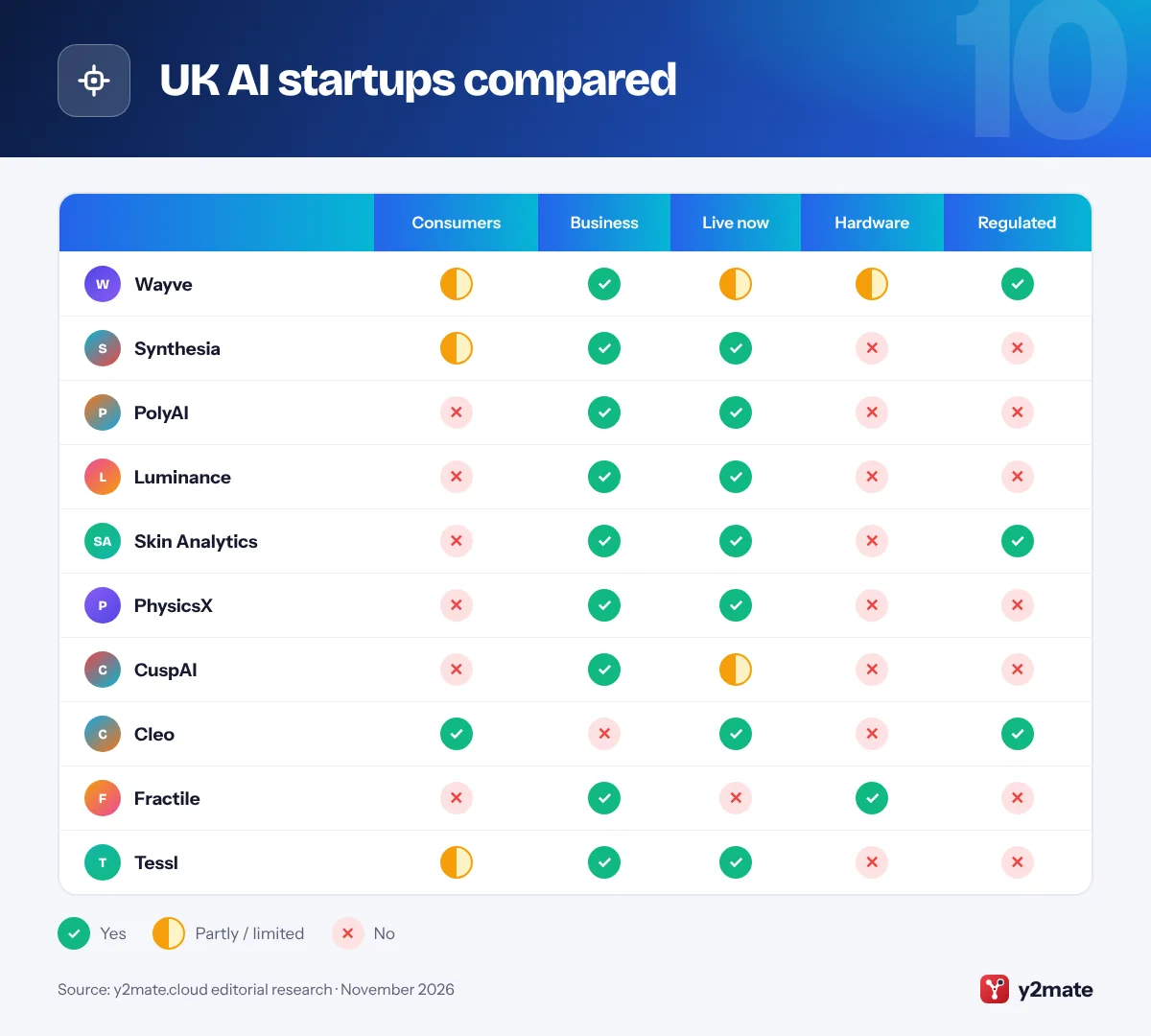
UK AI startups compared
How to judge AI startups in the UK
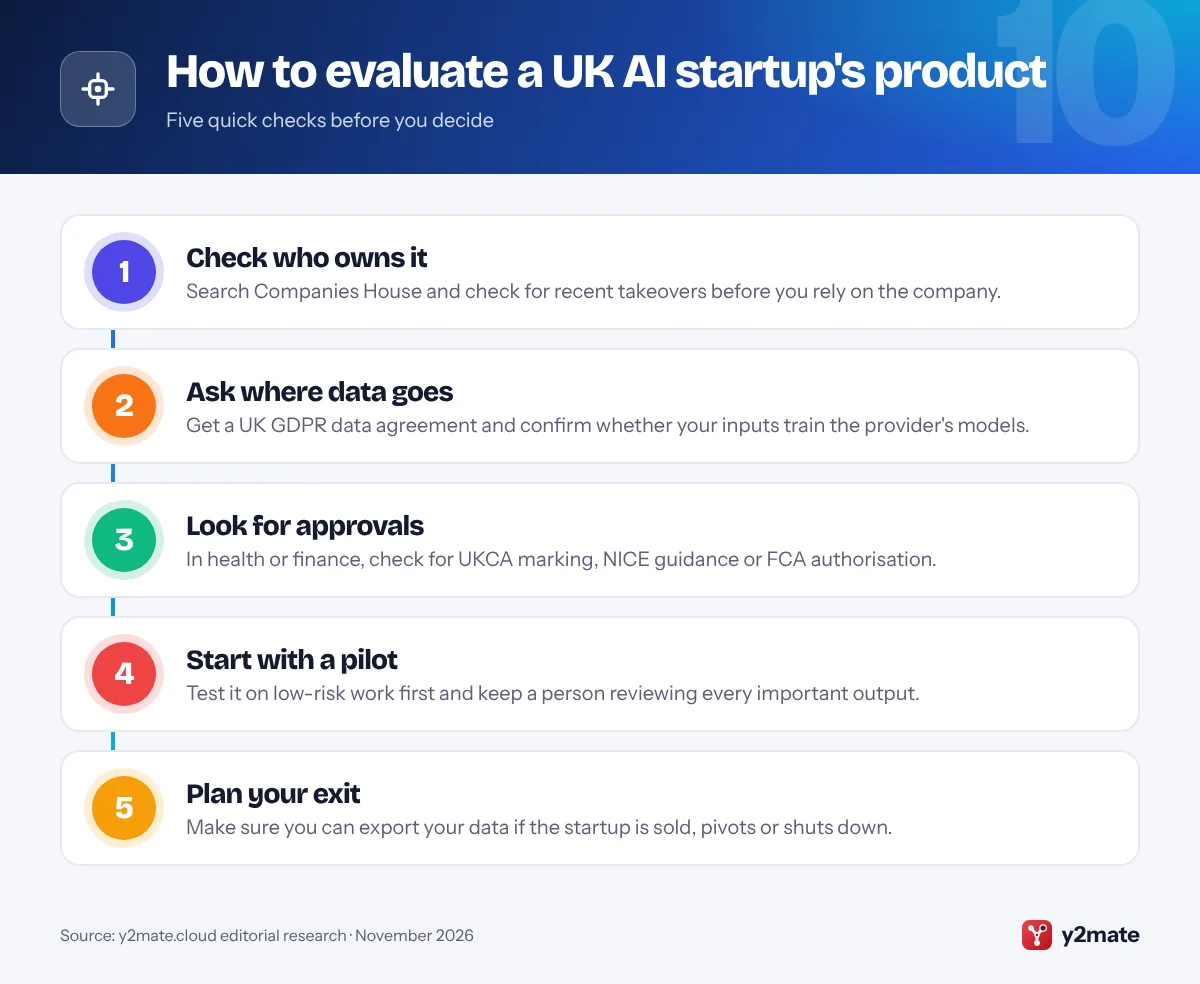
Before you rely on one of these products, or join one of these companies, check who owns the business, where your data goes and which regulator oversees your use.
The support behind British AI
- AI Opportunities Action Plan: published in January 2025, it set the government’s strategy for compute, data, talent and adoption. It led to AI Growth Zones for data centres, with sites named so far in Oxfordshire, North East England, North and South Wales, and Lanarkshire in Scotland.
- Sovereign AI Unit: launched in April 2026, it invests directly in UK AI startups and gives selected companies time on national supercomputers, such as Isambard-AI in Bristol, through the AI Research Resource.
- AI Security Institute: renamed from the AI Safety Institute in February 2025, it tests advanced AI models for security risks and publishes research and tools that smaller companies can build on.
What it means for users
UK GDPR applies to any tool that handles personal data, so ask for a data processing agreement and check whether your inputs are used to train the provider’s models. Sector rules still apply on top: medical software must meet MHRA medical device rules, usually shown by UKCA or CE marking; money apps must be authorised by, or work through, an FCA-regulated firm; and solicitors stay responsible for anything they file, whoever or whatever drafted it.
What it means for job seekers
Most of these companies cluster in London and Cambridge, with chip work growing in Bristol, close to universities that supply research talent. Many roles are not research jobs: forward-deployed engineers, solutions architects, clinical and legal specialists, and policy and safety staff are all needed. Overseas specialists often use the Global Talent visa.
Frequently asked questions
What are the best AI startups in the UK to watch in 2026?
Wayve in self-driving, Synthesia in AI video, PolyAI in voice agents and Luminance in contracts are the most established, all still independent and UK-headquartered in November 2026. Skin Analytics, PhysicsX, CuspAI, Cleo, Fractile and Tessl add health, engineering, materials, personal finance, chips and developer tools.
What is the difference between a startup and a scale-up?
A startup is a young company still proving that its product works and that customers will pay for it. A scale-up has already found that demand and is focused on growing quickly, often by hiring heavily and expanding abroad. Wayve, Synthesia and PolyAI are now really scale-ups, while Fractile and Tessl are earlier-stage startups.
Why are Google DeepMind and Isomorphic Labs not on this list?
Both are owned by Alphabet, Google's parent company, so they are not independent startups. Google DeepMind appears in our global list of AI companies to watch. This list covers only independent companies founded and headquartered in the UK, which is also why Faculty, which agreed to be acquired by Accenture, is left out.
How does the UK government support AI startups?
The AI Opportunities Action Plan, published in January 2025, sets the overall strategy. The Sovereign AI Unit, launched in April 2026, invests directly in British AI startups and offers selected companies time on national supercomputers through the AI Research Resource. AI Growth Zones aim to speed up data centre building, and the AI Security Institute researches the risks of advanced AI models.
Is it safe to use AI startup tools at work?
It can be, with the right checks. Confirm who owns the company, sign a UK GDPR data processing agreement, find out whether your data trains the provider's models and check sector approvals such as UKCA marking for medical software. Start with a small pilot, keep a person reviewing important outputs and make sure you can export your data.
Final verdict
The AI startups in the UK to watch in 2026 are led by Wayve, Synthesia, PolyAI and Luminance, which have moved from promising research to products used by large organisations. Skin Analytics and PhysicsX show British AI succeeding in regulated and industrial settings, while CuspAI, Fractile and Tessl are earlier bets on materials, chips and the future of software development.
If you are choosing a tool, start with a small pilot, check data handling and sector approvals, and keep a human in charge of important decisions. If you are job hunting, look beyond research roles.
Sources and further reading
- AI Opportunities Action Plan: The government's January 2025 plan for UK compute, data, skills and AI adoption, which led to AI Growth Zones and new support for startups.
- The AI Security Institute: The UK government body that tests advanced AI models for security risks and publishes its research and evaluation tools.
- AI Growth Zones on GOV.UK: Official announcements on the sites chosen to host large AI data centres across England, Wales and Scotland.
- NICE guidance on AI skin assessment: The NICE early value assessment that conditionally recommends AI technology for triaging urgent suspected skin cancer referrals in the NHS.
- Automated Vehicles Act 2024: The full text of the law that sets out how self-driving vehicles will be authorised and regulated on British roads.

Leave a Reply