- NEXTDC and OpenAI signed a non-binding agreement in December 2025 to develop an AI campus at S7 in Eastern Creek, with the first phase targeted for the second half of 2027, subject to approvals.
- Australia's Data Centre Expectations, released on 23 March 2026, ask developers to support the national interest, avoid pushing up energy prices, use water sustainably and invest in local skills.
- National Cabinet agreed in August 2026 to develop consistent mandatory standards for data centre energy, water and land use, with Commonwealth legislation planned for early 2027.
- Microsoft signed a memorandum of understanding with the federal government in April 2026 committing its Australian expansion to the Data Centre Expectations.
- NCI and Pawsey told a parliamentary inquiry in October 2026 that current funding is not enough to fully replace the Gadi and Setonix supercomputers, which reach the end of their supported life in 2028.
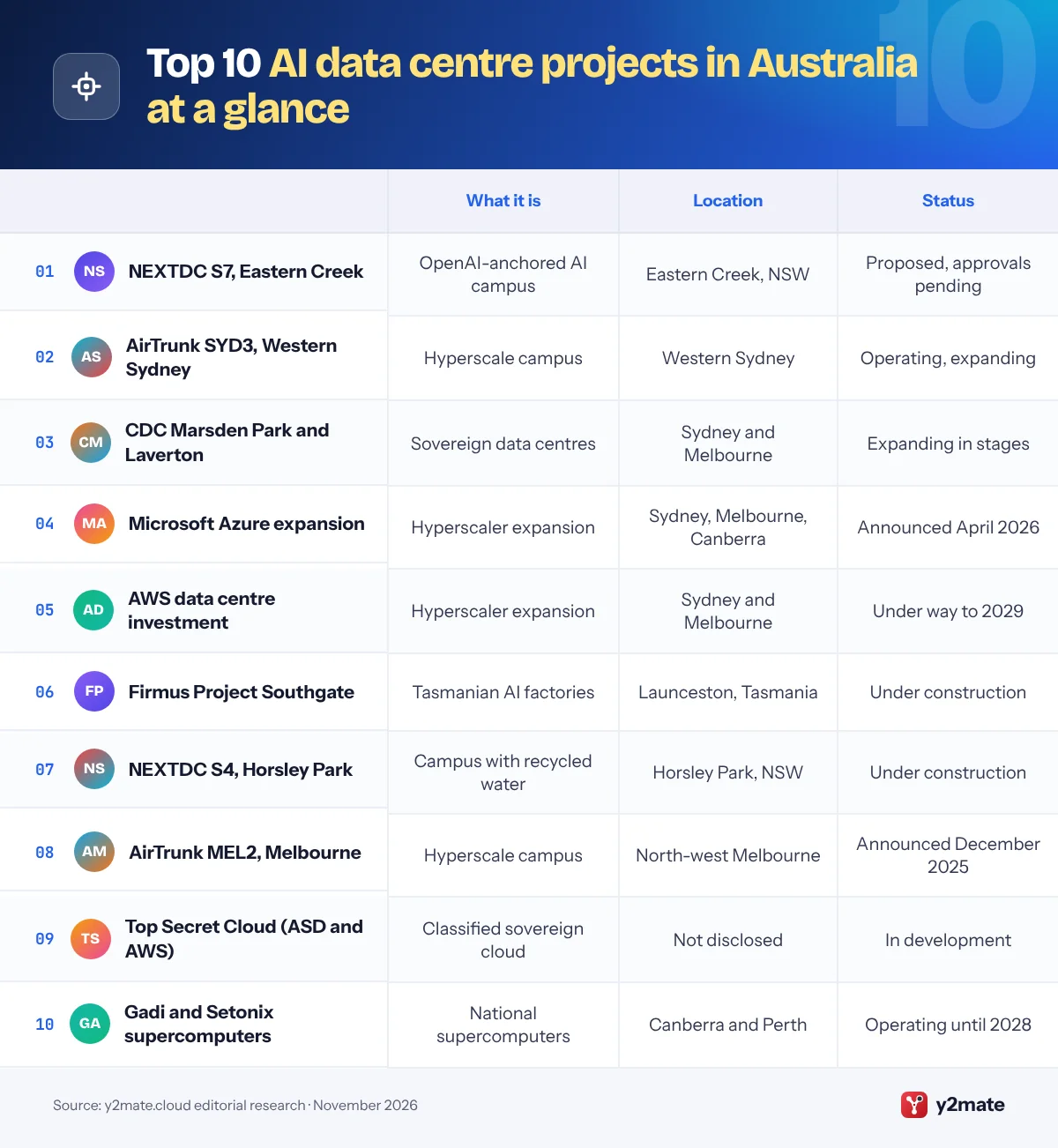
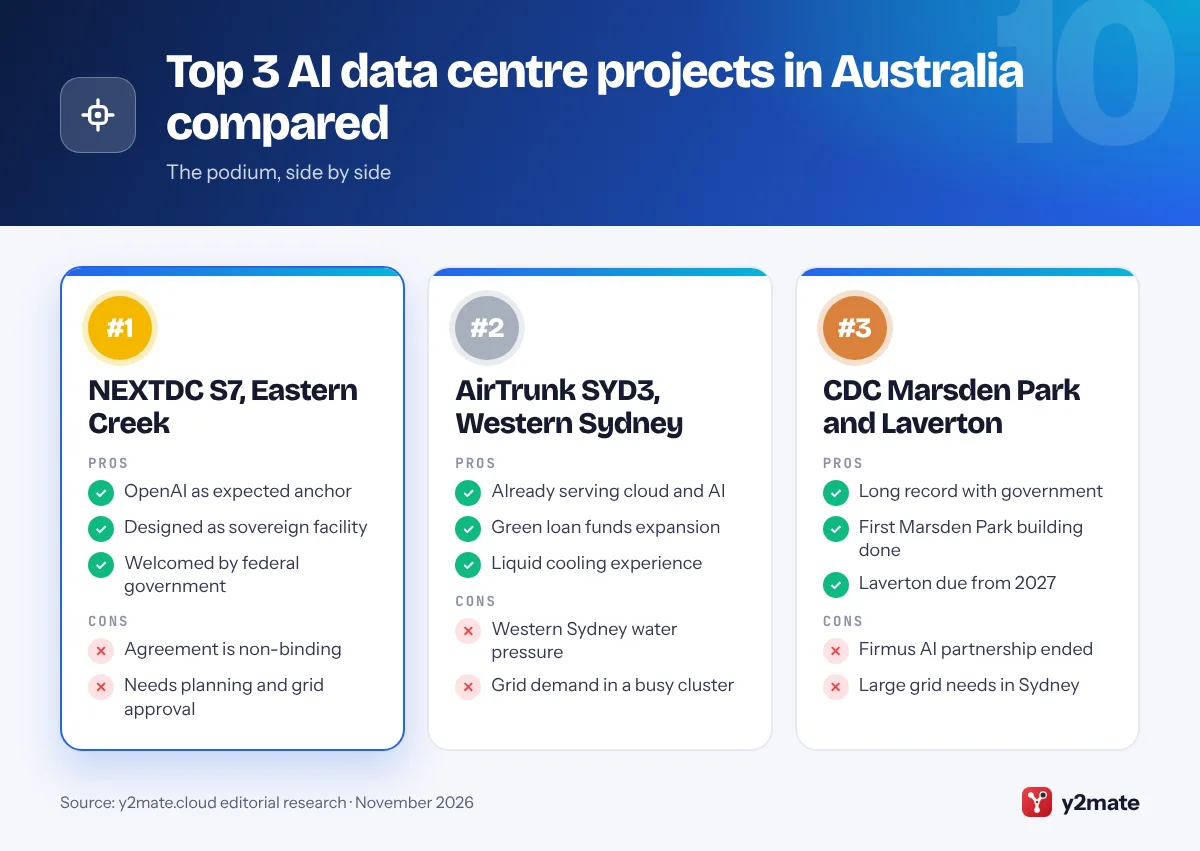
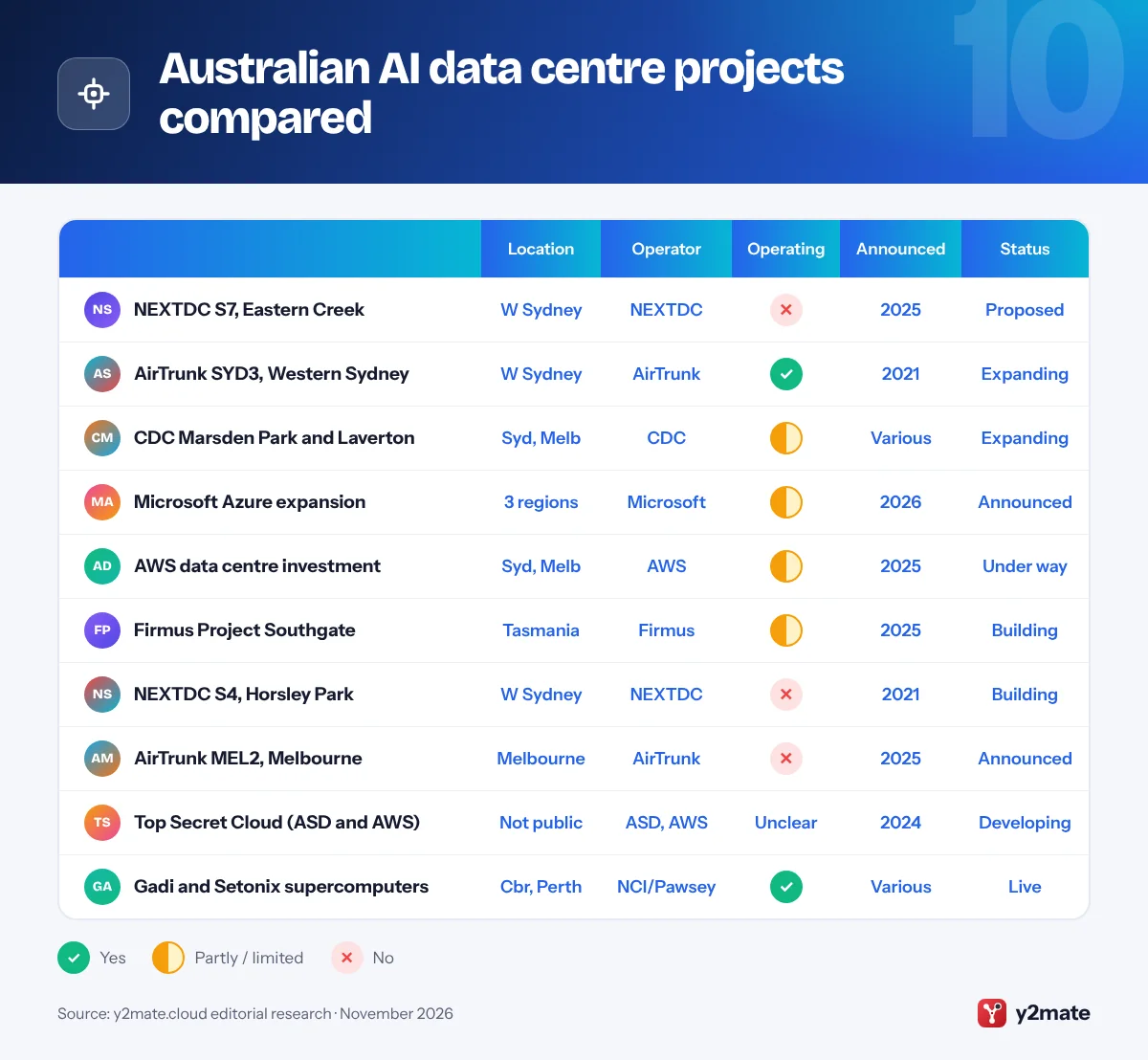
The biggest AI data centre projects in Australia in 2026 are NEXTDC’s planned S7 campus in Western Sydney, anchored by OpenAI, AirTrunk’s SYD3 campus and CDC’s Marsden Park and Laverton campuses. Microsoft’s and AWS’s national expansion plans, Firmus’s Project Southgate in Tasmania, NEXTDC’s S4, AirTrunk’s MEL2, the Top Secret Cloud for Defence and intelligence agencies, and the Gadi and Setonix research supercomputers complete the list.
An AI data centre is a facility built to train and run AI models, usually on a GPU cluster, a large group of graphics processors linked so they work as one machine. A hyperscaler is a company such as Microsoft, Amazon or Google that runs cloud data centres at very large scale. A grid connection is the agreement and physical link that lets a site draw power, arranged with network businesses and planned for by AEMO, the Australian Energy Market Operator. Sovereign capacity usually means data centres located in Australia and operated under Australian law and security rules, with sensitive data kept onshore.
Government rules are tightening. The National AI Plan was released on 2 December 2025, the Data Centre Expectations followed on 23 March 2026, and in August 2026 National Cabinet agreed to develop mandatory national standards for data centre energy, water and land use, with Commonwealth legislation planned for early 2027.
How we ranked this list
We ranked projects by their scale and significance as described in official sources, how far they have progressed and how much public debate they have generated over energy, water and sovereignty. We used company announcements and investor updates, federal and state government releases, AEMO publications and parliamentary inquiry material, and checked each status as of November 2026.
We did not visit the sites. We leave out investment totals, capacity figures and job estimates because they are often projections that change. Where a project is not yet running, we describe it as proposed, announced or under construction.
The Top 10 AI Data Centres
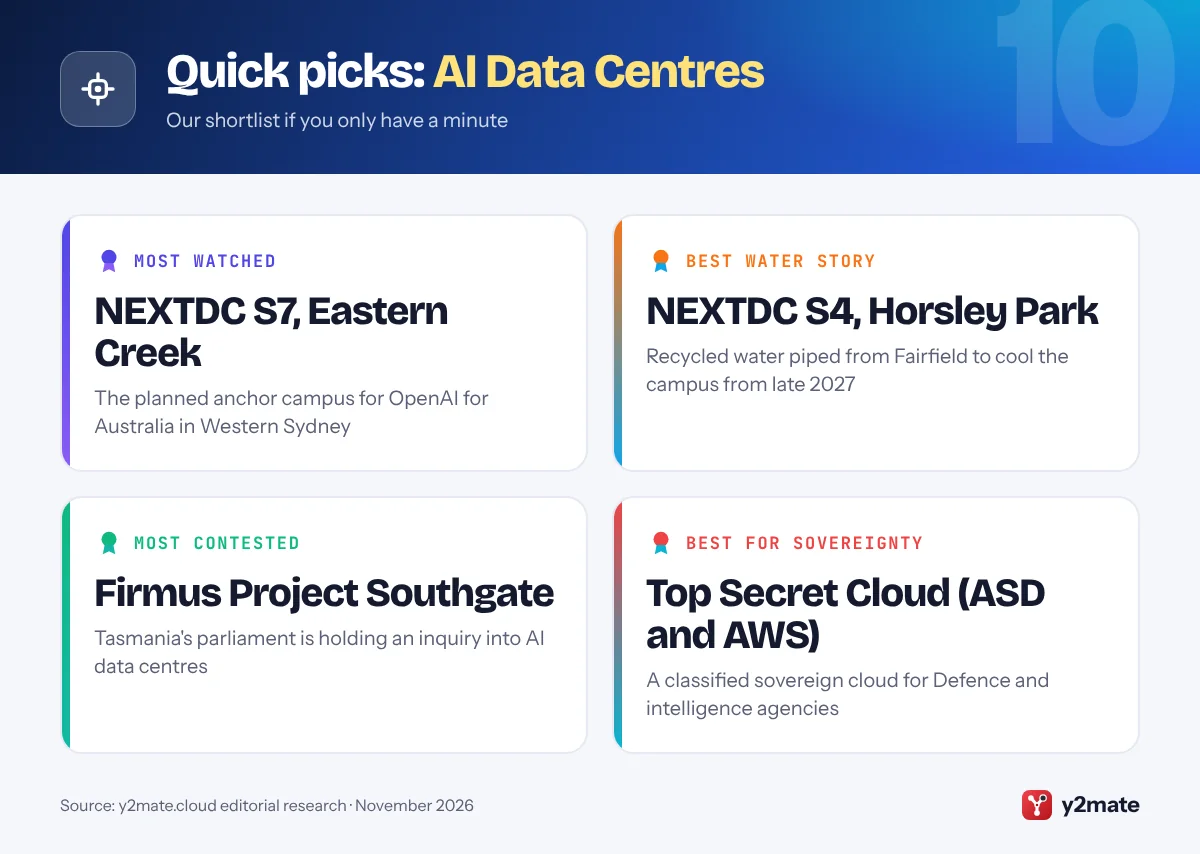
1. NEXTDC S7, Eastern Creek
Best for: OpenAI’s planned AI campus in Sydney
NEXTDC’s S7 campus at Eastern Creek in Western Sydney is the project most closely tied to OpenAI’s plans for Australia. In December 2025, under the OpenAI for Australia initiative, NEXTDC and OpenAI signed a memorandum of understanding to plan, build and operate a hyperscale AI campus and GPU supercluster at S7, with OpenAI expected to be an anchor customer. The memorandum is non-binding, with detailed commercial terms still to be settled.
NEXTDC says the campus is being engineered as a sovereign AI facility, with security and resilience aligned to the Security of Critical Infrastructure (SOCI) framework. It targeted the first phase for the second half of 2027, subject to planning and regulatory approvals, and the federal government welcomed the deal.
The open questions are approvals, power and water. A large new campus in Western Sydney needs a major grid connection, and S7 will be judged against the Data Centre Expectations, which ask operators not to push up energy prices and to use water sustainably. By November 2026 we found no public announcement that the memorandum had become a binding contract.
Official site: NEXTDC S7, Eastern Creek
- OpenAI as expected anchor
- Designed as sovereign facility
- Welcomed by federal government
- Agreement is non-binding
- Needs planning and grid approval
2. AirTrunk SYD3, Western Sydney
Best for: hyperscale capacity already serving cloud and AI
AirTrunk is a Sydney-founded hyperscale data centre company owned since 2024 by Blackstone and the Canadian pension investor CPP Investments. SYD3, its third Sydney campus, in Western Sydney, was first announced in 2021, serves large cloud and AI customers and is still being expanded.
In October 2026 AirTrunk secured a large green loan from a group of banks to fund SYD3’s continued development. A green loan must fund projects that meet environmental criteria, and AirTrunk said savings from the loan’s margin structure would go to its social impact programme. It has also deployed direct-to-chip liquid cooling for dense AI hardware at its Malaysian campus, experience that matters as AI chips run hotter.
SYD3 sits in the Western Sydney cluster, where water is the hottest local issue. Sydney Water projections cited at the NSW parliamentary inquiry suggested data centres could take a much larger share of Sydney’s drinking water by 2035 if operators keep relying on potable supplies, while AirTrunk has said its own modelling points to much lower use. The inquiry reported on 5 November 2026.
Official site: AirTrunk SYD3, Western Sydney
- Already serving cloud and AI
- Green loan funds expansion
- Liquid cooling experience
- Western Sydney water pressure
- Grid demand in a busy cluster
3. CDC Marsden Park and Laverton
Best for: sovereign data centres for government and cloud
CDC Data Centres began in Canberra in 2007 serving government and is now co-owned by New Zealand’s Infratil and Australian investors including the Future Fund. Its main new builds are the Marsden Park campus in north-west Sydney and the Laverton campus in Melbourne’s west.
In September 2026 CDC told investors that the first data centre at Marsden Park was finished, with more due across its 2028 and 2029 financial years. At Laverton, the first building is expected to open late in the 2027 financial year, with two more in the 2028 financial year. CDC has also completed new data centres in Canberra at Hume and Beard and is buying land for a third Sydney campus at Kemps Creek.
CDC describes itself as an owner and operator of sovereign, highly secure data centres, serving government, critical infrastructure operators and hyperscalers. Its planned AI factory partnership with Firmus did not proceed. The open questions are power in Western Sydney and Melbourne’s west, and how coming national standards will apply to campuses already being built.
Official site: CDC Marsden Park and Laverton
- Long record with government
- First Marsden Park building done
- Laverton due from 2027
- Firmus AI partnership ended
- Large grid needs in Sydney
4. Microsoft Azure expansion
Best for: AI cloud capacity tied to government expectations
On 23 April 2026 Microsoft chairman and chief executive Satya Nadella and Prime Minister Anthony Albanese announced a major Microsoft investment in Australia running to the end of 2029. It will significantly expand Microsoft’s Azure AI supercomputing and cloud infrastructure, building on an October 2023 commitment that grew its data centre presence across three Azure regions in Sydney, Melbourne and Canberra.
The investment is underpinned by a memorandum of understanding with the federal government, in which Microsoft affirms its commitment to the Data Centre Expectations on the national interest, clean energy, sustainable water use, local skills and jobs, and research. Microsoft points to its goals of matching its energy use with renewable energy and becoming water positive by 2030.
The package also expands the Microsoft-ASD Cyber Shield to more government agencies, adds collaboration with the Australian AI Safety Institute and starts work with Home Affairs on data centre and cloud resilience. The open questions are where the new capacity will be built, since the announcement named no individual sites, and how quickly grid connections can be secured.
Official site: Microsoft Azure expansion
- MoU on Data Centre Expectations
- Builds on three Azure regions
- Linked to ASD Cyber Shield
- New sites not yet named
- Grid connections still needed
5. AWS data centre investment
Best for: cloud and AI capacity backed by new solar farms
In June 2025 Amazon Web Services announced a plan running from 2025 to 2029 to expand, operate and maintain its data centre infrastructure in Australia, centred on its Sydney and Melbourne cloud regions. AWS presented it as supporting demand for cloud services and generative AI, the technology behind chatbots and AI image tools, from Australian customers.
The plan comes with energy commitments. Amazon agreed to buy power from three new solar farms in Victoria and Queensland, to be built and operated by European Energy, adding new renewable generation to the grid rather than drawing only on existing supply. AWS is also building the Top Secret Cloud for Defence and intelligence agencies, covered separately below.
AWS’s plan matters because it signals sustained hyperscaler demand in Sydney and Melbourne. AEMO’s 2026 Electricity Statement of Opportunities identifies data centres as a key driver of electricity consumption growth in NSW, Victoria and South Australia. The open questions are where new buildings will go and how quickly they can connect to the grid.
Official site: AWS data centre investment
- New solar farms add supply
- Long-term plan to 2029
- Supports local AI services
- Individual sites not named
- Heavy grid demand in NSW, Vic
6. Firmus Project Southgate
Best for: AI factories on Tasmania’s renewable grid
Firmus Technologies calls its AI data centres AI factories, and Project Southgate is its plan to build them in Australia, starting at St Leonards near Launceston in northern Tasmania. NVIDIA is an investor and technology partner, the draw is Tasmania’s largely hydro-powered grid, and in June 2025 the Tasmanian Government created an AI Factory Zone in the north of the state to support the project.
The Launceston AI factory is under construction, George Town Council approved a second site at Long Reach near Bell Bay in August 2026, and a third is proposed at Wesley Vale. Firmus, CDC Data Centres and NVIDIA announced plans in October 2025 to extend Southgate nationally, but in October 2026 Firmus and CDC confirmed they had agreed not to proceed with that partnership, and reports said only a small part of the national plan had been deployed.
Tasmania’s power is also the controversy. A petition calling for a moratorium drew thousands of signatures, and in August 2026 the House of Assembly opened an inquiry into AI data centres in Tasmania. Firmus has backed tougher rules assessed project by project.
Official site: Firmus Project Southgate
- Renewable Tasmanian power
- NVIDIA as investor and partner
- Second Tasmanian site approved
- CDC partnership did not proceed
- State inquiry under way
7. NEXTDC S4, Horsley Park
Best for: data centre cooling with recycled water
S4 is NEXTDC’s large campus at Horsley Park in Western Sydney, first announced in 2021 and assessed by the NSW Government as State Significant Development. Builder Multiplex broke ground in March 2026, completion is targeted for mid-2027, and NEXTDC raised new capital in April 2026 to speed up its Sydney rollout.
Water is what makes S4 stand out. In late October 2026 coNEXA, the operator of Western Sydney’s AquaNet recycled water network, announced an expansion to pipe recycled water from its Fairfield plant to S4, with NEXTDC as the first customer. The scheme needs approval from IPART, the NSW pricing regulator, which has consulted on the change, and first water is expected in late 2027.
Using recycled water for cooling takes pressure off Sydney’s drinking water supply, one of the central concerns of the NSW parliamentary inquiry into data centres. The open questions are local: objections to the planned reservoir site have been lodged with IPART, and S4 still needs a large grid connection as Western Sydney fills with data centres.
Official site: NEXTDC S4, Horsley Park
- Recycled water supply planned
- Construction under way
- State Significant Development
- Recycled water from late 2027
- Reservoir site objections
8. AirTrunk MEL2, Melbourne
Best for: new hyperscale capacity in Melbourne’s north-west
On 24 December 2025 AirTrunk announced it had bought a site in Melbourne’s north-west for its second Melbourne campus, MEL2, alongside its existing MEL1. AirTrunk said it was expanding in Melbourne to support Australia’s AI future, working closely with Invest Victoria, and linked the move to the National AI Plan released earlier that month.
MEL2 will be built in phases and gives AirTrunk’s global AI and cloud customers more geographic spread between Sydney and Melbourne, which helps with backup and resilience. It will be one of five AirTrunk campuses in Australia, alongside SYD1, SYD2, SYD3 and MEL1.
Victoria brings its own pressures. AEMO’s 2026 forecasts name data centres as a key driver of electricity consumption growth in the state, at the same time as Victoria is preparing for the closure of ageing coal power stations. The open questions are timing and power: AirTrunk’s announcement did not give an opening date, and a new campus of this kind needs a major grid connection.
Official site: AirTrunk MEL2, Melbourne
- Adds Melbourne capacity
- Spreads risk across two cities
- Experienced hyperscale operator
- No opening date given
- Needs a major grid connection
9. Top Secret Cloud (ASD and AWS)
Best for: understanding sovereign AI for defence
The Top Secret Cloud is a sovereign cloud that Amazon Web Services is establishing in Australia under a partnership with the Australian Signals Directorate (ASD), announced by the government on 4 July 2024. It is purpose-built for Defence and the National Intelligence Community to host and share the country’s most sensitive information, and the government says it will open up artificial intelligence and machine learning for that work.
It is the clearest example of what sovereign capacity means at the highest security level. The partnership runs over a decade, and the government says it will make Defence’s communications networks more resilient and support closer work with the United States.
Data storage and processing is already a critical infrastructure sector under the Security of Critical Infrastructure Act, and Commonwealth agencies use the Hosting Certification Framework when choosing providers for sensitive government data. The open questions are timing and transparency: the July 2024 announcement did not give an opening date, and for security reasons little detail about the facilities is public.
Official site: Top Secret Cloud (ASD and AWS)
- Highest-security sovereign cloud
- Brings AI to classified data
- Strengthens Defence resilience
- No public opening date
- Limited public detail
10. Gadi and Setonix supercomputers
Best for: public research compute and its funding gap
Gadi, run by the National Computational Infrastructure (NCI) at the Australian National University in Canberra, and Setonix, at the Pawsey Supercomputing Research Centre in Perth, are Australia’s main national research supercomputers. Researchers and government bodies use them for climate modelling, astronomy, medical research and, increasingly, AI.
Both are approaching the end of their supported life in 2028. In October 2026 NCI and Pawsey told a parliamentary inquiry that current funding levels were not sufficient, warning that higher prices for computing components caused by the AI boom meant existing funding would buy a lower-capacity replacement for Gadi and no replacement for Setonix at all. They said demand for research computing already far exceeds available capacity.
These machines matter because they give Australian universities, researchers and public agencies direct access to large-scale computing. The open question is whether the federal government funds full replacements in time. NCI has pointed to the 2027-28 Budget as the last realistic point to avoid a break in service, and Pawsey says a decision on Setonix is now before government.
Official site: Gadi and Setonix supercomputers
- Public access for researchers
- Supports science and AI
- Run by national institutions
- Supported life ends 2028
- Replacement funding unclear
Australian AI data centre projects compared
How to judge AI data centre projects in Australia
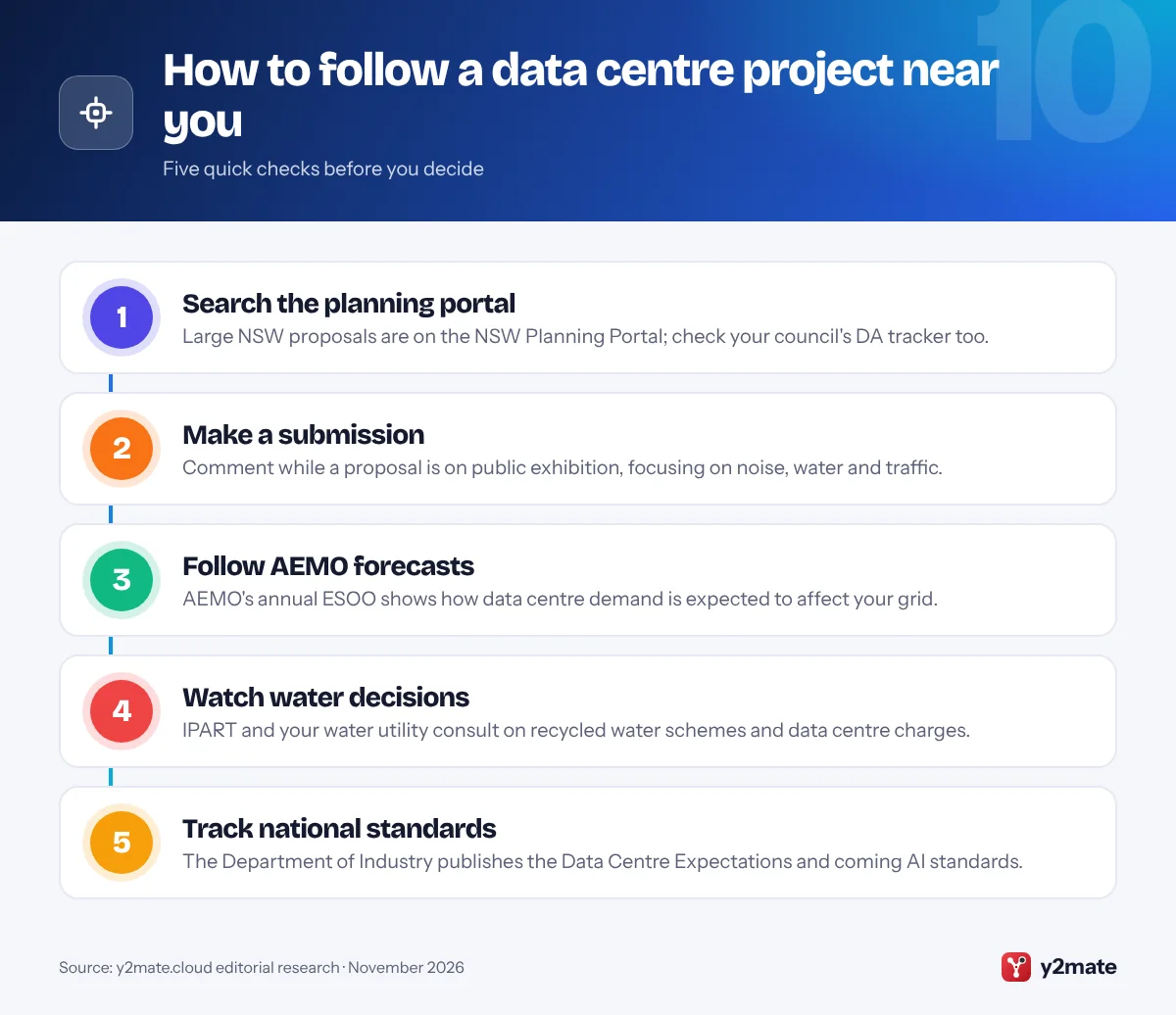
New proposals are announced almost every month, so focus on power, water and approvals. AEMO’s 2026 Electricity Statement of Opportunities notes that many proposed data centres never reach construction, so a signed contract, planning consent and a grid connection matter far more than a headline.
Energy and grid connections
AEMO identifies data centres as a key driver of electricity consumption growth in NSW, Victoria and South Australia. Under the AI laws in Australia’s Interests announced on 15 July 2026, large data centres will have a legal obligation to underwrite their own new power supply, pay their full share of connection costs so other customers’ bills are not affected, and reduce power use when the grid needs it.
Water and planning
The Data Centre Expectations ask operators to use efficient cooling, non-potable water where possible and to report water use transparently. In NSW, a Legislative Council inquiry reported on 5 November 2026, calling for a state data centre and AI strategy with serviced precincts, stronger cumulative impact assessment and renewable energy and water requirements. Tasmania’s House of Assembly opened its own inquiry in August 2026.
Security and sovereignty
- Critical infrastructure: data storage and processing is covered by the Security of Critical Infrastructure Act.
- Government data: Commonwealth agencies use the Hosting Certification Framework to choose hosting providers.
- Foreign investment: foreign purchases of data centre businesses and sites can require FIRB approval on national security grounds.
Frequently asked questions
What are Australia's Data Centre Expectations?
They are five expectations the federal government released on 23 March 2026 for data centre and AI infrastructure developers: prioritise the national interest, support the energy transition without pushing up prices, use water sustainably, invest in Australian skills and jobs, and strengthen local research and innovation. Proposals that align most closely are prioritised in Commonwealth assessments, and mandatory standards are planned for early 2027.
Is OpenAI building a data centre in Australia?
Not on its own. Under OpenAI for Australia, launched in December 2025, NEXTDC and OpenAI signed a non-binding memorandum of understanding to plan, build and operate a hyperscale AI campus at NEXTDC's S7 site in Eastern Creek, Western Sydney. NEXTDC targeted the first phase for the second half of 2027, subject to planning and regulatory approvals.
Do AI data centres use a lot of water in Sydney?
They can. Sydney Water projections cited at the NSW parliamentary inquiry suggest data centres could take a much larger share of Sydney's drinking water by 2035 if operators keep using potable water for cooling. Operators argue actual use will be lower, and some, such as NEXTDC at S4, are moving to recycled water. The Data Centre Expectations ask operators to use non-potable water where possible.
Will data centres push up electricity prices in Australia?
The government says they must not. Under the planned national standards, large data centres will have to underwrite their own new power supply, pay their full share of grid connection costs and reduce power use when the grid needs it. The Data Centre Expectations already say new facilities should not put upward pressure on energy prices and should support the energy transition.
What is sovereign AI infrastructure in Australia?
It usually means computing located in Australia, operated under Australian law and security rules, with sensitive data kept onshore. The Top Secret Cloud that AWS is establishing for the Australian Signals Directorate is the most secure example, while operators such as CDC and NEXTDC market sovereign facilities designed to meet critical infrastructure and government hosting requirements.
Final verdict
The AI data centre projects in Australia that matter most in 2026 are concentrated in Western Sydney and Melbourne. AirTrunk, CDC and the hyperscalers are already expanding, NEXTDC’s S4 and Firmus in Tasmania are under construction, and the OpenAI-anchored S7 campus is still waiting on a binding deal and approvals.
The rules are about to matter as much as the buildings. With mandatory national standards on energy, water and land use due in early 2027, check whether a project pays its own way on power, uses recycled water and has local approval before judging its promises.
Sources and further reading
- Data Centre Expectations: The federal government's March 2026 expectations for data centre and AI infrastructure developers on energy, water, skills and the national interest.
- AI in Australia's interests: The Prime Minister's July 2026 announcement of planned legal rules for large data centres on power supply, grid costs and water efficiency.
- National Cabinet August 2026 meeting: First Ministers' agreement to develop consistent mandatory standards for data centre energy, water and land use.
- AEMO 2026 ESOO: AEMO's 2026 Electricity Statement of Opportunities, which forecasts electricity demand, including growth from data centres.
- Joint ministerial media release: The industry and climate change ministers' joint release explaining the energy and water side of the Data Centre Expectations.

Leave a Reply