- OpenAI's Stargate campus in Abilene, Texas, Microsoft's Fairwater sites in Wisconsin and Atlanta, and Amazon's Project Rainier in Indiana are already operating.
- Meta said in October 2026 that the first phase of its Prometheus supercluster in New Albany, Ohio, was complete, while its Hyperion campus in Louisiana is still under construction.
- The Energy Department is leasing federal land for AI data centers, starting with the former Portsmouth uranium enrichment plant in Pike County, Ohio.
- Companies that signed the White House Ratepayer Protection Pledge on March 4, 2026 agreed to pay the full cost of the new power and grid upgrades their data centers need.
- Since Executive Order 14434 of September 29, 2026, federal agencies use the term Super Intelligence (SI) instead of AI in official communications.
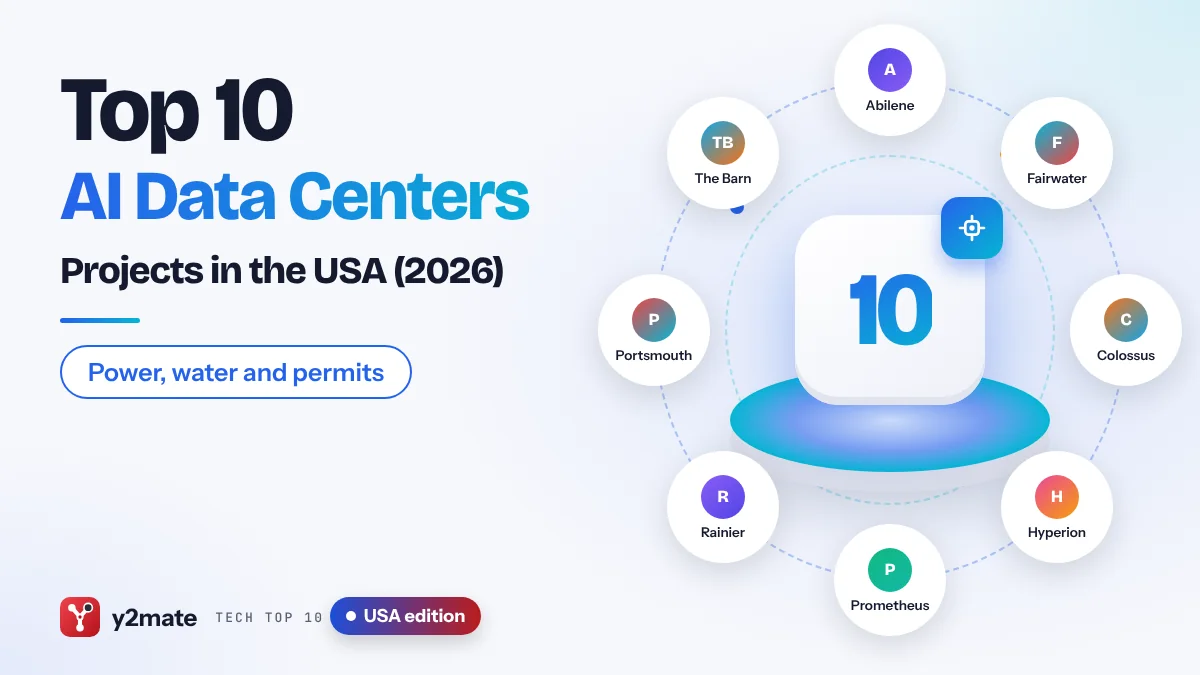
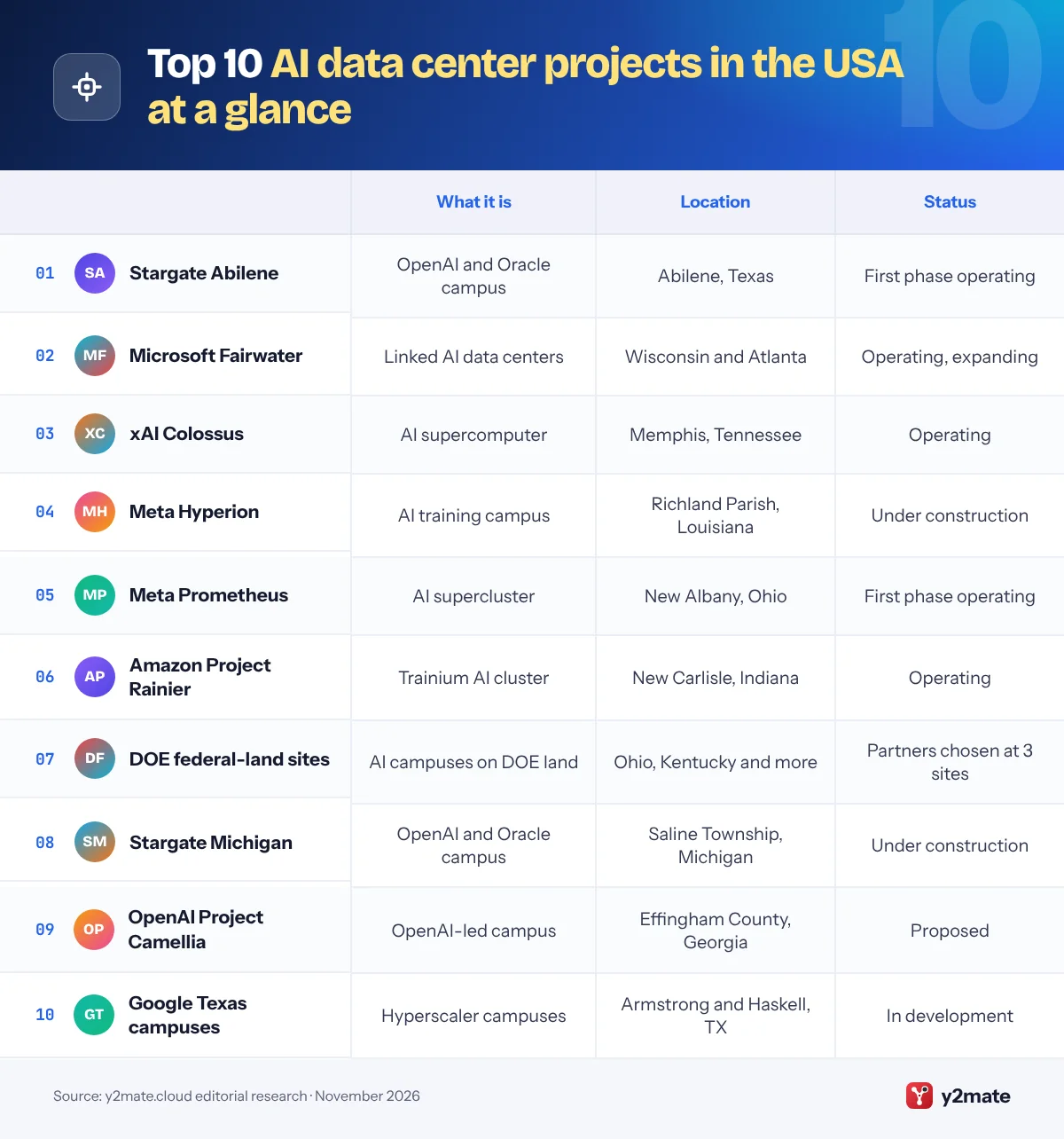
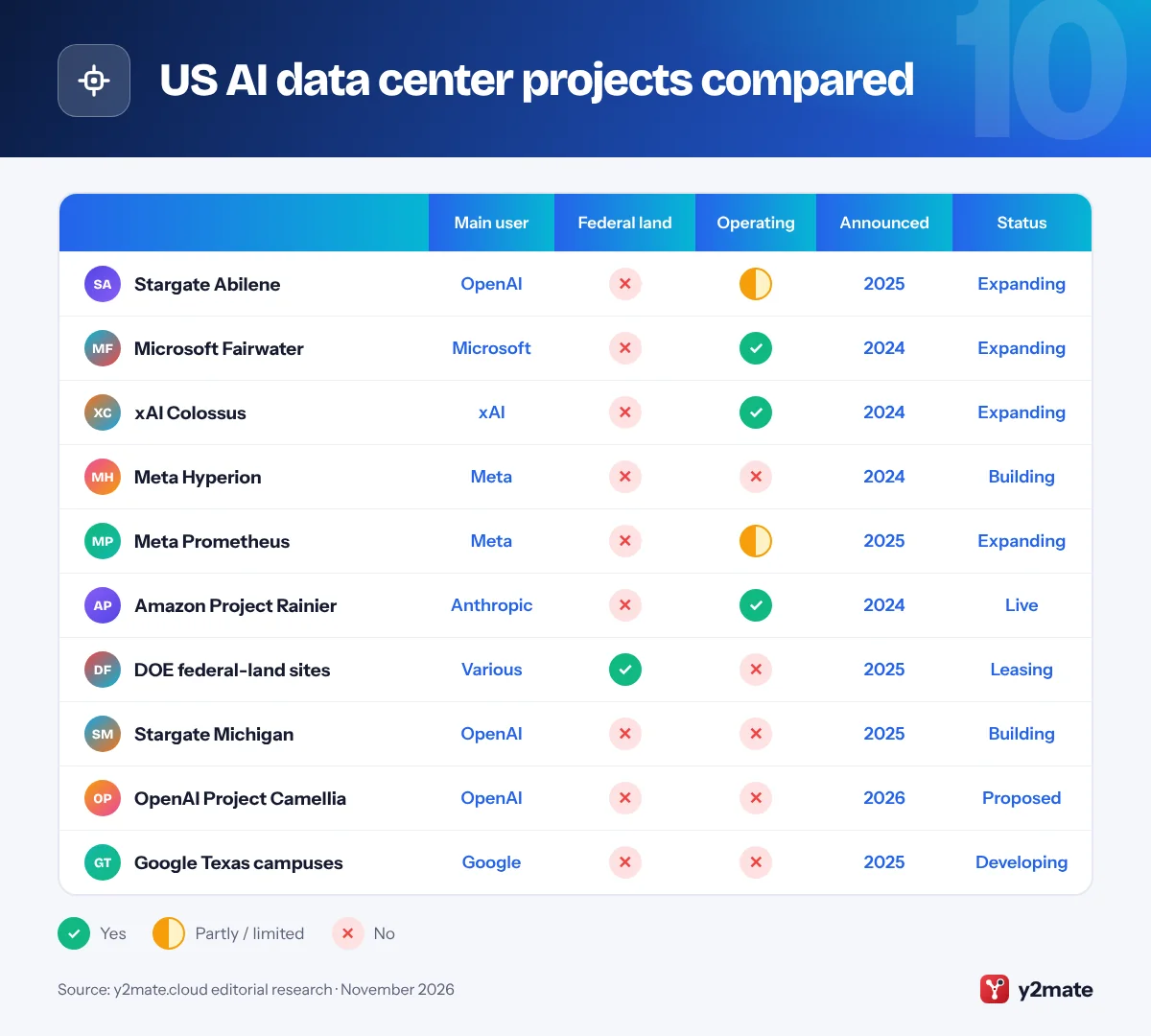
The biggest AI data center projects in the USA in 2026 are OpenAI’s Stargate campus in Abilene, Texas, Microsoft’s Fairwater sites in Wisconsin and Atlanta, and xAI’s Colossus in Memphis. Meta’s Hyperion and Prometheus, Amazon’s Project Rainier, the Energy Department’s federal-land sites, Stargate Michigan, OpenAI’s Project Camellia in Georgia and Google’s new Texas campuses complete the list, with each project’s status as of November 2026.
An AI data center is a facility built to train and run AI models. Most of the work happens on a GPU cluster, a large group of graphics processors linked by fast networks so they act as one machine. A hyperscaler is a company such as Microsoft, Google, Amazon or Meta that runs data centers at very large scale. A grid connection, often called interconnection, is the agreement and physical link that lets a site draw power from the electric grid, and regulators call these sites large loads because of how much electricity they use.
Federal language has also changed. Under Executive Order 14434, signed on September 29, 2026, federal agencies use the term Super Intelligence (SI) instead of artificial intelligence in official communications, so newer government pages may refer to SI data centers. This list uses AI.
How we ranked this list
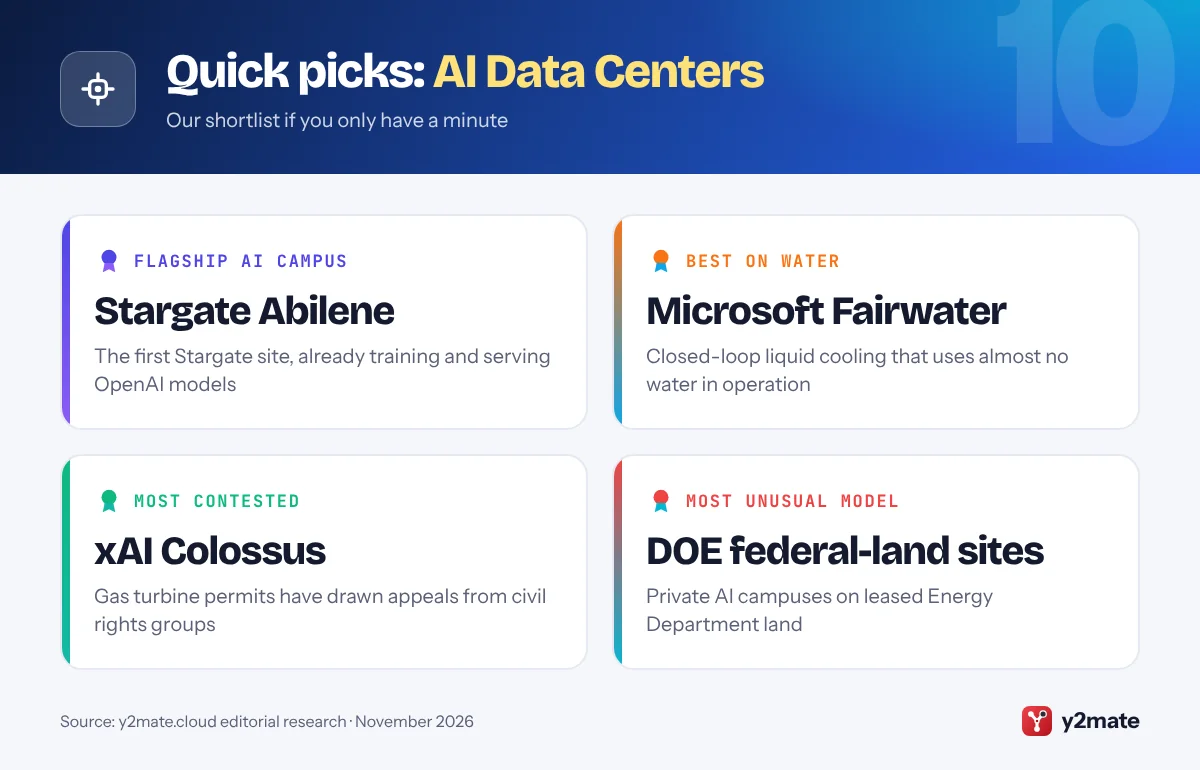
We ranked projects by their scale and significance as described in official sources, how far they have progressed and how much public debate they have generated over power, water and local approval. We used company newsrooms, Energy Department and White House releases, FERC orders and state regulatory decisions, and checked each status as of November 2026.
We did not visit the sites. We leave out investment totals, power capacity figures and job estimates because they are often projections that change. Where a project is not yet running, we say it is under construction, in development or proposed.
The Top 10 AI Data Centers
1. Stargate Abilene
Best for: understanding OpenAI’s Stargate program
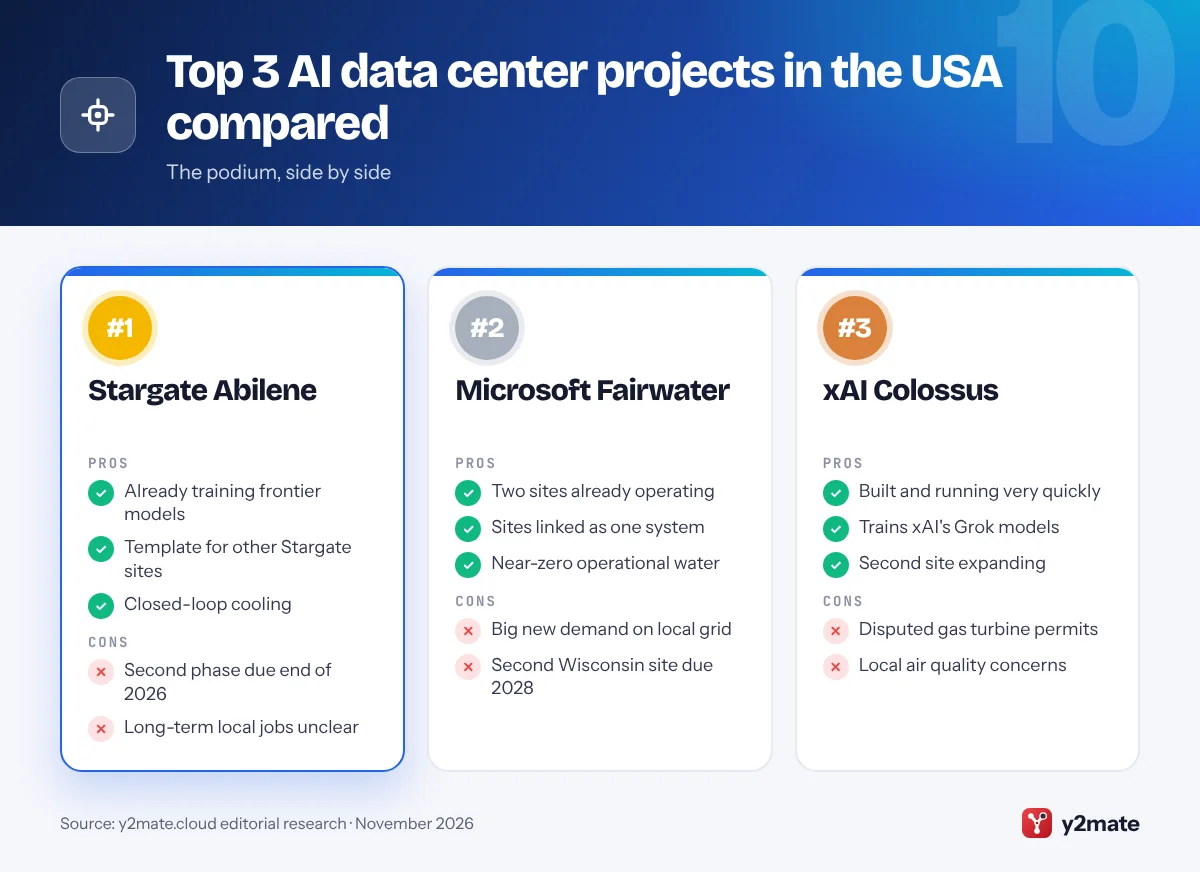
The Stargate campus in Abilene, Texas, is the flagship site of Stargate, OpenAI’s program to build the computing capacity it needs with partners. Crusoe develops the campus, Oracle runs the computing on Oracle Cloud Infrastructure and OpenAI is the main user. Construction began in June 2024, and Crusoe announced on September 30, 2025 that the first phase was live and running early training and inference work.
In January 2026 OpenAI said the Abilene site was already training and serving frontier AI systems. Crusoe said in March 2026 that the second phase, completing the planned eight-building campus, should be finished by the end of 2026. That month Crusoe also announced a separate campus next door for Microsoft, after reports that Oracle and OpenAI had decided not to take that extra expansion.
Abilene is the model for other Stargate sites OpenAI has announced in Texas, New Mexico, Ohio, Michigan and Wisconsin. OpenAI says the site uses closed-loop cooling that recirculates water. The open questions are power supply as the wider site grows, water use in West Texas and how many long-term jobs remain after construction.
Official site: Stargate Abilene
- Already training frontier models
- Template for other Stargate sites
- Closed-loop cooling
- Second phase due end of 2026
- Long-term local jobs unclear
2. Microsoft Fairwater
Best for: AI data centers linked across states
Fairwater is Microsoft’s name for its newest AI data centers, built to train very large AI models. The first is in Mount Pleasant, Wisconsin, south of Milwaukee. Microsoft announced on June 23, 2026 that construction was complete and the facility fully operational after equipment came online in April, and a second facility next door is due to be finished in 2028.
The second Fairwater site, in Atlanta, began operating in October 2025. Microsoft links the sites with a dedicated high-speed network so they can work on a single training job, an approach it calls an AI superfactory, and says the design uses closed-loop liquid cooling that consumes almost no water in operation.
In January 2026 Microsoft launched its Community-First AI Infrastructure commitments, promising to pay its way on electricity so household bills do not rise, to cut water use and to support local jobs and skills. Microsoft says it is working with local and state partners as it assesses further growth. The open questions are how much new generation the region needs and whether the bill protections hold up.
Official site: Microsoft Fairwater
- Two sites already operating
- Sites linked as one system
- Near-zero operational water
- Big new demand on local grid
- Second Wisconsin site due 2028
3. xAI Colossus
Best for: a very fast build and fierce permit fights
Colossus is the AI supercomputer xAI built inside a former Electrolux factory in South Memphis, Tennessee, to train its Grok models. It went from an empty building to an operating cluster within months in 2024, making it one of the most talked-about AI projects in the country. xAI became part of SpaceX in February 2026.
Power has been the controversy. To run before full grid supply was in place, xAI used mobile natural gas turbines, and residents and environmental and civil rights groups said turbines ran without proper permits. In July 2025 the Shelby County Health Department granted an air permit for permanent gas turbines at the site, and the county’s air pollution control board upheld it in December 2025 after an appeal by the NAACP and Young, Gifted and Green.
A second Memphis-area site, Colossus 2, draws on a gas-fired power plant across the state line in Southaven, Mississippi, which state regulators permitted in March 2026. The open questions are air quality in nearby neighborhoods and how long temporary turbines keep running.
Official site: xAI Colossus
- Built and running very quickly
- Trains xAI's Grok models
- Second site expanding
- Disputed gas turbine permits
- Local air quality concerns
4. Meta Hyperion
Best for: Meta’s largest planned AI training cluster
Hyperion is the AI training cluster Meta is building at its Richland Parish data center in northeast Louisiana, near Holly Ridge. Meta broke ground in December 2024, and on July 13, 2026 it announced an expansion that makes the site the largest in its data center fleet and the home of Hyperion, which Meta calls its largest AI training cluster.
Power comes from Entergy Louisiana, which won approval from the Louisiana Public Service Commission in August 2025 to build new natural gas power plants to serve the site. Meta says it pays for the energy, water and related infrastructure its data centers use so other customers’ bills do not rise, and it has invested in local roads, water and wastewater systems.
Meta’s contractors run training programs with Louisiana Delta Community College, and Meta funds scholarships for local data center trades. The open questions are environmental and timing: groups including the Sierra Club have criticized the new gas plants and the speed of their approval, and capacity will come online in phases over several years.
Official site: Meta Hyperion
- Meta's largest planned campus
- Local training partnerships
- Meta pays for its infrastructure
- Relies on new gas plants
- Phased completion over years
5. Meta Prometheus
Best for: an AI supercluster already training models
Prometheus is Meta’s AI supercluster at its New Albany data center campus near Columbus, Ohio. Meta said on October 19, 2026 that the first phase was complete and had been used to train its Muse family of AI models, and that it was working to scale the cluster further. Two years earlier, Meta says, New Albany was a conventional data center running web traffic.
To move fast, Meta spread Prometheus across conventional buildings, weatherproof outdoor structures and adjacent leased colocation space, linked by a dedicated network so it works as a single cluster. It shows AI developers trading traditional construction methods for speed.
Central Ohio’s grid is under pressure from data center growth. In July 2025 Ohio regulators approved a data center tariff for AEP Ohio, the local utility, requiring large new data center customers to pay for most of the capacity they reserve even if they use less, so other customers are not left with the cost. The open questions are how quickly further phases arrive and how much new generation the region needs.
Official site: Meta Prometheus
- First phase already training
- Fast build with outdoor structures
- Linked as one cluster
- Rising local grid demand
- Further phases still to come
6. Amazon Project Rainier
Best for: AI compute built on Amazon’s own chips
Project Rainier is the AI compute cluster Amazon Web Services built with Anthropic, the maker of Claude, using Amazon’s own Trainium2 chips rather than NVIDIA GPUs. AWS announced on October 29, 2025 that it was fully operational, less than a year after it was first announced, and describes it as one of the world’s largest AI compute clusters.
The cluster spans more than one site. The best known is the AWS campus in New Carlisle, St. Joseph County, Indiana, which AWS names as a Project Rainier site. AWS says its St. Joseph County data centers maximize outside-air cooling, using no water for cooling from October to March and only a few hours a day on average from April to September.
Rainier shows a hyperscaler pairing its own chips with its own data centers, reducing dependence on a single chip supplier. The open questions in Indiana are local: residents have raised concerns about water use, wetlands and wells, and about how fast farmland is turning into data center campuses as more buildings are planned.
Official site: Amazon Project Rainier
- Fully operational since 2025
- Built on Amazon's own chips
- No cooling water in winter
- Local water and wetland worries
- Farmland conversion concerns
7. DOE federal-land sites
Best for: AI data centers on Energy Department land
The Energy Department is leasing land at former nuclear and research sites for private AI data centers paired with new power generation. In July 2025 it selected Idaho National Laboratory, the Oak Ridge Reservation in Tennessee, the Paducah site in Kentucky and the Savannah River Site in South Carolina, and it later added the former Portsmouth Gaseous Diffusion Plant in Pike County, Ohio.
Portsmouth is the most advanced. In March 2026 DOE announced it would lease land there to an SB Energy affiliate, part of SoftBank, for a data center campus powered by new natural gas generation, with SB Energy paying for new transmission lines with AEP Ohio and for faster site cleanup. OpenAI and SB Energy have made joint community commitments in Pike County. In July 2026 DOE picked Brookfield to develop a campus at Paducah, with NextEra Energy building the power supply, and NNSA has chosen Amentum to negotiate a lease at Savannah River.
The appeal is speed, since many of these sites already have high-voltage transmission. The open questions are reliance on new gas plants and how cleanup fits around construction.
Official site: DOE federal-land sites
- Reuses existing federal sites
- Developers pay for grid upgrades
- Funds faster site cleanup
- Heavy reliance on new gas
- Cleanup and building overlap
8. Stargate Michigan
Best for: a Stargate site shaped by local commitments
Stargate Michigan, known as The Barn, is a data center campus in Saline Township near Ann Arbor that OpenAI, Oracle and the developer Related Digital announced in October 2025. The partners broke ground on June 1, 2026 alongside Governor Gretchen Whitmer, with Walbridge as general contractor and union construction labor through OpenAI’s partnership with North America’s Building Trades Unions.
OpenAI has made specific promises here. It says the infrastructure and energy needed for the site will be paid for by the project and not passed on to local ratepayers, and that the campus is designed to use closed-loop cooling with water use similar to a typical office building. The partners are funding improvements to the Saline Recreation Center, a priority chosen by the City of Saline, and OpenAI is offering Codex credits to eligible Michigan college and trade school students.
The project went ahead after a long local debate over the site. The open question is whether the cost and water promises hold up once the campus is fully running.
Official site: Stargate Michigan
- Ratepayer protection promised
- Closed-loop cooling design
- Local recreation center funding
- Promises not yet tested
- Long local debate over site
9. OpenAI Project Camellia
Best for: OpenAI’s own campuses and community compact
Project Camellia is a planned OpenAI data center campus in Effingham County, Georgia, near Savannah, announced on July 22, 2026. OpenAI has contracted with Georgia Power to supply the site in phases and has made community commitments on energy costs, water and local investment.
Its power deal is unusual. OpenAI says its agreement allows Georgia Power to reduce the electricity it delivers to the campus during periods of high demand, which helps the site connect without putting other customers’ supply at risk. OpenAI and Georgia Power say residents will not pay higher rates because OpenAI covers the full cost of the required infrastructure and electric service.
Residents helped shape a local grant that provides free school meals for every student in the county. On November 5, 2026 OpenAI published a National Community Compact for campuses it owns and operates, promising site-level reporting of water and electricity use, independent noise studies and no non-disclosure agreements with public officials beyond narrow exceptions. The open questions are timing, with power arriving in phases from 2028, and whether those promises are kept.
Official site: OpenAI Project Camellia
- Flexible power deal with utility
- Public water and power reporting
- Community-shaped local grant
- Power only from 2028
- Still at planning stage
10. Google Texas campuses
Best for: data centers built beside new solar and storage
On November 14, 2025 Google announced plans for three new data center campuses in Texas through 2027: one in Armstrong County in the Panhandle and two in Haskell County in West Texas. Google’s data center locations page lists Haskell, Texas, as in development.
One of the Haskell County data centers is being built alongside a new solar and battery storage plant, the first industrial park developed through Google’s partnership with Intersect and TPG Rise Climate. Google says putting energy supply next to data center demand reduces the need for new grid infrastructure and eases pressure on the Texas grid run by ERCOT, and that the new campuses will use advanced air cooling, limiting water use to site operations such as kitchens.
Google has also signed power purchase agreements adding new generation to the Texas grid and set up an Energy Impact Fund for Texas communities. The open questions are timing and state rules: under Senate Bill 6, signed in June 2025, large new loads must share grid connection costs and can be curtailed by ERCOT in emergencies.
Official site: Google Texas campuses
- Co-located solar and batteries
- Air cooling limits water use
- Community energy fund
- Sites still in development
- Subject to new Texas grid rules
US AI data center projects compared
What decides AI data center projects in the USA
Almost every project here is limited by electricity, so ask who pays for new power, how the site connects to the grid and which local approvals it still needs.
Who pays for power
On March 4, 2026, leading AI and cloud companies signed the White House Ratepayer Protection Pledge, agreeing to build, bring or buy the new power their data centers need and to pay for grid upgrades whether or not they use the electricity. Governors and utilities joined in July 2026. States are adding their own rules: Ohio regulators approved a data center tariff for AEP Ohio in July 2025 that makes large new data centers pay for most of the capacity they reserve, and Texas Senate Bill 6, signed in June 2025, makes large loads share connection costs and lets ERCOT curtail them in grid emergencies.
Grid connection rules
On June 18, 2026, FERC ordered the six regional grid operators it oversees to justify their rules for connecting large loads or propose changes, covering cost transparency, study timelines and flexible service. A July 2025 executive order also directs federal agencies to speed up permits for data center infrastructure.
Water and local approval
- Cooling: closed-loop liquid cooling and outside-air cooling use far less water than evaporative cooling towers, so ask which a project uses.
- Community deals: OpenAI’s National Community Compact and Microsoft’s Community-First commitments promise public reporting and local investment, but they are voluntary.
- Air permits: on-site gas turbines and backup generators need air permits, which usually include a public comment period.
Frequently asked questions
What is the biggest AI data center project in the USA?
There is no official ranking, and companies measure size in different ways. The most closely watched projects in 2026 are OpenAI's Stargate campus in Abilene, Texas, Microsoft's Fairwater sites in Wisconsin and Atlanta, xAI's Colossus in Memphis and Meta's Hyperion campus in Louisiana, which Meta describes as the largest site in its data center fleet.
What is the Stargate project?
Stargate is OpenAI's program to build the computing infrastructure it needs, announced in January 2025 with partners including Oracle and SoftBank. Its flagship campus in Abilene, Texas, is already running, and OpenAI has announced further US sites in Texas, New Mexico, Ohio, Michigan and Wisconsin.
Will AI data centers raise my electricity bill?
They can if utilities spread the cost of new power plants and power lines across all customers. To prevent that, companies that signed the March 2026 Ratepayer Protection Pledge agreed to pay the full cost of the power and grid upgrades their data centers need, and states such as Ohio and Texas have adopted rules for large loads. Check your state utility commission for local decisions.
How much water do AI data centers use?
It depends on the cooling system and the climate. Evaporative cooling towers consume the most water, while closed-loop liquid cooling and outside-air cooling use much less. Microsoft says its Fairwater sites use almost no water in operation, OpenAI says its Michigan campus will use about as much as a typical office building, and AWS says its Indiana sites use no cooling water from October to March.
Why do federal websites say Super Intelligence instead of AI?
Executive Order 14434, signed on September 29, 2026, directs federal agencies to use Super Intelligence and SI in place of artificial intelligence and AI in official communications, websites and reports, to the extent the law allows. It ties the new term to the existing legal definition of AI, so a federal page about SI data centers covers the same kind of projects described here.
Final verdict
The AI data center projects in the USA that matter most in 2026 are already reshaping local grids. Abilene, Fairwater, Colossus, Rainier and the first phase of Prometheus are running, Hyperion and Stargate Michigan are under construction, and the federal-land sites, Project Camellia and Google’s Texas campuses come next.
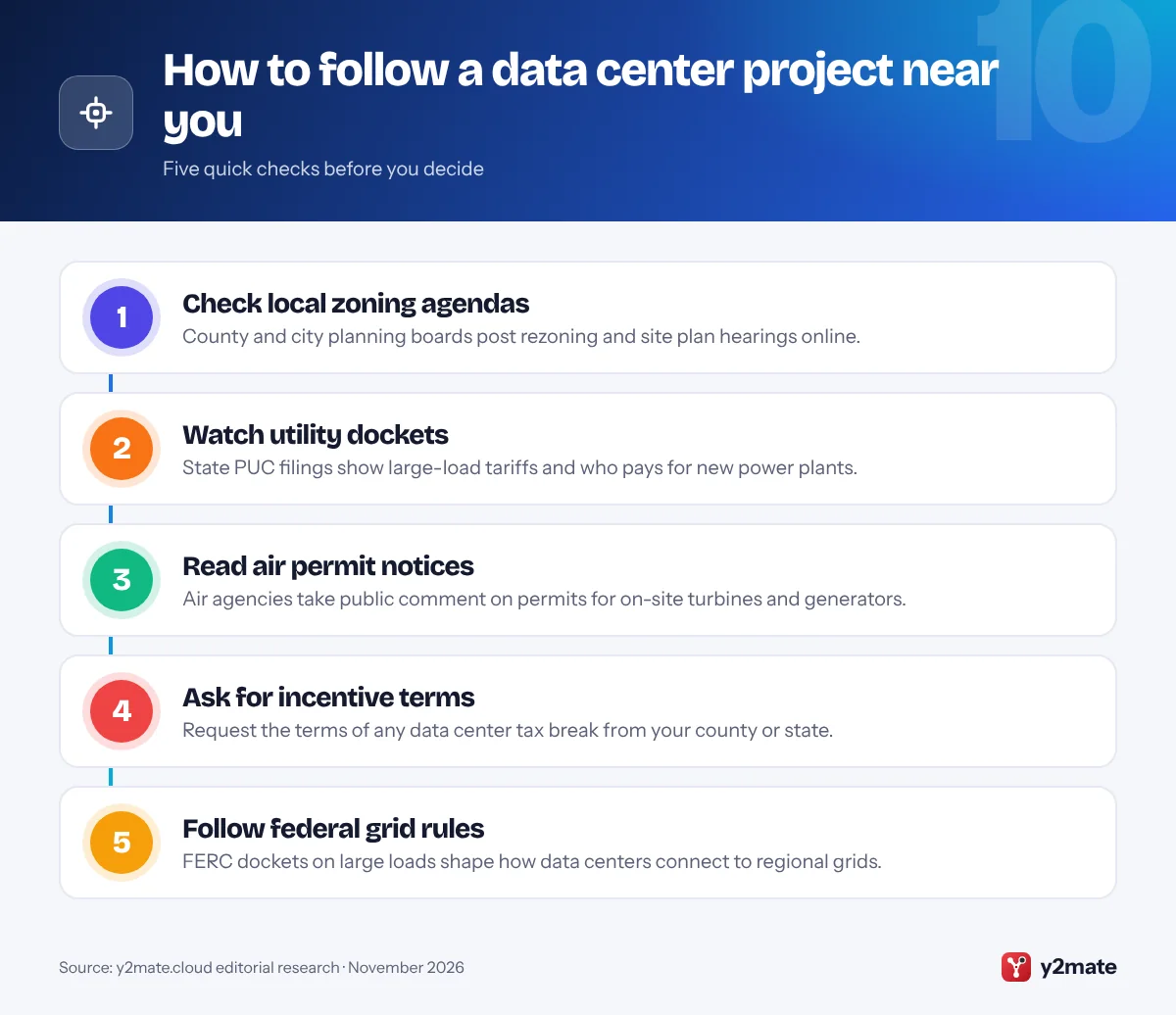
For residents, the key questions are the same everywhere: who pays for new power, how the site is cooled and what the developer has promised in writing. Watch your state utility commission, local zoning board and air permit notices so you can raise concerns before construction starts.
Sources and further reading
- Ratepayer Protection Pledge: The White House pledge, signed March 4, 2026, under which data center companies agree to pay the full cost of new power and grid upgrades.
- FERC action on large loads: FERC's June 2026 orders requiring regional grid operators to address how data centers and other large loads connect.
- DOE federal AI data center sites: The Energy Department's July 2025 selection of four federal sites for private AI data center and energy projects.
- DOE data center resource hub: Energy Department resources on powering data centers, including federal land, grid and energy supply programs.
- Executive Order 14434: The September 2026 order directing federal agencies to use Super Intelligence (SI) in place of artificial intelligence (AI).

Leave a Reply