
- Summ, Koinly and Syla are the strongest crypto tax software choices for Australians in 2026, and all three produce reports built for myTax or a registered tax agent.
- The ATO treats most crypto as a CGT asset, so selling, swapping, spending or gifting it is a CGT event, and individuals who hold it for at least 12 months can usually reduce the gain with the CGT discount.
- The ATO collects account and transaction data from Australian crypto providers to match against tax returns, and myTax can show a reminder that you may have had a crypto CGT event.
- Under a law passed in June 2026, gains that accrue from 1 July 2027 will use cost base indexation and a minimum tax instead of the CGT discount, so each holding's value on that date will matter.
- Treasury released draft laws in October 2026 to adopt the OECD Crypto-Asset Reporting Framework, with data collection proposed to start on 1 January 2027.
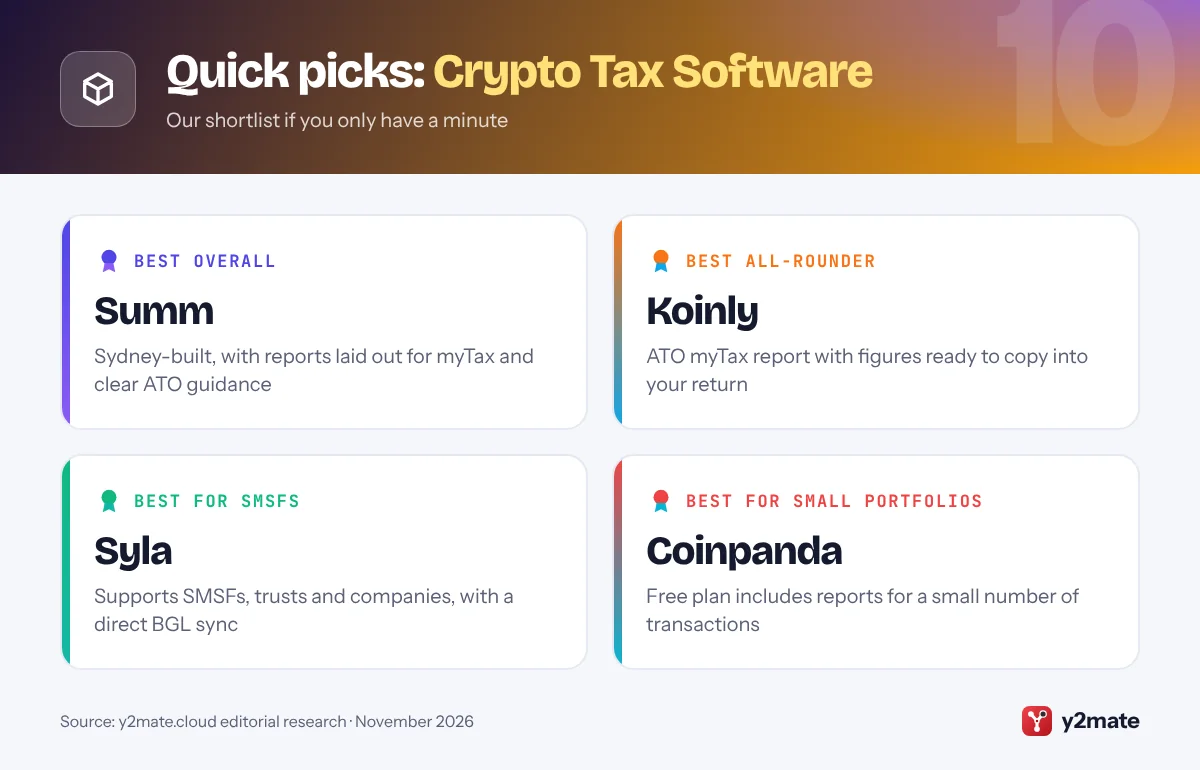
The best crypto tax software in Australia in 2026 is Summ for a Sydney-built platform with detailed ATO myTax reports, Koinly for an all-rounder that handles almost any exchange or wallet, and Syla for SMSFs, trusts and companies that need accountant-ready data. CoinLedger, CoinTracker, Coinpanda, CoinTracking, Blockpit, Kryptos and Awaken Tax complete the list. Each produces capital gains and income reports for the Australian financial year, which runs from 1 July to 30 June, and most let you import your history and check results before paying.
Some plain definitions first. The ATO treats most crypto as a CGT asset, not money. Selling it for Australian dollars, swapping one token for another, spending it or giving it away is a CGT event that creates a capital gain or loss: the difference between what you received and your cost base, broadly what you paid plus costs such as transaction fees. If you held the asset for at least 12 months, individuals can usually reduce the gain with the CGT discount. Crypto received from staking, airdrops or as payment is usually ordinary income. A narrow personal use asset exemption covers crypto bought and used soon after to pay for personal items, but crypto held as an investment does not qualify, even if you later spend it.
The ATO collects account and transaction data from Australian crypto providers and matches it against returns, and myTax may show a reminder that you had a crypto CGT event. Bigger changes are coming: from 1 July 2027, gains that accrue will be worked out with cost base indexation and a minimum tax rather than the discount. This article is general information, not tax advice; for anything complex, speak to a registered tax agent.
How we ranked this list
We compared publicly documented information only: the ATO-ready reports each tool produces, such as myTax summaries and CGT schedules; whether it applies the CGT discount and records income separately; support for SMSFs, trusts and companies; how its exchange, wallet and blockchain integrations are described, including local exchanges; its features for tax agents and accountants; and whether a free plan exists. We gave extra weight to Australian-built tools and detailed local guidance.
We did not carry out hands-on testing and do not quote prices or plan limits, which change often. Check each provider’s current terms before you sign up.

The Top 10 Crypto Tax Software
1. Summ
Best for: detailed ATO myTax reports from a local team
Summ, called Crypto Tax Calculator until October 2025, was founded in Sydney and publishes detailed guidance on Australian crypto tax. Its ATO reports are laid out for myTax: capital gains go in the capital gains section, while staking rewards, airdrops and similar receipts are listed separately as other income. Its guides also explain that brokerage, gas and transfer fees are added to your cost base rather than claimed as deductions.
The software imports from Australian exchanges such as CoinSpot and CoinJar as well as global platforms and many blockchains, and its review screens let you check and edit each transaction, which matters for DeFi. A free account lets you import data and explore your history, while real reports need a paid plan.
Summ’s myTax walkthrough does not cover crypto held in an SMSF, company or trust, or a trading business, so those cases need a registered tax agent, and accountants can use Summ’s client portal for that work. If you are an individual investor who wants a homegrown tool with clear ATO guidance, Summ is the best place to start.
Official site: Summ
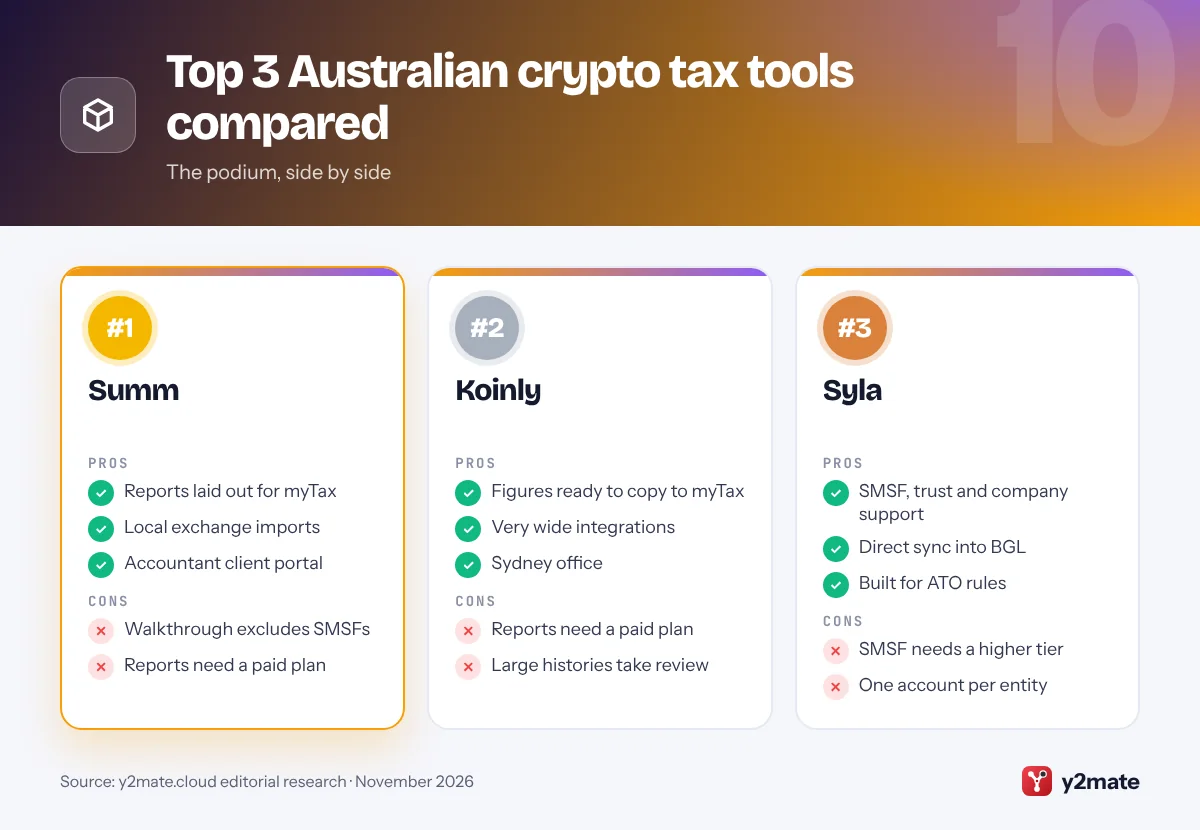
- Reports laid out for myTax
- Local exchange imports
- Accountant client portal
- Walkthrough excludes SMSFs
- Reports need a paid plan
2. Koinly
Best for: an all-rounder with a ready-made myTax report
Koinly is a London-headquartered crypto tax platform with an office in Sydney and strong Australian support. Its ATO myTax report gives you the figures to copy into myTax: total current-year capital gains, net capital gains after the CGT discount and any net capital loss to carry forward, plus income such as staking rewards. It also offers a fuller Complete Tax Report and a capital gains report for your records or your accountant.
Koinly connects to local exchanges including CoinSpot as well as global platforms and blockchains, matches transfers between your own wallets so they are not treated as disposals, and flags gaps such as missing purchase history. Its guides cover lodging through myGov and through services such as Etax, where you attach the Koinly report.
You can import and preview your figures free, but downloading reports needs a paid plan, and Koinly lists accountants who use the software. It also reminds users that people taxed as crypto traders cannot claim the CGT discount, so tell your tax agent if crypto is a business for you. If you want a dependable all-rounder, Koinly is a safe choice.
Official site: Koinly
- Figures ready to copy to myTax
- Very wide integrations
- Sydney office
- Reports need a paid plan
- Large histories take review
3. Syla
Best for: SMSFs, trusts and companies
Syla is an Australian crypto tax calculator built around ATO rules and aimed at the cases other tools treat as extras. As well as individuals, it supports self-managed super funds (SMSFs), trusts and companies, with a separate account for each entity. For SMSFs it can sync crypto transaction data straight into BGL Simple Fund 360 and Simple Invest 360, the accounting software many SMSF administrators use, recording every CGT event and income such as staking and airdrops.
Syla imports from exchanges, wallets and blockchains by API or CSV and calculates gains and income in Australian dollars. It does not lodge your return: its Crypto Tax Report is designed for you to self-lodge or hand to your tax agent, and Syla publishes checklists accountants can use to review the BGL data.
The free plan lets you import, edit and see the tax outcome of individual transactions, but final results and report downloads need a subscription, and SMSF support sits on higher tiers. Syla also works with several local exchanges as their tax partner. If you run an SMSF or family trust that holds crypto, Syla is the specialist to look at first.
Official site: Syla
- SMSF, trust and company support
- Direct sync into BGL
- Built for ATO rules
- SMSF needs a higher tier
- One account per entity
4. CoinLedger
Best for: beginners who want a guided path to myTax
CoinLedger is a US-based tool with a dedicated Australian product. Once you select Australian dollars and the Australian tax year in its tax settings, it produces an ATO MyTax report and an ATO individual tax return supplementary form from its downloads menu, with capital gains and income separated for the right parts of your return.
Its guided workflow suits beginners. Importing transactions and viewing your net gains and losses is free, so you can see roughly where you stand before paying for the full report, and the Invite My Tax Professional option shares your reports with your accountant. CoinLedger supports DeFi, NFTs and staking income, and its guides explain how the ATO’s crypto data-matching program compares exchange records with tax returns.
Its Australian guides have also flagged the capital gains changes due from 1 July 2027, while noting that the CGT discount still applies to gains made before then. If you run an SMSF or trust, check entity support carefully or consider Syla. For individual investors who want a simple, well-explained route to myTax, CoinLedger is a good choice.
Official site: CoinLedger
- ATO MyTax report
- Free gains and losses preview
- Invite your tax agent
- US company, AU is one market
- Check entity support
5. CoinTracker
Best for: year-round tracking with myTax-ready exports
CoinTracker, based in San Francisco, provides a myTax-ready crypto summary, CGT records and supporting exports you can use yourself or give to your registered tax agent. Its Australian reports include capital gains schedules and crypto income summaries, so disposals and income such as staking rewards are kept apart, and it integrates with local exchanges such as CoinSpot and CoinJar as well as global platforms and wallets.
CoinTracker’s web and mobile apps are designed for watching a portfolio all year rather than only at tax time, which suits people who check their holdings regularly. Tax agents can use a tax professional account to view and edit a client’s transactions and reports, with access the client can revoke at any time.
The free plan covers tracking and a preview, but full reports need a paid plan. Much of CoinTracker’s help content is written for US users, so follow its Australian guides and check dates and rules on ato.gov.au. If you want a clean app that doubles as a portfolio tracker and a myTax helper, CoinTracker fits well.
Official site: CoinTracker
- myTax-ready summary
- Year-round portfolio app
- Tax agent access
- Much of its help is US-focused
- Reports need a paid plan
6. Coinpanda
Best for: small portfolios that need a quick ATO report
Coinpanda, an Oslo-based company, generates an ATO report for myTax that breaks down every capital gains transaction, including where the CGT discount applies, alongside income such as staking rewards. It supports global and local platforms, DeFi, NFTs and staking, and keeps the workflow simple: connect accounts, review flagged transactions and download.
Its free plan stands out because it includes tax reports for a small number of transactions, so someone with only a few trades in the financial year may not need to pay at all, while paid plans cover larger histories. Coinpanda also offers a crypto tax suite for accountants and tax agents who manage several clients.
Some of Coinpanda’s Australian guide pages are older and show past years’ tax tables, so rely on ato.gov.au for current rates and for the capital gains changes due from 1 July 2027. Its articles also remind users that the ATO may already hold their exchange records through data matching. If your crypto activity is modest and you want a quick, accurate report, Coinpanda is a sensible pick.
Official site: Coinpanda
- Free reports for tiny histories
- Shows where discount applies
- Accountant suite
- Some AU guides are dated
- Check integration coverage
7. CoinTracking
Best for: experienced traders with long histories
CoinTracking is one of the longest-running crypto tax tools and remains a favourite of active traders who want detailed analysis. It imports trade history from Australian exchanges such as BTC Markets, Independent Reserve, CoinSpot and Digital Surge, by API or CSV, and generates an ATO-formatted report you can use in myTax or for a paper return.
Beyond tax, CoinTracking offers reports on realised and unrealised gains, income, fees and closing positions, with detailed settings for experienced users and dedicated plans for businesses and tax professionals. Beginners may find the interface busy compared with Koinly or Summ.
The free account lets you view a portfolio, but importing new transactions and downloading tax reports needs a paid plan. Paid plans cover every tax year without extra charges, which helps if you are catching up on earlier years that the ATO’s data matching may already cover. Some of its Australian guide pages disagree on details such as how mining is taxed, so check the rules on ato.gov.au. If you have years of trading across several local exchanges and want granular control, CoinTracking is a capable choice.
Official site: CoinTracking
- Imports major local exchanges
- Very detailed analysis
- All tax years on paid plans
- Busy interface for beginners
- Free plan only views portfolio
8. Blockpit
Best for: investors with assets in Australia and Europe
Blockpit is an Austrian crypto tax platform that lists Australia among its country-specific tax reports, with predefined Australian tax settings. Its reports list the timestamp, amount, asset, cost and fee for every transaction in the year, plus your balances and realised gains and losses, which makes your workings easy for a tax agent to follow. It bought rival Accointing in 2023 and invited Accointing users to move across.
Blockpit integrates with a wide range of exchanges, wallets and blockchains, including Australian platforms such as BTC Markets. Portfolio tracking is free, and you pay per tax year when you want a report. If you would rather not do the work yourself, its paid expert service can prepare the report for you.
Blockpit publishes less Australian guidance than local specialists such as Summ or Syla, so confirm with your tax agent where each figure belongs in myTax. If you hold crypto in both Australia and Europe, or have moved between them, Blockpit’s multi-country focus is its main appeal.
Official site: Blockpit
- Australian country settings
- Paid expert service
- Clear transaction detail
- Less Australian guidance
- Reports charged per tax year
9. Kryptos
Best for: a free first look at a small portfolio
Kryptos, a Swedish crypto tax platform formerly called KryptoSkatt, has a dedicated Australian product. It produces an ATO myTax report for online self-lodgement and a CGT schedule format for paper returns, applies the CGT discount where a parcel qualifies and keeps income separate from capital gains. Kryptos says most users hand the export to their registered tax agent, and it lists accountants who work with crypto.
Its free tier covers a limited number of transactions, which makes it a low-risk way to see how your figures look before you commit to any paid tool, while paid plans cover larger histories. It connects to exchanges, wallets and blockchains, and its reports are designed to slot into either a self-lodged or agent-lodged return.
Some of Kryptos’s Australian articles contain errors, including mixing in US tax forms and overstating how soon the Crypto-Asset Reporting Framework applies here, so use its software for the calculations but check the rules on ato.gov.au. If you want a quick, free first look at a small portfolio before choosing a tool, Kryptos is worth a try.
Official site: Kryptos
- myTax and CGT schedule formats
- Free tier for small histories
- Accountant listings
- Some AU articles contain errors
- Check rules on ato.gov.au
10. Awaken Tax
Best for: self-custody wallets, DeFi and NFTs
Awaken Tax, a San Francisco start-up founded in 2022, is built for people whose crypto lives on-chain. It supports DeFi, NFTs and many newer blockchains, and lets you label transactions such as liquidity deposits, bridges and NFT mints quickly. It lists Australia among its supported countries and says it produces native Australian tax documents.
Its pricing is easy to follow: upload wallets and see your tax summary free, then pay only when you download reports, with a free tier for smaller histories. A full-service option is available if you want its team to prepare your crypto reports.
The trade-off is local depth. Awaken’s Australian guidance is far thinner than Summ’s or Syla’s, and one of its own articles has misstated the holding period for the CGT discount, which the ATO sets at 12 months or more. Ask your tax agent to check where each figure belongs in myTax. If most of your activity is in self-custody wallets and other tools struggle with it, Awaken is worth considering alongside a local specialist.
Official site: Awaken Tax
- Built for DeFi and NFTs
- Free to upload and preview
- Full-service option
- Thin Australian guidance
- Check figures with an agent
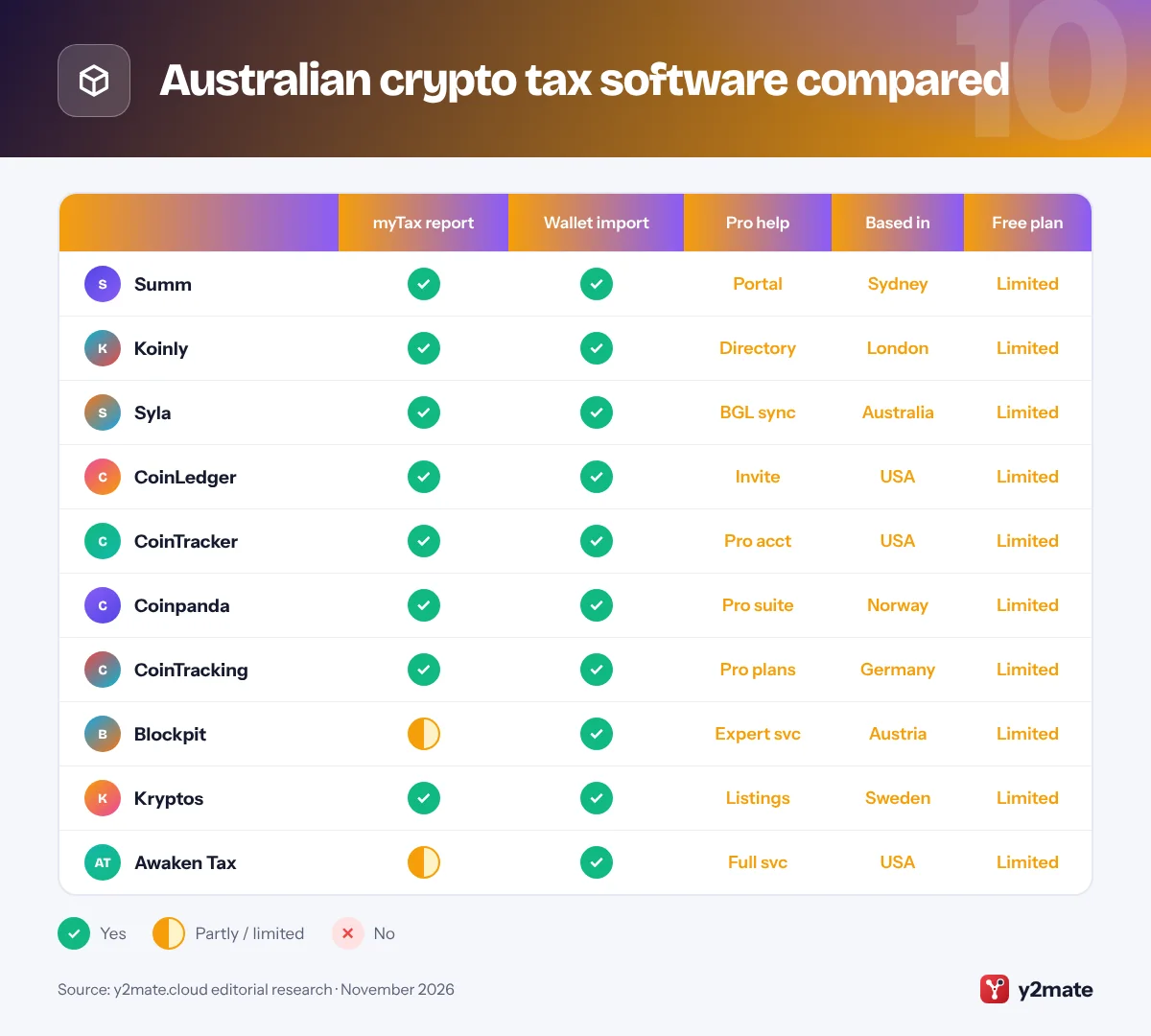
Australian crypto tax software compared
How to choose crypto tax software in Australia
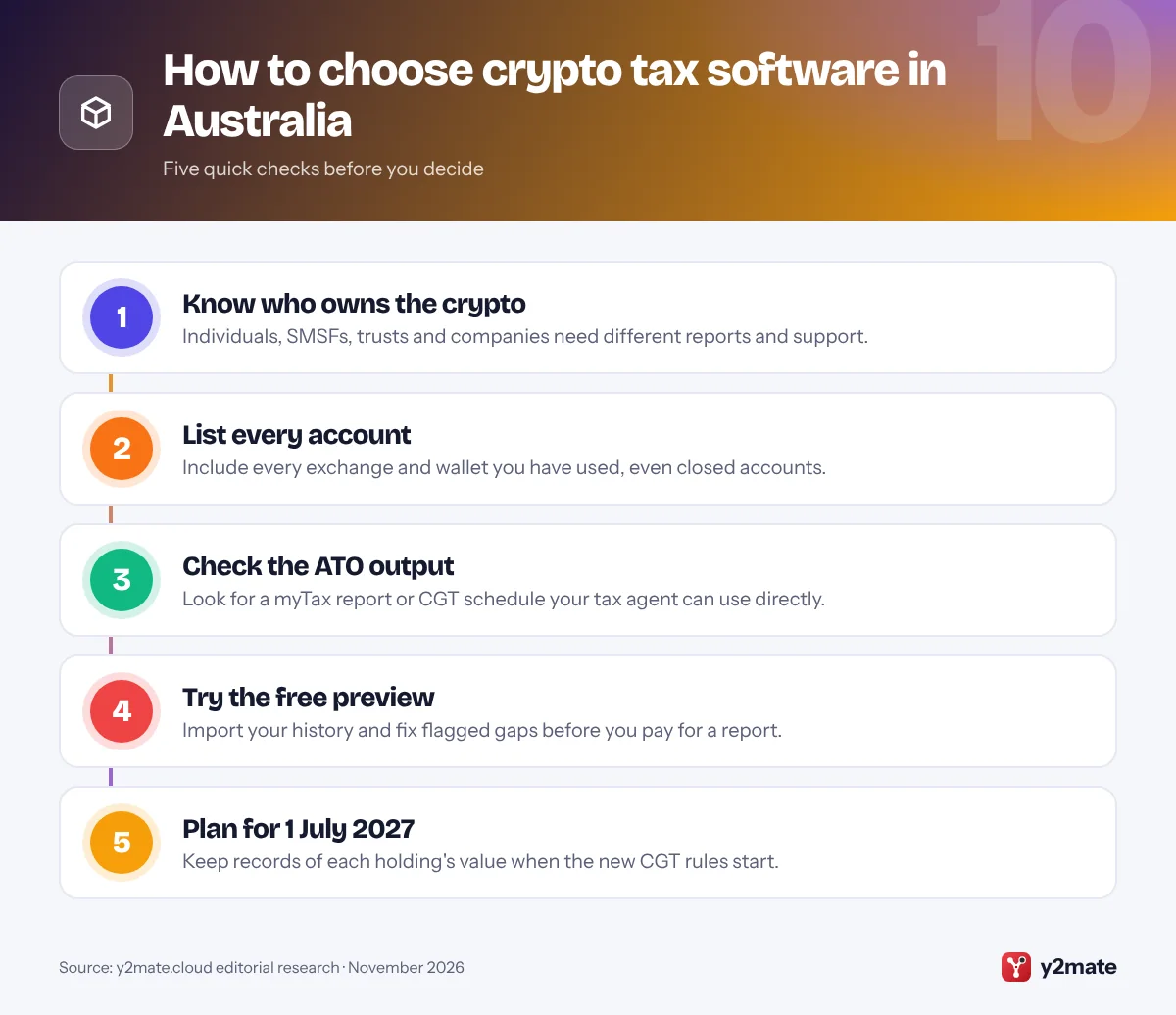
Start with who owns the crypto. Individuals can use any tool here, but an SMSF, trust or company needs software that supports that entity, and SMSF trustees should look for a direct link to their fund’s accounting software, such as Syla’s BGL sync.
Check it applies the ATO’s rules
- CGT events: selling, swapping, spending or gifting crypto are CGT events; moving coins between your own wallets is not, so transfer matching matters.
- CGT discount: individuals who hold an asset for at least 12 months can usually reduce the gain, but people taxed as traders cannot.
- Personal use assets: the exemption is narrow and rarely applies to crypto held as an investment.
- Income: staking rewards and many airdrops are income when you receive them.
Plan for 2027
Under the Treasury Laws Amendment (Tax Reform No. 1) Act 2026, gains that accrue from 1 July 2027 will be calculated with cost base indexation and a minimum tax instead of the discount, using each asset’s value at that date, and the ATO is still finalising detailed guidance. Choose software with reliable historical prices. Treasury has also released draft laws to adopt the OECD Crypto-Asset Reporting Framework, adding to the ATO’s existing data matching. If you prefer not to pay, the ATO’s free CGT record keeping tool can calculate gains from records you enter yourself. This is general information only, so speak to a registered tax agent if your situation is complex.
Frequently asked questions
What is the best crypto tax software in Australia?
Summ is our top pick for most individual investors because it was built in Sydney and its reports are laid out for myTax. Koinly is the best all-rounder for many exchanges and wallets, and Syla is the specialist for SMSFs, trusts and companies, with a direct sync into BGL. Most tools let you import your history free before you pay for a report.
How is crypto taxed in Australia?
The ATO treats most crypto as a CGT asset. Selling, swapping, spending or gifting it is a CGT event that creates a capital gain or loss, which goes in your tax return for the financial year from 1 July to 30 June. Individuals who held an asset for at least 12 months can usually apply the CGT discount. Crypto from staking, airdrops or payments is generally ordinary income.
Does the ATO know about my crypto?
Very likely. The ATO collects account and transaction data from Australian crypto providers and matches it against tax returns to find unreported disposals, and myTax can show a reminder that you may have had a crypto CGT event. That reminder does not include your cost base or proceeds, so you still need your own records or crypto tax software to work out the figures.
What changes to CGT start on 1 July 2027?
Under the Treasury Laws Amendment (Tax Reform No. 1) Act 2026, gains that accrue from 1 July 2027 will be calculated using cost base indexation, which adjusts your cost for inflation, plus a minimum tax, instead of the CGT discount. Gains built up before that date still get the discount, so each holding's value on 1 July 2027 will matter. The ATO is still finalising detailed guidance.
Can I do my crypto tax for free in Australia?
Sometimes. The ATO's free capital gains tax record keeping tool can calculate gains from records you enter yourself, and Coinpanda and Kryptos include free reports for small numbers of transactions. Most other tools let you import and preview free but charge for reports. A paid subscription may count as a cost of managing your tax affairs, so ask your tax agent whether you can claim it.
Final verdict
The best crypto tax software in Australia starts with Summ for detailed myTax reports from a Sydney-built platform, Koinly for an all-rounder that handles almost any exchange, and Syla for SMSFs, trusts and companies. CoinLedger and CoinTracker offer polished, guided workflows, Coinpanda and Kryptos suit small portfolios, CoinTracking serves experienced traders, and Blockpit and Awaken Tax cover more specific needs.
Whichever you choose, import every account, check the results against your own records and keep them. With ATO data matching and new CGT rules from 2027, accurate crypto records matter more than ever.
Sources and further reading
- ATO guide to CGT on crypto: The ATO explains how to work out a capital gain or loss on crypto, what records to keep and how to report it.
- ATO CGT record keeping tool: The ATO's free online tool for recording assets and calculating your net capital gain or loss for the year.
- Capital gains tax reform: The ATO's summary of the CGT changes that apply to gains accruing from 1 July 2027, including how the transition works.
- myTax capital gains instructions: Step-by-step ATO instructions for the capital gains section of myTax, including the crypto CGT event reminder.
- ATO crypto data-matching program: The ATO's protocol describing the crypto account and transaction data it collects from providers and matches against tax returns.

Leave a Reply