
- To install an EV charger at home in Australia, a licensed electrician must do the wiring, test it and give you your state's certificate of compliance, such as a CCEW in NSW or a COES in Victoria.
- A portable cable on a standard power point suits light driving, while a wallbox on its own circuit charges faster and supports scheduling and solar soft-charging.
- Your local network (DNSP) may need to be notified of or approve a new charger, and South Australia has required new home chargers to be demand-response capable since 1 July 2024.
- NSW's Home Energy Saver program and the ACT's Sustainable Household Scheme can help pay for an eligible home charger, while Tasmania's Energy Saver Loan Scheme and the NT's charger grant have closed.
- Renters need the landlord's written permission and apartment owners need owners corporation or body corporate approval before a charger goes in.
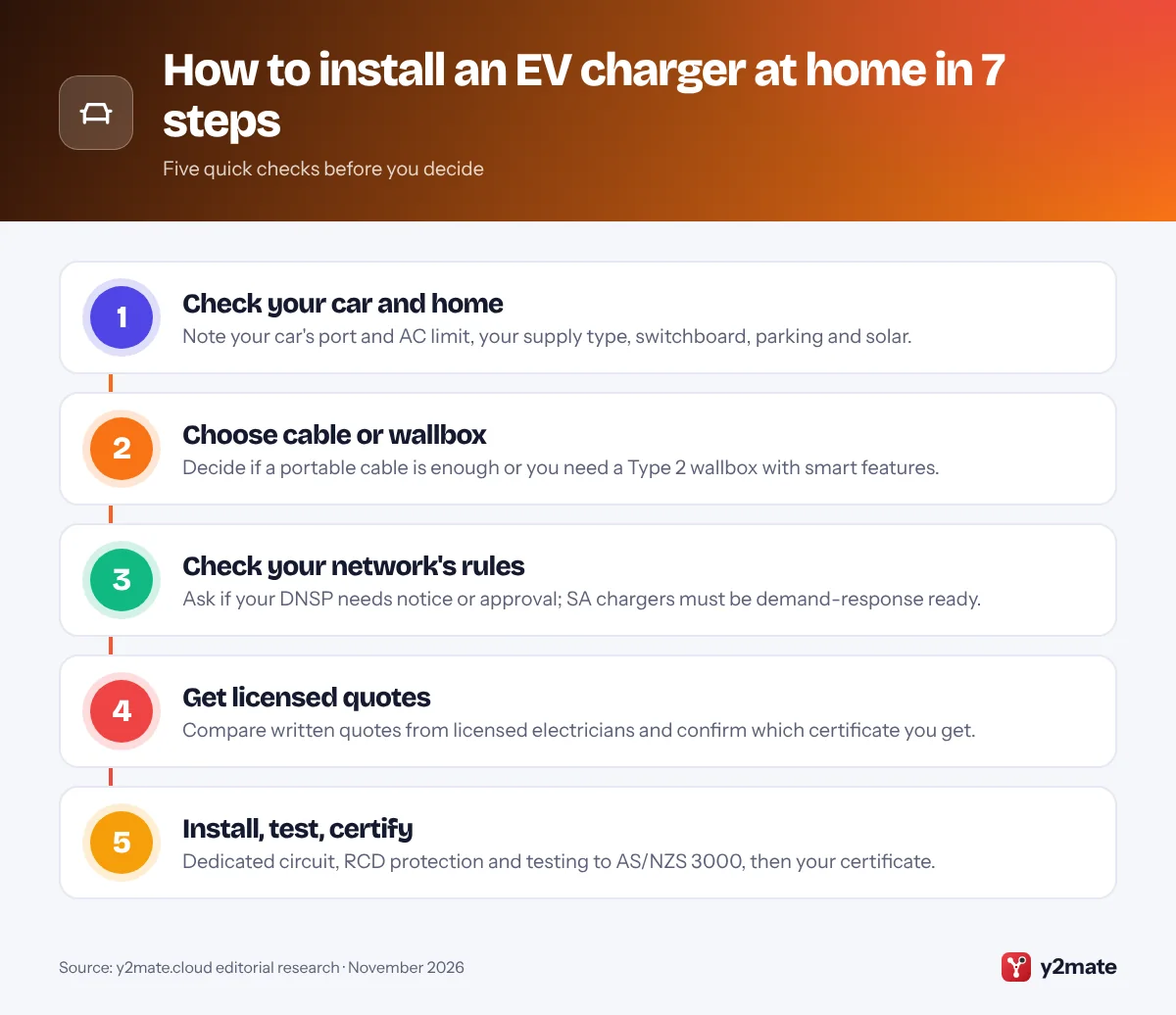
To install an EV charger at home in Australia, check your car and your home’s electricity supply, decide between the portable cable that came with your car and a fixed wallbox, and find out what your local network and state rules require. A licensed electrician then installs and tests the charger to the Australian Wiring Rules and gives you a certificate of compliance, and you finish by setting up off-peak or solar charging.
A wallbox is a charger fixed to a wall or post and wired to its own circuit, so it charges faster and more safely than a portable cable on a standard power point. Your DNSP (distribution network service provider) is the company that runs the poles and wires in your area, such as Ausgrid or SA Power Networks. It is not the retailer that sends your bill, but it may need to know about your charger.
This guide is for Australian homeowners, renters with their landlord’s permission and apartment owners with strata approval. Electrical work must be done by a licensed electrician, and rules differ between states and networks, so we flag the differences and point to official sources.
Level: Beginner · Time needed: A few weeks, from quotes to install
What you need
- Off-street parking, such as a garage, carport or driveway, near a wall or post for the charger
- Your car’s owner’s manual, showing its charging port and maximum AC charging rate
- Photos of your switchboard and meter, plus a recent electricity bill, which usually names your distributor
- Written approval from your landlord or owners corporation if you rent or live in strata
- Written quotes from two or more licensed electricians in your state
Step 1: Check Your Car, Parking and Electrical Supply
Start with the car, because it sets the limits. Your owner’s manual lists the charging port and the car’s maximum AC charging rate, which is controlled by the onboard charger inside the vehicle. A wallbox cannot charge faster than that, so don’t pay for capacity your car cannot use. Almost every new EV sold in Australia uses a Type 2 plug for AC charging and CCS2 for DC fast charging, although some older imports use different plugs.
Next, look at your home:
- Supply type. Most homes have single-phase power, which means one active supply line from the street. Some have three-phase power, with three active lines that can deliver more power at once. An electrician can confirm which you have from your switchboard and meter.
- Switchboard condition. Older switchboards with ceramic fuses, no safety switches or little spare room may need upgrading before a charger is added.
- Parking. Note where the car sits each night and how far it is from the switchboard, since long cable runs, trenching or a detached carport add work.
- Solar and batteries. List any rooftop solar, home battery or inverter, because they affect how the charger is wired and controlled.
Step 2: Choose Between a Portable Cable and a Wallbox
You have two main ways to charge at home.
- Portable charging cable. Many EVs come with, or offer as an option, a portable cable that plugs into a standard power point. It needs little or no new wiring, but it is slow, and a full charge can take many hours. Have an electrician check the power point and circuit first, and never use an extension lead or power board.
- Wallbox. A wallbox on a dedicated circuit charges much faster, is built for daily use and adds smart features.
When comparing wallboxes, check:
- Connector: a tethered Type 2 cable is convenient, while a socket-only unit lets you use your own cable.
- Smart features: app scheduling, load management that slows charging when the house is using a lot of power, and solar soft-charging, a mode that adjusts charging speed to match spare rooftop solar.
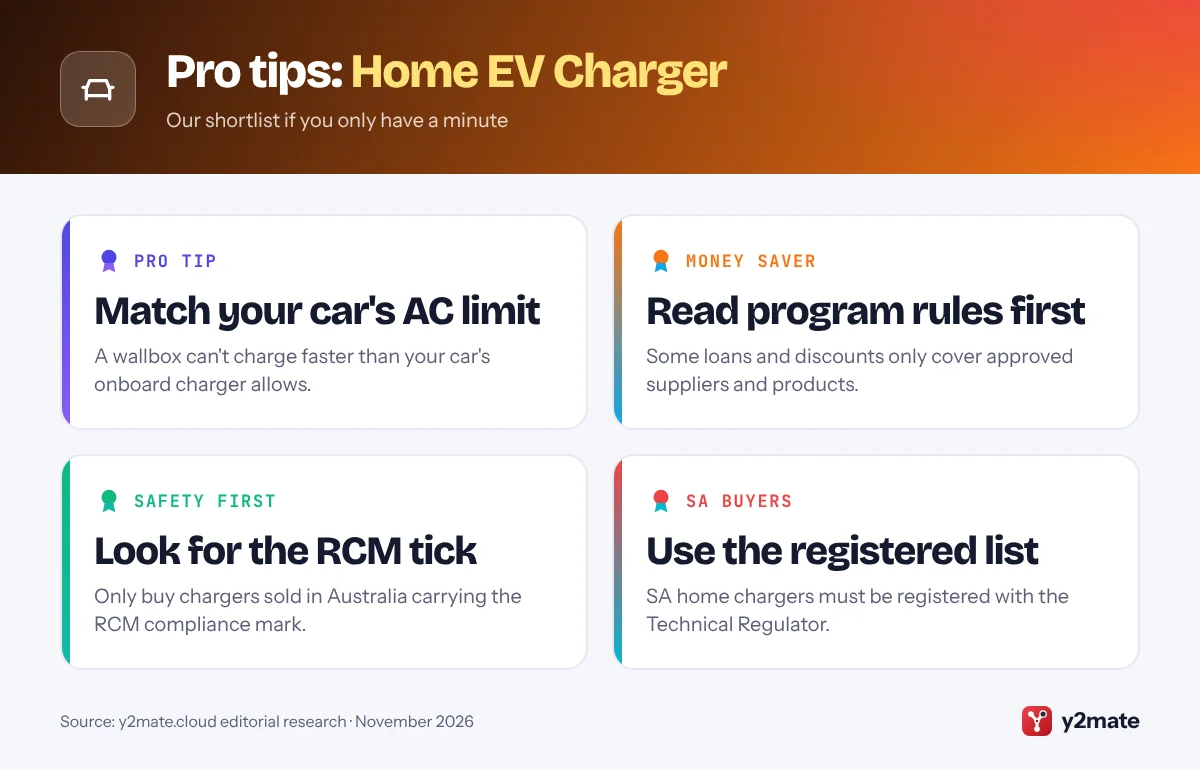
- Compliance: the RCM (Regulatory Compliance Mark) tick and, in South Australia, registration with the Technical Regulator.
- Outdoor rating, warranty and local support.
Bidirectional chargers, which can power your home or the grid from the car, face extra network rules, so treat them as a separate project.
Step 3: Check Your Network (DNSP) and State Rules
Your DNSP decides how new loads connect to its network. The main ones are Ausgrid, Endeavour Energy and Essential Energy in NSW; CitiPower, Powercor, United Energy, Jemena and AusNet in Victoria; Energex and Ergon Energy Network in Queensland; SA Power Networks; Western Power and Horizon Power in WA; TasNetworks in Tasmania; and Evoenergy in the ACT.
Each network publishes service and installation rules that say when a new charger must be notified or approved. Ausgrid, for example, says the NSW rules require it to approve load increases before connection. Larger chargers and three-phase upgrades are more likely to need approval.
Some states add their own requirements:
- South Australia: since 1 July 2024, new home chargers must be capable of demand response, meaning they can change their charging rate when a remote signal asks, and must be registered with the Office of the Technical Regulator before installation.
- Queensland: Energex and Ergon Energy Network withdrew their switched-load limits for EV chargers from 1 October 2026, removing an earlier requirement for active network management of larger single-phase chargers.
If anything is unclear, check with your DNSP before you buy a charger.
Step 4: Get Quotes From a Licensed Electrician
Electrical work must be done by a licensed electrician. In every state and territory it is illegal for an unlicensed person to wire a charger, add a circuit or work inside a switchboard, and DIY work can also put insurance and rebates at risk. Ask for the electrician’s licence number and check it with your state’s licensing body.
Give each electrician the same details: your car and charger model, photos of the switchboard and meter, where you park and whether you have solar or a battery. A good written quote should state:
- whether your switchboard or supply needs upgrading;
- the cable route, how the cable is protected and the type of RCD used;
- who handles any DNSP notification or application;
- commissioning, app setup and which certificate you will receive.
A certificate of compliance is the document your electrician must give you after testing the work, confirming it meets the rules. Its name varies by state: a Certificate of Compliance for Electrical Work (CCEW) in NSW, a Certificate of Electrical Safety (COES) in Victoria, a certificate of testing and compliance in Queensland, an electronic certificate of compliance (eCoC) in South Australia and an electrical safety certificate in WA. If your supply needs upgrading in NSW, work on the network connection is done by an Accredited Service Provider (ASP).
Step 5: Installation Day, Safety Testing and Your Certificate
A straightforward installation is often finished in a day, though switchboard upgrades or long cable runs take longer. The electrician will typically:
- switch off the power at the switchboard, so expect a short outage;
- add a new circuit breaker and RCD, or upgrade the board if your quote included it;
- run cable to the charger, protected by conduit where needed;
- mount and connect the wallbox, then test and commission it.
Two Australian standards guide the work. AS/NZS 3000, known as the Wiring Rules, sets safety requirements for electrical installations, including, in most cases, a dedicated circuit for each charging point and protection by an RCD (residual current device), which Australians call a safety switch. EV chargers also need protection against DC leakage, either from a suitable RCD type or from detection built into the charger. AS/NZS 3008 covers cable sizing, matching the cable to the load, the length of the run and how it is installed.
Before the electrician leaves, ask them to set the charger’s maximum current to suit the circuit, connect the app and hand over your certificate, then keep it with the invoice. In Victoria, some higher-risk prescribed work, such as replacing a switchboard, must also be checked by an independent licensed electrical inspector.
Step 6: Set Up Off-Peak Charging, Solar Charging and the Right Tariff
Your tariff matters as much as the hardware. Look at three options:
- Time-of-use tariffs charge different rates at different times of day, so you can schedule charging for cheaper periods. They need a smart meter.
- EV plans from some retailers add a cheaper charging window, usually overnight. Compare plans on Energy Made Easy, or on Victorian Energy Compare in Victoria. In WA, check the options from Synergy or Horizon Power.
- The Solar Sharer Offer. Since 1 July 2026, retailers in NSW, south-east Queensland and South Australia have had to offer eligible smart-meter households a plan with free electricity for a set window in the middle of the day. It suits cars that sit at home around lunchtime, but power used outside the window is still charged, so compare it with your current plan.
With rooftop solar, switch on solar soft-charging so the car soaks up spare solar instead of exporting it, and keep a scheduled overnight top-up as a backup for cloudy weeks. Set the schedule in either the car’s app or the charger’s app, not both, because two schedules can clash. In South Australia, if you connect your charger to a demand response program, it may occasionally slow charging when the grid is under strain.
Step 7: Check Rebates and Get Landlord or Strata Approval
Help with home charger costs depends on where you live. As of November 2026:
- NSW: the Home Energy Saver program offers zero-interest loans to eligible homeowners and landlords, and discounts to eligible lower-income households, for approved upgrades that include a Level 2 home EV charger from an approved supplier.
- ACT: the Sustainable Household Scheme offers low-interest loans that can cover a dedicated home charger and any three-phase upgrade it needs.
- South Australia: under the Retailer Energy Productivity Scheme, participating retailers can offer incentives for connecting a charger to an approved demand response aggregator.
- Closed: Tasmania’s Energy Saver Loan Scheme closed in 2025, and the Northern Territory’s EV charger grant closed to applications at the end of 2025.
Check the energy.gov.au rebates finder for new programs, and read each program’s rules before work starts.
Renters need the landlord’s written permission before any electrical work, plus agreement on who pays and whether the charger stays. Apartment owners need approval from the owners corporation or body corporate, because wiring usually crosses common property. NSW has passed strata reforms that stop committees unreasonably refusing a charger on an owner’s lot, so check NSW Fair Trading for when each change applies.
How to Install an EV Charger at Home in Australia: Rules by State
The steps to install an EV charger at home in Australia are the same everywhere, but certificate names, networks and extra rules differ. Confirm the details with your electrician.
- NSW: CCEW certificate; Ausgrid, Endeavour Energy or Essential Energy; Home Energy Saver loans and discounts can cover an eligible charger.
- Victoria: COES certificate; CitiPower, Powercor, United Energy, Jemena or AusNet; prescribed work also needs an independent inspection.
- Queensland: certificate of testing and compliance; Energex in the south-east and Ergon Energy Network in regional areas; single-phase charger limits relaxed from 1 October 2026.
- South Australia: eCoC certificate; SA Power Networks; chargers must be demand-response capable and registered with the Technical Regulator.
- Western Australia: electrical safety certificate; Western Power in the south-west and Horizon Power in regional areas.
- Tasmania, ACT and NT: TasNetworks, Evoenergy and Power and Water respectively; ask your electrician which certificate applies.
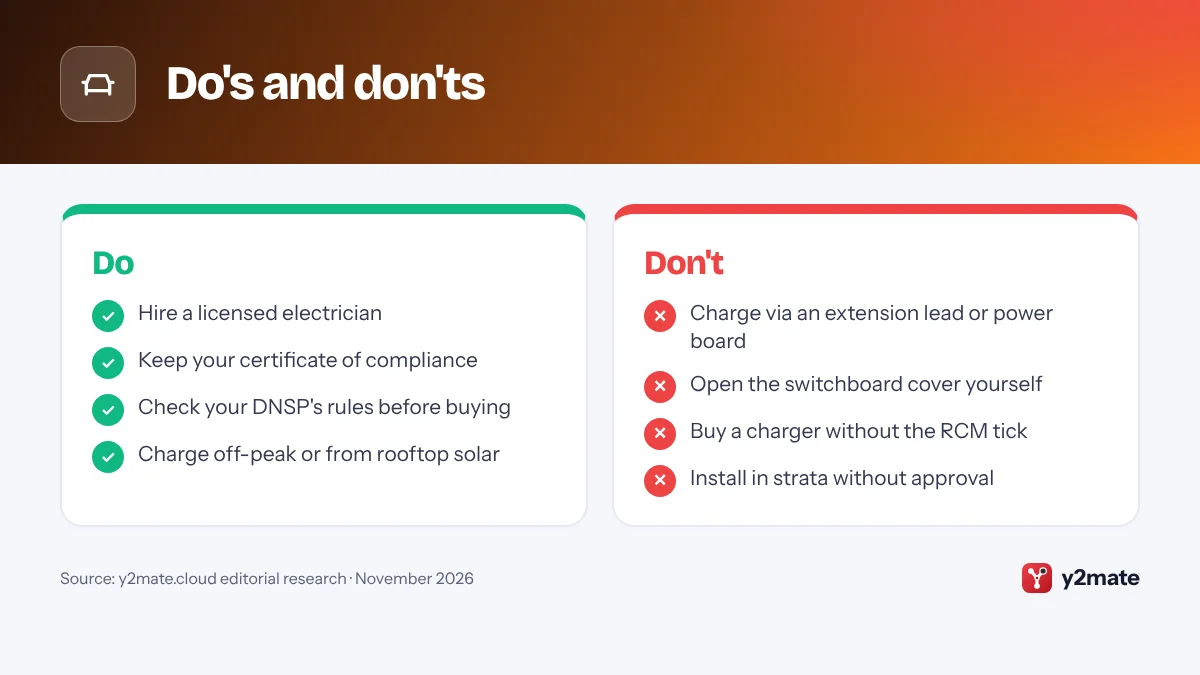
Do's and don'ts
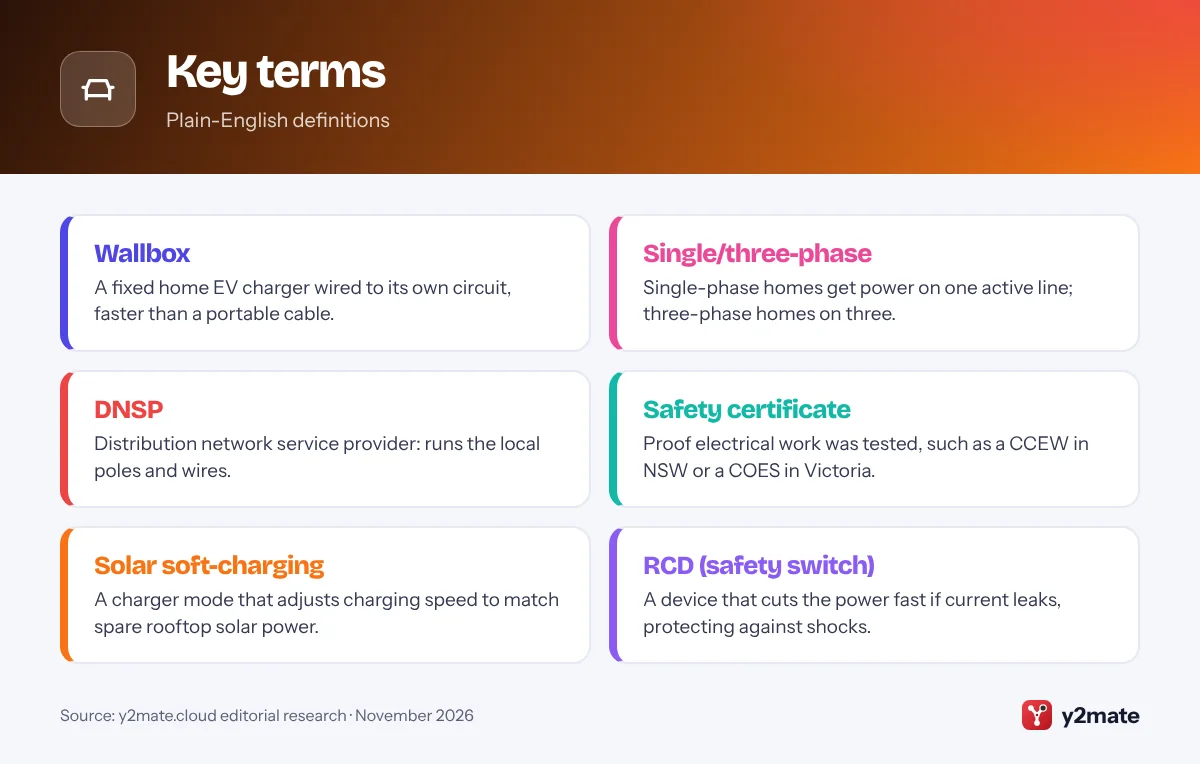
Key terms
Troubleshooting
The electrician says your switchboard needs upgrading
This is common with older boards. Ask for the reason in writing, with the upgrade listed separately in the quote, and ask whether load management would avoid a supply upgrade. In NSW, a switchboard upgrade is also an approved upgrade under the Home Energy Saver loans.
Charging slows down or pauses in the evening
Load management is probably reducing charging while the oven, air conditioner or hot water system runs, which is normal. If the car is not ready by morning, ask your electrician to review the settings.
Solar soft-charging keeps stopping
On cloudy days, or when the house is using most of the solar, there may not be enough spare power. Add a scheduled overnight top-up, and ask your installer to check the charger’s energy meter or solar sensor.
The safety switch trips while charging
Stop charging and call your electrician rather than resetting it repeatedly. A trip can point to a fault in the charger, cable, car or wiring. Also check Product Safety Australia, run by the ACCC, for any recall on your charger model.
Frequently asked questions
Can I install an EV charger at home myself in Australia?
No. Electrical work must be done by a licensed electrician in every Australian state and territory, and that includes wiring a wallbox, adding a circuit or upgrading a switchboard. Plugging the car's portable cable into an existing, suitable power point is not electrical work. A licensed electrician will test the installation and give you your state's certificate of compliance, such as a CCEW in NSW or a COES in Victoria.
Do I need to tell my electricity network before installing a home EV charger?
Often, yes, although your electrician usually handles it. Each distribution network (DNSP), such as Ausgrid, Energex or SA Power Networks, has service and installation rules that say when a new charger must be notified or approved, and larger chargers or three-phase upgrades are more likely to need approval. In South Australia, the charger must also be demand-response capable and registered with the Technical Regulator.
Do I need three-phase power for a home EV charger?
Usually not. A wallbox on a standard single-phase supply is enough for many households to replace a typical day's driving overnight. Three-phase power lets a compatible wallbox charge faster, but only if your car's onboard charger can accept three-phase AC power, and not all can. Upgrading to three-phase involves your network and extra work, so check your car's specifications and ask an electrician first.
Are there rebates for home EV chargers in Australia?
It depends where you live. In NSW, the Home Energy Saver program offers zero-interest loans and, for eligible lower-income households, discounts that can cover a Level 2 home charger. The ACT's Sustainable Household Scheme offers low-interest loans that can include a charger, and South Australian retailers may offer incentives for connecting to a demand response aggregator. Check the energy.gov.au rebates finder for current programs.
Can I install an EV charger if I rent or live in an apartment?
Yes, with permission. Renters need the landlord's written consent before any electrical work, and should agree who pays and whether the charger stays when they leave. Apartment owners need approval from the owners corporation or body corporate, because wiring usually crosses common property. NSW has passed reforms that stop strata committees unreasonably refusing a charger on an owner's own lot, so check current NSW Fair Trading guidance.
Wrapping up
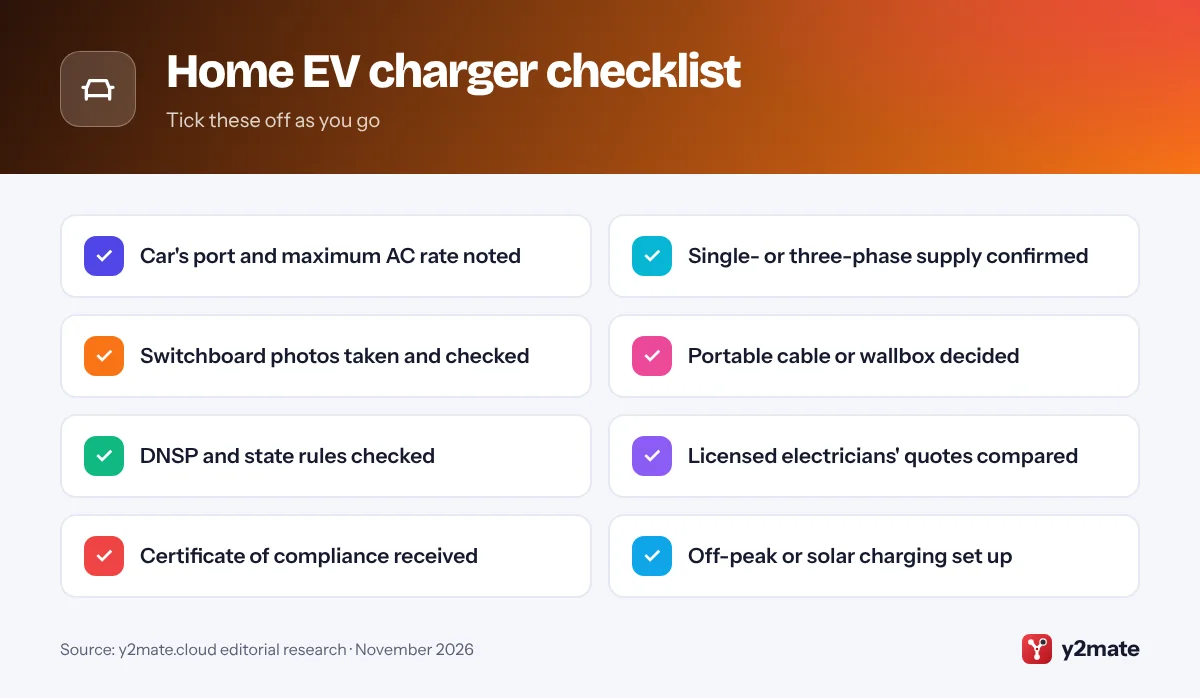
To install an EV charger at home in Australia, work through it in order: check your car and supply, choose a portable cable or a wallbox, confirm your DNSP and state rules, use a licensed electrician who gives you your certificate of compliance, then set up off-peak or solar charging. Check NSW, ACT or South Australian programs before you buy, and get landlord or strata approval first if you need it.
Home charging covers most everyday driving, but longer trips still rely on public fast chargers. See our guide to the Top 10 EV Charging Networks in Australia and, if you are still choosing a car, our list of the Top 10 Electric Cars in Australia.
Sources and further reading
- energy.gov.au home charging options: The Australian Government explains home charging options for houses and strata buildings, including dedicated chargers and strata approvals.
- NSW electrical compliance requirements: The NSW Government explains licensed electrical work and the Certificate of Compliance for Electrical Work (CCEW) your electrician must give you.
- Energy Safe Victoria COES guide: Energy Safe Victoria explains what a Certificate of Electrical Safety is and when you should receive one after electrical work.
- SA Power Networks home EV chargers: South Australia's distributor sets out home EV charger requirements, including demand response and when network approval is needed.
- Standards Australia Wiring Rules: Standards Australia's overview of AS/NZS 3000, the Wiring Rules that electricians follow for safe electrical installations.

Leave a Reply