
- No single check proves a deepfake; the most reliable steps are checking the source, ringing back on a number you find yourself and using free tools such as reverse image search and Content Credentials.
- Since 3 September 2024, it has been a federal crime to transmit sexual material depicting an adult without consent online, whether the material is real or made or altered with AI.
- eSafety can issue a removal notice requiring an intimate image, including a deepfake, to be taken down within 24 hours.
- ASIC warns that scammers use AI to build networks of deepfake videos, websites and fake reviews, so check a firm's Australian Financial Services licence on ASIC's registers before investing.
- Report deepfake scams to your bank, ReportCyber and Scamwatch, and report intimate deepfakes to the police and eSafety.
The best ways to spot deepfakes Australia-wide are habits backed by free tools: stop and check where a photo, video or voice message came from, ring the person back on a number you find yourself, and run checks such as reverse image search, Content Credentials and Google’s SynthID Detector. Odd hands or out-of-sync lips are clues, not proof. If you find a deepfake, report it: scams to your bank, ReportCyber and Scamwatch, and intimate deepfakes to the police and eSafety, which can order their removal.
A deepfake is an image, video or audio clip created or altered with artificial intelligence so that a real person appears to say or do something they never did. In Australia they turn up in fake celebrity investment ads, cloned-voice calls from “family members”, fake romance profiles and sexual images made without consent.
Below are the ten most useful checks and reporting routes for Australians as of November 2026, ranked for everyday use. This is general information, not legal advice.
How we ranked this list
We ranked the ten ways by how reliable, free and easy they are for ordinary Australians, and by how closely they match official guidance from the eSafety Commissioner, Scamwatch and the National Anti-Scam Centre, ASIC, the Australian Cyber Security Centre and the Australian Electoral Commission, plus standards bodies such as the Coalition for Content Provenance and Authenticity (C2PA).
We did not test detection tools hands-on and give no accuracy figures, since results vary with the content and change as AI models improve.
The Top 10 Ways to Spot Deepfakes
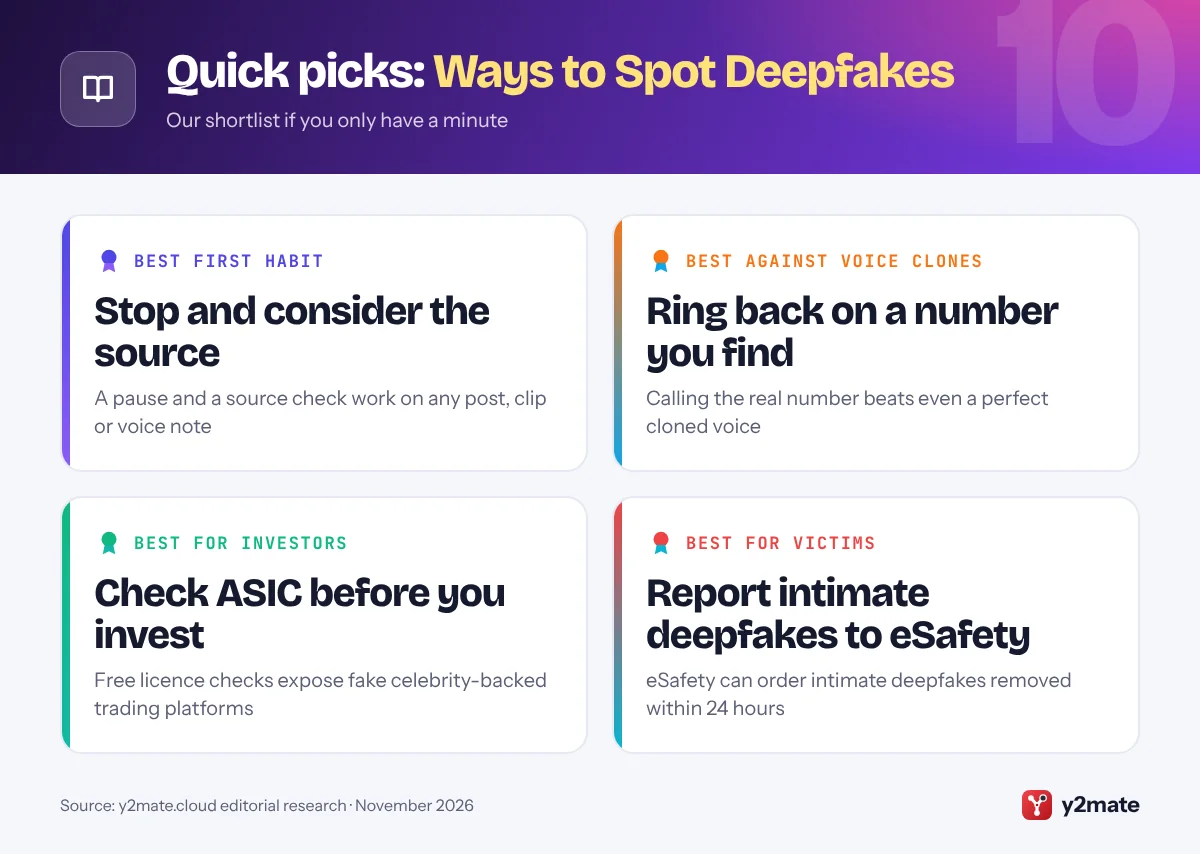
1. Stop and consider the source
Best for: viral posts, news clips and election content
Scamwatch’s advice for any suspicious contact comes down to three words: stop, check, protect. Apply the same to images and video. Stop before you share or react, then check where the content came from: the original upload, whether the account is genuine, and whether reputable Australian outlets or the official source confirm it. Deepfakes rely on emotion and speed, so a pause is your best defence.
For elections, the Australian Electoral Commission runs a Stop and Consider campaign that asks voters to think about whether content about voting could be AI-generated. The AEC says deepfakes that mislead voters about casting a vote may breach the Electoral Act. South Australia has gone further: its electoral law bans AI-generated election ads that show a real person doing something they did not do, unless that person consents in writing, with rules in place before the March 2026 state election.
When in doubt, check voting information directly with the AEC or your state electoral commission.
Official site: Stop and consider the source
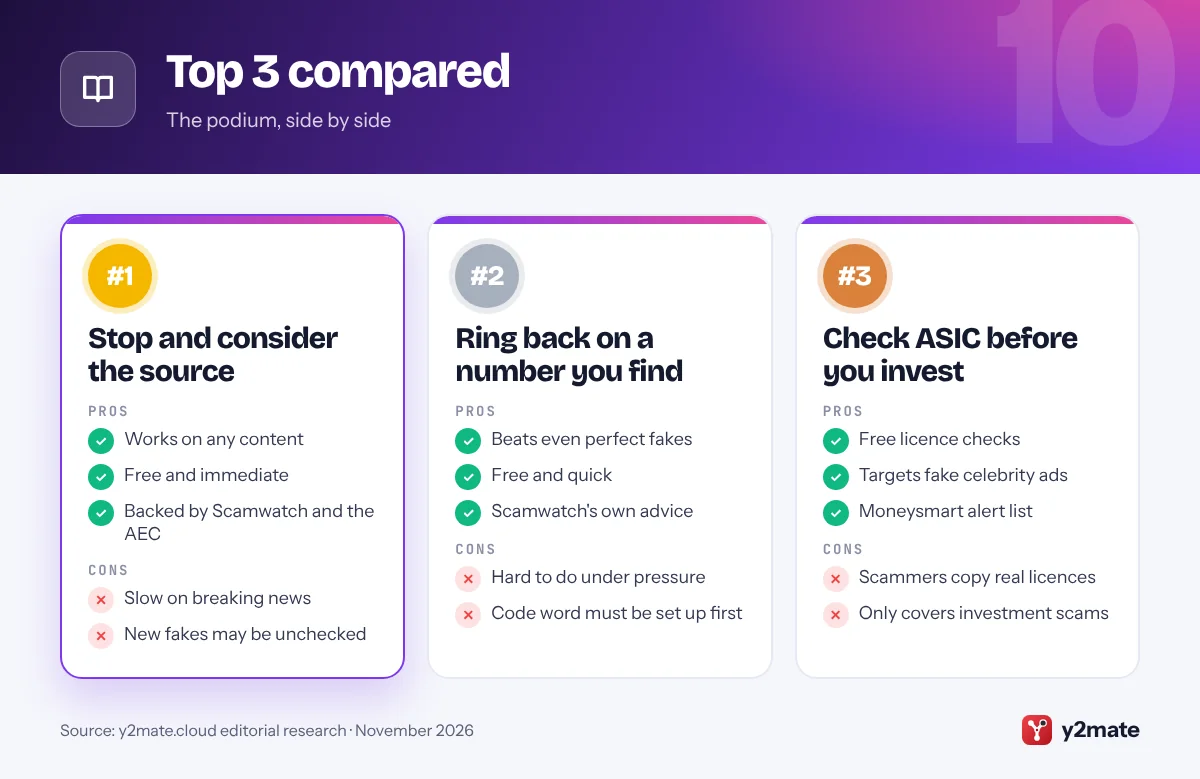
- Works on any content
- Free and immediate
- Backed by Scamwatch and the AEC
- Slow on breaking news
- New fakes may be unchecked
2. Ring back on a number you find
Best for: urgent calls or messages asking for money
Scamwatch warns that scammers can use a few seconds of a voice recording to create an AI clone, then call pretending to be a friend or family member in distress. Its advice is to call the person back on their real number and not to reply to a message from a new number claiming to be someone you know. For an organisation, call back on a number you find yourself on its official website or app.
Add a family code word: a word or phrase agreed in person that anyone asking for money or urgent help must say. A cloned voice cannot know a word it has never heard. At work, agree that changes to payment details are always confirmed by a call to a known number, even if the request arrives by video.
Texts are another way in. Since 1 July 2026, texts from branded sender names that are not on ACMA’s SMS Sender ID Register are marked “Unverified”, and the ACMA advises treating them with extra caution.
Official site: Ring back on a number you find
- Beats even perfect fakes
- Free and quick
- Scamwatch's own advice
- Hard to do under pressure
- Code word must be set up first
3. Check ASIC before you invest
Best for: celebrity videos promoting trading platforms
Deepfake videos of well-known Australians promoting investment platforms are a recurring scam here. Scamwatch has warned about lifelike fakes of celebrities and public figures backing so-called “AI” or “quantum” trading platforms, and in August 2026 ASIC warned that scammers are using generative AI to build whole networks of deepfake websites, endorsements, fake reviews and news articles.
ASIC’s point is that a quick online search is not enough, because scammers plant supportive content in exactly the places people check. Instead, confirm that the business holds an Australian Financial Services licence on ASIC’s professional registers, make sure the name and number match what is being promoted, and look at the Moneysmart investor alert list. ASIC says it never cold calls people about investments and never endorses investment platforms.
Treat any celebrity, politician or influencer promoting a trading platform as fake until proven otherwise, and never move money because of a video alone.
Official site: Check ASIC before you invest
- Free licence checks
- Targets fake celebrity ads
- Moneysmart alert list
- Scammers copy real licences
- Only covers investment scams
4. Reverse image search
Best for: finding where a photo really came from
A reverse image search looks for other copies of an image online. It can reveal an older original, a photo taken somewhere else entirely, or the picture a fake profile was built from. Google Lens, Bing Visual Search and TinEye are free; try more than one, because each covers different sites. For video, search a clear screenshot of a key frame.
It is especially useful against romance scams. Scamwatch notes that scammers use AI to create photo albums of people who do not exist, so be cautious if a new online contact’s photos turn up under other names or look too polished and consistent, and never send money to someone you have only met online.
Google also lets you ask Lens or Circle to Search whether an image is AI-generated, which checks for its SynthID watermark. No matches does not mean an image is real: fresh fakes and fresh genuine photos both start without any history.
Official site: Reverse image search
- Free on phone and desktop
- Exposes fake profiles
- Finds older originals
- Fresh fakes have no matches
- No help with voice
5. Content Credentials (C2PA)
Best for: seeing how a photo was made and edited
Content Credentials are a digital record attached to a photo, video or audio file showing where it came from, what edited it and whether AI tools were used. They are based on an open standard from the Coalition for Content Provenance and Authenticity (C2PA), supported by Adobe, Google, Microsoft, OpenAI, Meta and hundreds of other companies. Check a file by uploading it to the free Verify tool at contentcredentials.org, or install Adobe’s free Content Authenticity extension for Chrome.
More devices now add credentials at the moment of capture, including the camera app on Google’s Pixel 10, and the Gemini app can read them on the web and Android. That flips the question from “is this fake?” to “can this show it is real?”.
Do not over-read the result. Most images still carry no credentials, many platforms strip them on upload, and credentials record history rather than certifying that content is truthful. Their absence proves nothing either way.
Official site: Content Credentials (C2PA)
- Shows capture and edit history
- Free online Verify tool
- Growing camera support
- Missing from most images
- Stripped by many platforms
6. SynthID and AI detectors
Best for: a second opinion on a suspicious file
Google’s SynthID Detector, opened to everyone in October 2026 and available globally in English, checks a file for SynthID, the invisible watermark Google adds to images, video and audio from its AI tools. Google says it also detects watermarks used by partners including OpenAI and NVIDIA. The Gemini app offers a similar check when you upload a file and ask whether Google AI made it.
A watermark match is strong evidence of AI. No match only means no SynthID watermark was found; the detector itself says it is not a general AI detector, so the content could still come from other AI systems.
General “deepfake detector” websites and apps are less dependable. eSafety has told the Senate that detection tools are falling behind the AI used to make deepfakes, and detectors can both miss fakes and wrongly flag real, compressed footage. Use them as one signal, upload the original file where you can, and never let a “likely real” result outweigh a failed call-back.
Official site: SynthID and AI detectors
- SynthID free for everyone
- Covers image, video and audio
- Strong when it finds a mark
- Detectors give false results
- Clean result proves nothing
7. Look and listen for glitches
Best for: a fast first look at images and voice notes
Rougher deepfakes still show tell-tale flaws. In pictures, check hands, teeth, ears, glasses and jewellery, and any text in the scene, which AI often garbles. Look at whether shadows and lighting match across the image. In video, watch for lips that drift out of sync, unnatural blinking, or a face that blurs at the edges when the person turns.
For voice, listen for a flat or oddly steady tone, unnatural pauses, no sound of breathing, or words the person would not normally use. On a live call, asking something unexpected, such as a personal question only they could answer, can expose a script.
These are clues, not proof. The best AI images and cloned voices now have few obvious errors, and genuine footage squeezed through a messaging app can look glitchy. Use glitches to decide what to check next, never as a verdict, and fall back on the source and call-back checks above.
Official site: Look and listen for glitches
- Instant and free
- Catches low-effort fakes
- Covers images and voice
- Top fakes look flawless
- Real clips can look odd
8. Platform labels and reporting
Best for: deepfakes on social media and in ads
Meta, YouTube and TikTok label some AI content. Meta’s “AI info” label appears when it detects industry signals such as Content Credentials or when users disclose AI use; YouTube requires creators to disclose realistic altered or synthetic content; and TikTok labels AI-generated content, including uploads carrying Content Credentials. Plenty of AI content still goes unlabelled, so a missing label means nothing.
Report harmful deepfakes with the platform’s own tools, choosing scam, impersonation or intimate image abuse as relevant, and keep a note of what you reported and when in case you need to escalate. Australian regulators are pressing platforms too: ASIC uses a takedown service to remove scam websites and social media ads, and eSafety can issue formal removal notices for intimate images.
If a platform does not act on a sexual deepfake, report it to eSafety. For scam ads, report to Scamwatch as well, so the National Anti-Scam Centre can track the scam and warn others.
Official site: Platform labels and reporting
- Reporting built into apps
- Labels flag some AI content
- Regulators back up reports
- Many AI posts unlabelled
- Platform responses vary
9. Report intimate deepfakes to eSafety
Best for: anyone targeted with fake sexual images
Since 3 September 2024, the Criminal Code Amendment (Deepfake Sexual Material) Act 2024 has made it a federal offence to use an online or phone service to transmit sexual material depicting an adult without their consent, whether the material is real or created or altered with technology such as AI. Tougher aggravated offences apply where the person also created or altered it. Several states and territories have their own laws, and sexual material involving children is illegal whether real or AI-generated.
eSafety’s image-based abuse scheme covers digitally altered and deepfake intimate images, and eSafety can issue a removal notice requiring a platform or the person who posted the image to remove it within 24 hours. Its advice is to record URLs, usernames and dates without copying the image itself, and to report to the police and to eSafety.
To help block copies, adults can create a case with StopNCII.org, and people pictured when under 18 can use NCMEC’s Take It Down, which works worldwide. Child abuse material can also be reported to the ACCCE.
Official site: Report intimate deepfakes to eSafety
- 24-hour removal notices
- Federal crime to share
- Free hashing tools
- Non-sexual fakes may not qualify
- Hashing needs partner platforms
10. Scamwatch and ReportCyber
Best for: deepfake scams, fake ads and lost money
If a deepfake was part of a scam, act quickly. Contact your bank or card provider first to try to stop payments. Then report the cybercrime to police through ReportCyber at cyber.gov.au, run by the Australian Signals Directorate’s Australian Cyber Security Centre; reports from individuals are referred to the relevant state or territory police. The Australian Cyber Security Hotline, 1300 CYBER1, can guide you through it.
Report the scam to Scamwatch too, which is run by the ACCC’s National Anti-Scam Centre. Reports help it warn others, and you can report without giving your name. If your identity documents or accounts were exposed, IDCARE, the national identity and cyber support service, can help you make a recovery plan for free.
Beware of “recovery” offers afterwards. Scammers target victims again, posing as officials who promise to get money back for a fee. ASIC says it never asks for payment to recover money stolen by scammers.
Official site: Scamwatch and ReportCyber
- Cybercrime reports reach police
- Scamwatch reports can be anonymous
- Free IDCARE support
- Two separate reports needed
- No promise of money back
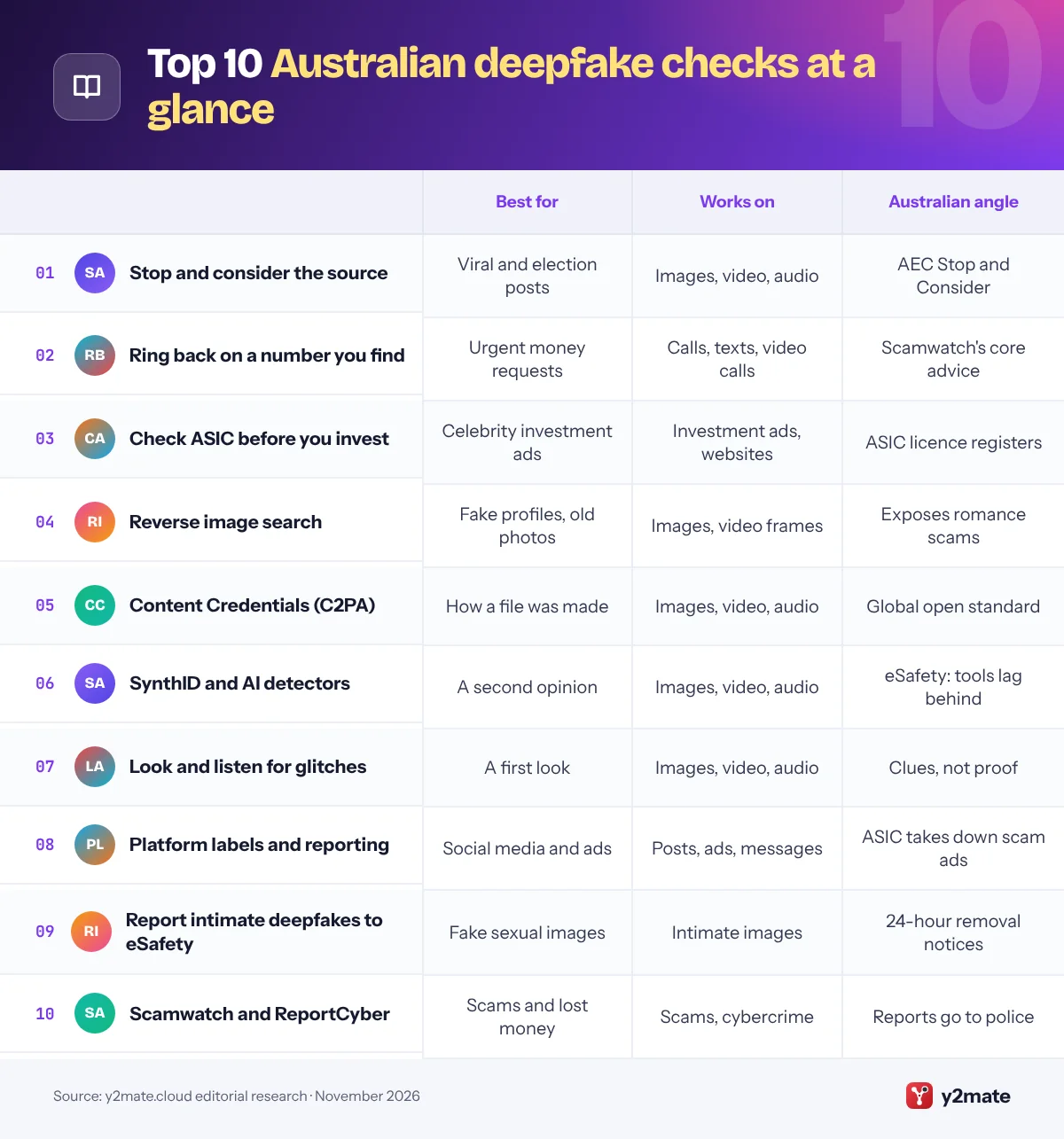
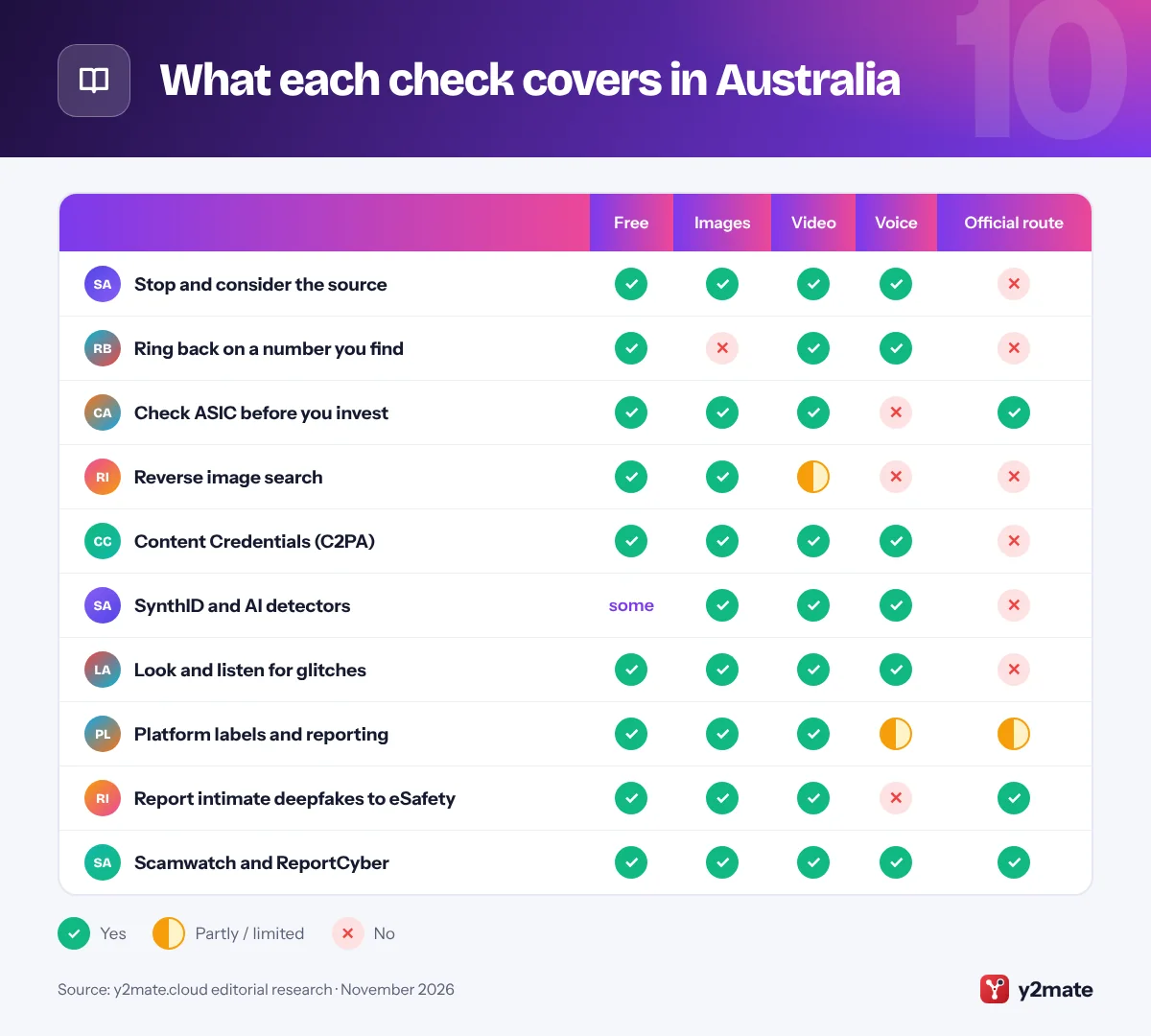
What each check covers in Australia
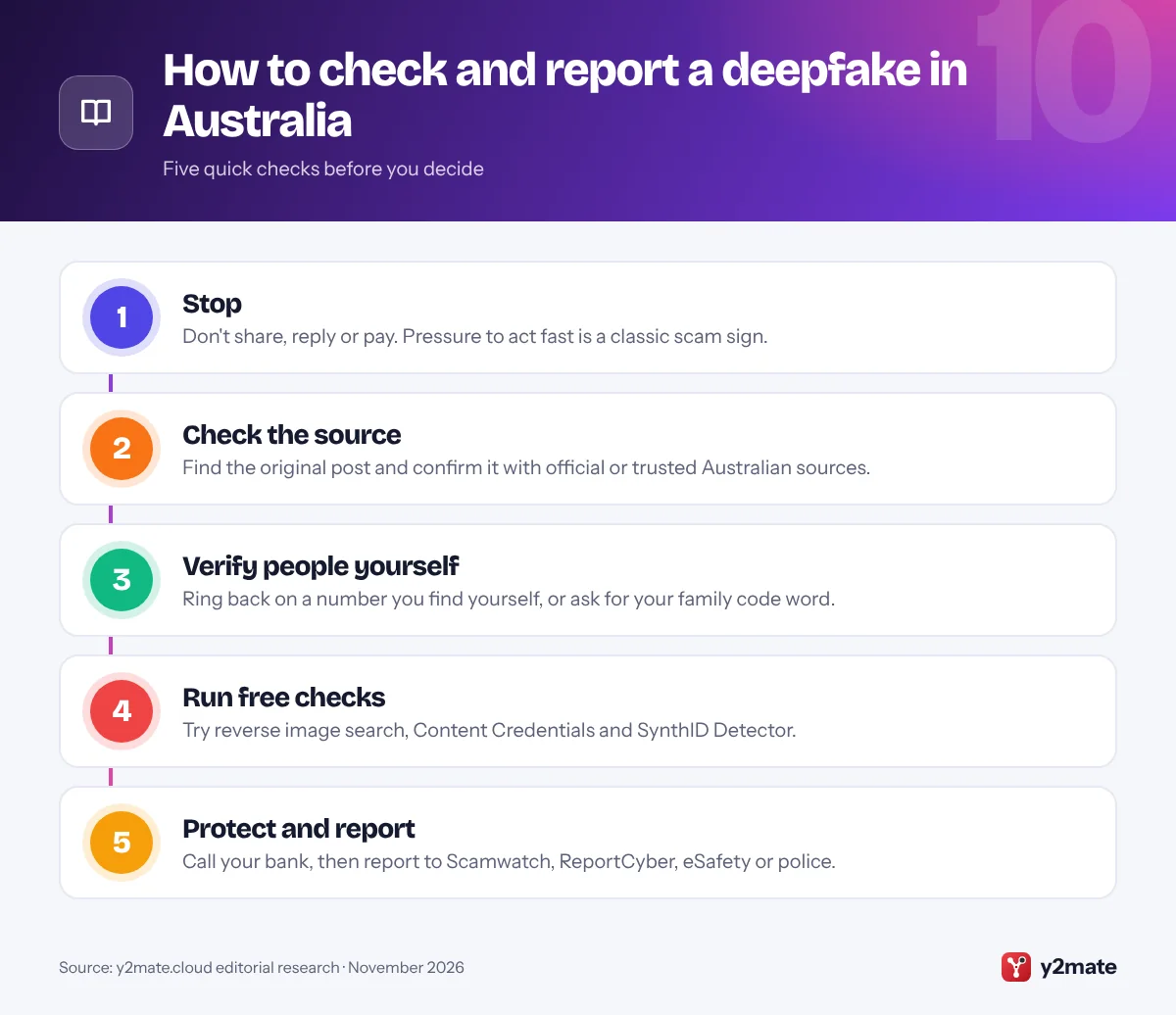
How to spot deepfakes Australia-wide and what to do next
Spotting a fake is only half the job. Your next steps depend on whether it is a scam, an attack on you, or misinformation.
Keep evidence the right way
- For scams: save links, usernames, phone numbers, screenshots of messages and payment receipts before blocking anyone.
- For intimate deepfakes: write down URLs, account names and dates instead of saving or forwarding the image, as eSafety advises.
- Get a reference: note any police event number and include it in your report to eSafety.
Protect your family before it happens
- Agree a family code word and explain voice cloning to older relatives and teenagers.
- Make social media accounts private and think twice before posting clear videos of your face and voice.
- Teach children that eSafety and Take It Down can help if someone makes a fake nude of them, and that it is not their fault.
If it is misinformation
Do not share it, even to debunk it, because sharing spreads it further. Report it on the platform, and for false information about how to vote, check the AEC or your state electoral commission. The AEC’s Stop and Consider guidance is a useful checklist for the whole family.
Frequently asked questions
What are deepfakes?
Deepfakes are images, videos or audio clips made or changed with artificial intelligence so that a real person appears to say or do something they never did. They range from harmless face-swap jokes to fake celebrity investment ads, cloned-voice scam calls and sexual images made without consent. Australian law targets the harmful uses rather than the technology itself.
How do deepfakes work?
AI models are trained on large numbers of real photos, videos or voice recordings until they learn how faces move and voices sound. They can then generate new images, place one person's face on another body, or read any script in a cloned voice. Scamwatch warns that a few seconds of someone's recorded voice can be enough to create a clone.
What are deepfake scams?
Deepfake scams use AI-made video, images or voices to make fraud more convincing. In Australia, common examples include fake videos of celebrities and politicians promoting investment platforms, cloned-voice calls from "family members" needing money, and fake romance profiles. Report them to your bank, ReportCyber and Scamwatch, and check ASIC's registers before investing.
Are deepfakes illegal in Australia?
Making a deepfake is not automatically illegal, but many uses are. It is a federal crime to transmit sexual material of an adult without consent, including deepfakes, and sexual material of children is illegal whether real or AI-made. Posting intimate images without consent can also bring civil penalties through eSafety, fraud laws cover deepfake scams, and South Australia bans deceptive AI election ads.
How do deepfakes affect people?
Sexual deepfakes can cause serious distress, humiliation and harassment, and they have been used against Australian school students; eSafety has acted against nudify services as a result. Voice-clone and investment scams take people's money. More broadly, deepfakes erode trust, because people may believe fakes or dismiss genuine evidence as AI-generated.
What is deepfake detection?
Deepfake detection is any method of telling whether content was made or altered by AI. It includes automated detectors, invisible watermarks such as Google's SynthID, provenance records such as Content Credentials, and human checks on the source. eSafety has said detection tools lag behind generation tools, so combine them with source checks and calling people back.
Final verdict
To spot deepfakes Australia-wide, rely on habits first: stop, check the source and ring back on a number you find yourself. Then add free tools such as reverse image search, Content Credentials and SynthID Detector, and check ASIC’s registers before acting on any celebrity investment video.
If a deepfake is aimed at you, report it. Scams go to your bank, ReportCyber and Scamwatch; sexual deepfakes go to the police and eSafety, which can require removal within 24 hours.
Sources and further reading
- Deepfake Sexual Material Act 2024: The Federal Register of Legislation text of the Act that made sharing non-consensual sexual deepfakes of adults a federal crime from 3 September 2024.
- Scamwatch alert on fake celebrity scams: Scamwatch explains how deepfake videos of celebrities are used to promote fake online investment platforms and what to check before investing.
- ASIC warning on AI-powered scams: ASIC's April 2026 warning about AI-generated investment scam ads and the warning signs to look for before handing over details.
- Help during a cybercrime: The Australian Cyber Security Centre explains how to report cybercrime through ReportCyber and where else to get help.
- ACMA SMS Sender ID Register: The ACMA explains its SMS Sender ID Register, which labels texts from unregistered branded sender names as Unverified to help stop impersonation scams.

Leave a Reply