
- Since 7 October 2024, UK payment firms must reimburse most victims of APP scams paid by Faster Payments or CHAPS, which gives banks a strong reason to use AI to stop scam payments.
- Starling Assistant, launched in March 2026, and NatWest's Cora are among the first UK bank assistants to use agentic AI that carries out tasks or routes fraud cases.
- The FCA has no AI-specific rulebook: it applies the Consumer Duty and the Senior Managers regime, and published AI good practice examples in October 2026.
- Under UK data protection law, as updated by the Data (Use and Access) Act 2025, you can challenge significant decisions made solely by automated means and obtain human intervention.
- The FCA's Mills Review, published in July 2026, sets out how agentic AI could reshape retail financial services by 2030.
The AI in banking UK customers meet in 2026 goes far beyond chatbots. It checks payments for signs of scams, powers assistants that can now carry out tasks for you, helps decide who gets credit and is drawing close attention from the FCA, the Bank of England and Parliament. Below are the ten developments that matter most for UK bank customers in November 2026.
Two definitions. Generative AI creates new text, images or audio, like the chatbots that write their own answers. Agentic AI goes further and carries out tasks, such as setting up a savings goal or organising a payment, within limits you set.
For each item we cover what it does, who it affects, a practical tip and the main risk. This is a news explainer, not financial advice.
How we ranked this list
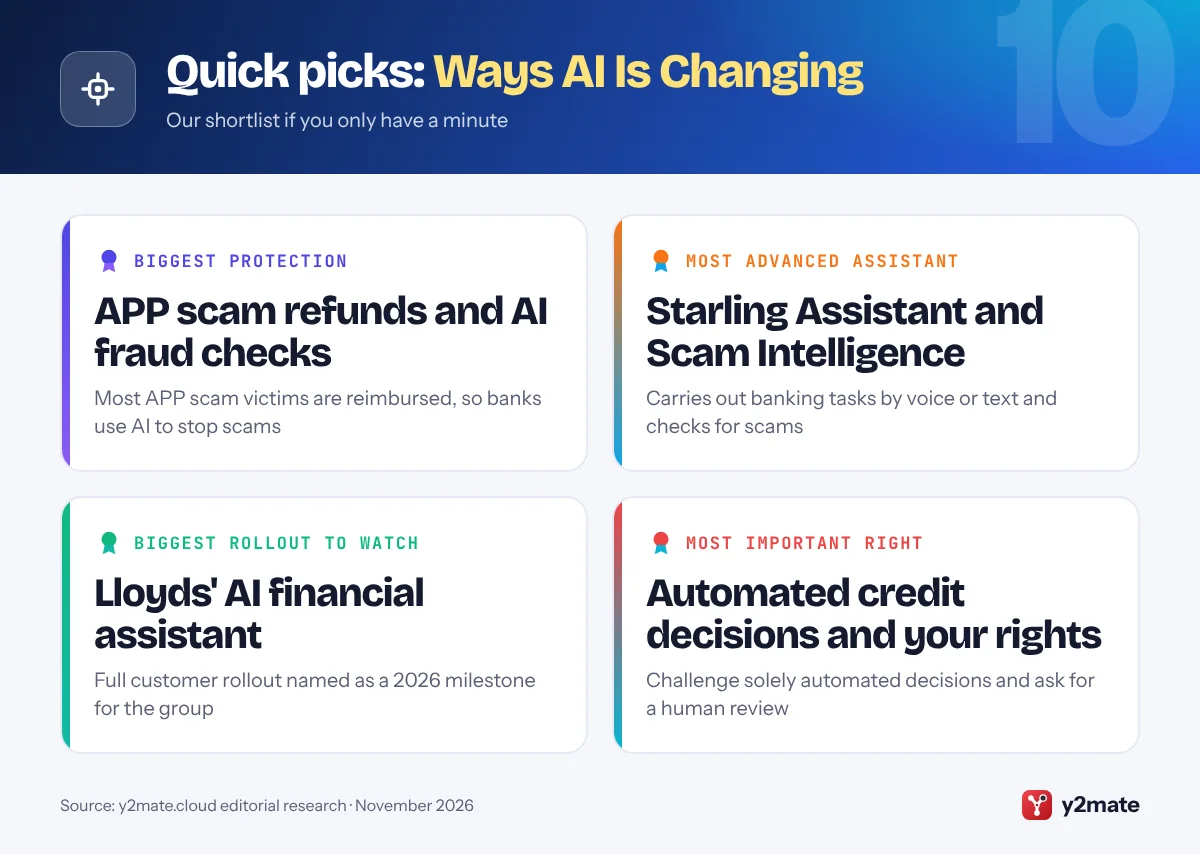
We chose and ranked these items by how many UK bank customers they affect, how far along they are (live, a pilot or rollout, or a rule in force), and how well banks and official bodies such as the FCA, the Payment Systems Regulator, the Bank of England and the ICO document them.
We did not test any bank’s AI tools and make no claims about their accuracy beyond what official sources state.
The Top 10 Ways AI Is Changing
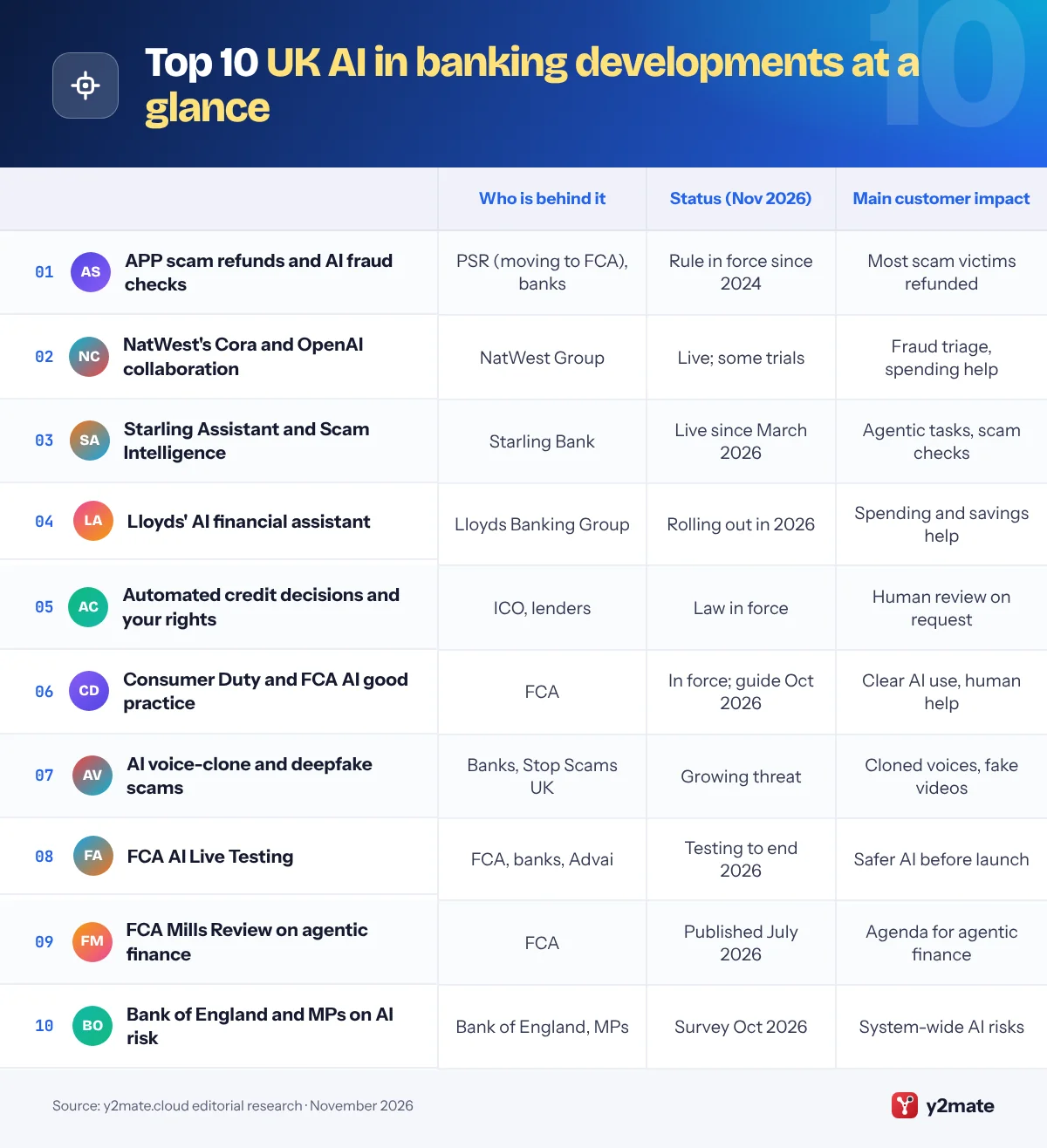
1. APP scam refunds and AI fraud checks
Best for: anyone who sends money by bank transfer
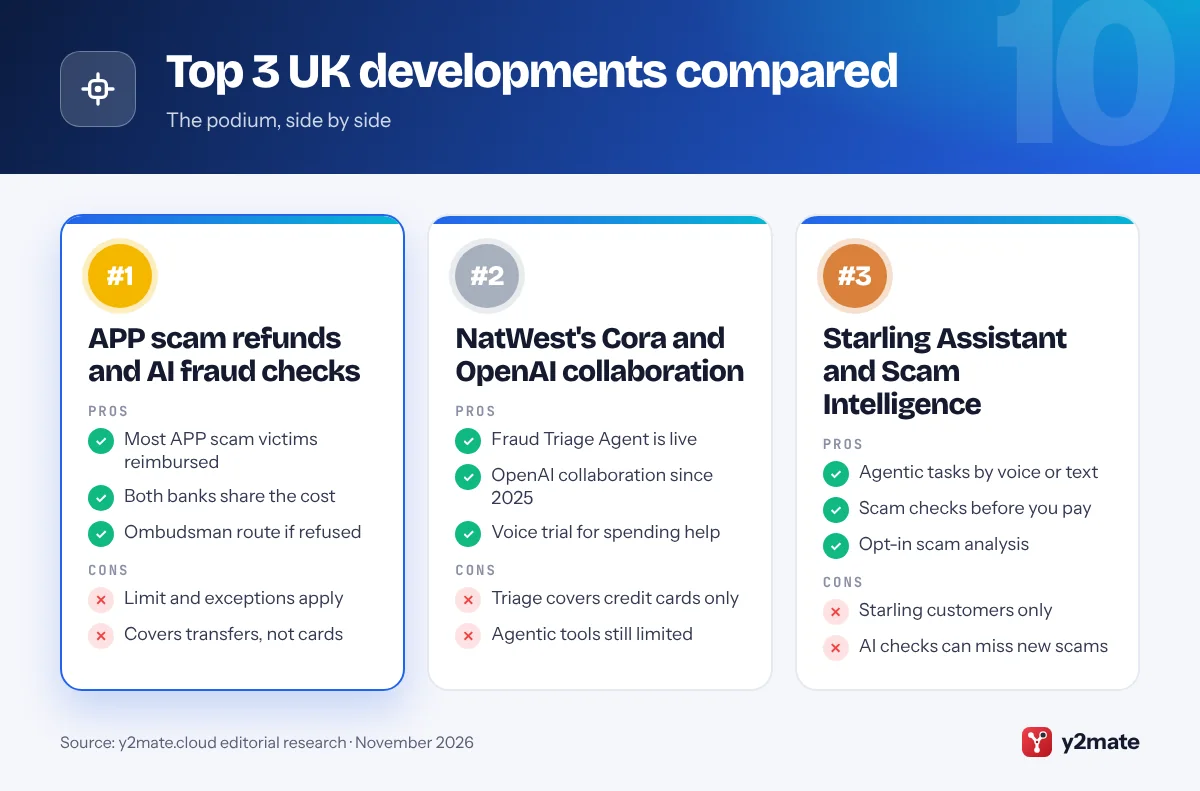
Since 7 October 2024, UK banks and other payment firms have had to reimburse most victims of authorised push payment (APP) scams, where you are tricked into sending money, for payments made by Faster Payments or CHAPS. Sending and receiving firms split the cost, so both have reason to stop scam payments. There is a maximum reimbursement limit and some exceptions, such as gross negligence by the customer or a claim made too late.
That is a big reason banks invest in AI. Machine-learning models score payments in real time against your normal behaviour and known scam patterns, then show a warning, ask questions or pause the payment. The Payment Systems Regulator (PSR) runs the rules, but the government is moving its functions into the FCA.
Customer tip: if your bank stops a payment and asks questions, answer honestly; scammers often coach victims to mislead their bank. If a valid claim is refused, complain to the Financial Ombudsman Service.
Official site: APP scam refunds and AI fraud checks
- Most APP scam victims reimbursed
- Both banks share the cost
- Ombudsman route if refused
- Limit and exceptions apply
- Covers bank transfers, not cards
2. NatWest's Cora and OpenAI collaboration
Best for: NatWest, RBS and Ulster Bank customers
Cora is NatWest Group’s digital assistant in its apps and online banking. In March 2025 NatWest became the first UK bank to sign a strategic collaboration with OpenAI, with an early focus on helping customers identify, report and resolve fraud. NatWest says generative AI now powers a growing number of customer journeys in Cora, making conversations more natural.
In 2026 it moved into agentic AI, saying a first group of customers would get an agentic financial assistant within Cora. In September 2026 it launched a Fraud Triage Agent in Cora: if you are worried about a suspicious credit card transaction, you explain what happened and are guided to the right fraud, scam or dispute team, instead of choosing a category yourself. It also announced a trial of a voice-and-text Spending Insights tool running on the bank’s own small language models.
Customer tip: Cora can speed up routine help, but if a scam is happening right now, call your bank directly or dial 159.
Official site: NatWest's Cora and OpenAI collaboration
- Fraud Triage Agent is live
- OpenAI collaboration since 2025
- Voice trial for spending help
- Triage covers credit cards only
- Agentic tools still limited
3. Starling Assistant and Scam Intelligence
Best for: Starling customers who want AI to do tasks
Starling has moved quickly to put generative AI in front of customers. In June 2025 it launched Spending Intelligence, built with Google’s Gemini models, so customers could ask plain-language questions about their spending. In October 2025 came Scam Intelligence, an opt-in tool that analyses images of online marketplace adverts and items for signs of a scam before you pay.
In March 2026 Starling launched Starling Assistant, which it calls the UK’s first agentic AI financial assistant, starting with personal current account customers. It responds to voice or typed requests and can carry out tasks on your behalf, such as setting up saving goals in Spaces or organising bill payments. In June 2026 Scam Intelligence was expanded inside the assistant to detect many more types of scam, including romance, investment and deepfake scams, and to coach customers on what to do next.
Customer tip: run the scam check before paying a stranger, but remember a clean result is not a guarantee.
Official site: Starling Assistant and Scam Intelligence
- Agentic tasks by voice or text
- Scam checks before you pay
- Opt-in scam analysis
- Starling customers only
- AI checks can miss new scams
4. Lloyds' AI financial assistant
Best for: Lloyds, Halifax and Bank of Scotland app users
Lloyds Banking Group, which includes Lloyds, Halifax and Bank of Scotland, announced in November 2025 an AI-powered financial assistant for its mobile app, describing it as the UK’s first multi-feature AI financial assistant. It starts with two main features, conversational spending insights and help with savings and investments, and can refer customers to a human colleague when needed. The group plans to extend it to more products over time, including mortgages and car finance.
The assistant was tested first with colleagues, and Lloyds named its full customer rollout as a major milestone for 2026, so check your app to see whether you have it yet. Staff already use Athena, an internal AI knowledge and search tool, and the group’s Scottish Widows business has taken part in the FCA’s AI Live Testing.
Customer tip: an AI assistant gives general guidance. For a personal recommendation about investments or pensions, you need regulated financial advice.
Official site: Lloyds' AI financial assistant
- Spending insights in plain English
- Refers you to human colleagues
- Covers several big UK brands
- Full rollout still in progress
- Not personal financial advice
5. Automated credit decisions and your rights
Best for: anyone applying for a loan, card or overdraft
Banks use automated scoring for credit cards, overdrafts and loans. UK data protection law gives you specific protections when a significant decision about you is made solely by automated means, with no meaningful human involvement. The Data (Use and Access) Act 2025, whose data protection changes came into force in stages up to June 2026, made these rules more permissive for organisations but kept safeguards: you must be told about such decisions, be able to make representations and challenge them, and be able to obtain human intervention. Solely automated significant decisions using special category data, such as health or ethnicity, remain far more restricted.
If you are refused credit after a credit check, the lender must tell you and, if you ask, name the credit reference agency it used, although it does not have to give a detailed reason.
Customer tip: ask whether a person reviewed the decision, request one if not, and check your files with Equifax, Experian and TransUnion.
Official site: Automated credit decisions and your rights
- Right to human intervention
- Right to challenge decisions
- Credit agency must be named
- Rules now more permissive
- No duty to give full reasons
6. Consumer Duty and FCA AI good practice
Best for: anyone frustrated by a bank chatbot
The UK has no AI-specific law for banks. Instead the FCA applies its existing rules, especially the Consumer Duty, in force since July 2023, which requires firms to deliver good outcomes for retail customers, and the Senior Managers and Certification Regime, which makes named executives accountable. The FCA’s chair says this approach has helped it keep pace with AI.
In October 2026 the FCA published AI in financial services: good practice and areas for improvement. It confirms existing rules apply to firms’ use of AI and gives examples of good practice, such as telling customers clearly when they are using an AI tool and what it can and cannot do, limiting chatbots to approved source material to reduce made-up answers, and keeping records so challenged outcomes can be investigated. It flags poor practice too, such as excluding vulnerable customers from AI journeys without another route to support.
Customer tip: if a chatbot cannot help, ask for a person, and complain if you are left stuck.
Official site: Consumer Duty and FCA AI good practice
- Existing rules apply to AI
- Clear good practice examples
- Protects vulnerable customers
- No AI-specific rulebook
- Examples are not binding rules
7. AI voice-clone and deepfake scams
Best for: families worried about cloned-voice calls
Generative AI makes scams more convincing: cloned voices of relatives, deepfake videos of famous people promoting fake investments and polished messages without tell-tale mistakes. In September 2024 Starling launched its Safe Phrases campaign, supporting the government’s Stop! Think Fraud campaign, warning that a voice can be cloned from a short clip posted online and urging families to agree a phrase shared only in person. Banks now use their own AI to spot these scams, and Starling’s scam checker covers deepfake scams.
The UK’s main protections still apply. Most APP scam losses must be reimbursed whether or not AI was used to trick you, and the Stop Scams UK 159 service connects customers of most UK banks to their bank safely when they receive a suspicious call.
Customer tip: agree a family safe phrase, hang up on any unexpected call about money and dial 159 or the number on your card. Be sceptical of investment adverts featuring celebrities.
Official site: AI voice-clone and deepfake scams
- 159 reaches your bank safely
- Safe phrases beat voice clones
- In-app AI scam checkers
- Deepfakes are hard to spot
- Not every bank is on 159
8. FCA AI Live Testing
Best for: readers tracking which banks test AI with the FCA
The FCA’s AI Live Testing service, part of its AI Lab, helps firms test AI in real-world conditions with support from the regulator and its technical partner, Advai. The first group, announced in December 2025, included NatWest, Monzo, Santander and Scottish Widows, part of Lloyds Banking Group; Monzo has said it is exploring an AI assistant to help customers save. The second group, announced in April 2026, added firms including Barclays, Experian and UBS, with use cases such as credit score insights for consumers, targeted support for investments, agentic payments and anti-money laundering checks. Testing ends in late 2026, with an evaluation report due in early 2027.
Taking part does not mean the FCA endorses a product, but it shows the regulator examining how firms evaluate and monitor AI before customers rely on it.
Customer tip: if your bank invites you to try an AI pilot, check what data it uses and how to opt out.
Official site: FCA AI Live Testing
- Big banks test with the regulator
- Covers credit and payments
- Public evaluation due 2027
- Not an endorsement of products
- Results not yet published
9. FCA Mills Review on agentic finance
Best for: readers who want to know what comes next
In July 2026 the FCA published The Mills Review, led by executive director Sheldon Mills, on how AI could reshape retail financial services by 2030 and beyond. It identifies four AI-driven shifts: in how firms operate, in consumer journeys, in competition and market power, and in amplified fraud and cyber risks. It found consumer appetite for agentic AI that acts within pre-set goals, alongside concerns about trust and control.
The review made seven recommendations for the FCA to consider, including adapting the regulatory perimeter, monitoring the move to autonomous models, enabling the foundations for agentic finance and scaling up the FCA’s AI Lab. Separately, HM Treasury published an independent Financial Services AI Adoption Plan in July 2026 that includes readiness for agentic payments.
None of this is a new rule yet, but it shows where UK banking is heading: assistants that act for you.
Customer tip: before letting an AI agent move money, check who is responsible if it gets something wrong.
Official site: FCA Mills Review on agentic finance
- Clear map of risks ahead
- Agentic finance on the agenda
- Seven practical recommendations
- No new rules yet
- Timing of changes unclear
10. Bank of England and MPs on AI risk
Best for: readers interested in system-wide AI risk
Regulators also watch AI’s effect on the whole financial system. In October 2026 the Bank of England and the FCA published their fourth survey of AI and machine learning in UK financial services, which tracks how firms use AI, which tools they rely on and the risks they see, including dependence on outside technology providers.
Parliament has pushed for faster action. In January 2026 the House of Commons Treasury Committee warned that a wait-and-see approach to AI by regulators could expose consumers and the financial system to serious harm. It recommended AI-specific stress testing by the FCA and the Bank of England, practical FCA guidance on AI by the end of 2026, and bringing major AI and cloud providers under the critical third parties regime. In responses published in April 2026, the Bank rejected the wait-and-see label and called its approach risk-based and proportionate.
Customer tip: outages can hit several banks at once, so keep a second way to pay.
Official site: Bank of England and MPs on AI risk
- Regular official survey of AI use
- MPs pressing for stress tests
- Focus on outside AI providers
- Little direct effect on customers
- Recommendations are not rules
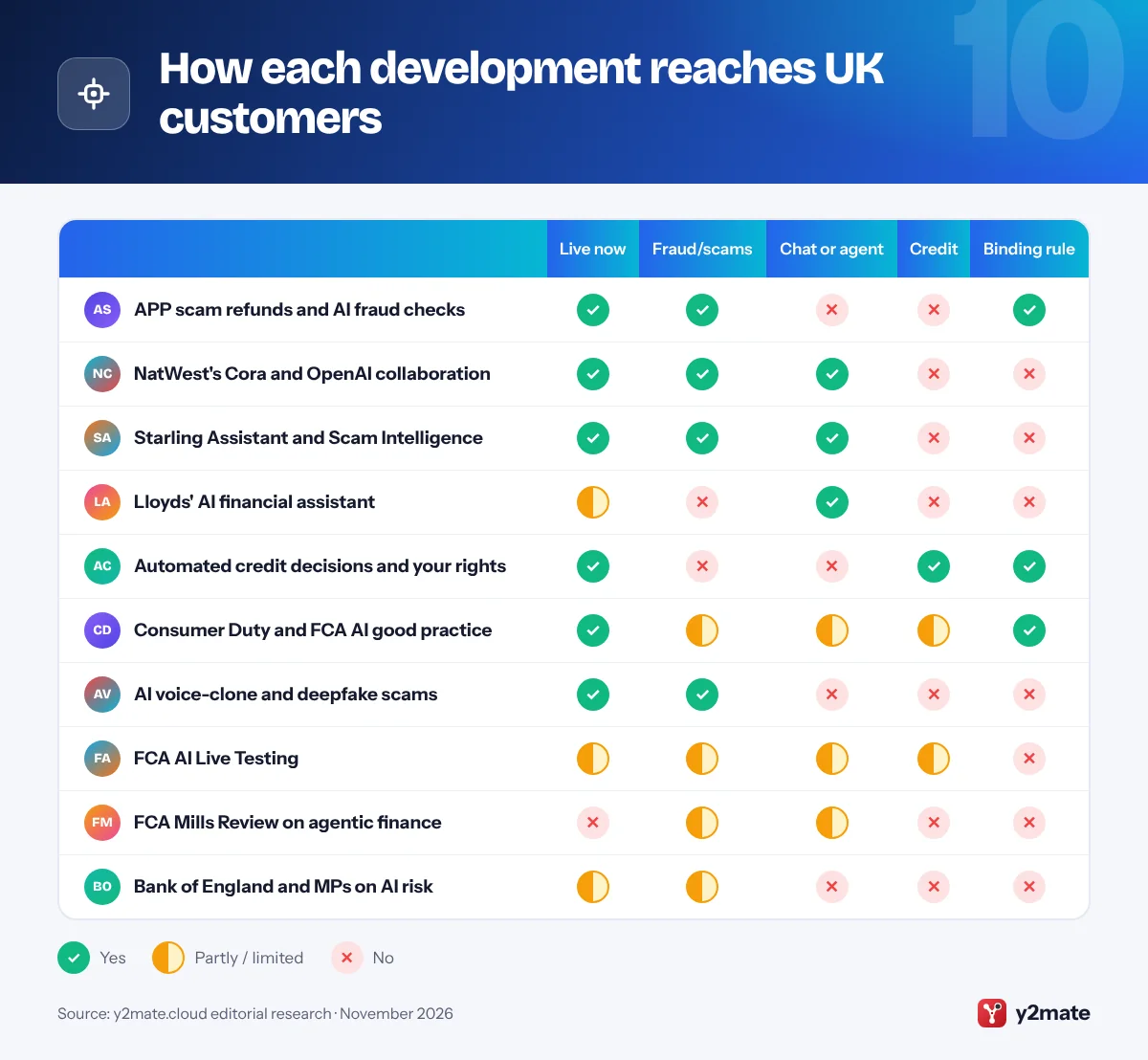
How each development reaches UK customers
AI in banking UK: what it means for you as a customer
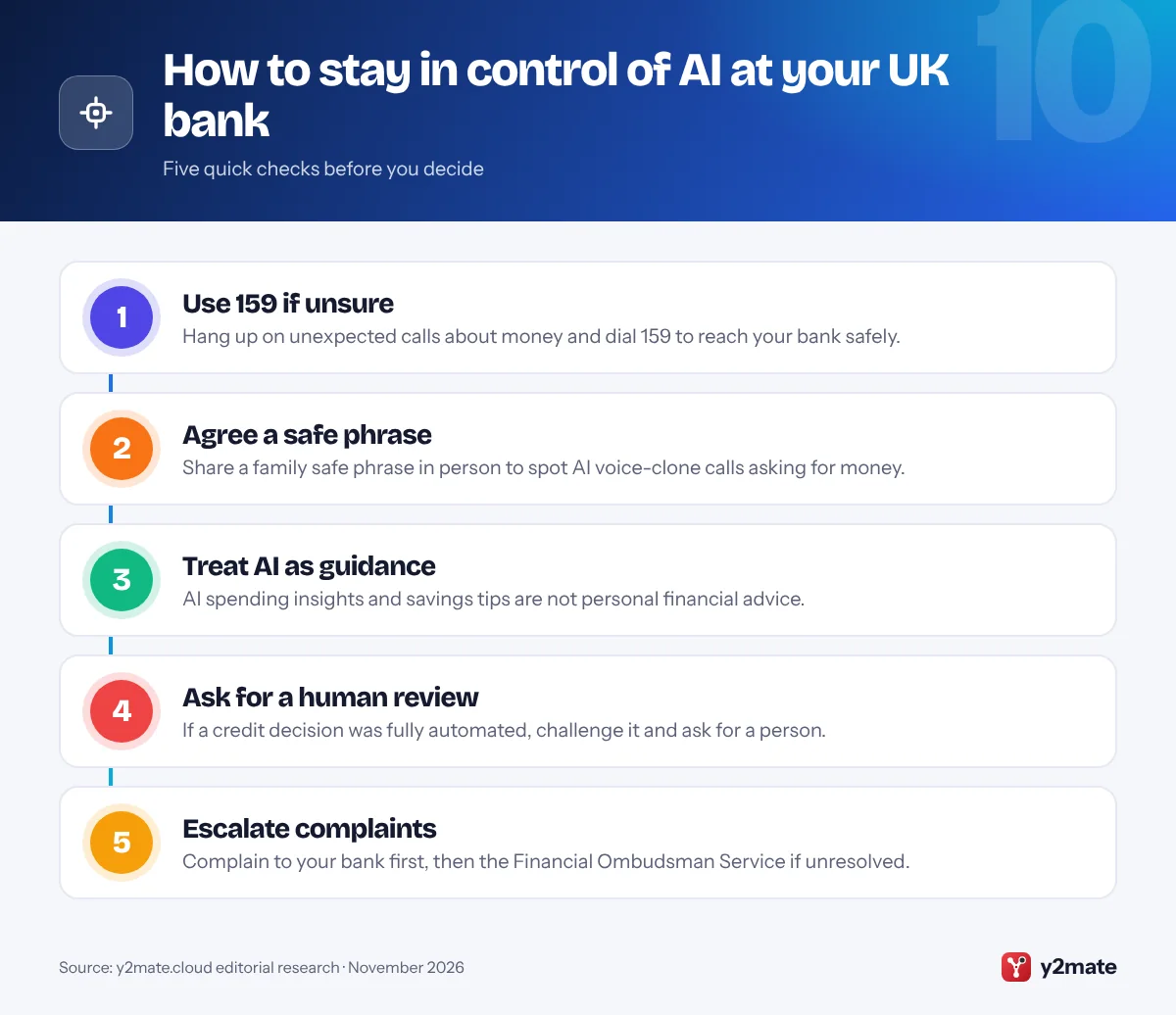
Most AI at UK banks works in the background, but more of it now talks to you directly. These habits help you get the benefits safely.
How is AI used in banking?
Mainly in four places: app assistants such as Cora and Starling Assistant, fraud and scam detection on payments, credit decisions, and internal tools that help staff answer you faster. The benefits are quicker help and earlier scam warnings; the risks are mistakes, wrongly blocked payments and decisions that are hard to explain.
Using AI assistants safely
- Stay in the official app: never follow links in texts or emails to reach a bank chatbot.
- Treat answers as guidance: spending insights and savings suggestions are not regulated financial advice.
- Ask for a person: the FCA’s good practice examples include telling customers what an AI tool cannot do and when to seek other help.
If you are scammed
- Call your bank straight away on 159 or the number on your card.
- Make a reimbursement claim promptly; most APP scam victims are covered for Faster Payments and CHAPS transfers.
- Keep screenshots, messages and call details as evidence.
If an automated decision goes against you
- Ask whether the decision was fully automated and request a human review.
- Check your credit files with Equifax, Experian and TransUnion and correct any errors.
- Complain to the bank first, then to the Financial Ombudsman Service; data protection concerns can go to the ICO.
Frequently asked questions
What is AI in banking?
It means software that learns from data or generates language doing work people once did by hand. UK banks use it in app assistants such as NatWest's Cora and Starling Assistant, to score payments for fraud and scams, to support credit decisions and to help staff find answers. Existing rules, including the FCA's Consumer Duty, apply to how banks use it.
How do banks use AI to stop scams?
Machine-learning models score payments in real time against your normal behaviour and known scam patterns, then warn you, ask questions or hold the payment. Some banks also offer opt-in tools, such as Starling's Scam Intelligence. Because UK payment firms must reimburse most APP scam victims for Faster Payments and CHAPS transfers, they have a strong incentive to stop scams early.
What is generative AI in banking?
Generative AI creates new text, images or audio. In UK banking it powers assistants that answer plain-language questions about your spending, such as Starling's Spending Intelligence and NatWest's Cora, and staff tools such as Lloyds' Athena. The FCA's good practice examples include telling customers when they are using AI and limiting chatbots to approved sources.
What is agentic AI in banking?
Agentic AI carries out tasks for you rather than just answering questions. Starling Assistant, launched in March 2026, can set up saving goals and organise bill payments on request, and NatWest is bringing an agentic assistant to Cora, starting with a first group of customers. The FCA's Mills Review recommends preparing the foundations for agentic finance, so expect more guidance.
Can a bank use AI to decide my loan?
Yes, with safeguards. If a significant decision is made solely by automated means, UK data protection law requires the lender to tell you, let you make representations and challenge it, and provide human intervention. If you are refused after a credit check, the lender must tell you and, if you ask, name the credit reference agency it used.
Is it safe to use a bank's AI chatbot?
Generally yes inside your bank's official app or website, where your login protects you. Treat answers as general guidance rather than personal advice, and ask for a person for complaints, scams or financial difficulty. Never share passwords or one-time passcodes with anyone who contacts you, and if in doubt hang up and call 159.
Will my bank refund me if I fall for an AI scam?
Often, yes. Since October 2024, UK payment firms must reimburse most victims of APP scams paid by Faster Payments or CHAPS, up to a maximum limit, whether or not AI was used to trick you. Exceptions include gross negligence and late claims. Report the scam to your bank straight away, and if it refuses, complain to the Financial Ombudsman Service.
Final verdict
The AI in banking UK customers can use today is led by NatWest’s Cora, Starling Assistant and Lloyds’ new assistant, while AI quietly checks payments for scams behind the APP reimbursement rules. Regulators have chosen to apply existing rules, especially the Consumer Duty, rather than write an AI law, but the Mills Review and the Treasury Committee show agentic AI is next on the agenda. Your key protections are scam reimbursement, your rights over automated decisions and the Financial Ombudsman Service.
This article is general information, not financial or legal advice.
Sources and further reading
- ICO guide to new data law: The ICO's plain-English explanation of how the Data (Use and Access) Act 2025 changes your rights, including on automated decisions.
- Financial Ombudsman Service: The free, independent service for settling complaints with UK banks, including refused scam reimbursement claims.
- PSR APP scams reimbursement data: The Payment Systems Regulator's dashboard explaining APP scam reimbursement and how payment firms handle claims.
- Stop! Think Fraud campaign: The UK government's anti-fraud campaign with advice on spotting scams and what to do if you are targeted.
- Financial Services AI Adoption Plan: The July 2026 independent plan published by HM Treasury on scaling AI in UK financial services, including agentic payments readiness.

Leave a Reply