
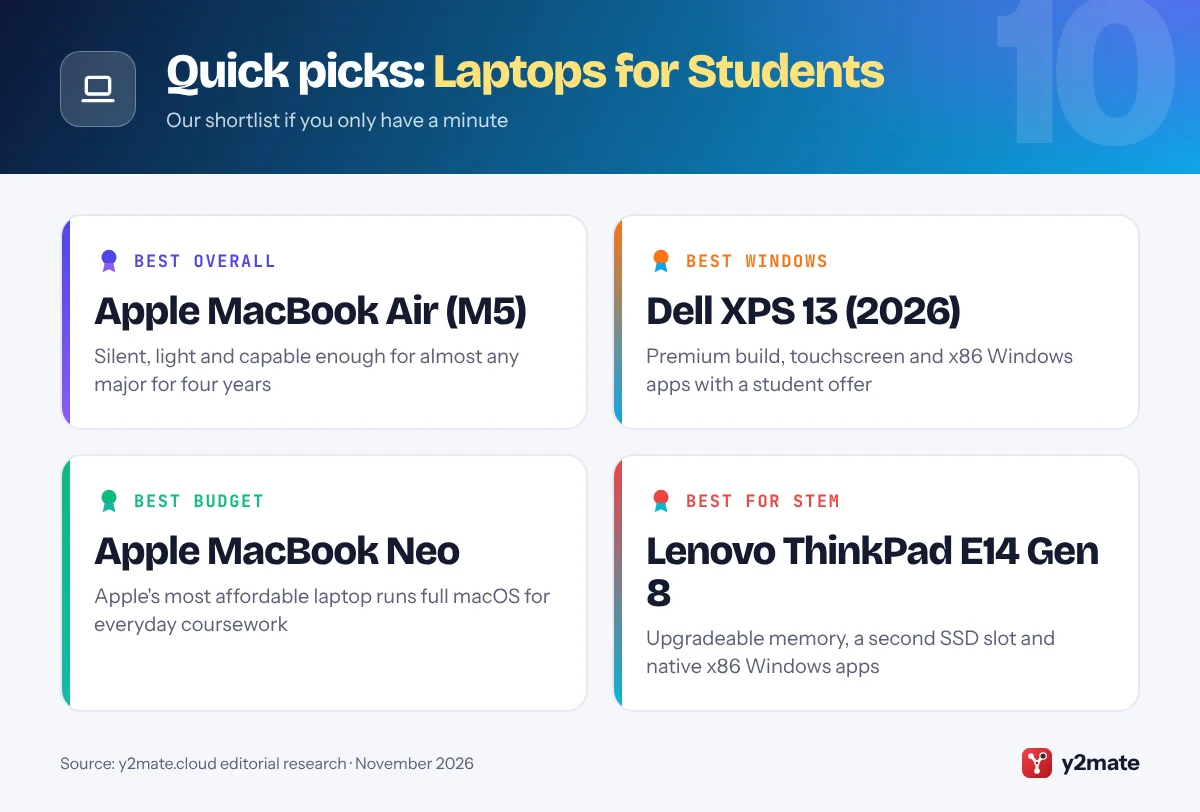
- The Apple MacBook Air with M5, the Dell XPS 13 (2026) and the Apple MacBook Neo are the strongest all-round laptops for college students in the USA in 2026.
- Some engineering, architecture and business programs use Windows-only software, so check your major's requirements before choosing a Mac, Chromebook or Arm-based Windows laptop.
- The IRS says a qualified 529 plan withdrawal can cover computer technology and related equipment used by the beneficiary while enrolled at an eligible school.
- Apple, Microsoft and Dell all offer education pricing to eligible US students, and since May 2026 Apple has verified US college students through UNiDAYS.
- Chromebooks get 10 years of automatic updates counted from the hardware platform's release date, not the purchase date.
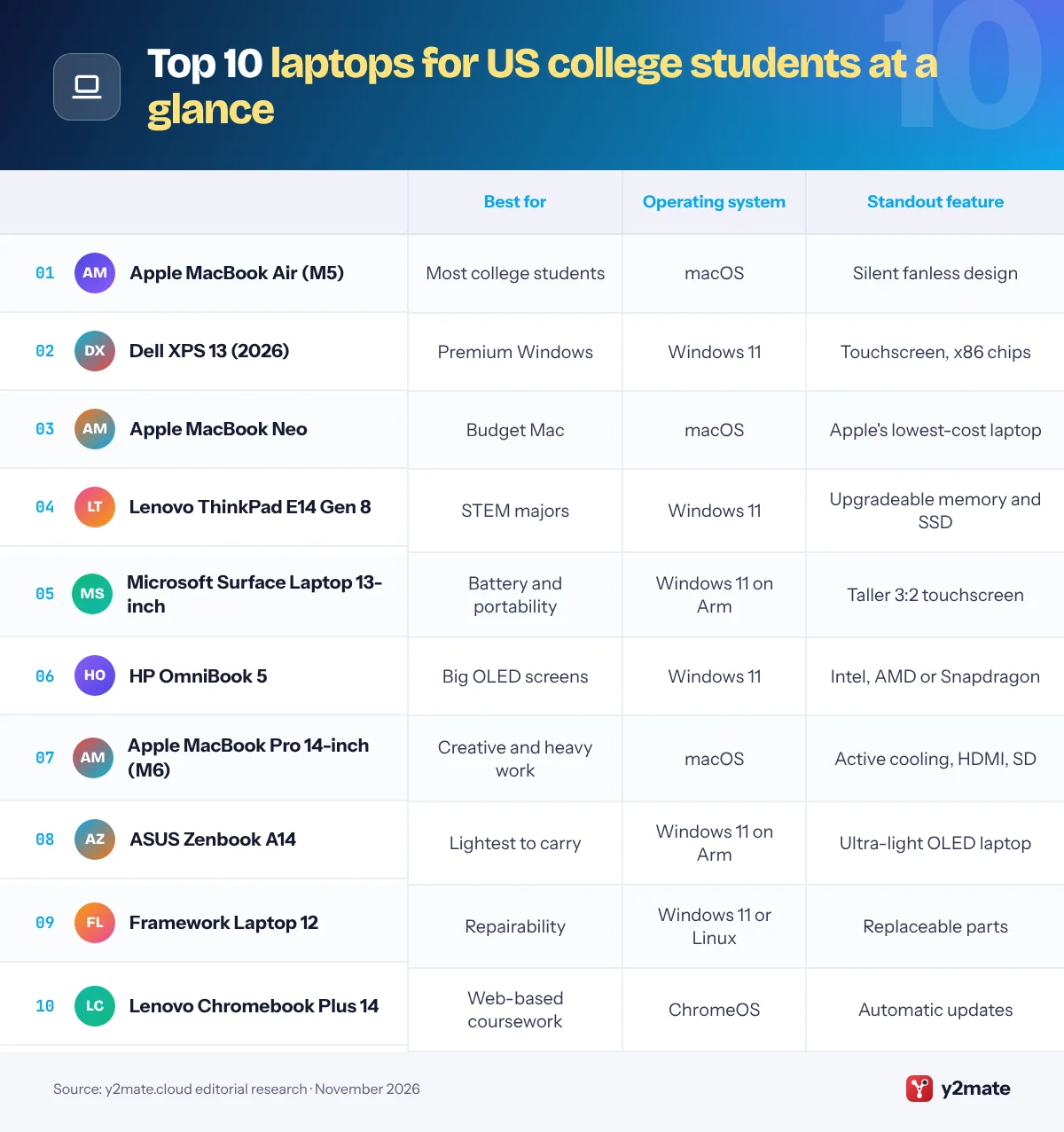
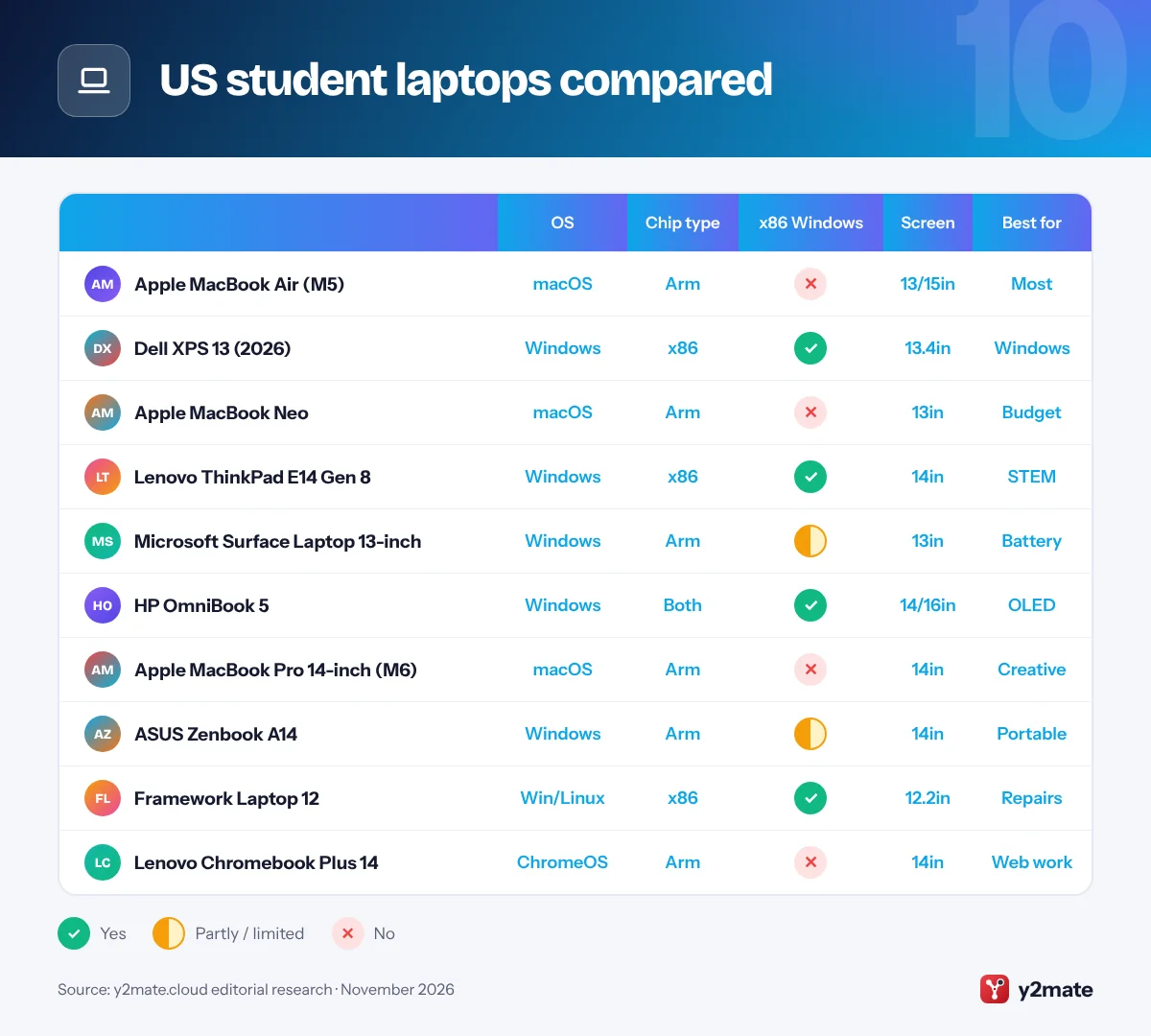
The best laptops for students in the USA in 2026 are the Apple MacBook Air with M5 for most college students, the Dell XPS 13 (2026) for anyone who needs Windows, and the Apple MacBook Neo for the lowest-cost route to a Mac. The Lenovo ThinkPad E14 Gen 8, Microsoft Surface Laptop 13-inch, HP OmniBook 5, MacBook Pro 14-inch with M6, ASUS Zenbook A14, Framework Laptop 12 and Lenovo Chromebook Plus 14 complete the list, covering STEM majors, creative programs, repair-minded buyers and tight budgets.
A few terms are worth knowing. Education pricing is a lower price that makers such as Apple, Microsoft and Dell offer to eligible students, usually after you verify your status online. A Copilot+ PC is a Windows 11 laptop with a built-in AI processor, called an NPU, fast enough for Microsoft’s on-device AI features. A Chromebook Plus is a Chromebook that meets Google’s higher minimum hardware standard and includes extra Google AI tools. Arm chips, used in every current Mac and in Snapdragon-based Windows laptops, are known for long battery life, but some older Windows software only runs natively on x86 chips from Intel and AMD.
This guide ranks ten laptops on the points that matter on campus and explains college requirements, education pricing, 529 plans and state sales tax holidays.
How we ranked this list
We compared publicly documented information only: each maker’s US product pages and specs, how well the operating system fits common college majors, portability and battery life as the makers describe them, keyboard and screen, repair and upgrade options, standard warranty where the maker states it, and software update policy. Every laptop here is sold officially in the US through the maker or its authorized retailers in November 2026.
We did not test these laptops ourselves, and we do not quote prices, discounts, battery-hour claims or weights, because they change with configuration and season.
The Top 10 Laptops for Students
1. Apple MacBook Air (M5)
Best for: most college students who want a Mac
The MacBook Air with M5, launched in March 2026, is the best laptop for most college students in the USA. It comes in 13-inch and 15-inch sizes, has a completely silent fanless design and is thin and light enough to carry to every class. Apple rates its battery for a full day of use, which matters in lecture halls with few outlets.
The M5 chip handles writing, research, spreadsheets, intro coding classes, photo editing and light video work with ease. Both sizes have two Thunderbolt 4 ports plus MagSafe charging, so a stray foot on the cable will not drag the laptop off the desk, and they can drive up to two external displays for a dorm-room desk setup.
The catch is that memory and storage cannot be upgraded after purchase, so choose a configuration that will last all four years. Engineering and architecture majors should also check whether their programs rely on Windows-only software. Apple sells it with education pricing to current and newly accepted college students and their parents, and every Mac comes with Apple’s one-year limited warranty.
Official site: Apple MacBook Air (M5)
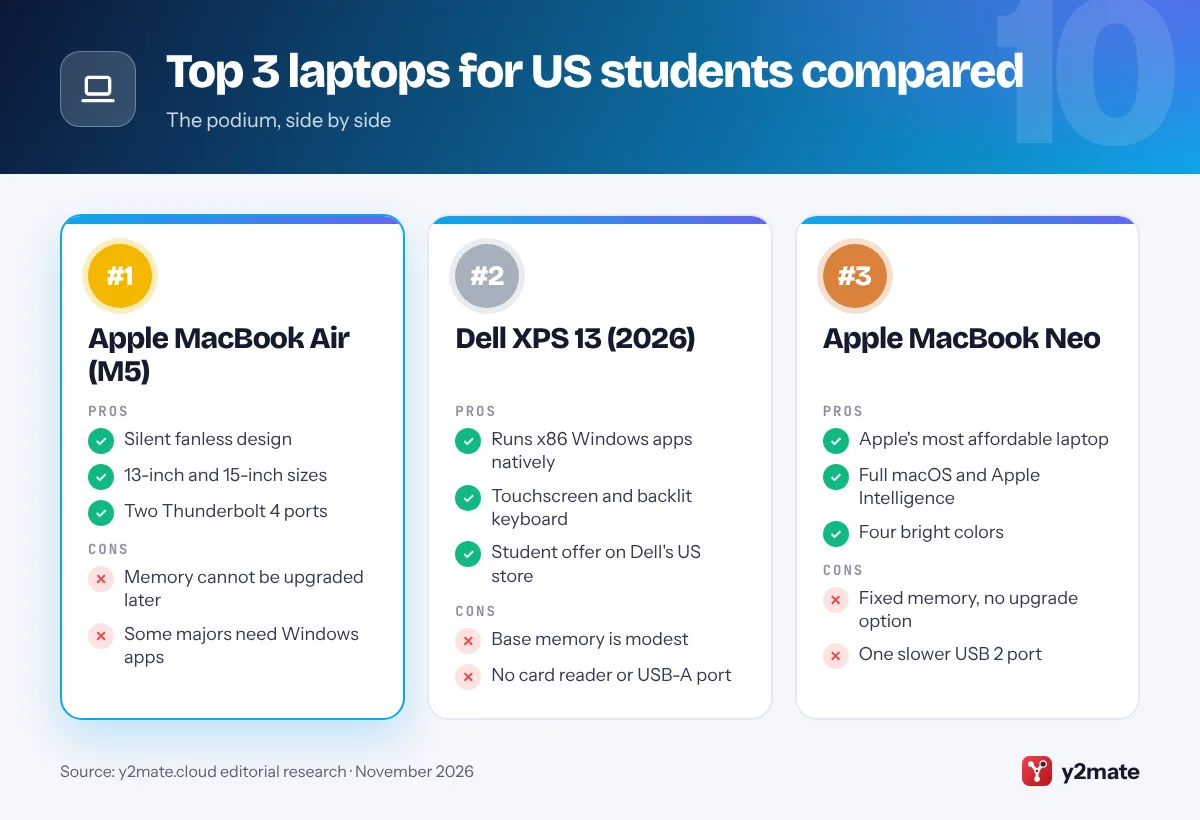
- Silent fanless design
- 13-inch and 15-inch sizes
- Two Thunderbolt 4 ports
- Memory cannot be upgraded later
- Some majors need Windows apps
2. Dell XPS 13 (2026)
Best for: a premium Windows laptop with student pricing
Dell brought back the XPS 13 in June 2026, and it is the best Windows laptop for most college students in the USA. Dell calls it the thinnest and lightest XPS it has ever made, yet it keeps a CNC-machined aluminum body, a backlit keyboard, four speakers and a 13.4-inch touchscreen with a variable refresh rate.
It uses Intel processors, either Core Series 3 or Core Ultra Series 3 depending on configuration, so it runs standard x86 Windows software natively. That makes it a safer choice than an Arm-based laptop if your engineering, statistics or business classes use older Windows programs or exam tools. Its two USB-C ports handle charging, docks and external monitors.
The base model has modest memory that is soldered in place, so step up if you keep many tabs and apps open, and note there is no card reader or USB-A port. Dell runs a student offer on its US store for high school students aged 16 and over and for college students, and the base configuration includes a year of basic hardware service.
Official site: Dell XPS 13 (2026)
- Runs x86 Windows apps natively
- Touchscreen and backlit keyboard
- Student offer on Dell's US store
- Base memory is modest
- No card reader or USB-A port
3. Apple MacBook Neo
Best for: the lowest-cost way into a Mac
The MacBook Neo, launched in March 2026, is Apple’s entry-level laptop and the best budget Mac for college students. It uses the A18 Pro chip, first seen in the iPhone 16 Pro, inside a durable recycled aluminum body with a 13-inch Liquid Retina display, and it comes in silver, blush, citrus and indigo with color-coordinated keys.
For essays, research, note-taking, spreadsheets and video calls it feels quick, and it runs the same macOS apps, including Microsoft Office, Pages and Keynote, plus Apple Intelligence features. Apple rates its battery for a full day of classes. It is also covered by Apple’s education pricing, which makes it the most affordable new Mac laptop a student can buy.
The compromises are real, though. Every model has 8GB of memory with no option to add more, one of its two USB-C ports runs at slower USB 2 speeds, it supports only one external display and Touch ID comes on only one of the two models. That makes it a weak fit for heavy video editing, large coding projects or data-heavy science classes. If you mostly write, read, browse and stream, the Neo is excellent value.
Official site: Apple MacBook Neo
- Apple's most affordable laptop
- Full macOS and Apple Intelligence
- Four bright colors
- Fixed memory, no upgrade option
- One slower USB 2 port
4. Lenovo ThinkPad E14 Gen 8
Best for: STEM majors who want upgradeable Windows
The ThinkPad E14 Gen 8 reached the US in August 2026, and it is the best choice for engineering, science and business majors who want a practical Windows laptop that can be upgraded and repaired. Unlike most thin laptops, it takes standard DDR5 memory modules and has room for a second SSD, so you can add memory or storage later. Lenovo also lists the battery, memory, SSD and speaker as customer-replaceable parts.
Lenovo offers it with Intel Core Series 3 or AMD Ryzen AI processors, both x86 chips that run Windows engineering, statistics and lab software natively. You get a 14-inch 16:10 display, HDMI for classroom projectors, a webcam privacy shutter and a spill-resistant, backlit ThinkPad keyboard with the red TrackPoint pointing stick. Lenovo says it is tested against the MIL-STD 810H durability standard.
It is heavier and plainer than an XPS 13 or MacBook Air, and its standard IPS screens are less vivid than OLED. US configurations were limited at launch, so check what Lenovo’s US store currently lists. If your degree will need more memory in junior year than in freshman year, the E14’s upgradeability is a real advantage.
Official site: Lenovo ThinkPad E14 Gen 8
- Upgradeable memory and storage
- Runs x86 Windows software
- Spill-resistant ThinkPad keyboard
- Heavier than ultraportables
- Few US configurations so far
5. Microsoft Surface Laptop 13-inch
Best for: long battery life and a touchscreen
The Surface Laptop 13-inch is Microsoft’s most portable and affordable Surface Laptop, and Microsoft itself recommends it for students. The latest version uses a Qualcomm Snapdragon X2 Plus processor, which makes it a Copilot+ PC, and Microsoft calls it the longest-lasting Surface Laptop it sells. It has a 13-inch PixelSense touchscreen in a taller 3:2 shape that shows more of a document, a full-size backlit keyboard and a fingerprint reader for Windows Hello sign-in.
Ports are practical for a small laptop: two USB-C, one USB-A and a headphone jack, so older flash drives and mice still plug straight in. Microsoft’s US store offers student discounts after an eligibility check, and Microsoft 365 web apps, Teams and most popular software run natively.
Because Snapdragon chips use the Arm architecture, some apps rely on Microsoft’s Prism emulation, and some older programs, drivers, VPN clients and exam or lab tools may not work at all. Check your course software list before you buy. The screen is also a standard 60Hz panel rather than the smoother displays on the 13.8-inch and 15-inch models. For humanities, business and general studies majors, it is an excellent, long-lasting choice.
Official site: Microsoft Surface Laptop 13-inch
- Longest-lasting Surface Laptop
- Touchscreen in a taller 3:2 shape
- USB-A port still included
- Some x86 apps may not run
- Basic 60Hz display
6. HP OmniBook 5
Best for: OLED screens and a choice of chips
The OmniBook 5 is the mainstream model in HP’s simplified laptop range, which replaced older names such as Pavilion and Envy. HP lists students among the buyers it is designed for, and it is a sensible pick for students who want a big, sharp screen without paying for a flagship.
The range spans 14-inch and 16-inch laptops plus a 14-inch Flip 2-in-1 with optional stylus support, and HP offers OLED displays on selected models. The most useful feature for students is choice: HP sells OmniBook 5 models with AMD Ryzen AI and Intel Core Ultra chips, which run x86 Windows software natively, and with Qualcomm Snapdragon X2 chips for longer battery life on Arm.
The downside of so many versions is that specs vary a lot between models, so read the full listing for memory, storage, screen type, ports and processor before you buy, and skip the most basic configurations if you plan to keep it through graduation. If you want a 16-inch screen for spreadsheets, coding or side-by-side reading in a dorm without room for a monitor, the larger OmniBook 5 is one of the few mainstream options in this list.
Official site: HP OmniBook 5
- OLED screen options
- Intel, AMD or Snapdragon chips
- 14-inch, 16-inch and Flip models
- Specs vary widely by model
- Easy to pick a weak config
7. Apple MacBook Pro 14-inch (M6)
Best for: film, music, design and computer science
The 14-inch MacBook Pro with Apple’s new M6 chip started arriving on November 6, 2026, and it is the laptop to choose if your major involves video editing, music production, 3D design or large coding projects. Unlike the fanless MacBook Air, it has active cooling, so it can sustain heavy work such as exporting video or compiling code for longer.
Apple fits 16GB of unified memory as standard, configurable up to 32GB, and the ports suit creative students: three Thunderbolt 4 ports, HDMI, an SDXC card slot for camera cards, MagSafe 3 and a headphone jack. Apple says this model has the longest battery life of any Mac so far.
For most students it is more laptop than they need, and like every Mac its memory and storage cannot be upgraded later. Apple also launched MacBook Pro models with a touch-enabled PROLED XDR display and M5 Pro or M5 Max chips in October 2026, but those are aimed at professionals. Education pricing on the M6 model is available to college students through Apple’s US education store. If your coursework is creative or compute-heavy and does not depend on Windows-only software, this is the Mac to get.
Official site: Apple MacBook Pro 14-inch (M6)
- Active cooling for heavy work
- HDMI and SD card slot built in
- Apple's longest Mac battery life
- More than most students need
- No upgrades after purchase
8. ASUS Zenbook A14
Best for: the lightest Windows laptop to carry daily
The ASUS Zenbook A14 is one of the lightest 14-inch Windows laptops you can buy, and ASUS markets it as an ultra-lightweight Copilot+ PC. If you cross a large campus several times a day, a laptop you barely notice in your backpack makes a real difference by the end of the semester.
It uses Qualcomm Snapdragon X-series processors, including newer Snapdragon X2 versions, paired with a large battery, so it is built for long days away from a charger. The 14-inch OLED display has a 16:10 shape that suits reading and writing, with deep blacks for movies after class. ASUS’s US specs list the screen as non-touch, which keeps the design simple.
Like the Surface Laptop, it runs Windows on Arm. Microsoft 365, web browsers, Zoom and most popular software run natively or through emulation, but specialized engineering programs, some games, older printer drivers and certain exam tools may not. Check your course requirements and your college’s IT advice first. If your work is mainly writing, research and online learning, the Zenbook A14 is one of the easiest Windows laptops to carry all day.
Official site: ASUS Zenbook A14
- Ultra-lightweight 14-inch body
- Large battery for long days
- OLED display
- Arm chip limits some software
- No touchscreen
9. Framework Laptop 12
Best for: a repairable 2-in-1 that can be upgraded
The Framework Laptop 12 is a 12.2-inch touchscreen convertible designed for students who want a laptop they can repair themselves. Its 360-degree hinge folds into tablet mode, it supports a stylus for handwritten notes and diagrams, and Framework says its shock-absorbing chassis meets MIL-STD-810 durability standards.
Almost every part, from the battery and screen to the keyboard and mainboard, can be replaced, and memory and storage are upgradeable. In August 2026 Framework announced Intel Core Series 3 mainboards with Thunderbolt 4, Wi-Fi 7 and an optional backlit keyboard, with shipping from October, and owners of the original model can fit the new board. Ports are swappable Expansion Cards, so you choose the mix of USB-C, USB-A or HDMI you need.
You can order it with Windows 11, as a DIY Edition that you finish yourself, or, for the first time, pre-built with Fedora Linux, which suits computer science students. The small screen and entry-level processors mean it is not built for heavy creative work. If you value repairability and want a laptop that can grow with your degree, it is the most repairable machine on this list.
Official site: Framework Laptop 12
- Most repairable laptop here
- Touchscreen 2-in-1, stylus support
- Upgradeable memory and storage
- Small 12.2-inch screen
- Entry-level processors
10. Lenovo Chromebook Plus 14
Best for: web-based coursework on a budget
The Lenovo Chromebook Plus 14 is the most capable Chromebook in this list and the best choice if your college work lives in Google Docs, Microsoft 365 on the web, Canvas and other browser tools. It uses a MediaTek Kompanio Ultra processor, an efficient Arm chip, with a 14-inch OLED display, and as a Chromebook Plus it includes Google’s extra AI tools.
ChromeOS is simple, fast to start and hard to break, with security updates that install automatically. Google gives Chromebooks 10 years of automatic updates, counted from the release date of the hardware platform rather than the day you buy, so check the update date for any model you consider. You can also run Android apps and switch on a Linux development environment for intro programming classes.
The big limit is software. Chromebooks cannot install full Windows or Mac programs such as SolidWorks or other specialist design and lab tools, so confirm your course requirements first. Google also launched Googlebook, a new premium laptop line built on Android, in October 2026, but it is too new to recommend over proven Chromebooks. For writing-heavy majors and tight budgets, the Chromebook Plus 14 is an easy, low-maintenance choice.
Official site: Lenovo Chromebook Plus 14
- Sharp 14-inch OLED display
- Automatic updates and security
- Simple, low-maintenance software
- No full Windows or Mac apps
- Check the update end date
US student laptops compared
How to choose laptops for students in the USA
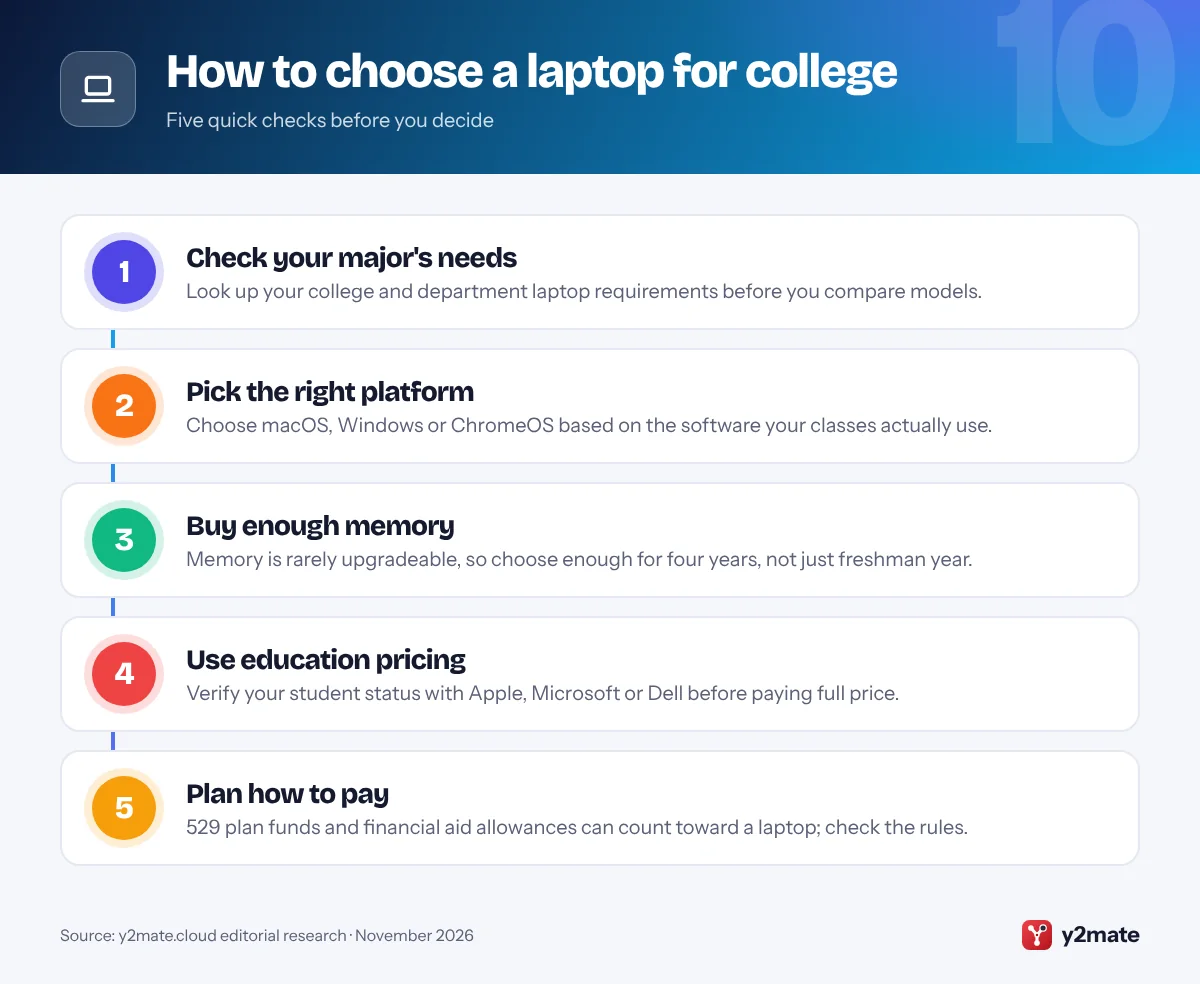
Start with your college, not the spec sheet. Many colleges and individual departments publish recommended laptop specs, and some engineering, architecture and business programs rely on Windows-only software. If yours does, choose an x86 Windows laptop or confirm that the school offers that software through campus labs or virtual desktops.
Education pricing and verification
- Apple: its education store is open to current and newly accepted college students and their parents, and since May 2026 Apple has verified US students through UNiDAYS.
- Microsoft: the US Microsoft Store offers student discounts, including on Surface laptops, after an eligibility check.
- Dell: its US student offer is open to high school students aged 16 and over and to college students.
Paying with a 529 plan or financial aid
The IRS says a qualified, tax-free 529 plan withdrawal can cover computer technology and related equipment used by the beneficiary while enrolled at an eligible institution, though state tax rules can differ. Federal aid rules also let colleges include a reasonable allowance for buying a personal computer in the cost of attendance, so ask your financial aid office.
Sales tax holidays and warranties
Several states hold back-to-school sales tax holidays, and some include computers up to a set limit, so check your state revenue department before buying in late summer. Finally, read the warranty before you pay: the FTC explains how written and implied warranties work, and accidental damage cover is usually sold separately.
Frequently asked questions
What is the best laptop for college students in 2026?
For most college students, the Apple MacBook Air with M5 is the best laptop in 2026 because it is light, silent, long-lasting and powerful enough for almost any major. The Dell XPS 13 (2026) is the best Windows choice, the MacBook Neo is the best budget Mac, and the Lenovo ThinkPad E14 Gen 8 suits engineering and science majors who want upgradeable Windows hardware.
Can I use a 529 plan to buy a laptop for college?
Yes. The IRS says a qualified, tax-free 529 plan withdrawal can pay for computer technology, related equipment and services such as internet access, as long as they are used by the beneficiary and their family during years the student is enrolled at an eligible institution. Equipment used mainly for entertainment does not count, and state tax treatment can differ, so check your plan's rules first.
Is a Chromebook good enough for college?
A Chromebook works well if your classes run in a web browser, such as Google Docs, Microsoft 365 on the web and your college's learning platform. It cannot install full Windows or Mac programs, so it is a poor fit for majors that need specialist design, engineering or statistics software. Chromebooks get 10 years of automatic updates from their platform's release, so check the update date before buying.
Should I get a Mac or a Windows laptop for college?
Choose based on your classes. A Mac suits most majors and creative work, and it is required for building Apple apps with Xcode. Windows is safer for engineering, architecture and some business programs that use Windows-only software. If you choose Windows, an Intel or AMD model runs older Windows programs natively, while Arm-based Snapdragon laptops rely on emulation for some apps.
How do I get education pricing on a laptop in the USA?
Buy through the maker's education or student store and verify your status. Apple's US education store now uses UNiDAYS to confirm college students, Microsoft runs an eligibility check before applying its student discount, and Dell's student offer covers high school students aged 16 and over as well as college students. Education pricing is available on many models, but compare it with seasonal sales before you buy.
Final verdict
The best laptops for students in the USA in 2026 are the MacBook Air with M5 for most college students, the Dell XPS 13 (2026) for premium Windows and the MacBook Neo for a budget Mac. The ThinkPad E14 Gen 8 is the smart pick for STEM majors, the MacBook Pro 14-inch suits creative and compute-heavy work, and the Framework Laptop 12 and Chromebook Plus 14 cover repairability and web-first study.
Before you buy, check your major’s software requirements, verify your status for education pricing, and see whether 529 funds or a state sales tax holiday can help.
Sources and further reading
- IRS 529 plan questions and answers: The IRS explains when a 529 plan withdrawal can pay for computer technology, related equipment and internet access for a student.
- Federal cost of attendance rules: The Federal Student Aid Handbook chapter that lets colleges include a reasonable allowance for a personal computer in the cost of attendance.
- FTC guide to warranties: FTC advice on written and implied warranties, service contracts and what to do if a warranty claim is refused.
- ChromeOS Auto Update policy: Google's official policy on how long Chromebooks receive automatic updates, counted from each hardware platform's release date.

Leave a Reply