- Harrison.ai, Heidi Health and Relevance AI are among the most established AI startups in Australia, working in medical imaging, clinical documentation and AI agents.
- Australia released its National AI Plan on 2 December 2025, and its new AI Safety Institute operates within the Department of Industry, Science and Resources.
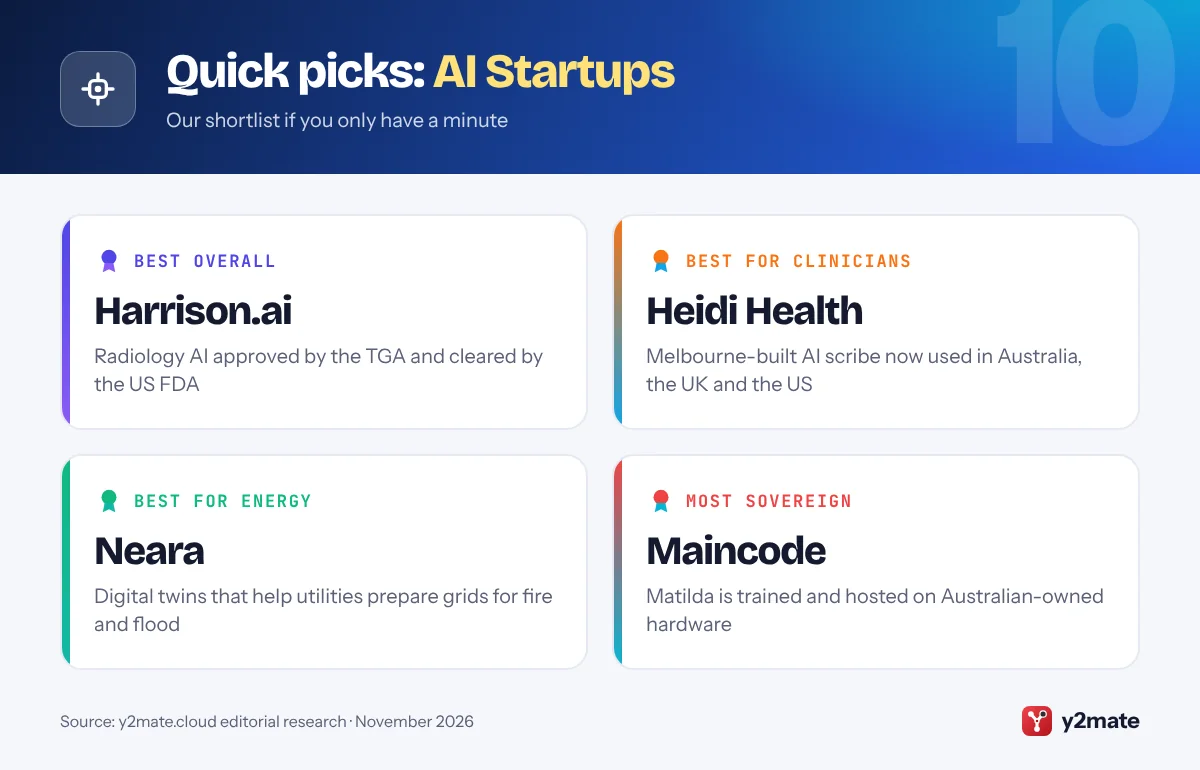
- The TGA says a digital scribe that only records and transcribes is generally not a medical device, but one that adds diagnoses or treatment suggestions can be.
- Leonardo.ai is owned by Canva and Marqo now lists San Francisco as its headquarters, so neither is included here as an independent Australian startup.
- Maincode's Matilda is a large language model trained and hosted on Australian-owned hardware in Melbourne.
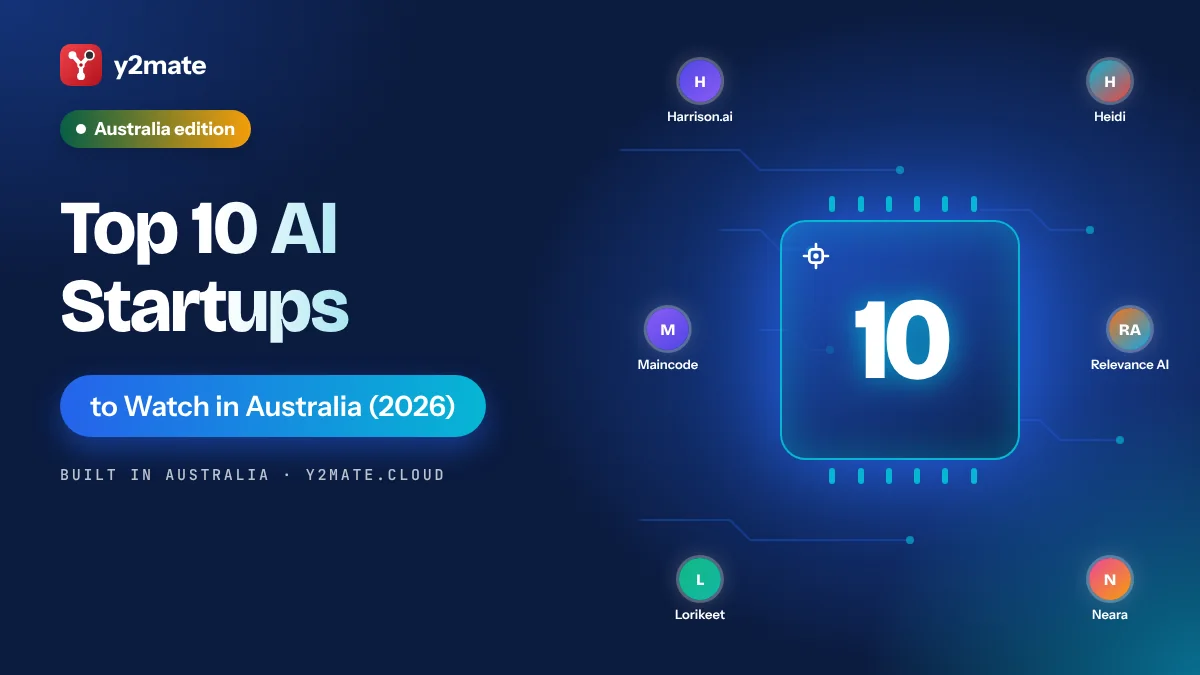
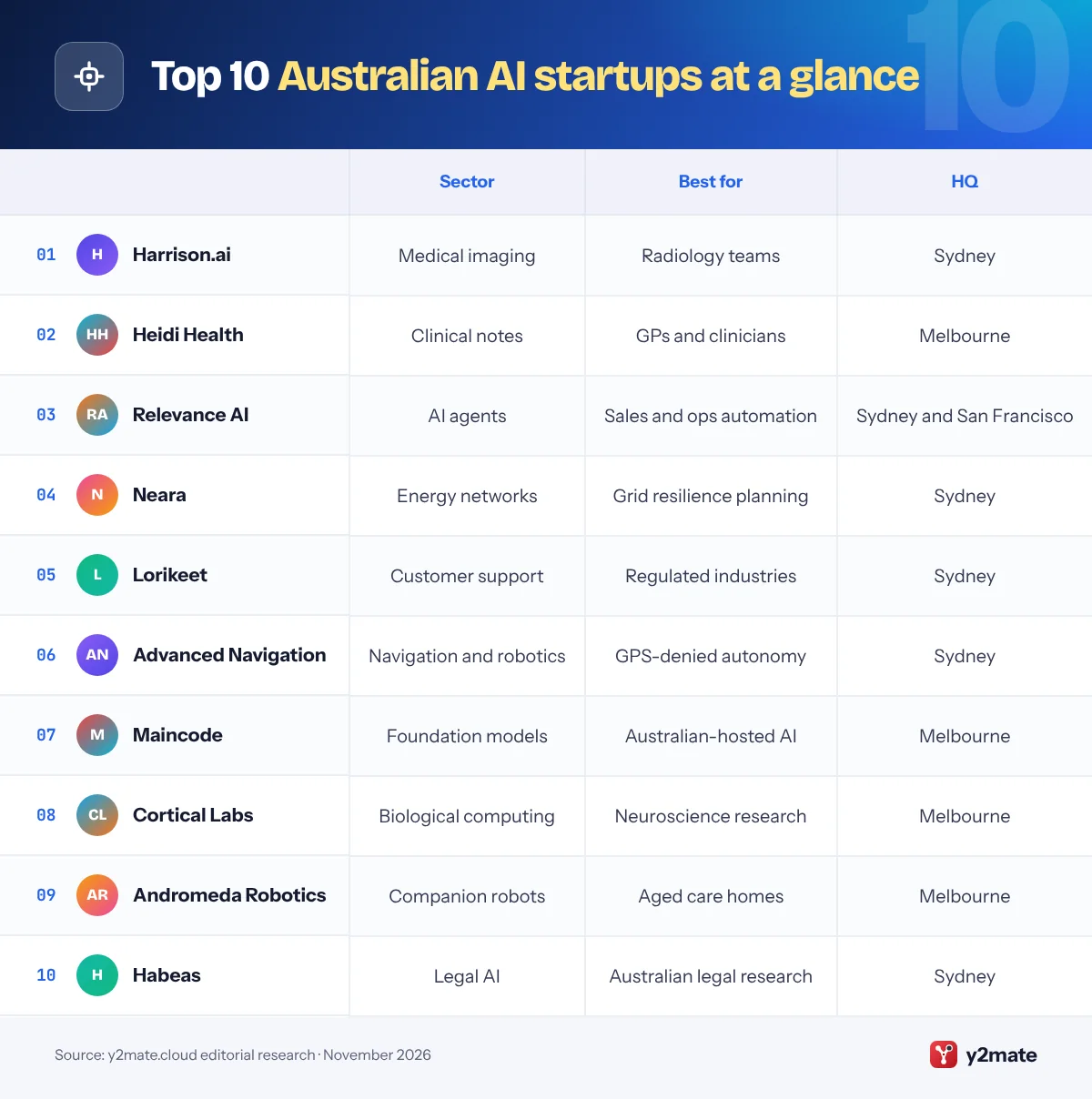
The AI startups in Australia most worth watching in 2026 are Harrison.ai in medical imaging, Heidi Health in clinical documentation and Relevance AI in AI agents, followed by Neara, Lorikeet, Advanced Navigation, Maincode, Cortical Labs, Andromeda Robotics and Habeas. All ten were founded in Australia and were independent in November 2026. Nine are headquartered here, and Relevance AI now splits its headquarters between Sydney and San Francisco.
A few definitions. A startup is a young company still proving its product and business model, while a scale-up has paying customers and is growing quickly, often overseas. A foundation model is a large AI model trained on broad data that can be adapted to many tasks, such as the model behind a chatbot. An AI agent is software that plans and carries out multi-step tasks, like updating a customer’s account or drafting a legal memo, with limited human input.
The list skips the global labs covered in our list of AI companies to watch and explains the local context: the National AI Plan, the new AI Safety Institute, the National AI Centre and CSIRO’s Data61.
How we ranked this list
We ranked companies on publicly documented criteria only: what each product does today, customers and partners the company has announced, regulatory milestones such as TGA approval or FDA clearance, and technical significance. We confirmed each company was Australian-founded, independent and operating in November 2026. We did not test any products, and we leave out funding figures, which change quickly and say little about usefulness.
Some familiar names are missing on purpose. Leonardo.ai has been owned by Canva since 2024, and Marqo and Earth AI, both with Australian roots, now list San Francisco as their headquarters. Annalise.ai’s radiology products appear under their new name, Harrison.ai Radiology.
The Top 10 AI Startups
1. Harrison.ai
Best for: radiology practices and hospitals
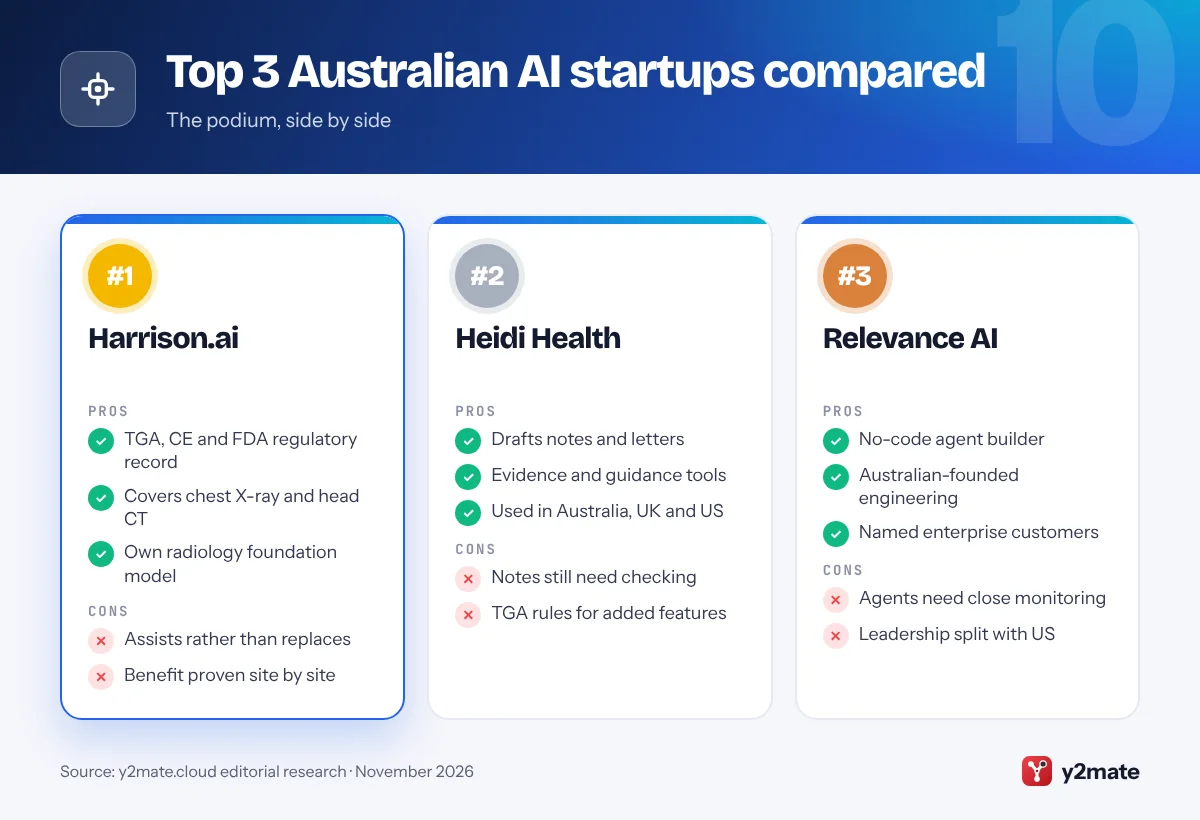
Harrison.ai was founded in Sydney in 2018 by brothers Dr Aengus Tran and Dimitry Tran. It builds AI that helps radiologists read medical images. Its products, sold as Annalise.ai until they were renamed Harrison.ai Radiology in October 2025, analyse chest X-rays and brain CT scans, flag a wide range of findings and help prioritise urgent cases.
Its regulatory record is its strongest credential. The products are approved for use in Australia by the Therapeutic Goods Administration, carry CE marking in Europe and hold a series of US FDA clearances. In March 2026 the company announced FDA clearance for triaging acute brain infarcts, a type of stroke, on non-contrast CT. It has also built Harrison.rad.1, a radiology-specific foundation model, and is expanding in North America from Boston.
Why it matters: imaging demand keeps growing while radiologists are scarce in many regions, so surfacing critical findings sooner matters. The limitation is that the products assist rather than replace specialists, and real-world benefit has to be shown hospital by hospital. In April 2026 the FDA also rejected the company’s petition to exempt some detection software from premarket review.
Official site: Harrison.ai
- TGA, CE and FDA regulatory record
- Covers chest X-ray and head CT
- Own radiology foundation model
- Assists rather than replaces
- Benefit proven site by site
2. Heidi Health
Best for: clinicians who want less time on notes
Heidi Health is a Melbourne company co-founded by Dr Thomas Kelly, Waleed Mussa and Yu Liu. Its AI scribe listens to a consultation, with the patient’s consent, and drafts clinical notes, referral letters and other documents for the clinician to review. It now calls itself an AI care partner, adding Heidi Evidence for point-of-care guidance in 2026 and a dedicated audio capture device.
Heidi is used by GPs, specialists and allied health practitioners around Australia, and it has announced deployments at the Royal Children’s Hospital Melbourne and Cabrini Health, plus a partnership with General Practice Registrars Australia. Overseas, it has been selected by NHS trusts in the UK and has expanded into Canada and the US.
Why it matters: Heidi is one of the clearest examples of an Australian AI product competing globally. The local open question is regulation. The TGA says a scribe that only records and transcribes is generally not a medical device, but one that suggests diagnoses or treatments the clinician did not state can be, and it has reviewed scribe suppliers for compliance. Clinicians must also check every note.
Official site: Heidi Health
- Drafts notes and letters
- Evidence and guidance tools
- Used in Australia, UK and US
- Notes still need checking
- TGA rules for added features
3. Relevance AI
Best for: teams building AI agents without code
Relevance AI was founded in Sydney in 2020 by Daniel Vassilev, Jacky Koh and Daniel Palmer, and now splits its headquarters between Sydney and San Francisco. It is a no-code platform for building what it calls an AI workforce: teams of AI agents that research leads, qualify enquiries, update customer records and pass work to each other, with people approving key steps.
Businesses use it mainly for sales, marketing and operations. Customers named in coverage include Canva, Autodesk, Databricks, Freshworks and SafetyCulture. In September 2026 it launched Invent 2.0, a tool for designing, testing and managing multi-agent teams, building on its templates and integrations with common business software.
Why it matters: Relevance AI is one of Australia’s best-known AI agent companies. Its dual base also shows a common path for Australian founders, who keep engineering at home while moving sales and leadership closer to US customers. The open questions are reliability and cost control. Agents that take actions need monitoring, sensible permissions and clear audit trails, especially when they touch personal information covered by the Privacy Act.
Official site: Relevance AI
- No-code agent builder
- Australian-founded engineering
- Named enterprise customers
- Agents need close monitoring
- Leadership split with US
4. Neara
Best for: electricity networks planning for extreme weather
Neara is a Sydney-based company that builds physics-based digital twins of electricity networks. Using laser scans, imagery and engineering data, it creates a 3D model of every pole, wire and nearby tree, then uses AI and simulation to test how the network would cope with heat, wind, bushfire risk, flooding or extra load before it happens.
Its customers include many of Australia’s network operators, among them Essential Energy, Endeavour Energy, Ausgrid, AusNet, Powercor and SA Power Networks, as well as overseas utilities such as Southern California Edison, ESB Networks and ScottishPower. SA Power Networks has described using Neara during major flooding to check line clearances remotely and restore power faster than manual inspections would allow.
Why it matters: Australia’s grid is being rebuilt for renewables and electrification while facing more severe weather, and network businesses must prioritise limited maintenance budgets. Neara points AI at that unglamorous but vital job. The limitation is that it sells to utilities rather than households, so consumers benefit indirectly through fewer outages and better-targeted investment, and results depend on the quality of the data each utility can supply.
Official site: Neara
- Whole-network 3D digital twins
- Bushfire and flood modelling
- Major Australian utility customers
- Sells to utilities, not homes
- Depends on utility data quality
5. Lorikeet
Best for: fintech and health firms with complex support
Lorikeet was founded in Sydney in 2023 by Jamie Hall, a former Google AI engineer, and Steve Hind, a former Stripe executive. It builds what it calls an AI customer concierge for complex, regulated businesses. Instead of answering FAQs, its agents follow a company’s own procedures to resolve problems, such as updating an insurance policy or tracking an urgent medication order, across chat, email and voice.
Customers it has named include online health company Eucalyptus and fintechs such as Airwallex, and it has opened in London to serve European clients. In 2026 it added Coach, which diagnoses drops in support quality and suggests fixes, and tools for handling requests that arrive from customers’ own AI assistants rather than from people.
Why it matters: in finance and health, a wrong answer can cost money or harm patients, so Lorikeet’s compliance-first design is a different bet from general chatbots. The open question is how its agents perform when a case falls outside documented procedures, so a fast route to human staff remains essential. Buyers should also review how it handles personal information under Australian privacy law.
Official site: Lorikeet
- Built for regulated industries
- Follows company procedures
- Chat, email and voice
- Edge cases need humans
- Younger, smaller company
6. Advanced Navigation
Best for: robots and vehicles that cannot rely on GPS
Advanced Navigation was founded in Sydney by Xavier Orr and Chris Shaw to commercialise research on AI-based inertial navigation. Its sensors and software work out where a vehicle, vessel, drone or robot is and how it is moving, combining satellite positioning with motion sensors and machine learning so the system keeps working when GPS signals are jammed, blocked or lost.
The company designs and manufactures hardware in Australia, including at a robotics manufacturing facility at the UTS Tech Lab in Botany, and sells to customers in defence, aerospace, marine, mining and autonomous systems around the world. In 2026 it secured new investment, led by Airtree Ventures, to expand in the US and Europe while keeping its headquarters in Sydney.
Why it matters: as autonomous machines spread and GPS interference becomes more common, reliable positioning is a foundation for safe robotics. It also shows Australia can build sophisticated deep-tech hardware at home. The trade-off is that much of its market is specialised and defence-related, so it is less visible to everyday users, and export controls and security rules shape where it can sell.
Official site: Advanced Navigation
- Works when GPS is jammed
- Designed and built in Australia
- Serves many industries
- Specialised, defence-heavy market
- Export rules limit some sales
7. Maincode
Best for: organisations wanting Australian-made AI models
Maincode is a Melbourne company, led by co-founder and chief executive Dave Lemphers, that builds Matilda, which it describes as Australia’s first national large language model. Unusually for a startup, it controls the whole stack: Matilda was trained and is hosted on hardware Maincode owns in Australian data centres, including a Melbourne AI factory built with AMD processors.
Matilda is both a chat model and a coding agent. Maincode opened a public beta in July 2026, on the web and the Apple App Store, and in October 2026 it said Matilda was live. It has also released open weights for a version called Matilda Platypus, so organisations can run it on their own infrastructure, and offers an API for developers.
Why it matters: a foundation model trained and hosted onshore gives Australian organisations an option for sovereignty, data residency and local context. The open question is capability. Maincode competes with global labs that spend far more on computing, so it is betting on precision and trust rather than size, and buyers should compare its quality on their own tasks before switching.
Official site: Maincode
- Trained and hosted in Australia
- Open-weights version
- Chat model and coding agent
- Smaller than global models
- Young product, still maturing
8. Cortical Labs
Best for: researchers exploring biological computing
Cortical Labs was founded in Melbourne in 2019 by Dr Hon Weng Chong, a medical doctor and software engineer. It grows human neurons, derived from stem cells, on silicon chips and connects them to software, creating what it calls the world’s first code-deployable biological computer, the CL1. In 2021 its researchers showed neurons on a chip learning to play the video game Pong.
The CL1 launched in 2025, and the company has since opened Cortical Cloud, so researchers can run experiments on its living neural networks remotely without their own cell culture lab. It received an Early-Stage Commercialisation grant through the Australian Government’s Industry Growth Program and is working with operator DayOne on a biological data centre in Singapore.
Why it matters: biological computing is a long-term bet on learning systems that need far less energy and data than conventional chips, and it already helps drug discovery and disease research. It is also the most experimental pick on this list. Buyers of a CL1 need institutional ethics approval and proper cell culture facilities, and wider questions about the ethics of computing with human neurons are still being worked through.
Official site: Cortical Labs
- Neurons on silicon chips
- Remote Cortical Cloud access
- Drug discovery research uses
- Highly experimental technology
- Ethics approval required
9. Andromeda Robotics
Best for: aged care homes tackling loneliness
Andromeda was founded in Melbourne in 2022 by University of Melbourne engineering graduate Grace Brown and Yan Chen. It designs and builds Abi, a humanoid companion robot for aged care and assisted living. Abi uses conversational AI to chat with residents in many languages, recognise familiar faces, lead group activities and remind people about their daily schedule.
Abi is designed and manufactured at the company’s Melbourne headquarters. In April 2026, not-for-profit provider mecwacare announced what it described as Australia’s largest rollout of humanoid companion robots in aged care, with Abi robots living full-time across all its residential homes, and Benetas has also brought Abi into its homes. Backed by US investors, Andromeda is now expanding into the American aged care market.
Why it matters: Australia’s population is ageing, care staff are stretched and loneliness is a serious health risk for older people. Andromeda positions Abi as extra support for care teams, not a replacement for human contact. The open questions are evidence and ethics: independent research on wellbeing outcomes is still limited, and families will want clear answers about consent, privacy and what the robot records.
Official site: Andromeda Robotics
- Designed and built in Melbourne
- Live in aged care homes
- Multilingual conversation
- Outcome evidence still limited
- Privacy and consent questions
10. Habeas
Best for: Australian lawyers researching case law
Habeas was founded in Sydney in 2023 by Will McCartney, who deferred his law degree at the University of Sydney to build it. It is an AI legal research and drafting platform grounded in Australian case law, legislation and regulatory material, designed for litigators, boutique firms and in-house teams. Answers are cited to paragraph level, and users can build custom assistants for their practice area.
Being built for Australian law reduces a common chatbot problem: mixing up Australian, UK and US authorities. It integrates with practice management software Smokeball, and its data is hosted in Australia. In 2026 it expanded from research into drafting and analysis across matter files.
Why it matters: Australian courts have referred practitioners to regulators after filings containing AI-generated citations that did not exist, and the NSW Supreme Court has issued a practice note restricting generative AI in some court documents. Tools grounded in verified local sources help, but they do not remove a lawyer’s duty to check every authority. Habeas is also small next to global players such as Harvey, which now operates in Australia, so it must compete on local depth.
Official site: Habeas
- Built on Australian law
- Paragraph-level citations
- Australian data hosting
- Small next to global rivals
- Lawyers must still verify
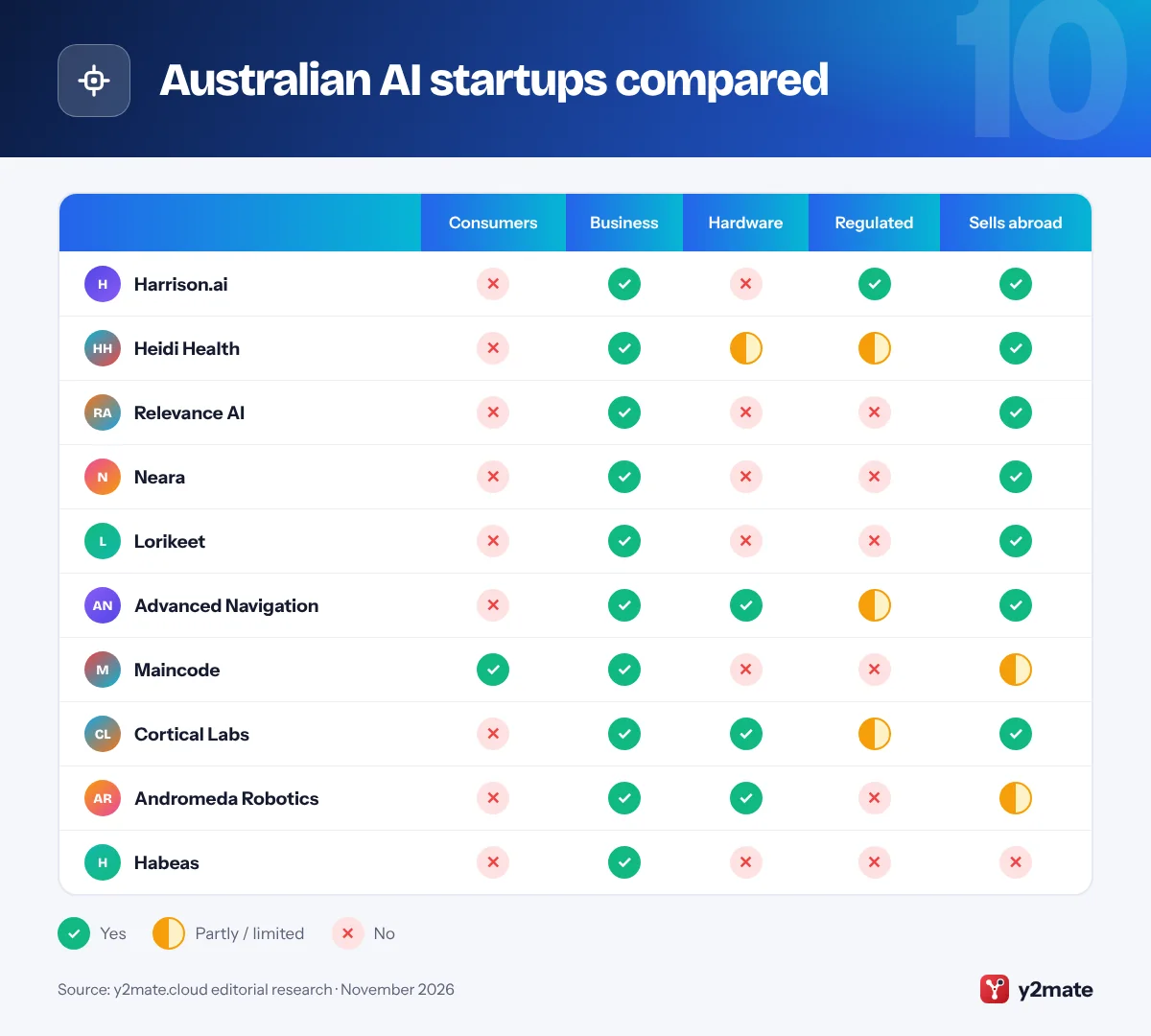
Australian AI startups compared
How to judge AI startups in Australia
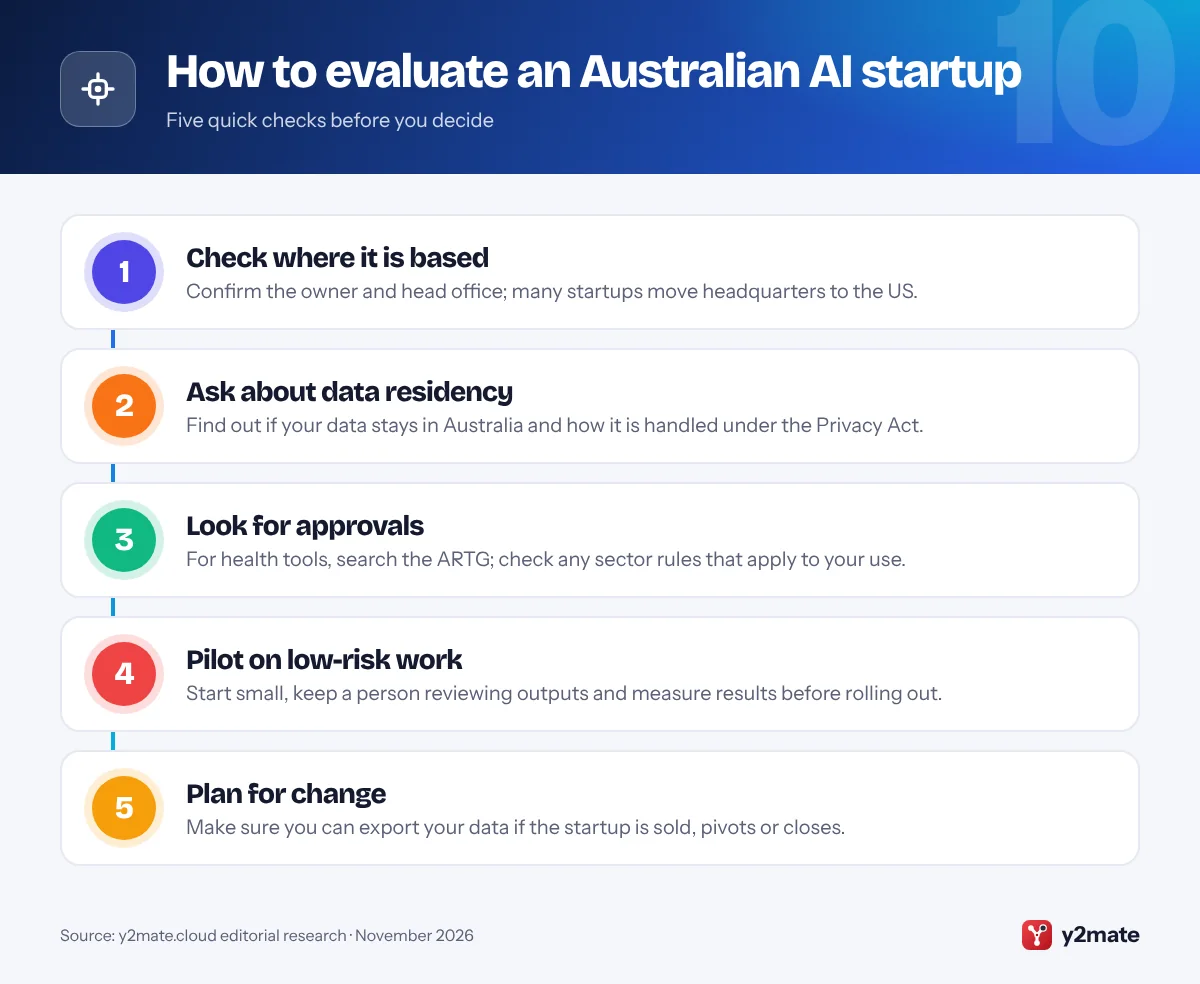
Before you rely on one of these products, or join one of these companies, check who owns it, where your data is stored and which rules apply.
Government support and safety
- National AI Plan: released on 2 December 2025, it is built around three goals: capturing the opportunity, spreading the benefits and keeping Australians safe. It relies mainly on existing laws rather than a standalone AI act.
- AI Safety Institute: set up within the Department of Industry, Science and Resources and operating in 2026, it tests advanced AI models, supports regulators and works with partner institutes in the UK and Canada.
- National AI Centre and CSIRO: the National AI Centre publishes the Guidance for AI Adoption for organisations and runs AI.gov.au, while CSIRO’s Data61 is the national science agency’s data and digital research arm.
- Computing power: most startups rent capacity from global cloud providers’ Australian regions, while companies such as Maincode are building onshore AI factories for sovereign workloads.
Your rights as a user
From 10 December 2026, organisations covered by the Privacy Act must explain in their privacy policies when computer programs make, or substantially help make, decisions that significantly affect people. Health software may also fall under TGA medical device rules, so check the Australian Register of Therapeutic Goods for any product that claims to diagnose or recommend treatment.
For job seekers
Sydney and Melbourne dominate, while Brisbane and Adelaide have growing robotics and defence-tech clusters. Many startups keep engineering teams here while opening US sales offices, creating roles in both places. Overseas specialists can look at the National Innovation visa, which replaced the Global Talent visa in December 2024.
Frequently asked questions
What are the best AI startups in Australia to watch in 2026?
Harrison.ai in medical imaging, Heidi Health in clinical documentation and Relevance AI in AI agents are the most established. Neara, Lorikeet, Advanced Navigation, Maincode, Cortical Labs, Andromeda Robotics and Habeas add energy networks, customer support, navigation, sovereign language models, biological computing, aged care robots and legal research. All were Australian-founded and independent in November 2026.
Is Leonardo.ai still an Australian startup?
Leonardo.ai was founded in Sydney, but Canva, itself an Australian company, acquired it in 2024. It still operates as a separate platform for AI image and video generation, but it is no longer an independent startup, so it is not on this list.
What is Australia's National AI Plan?
The National AI Plan is the federal government's strategy for artificial intelligence, released on 2 December 2025. It is built around three goals: capturing the economic opportunity, spreading the benefits across the community and keeping Australians safe. It relies mainly on existing laws, supported by a new AI Safety Institute and practical guidance from the National AI Centre.
Are AI scribes regulated by the TGA?
It depends on what they do. The TGA says a digital scribe that only records, transcribes and turns a consultation into written notes is generally not a medical device. A scribe that suggests diagnoses or treatments the clinician did not state can meet the definition of a medical device and need TGA approval. Clinicians must also get patients' informed consent.
Why do so many Australian AI startups open offices in the US?
The US is the largest market for business software, and many investors and enterprise customers are based there. Founders often keep engineering in Australia while moving sales, and sometimes leadership, to San Francisco or New York, as Relevance AI and Andromeda Robotics have done. Some, such as Marqo, eventually move their headquarters overseas.
Final verdict
The AI startups in Australia to watch in 2026 are led by Harrison.ai and Heidi Health, which have taken Australian health AI to global markets, and Relevance AI, one of the best-known names in AI agents. Neara, Lorikeet and Advanced Navigation solve practical problems for utilities, regulated businesses and machines, while Maincode, Cortical Labs, Andromeda Robotics and Habeas are bolder bets.
If you are choosing a tool, start with a pilot, ask where your data is stored and keep human review in place. If you are job hunting, look beyond research roles and beyond Sydney and Melbourne.
Sources and further reading
- Australia's National AI Plan: The Department of Industry, Science and Resources announces the National AI Plan and its three goals for capturing opportunities and keeping Australians safe.
- Australia's AI Safety Institute: The official page for the government body that tests advanced AI models and supports Australian regulators.
- Guidance for AI adoption: The National AI Centre's practical guidance on governing and using AI safely in Australian organisations.
- TGA guidance on digital scribes: The TGA explains when an AI scribe is regulated as a medical device and what suppliers and clinicians need to know.
- CSIRO artificial intelligence research: CSIRO's overview of its artificial intelligence research, including work by its Data61 digital research team.

Leave a Reply