- Harvey, Abridge, Sierra and Glean are among the most established independent AI startups in the USA, serving law, health care, customer service and workplace search.
- SpaceX agreed in June 2026 to acquire Anysphere, the maker of Cursor, and Cerebras listed on Nasdaq in May 2026, so neither is treated here as an independent startup.
- Executive Order 14434, signed on September 29, 2026, directs federal agencies to use the term Super Intelligence (SI) in place of artificial intelligence in official communications.
- BMW said in June 2026 that it was deploying Figure 03 humanoid robots at its Spartanburg, South Carolina, plant after a pilot of the earlier Figure 02.
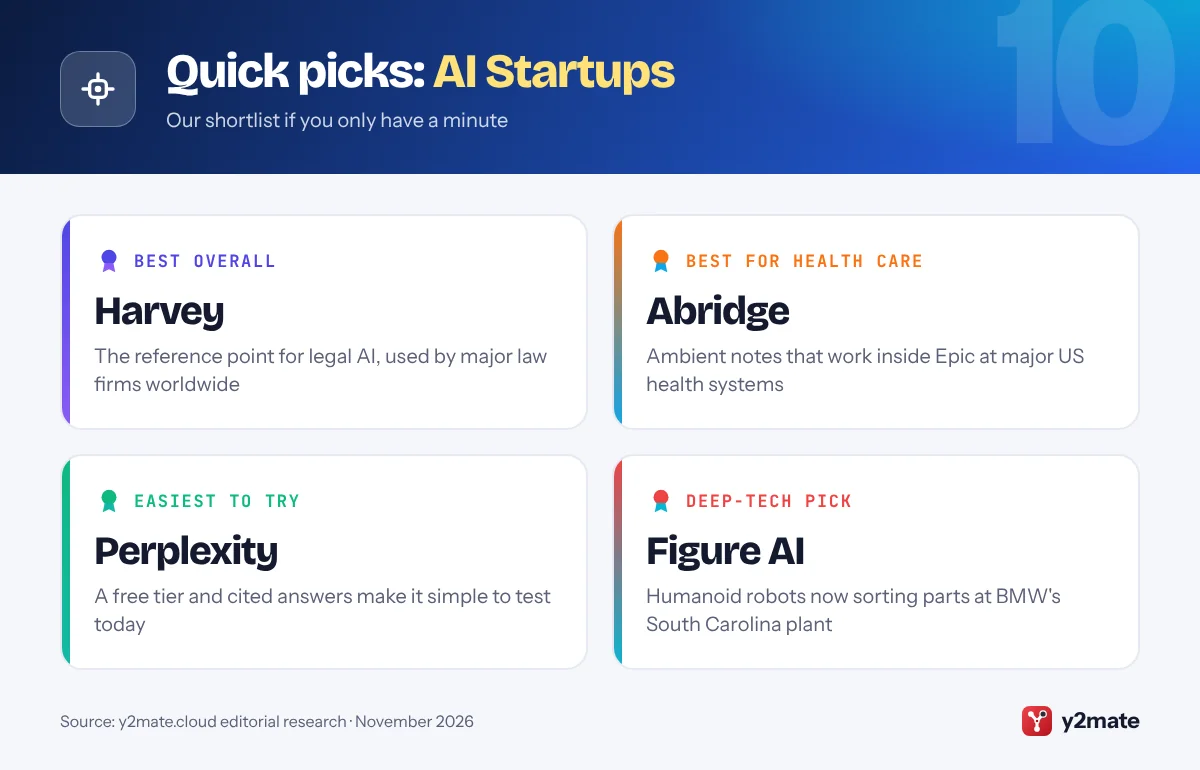
- Abridge became the first company in Epic's Partners and Pals program in 2023, so its AI documentation works inside Epic's widely used health record system.
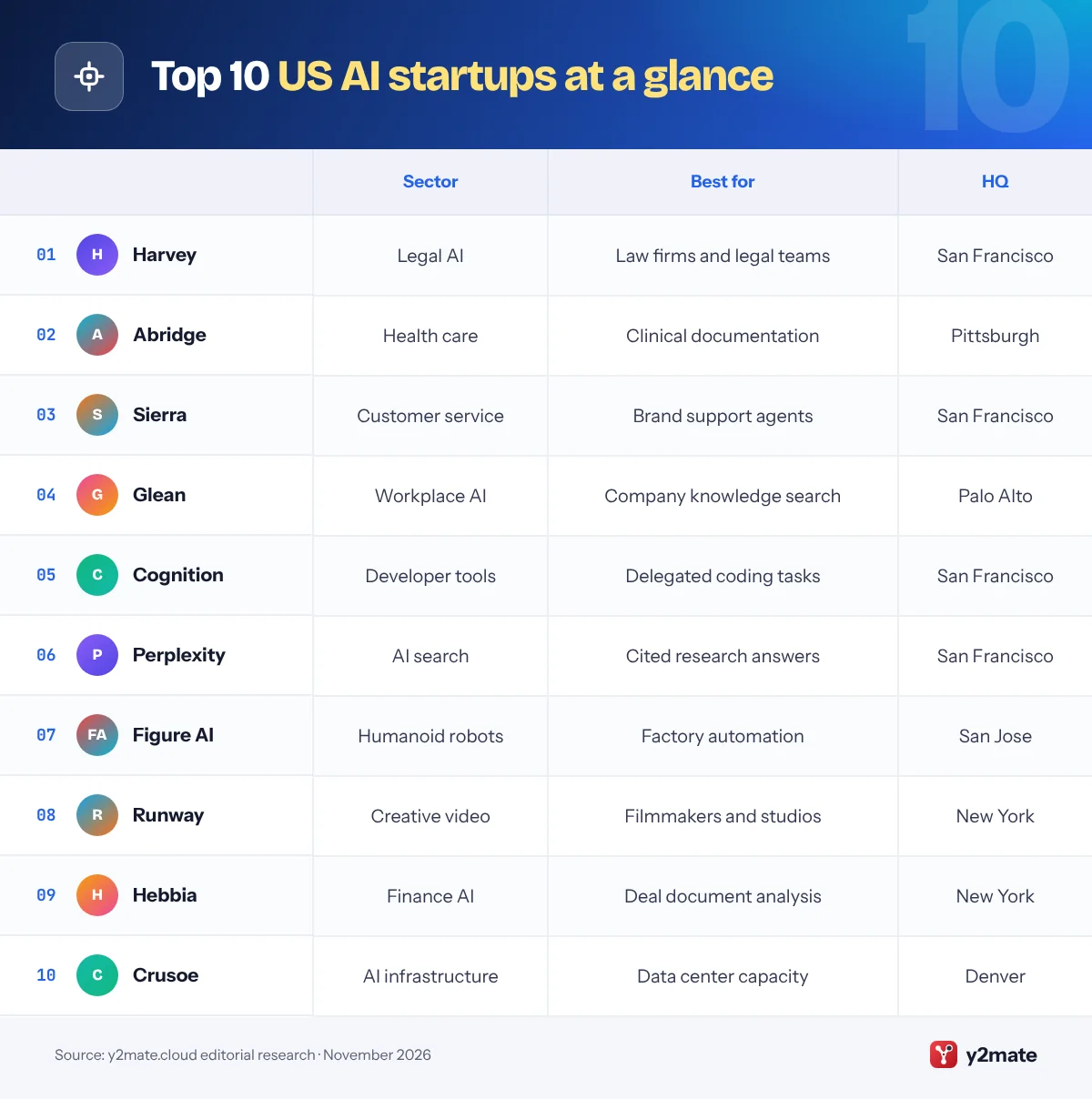
The AI startups in the USA most worth watching in 2026 are Harvey in law, Abridge in health care, Sierra in customer service and Glean in workplace search, followed by Cognition, Perplexity, Figure AI, Runway, Hebbia and Crusoe. All ten were founded in the US, were privately held and independent in November 2026, and none is one of the big model labs, such as OpenAI or Anthropic, that we cover in our global list of AI companies to watch.
Some quick definitions. A startup is a young company still proving its product and business model, while a scale-up has found paying customers and is growing fast; most companies here are now scale-ups. A foundation model is a large AI model trained on broad data that can be adapted to many tasks. An AI agent is software that plans and carries out multi-step tasks, such as processing a return or fixing a bug, with limited human input.
We also explain the American context, including a September 2026 executive order telling federal agencies to say Super Intelligence instead of artificial intelligence, the state laws that still matter, and what this boom means for users and job seekers.
How we ranked this list
We ranked companies on publicly documented criteria only: what each product does today, customers and partners the company itself has announced, regulatory and integration milestones, and technical significance. We confirmed each company was US-headquartered, independent and operating in November 2026. We did not test any products, and we leave out funding figures, which change quickly and say little about usefulness.
Some famous names are missing on purpose. Anysphere, the maker of Cursor, agreed in June 2026 to be acquired by SpaceX, and AI chipmaker Cerebras became a public company through a Nasdaq listing in May 2026. We also left out ElevenLabs, whose headquarters is split between New York and a large London base, and the big labs already covered in our global list.
The Top 10 AI Startups
1. Harvey
Best for: law firms and in-house legal teams
Harvey was founded in San Francisco in 2022 by Winston Weinberg, a former litigator, and Gabe Pereyra, a former AI research scientist. It is a platform for legal and professional services work: lawyers use it to research questions, analyze document sets in its Vault workspace, draft contracts, track regulatory changes and run agent workflows for tasks such as due diligence.
Harvey has become the reference point for legal AI. Customers it highlights include Reed Smith, O’Melveny & Myers, Blank Rome, CMS, Dentsu and Deutsche Telekom, and it now serves corporate legal departments as well as law firms. Recent additions include a Memory feature that remembers user preferences and a connector library that links Harvey to other software through the Model Context Protocol.
Why it matters: Harvey shows how a specialist layer on top of general models can transform document-heavy professions. The limitation is accountability. Courts have sanctioned lawyers for filing AI-generated citations that did not exist, so every output still needs checking by a qualified lawyer, and Harvey is sold mainly to larger organizations rather than solo practitioners.
Official site: Harvey
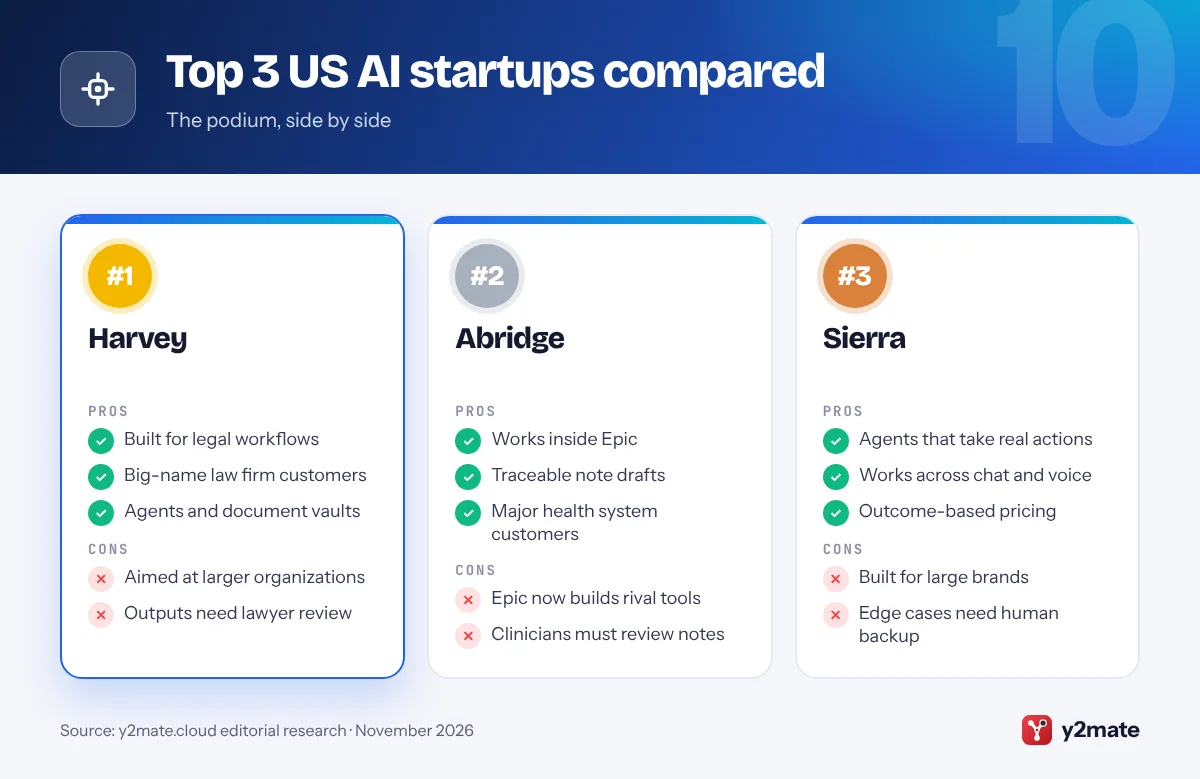
- Built for legal workflows
- Big-name law firm customers
- Agents and document vaults
- Aimed at larger organizations
- Outputs need lawyer review
2. Abridge
Best for: hospitals reducing clinician paperwork
Abridge was founded in Pittsburgh in 2018 by Dr. Shiv Rao, a practicing cardiologist. It makes ambient AI documentation: with the patient’s consent, it listens to a clinical visit and drafts the medical note, which the clinician reviews and signs. Statements in the draft can be traced back to the conversation, which makes checking easier.
In 2023 Abridge became the first company in Epic’s Partners and Pals program, so its tools work inside the electronic health record used by many of the largest US health systems. Health systems it has announced include UPMC, Emory Healthcare, Mayo Clinic, Sutter Health, Northwell Health and WVU Medicine. It has expanded from physician notes into nursing documentation and billing support.
Why it matters: documentation is a major driver of clinician burnout, and ambient scribes are among the first AI tools to see broad hospital adoption. The open question is competition. Epic has been adding its own AI charting features, which could squeeze independent vendors. Patients can ask whether an AI scribe is being used, and HIPAA privacy rules still apply.
Official site: Abridge
- Works inside Epic
- Traceable note drafts
- Major health system customers
- Epic now builds rival tools
- Clinicians must review notes
3. Sierra
Best for: brands automating customer conversations
Sierra was founded in San Francisco in 2023 by Bret Taylor, former co-CEO of Salesforce, and Clay Bavor, a longtime Google executive. It builds customer-facing AI agents that can answer questions and take actions, such as changing a subscription, processing a return or moving a mortgage application forward, across chat, SMS, WhatsApp, email and voice.
Companies it features include Rocket Mortgage, Singtel, Airtable and CLEAR. A notable detail is its outcome-based pricing: Sierra says customers pay for results, such as a resolved conversation, rather than per seat. Its platform covers building, testing and monitoring agents, with or without engineers.
Why it matters: customer service is one of the first areas where companies trust AI agents to act, not just chat, and Sierra is a direct challenger to established customer service software. The open questions are how agents handle unusual or emotional situations and how mistakes get corrected. Consumers dealing with any AI agent should be able to reach a human, and businesses remain responsible for what their agents promise customers.
Official site: Sierra
- Agents that take real actions
- Works across chat and voice
- Outcome-based pricing
- Built for large brands
- Edge cases need human backup
4. Glean
Best for: finding answers across workplace apps
Glean was founded in 2019 by Arvind Jain, a former Google search engineer and co-founder of Rubrik, and is based in Palo Alto. It started as enterprise search, a single search box across a company’s apps such as email, chat, documents and ticketing systems, and has grown into an AI assistant and agent platform built on that index.
The key technical idea is permissions-aware retrieval: Glean only shows each person information they are already allowed to see, which is essential before letting AI answer questions from company data. In 2026 it added voice, slide creation and actions to Glean Assistant, alongside a builder for custom agents. Customers it has named include Databricks, Confluent and Okta.
Why it matters: generative AI at work is only as good as the context it can reach, and Glean is betting on being the neutral knowledge layer underneath different models. The open question is platform competition, since Microsoft, Google and Salesforce are building similar features into their own suites. Setup also takes real effort if a company’s data and permissions are messy.
Official site: Glean
- Searches across workplace apps
- Respects existing permissions
- Assistant and agent builder
- Big suites offer rival tools
- Needs careful data setup
5. Cognition
Best for: engineering teams delegating coding tasks
Cognition was founded in San Francisco in 2023 and makes Devin, which it describes as an autonomous software engineer. Instead of suggesting the next line of code, Devin takes a task such as fixing a bug or writing tests, then plans, codes, tests and opens a pull request in a team’s existing codebase.
In July 2025 Cognition acquired Windsurf, the AI coding editor, after Google hired Windsurf’s founders, giving it both an autonomous agent and an editor where developers work alongside AI. It keeps shipping quickly: in November 2026 it introduced SWE-2 Flash, a new coding model, and it publishes FrontierCode, a benchmark that asks whether a human maintainer would actually merge AI-written code.
Why it matters: software engineering is where AI agents are most advanced and easiest to measure. With Cursor’s maker agreeing to be acquired by SpaceX, Cognition is also one of the largest independent rivals to coding tools from the big labs. The limitation is oversight. Autonomous agents can produce plausible but subtly wrong code, so teams need code review, testing and clear limits on what an agent can change.
Official site: Cognition
- Agent plus Windsurf editor
- Works in existing codebases
- Fast product cadence
- Needs strong code review
- Crowded coding-tool market
6. Perplexity
Best for: researching questions with cited sources
Perplexity was founded in San Francisco in 2022 and runs an answer engine: you ask a question, it searches the web and writes a direct answer with numbered citations to its sources. It lets paying users choose among models from several AI labs, and it offers a free tier, paid plans and an enterprise version.
The company has pushed well beyond search. Its Comet web browser, launched in 2025 and later made free, builds an AI assistant into browsing and can carry out tasks on websites. In February 2026 it launched Perplexity Computer, an agent system, and in November 2026 it introduced Teammates, agents that work in the background on ongoing tasks and ask for decisions when needed, initially for its top-tier subscribers.
Why it matters: Perplexity is one of the few independent challengers in consumer search, and a test case for how AI answers share value with publishers. It faces copyright lawsuits from news publishers, and Amazon has sued over Comet’s ability to shop on its site. Answers can still be wrong, so open the cited sources for anything important.
Official site: Perplexity
- Answers with linked sources
- Free tier available
- Comet browser and agents
- Publisher copyright lawsuits
- Answers can still be wrong
7. Figure AI
Best for: factories exploring humanoid robots
Figure AI was founded in 2022 by entrepreneur Brett Adcock and is based in San Jose, California. It builds general-purpose humanoid robots and the AI that controls them. Its Helix model is a vision-language-action system that turns camera images and spoken instructions into movements, so a robot can handle tasks it was not specifically programmed for.
The most concrete proof point is BMW. After a long pilot of the earlier Figure 02 at BMW’s plant in Spartanburg, South Carolina, BMW said in June 2026 that it was deploying the newer Figure 03 there to sort and sequence parts for vehicle production. Figure 03 adds more sensitive hands, cameras in the palms and wireless charging, and Figure now also promotes it for help around the home.
Why it matters: humanoids are designed to work in spaces built for people without rebuilding factories or homes, which is why physical AI is so closely watched. The open questions are reliability, safety around people and cost. Factory deployments are still narrow, and home use raises privacy questions about cameras and microphones in private spaces.
Official site: Figure AI
- Deployed at a BMW plant
- Helix vision-language-action AI
- Designed for human spaces
- Deployments still narrow
- Safety and privacy questions
8. Runway
Best for: filmmakers and creative teams
Runway was founded in New York in 2018 by three graduates of NYU’s Interactive Telecommunications Program. Its tools generate and edit video from text prompts, images and existing footage. Its Gen-4.5 model, released in December 2025, focuses on consistent characters and camera control, and GWM-1, its first world model, simulates explorable environments.
Runway works directly with the entertainment industry. Lionsgate partnered with it in 2024 to build a custom model trained on the studio’s own catalog, and AMC Networks announced a partnership in 2025 to use Runway for marketing and pre-visualization. Runway also runs an annual AI Film Festival showcasing work made with its tools.
Why it matters: Runway is a bellwether for how Hollywood and advertisers adopt generative video. The open questions are legal and cultural. Training data and copyright remain contested across the industry, and unions and creators are still negotiating how AI tools can be used on productions. Individuals can try it on a free plan with limited credits before committing.
Official site: Runway
- Advanced video generation
- Hollywood studio partnerships
- Free plan to try
- Copyright questions persist
- Credits limit heavy use
9. Hebbia
Best for: investors and bankers analyzing documents
Hebbia was founded in 2020 by George Sivulka, who started it while a Ph.D. student at Stanford, and is based in New York. Its flagship product, Matrix, lays out AI analysis like a spreadsheet: documents become rows, questions become columns, and each cell holds an answer with a citation back to the source. That makes it practical to interrogate hundreds of filings, contracts or data-room documents at once.
Hebbia focuses on finance and professional services. Customers named in public reporting include investment bank Centerview Partners and law firm Fenwick, and its site lists connections to sources such as SEC filings, earnings call transcripts, FactSet, S&P Capital IQ and PitchBook. In 2026 it launched Max, which it describes as an always-on AI analyst for deal teams.
Why it matters: finance runs on reading dense documents under time pressure, and Hebbia’s grid design makes AI work easier to audit than a chat window. The limitation is scope. It is built for professional teams, not individual investors, and any AI-generated analysis used for investment decisions still needs human verification and compliance review.
Official site: Hebbia
- Spreadsheet-style AI analysis
- Citations in every cell
- Finance data integrations
- Built for professional teams
- Outputs need compliance review
10. Crusoe
Best for: AI companies that need data center capacity
Crusoe was founded in 2018 and is headquartered in Denver. It began by using gas that would otherwise be flared at oil wells to power computing, and now calls itself an AI factory company: it develops energy, builds AI-optimized data centers and rents computing through Crusoe Cloud.
Its flagship campus in Abilene, Texas, went live in 2025 and hosts AI capacity for Oracle and OpenAI. In March 2026 Crusoe announced a second campus in Abilene to support Microsoft’s AI infrastructure. It has also opened a factory in Brighton, Colorado, to build modular data center units, and in November 2026 it updated plans for a campus in Wyoming.
Why it matters: the limiting factor for AI is increasingly electricity rather than chips, and Crusoe’s energy-first model is one answer to that problem. It also shows how AI investment is reshaping local economies in places such as West Texas. The open questions are environmental and financial: large data centers draw heavily on power grids and water, and building at this pace relies on a small number of very large customers. Nearby residents can follow local permitting and utility hearings.
Official site: Crusoe
- Energy-first data centers
- Major cloud and AI customers
- Modular data center units
- Heavy power and water demand
- Relies on a few big customers
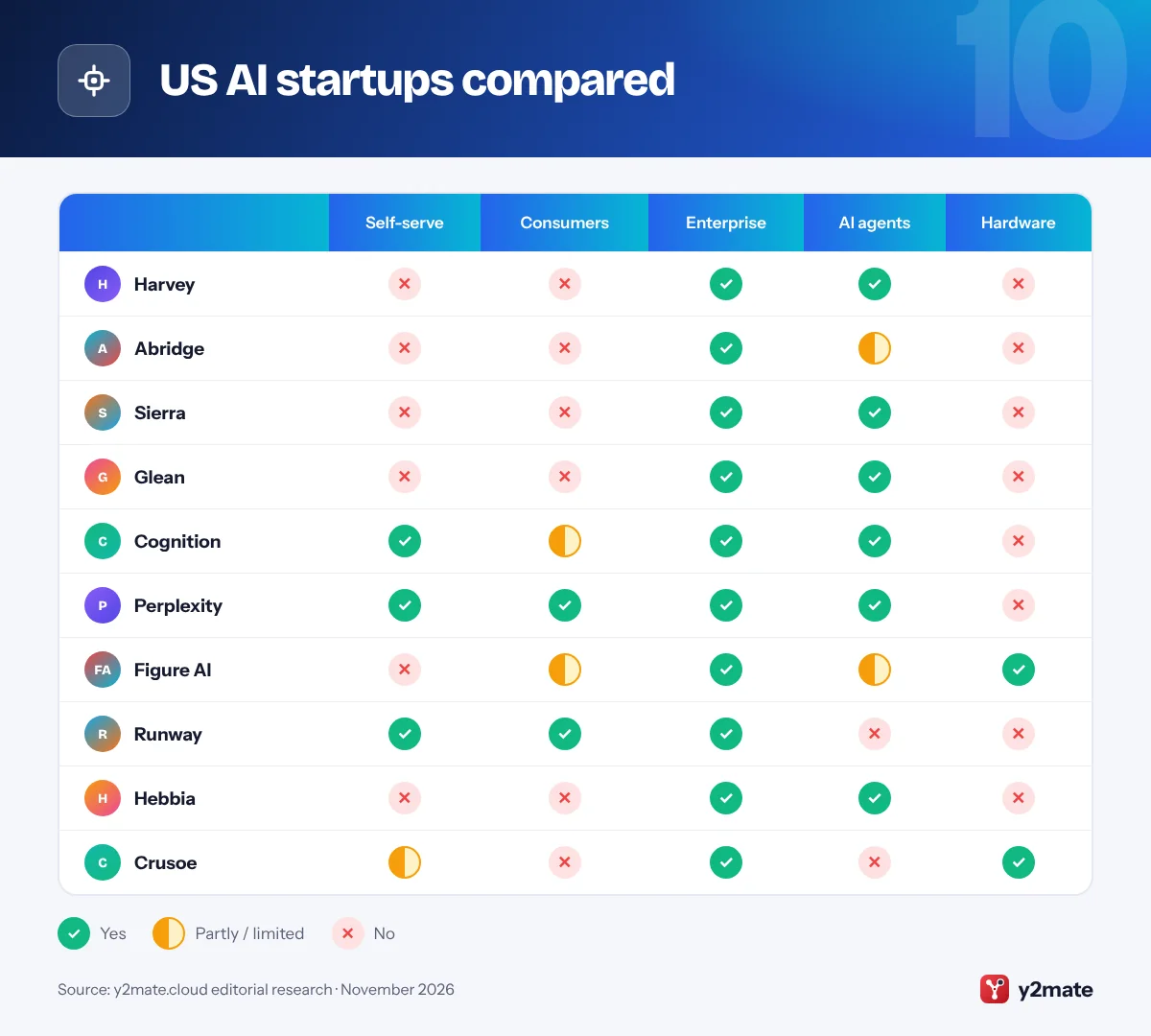
US AI startups compared
How to judge AI startups in the USA
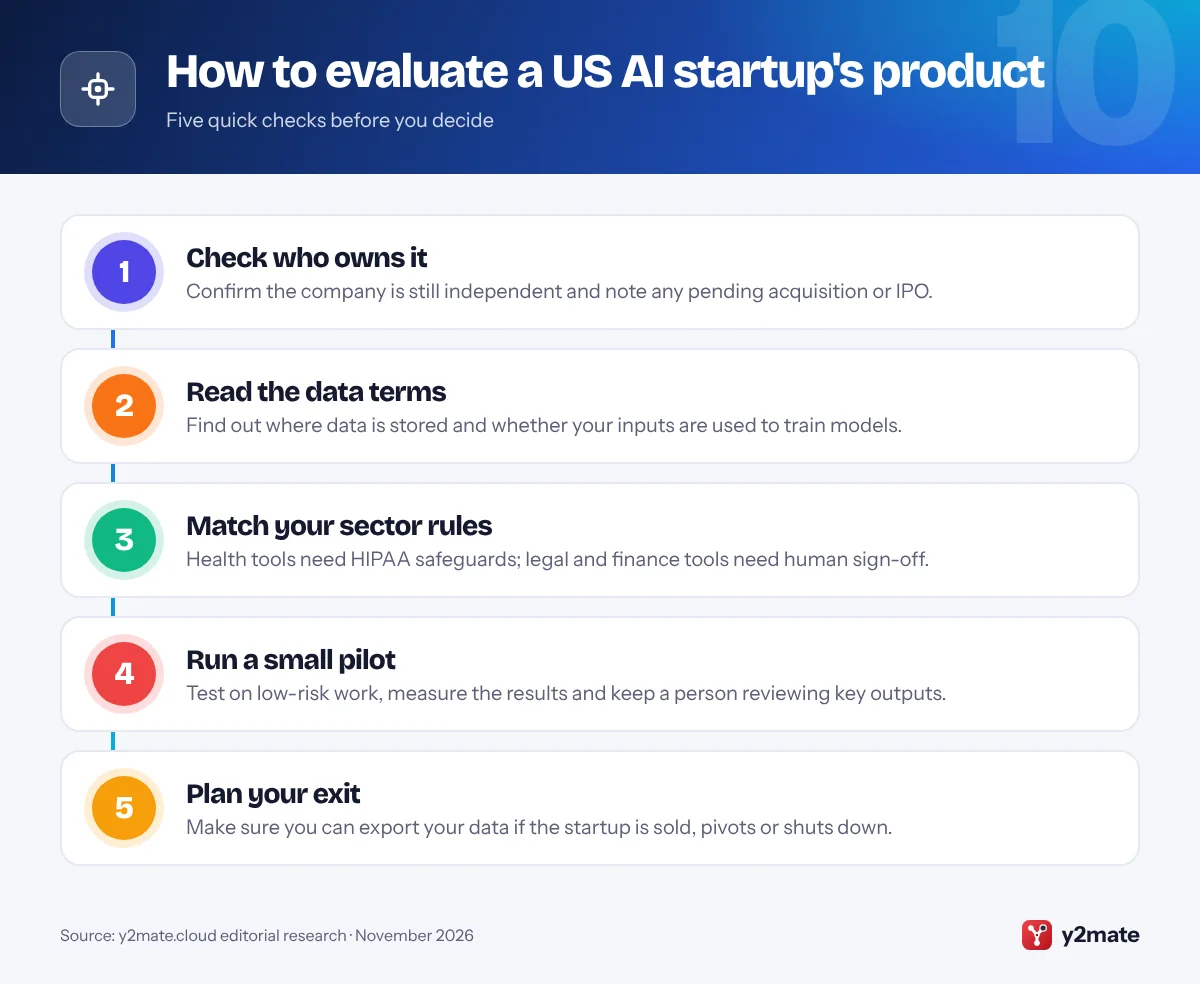
Before you rely on one of these products, or join one of these companies, check who owns the business, how it handles your data and which rules apply to your industry. US policy is shifting quickly at both federal and state level.
The federal picture
- Policy direction: America’s AI Action Plan, released in July 2025, prioritizes innovation, infrastructure and exports. Executive Order 14365, signed in December 2025, directed the Justice Department to set up a task force to challenge state AI laws the administration considers too burdensome.
- New terminology: Executive Order 14434, signed on September 29, 2026, tells federal agencies to use Super Intelligence (SI) instead of artificial intelligence in official communications. That is why ai.gov now redirects to si.gov and NIST’s standards center is now the Center for Advancing Innovation and Standards for Super Intelligence (CAISSI). Existing laws and contracts keep the old wording.
- Research and computing: the Department of Energy’s Genesis Mission links national labs, universities and industry on AI-driven science, and the NSF-led NAIRR Pilot gives researchers access to computing power and data.
State rules still matter
California’s Transparency in Frontier Artificial Intelligence Act sets disclosure duties for the largest model developers, and Colorado replaced its delayed AI Act in May 2026 with a narrower law on high-stakes automated decisions that is due to start in January 2027. Sector laws also apply: HIPAA for health data, and FTC rules against deceptive claims for any product.
For job seekers
The Bay Area and New York remain the main hubs, but Pittsburgh, Denver and Texas data center towns show AI jobs spreading. Many openings are for forward-deployed engineers, solutions engineers, data center technicians and domain experts such as clinicians and lawyers, not only researchers.
Frequently asked questions
What are the best AI startups in the USA to watch in 2026?
Harvey in law, Abridge in health care, Sierra in customer service and Glean in workplace search are the most established. Cognition, Perplexity, Figure AI, Runway, Hebbia and Crusoe add coding agents, AI search, humanoid robots, video, financial research and data centers. All were independent and US-headquartered in November 2026.
What is the difference between an AI startup and an AI lab like OpenAI?
Big AI labs such as OpenAI, Anthropic and Google DeepMind train the largest foundation models and sell access to them. Most AI startups build specialized products on top of those models, adding industry data, workflows, integrations and safeguards for a specific job, such as legal drafting or clinical notes. Some, like Figure AI and Runway, also train their own specialized models.
Why do US government websites now say Super Intelligence instead of AI?
Executive Order 14434, signed on September 29, 2026, directs federal agencies to use the terms Super Intelligence and SI in place of artificial intelligence and AI in official communications, websites and reports. It does not change existing laws or contracts, and for now the terms mean the same thing as the existing legal definition of artificial intelligence.
Is Cursor still an independent startup?
No longer, in practice. SpaceX agreed in June 2026 to acquire Anysphere, the company behind the Cursor AI code editor, and the deal was subject to regulatory approval. That is why Cursor is not on this list. Cognition, which makes the Devin coding agent and owns the Windsurf editor, is included instead as a leading independent coding startup.
How can I safely try tools from AI startups at work?
Get approval from your IT or security team and use a business account, not a personal one. Check whether the vendor trains models on your inputs, where data is stored and for how long. Start with low-risk tasks, never paste regulated data such as health records without a proper agreement, and keep a person reviewing anything important.
Final verdict
The AI startups in the USA to watch in 2026 are led by Harvey, Abridge, Sierra and Glean, which have turned foundation models into products that large organizations rely on every day. Cognition and Perplexity show how fast AI agents are moving into coding and search, while Figure AI, Runway, Hebbia and Crusoe stretch AI into robotics, film, finance and the energy that powers it all.
If you are choosing a tool, start with a pilot, read the data terms and keep human review in place. If you are job hunting, look beyond research roles and beyond Silicon Valley.
Sources and further reading
- Executive Order 14434 text: The official text of the September 2026 order directing federal agencies to use Super Intelligence in place of artificial intelligence.
- NIST's CAISSI standards center: NIST's page for its renamed standards center, which works with industry on testing, security guidelines and voluntary standards.
- America's AI Action Plan: The White House's July 2025 plan setting federal priorities for AI innovation, infrastructure and international partnerships.
- The Genesis Mission: The Department of Energy's initiative linking national labs, universities and industry to apply advanced AI to scientific research.
- NAIRR Pilot: The NSF-led pilot that gives US researchers and educators access to computing power, data and AI tools.

Leave a Reply