
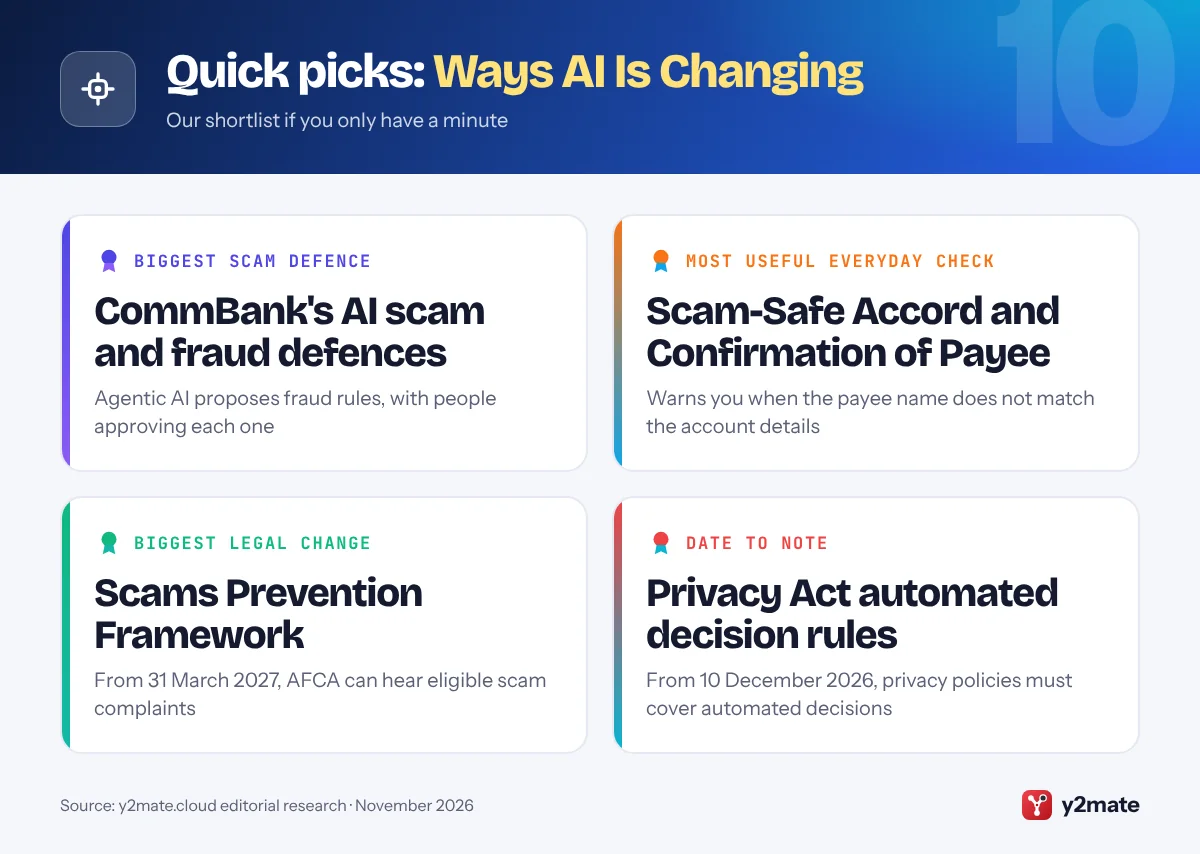
- CommBank uses an agentic AI system, announced in April 2026, that proposes new fraud detection rules, which its fraud team reviews and approves before they are used.
- Confirmation of Payee, the centrepiece of the banks' Scam-Safe Accord, began rolling out in July 2025 and warns you when a payee name does not match the account.
- Most Scams Prevention Framework obligations apply from 31 March 2027, when AFCA starts handling eligible scam complaints against banks, telcos and digital platforms.
- From 10 December 2026, privacy policies must describe the kinds of decisions made using computer programs and the kinds of personal information they use.
- ASIC says AI and chatbots do not change a firm's legal obligations and has named harmful use of AI among its 2027 enforcement priorities.
AI in banking Australia-wide has moved well beyond chatbots. It scores payments for signs of scams, powers scam-baiting bots and in-app warnings, shapes the prompts and offers you see, and is now firmly on the radar of ASIC, APRA and the privacy regulator. Below are the ten developments that matter most for Australian bank customers in November 2026.
Two definitions. Generative AI creates new text, images or audio, like the chatbots that write their own answers. Agentic AI goes further and carries out tasks, such as investigating a new fraud pattern and proposing a fix, sometimes with a person approving each step.
For each item we cover what it does, who it affects, a practical tip and the main risk. This is a news explainer, not financial advice.
How we ranked this list
We chose and ranked these items by how many Australian bank customers they affect, how far along they are (live, a pilot, or a law or rule in force or starting soon), and how well banks and official bodies such as ASIC, APRA, the ACCC, the OAIC and the Australian Banking Association document them.
We did not test any bank’s AI tools and make no claims about their accuracy beyond what official sources state.
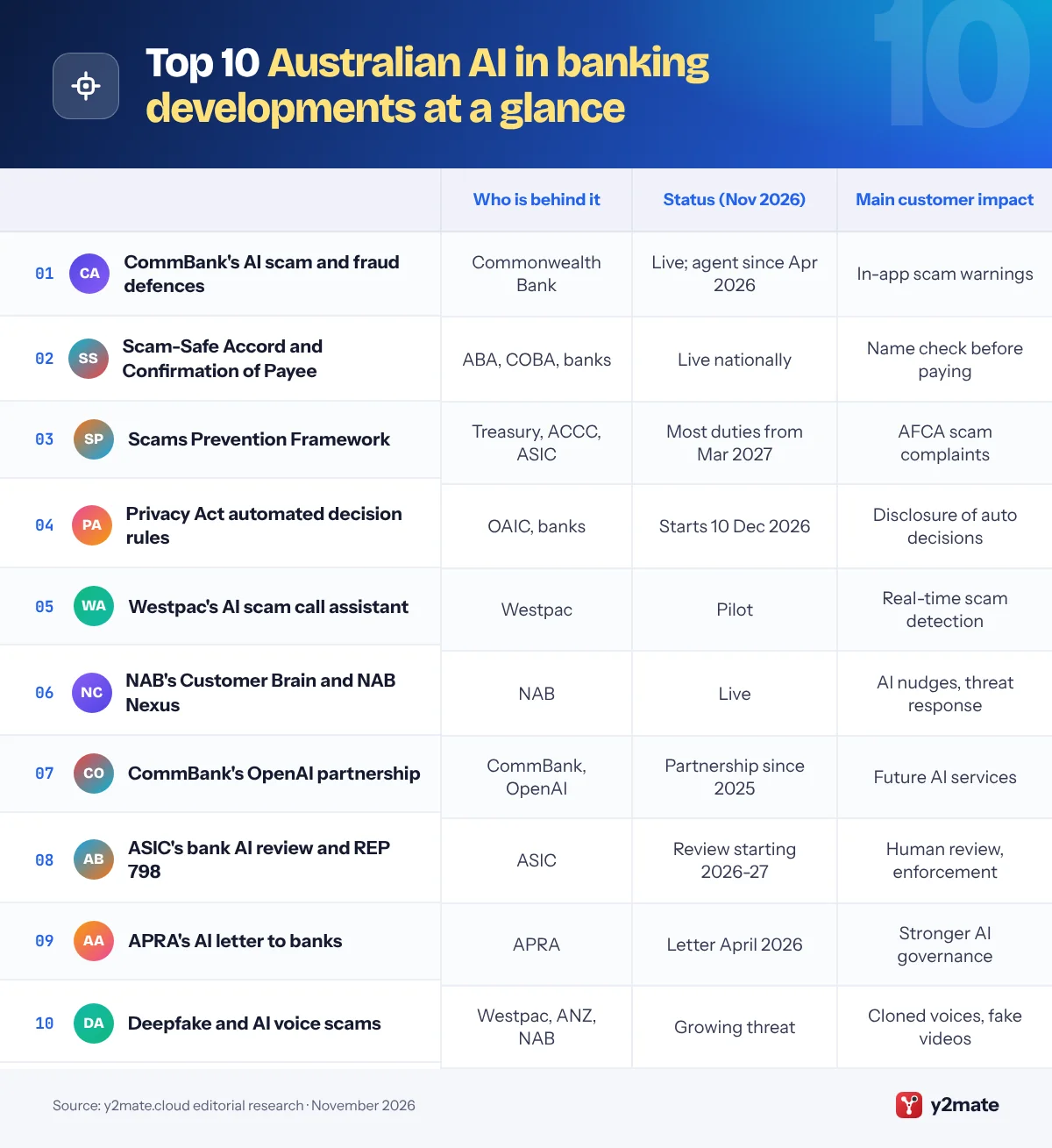
The Top 10 Ways AI Is Changing
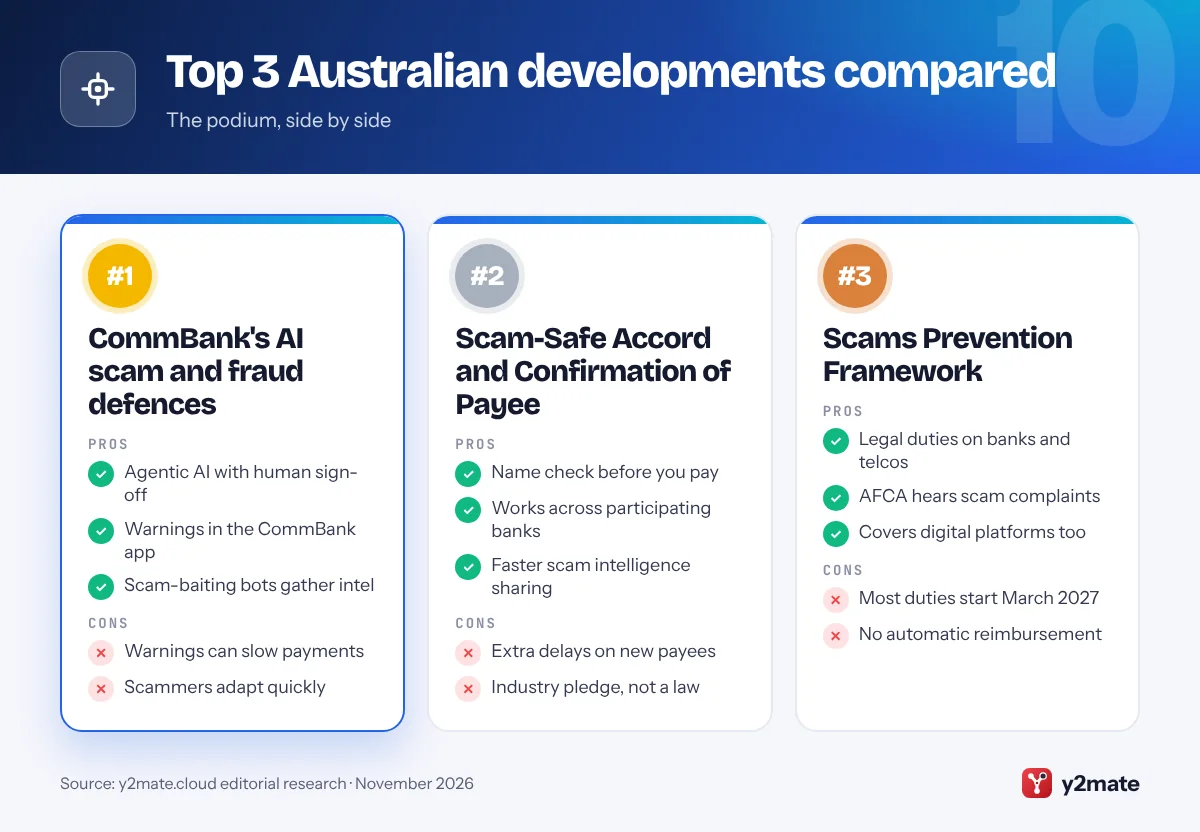
1. CommBank's AI scam and fraud defences
Best for: CommBank customers worried about scams
Commonwealth Bank uses AI throughout its fraud and scam controls. Its systems monitor transactions, card and online payments and digital banking activity, and send proactive warning alerts through the CommBank app. In April 2026 it said it had deployed an agentic AI system, built by its own data science and engineering teams, that looks for emerging fraud and scam patterns in payments data, assesses how serious they are and proposes new detection rules. People stay in the loop: CommBank’s fraud analytics team reviews and approves new rules before they are used.
Since June 2025 CommBank has also worked with Apate.ai, a Macquarie University spin-out whose conversational AI bots pose as potential victims, keep scammers talking on calls and texts, and feed near real-time intelligence into the bank’s scam controls.
Customer tip: take in-app warnings seriously; a pause or a question usually means the payment matches a known scam pattern. If someone calls claiming to be CommBank, hang up and call the number on your card.
Official site: CommBank's AI scam and fraud defences
- Agentic AI with human sign-off
- Warnings inside the CommBank app
- Scam-baiting bots gather intel
- Warnings can slow payments
- Scammers adapt quickly
2. Scam-Safe Accord and Confirmation of Payee
Best for: anyone paying someone new by bank transfer
In November 2023 Australian retail banks, through the Australian Banking Association (ABA) and the Customer Owned Banking Association, launched the Scam-Safe Accord, a set of anti-scam commitments. Its centrepiece is Confirmation of Payee, an industry-wide service that checks the name of the person or business you are paying against the account details you enter and warns you before the transfer if they do not match. Banks began rolling it out in July 2025, and the ABA says it is now live at participating banks nationally.
The Accord also means more warnings and delays when you pay someone new or raise payment limits, biometric checks when opening accounts at the major banks, and faster sharing of scam intelligence through the Australian Financial Crimes Exchange. Banks use machine learning to decide which payments look risky enough to warn about or hold.
Customer tip: never ignore a name mismatch. Check the details with the payee using contact details you already trust, not ones sent in the same message.
Official site: Scam-Safe Accord and Confirmation of Payee
- Name check before you pay
- Works across participating banks
- Faster scam intelligence sharing
- Extra delays on new payees
- Industry pledge, not a law
3. Scams Prevention Framework
Best for: scam victims who need a route to redress
The Scams Prevention Framework, which became law in February 2025, turns anti-scam expectations into legal duties for banks, telcos and digital platforms. From 31 March 2027 most obligations apply: regulated businesses must take steps to prevent, detect, disrupt, report and respond to scams, under an overarching framework and sector codes that are still being finalised. ASIC will be the sector regulator for banks, and the ACCC is the general regulator.
For customers, the key change is redress. Businesses in these sectors had to join the Australian Financial Complaints Authority (AFCA) by 1 September 2026, and from 31 March 2027 AFCA will handle eligible scam complaints that a bank, telco or platform has not resolved.
Unlike the UK, Australia has no blanket rule that banks reimburse scam victims; compensation will depend on whether a business met its obligations.
Customer tip: report a scam to your bank immediately and to Scamwatch, and keep screenshots and records in case you need to complain.
Official site: Scams Prevention Framework
- Legal duties on banks and telcos
- AFCA hears scam complaints
- Covers digital platforms too
- Most duties start March 2027
- No automatic reimbursement
4. Privacy Act automated decision rules
Best for: customers who want to know when computers decide
From 10 December 2026, organisations covered by the Privacy Act, including banks, must be more open about automated decisions. The change, made by the Privacy and Other Legislation Amendment Act 2024, applies where a computer program makes a decision, or does something substantially and directly related to making it, that could significantly affect your rights or interests, using your personal information. The privacy policy must then describe the kinds of personal information used and the kinds of decisions made this way.
Credit decisions and account closures could be covered. The Office of the Australian Information Commissioner (OAIC) has published guidance and a fact sheet, and the rule applies to decisions made from 10 December 2026, even if the system was set up earlier. It is a transparency rule, not a right to an explanation of your own decision.
Customer tip: read your bank’s privacy policy after 10 December. If you are refused credit after a credit check, the lender must send a written notice, and you can get a free credit report.
Official site: Privacy Act automated decision rules
- Banks must disclose automated use
- Covers decisions from Dec 2026
- OAIC guidance already out
- No right to an explanation
- General descriptions only
5. Westpac's AI scam call assistant
Best for: Westpac customers who call about a payment
In May 2025 Westpac began piloting an AI-powered call assistant with its specialist scam and fraud team. During live calls, it looks for signs that a customer may be about to send money to a scammer, including signs that someone in the background is coaching them on what to say, and helps staff respond quickly and consistently.
It sits alongside other Westpac protections: SaferPay, which asks questions before high-risk payments; Westpac Verify, which flags mismatched account names; SafeCall, which delivers verified calls through the app; SafeBlock, which lets customers freeze accounts instantly; and behavioural analytics to help spot remote access scams. In April 2026 Westpac warned of a surge in personalised, AI-driven scams, including impersonation using cloned voices, faces and video calls.
Customer tip: if a Westpac staff member asks whether someone is telling you what to say, answer honestly. Scammers often coach victims to mislead their bank, and the questions are there to protect you.
Official site: Westpac's AI scam call assistant
- Spots scam coaching in real time
- Backed by SaferPay and Verify
- Instant SafeBlock account freeze
- Still a pilot
- Only works on calls to Westpac
6. NAB's Customer Brain and NAB Nexus
Best for: NAB customers curious about app nudges
NAB’s Customer Brain, launched in 2023 and powered by Pegasystems’ Customer Decision Hub, is an AI decisioning engine that works out the next best action for each customer, such as a helpful reminder, a timely nudge or a moment of recognition. It makes real-time decisions across NAB’s channels and learns what customers respond to, so the prompts and offers you see in the app or from a banker are increasingly chosen by AI.
On the security side, NAB launched NAB Nexus in June 2026, a 24/7 integrated operations hub that brings together technology, cyber security, fraud, payments and physical security teams to respond faster to AI-enabled threats. NAB has also described how branch staff helped a customer who was nearly scammed through a deepfake video call.
Customer tip: personalised nudges are partly marketing. A suggested product is not advice that it suits you, and you can usually adjust marketing preferences in the app.
Official site: NAB's Customer Brain and NAB Nexus
- Timely reminders and nudges
- 24/7 hub for AI-enabled threats
- Learns what customers find useful
- Nudges are partly marketing
- Little detail on how it decides
7. CommBank's OpenAI partnership
Best for: readers tracking big-bank AI partnerships
In August 2025 CommBank announced a multi-year partnership with OpenAI, becoming OpenAI’s strategic banking partner in Australia. Engineers from both companies are exploring generative AI tools that aim to strengthen scam and fraud detection and deliver more personalised services, and CommBank employees are progressively getting access to ChatGPT Enterprise, backed by training on responsible AI use.
The announcement described tools to explore rather than a specific customer product with a launch date. CommBank’s best-documented customer-protection AI, the agentic fraud system announced in April 2026, was built in-house.
The partnership matters because it brings a frontier AI developer directly into Australia’s largest bank, which raises fair questions about where customer data is processed and how it is protected.
Customer tip: if CommBank or any bank offers a new AI chat feature, check whether you can opt out, how your conversations are stored and whether they are used to train AI models.
Official site: CommBank's OpenAI partnership
- Aimed at scam and fraud detection
- Staff trained on responsible AI
- Frontier AI expertise locally
- Customer benefits still to come
- Data handling details unclear
8. ASIC's bank AI review and REP 798
Best for: anyone stuck with a bank chatbot or system
ASIC regulates how banks treat customers, and AI is now one of its stated priorities. Its October 2024 report REP 798, Beware the gap, reviewed how financial services and credit licensees use AI and found adoption was growing while governance and assessment of consumer risks lagged. In its 2026–27 supervisory priorities for banks, published in September 2026, ASIC said it would start a banking sector AI review focused on new and proposed AI uses and their impact on customers, working with APRA.
On 18 November 2026 ASIC named harmful use of AI and other technology among its 2027 enforcement priorities, including systems that produce misleading information, make inappropriate decisions or stop customers getting help. ASIC said AI, automated decision-making and chatbots do not change a firm’s legal obligations, and that human review matters most when customers are complaining, responding to a scam or seeking financial hardship help.
Customer tip: if a chatbot blocks you from reaching a person, insist, and take unresolved complaints to AFCA.
Official site: ASIC's bank AI review and REP 798
- Human review stressed for scams
- Bank AI review starting
- Clear enforcement focus
- Review not yet complete
- No AI-specific rules
9. APRA's AI letter to banks
Best for: readers interested in how bank AI is supervised
APRA supervises the financial safety of banks rather than individual customer outcomes, but its view of AI matters because weak controls can lead to outages, data breaches or faulty automated decisions. On 30 April 2026 it wrote to all APRA-regulated entities calling for a step-change in how banks, insurers and superannuation trustees manage AI-related risks, warning that governance, risk management, assurance and operational resilience were not keeping pace with AI adoption.
The letter followed a targeted review of selected large institutions. APRA found many boards were still building the technical literacy needed to challenge AI risks and relied too heavily on vendor presentations. It expects boards to understand AI well enough to set strategic direction and oversee an AI strategy. APRA and ASIC have since held industry roundtables on frontier AI risks.
Customer tip: there is nothing to do directly, but if an AI-related outage or error affects your account, record what happened and ask your bank how it will fix it.
Official site: APRA's AI letter to banks
- Pushes boards to understand AI
- Focus on resilience and outages
- Applies to all major banks
- No direct customer rights
- Expectations, not new rules
10. Deepfake and AI voice scams
Best for: families worried about cloned-voice calls
Australian banks warn that criminals now use AI against customers. In April 2026 Westpac warned of a wave of personalised, AI-driven scams, including ‘Hi Mum’ and fake invoice scams using cloned voices, faces and video calls made from seconds of publicly available content. In October 2026 ANZ urged businesses to stay alert as AI-enabled scams and identity fraud evolve, and NAB has described a customer who was nearly scammed through a deepfake video call.
Banks answer with their own AI, from payment risk models to scam-baiting bots and in-app warnings, but detection is never perfect, and Australia has no automatic reimbursement for scam losses.
Customer tip: agree a family safe word, call back on a number you already have, and never move money to a so-called safe account at a caller’s request. Report scams to your bank straight away and to Scamwatch, and complain to AFCA if you are unhappy with your bank’s response.
Official site: Deepfake and AI voice scams
- Banks issue clear scam warnings
- AI detection keeps improving
- Scamwatch and AFCA support
- Deepfakes are convincing
- No automatic refunds
How each development reaches Australian customers
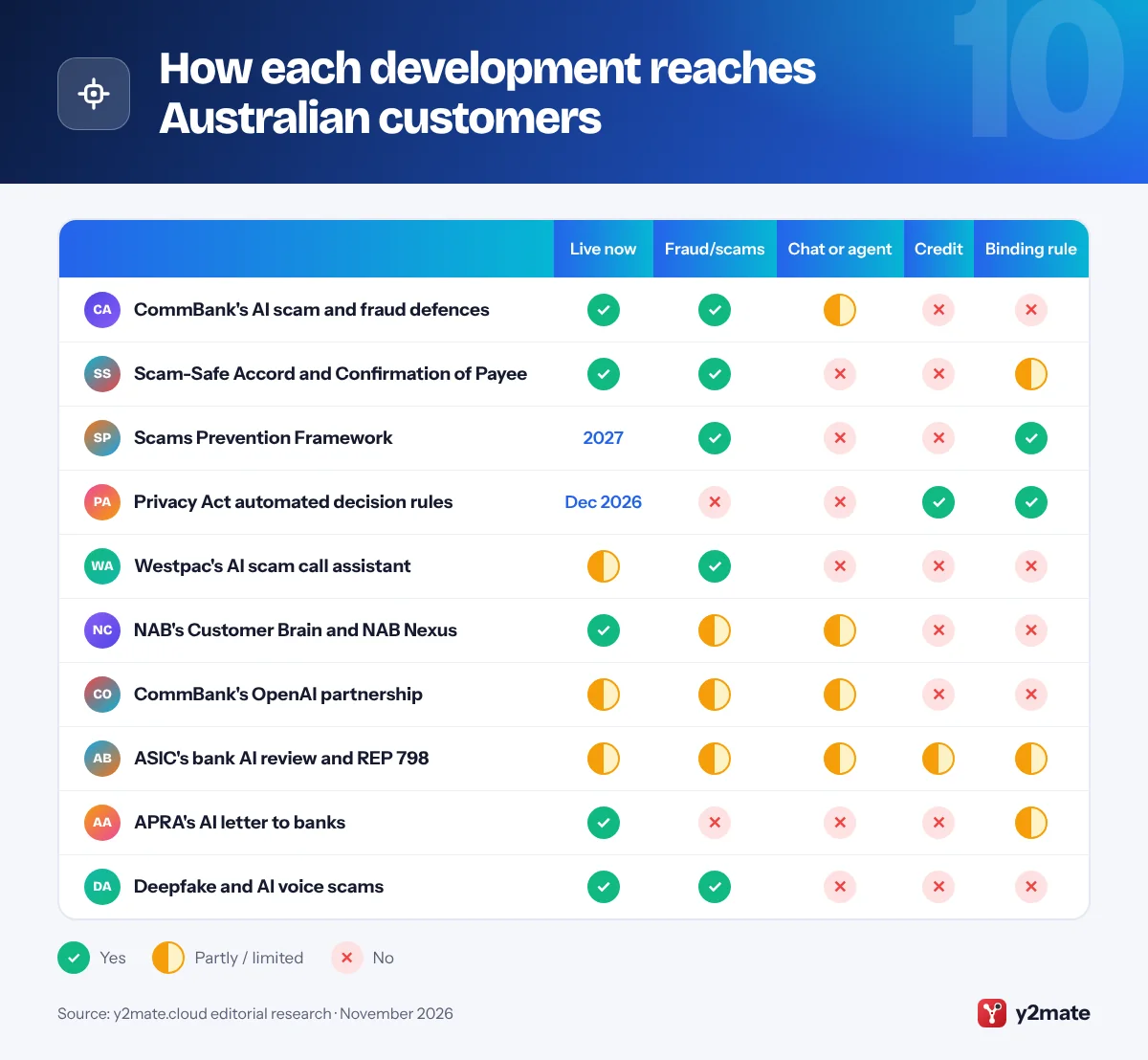
AI in banking Australia: what it means for you as a customer
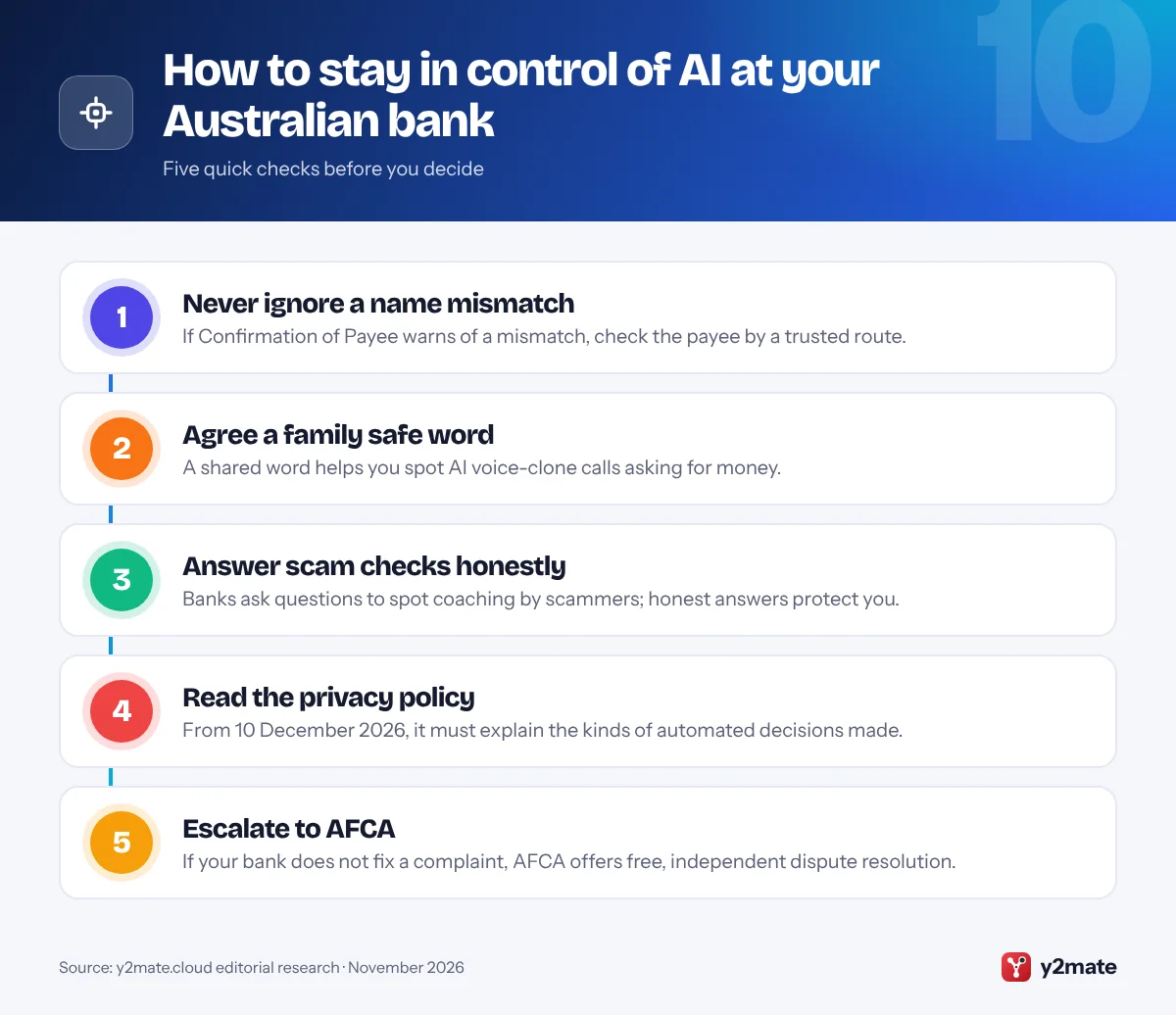
Most AI at Australian banks works in the background, checking payments and shaping offers. These habits help you benefit while staying protected.
How is AI used in banking?
Mainly for scam and fraud detection, personalised prompts and offers, lending decisions and tools that help staff. The benefits are earlier scam warnings and faster service; the risks are wrongly blocked payments, pushy nudges and decisions that are hard to explain.
Protecting yourself from AI scams
- Never ignore a Confirmation of Payee mismatch or an in-app scam warning.
- Hang up on unexpected calls about money and call back on a number you trust.
- Report scams to your bank first, then to Scamwatch.
If an automated decision goes against you
- Ask the bank to explain the decision and whether a person reviewed it.
- Get your free credit report and correct any errors.
- From 10 December 2026, check the bank’s privacy policy for the kinds of automated decisions it makes.
Where to complain
- Your bank first: use its internal complaints process.
- AFCA: free, independent dispute resolution for banking complaints, including eligible scam complaints under the new framework from 31 March 2027.
- OAIC: for privacy complaints you cannot resolve with the bank.
Frequently asked questions
What is AI in banking?
It means software that learns from data or generates language doing work people once did by hand. Australian banks use it to score payments for scams and fraud, run scam-baiting bots, personalise prompts and offers, support lending decisions and help staff. There is no AI-specific banking law, so existing consumer, credit and privacy laws apply to how banks use it.
How do Australian banks use AI to stop scams?
Banks run machine-learning models that compare each payment with your normal behaviour and known scam patterns, then warn you, ask questions or pause the transfer. CommBank uses an agentic AI system to propose new fraud rules, and Westpac has piloted AI that listens for scam signs on calls. Confirmation of Payee adds a name check before you pay.
What is generative AI in banking?
Generative AI creates new text, images or audio. In Australian banking much of it works behind the scenes for now, for example CommBank giving staff ChatGPT Enterprise through its OpenAI partnership, and conversational bots run by Apate.ai that keep scammers busy. ASIC says AI and chatbots do not change a bank's legal obligations to customers.
What is agentic AI in banking?
Agentic AI can plan and carry out tasks rather than only answer questions. CommBank's fraud agent, announced in April 2026, finds emerging scam patterns and proposes detection rules, which people approve before use. Banks are exploring agents for other tasks too, and existing consumer, credit and privacy laws apply to them.
Can a bank use AI to decide my loan?
Yes, but responsible lending obligations under the National Consumer Credit Protection Act still apply, so the lender must make reasonable inquiries and verify your situation, whatever tools it uses. From 10 December 2026, privacy policies must describe automated decisions. If you are refused after a credit check, the lender must give written notice and you can get a free credit report.
Is it safe to use a bank's AI chatbot?
Generally yes inside your bank's official app or website. Treat answers as general information, not personal advice, and ask for a person for complaints, scams or hardship; ASIC says human review is especially important in those situations. Never share passwords or one-time codes with anyone who contacts you, and call your bank on a number you trust.
Will my bank refund me if I lose money to an AI scam?
Not automatically. Australia has no blanket reimbursement rule like the UK's, so banks assess claims case by case. From 31 March 2027, the Scams Prevention Framework lets AFCA handle eligible scam complaints where a bank, telco or platform may not have met its obligations. Report the scam to your bank immediately, as quick action improves the chance of recovering money.
Final verdict
Most of the AI at Australian banks works out of sight, from CommBank’s fraud agent and Westpac’s call assistant to NAB’s Customer Brain, deciding which payments to question and which prompts you see. The big shift in AI in banking Australia will see next is legal rather than technical: automated decision transparency from 10 December 2026, then enforceable scam obligations and AFCA scam complaints from 31 March 2027. Until then, Confirmation of Payee, in-app warnings and quick reporting are your best defences.
This article is general information, not financial or legal advice.
Sources and further reading
- ASIC REP 798 Beware the gap: ASIC's October 2024 review of how financial services and credit licensees use AI and govern the risks to consumers.
- OAIC automated decisions fact sheet: The OAIC's fact sheet on the automated decision-making transparency obligation that starts on 10 December 2026.
- Scam-Safe Accord launch: The Australian Banking Association's announcement of the Scam-Safe Accord and the commitments banks made to fight scams.
- Report a scam to Scamwatch: The National Anti-Scam Centre's site for reporting scams and reading current scam alerts in Australia.
- Australian Financial Complaints Authority: AFCA's free, independent service for resolving complaints with banks and other financial firms.

Leave a Reply