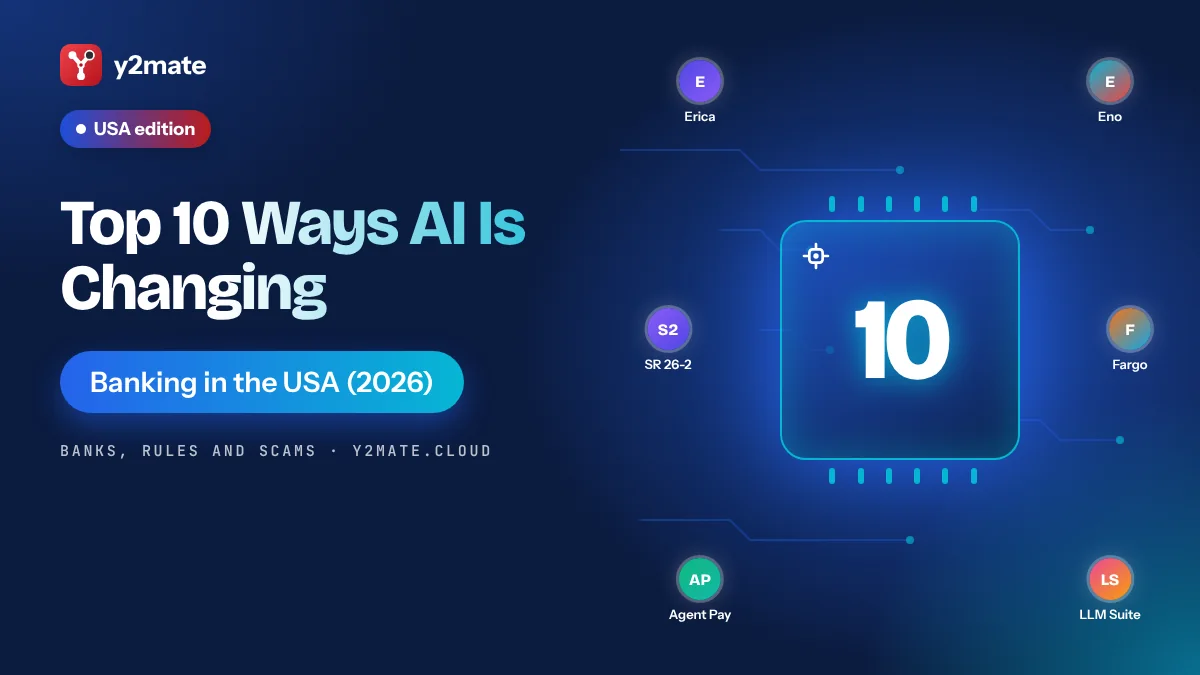
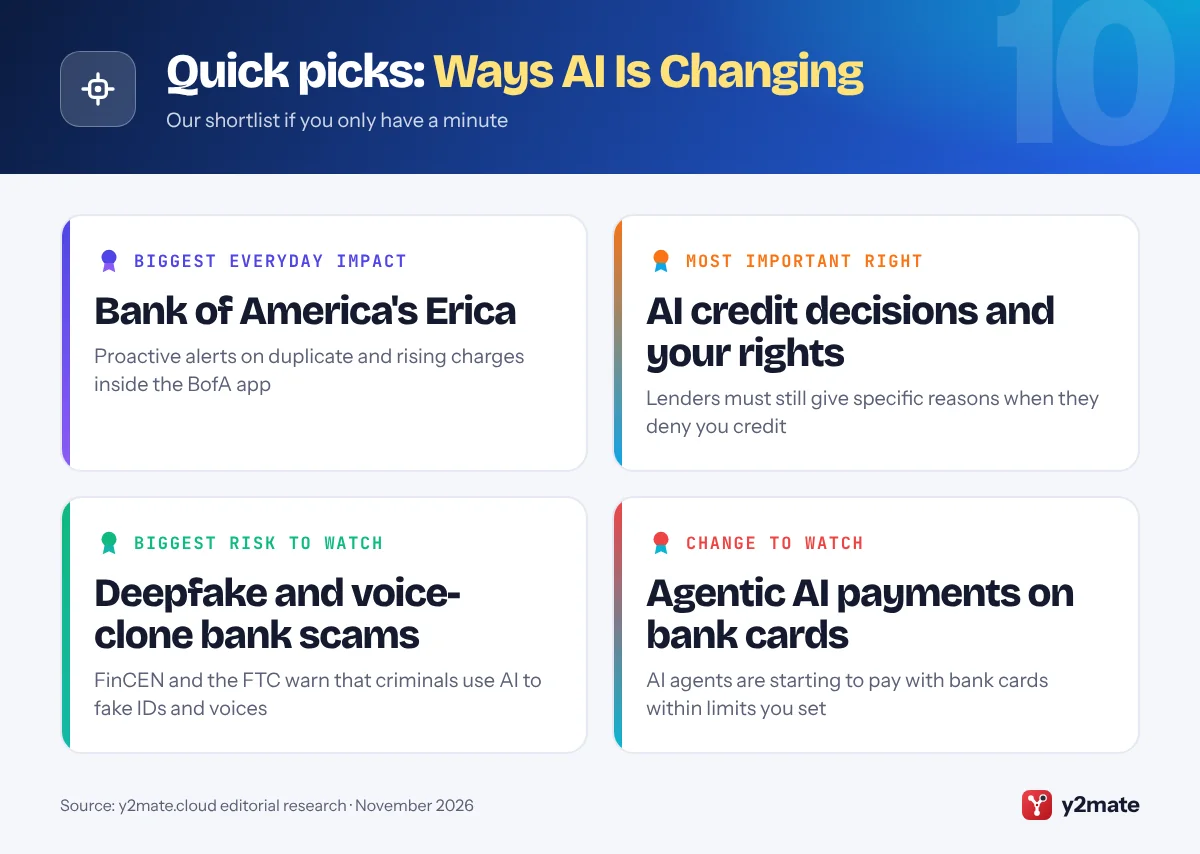
- Bank of America's Erica, Capital One's Eno, Wells Fargo's Fargo and the Chase Digital Assistant are the main AI assistants US bank customers use in their apps today.
- Lenders that deny credit must still give specific reasons under the Equal Credit Opportunity Act and Regulation B, even though the CFPB withdrew its AI-specific circulars in May 2025.
- Revised federal model risk guidance issued in April 2026 says generative AI and agentic AI models are outside its scope.
- FinCEN has warned banks about fraud schemes that use deepfake media, and the FTC warns that scammers clone voices for fake family emergencies.
- Colorado's rewritten automated decision-making law takes effect on January 1, 2027, adding rights to correct data and to request human review of adverse decisions.
AI in banking is no longer a back-office experiment in the USA. It answers questions inside your banking app, scores card payments and logins for fraud, helps decide who gets credit and is starting to take actions on your behalf. Below are the ten developments that matter most for US bank customers in November 2026, from assistants such as Bank of America’s Erica to AI-powered scams and the rules on what banks owe you.
Two quick definitions. Generative AI creates new text, images or audio; it is the technology behind chatbots that write their own answers. Agentic AI goes further: it plans and carries out tasks, such as making a purchase within limits you set.
For each item we cover what it does, who it affects, a practical tip and the main risk. This is a news explainer, not financial advice.
How we ranked this list
We chose and ranked these items by how many US bank customers they affect, how far along they are (live, pilot or early rollout, or a rule in force), and how well banks and regulators such as the CFPB, the Federal Reserve and FinCEN document them.
We did not test any bank’s AI tools and make no claims about their accuracy beyond what official sources state.
The Top 10 Ways AI Is Changing
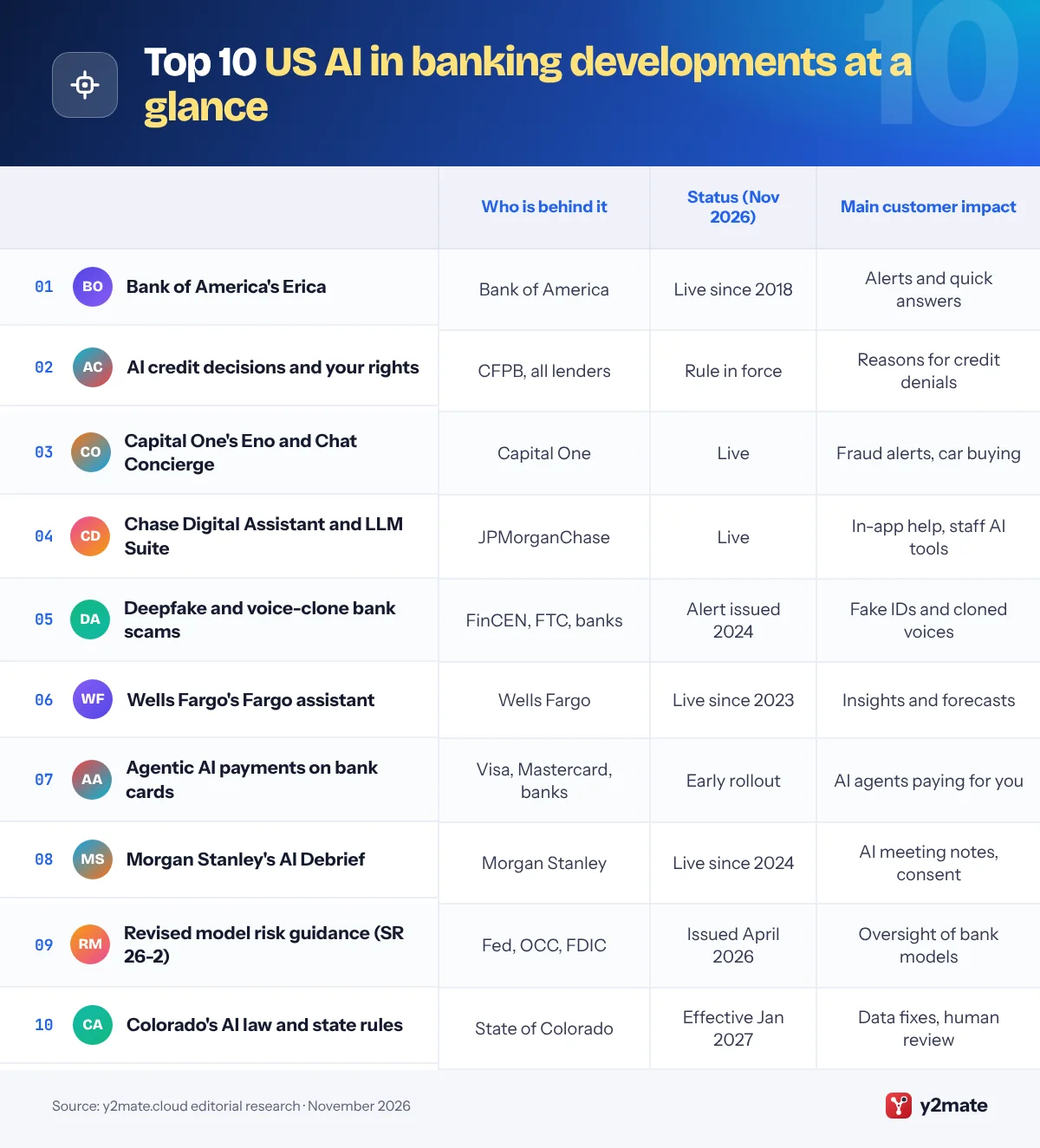
1. Bank of America's Erica
Best for: Bank of America customers using the app
Erica is Bank of America’s AI-driven virtual financial assistant, built into the Mobile Banking app since 2018. Erica answers account questions, helps with everyday tasks and connects you to a specialist when it cannot help. Its best-known feature is proactive insights: alerts about possible duplicate charges, recurring charges or membership fees that go up, and merchant refunds posting to your account.
The bank also uses AI behind the scenes. In July 2026 it said it had added generative AI to EricaAssist, an internal tool that gives employees guidance while they help clients, with the employee still handling the conversation. So even a human answer may be AI-assisted.
Customer tip: Erica’s alerts are a useful early warning for subscription creep and double charges, but they do not replace checking your statements. Only use Erica inside the official app, and be wary of texts or calls using the bank’s name that ask for one-time passcodes, a common scam.
Official site: Bank of America's Erica
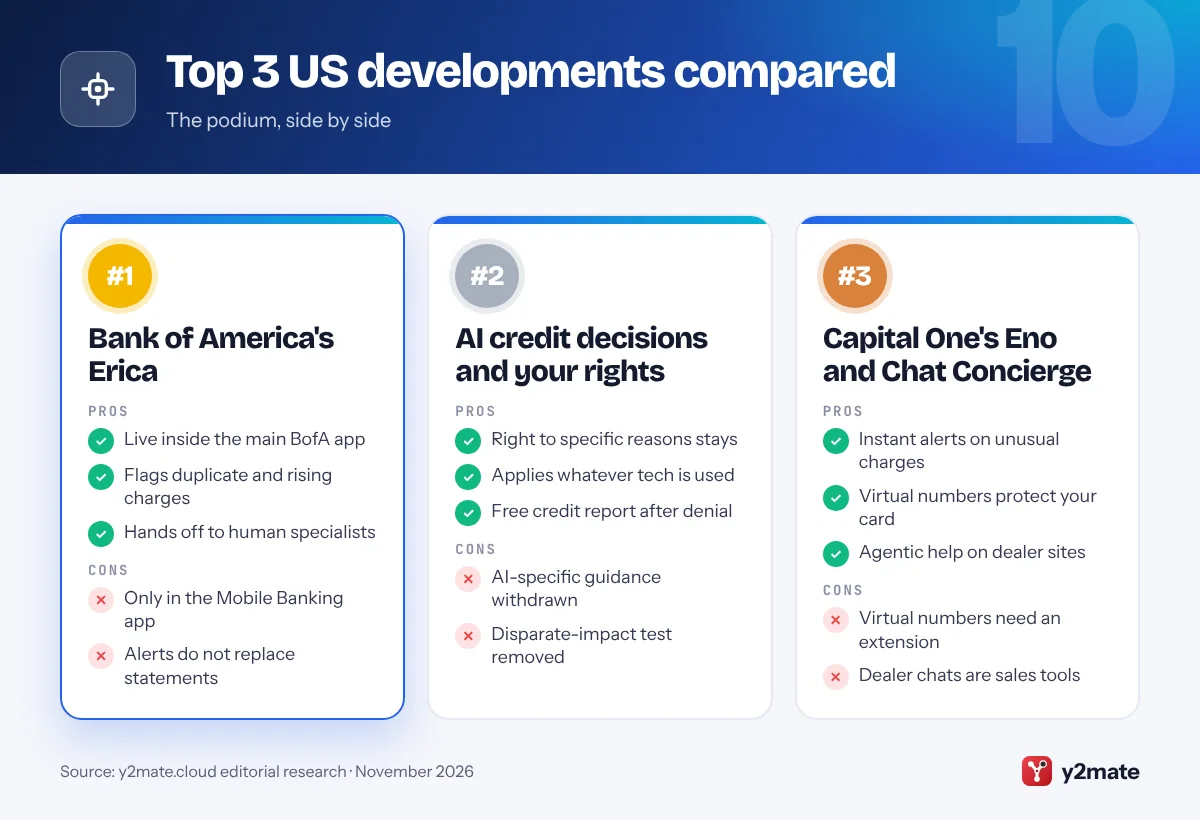
- Live inside the main BofA app
- Flags duplicate and rising charges
- Hands off to human specialists
- Only in the Mobile Banking app
- Alerts do not replace statements
2. AI credit decisions and your rights
Best for: anyone applying for a card, loan or car finance
Lenders increasingly use machine-learning models to decide credit. Whatever the technology, the Equal Credit Opportunity Act (ECOA) and its Regulation B require a lender that turns you down, or does not grant credit on the terms you asked for, to give you a statement of the specific principal reasons or tell you how to get them. If a credit report was used, the Fair Credit Reporting Act gives you a free copy and the right to dispute errors.
The rules around them have shifted. In May 2025 the Consumer Financial Protection Bureau (CFPB) withdrew two circulars, from 2022 and 2023, which said black-box models were no excuse for vague denial reasons. In April 2026 it amended Regulation B to remove the effects test, stating that ECOA does not recognize disparate-impact liability, a key way to challenge models that disadvantage protected groups without intent. The duty to explain a denial remains.
Customer tip: if a denial letter is vague, ask the lender in writing for the specific reasons and check your credit reports.
Official site: AI credit decisions and your rights
- Right to specific reasons stays
- Applies whatever tech is used
- Free credit report after denial
- AI-specific CFPB guidance withdrawn
- Disparate-impact test removed
3. Capital One's Eno and Chat Concierge
Best for: Capital One card holders and car buyers
Eno is Capital One’s virtual assistant, available in the app, online and by text for credit card and bank customers. It alerts you when it spots a charge that looks unusual, flags possible mistakes such as a duplicate purchase or a sudden increase in a recurring bill, and answers questions about balances. With a free browser extension, Eno can also create merchant-specific virtual card numbers, so your real card number is not shared when you shop online.
Chat Concierge is newer. Capital One describes it as its first proprietary multi-agent conversational AI assistant, built for car buying. On participating dealers’ websites and platforms it helps shoppers find the right car, request a test drive and move the purchase forward. It is a working example of agentic AI, where several AI agents plan and complete steps rather than simply answering a question.
Customer tip: treat a dealer’s AI chat as a sales channel and confirm prices and financing terms in writing.
Official site: Capital One's Eno and Chat Concierge
- Instant alerts on unusual charges
- Virtual numbers protect real card
- Agentic help on dealer sites
- Virtual numbers need an extension
- Dealer chats are sales tools
4. Chase Digital Assistant and LLM Suite
Best for: Chase Mobile users with personal accounts
JPMorganChase uses AI in two ways. Customers see the Chase Digital Assistant in the Chase Mobile app, which answers questions, provides information and completes simple tasks such as locking a card or checking a balance. Chase says the assistant does not currently serve Private Bank or Business Banking customers, or customers who have both personal and business accounts.
Behind the scenes, the bank rolled out LLM Suite, its in-house generative AI platform, to employees from 2024. Staff use it to draft text, summarize documents and analyze data. Customers never use it directly, but it shapes the service they receive.
This split is common at large US banks: generative AI is spreading fastest among employees, while customer-facing assistants handle a narrower set of tasks, partly because a wrong answer about money is costly.
Customer tip: use the in-app assistant for quick jobs such as card locks, and ask for a person when an issue involves a dispute, fraud or financial hardship.
Official site: Chase Digital Assistant and LLM Suite
- Quick help inside Chase Mobile
- Handles card locks and balances
- Staff get AI drafting tools
- Not for business or Private Bank
- LLM Suite is staff-only
5. Deepfake and voice-clone bank scams
Best for: anyone who could get an urgent call about money
AI is not only a tool for banks; criminals use it too. In November 2024 the Treasury’s Financial Crimes Enforcement Network (FinCEN) issued an alert warning banks about fraud schemes using deepfake media made with generative AI, including fake identity documents and impersonation scams aimed at customers. The FTC has warned that scammers use AI voice cloning in fake family emergency calls, copying a relative’s voice from a short clip posted online.
Banks respond with their own AI: models that score payments, logins and new accounts for signs of fraud and trigger alerts, holds or extra checks. FinCEN’s alert lists red flags, such as altered-looking identity photos and odd behavior during live video checks.
Customer tip: agree a family code word, hang up and call back on a number you already know. Report fraud to your bank at once and to the FTC at ReportFraud.ftc.gov. Federal rules on unauthorized transfers may not cover a payment you were tricked into making yourself.
Official site: Deepfake and voice-clone bank scams
- FinCEN alert spells out red flags
- Banks score payments for fraud
- Simple code-word defense works
- Deepfakes are hard to spot
- Tricked payments may not be refunded
6. Wells Fargo's Fargo assistant
Best for: Wells Fargo app users who want spending insights
Fargo is the virtual assistant in the Wells Fargo mobile app. Announced in 2022 as an assistant powered by Google Cloud AI, it went live in 2023 and added Spanish later that year. Wells Fargo describes it as a way to handle banking tasks, find answers and get account insights, including spending summaries and short-term forecasts of your balance and account activity. Requests it cannot answer are routed to the bank’s support teams.
In August 2025 Wells Fargo and Google Cloud expanded their relationship to give employees across the bank Google’s generative and agentic AI tools, such as agents that help staff search internal documents and research questions. That rollout targets staff productivity rather than customers directly.
Customer tip: balance forecasts are estimates based on your past activity, not guarantees. Keep a buffer when bills are due, and use account alerts rather than relying on a forecast alone.
Official site: Wells Fargo's Fargo assistant
- Built into the Wells Fargo app
- Spending and balance insights
- Available in Spanish
- Forecasts are only estimates
- Staff AI is not customer-facing
7. Agentic AI payments on bank cards
Best for: early adopters who let AI agents shop for them
Agentic AI can act for you, such as buying a product within limits you set. The card networks are building the plumbing so these agents can pay with your bank-issued card. Visa launched Visa Intelligent Commerce in April 2025, letting AI agents make purchases using tokenized card credentials and controls the cardholder sets, such as spending limits. In September 2025 Mastercard said Citi and U.S. Bank cardholders would be among the first able to use Mastercard Agent Pay, with plans to enable all US Mastercard cardholders.
Your bank, as card issuer, still approves each transaction and handles disputes. But what happens if an agent buys the wrong item or is fooled by a fake merchant? Visa says cardholders keep their usual protections, and Mastercard is testing a US tool to help issuers tell whether an AI agent started a transaction.
Customer tip: only connect a card to an AI agent from a provider you trust, set tight limits and check your statement for agent purchases.
Official site: Agentic AI payments on bank cards
- Spending limits set by you
- Bank still approves each payment
- Built on secure card tokens
- Dispute handling still untested
- Early and limited availability
8. Morgan Stanley's AI Debrief
Best for: wealth clients who meet a financial advisor
Morgan Stanley Wealth Management has worked with OpenAI since 2023. In June 2024 it launched AI @ Morgan Stanley Debrief, an OpenAI-powered tool that, with the client’s consent, generates notes during meetings with a financial advisor and surfaces action items. After the meeting it summarizes key points, drafts an email for the advisor to edit and send at their discretion, and saves a note to the firm’s client records.
For clients, this is one of the clearest examples of generative AI in US finance: software is listening to a conversation about your money. Consent is the standard to look for at any firm using AI note-takers.
Customer tip: if a bank or advisor wants to record or transcribe a meeting with AI, ask how the recording and notes are stored, who can see them, whether they are used to train AI models and whether you can say no. Ask for the summary and correct any errors.
Official site: Morgan Stanley's AI Debrief
- Runs only with client consent
- Advisor reviews every draft
- Clear record of action items
- AI may mishear or miss nuance
- Limited to wealth clients
9. Revised model risk guidance (SR 26-2)
Best for: readers who want to know how bank AI is supervised
Banks must test and monitor the models behind credit, fraud and capital decisions. On April 17, 2026 the Federal Reserve, the Office of the Comptroller of the Currency (OCC) and the FDIC replaced the 2011 model risk guidance, known as SR 11-7, with revised guidance issued by the Fed as SR 26-2. It scales oversight to how material and risky a model is, and the Fed says it is most relevant to larger banks.
The surprise for many readers: the guidance says generative AI and agentic AI models are novel and rapidly evolving, so they are not within its scope. It still applies to traditional statistical models and to non-generative AI, such as many fraud and credit models, and says banks’ wider risk management should guide controls for tools it does not cover.
Customer tip: this is how supervisors check the models behind a fraud block or credit limit. Consumer laws still apply, so ask for a human review if a decision looks wrong.
Official site: Revised model risk guidance (SR 26-2)
- Covers fraud and credit models
- Scales oversight to risk
- Joint Fed, OCC and FDIC approach
- Generative AI is out of scope
- Guidance, not binding law
10. Colorado's AI law and state rules
Best for: Colorado residents tracking state AI laws
States are writing their own rules for AI in important decisions such as lending. Colorado passed the first broad law in 2024, aimed at algorithmic discrimination by high-risk AI systems, delayed it, then in May 2026 repealed and replaced it with Senate Bill 26-189. The new law covers automated decision-making technology used in consequential decisions. Colorado’s official summaries say consumers must get clear notice, can ask for more information after an adverse outcome, and can request correction of inaccurate data and meaningful human review. It takes effect on January 1, 2027.
Federal policy is pulling the other way. A December 2025 executive order called for a national AI policy framework, set up a Justice Department task force to challenge conflicting state AI laws and named Colorado’s original law. The order does not itself cancel any state law.
Customer tip: if you live in Colorado, from 2027 ask lenders whether automated technology shaped a decision about you and how to correct the data used.
Official site: Colorado's AI law and state rules
- Right to correct data from 2027
- Right to request human review
- Notice when ADMT is used
- Only applies in Colorado
- Federal challenge risk remains
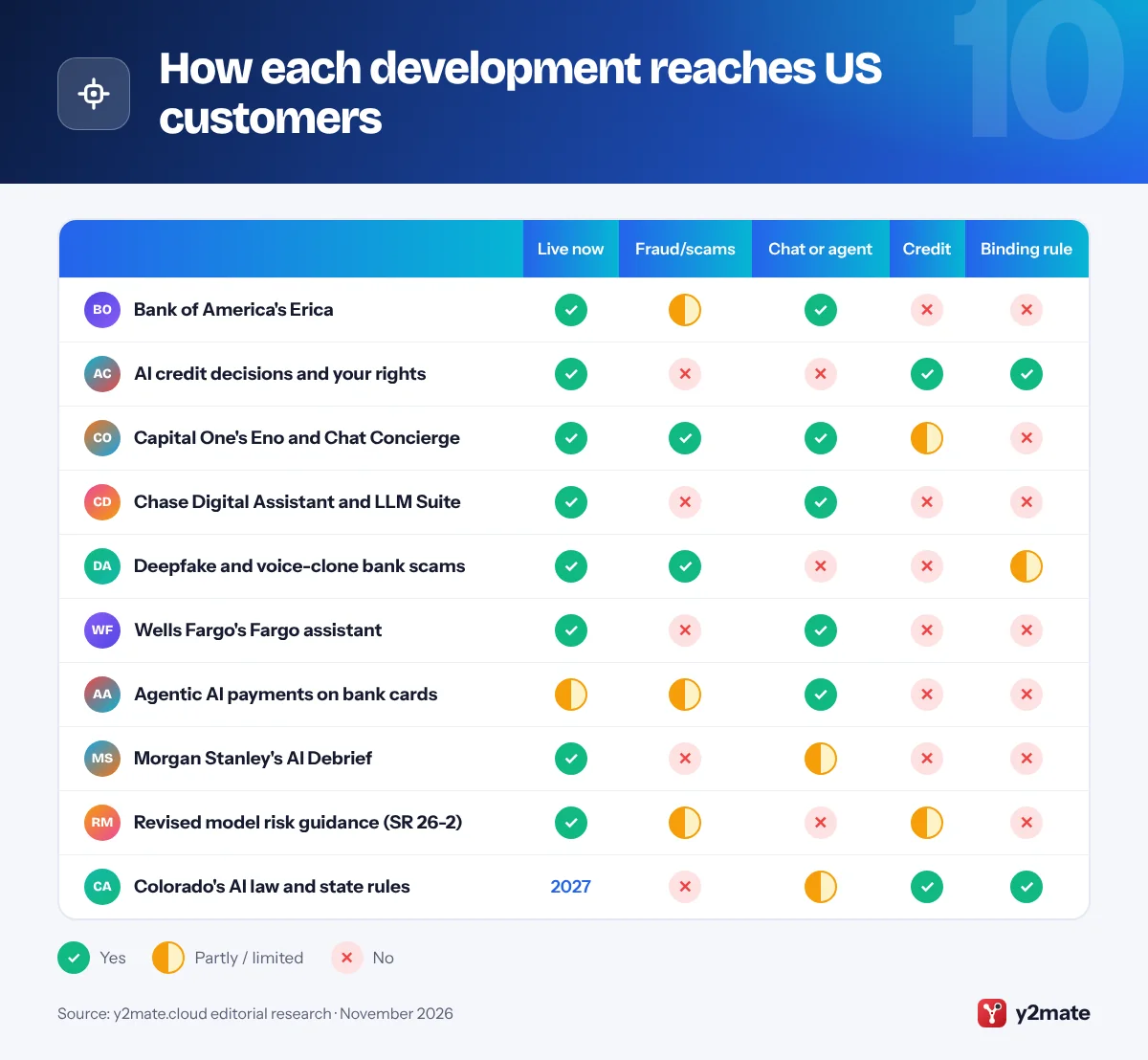
How each development reaches US customers
AI in banking: what it means for you as a customer
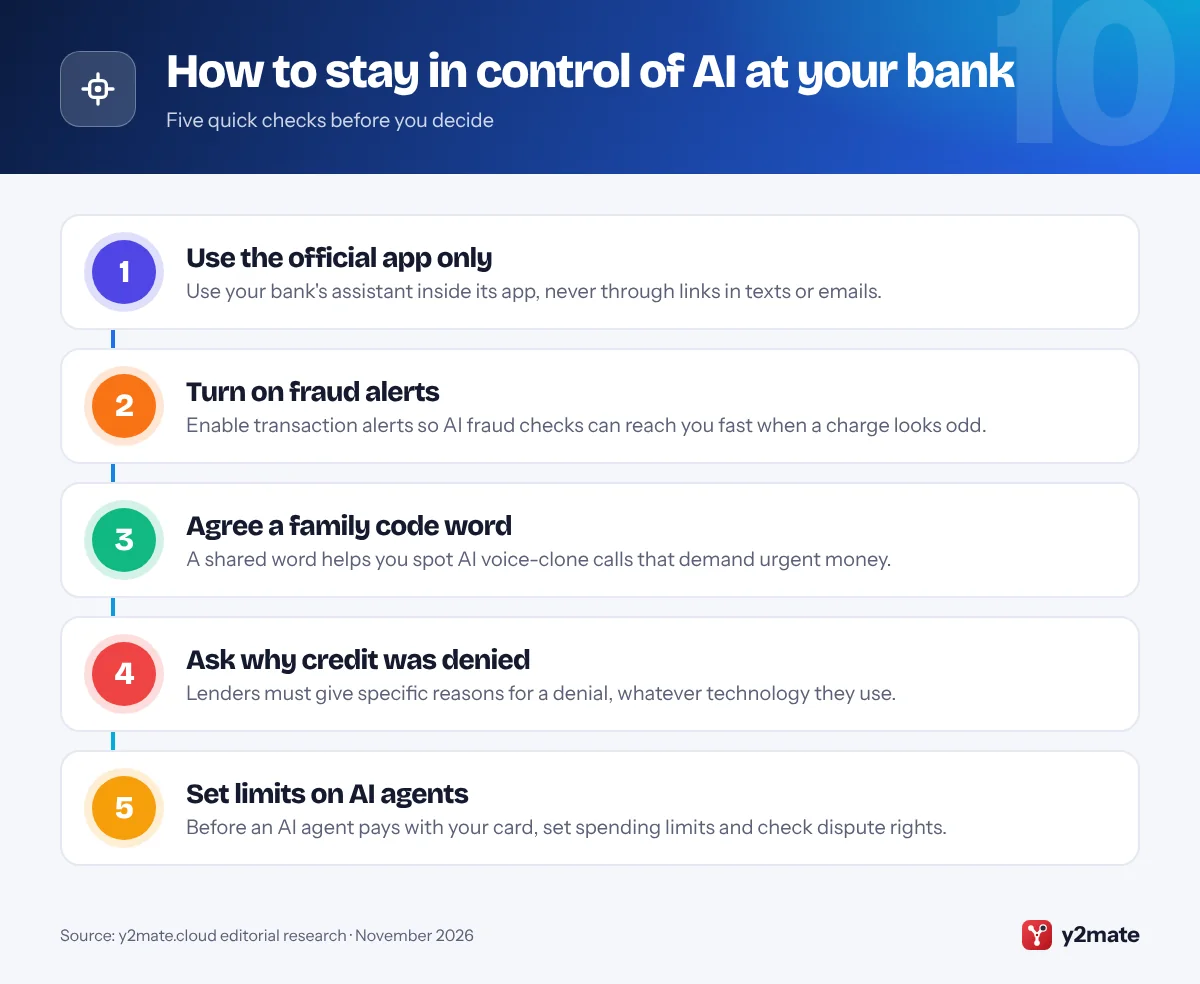
Most of the AI at your bank works quietly in the background. A few habits help you get the benefits while limiting the risks.
What are the benefits for customers?
The biggest gains are faster fraud alerts, round-the-clock answers to simple questions and early warnings about duplicate or rising charges. The trade-offs are errors, wrongly blocked payments and decisions that are harder to explain. Use AI tools for speed, and keep a person involved for anything that really matters.
Which types of AI do banks use?
- Machine-learning models that score payments for fraud and help assess credit applications.
- Virtual assistants such as Erica, Eno, Fargo and the Chase Digital Assistant; Fargo was built with Google Cloud’s AI.
- Generative AI tools for staff, such as LLM Suite at JPMorganChase and OpenAI-powered tools at Morgan Stanley.
How to protect yourself from AI-powered scams
- Agree a family code word, hang up on urgent money requests and call back on a number you already know.
- Turn on transaction alerts and respond quickly to fraud warnings in your bank’s app.
- Report fraud to your bank at once, then to ReportFraud.ftc.gov or the FBI’s Internet Crime Complaint Center (IC3).
If an AI decision goes against you
- Ask the lender in writing for the specific reasons for a denial and for a free copy of any credit report it used.
- Dispute errors with the credit bureau and ask whether a person can review the decision.
- If you get no answer, complain to the CFPB, or to the OCC through HelpWithMyBank.gov if your bank is a national bank.
Frequently asked questions
What is AI in banking?
It means software that learns from data or generates language doing work people once did by hand. US banks use it to answer questions in apps, such as Bank of America's Erica, to score card payments and logins for fraud, to help assess credit applications and to support staff with research and paperwork. Banks remain responsible for the results.
How is AI used in banking?
The main uses are customer service, fraud and credit. Virtual assistants such as Erica, Eno and Fargo answer questions and send alerts. Machine-learning models score payments, logins and new accounts for signs of fraud. Lenders use models to help approve and price credit. Staff also use generative AI tools such as JPMorganChase's LLM Suite.
How can AI help in banking fraud analytics?
AI fraud models compare each transaction with your usual behavior and with known fraud patterns, such as a new device, an unfamiliar merchant or a sudden large transfer, and score the risk in real time. High-risk payments can trigger an alert, a hold or a request to confirm.
What is generative AI in banking?
Generative AI creates new text, images or audio. In banking it powers tools that draft answers, summarize documents and take meeting notes, such as Morgan Stanley's Debrief, which works only with client consent, and Bank of America's EricaAssist for employees. Federal model risk guidance issued in April 2026 leaves it outside its scope.
What is agentic AI in banking?
Agentic AI can plan and carry out steps toward a goal instead of only answering questions. Capital One's Chat Concierge helps car buyers on dealer sites move from questions to a test drive, and Visa and Mastercard are enabling AI agents to pay with bank cards within limits you set. It is early, so check limits and dispute rights first.
Can a bank use AI to decide my loan?
Yes. No federal law bans AI in credit decisions. But the Equal Credit Opportunity Act and Regulation B require a lender that denies you to give the specific principal reasons, or tell you how to get them, whatever technology it used. If a credit report was involved, you can get a free copy. From 2027, Colorado adds rights to correct data and request human review.
Is it safe to use a bank's AI chatbot?
Generally yes, if you use the assistant inside your bank's official app or website, where your login already protects you. Treat answers as general guidance and ask for a person for disputes, fraud or hardship. Never share passwords or one-time codes in a chat, text or call you did not start, even if it uses your bank's name.
Final verdict
AI in banking now touches almost every US customer, from Erica and Eno flagging odd charges to the models that score loan applications. The rules are moving in two directions: federal regulators have stepped back from some AI-specific guidance, while Colorado adds rights from 2027. Your strongest protections remain the basics: specific reasons when credit is denied, fast fraud reporting and healthy suspicion of urgent calls, even in a familiar voice.
This article is general information, not financial or legal advice. Check your own bank’s terms and talk to a qualified adviser about your situation.
Sources and further reading
- Revised model risk guidance: The April 2026 interagency guidance from the Fed, OCC and FDIC, including the note that generative and agentic AI are outside its scope.
- FinCEN deepfake fraud alert: FinCEN's November 2024 alert describing fraud schemes that use deepfake media and the red flags banks should watch for.
- FTC warning on AI voice scams: The FTC's consumer alert on scammers using AI voice cloning in fake family emergency calls, with tips to verify callers.
- Submit a complaint to the CFPB: The CFPB's official complaint portal for problems with banks, credit cards, loans and credit reports.
- OCC HelpWithMyBank site: The OCC's consumer site with answers about national banks and a route to file a complaint.

Leave a Reply