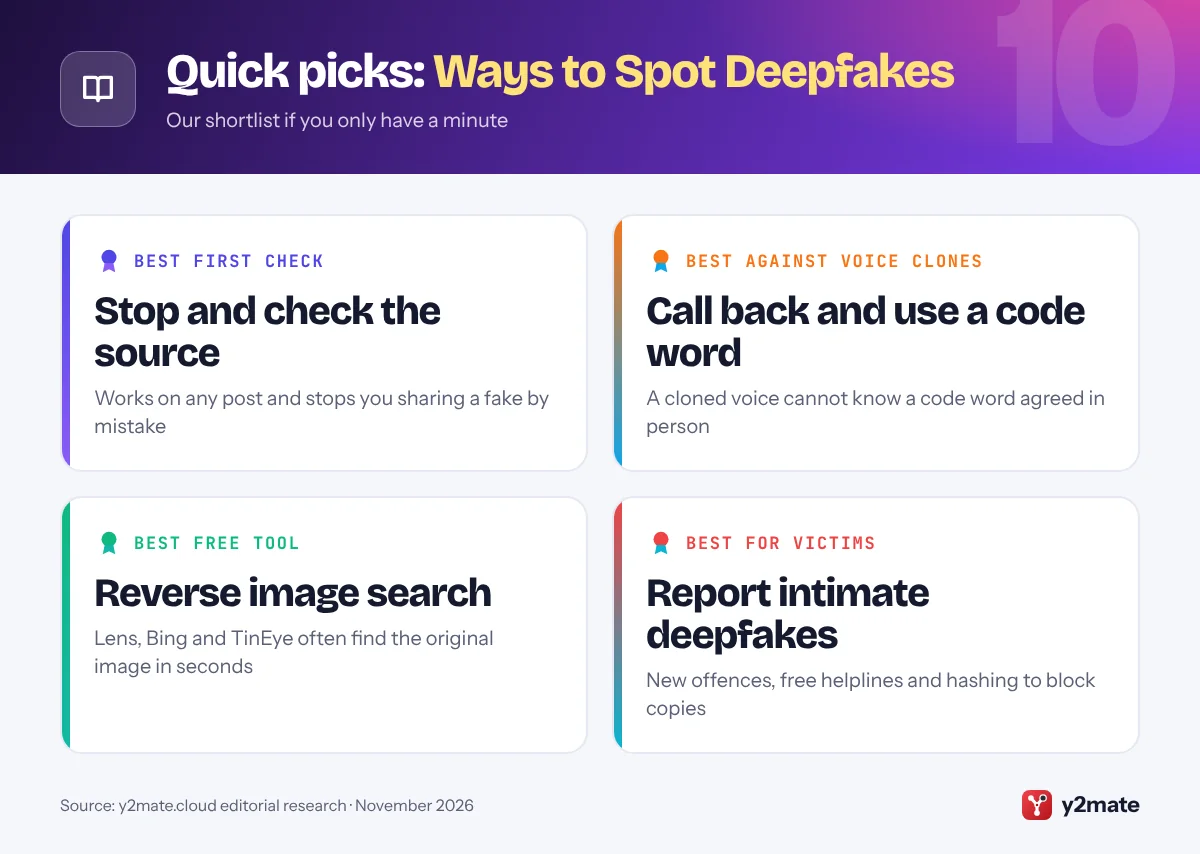
- No single test proves a deepfake; the most reliable checks are the source, a call back on a number you trust, and free tools such as reverse image search and Content Credentials.
- In England and Wales it has been an offence since 31 January 2024 to share, or threaten to share, an intimate image without consent, including a deepfake, and since 6 February 2026 to create or request one of an adult.
- Ofcom's strengthened codes expect higher-risk platforms to use hash matching from 30 September 2026 to stop known intimate images, including AI deepfakes, being shared again.
- Report Fraud has replaced Action Fraud as the place to report fraud and cyber crime in England, Wales and Northern Ireland; in Scotland, contact Police Scotland on 101.
- Adults can get help from the Revenge Porn Helpline and StopNCII.org, and under-18s can use Report Remove from Childline and the IWF, which accepts AI fakes.
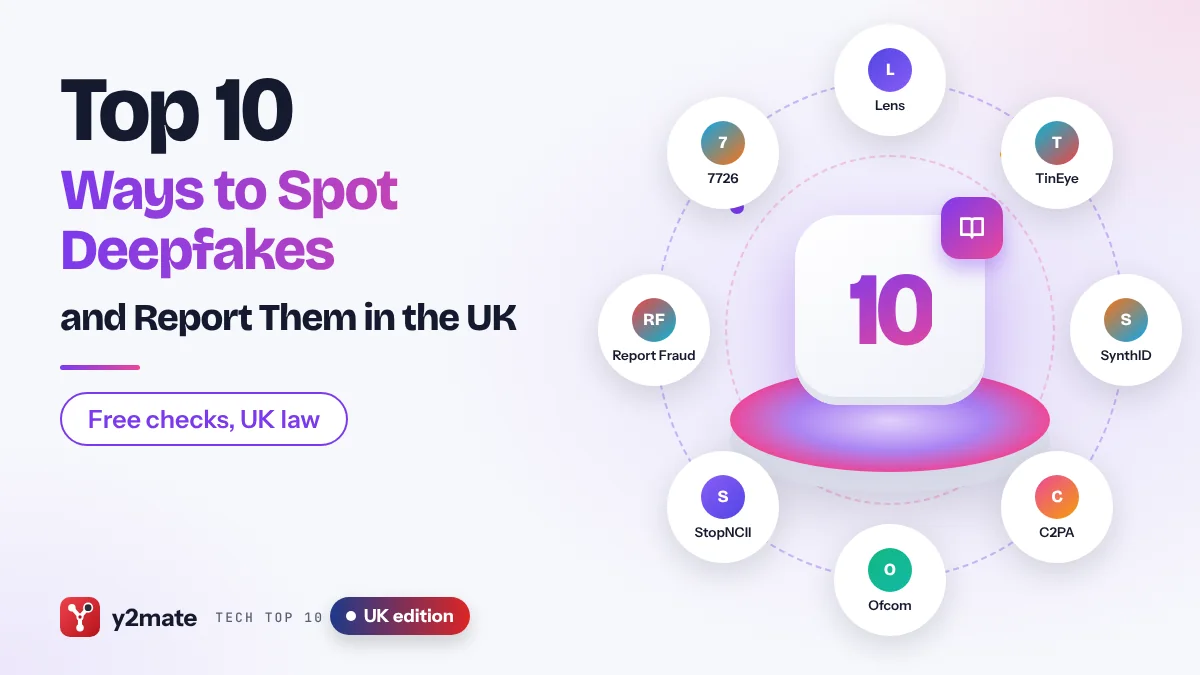
The best ways to spot deepfakes UK residents can rely on are simple checks: find where a photo, video or voice message really came from, ring the person back on a number you already trust, and use free tools such as reverse image search, Content Credentials and Google’s SynthID Detector. Glitches like warped hands or out-of-sync lips are clues, not proof, and detection apps can be wrong. If a deepfake targets you, UK law now gives you clear routes to report it and get it removed.
A deepfake is an image, video or audio clip made or changed with artificial intelligence so that a real person appears to do or say something they did not. In the UK they turn up in fake celebrity investment adverts, cloned-voice calls from “relatives” or “bosses”, sexually explicit images made without consent, and misleading political posts.
This list covers the ten most useful checks and routes for people in the UK as of November 2026. It is general information, not legal advice.
How we ranked this list
We ranked these ways by how reliable, free and easy they are for ordinary people, and by how closely they follow official guidance from UK bodies such as the National Cyber Security Centre (NCSC), Ofcom, the police and the Electoral Commission, and from standards bodies such as the Coalition for Content Provenance and Authenticity (C2PA).
We did not run hands-on tests of detection tools and quote no accuracy figures, because results depend heavily on the content and change as AI improves.
The Top 10 Ways to Spot Deepfakes
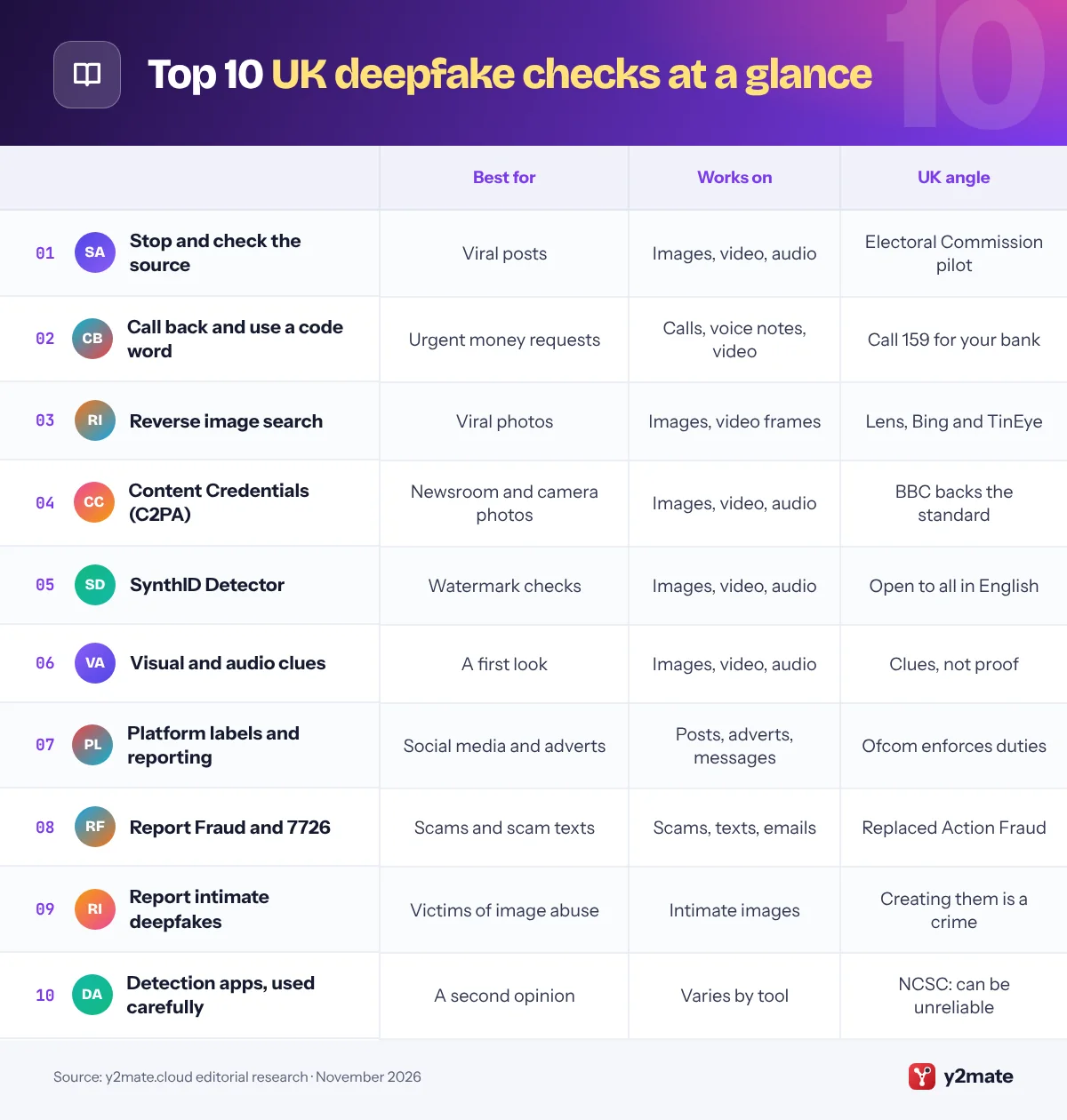
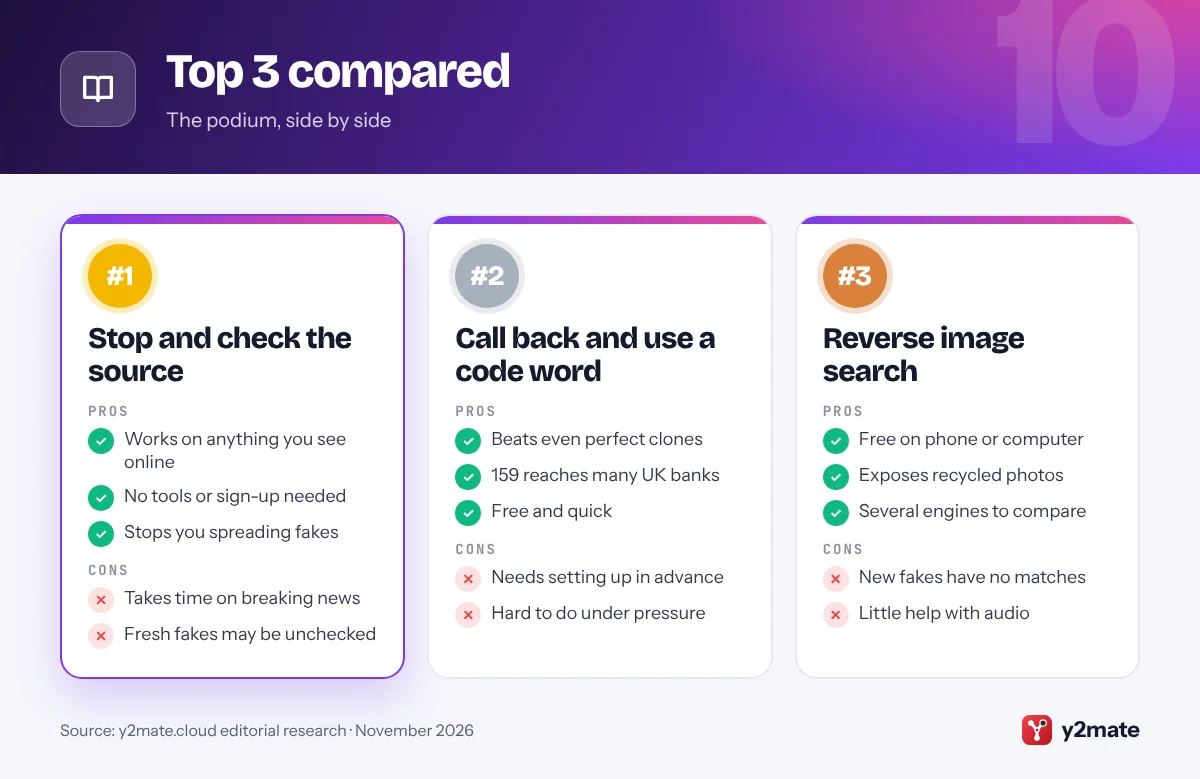
1. Stop and check the source
Best for: shocking clips and posts about public figures
The quickest way to catch most deepfakes is to stop and ask where the content came from before you study the pixels. Find the original upload, check that the account really belongs to the person or organisation shown, and see whether reputable UK news outlets or the official source report the same thing. Content designed to make you angry, frightened or excited is exactly the kind to check before you share it.
This matters at election time. The Electoral Commission ran a deepfake detection pilot during the May 2026 elections in England and said it found no evidence of highly convincing political deepfakes being used deliberately to interfere, although AI-generated content was common online. It has still called for electoral law and platform duties to be updated to deal with manipulated media.
For claims about voting, check the Electoral Commission or your local council. For celebrity endorsements of investments, assume they are fake until the person’s verified channels confirm them.
Official site: Stop and check the source
- Works on anything you see online
- No tools or sign-up needed
- Stops you spreading fakes
- Takes time on breaking news
- Fresh fakes may be unchecked
2. Call back and use a code word
Best for: urgent calls or voice notes asking for money
Cloned voices and live video deepfakes are designed to rush you. The NCSC’s advice for any suspicious call or message is to stop, break contact and get in touch with the person or organisation directly, using details you find yourself, such as the official website. Its guidance also points out that phone and text systems cannot reliably show who really started a call, so a familiar name on screen proves nothing.
For banks, hang up and call 159, which connects you to many major UK banks. For family, agree a code word in person that anyone asking for money or urgent help must give, and keep it off social media. If you are unsure, ask something only the real person would know.
These checks work however good the fake is. A perfect clone of your daughter’s voice still cannot give a code word it never heard, and a fake finance director cannot answer when you ring the real one’s known number.
Official site: Call back and use a code word
- Beats even perfect clones
- 159 reaches many UK banks
- Free and quick
- Needs setting up in advance
- Hard to do under pressure
3. Reverse image search
Best for: checking a viral photo in seconds
Reverse image search shows where a picture has appeared before, which often exposes an old photo passed off as new, or the original image that a fake was built from. Google Lens, Bing Visual Search and TinEye are all free, and each covers different parts of the web, so try more than one. For a video, search a screenshot of a clear frame showing faces or landmarks.
Look at the dates and context of the earliest matches. If a “breaking” image of flooding in a UK town first appeared years ago in another country, you have your answer without needing any AI expertise.
Since May 2026, Google Lens, AI Mode and Circle to Search can also check for Google’s SynthID watermark if you ask whether an image is AI-generated. A lack of matches is not proof of anything, though: brand-new genuine photos and brand-new fakes both start with no history online.
Official site: Reverse image search
- Free on phone or computer
- Exposes recycled photos
- Several engines to compare
- New fakes have no matches
- Little help with audio
4. Content Credentials (C2PA)
Best for: photos from newsrooms, brands and new phones
Content Credentials are tamper-evident records attached to a file that show who made it, which tools edited it and whether AI was involved. They follow an open standard from the Coalition for Content Provenance and Authenticity (C2PA), whose backers include the BBC, Adobe, Google, Microsoft and Meta. Look for a small “Cr” symbol on images, or upload a file to the free Verify tool at contentcredentials.org.
Support is growing. Google’s Pixel 10 adds credentials to photos from its camera app, the Gemini app can read them on the web and Android, and Adobe offers a free Chrome extension that reveals them on websites. The NCSC has endorsed international guidance on Content Credentials, while calling the topic important but embryonic.
Mind the limits. Most images online carry no credentials, many sites strip them on upload, and Google notes they record history rather than telling you definitively whether something is AI-generated. A valid credential is helpful evidence; a missing one tells you nothing.
Official site: Content Credentials (C2PA)
- Shows edits and AI use
- Free Verify tool online
- Backed by the BBC and others
- Rare on everyday images
- Often stripped on upload
5. SynthID Detector
Best for: checking a file for an invisible AI watermark
SynthID is Google DeepMind’s invisible watermark, added to images, video and audio made with Google’s AI tools and designed to survive cropping, filters and compression. Google opened its SynthID Detector to everyone in October 2026, available globally in English, so people in the UK can upload a file and check whether it carries a watermark from Google or from partners such as OpenAI and NVIDIA.
The Gemini app offers a similar check: upload a file and ask whether it was made or edited with Google AI. Google has also built SynthID checks into Search and Chrome.
Read the results precisely. The detector’s own page says it is not a general AI detector and can only find media from companies that use SynthID. A detected watermark is strong evidence of AI involvement, but no watermark only means none was found. Ofcom’s research on deepfake defences has also warned that watermarks can often be stripped with basic edits, so a clean result never proves content is genuine.
Official site: SynthID Detector
- Free and open to everyone
- Image, video and audio
- Strong evidence when positive
- Only finds partner watermarks
- Clean result proves nothing
6. Visual and audio clues
Best for: a quick first look before you dig deeper
Lower-quality deepfakes still give themselves away. In images, check hands and fingers, teeth, ears, jewellery and glasses, and any writing, which AI often renders as gibberish. Look at lighting and shadows: do they fall the same way across faces and background? In video, watch for lips out of sync with speech, unnatural blinking, and blurring or flickering where a face meets hair or a collar.
With voice notes and calls, listen for flat or oddly even emotion, strange pauses, missing breaths, or phrasing the person would never use. Background noise that cuts in and out can also point to editing.
Keep these in proportion: they are clues, not proof. The best current tools produce clean images and convincing voices, and genuine footage that has been compressed by messaging apps can look glitchy. That is why checking the source and calling back rank higher on this list than any visual inspection.
- Instant and free
- Catches cheap fakes
- Works on images and voice
- Best fakes show no clues
- Real footage can look odd
7. Platform labels and reporting
Best for: fakes you find on social media or in adverts
Meta, YouTube and TikTok all label some AI-generated content, using signals such as Content Credentials and creators’ own disclosures. Meta shows an “AI info” label, YouTube requires creators to disclose realistic altered or synthetic content, and TikTok reads Content Credentials to label uploads from other apps. Many AI posts still carry no label, so treat a label as a bonus, not a test.
Reporting is where UK law helps. Under the Online Safety Act, platforms must tackle illegal content, including intimate image abuse and fraud, and Ofcom enforces those duties. Ofcom’s strengthened codes expect higher-risk services to use hash matching from 30 September 2026 to stop known intimate images, including AI deepfakes, being shared again. Ofcom has also been investigating X since January 2026 over sexualised images made with its Grok chatbot.
Use the platform’s own report tools first, choosing impersonation, scam or intimate image abuse as appropriate, and keep a note of what you reported and when.
Official site: Platform labels and reporting
- Reporting built into apps
- Ofcom enforces platform duties
- Hash matching blocks re-uploads
- Labels miss much AI content
- Platform responses vary
8. Report Fraud and 7726
Best for: deepfake scams, scam adverts and texts
If a deepfake was used to try to scam you, report it. Report Fraud, run by the City of London Police, replaced Action Fraud as the national service for reporting fraud and cyber crime in England, Wales and Northern Ireland, going live in December 2025. In Scotland, contact Police Scotland on 101. If you have lost money, call your bank first, using 159 or the number on your card.
For the messages that carry deepfakes, use the free official routes. Forward scam texts to 7726 so your mobile network can investigate and block the sender, and send suspicious emails to the NCSC’s reporting service at report@phishing.gov.uk. Scam websites can be reported to the NCSC too. For a fake celebrity investment advert, report it on the platform and check the FCA Register and Warning List before any money moves.
Keep evidence: links, usernames, phone numbers, payment details and screenshots of the conversation, but never of an intimate image.
Official site: Report Fraud and 7726
- One national reporting service
- 7726 is free to use
- NCSC acts on scam sites
- Scotland uses a different route
- No guarantee of money back
9. Report intimate deepfakes
Best for: anyone whose image has been faked sexually
In England and Wales, sharing or threatening to share an intimate image without consent, including one that only appears to show you, has been an offence since 31 January 2024. Since 6 February 2026, creating or asking someone to create a sexually explicit deepfake of an adult without consent has also been an offence, and since 29 June 2026 it has been illegal to make or supply “nudification” tools. Sexual images of under-18s are covered by long-standing child abuse image laws. Scotland and Northern Ireland have their own laws.
Report it to the police, noting where the image appears without copying it. Adults can contact the Revenge Porn Helpline, which supports UK adults facing intimate image abuse, including synthetic images, and create a case at StopNCII.org so partner platforms can block copies. Under-18s can use Report Remove from Childline and the Internet Watch Foundation, which accepts AI fakes.
The Crime and Policing Act 2026 adds a duty on platforms to remove reported intimate images within 48 hours; Ofcom expects to bring it into force in 2027.
Official site: Report intimate deepfakes
- Creating fakes is now a crime
- Free, confidential helplines
- Hashing blocks re-uploads
- 48-hour duty not yet in force
- Laws differ across the UK
10. Detection apps, used carefully
Best for: a second opinion, never the final word
Plenty of websites and apps promise to tell you whether a photo, video or voice is AI-generated. They look for statistical traces that AI models leave behind and return a score or a verdict. Used alongside other checks, they can add a useful signal.
Do not treat them as lie detectors. The NCSC has warned that AI tools designed to detect synthetic content can be ineffective and unreliable, which is why it backs layered defences such as provenance records. Detectors are trained on older AI models and can miss newer ones, they can flag genuine photos that have been compressed or edited, and results can change if you upload a screenshot instead of the original file.
If you try one, upload the original where possible, prefer tools that show what they detected, and be wary of any app that wants payment or personal details before giving a result. Never let a “probably real” verdict override a failed call-back or a missing code word.
Official site: Detection apps, used carefully
- Quick extra signal
- Some are free
- Useful when tools agree
- False alarms and misses
- Fall behind new AI models
What each check covers in the UK
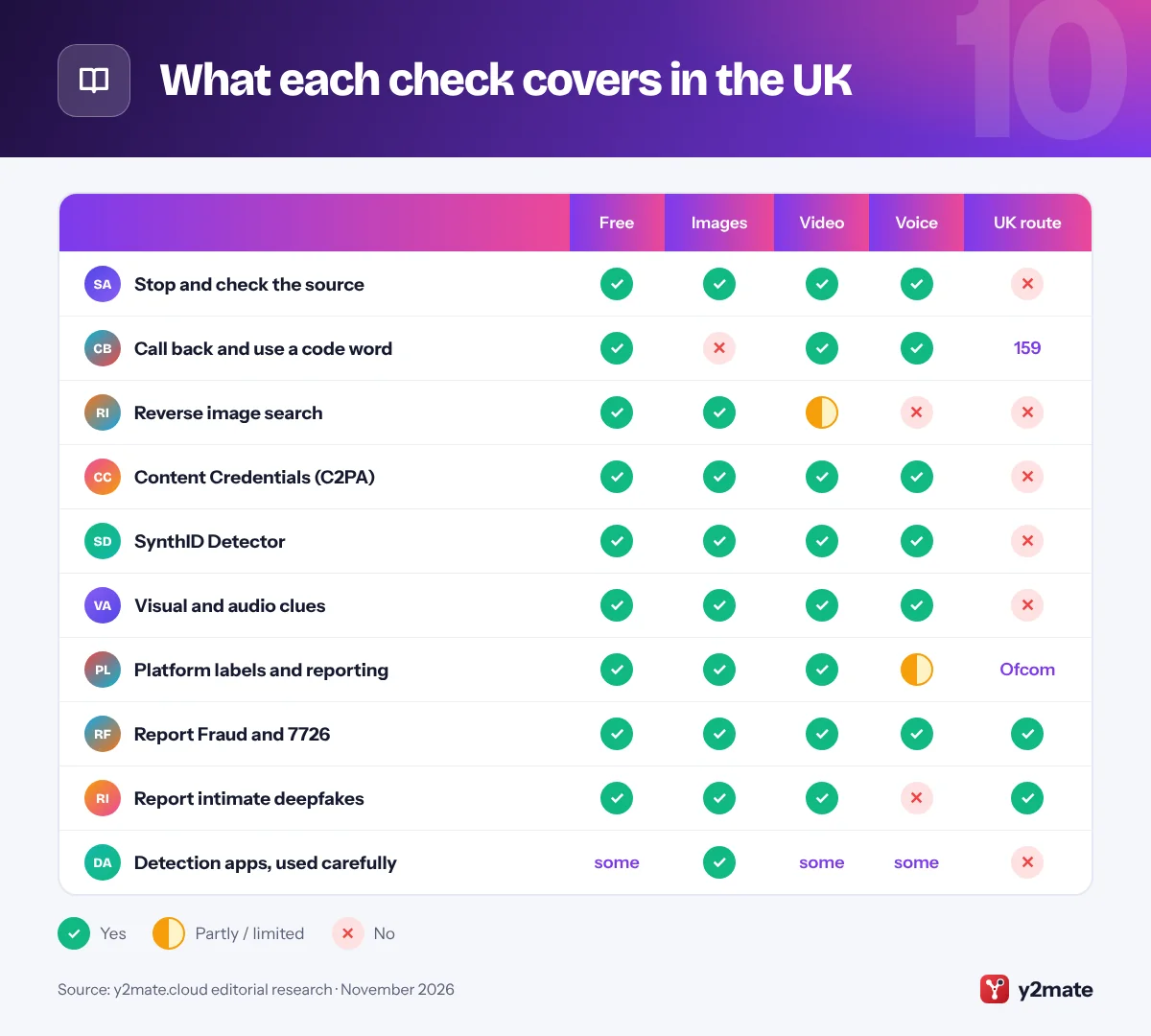
How to spot deepfakes UK-wide and act on them
Spotting a fake is only the first step. What you do next depends on what the deepfake is for and who it targets.
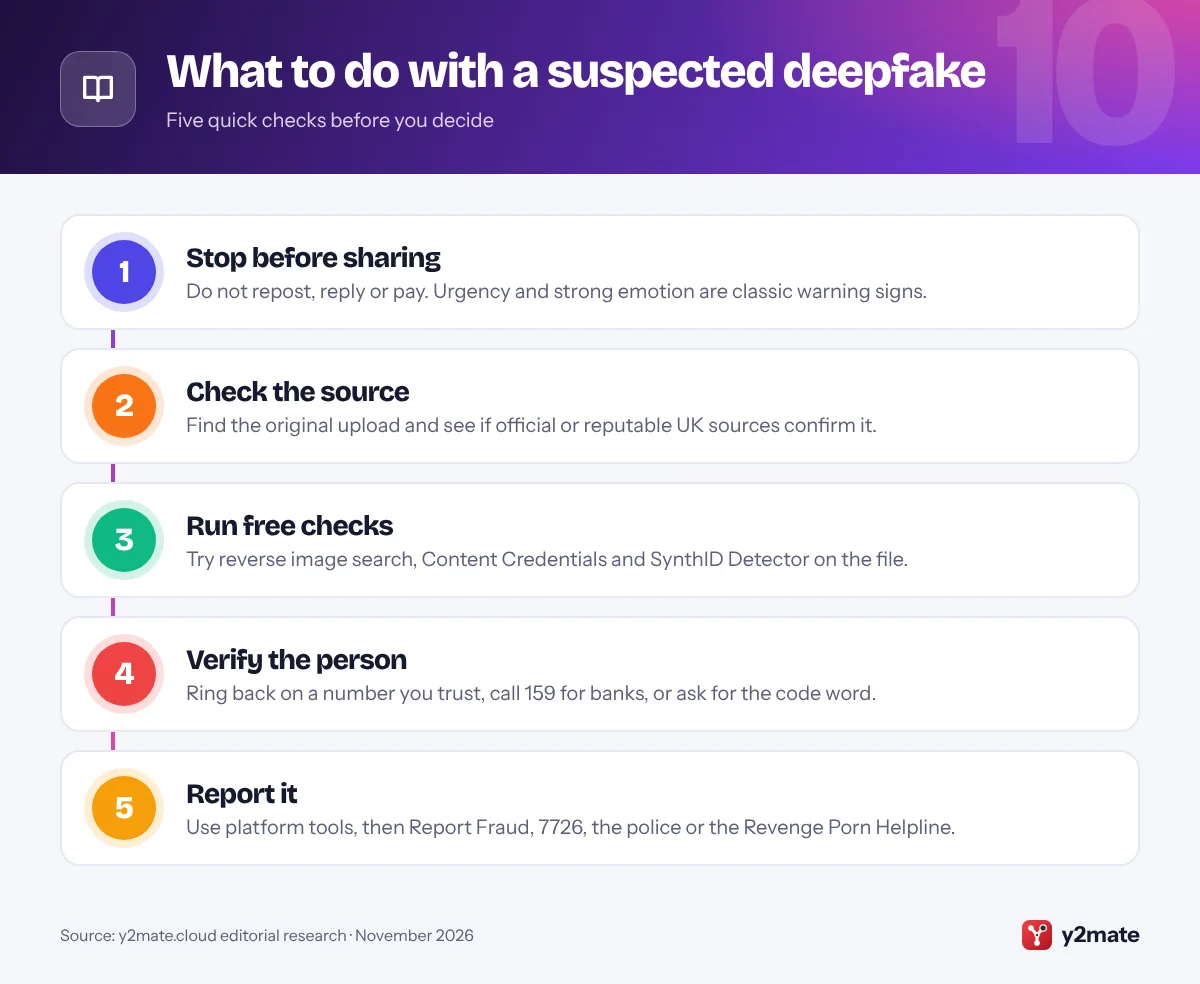
If someone uses a deepfake to scam you
- End the contact: do not pay, share one-time codes or install anything, however urgent it sounds.
- Call your bank: use 159 or the number on your card if money or account details are involved.
- Report it: to Report Fraud, or Police Scotland on 101, with phone numbers, usernames, links and payment details.
If a deepfake shows you
- Record, don’t spread: note links, usernames and dates; never forward an intimate image, even to friends who want to help.
- Get specialist help: the Revenge Porn Helpline can help adults with reporting and removal, and StopNCII.org can block copies on partner platforms.
- Involve the police: creating, requesting and sharing sexual deepfakes of adults without consent are offences in England and Wales.
If it is political
Do not share it. Check the claim against official sources, report it to the platform, and if it misleads people about how to vote, tell your local council’s electoral services team.
Make yourself a harder target
- Set social media accounts to private and limit public videos of your voice and face.
- Agree a family code word, and explain voice cloning to older relatives and teenagers.
- At work, require a call-back to a known number before any payment change.
Frequently asked questions
What are deepfakes and how are they created?
Deepfakes are images, videos or audio clips made or altered with AI to show real people doing or saying things they never did. They are created with AI models trained on large collections of photos, video or voice recordings, which learn patterns such as facial movement and speech, then generate new content, swap faces or clone a voice. Many apps now make this quick and easy.
What are deepfakes used for?
Many uses are harmless, such as film effects, satire and dubbing. The harmful uses are the ones to watch: scams with cloned voices or fake celebrity adverts, sexually explicit images of real people made without consent, and misleading political content. In England and Wales, creating sexual deepfakes of adults without consent has been an offence since February 2026.
What are deepfake scams?
Deepfake scams use AI-generated video, images or cloned voices to make fraud more convincing. Examples include a call from a "relative" in trouble, a fake video of a celebrity backing an investment, and a video call with a fake boss asking for an urgent transfer. Hang up and verify on a number you trust, then report it to Report Fraud, or to Police Scotland on 101.
Which deepfakes are illegal in the UK?
In England and Wales it is an offence to share or threaten to share an intimate image without consent, including a deepfake, and since 6 February 2026 to create or request one of an adult. Making or supplying nudification tools became an offence on 29 June 2026. Sexual images of children are illegal whether real or AI-made, and deepfakes used to defraud people fall under fraud law.
How do deepfakes affect people and society?
For individuals, sexual deepfakes cause serious distress and harassment, and voice-clone scams can take people's savings. For society, the bigger risk is eroding trust, as people may believe fakes or dismiss real evidence as fake. The Electoral Commission found no deliberate use of highly convincing deepfakes in the May 2026 elections, but it has called for the law to be updated.
What is deepfake detection?
Deepfake detection covers any method of telling whether content is AI-made or manipulated. It includes automated detectors that look for AI traces, invisible watermarks such as Google's SynthID, provenance records such as Content Credentials, and human checks on the source. None is fully reliable alone, so combine tools with checks on the source and the people involved.
Final verdict
The best ways to spot deepfakes UK readers can use are habits rather than apps: check the source, ring back on a number you trust, and agree a family code word. Reverse image search, Content Credentials and SynthID Detector then add free evidence, while detection apps are only a second opinion.
If a deepfake targets you, act. Report scams to Report Fraud or Police Scotland, forward scam texts to 7726, and if someone has faked an intimate image of you, go to the police and the Revenge Porn Helpline or, for under-18s, Report Remove.
Sources and further reading
- Crime and Policing Act 2026 factsheet: The Home Office explains the ban on nudification tools and the new 48-hour duty for platforms to remove reported intimate images.
- Commencement of the deepfake offences: The regulations that brought the offences of creating, or requesting, a purported intimate image of an adult into force on 6 February 2026.
- NCSC guide to reporting scam texts: The NCSC shows how to forward a suspicious text message to 7726 for free so your mobile provider can investigate the sender.
- Childline Report Remove: How under-18s in the UK can report nude images of themselves, including AI fakes, to the Internet Watch Foundation for removal.
- StopNCII.org hashing tool: A free tool run by the Revenge Porn Helpline that lets adults hash intimate images, including deepfakes, so partner platforms can block copies.

Leave a Reply