- No single check proves a photo, video or voice is real or fake; combine a source check, reverse image search, Content Credentials and a call back on a number you know.
- A missing watermark or AI label does not mean content is genuine, because many AI tools add none and labels are often stripped.
- Since May 19, 2026, covered platforms must remove reported non-consensual intimate images, including AI deepfakes, within 48 hours under the TAKE IT DOWN Act, and the FTC enforces the rule.
- The FBI advises families to agree a secret word or phrase to confirm the identity of a caller who claims to be a relative in trouble.
- Report deepfake scams to the FBI at ic3.gov and the FTC at ReportFraud.ftc.gov, and use NCMEC's Take It Down or StopNCII.org to block intimate images from spreading.
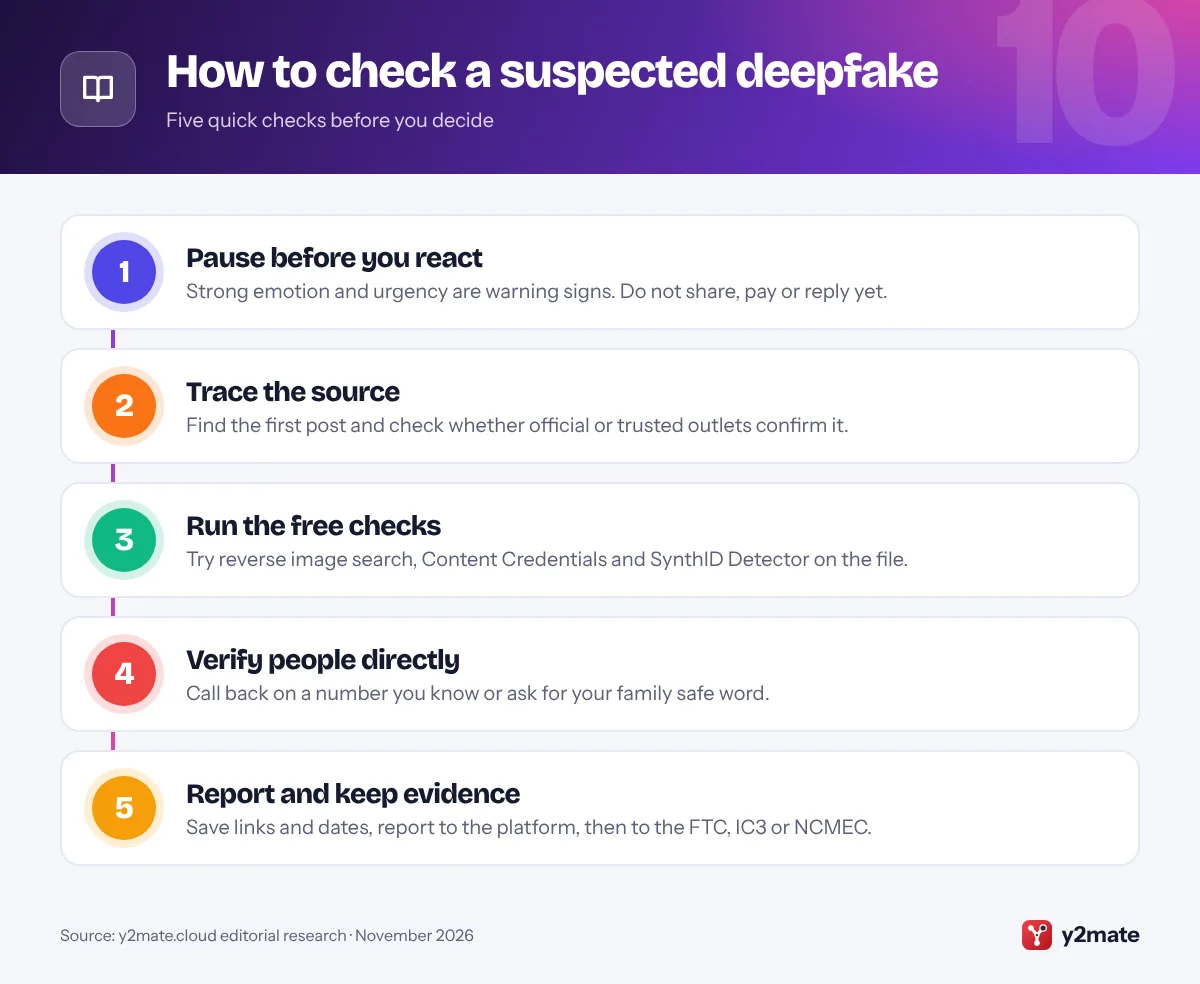
To spot deepfakes, start with the source rather than the pixels: check who first posted the image, video or audio and whether trusted outlets confirm it, run a reverse image search, look for Content Credentials or a Google SynthID watermark, and call back on a number you already know before acting on any urgent request. Visual glitches such as warped hands or garbled text are clues, not proof, and no detector is reliable on its own. If a deepfake targets you, US law now gives you removal and reporting routes through platforms, the FTC, the FBI and NCMEC.
A deepfake is an image, video or audio clip made or altered with artificial intelligence so that a real person appears to do or say something they never did. Criminals use deepfakes in investment and impersonation scams, to create sexual images of real people without consent, and to spread false claims around elections.
Below are ten checks and routes that work for ordinary people in the US in November 2026, from everyday habits to specialist tools and the legal steps to take when you find a fake. This is general information, not legal advice.
How we ranked this list
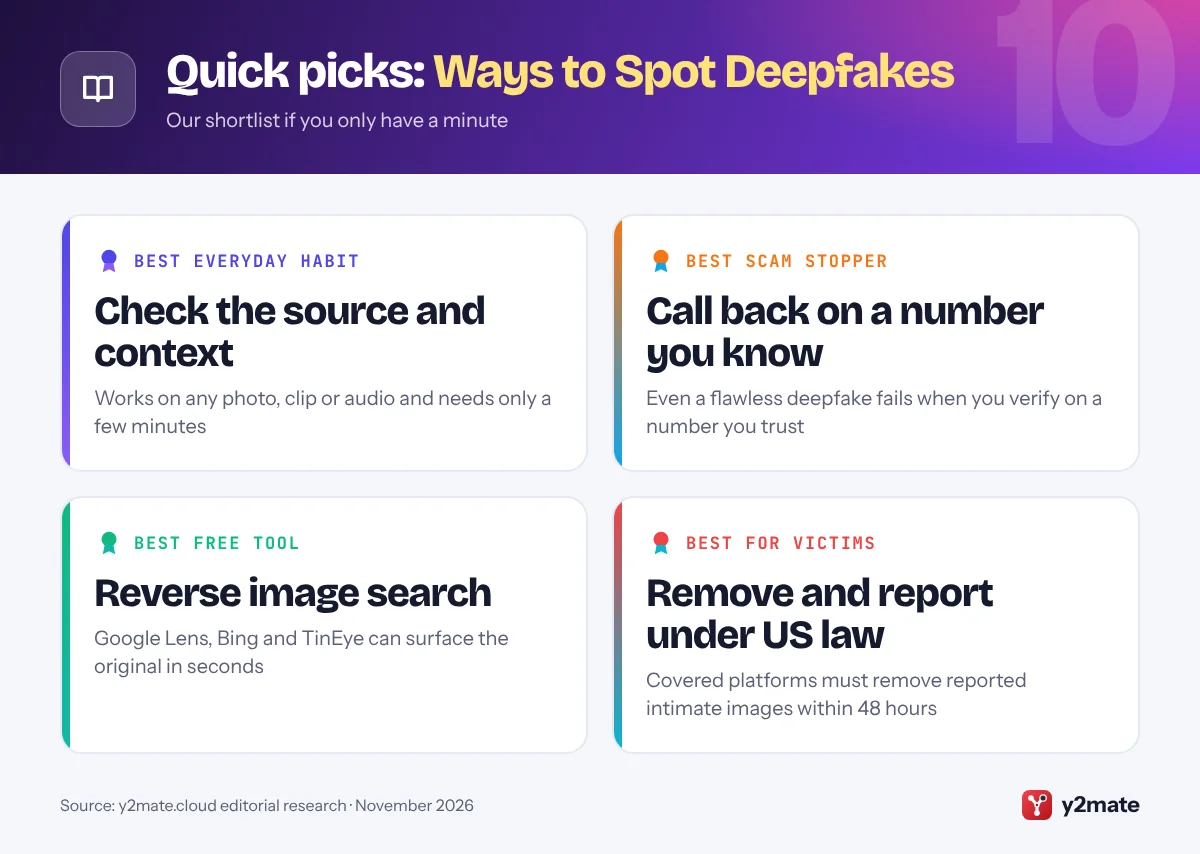
We ranked the ten ways by how reliable, free and easy they are for ordinary people, and by how closely they follow official guidance from US regulators and law enforcement, such as the FTC, the FBI and the FCC, and from standards bodies including the Coalition for Content Provenance and Authenticity (C2PA) and NIST.
We did no hands-on testing of detection tools and quote no accuracy figures, because results vary with the content and change as AI models improve.
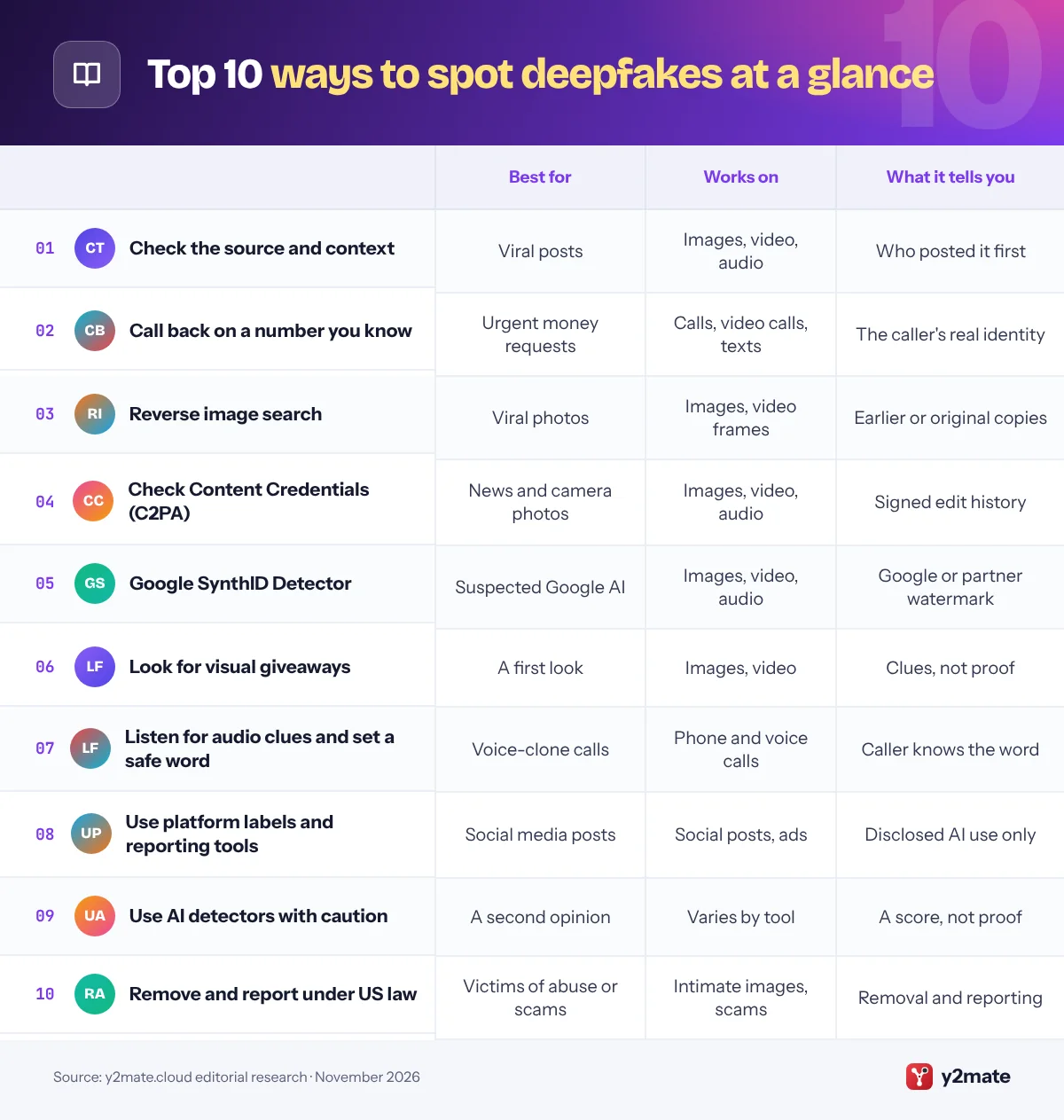
The Top 10 Ways to Spot Deepfakes
1. Check the source and context
Best for: any viral photo, clip or audio post
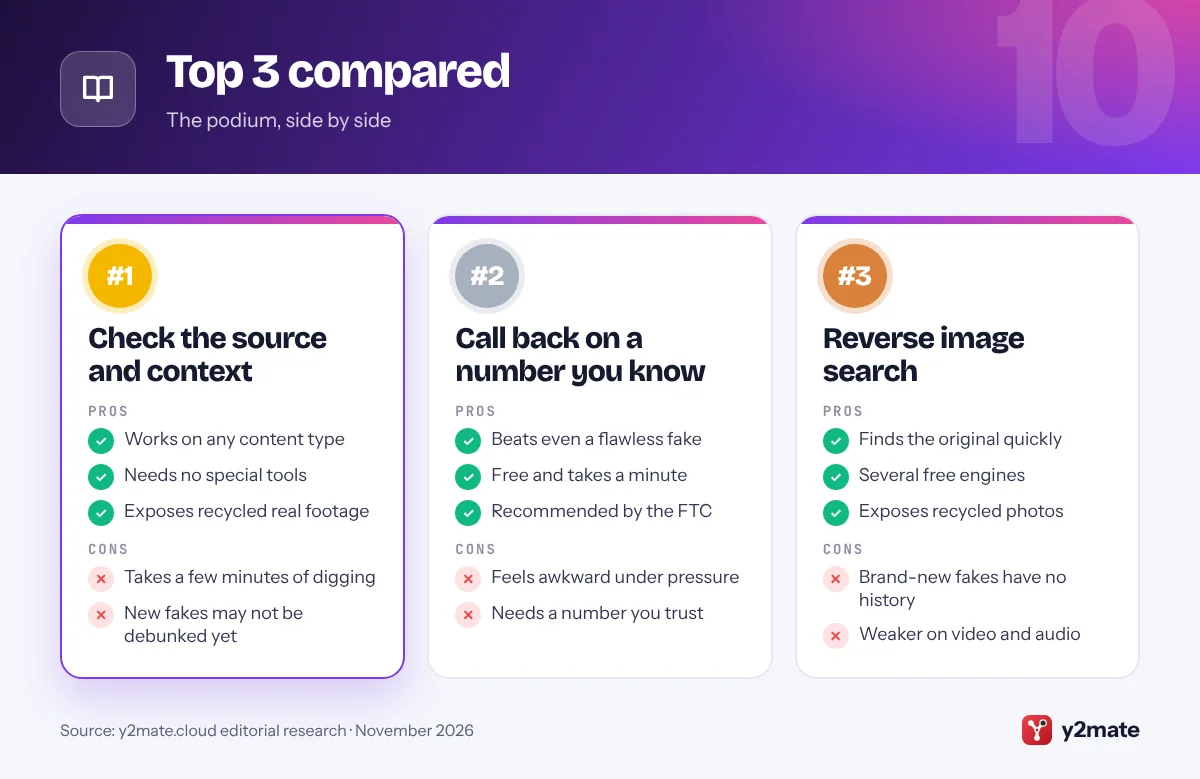
Before you study a suspicious image or clip, ask where it came from. Find the earliest post you can, check whether the account really belongs to the person or organization shown, and see whether reputable news outlets or the official source report the same thing.
The FBI’s public guidance is blunt: AI-generated content is often difficult to identify, so be wary of anything that triggers anger, fear or disbelief, and verify a surprising image or video through reputable news sources or known official channels. In July 2026 the FBI warned that deepfake videos of a senior FBI leader were steering people to a fake copy of its IC3 complaint website.
Context matters most of all around elections. In October 2026 the FBI warned that scammers were using AI-generated voices and images to impersonate candidates and campaigns ahead of the midterms, so check voting information with your state or local election office.
Official site: Check the source and context
- Works on any content type
- Needs no special tools
- Exposes recycled real footage
- Takes a few minutes of digging
- New fakes may not be debunked yet
2. Call back on a number you know
Best for: urgent calls or messages asking for money
Most deepfake scams end with a request for money or a code. The most reliable defense is to break contact and verify through a channel you control. The FTC’s advice on family emergency scams is to call the person on a phone number you know is theirs, not one the caller gives you.
The same rule applies to a boss on a video call asking for an urgent transfer, your bank’s “fraud team” or a government agency. Look up the number yourself on the official website or the back of your card. The FBI notes that criminals now use AI-generated video in real-time video chats while posing as executives and law enforcement, so a familiar face on screen is not proof.
Caller ID can be faked, too. The FTC’s rule against impersonating government agencies and businesses, in force since 2024, lets it seek refunds and civil penalties from scammers who break it.
Official site: Call back on a number you know
- Beats even a flawless fake
- Free and takes a minute
- Recommended by the FTC
- Feels awkward under pressure
- Needs a number you trust
3. Reverse image search
Best for: checking a viral photo in seconds
A reverse image search shows where else a picture, or a frame from a video, appears online. It can reveal the unedited original, an older date that proves a “breaking” photo is recycled, or an existing fact-check. Google’s own help pages suggest it as a step when judging whether an image is AI-generated.
Use more than one engine, because each indexes different sites. Google Lens works in the Google app, in Chrome and through Circle to Search on Android, while Bing Visual Search and TinEye are free on the web. For video, screenshot a clear frame.
Since May 2026 Google has also let you ask Lens, AI Mode or Circle to Search whether an image is AI-generated, and it checks for its SynthID watermark. Finding no matches at all can be a warning sign for a photo that claims to show a major public event, but brand-new real photos also start with no history.
Official site: Reverse image search
- Finds the original quickly
- Several free engines
- Exposes recycled photos
- Brand-new fakes have no history
- Weaker on video and audio
4. Check Content Credentials (C2PA)
Best for: photos from news outlets and newer cameras
Content Credentials work like a nutrition label for digital media. They follow an open standard from the Coalition for Content Provenance and Authenticity (C2PA), backed by companies including Adobe, Google, Microsoft, OpenAI and Meta. When a camera, phone or editing app supports them, the file carries a signed record of how it was made and edited, including whether generative AI was used. Google’s Pixel 10 was the first phone to add them to photos in its built-in camera app.
To check a file, upload it to the free Verify tool at contentcredentials.org, or install Adobe’s free Content Authenticity extension for Chrome, which shows a small “Cr” pin on images that carry credentials. The Gemini app on the web and on Android can read them too.
Read the result carefully. Credentials record history, not truth, and Google’s help pages say they do not tell you definitively whether something is AI-generated. Most images online still have none, and many sites strip them on upload, so a missing label proves nothing.
Official site: Check Content Credentials (C2PA)
- Shows edit history and AI use
- Free Verify tool online
- Backed by major tech firms
- Most images carry none
- Often stripped on upload
5. Google SynthID Detector
Best for: content you suspect came from Google AI
SynthID is an invisible watermark that Google DeepMind embeds in images, video and audio made with Google’s AI tools. It is designed to survive common changes such as cropping, filters and compression. In October 2026 Google opened its SynthID Detector to everyone, globally in English, and said it can check whether an image, video or audio file was made with AI from Google or from partners including OpenAI and NVIDIA.
You can also upload a file to the Gemini app and ask whether it was created or edited by Google AI. Gemini checks for SynthID and, on the web and Android, for Content Credentials.
The key limitation is scope. A positive result is strong evidence that the content came from a participating AI tool. A negative result only means no SynthID watermark was found: the file could still have been made by an AI system that does not use SynthID.
Official site: Google SynthID Detector
- Free for everyone in English
- Covers image, video and audio
- Strong evidence when positive
- Only finds participating AI tools
- No watermark is not proof
6. Look for visual giveaways
Best for: a quick first look at a suspicious image
AI images and videos still slip up, and the FBI’s public guidance lists the clues: distorted hands or feet, unrealistic teeth or eyes, indistinct or irregular faces, odd accessories such as glasses or jewelry, shadows that fall the wrong way, and unnatural movement. Google adds garbled or nonsensical text, such as signs and labels that turn to gibberish.
In video, watch whether the mouth matches the words, whether blinking looks natural, and whether earrings, collars or the background flicker or change between frames. Lag or blurring around the face when the person moves is another sign the FBI mentions.
Treat all of these as clues, not proof. Newer models make far fewer mistakes, heavy compression can make genuine footage look glitchy, and the FBI says AI content has advanced to the point that it is often difficult to identify. Use giveaways to decide what to check next, not to reach a verdict on their own.
Official site: Look for visual giveaways
- Free and instant
- FBI lists the key signs
- Catches low-effort fakes
- Newer fakes have few errors
- Real photos can look odd too
7. Listen for audio clues and set a safe word
Best for: families worried about voice-clone scams
Voice cloning tools can copy a voice from a short recording, such as a social media video or a voicemail greeting. The FTC warns that a voice that sounds like a family member is not proof that it is them. Listen for flat emotion, odd pauses, missing breaths or a script that does not sound like the person, but the FBI cautions that cloned voices and real calls can sound nearly identical.
The stronger defense is a family safe word: a word or phrase agreed in person that a caller must give before anyone sends money or shares information. The FBI recommends exactly this. Keep it offline, and, as the FTC suggests, ask a question only the real person would know.
Federal rules help here as well. In February 2024 the FCC ruled that AI-generated voices count as “artificial” voices under the Telephone Consumer Protection Act, so robocalls that use them need the called person’s prior consent, with limited exceptions.
Official site: Listen for audio clues and set a safe word
- Works against perfect clones
- Takes one family conversation
- Recommended by the FBI
- Everyone must remember it
- No help with strangers' calls
8. Use platform labels and reporting tools
Best for: deepfakes you find on social media
The big platforms now label some AI content. Meta shows an “AI info” label on its apps when it detects industry-standard signals such as C2PA data or when people disclose AI use, and it requires users to disclose realistic AI video and audio. YouTube requires creators to disclose realistic altered or synthetic content and shows a label to viewers, and TikTok labels AI-generated content and reads Content Credentials from other apps.
Labels help, but their absence means very little, because plenty of AI content is never labeled at all. When you find a harmful deepfake, use the platform’s report menu and choose impersonation, scam or non-consensual intimate imagery where offered, including for fake celebrity ads.
The FTC is also looking at platforms’ role. In September 2026 it asked for public comment on whether to update its impersonation rule to address how search engines, social media and other online platforms promote impersonation scams.
Official site: Use platform labels and reporting tools
- Built into apps you already use
- Labels flag some AI content
- Report menus are free
- Many AI posts carry no label
- Removal can be slow
9. Use AI detectors with caution
Best for: a second opinion, never a final verdict
Many websites and apps claim to tell you whether an image, video or voice is a deepfake. They analyze patterns that AI models tend to leave behind and return a score or a verdict. Used as one signal among several, especially when different tools agree, they can add something to your checks.
Be honest about their limits. Detectors learn from examples of past AI models, so they can miss content from newer ones, and they can wrongly flag real photos, especially compressed or heavily edited ones. NIST’s overview of synthetic content treats automated detection as one technical approach alongside watermarking and provenance tracking, and lists open research problems for each. A detector’s “real” verdict should never persuade you to send money or share a file.
If you do try one, test the original file rather than a screenshot, prefer tools that explain what they found, and avoid any that demand payment or personal details first.
Official site: Use AI detectors with caution
- Quick second opinion
- Some free options
- Can flag subtle fakes
- Can be wrong both ways
- Lag behind new AI models
10. Remove and report under US law
Best for: victims of deepfake abuse or scams
If a sexual deepfake of you is posted, the TAKE IT DOWN Act, signed on May 19, 2025, is your main federal tool. Knowingly publishing intimate images without consent, including AI-made “digital forgeries”, is a federal crime, and since May 19, 2026, covered platforms must remove a reported image and known identical copies within 48 hours of a valid request. If a platform misses that deadline or offers no way to ask, report it to the FTC at TakeItDown.ftc.gov.
To stop images spreading, adults can use StopNCII.org, and people pictured when under 18 can use NCMEC’s Take It Down, which NCMEC says covers real or AI-created images. Both create a digital fingerprint on your device, so the image itself is never uploaded. Google also lets you ask for fake explicit images of you to be removed from Search.
For scams, report to the FBI at ic3.gov and to the FTC at ReportFraud.ftc.gov. Many states have their own laws on sexual or election deepfakes, so tell local police too.
Official site: Remove and report under US law
- 48-hour removal duty for platforms
- Hashing keeps your image private
- FTC can act against platforms
- Hashing needs a copy of the image
- Only covers intimate images
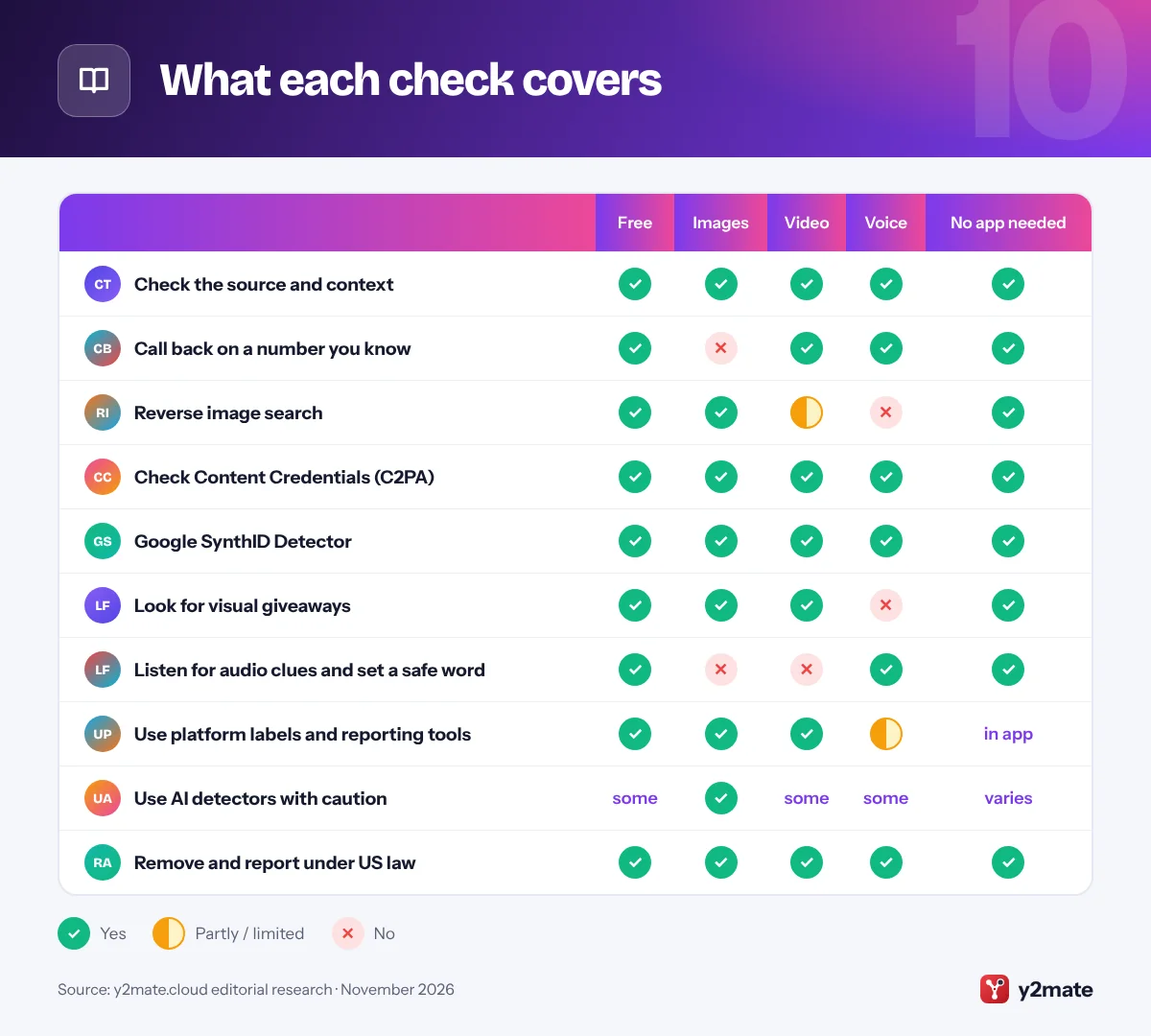
What each check covers
How to spot deepfakes and what to do if you find one
Spotting a fake is only half the job. What you do next depends on who it targets.
How do deepfakes work?
Deepfakes are made with AI models trained on large numbers of real images, videos or voice recordings. The model learns patterns, such as how a face moves or how a voice sounds, and can then generate new content, swap one person’s face onto another body, or speak any text in a cloned voice. The FBI says generative AI has cut the time and effort criminals need to make a scam believable.
What is deepfake detection?
Deepfake detection means any method for telling whether media is synthetic: automated detectors that look for traces AI leaves behind, invisible watermarks such as SynthID, provenance records such as Content Credentials, and human checks on the source. Combining several beats trusting any single tool.
If the deepfake is a scam
- Stop contact: do not pay, share codes or click links.
- Call your bank: if you sent money, contact your bank or card issuer straight away using the number on your card.
- Report it: file at ic3.gov and ReportFraud.ftc.gov with dates, phone numbers, usernames and payment details.
If the deepfake shows you
- Keep evidence: note links, usernames and dates, but do not share the image further.
- Ask for removal: use the platform’s removal form and report missed 48-hour deadlines at TakeItDown.ftc.gov.
- Get support: report threats to local police or tips.fbi.gov. People pictured when under 18 can also report to NCMEC’s CyberTipline.
If it is about an election
Do not share it. Check the claim with your state or local election office and report it to the platform. Many states now regulate deceptive AI in election messaging, mostly by requiring a clear disclaimer, though rules and court rulings vary by state.
Frequently asked questions
How can you spot deepfakes and AI-generated images?
Start with the source: find who posted it first and whether trusted outlets confirm it. Then run a reverse image search, check for Content Credentials and test the file with Google's SynthID Detector. Look for clues such as warped hands, garbled text and odd shadows, but treat them as hints, not proof, because newer AI images often have none.
How do you spot a deepfake video?
Watch whether the lips match the words, whether blinking and head movement look natural, and whether earrings, hair or the background flicker between frames. Screenshot a clear frame and run a reverse image search to find the original footage. On a live video call, hang up and call the person back on a number you know.
Can AI detect deepfakes?
Sometimes. AI detectors can flag patterns that generators leave behind, and watermark checkers such as SynthID Detector can confirm content from participating AI tools. But detectors can miss content from newer models and wrongly flag real images, and a missing watermark proves nothing. Use them as one signal alongside source checks and verification through a second channel.
How can I find deepfakes of myself online?
Run reverse image searches on your most public photos, such as profile pictures, using Google Lens, Bing and TinEye. If you find sexual deepfakes, ask Google to remove them from Search, use StopNCII.org (adults) or NCMEC's Take It Down (images from under 18) to block copies on participating platforms, and use each site's removal form.
What are deepfake scams?
Deepfake scams use AI-made video, images or cloned voices to make a lie more convincing. Common examples include calls from a "relative" in trouble, fake celebrity videos promoting investments, video calls with fake executives requesting transfers. The FBI advises verifying identities independently and reporting scams at ic3.gov.
Which deepfakes are illegal in the US?
No federal law bans deepfakes as such; the law targets harmful uses. The TAKE IT DOWN Act makes it a crime to knowingly publish intimate deepfakes without consent, sexual images of minors are illegal whether real or AI-made, and AI-voice robocalls need consent under FCC rules. Fraud is illegal whatever the tool, and many states add laws on sexual and election deepfakes.
Final verdict
The most reliable ways to spot deepfakes cost nothing: check the source, verify people on a number you already know, and agree a family safe word. Free tools such as reverse image search, Content Credentials and SynthID Detector add useful evidence, but none of them can clear a file on its own.
If a deepfake targets you, act quickly and keep evidence. Use platform removal forms backed by the TAKE IT DOWN Act, StopNCII.org or NCMEC’s Take It Down to block copies, and report scams to the FBI’s IC3 and the FTC.
Sources and further reading
- FTC on Take It Down enforcement: The FTC explains the TAKE IT DOWN Act duties it began enforcing on May 19, 2026, including 48-hour removal of reported intimate images.
- FCC ruling on AI voices: The FCC's February 2024 ruling that AI-generated voices in robocalls count as artificial voices under the Telephone Consumer Protection Act.
- NCMEC Take It Down: NCMEC's free, anonymous service that helps remove nude or sexual images taken before age 18 from participating platforms using a digital fingerprint.
- StopNCII.org hashing tool: A free tool run by the Revenge Porn Helpline that helps adults stop intimate images, including deepfakes, spreading on partner platforms.
- Google removal of fake sexual content: Google's help page on asking for fake or real sexual images of you to be removed from Search results.

Leave a Reply