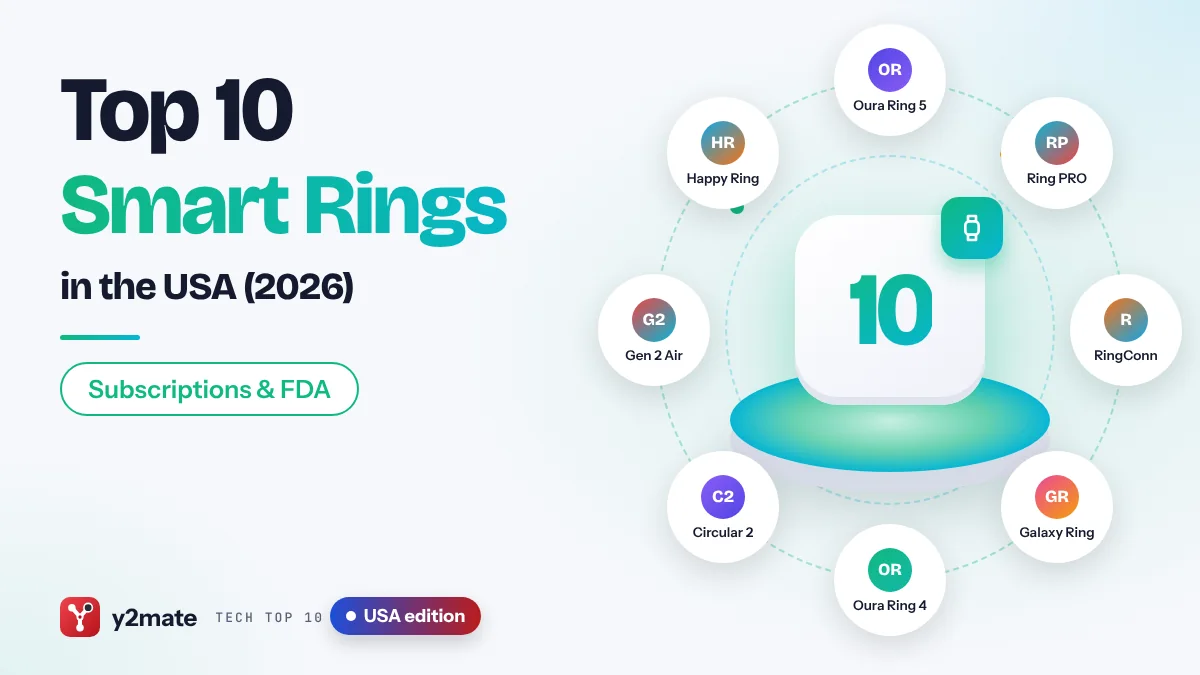
- The Oura Ring 5 is the most complete smart ring sold in the US in late 2026, but most of its features need a paid Oura Membership.
- Ultrahuman's older Ring AIR is still covered by the 2025 ITC import ban, but US Customs ruled in March 2026 that the redesigned Ultrahuman Ring PRO falls outside it.
- RingConn signed a multi-year patent license with Oura in October 2025, so RingConn rings are still sold in the US with no subscription.
- Most smart rings are general wellness products, and the FDA has warned against wearables that claim to measure blood pressure without FDA authorization.
- Happy Health's prescription Happy Ring is an FDA-cleared medical device, and software that uses it for blood pressure readings was cleared in September 2026.
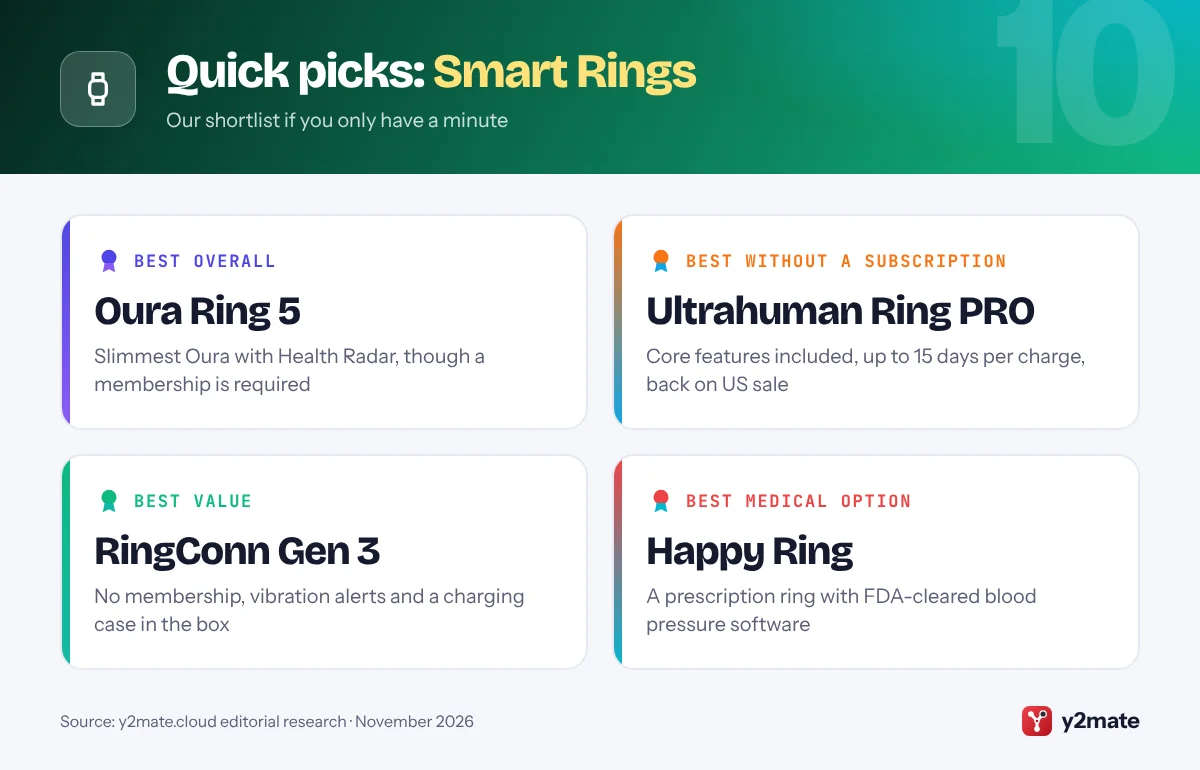
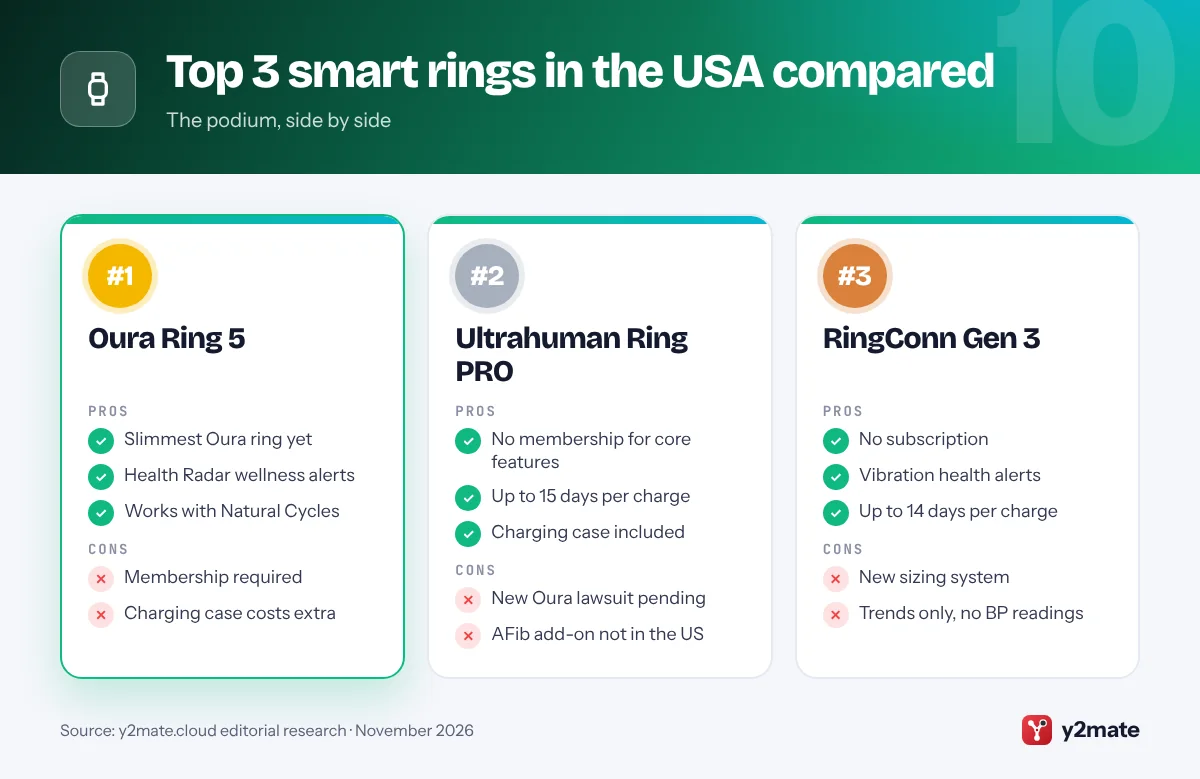
The best smart rings in the USA in late 2026 are the Oura Ring 5 for most people, the Ultrahuman Ring PRO if you want no subscription and the longest battery life, and the RingConn Gen 3 for vibration alerts without a membership. Samsung’s Galaxy Ring suits Galaxy phone owners, and the prescription-only Happy Ring is the one to consider for FDA-cleared blood pressure readings.
A smart ring is a health tracker shaped like a ring. Light sensors on the inside, known as PPG (photoplethysmography), read your pulse through the skin, a temperature sensor follows overnight changes and an accelerometer counts movement. HRV, or heart rate variability, is the small variation between heartbeats and a common recovery signal. SpO2 is an estimate of blood oxygen.
The US market has changed a lot in a year. A patent case Oura won at the US International Trade Commission (ITC) led to an import ban on Ultrahuman rings from October 2025, RingConn took a license from Oura, and Ultrahuman returned in 2026 with a redesigned ring. Almost every ring here is a general wellness product, not an FDA-regulated medical device, so read its numbers as trends rather than diagnoses.
How we ranked this list
We ranked these rings on the makers’ published tracking features, their app and subscription model, phone and health-platform compatibility (iPhone, Android, Apple Health, Health Connect and Samsung Health), US availability and support, and widely reported owner feedback. We did not test the rings ourselves, and we quote battery life only as each maker states it.
We left out the Ultrahuman Ring AIR, which is still covered by the ITC import ban, and Movano’s Evie ring, which is not currently available to order. The Amazfit Helio Ring is no longer listed on Amazfit’s US store, and Whoop and the Polar Loop are screenless bands rather than rings.
The Top 10 Smart Rings
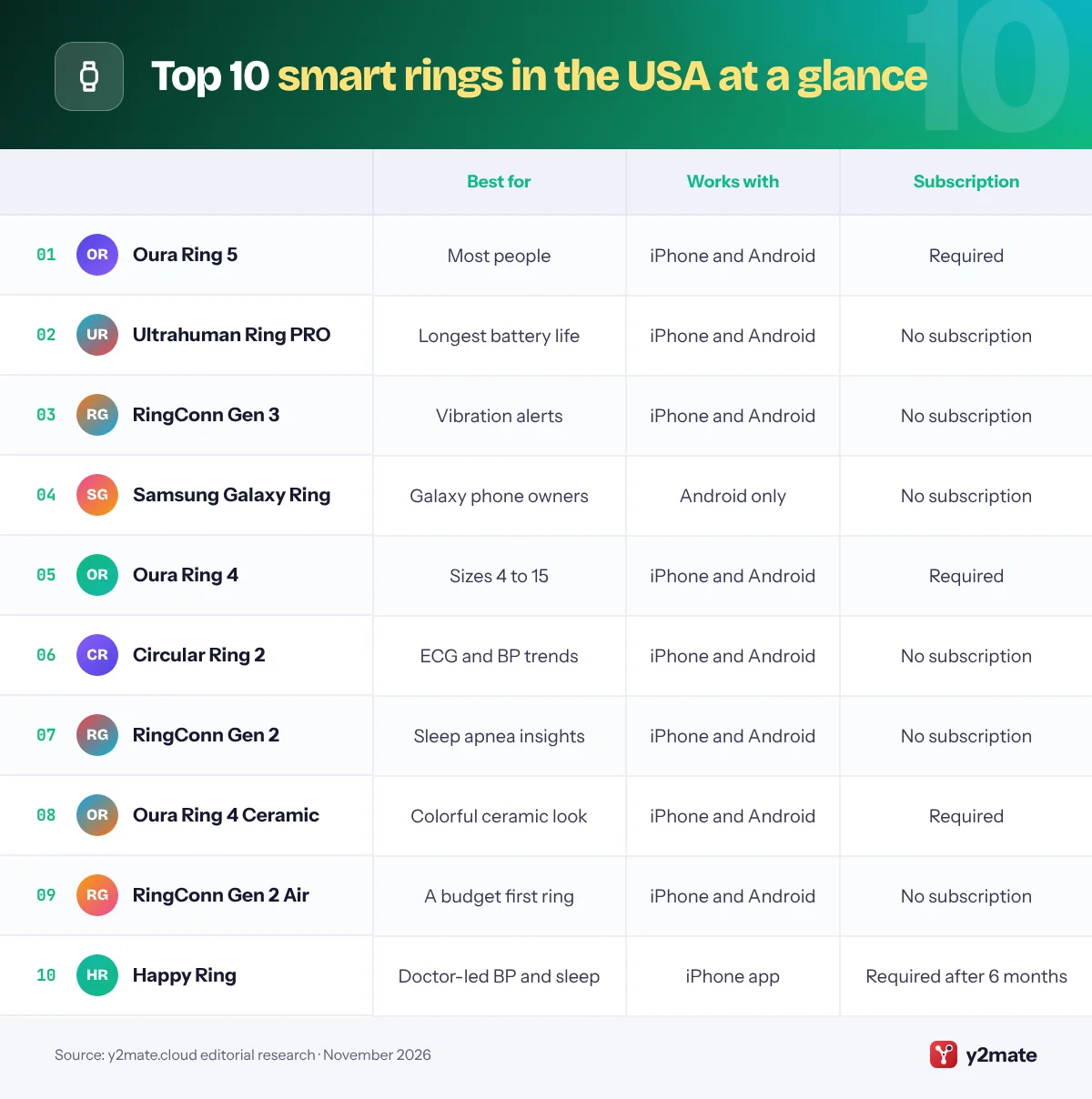
1. Oura Ring 5
Best for: the most complete app and sleep insights
The Oura Ring 5 is the best smart ring for most Americans. Announced in May 2026, it is slimmer than the Ring 4, made entirely of titanium and sold in sizes 6 to 13. It tracks sleep, heart rate, HRV, temperature trends, blood oxygen, stress and activity, and Oura quotes 6 to 9 days of battery life.
Oura’s newest software launched in the US first. Health Radar, with Blood Pressure Signals and Nighttime Breathing, looks for overnight patterns that may point to cardiovascular strain or disturbed breathing. Oura calls these general wellness features: they show no blood pressure readings and diagnose nothing. Cycle Insights predicts periods and your fertile window, and the ring can feed Natural Cycles, an FDA-cleared birth control app with its own subscription.
It works with iPhone and Android and syncs with Apple Health and Health Connect. A paid Oura Membership is required for most features. Oura lists the ring as HSA/FSA eligible, sells a sizing kit and charges extra for the charging case. Skip it if you will not pay a subscription.
Official site: Oura Ring 5
- Slimmest Oura ring yet
- Health Radar wellness alerts
- Works with Natural Cycles
- Membership required
- Charging case costs extra
2. Ultrahuman Ring PRO
Best for: no subscription and the longest battery
The Ultrahuman Ring PRO is the best subscription-free alternative to Oura in the US. After the 2025 import ban on its earlier rings, Ultrahuman redesigned the ring, and in March 2026 US Customs and Border Protection ruled that the Ring PRO falls outside the exclusion order, so it is back on sale here.
It is a one-piece titanium ring in sizes 5 to 14, with a sizing kit. Ultrahuman claims up to 15 days per charge, and the included PRO Charger case stores extra power and data. The app covers sleep, recovery, HRV, temperature, stress and movement, plus a free Cycle and Ovulation add-on. Core features need no membership, though some add-ons are paid, and its AFib Detection add-on has not launched in the US.
It works with iPhone and Android, syncs with Apple Health and can be paid for with HSA/FSA funds. One caution: Oura filed a new patent lawsuit over the Ring PRO in October 2026. Ultrahuman says no injunction has been issued, but if that worries you, choose Oura or RingConn.
Official site: Ultrahuman Ring PRO
- No membership for core features
- Up to 15 days per charge
- Charging case included
- New Oura lawsuit pending
- AFib add-on not in the US
3. RingConn Gen 3
Best for: vibration alerts with no subscription
The RingConn Gen 3, launched in May 2026, is the best-value smart ring in the US if you never want to pay a membership. RingConn settled with Oura in October 2025 through a multi-year patent license, so its rings escaped the import ban. It ships free within the US, and RingConn says it is HSA/FSA eligible.
It tracks heart rate, HRV, blood oxygen, respiratory rate, skin temperature, stress, steps and sleep, including breathing patterns. A built-in vibration motor buzzes for health changes, inactivity reminders and low battery, though not for messages or alarms. Its vascular health trends are, in RingConn’s own words, trend insights rather than blood pressure readings.
RingConn quotes up to 14 days of battery with vibration off and up to 12 with it on, and a charging case is included. It works with iPhone (iOS 17 or later) and Android, and syncs with Apple Health and Health Connect. The Gen 3 uses a new sizing system, so order the free sizing kit. Skip it if you want features cleared as medical devices.
Official site: RingConn Gen 3
- No subscription
- Vibration health alerts
- Up to 14 days per charge
- New sizing system
- Trends only, no BP readings
4. Samsung Galaxy Ring
Best for: Samsung Galaxy phone owners
The Galaxy Ring is the obvious choice if you own a Samsung Galaxy phone, because it is the only ring here that reports straight into Samsung Health. It is a titanium ring in sizes 5 to 15, rated 10ATM and IP68, with a charging case in the box. Samsung quotes up to 7 days of battery for sizes 12 and 13 and up to 6 days for smaller sizes.
It tracks sleep stages, heart rate, HRV, skin temperature and activity, and Samsung’s Cycle Tracking uses overnight skin temperature to predict periods. There is no subscription. Galaxy AI wellness tips and Energy Score insights need a compatible Galaxy phone, and a double-pinch gesture can control a Galaxy phone’s camera or alarm.
The big limitation is phone support: it works only with Android, and the full experience needs a Samsung phone, so iPhone owners should look elsewhere. It cannot make payments, and Samsung has not announced a successor. Use the sizing kit, because Galaxy Ring sizes differ from jewelry sizes.
Official site: Samsung Galaxy Ring
- No subscription
- Built into Samsung Health
- Charging case included
- No iPhone support
- Best features need a Galaxy
5. Oura Ring 4
Best for: very small or very large finger sizes
The Oura Ring 4 is still on sale next to the Ring 5, and it is the Oura to choose if your size falls outside the newer ring’s range. It comes in sizes 4 to 15, while the Ring 5 runs from 6 to 13, and Oura quotes 5 to 8 days of battery life.
Oura says the Ring 5 offers the same app features as the Ring 4 with a membership, so you give up no software by choosing the older model. That includes sleep analysis, temperature trends, cycle insights and Health Radar, which Oura offers on Gen3 rings and newer. It is wider and thicker than the Ring 5, though.
Like every Oura ring, it needs a paid membership for full features, works with iPhone and Android, and syncs with Apple Health and Health Connect. It also works with Natural Cycles, and Oura lists it as HSA/FSA eligible. Skip it if you want the slimmest ring or refuse to pay a recurring fee.
Official site: Oura Ring 4
- Sizes 4 to 15
- Same app features as Ring 5
- Works with Natural Cycles
- Membership required
- Bulkier than the Ring 5
6. Circular Ring 2
Best for: on-demand ECG and blood pressure trends
The Circular Ring 2, from Paris-based Circular, packs the widest set of sensors here. Alongside heart rate, HRV, skin temperature, blood oxygen, sleep and activity, you can record a single-lead ECG in about 40 seconds and export it as a PDF for your doctor.
It also estimates blood pressure trends by timing the pulse between its ECG and optical sensors, calibrated with three readings from a home cuff at setup and one every 30 days. Circular calls these wellness estimates for spotting trends, not a diagnosis or a cuff replacement. It also has a vibrating smart alarm and cycle tracking.
Circular quotes around 8 days in power mode and about 5 in performance mode. No subscription is required, with optional premium extras. It works with iPhone and Android, offers a sizing kit and is listed as HSA/FSA eligible. Reviewers have reported slow syncing, so skip it if you want the smoothest app.
Official site: Circular Ring 2
- On-demand ECG recording
- Cuff-calibrated BP trends
- No subscription required
- App syncing can be slow
- BP figures are estimates only
7. RingConn Gen 2
Best for: snoring and sleep apnea risk insights
The RingConn Gen 2 is the older sibling of the Gen 3, and RingConn still recommends it if sleep and snoring risk are your main concern. Its headline feature is sleep apnea monitoring, which looks at blood oxygen and breathing patterns overnight. RingConn says the ring is not a medical device, so treat any warning as a reason to ask a doctor about a proper sleep test.
It also predicts periods from temperature trends. RingConn quotes up to 12 days of battery on the largest sizes and up to 10 on the smallest. A size-specific charging case is included.
There is no subscription. It works with iPhone (iOS 17 or later) and Android, syncs with Apple Health and Health Connect, and shares its free sizing kit with the Gen 2 Air. Skip it if you want vibration alerts, which only the Gen 3 has, or if you already have sleep apnea symptoms and need a diagnosis.
Official site: RingConn Gen 2
- Sleep apnea risk monitoring
- Up to 12 days per charge
- No subscription
- No vibration alerts
- Not a medical diagnosis
8. Oura Ring 4 Ceramic
Best for: a colorful ring that looks like jewelry
The Oura Ring 4 Ceramic puts the Ring 4’s sensors and software inside a zirconia ceramic exterior, in Midnight, Cloud, Tide and Petal colors. It is the pick if you want a smart ring that looks more like a fashion piece than a gadget.
Tracking matches the Oura Ring 4, including Health Radar with an active membership. Oura quotes 5 to 8 days of battery. The trade-off is bulk: Oura lists it at 3.51 mm thick and 5.1 to 8.1 grams depending on size, chunkier and heavier than the titanium Ring 5.
Oura notes that minor scratches from regular wear are normal, so it suits people who are not lifting weights or doing manual work all day. It needs a paid membership, works with iPhone and Android, syncs with Apple Health and Health Connect, and is listed as HSA/FSA eligible. Skip it if comfort in bed matters more than color.
Official site: Oura Ring 4 Ceramic
- Four ceramic colors
- Same features as Ring 4
- Works with iPhone and Android
- Membership required
- Thicker and heavier
9. RingConn Gen 2 Air
Best for: a first smart ring on a tight budget
The RingConn Gen 2 Air is RingConn’s budget model and a sensible first smart ring if you want to see whether you will actually wear one. It covers the tracking most people use every day: sleep stages, heart rate, HRV, blood oxygen, skin temperature, stress and steps, plus cycle predictions from temperature trends and your cycle history.
The differences from the Gen 2 are clear. The Air is made of titanium steel rather than titanium, it skips sleep apnea monitoring, and it charges on a dock instead of a carry-along case. RingConn quotes up to 10 days of battery, depending on ring size.
There is still no subscription. It works with iPhone (iOS 17 or later) and Android, syncs with Apple Health and Health Connect, and uses the same free sizing kit as the Gen 2. RingConn describes its rings as HSA/FSA eligible. Skip it if you want vibration alerts, breathing insights or a charging case for trips.
Official site: RingConn Gen 2 Air
- No subscription
- Up to 10 days per charge
- Apple Health and Health Connect
- No sleep apnea monitoring
- Charging dock, not a case
10. Happy Ring
Best for: a doctor-led sleep and blood pressure check
The Happy Ring from Happy Health is unlike everything else here. It is an FDA-cleared Class II medical device, available by prescription from a Happy Sleep physician. You wear it at home for at least five nights a month, and doctors review the data for conditions such as sleep apnea and high blood pressure.
It is also the clearest answer to whether a smart ring can measure blood pressure. On September 3, 2026 the FDA cleared the Happy Health Blood Pressure Monitor, software that uses Happy Ring data to give spot-check systolic and diastolic readings for adults aged 22 to 50. Its labeling rules out people with arrhythmias such as AFib, people on vasoactive drugs and pregnant women.
The ring is yours to keep. Six months of monitoring are included, then a monthly fee applies, and Happy Sleep says it works with many insurance plans. The app is listed for iPhone, and we could not confirm an Android version. Skip it if you simply want a fitness tracker.
Official site: Happy Ring
- FDA-cleared medical device
- Doctors review your results
- Cleared blood pressure software
- Needs a prescription
- Monthly fee after six months
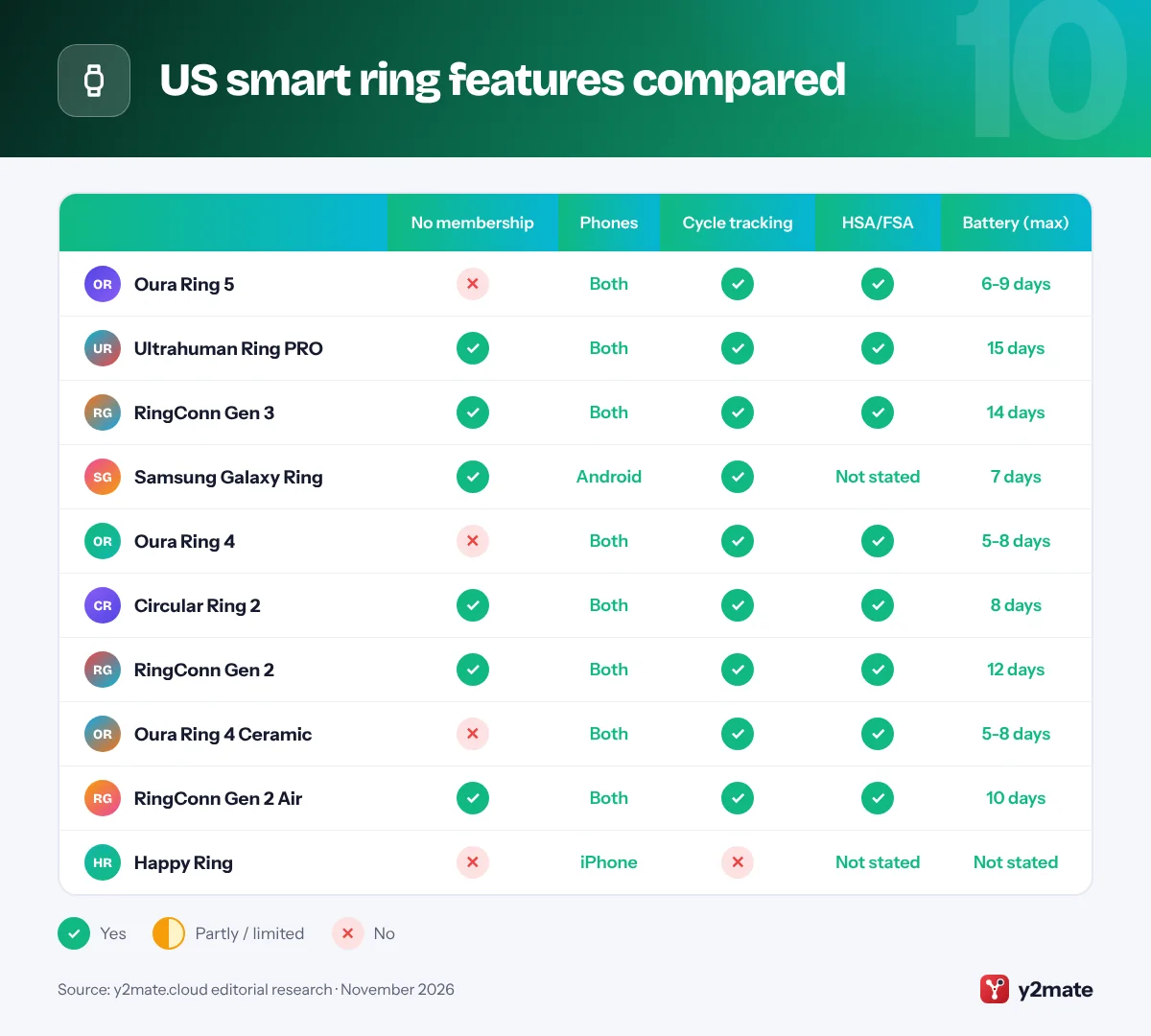
US smart ring features compared
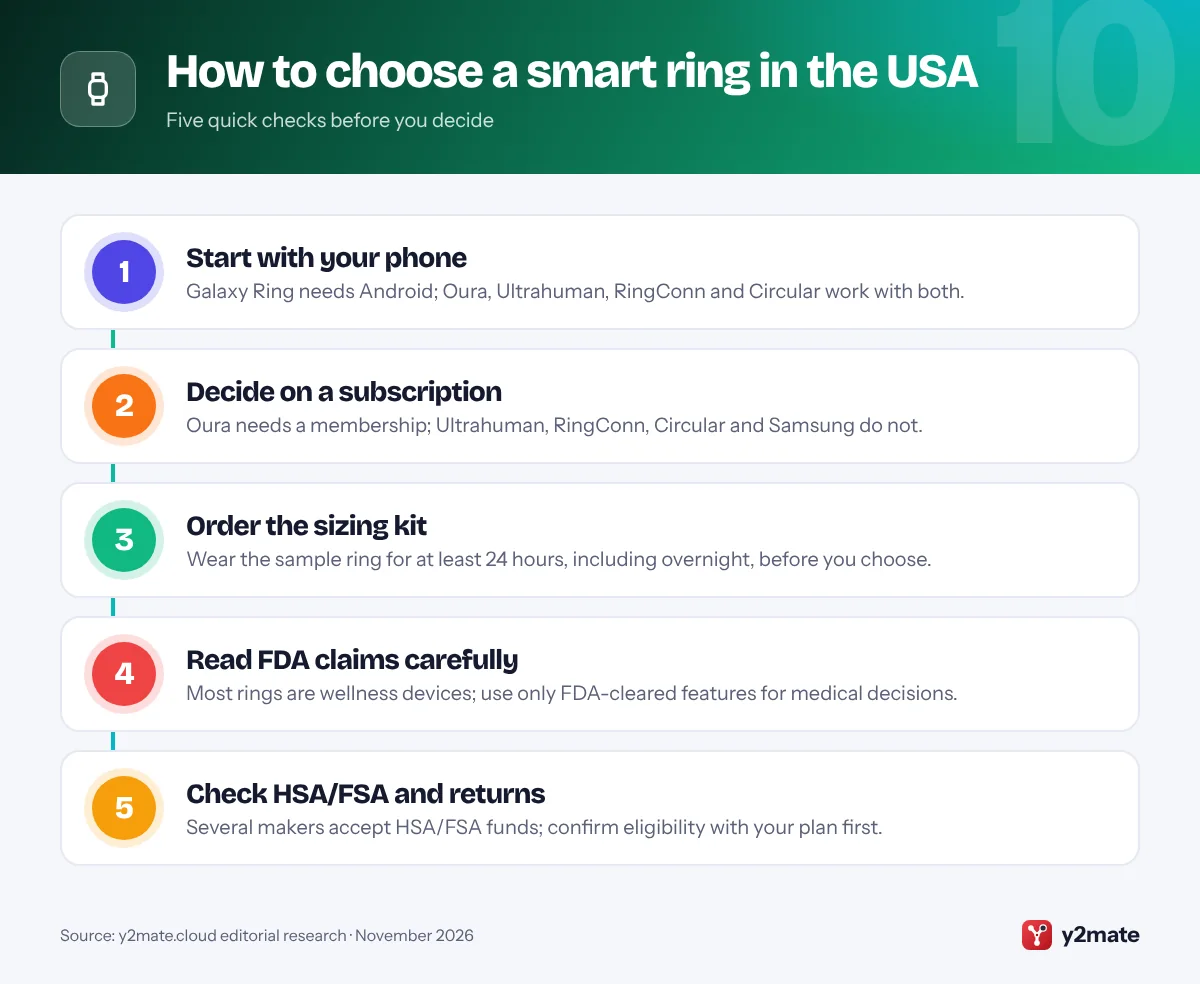
How to choose between smart rings in the USA
Start with your phone and your view on subscriptions. The Galaxy Ring needs Android, and Oura is the only big brand here that requires a membership for full features.
The patent fight and what it means for buyers
In August 2025 the ITC ruled that Ultrahuman and RingConn rings infringed an Oura patent, and its exclusion and cease-and-desist orders took effect on October 21, 2025. RingConn avoided the ban by signing a multi-year license with Oura. Ultrahuman’s Ring AIR is still excluded, but US Customs and Border Protection ruled on March 6, 2026 that the redesigned Ring PRO falls outside the order. Oura sued again in October 2026 over different patents, and no injunction had been issued when we published.
FDA rules: wellness versus medical
The FDA’s general wellness policy, updated in January 2026, covers low-risk products that support a healthy lifestyle without diagnosing disease, which is why Oura, Samsung and RingConn describe their features as wellness tools. In September 2025 the FDA also told people not to use smartwatches or smart rings that claim to measure blood pressure without FDA authorization. Only cleared products, such as Happy Health’s blood pressure software or the Natural Cycles birth control app, have passed FDA review for those uses.
Which smart rings vibrate?
The RingConn Gen 3 vibrates for health alerts, inactivity reminders and low battery, and the Circular Ring 2 uses vibration for its smart alarm and guided breathing. Neither buzzes for phone notifications.
Payments, HSA/FSA and your health data
None of these rings can make contactless payments, although Circular has announced NFC payments for its upcoming Ring 3 series. Oura, Ultrahuman, RingConn and Circular describe their rings as HSA/FSA eligible, so check with your plan first. Data held by consumer ring makers is often outside HIPAA, but the FTC’s Health Breach Notification Rule requires many health apps and connected devices to tell you about breaches.
Frequently asked questions
What are smart rings and what are they used for?
Smart rings are health trackers worn on a finger. They use light, temperature and motion sensors to estimate sleep, heart rate, HRV, skin temperature, blood oxygen and activity, then turn the data into daily scores and trends. Most people use them to follow sleep and recovery without wearing a watch in bed. Almost all are wellness devices, not medical ones.
How does a smart ring track sleep?
The ring combines movement from its accelerometer with heart rate, HRV, breathing rate and skin temperature recorded overnight. Algorithms then estimate when you fell asleep, how long you spent in light, deep and REM sleep, and how restless you were. Sleep stages from a ring are estimates, not the result of a sleep-lab test.
Which smart rings work with iPhone and Apple Health?
Oura, Ultrahuman, RingConn and Circular all work with iPhone and share data with Apple Health, although Oura's two-way Apple Health sync needs an active membership on its current rings. The Happy Ring uses an iPhone app. The Samsung Galaxy Ring does not work with iPhone at all, so iPhone owners should choose one of the other brands.
Which smart rings work with Samsung Health?
The Samsung Galaxy Ring is the only ring that works directly with Samsung Health, and some of its features need a Galaxy phone. Rings such as Oura and RingConn can share data through Google's Health Connect on Android, and Samsung Health can sync with Health Connect, so some of their data can appear in Samsung Health too.
Can a smart ring measure blood pressure?
Most cannot give you a medical reading. Oura's Blood Pressure Signals and RingConn's vascular trends only flag patterns, and Circular's cuff-calibrated figures are wellness estimates. The exception is the prescription Happy Ring: in September 2026 the FDA cleared software that uses its data for spot-check systolic and diastolic readings in adults aged 22 to 50. Keep using a validated cuff.
Which smart rings track your menstrual cycle or work with Natural Cycles?
Oura, Ultrahuman, RingConn, Samsung and Circular all offer cycle tracking based on skin temperature. Oura integrates with Natural Cycles, an FDA-cleared birth control app; you need both an Oura Membership and a Natural Cycles subscription, and you must be over 18. Ultrahuman's free Cycle and Ovulation add-on predicts your fertile window. Period predictions alone are not contraception.
How do you size a smart ring, and which finger should you wear it on?
Order the maker's sizing kit, because smart ring sizes differ from jewelry sizes and often between brands. Wear the sample ring for at least 24 hours, including overnight, and if you are between sizes Oura recommends the smaller one. Oura suggests the index, middle or ring finger. Samsung says the finger does not change tracking, but its pinch gesture works best on the index finger.
Final verdict
The Oura Ring 5 is the best smart ring in the USA for most people, as long as you will pay for a membership. The Ultrahuman Ring PRO and RingConn Gen 3 are the strongest subscription-free choices, the Galaxy Ring suits Samsung phone owners, and the Happy Ring is the one to consider if you want a doctor involved.
Before you buy, order a sizing kit, check that the ring works with your phone, and treat sleep, temperature and blood pressure trends from a wellness ring as prompts to talk to a clinician, not as a diagnosis.
Sources and further reading
- FDA general wellness policy: The FDA's January 2026 guidance on low-risk general wellness products, the category most smart ring features fall into.
- FDA warning on blood pressure wearables: The FDA's September 2025 safety communication telling people not to use unauthorized smartwatches or smart rings that claim to measure blood pressure.
- ITC smart ring exclusion order: The US International Trade Commission's exclusion order in investigation 337-TA-1398, the case that led to the smart ring import ban.
- CBP ruling on Ultrahuman Ring PRO: US Customs and Border Protection's March 6, 2026 ruling on whether the redesigned Ultrahuman Ring PRO falls under the exclusion order.
- FTC Health Breach Notification Rule: The FTC explains when health apps and connected devices must notify users about breaches of their health data.

Leave a Reply