- The RACGP says GPs must obtain patient consent before using an AI scribe, and Ahpra says AI scribes that use generative AI generally require informed consent.
- The TGA says AI scribes used only for administrative tasks are not medical devices, but those that generate recommendations to support diagnosis or treatment may be.
- BreastScreen NSW uses TGA-approved AI to support radiologists reading screening mammograms, and specialist radiologists still independently review the images.
- From 10 December 2026, organisations covered by the Privacy Act must explain significant automated decisions, including those made with AI, in their privacy policies.
- Australia regulates health AI mainly through existing laws and standards on therapeutic goods, privacy and practitioner conduct rather than a dedicated AI act.
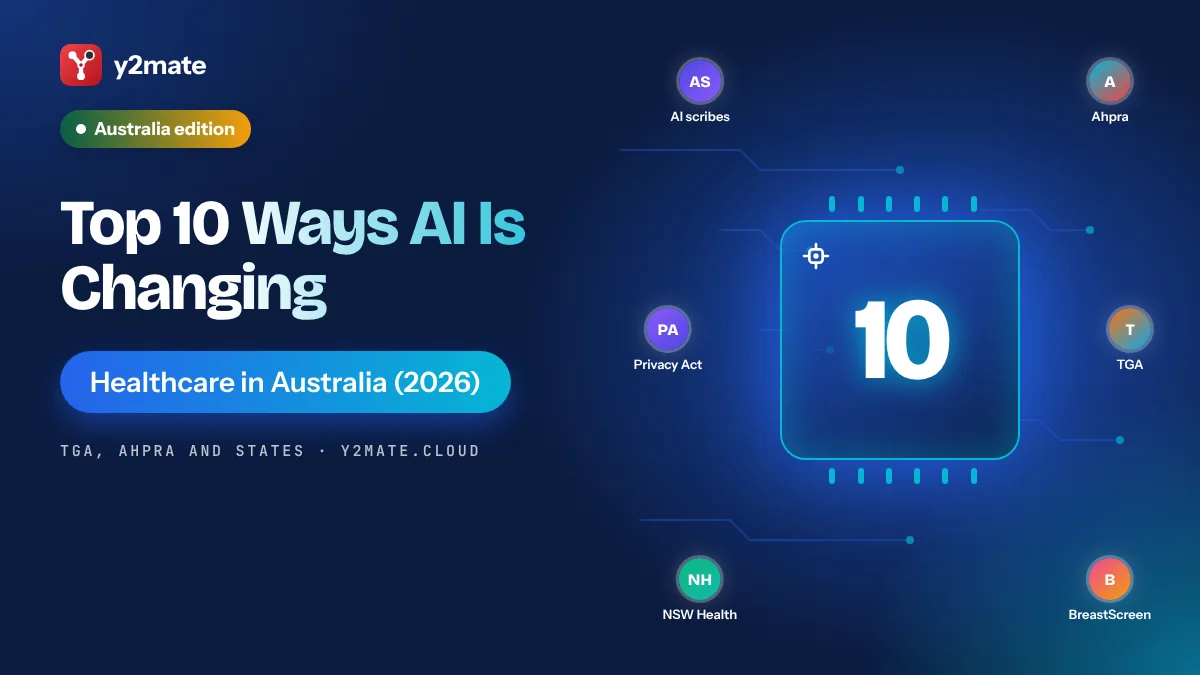
AI in healthcare in Australia is already part of everyday care: AI scribes draft notes in GP clinics and public hospitals, AI helps radiologists read mammograms and X-rays, and regulators are deciding which tools count as medical devices. The ten developments below matter most for patients in November 2026, from Ahpra and RACGP rules on consent to the TGA’s review of AI scribes and new Privacy Act transparency rules.
Two plain definitions. An AI scribe listens to a consultation and drafts clinical notes or letters for the clinician to check. Software as a medical device is software, including AI, intended to diagnose, monitor, treat or prevent disease, which the Therapeutic Goods Administration (TGA) regulates.
Australia has no dedicated AI law for health care, so most rules come from existing laws and professional standards, with states running their own hospitals. This is a news explainer, not medical advice.
How we ranked this list
We chose and ranked these items by how many patients they could affect, how far along they are (guidance or rules in force, a statewide rollout, or a trial), and how well documented they are by official sources such as the TGA, Ahpra, the Department of Health, Disability and Ageing, the OAIC and state health services.
We did not test any AI tools and make no claims about their accuracy beyond what official sources state.

The Top 10 Ways AI Is Changing
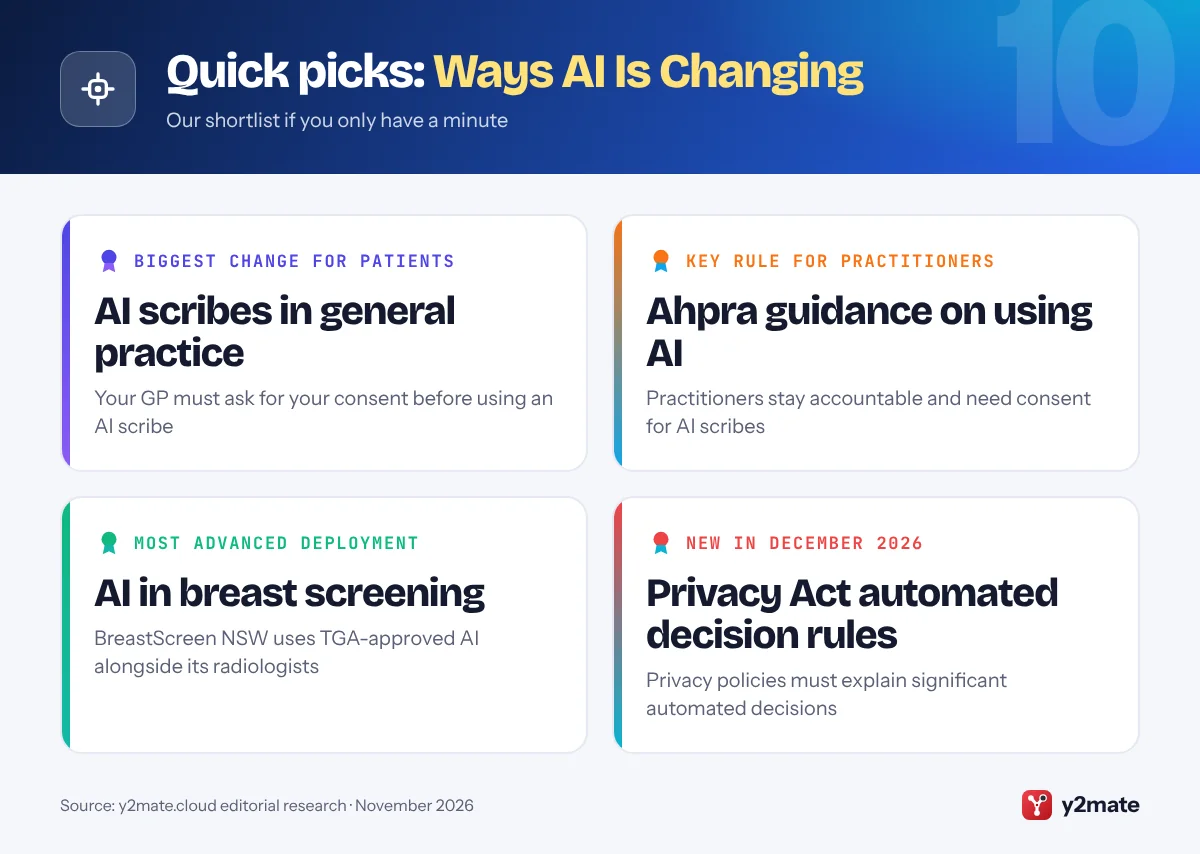
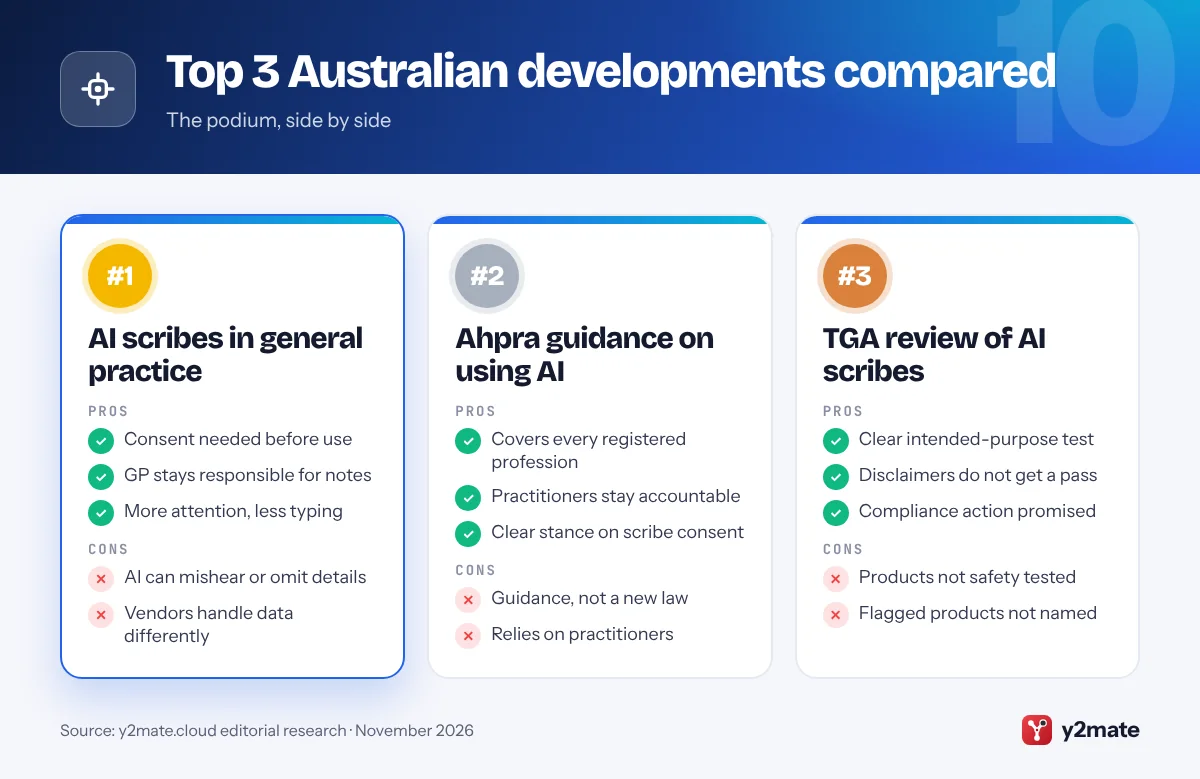
1. AI scribes in general practice
Best for: patients seeing a GP
AI scribes are now a familiar part of Australian general practice. These tools listen to a consultation and draft clinical notes, referral letters or summaries for the GP to check. The RACGP’s guidance says GPs must obtain your consent before using an AI scribe, with some medical defence organisations advising that consent be recorded in writing. It also warns that in some states and territories recording a private conversation without consent can be a criminal offence under surveillance device laws.
Your GP remains responsible for the accuracy of your health record, even when AI drafts it. Professional bodies advise checking how a scribe vendor stores and uses patient information before signing up.
In practice, you should be asked before a scribe is switched on, and if you say no, the consultation should go ahead without it. You can also ask your GP whether the audio is kept and where your information is stored.
Official site: AI scribes in general practice
- Consent needed before use
- GP stays responsible for notes
- More attention on you, less typing
- AI can mishear or omit details
- Vendors handle data differently
2. Ahpra guidance on using AI
Best for: patients of any registered practitioner
Ahpra, which regulates registered health practitioners together with the National Boards, published guidance in August 2024 on meeting professional obligations when using AI in healthcare. It applies across all registered professions, including doctors, nurses, pharmacists and psychologists.
The guidance makes clear that practitioners remain responsible for the care they provide, even when AI is involved, and must apply their own judgement to AI output. It asks them to understand a tool’s intended use and limitations, be transparent with patients, protect privacy, and involve patients in decisions to use AI tools that need their personal information. For AI scribes that use generative AI, Ahpra says informed consent will generally be required, notes there may be criminal implications if consent is not obtained before recording, and suggests noting the patient’s response in the health record.
If you think a practitioner has used AI in a way that put you at risk, you can raise a concern with Ahpra or your state or territory health complaints body.
Official site: Ahpra guidance on using AI
- Covers every registered profession
- Practitioners stay accountable
- Clear stance on scribe consent
- Guidance, not a new law
- Relies on practitioners applying it
3. TGA review of AI scribes
Best for: understanding which scribes are regulated
The TGA regulates software with a therapeutic purpose as a medical device, and it has been checking whether AI scribes cross that line. Its guidance says scribes intended only for administrative tasks, such as turning a conversation into notes, are not medical devices, but scribes that generate patient-specific recommendations or conclusions to support diagnosis, monitoring or treatment may be. Disclaimers do not settle the question; what matters is what the product does and how it is presented.
In 2026 the TGA published the outcome of its digital scribe review. None of the suppliers it examined had identified their software as a medical device, yet most of the products it looked at included functions likely to meet the definition. The TGA said it would take targeted compliance action. It did not test the products or name them.
For patients, this means AI scribes vary. Ask your clinician whether the tool does anything beyond note-taking, such as suggesting diagnoses or treatments.
Official site: TGA review of AI scribes
- Clear intended-purpose test
- Disclaimers do not get a pass
- Compliance action promised
- Products were not safety tested
- Flagged products not named
4. AI in breast screening
Best for: women having a screening mammogram
BreastScreen NSW introduced AI machine-reading technology in November 2024 to support its radiologists in interpreting screening mammograms, citing a growing screening population and a widely reported shortage of radiologists. NSW Health describes it as the first population-based breast screening program in Australia to introduce AI to support radiologists’ review of mammograms.
BreastScreen NSW says the technology is approved by the TGA and that one or more specialist radiologists still independently review your images. It also says that, just as you cannot choose which radiologists read your images, you cannot opt out of the technology being used to assist.
Other states are testing the approach. The BRAIx research trial, a partnership including BreastScreen Victoria, BreastScreen SA, St Vincent’s Institute of Medical Research and university partners, is testing whether an AI reader can safely replace one of the two independent human readers. Taking part in that trial is optional. If you have questions about how your mammogram is read, ask your BreastScreen service.
Official site: AI in breast screening
- TGA-approved technology
- Radiologists still review images
- Trials elsewhere are optional
- No opt-out in NSW
- Approach differs by state
5. AI scribes in public hospitals
Best for: public hospital patients in NSW and Qld
State health systems are moving from AI scribe pilots to wider rollouts. The NSW 2026-27 Budget includes funding to implement AI scribe technology for clinicians in the public health system, and NSW Health’s AI Framework requires any use of AI to be approved following advice from the eHealth NSW AI Advisory Service. In Queensland, Metro South Health has begun rolling out an ambient AI scribe across its health service after a trial.
Metro South Health tells patients that using its AI scribe is always optional, that it is used only with their clear consent, and that they can ask their healthcare team to pause or turn it off at any time. It is designed for English-language conversations but can be used with an interpreter.
Public hospitals are generally covered by state and territory privacy laws rather than the federal Privacy Act. If you are a hospital patient, ask whether a scribe is in use and how your information is stored.
Official site: AI scribes in public hospitals
- Consent-based at Metro South
- Statewide funding in NSW
- Governed by state AI frameworks
- Rules differ between states
- NSW vendor and timing unclear
6. TGA rules for AI medical software
Best for: checking if a health AI tool is approved
Australia regulates medical AI mainly through existing therapeutic goods law, which is technology-neutral. Software, including chatbots, is a medical device if its intended purpose is to diagnose, monitor, predict, treat or prevent disease, and it generally must be included in the Australian Register of Therapeutic Goods (ARTG) before supply unless an exemption or exclusion applies.
The TGA’s 2025 review of AI regulation found the framework largely appropriate but recommended targeted action, including a review of digital scribes and an urgent review of the exclusion for some digital mental health tools. Since then the TGA has published guidance on when AI products, including chatbots built on large language models, are regulated, and has made software a compliance priority. Amendments clarifying the exemption for clinical decision support software, which supports rather than replaces a clinician’s judgement, apply from 1 November 2026.
You can search the ARTG on the TGA website to see whether a medical AI product is included.
Official site: TGA rules for AI medical software
- Technology-neutral, purpose-based
- Public ARTG search
- Software is a compliance priority
- Mental health tool review ongoing
- Some decision support is exempt
7. Privacy Act automated decision rules
Best for: anyone sharing health data with services
From 10 December 2026, organisations covered by the Privacy Act 1988, including private health service providers, insurers and many health apps, must explain in their privacy policies when they use a computer program to make, or do something substantially and directly related to making, decisions that could significantly affect people’s rights or interests. The change comes from the Privacy and Other Legislation Amendment Act 2024, and the Office of the Australian Information Commissioner (OAIC) released guidance on it in September 2026.
Privacy policies will need to describe the kinds of personal information used and the kinds of decisions made. The rule applies to decisions made after it starts, even if the information was collected earlier.
It is a transparency rule, not a ban. Health information is sensitive information under the Privacy Act, and if you think a private provider has mishandled yours, you can complain to the provider and then to the OAIC.
Official site: Privacy Act automated decision rules
- More transparency about AI use
- Applies to existing data too
- OAIC guidance published
- Transparency only, not a ban
- Public hospitals not covered
8. Commission's AI Clinical Use Guide
Best for: patients in hospitals and clinics
The Australian Commission on Safety and Quality in Health Care, which develops the national safety and quality standards that hospitals are accredited against, published its AI Clinical Use Guide in August 2025. It came with two safety scenarios, one on ambient scribes and one on interpreting medical images, and is organised around what clinicians should check before, while and after using an AI tool.
The guide asks clinicians to critically assess a tool’s scope, evidence, limitations and risks before using it, noting that evidence of safety and effectiveness can lag behind adoption. The scribe scenario tells clinicians to review AI notes for bias, hallucinations, over-summarising and missing information, and the imaging scenario suggests explaining the risks, benefits and limits of AI to patients and giving them a chance to discuss alternatives.
In November 2026 the Commission was also consulting on draft AI guidance for health services. Patients can borrow the same before, during and after questions when talking to clinicians.
Official site: Commission's AI Clinical Use Guide
- Practical, clinician-focused steps
- Scribe and imaging scenarios
- Backed by the national safety body
- Guidance, not binding law
- Service-level guidance still draft
9. Harrison.ai Radiology
Best for: patients having X-rays and CT scans
Sydney-based Harrison.ai is one of Australia’s best-known health AI companies. Its radiology tools, previously sold under the Annalise.ai name, were rebranded as Harrison.ai Radiology in October 2025. They are designed to help radiologists by flagging possible findings on chest X-rays and brain CT scans, the company has products included in the ARTG, and it has received US FDA clearances for specific findings.
The company has also been part of a debate about patient data. In 2024 questions were raised about patient scans shared by I-MED Radiology Network with Harrison.ai and used to train AI. In 2025 the OAIC closed its preliminary inquiries without regulatory action, finding the data had been sufficiently de-identified, while stressing this was not an endorsement of I-MED’s broader compliance.
For patients, Harrison.ai shows both sides of Australian health AI: locally built tools used in radiology practices here and overseas, and live questions about consent when health data is used to train AI. A radiologist remains responsible for your report.
Official site: Harrison.ai Radiology
- Australian-built radiology AI
- Supports radiologists' reads
- Cleared in Australia and the US
- Training data use was questioned
- Use varies between practices
10. Safe and Responsible AI review
Best for: following Australia’s health AI policy
The Department of Health, Disability and Ageing ran the Safe and Responsible Artificial Intelligence in Health Care Legislation and Regulation Review to test whether Australia’s health laws are ready for AI. Its final report, published in 2025 after a public consultation, looked at the rules the department administers, including privacy, consumer law, therapeutic goods and the regulation of health practitioners.
Among its findings, the report pointed to a lack of high-quality, up-to-date guidance to support the evidence-based use of AI across health care, and a need for national policy leadership. It also warned that low-quality or misleading information about AI in health can distort decisions.
Much of the follow-up sits with the TGA, Ahpra, the Commission and the OAIC, which is why several items in this list are guidance documents and reviews rather than new laws. The report describes itself as a point-in-time snapshot, and the department’s AI in health care page is the place to watch for next steps.
Official site: Safe and Responsible AI review
- Whole-of-system view
- Based on public consultation
- Shapes national guidance
- No new law on its own
- A point-in-time snapshot
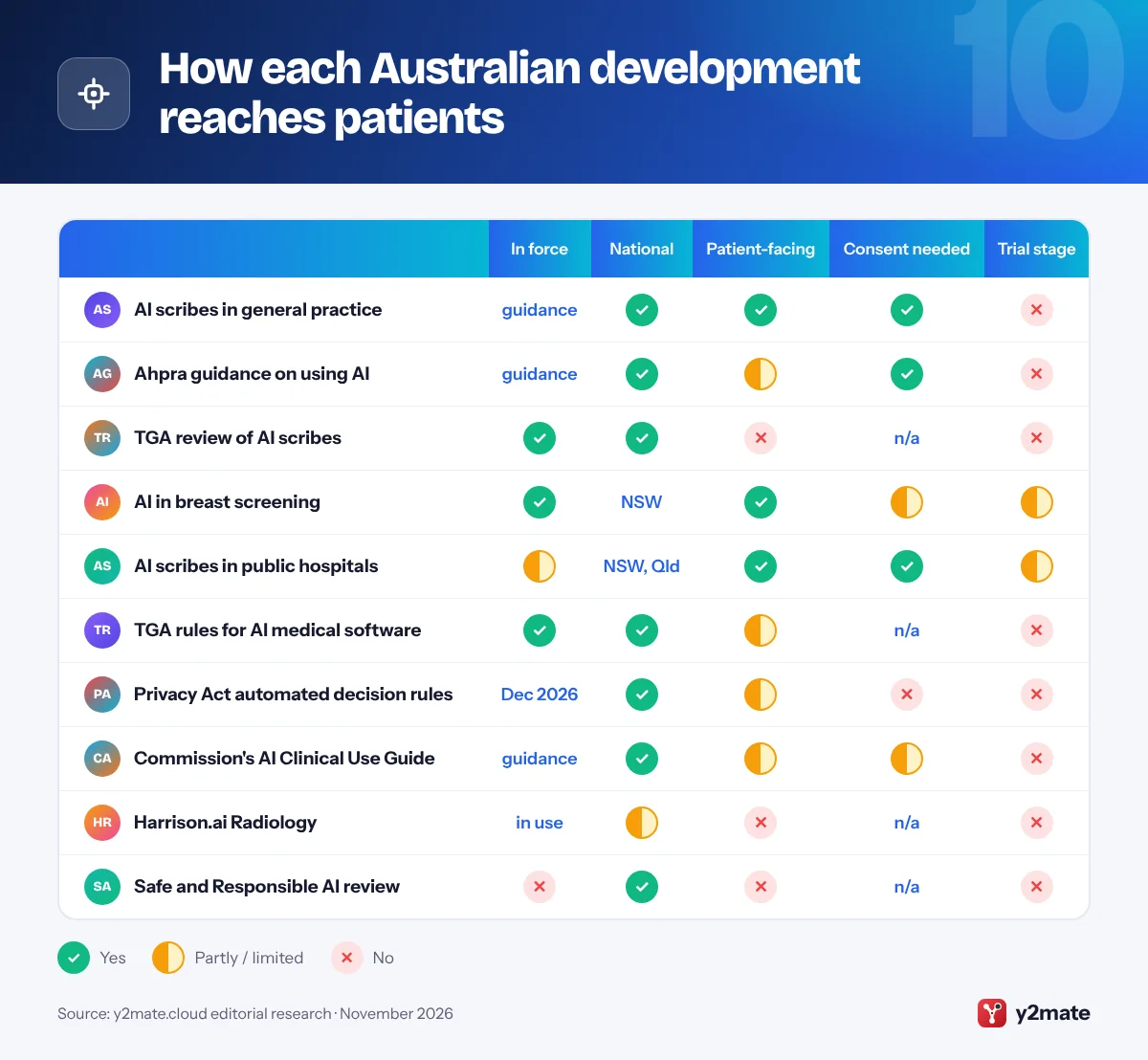
How each Australian development reaches patients
AI in healthcare Australia: what it means for you as a patient
Most rules on AI in Australian health care come from existing laws and professional standards, so knowing your rights as a patient covers most situations.
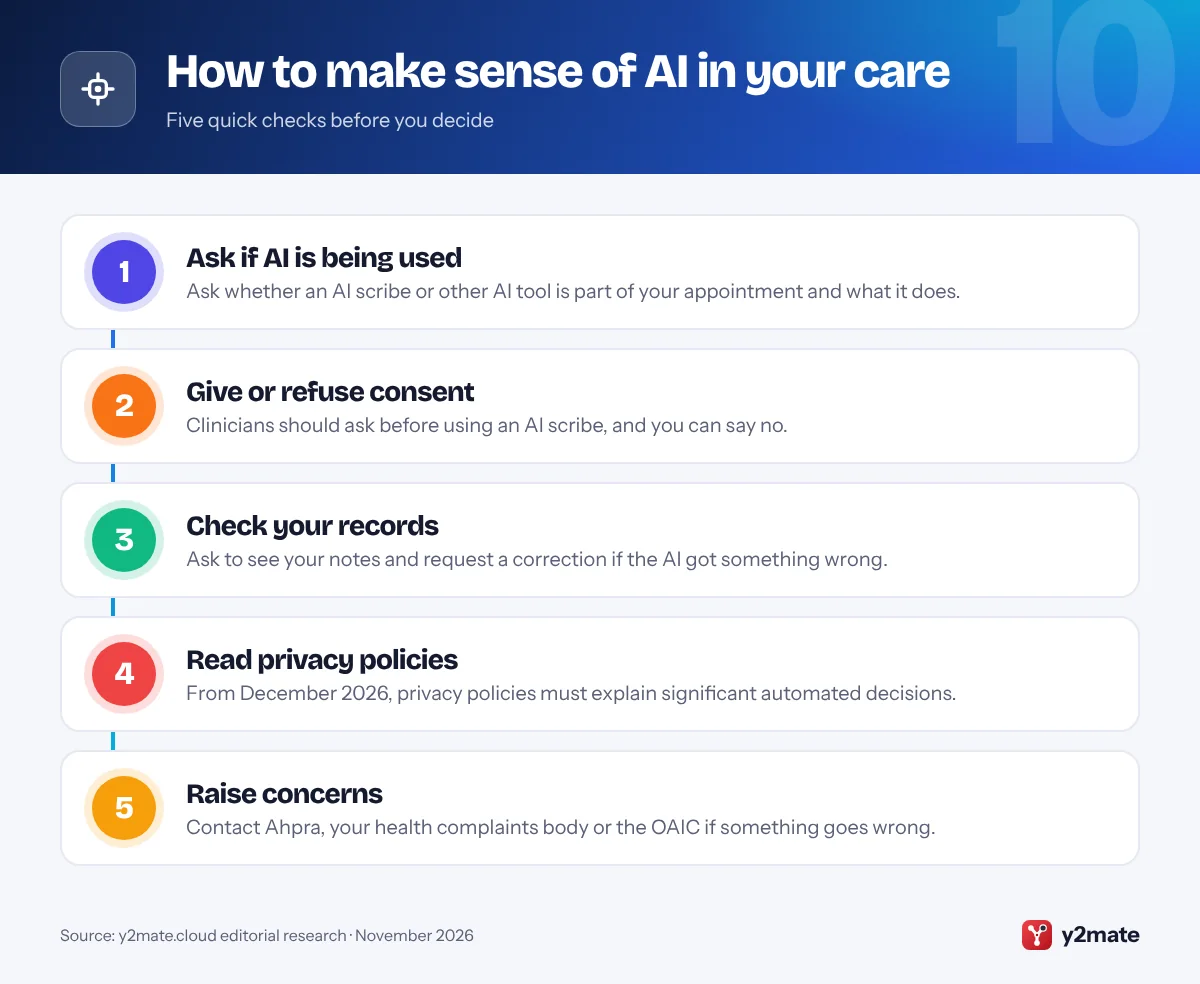
At appointments
- Consent comes first: your GP or other practitioner should ask before using an AI scribe, and you can say no.
- Ask what the tool does: a scribe that only takes notes is treated differently from one that suggests diagnoses or treatments.
- Check your records: ask to see your notes if something seems wrong. Private providers must take reasonable steps to correct inaccurate personal information under the Privacy Act.
Screening, scans and apps
- Screening: ask your BreastScreen service how AI is used; in NSW it supports, rather than replaces, radiologists.
- Medical apps: apps or chatbots that diagnose or treat should generally be included in the ARTG, which you can search on the TGA website.
- My Health Record: you can view documents and results your providers upload and set controls on who can access them.
If something goes wrong
- Practitioner conduct: contact Ahpra or your state or territory health complaints body.
- Privacy: complain to the provider first, then to the OAIC if it is a private service.
- Device problems: report issues with medical AI software to the TGA.
Frequently asked questions
Can my doctor use an AI scribe without telling me?
They should not. The RACGP says GPs must obtain your consent before using an AI scribe, and Ahpra says scribes that use generative AI will generally require informed consent. Recording a private conversation without consent can also be a criminal offence in some states and territories. You can say no, and you can ask how the recording and notes are stored.
Are AI scribes regulated by the TGA?
Only some. The TGA says scribes intended purely for administrative tasks, such as turning a conversation into notes, are not medical devices. Scribes that generate patient-specific recommendations or conclusions to support diagnosis or treatment may be, and its 2026 review found most products it examined had functions likely to meet that definition. It plans targeted compliance action.
Is AI used to read my mammogram in Australia?
It depends on your state. BreastScreen NSW uses TGA-approved AI to support its radiologists, who still independently review your images, and says you cannot opt out of the technology. In Victoria and South Australia the BRAIx research trial is testing an AI reader, and taking part is optional. Ask your BreastScreen service how your images are read.
What changes for health privacy and AI in December 2026?
From 10 December 2026, organisations covered by the Privacy Act, such as private health providers and insurers, must say in their privacy policies when computer programs make, or substantially help make, decisions that significantly affect people. It is a transparency rule rather than a ban, and the OAIC has published guidance on how to comply.
Who can I complain to about AI in my healthcare?
It depends on the problem. Concerns about a practitioner's conduct go to Ahpra or your state or territory health complaints body. Privacy complaints about private providers go to the provider first, then the OAIC. Problems with a medical device, including AI software, can be reported to the TGA, and you can also raise concerns with the clinic or hospital.
Final verdict
AI in healthcare in Australia is growing fastest in the consulting room, where AI scribes draft notes for GPs and hospital clinicians, and in imaging, from BreastScreen NSW to Harrison.ai’s radiology tools. The rules mostly come from existing laws and professional guidance: consent and accountability under Ahpra and the RACGP, the TGA’s intended-purpose test for medical software, and new Privacy Act transparency from December 2026.
This article is general information, not medical advice: talk to your GP or clinician about your own care.
Sources and further reading
- AI in health care: The Department of Health, Disability and Ageing's page on its work on safe and responsible AI in Australian health care.
- AI-enabled devices in the ARTG: The TGA's published list of AI-enabled medical devices included in the Australian Register of Therapeutic Goods.
- Ambient scribe safety scenario: The national safety commission's guidance for clinicians on using AI scribes safely, including checks before, during and after use.
- OAIC statement on I-MED inquiries: The privacy regulator explains why it closed its preliminary inquiries into patient scans used to train radiology AI.
- Raise a concern with Ahpra: How patients can raise a concern about a registered health practitioner, including how they use AI in care.

Leave a Reply