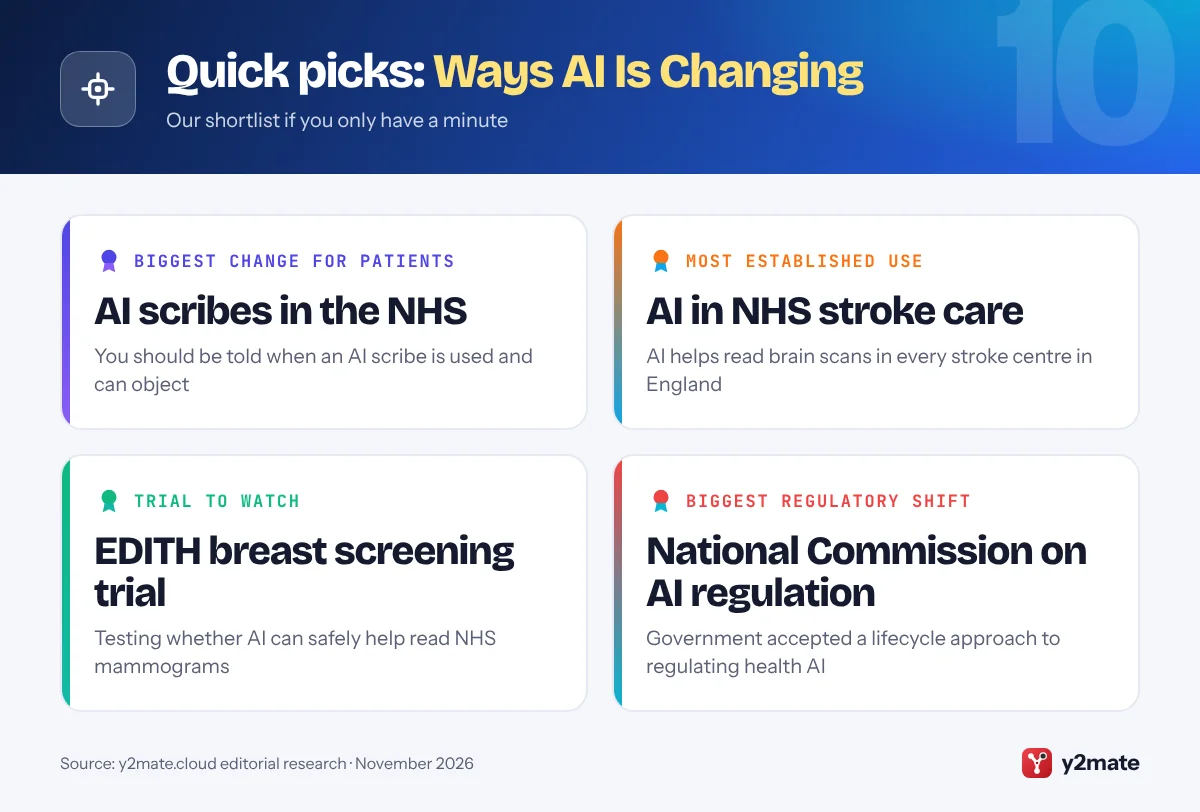
- NHS England guidance says patients should be told when an AI scribe (ambient voice technology) is used in their care and can object, although explicit consent is not usually required.
- In July 2026 the MHRA confirmed that AI scribes used only to transcribe or summarise for clinician review are not medical devices, while those that support diagnosis or treatment are.
- NHS England says AI decision-support software for reading brain scans has been used in all stroke centres in England since summer 2024.
- The EDITH trial is testing whether AI can safely help read NHS breast screening mammograms; AI is not yet part of routine breast screening.
- In October 2026 the government accepted all the recommendations of the National Commission into the Regulation of AI in Healthcare.
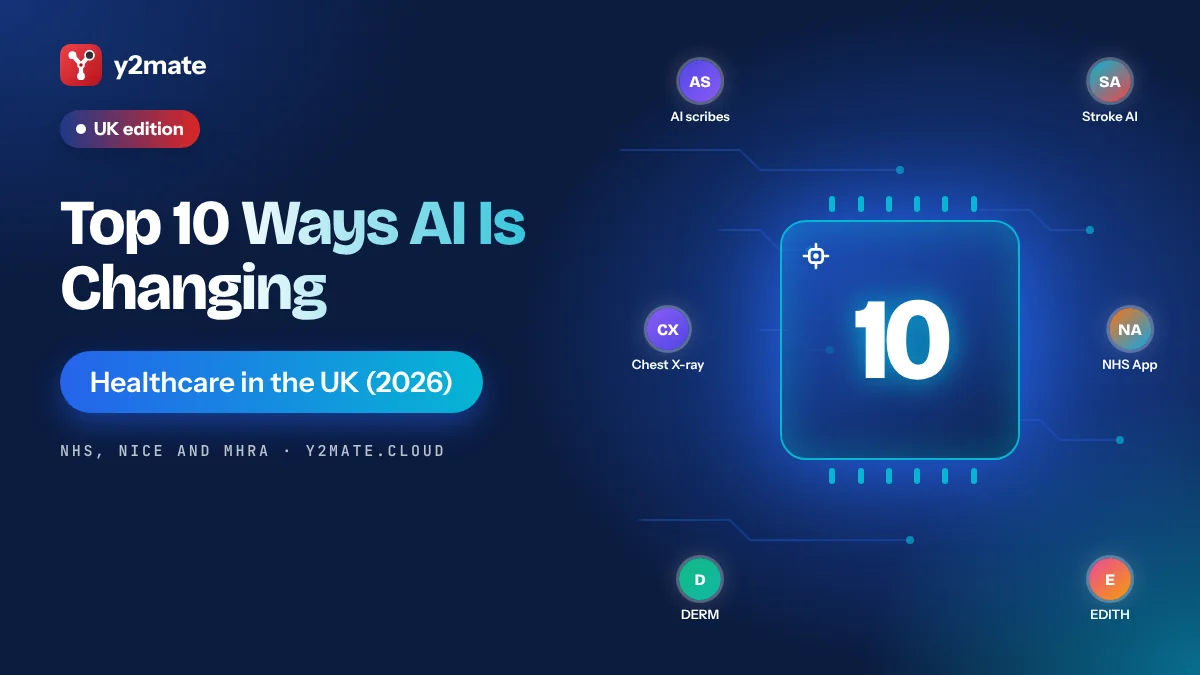
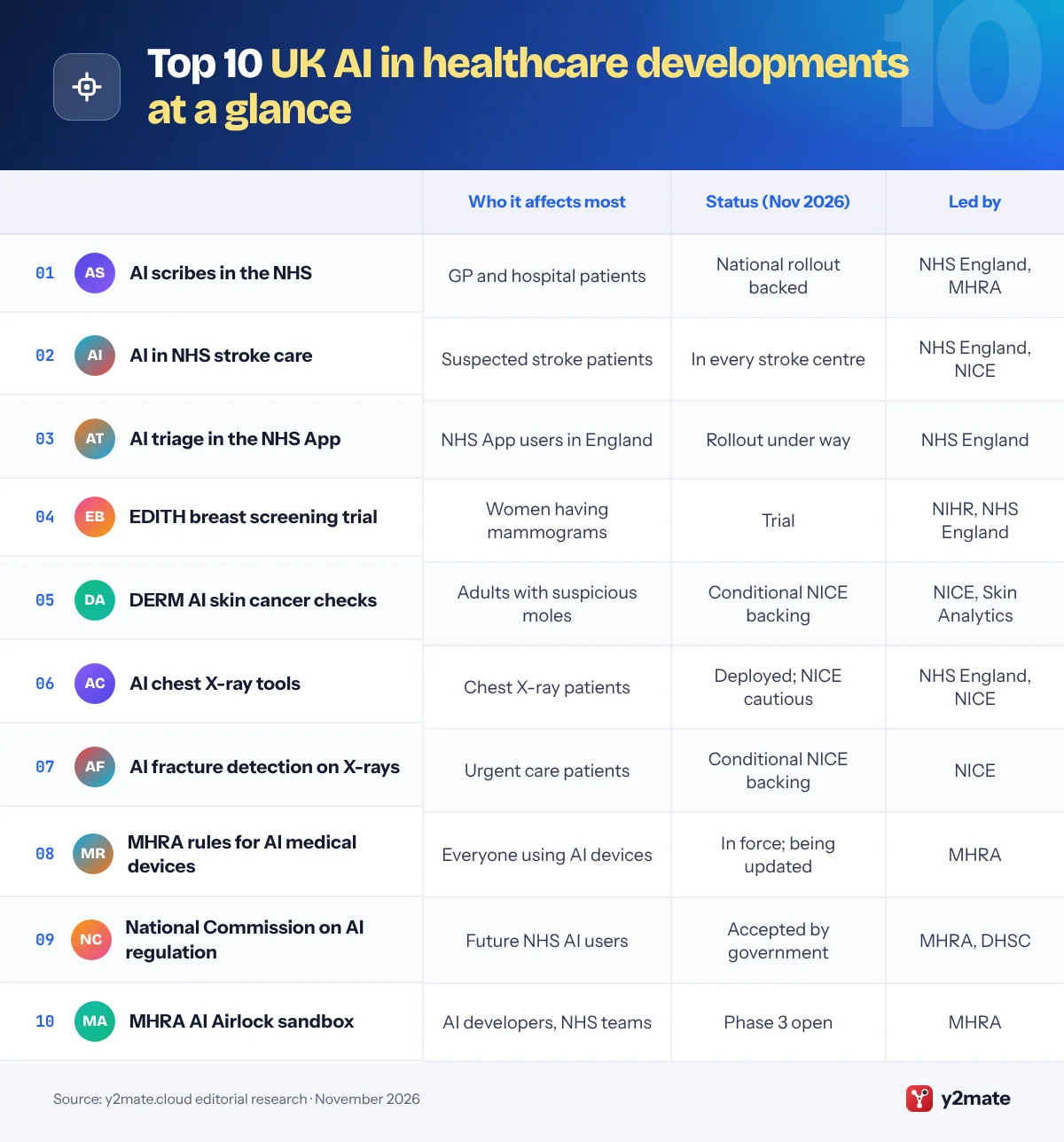
AI in healthcare in the UK is already part of NHS care: it helps stroke teams read brain scans, drafts clinical notes through AI scribes and is being trialled to see whether it can safely help read breast screening mammograms. The ten developments below matter most for patients in November 2026, covering NHS England programmes, NICE assessments of AI tools and how the MHRA regulates AI as a medical device.
Two plain definitions. An early value assessment is a fast NICE review that lets promising digital tools be used in the NHS while more evidence is gathered. Software as a medical device means software, including AI, with a medical purpose such as diagnosing or monitoring disease, which the Medicines and Healthcare products Regulatory Agency (MHRA) regulates.
Health is devolved, so most items apply to England and we flag where Scotland, Wales or Northern Ireland differ. This is a news explainer, not medical advice.
How we ranked this list
We chose and ranked these items by how many patients they could affect, how far along they are (guidance or rules in force, a national rollout, or a trial), and how well documented they are by official sources such as NHS England, GOV.UK, NICE and the MHRA.
We did not test any AI tools and make no claims about their accuracy beyond what official sources state.
The Top 10 Ways AI Is Changing
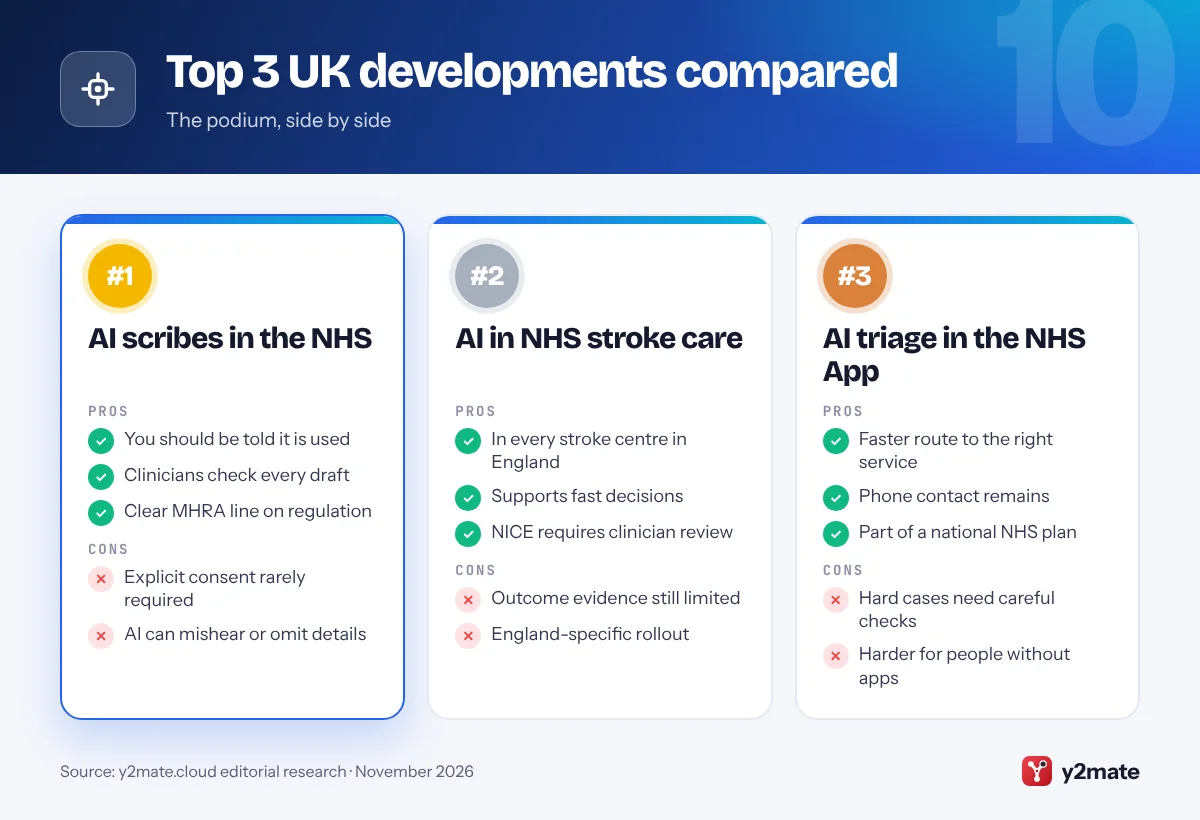
1. AI scribes in the NHS
Best for: patients at GP and hospital appointments
Ambient voice technology (AVT), usually called an AI scribe, listens to a consultation and drafts notes or letters for the clinician to check. The 10 Year Health Plan for England, published in July 2025, commits to scaling the use of AI scribes to cut paperwork, and NHS England has since backed a national rollout.
NHS England’s guidance on ambient scribing, updated in March 2026 with input from the Information Commissioner’s Office and the National Data Guardian, says explicit consent is not usually required when a scribe supports your individual care, but you should be told it is in use and can object. NHS England also runs a self-certified supplier registry.
In July 2026 the MHRA confirmed that scribes used only to transcribe, summarise or draft documents for a clinician to review are not medical devices, while those that support diagnosis or treatment, or take action without clinician review, are regulated as devices. Wales has issued its own interim guidance.
Official site: AI scribes in the NHS
- You should be told when one is used
- Clinicians check every draft
- Clear MHRA line on regulation
- Explicit consent rarely required
- AI can mishear or omit details
2. AI in NHS stroke care
Best for: people treated for a suspected stroke
Stroke care is where AI is most firmly established in the NHS. NHS England says AI decision-support software was rolled out to all stroke centres in England in summer 2024 as part of a national stroke imaging pathway. The software analyses brain scans and highlights findings such as a possible blockage in a large blood vessel, helping teams decide quickly whether a patient may need a clot-removing procedure called thrombectomy.
NICE guidance published in January 2024 says e-Stroke, RapidAI and Viz can be used in the NHS while more evidence is generated, and that the software should always be used with review by a healthcare professional. NICE wants more evidence on outcomes such as time to treatment, and said more research is needed on other products.
For patients and families, the key point is that a stroke specialist still makes the treatment decision. AI support aims to speed up the steps that matter most in the first hours.
Official site: AI in NHS stroke care
- Used in every stroke centre in England
- Supports fast treatment decisions
- NICE requires clinician review
- Evidence on outcomes still limited
- England-specific rollout
3. AI triage in the NHS App
Best for: NHS App users in England
The NHS App is becoming the main digital front door to the NHS in England. The 10 Year Health Plan says that by 2028 patients will be able to get instant advice on non-urgent care, and help finding the right service first time, through a feature called My NHS GP.
In July 2026 NHS England announced it would speed up the rollout of an AI triage tool in the NHS App after a pilot at a GP practice in Sussex. The tool asks about symptoms and points patients to the most suitable option, from a GP appointment or pharmacy to A&E or self-care advice. NHS England says patients will still be able to contact their practice in the usual ways.
Nursing and health leaders have called for strong safety checks, especially for symptoms that are hard to judge and for people who cannot easily use apps. If the app’s advice does not feel right, contact your practice or call NHS 111.
Official site: AI triage in the NHS App
- Faster route to the right service
- Phone and in-person contact remain
- Part of a national NHS plan
- Hard cases need careful checks
- Not ideal for people without apps
4. EDITH breast screening trial
Best for: patients having a mammogram in England
EDITH (Early Detection using Information Technology in Health) is a large NHS trial testing whether AI can safely help read mammograms in the NHS Breast Screening Programme in England. The government announced it in February 2025, with funding through the National Institute for Health and Care Research, and women already booked for routine screening at participating sites can take part.
Each screening mammogram is currently read by two specialists. The trial compares approved AI tools used in different ways, such as giving a first assessment of each image or checking images after a human reader, to see whether AI could safely take on part of that work.
AI is not yet part of routine NHS breast screening: the UK National Screening Committee has not recommended it and has asked for better evidence, which EDITH is designed to provide. Scotland’s GEMINI project in NHS Grampian helped pave the way. Women at participating clinics are given information about the trial and can choose not to take part.
Official site: EDITH breast screening trial
- Tests AI under real NHS conditions
- Experts still read the images
- Could free up radiologist time
- Results are some way off
- Only at participating sites
5. DERM AI skin cancer checks
Best for: adults referred with a worrying mole
DERM, made by the UK company Skin Analytics, is an AI tool that assesses dermoscopic photos of skin lesions for adults referred on the urgent suspected skin cancer pathway. In May 2025 NICE said DERM can be used in NHS teledermatology services during an evidence-generation period, as long as the agreed evidence is being collected and the tool has the required approvals.
DERM can be used on its own or with a healthcare professional checking its result. If it judges a lesion benign, the patient may be discharged from the urgent pathway; if it flags possible cancer or pre-cancer, a dermatologist reviews the case. NICE says more evidence is needed on accuracy for people with black or brown skin, requires a healthcare professional review for them, and asks for regular monitoring of DERM’s performance.
If you are referred with a worrying mole, ask whether AI is part of your assessment and how results are checked. See your GP again if a lesion changes.
Official site: DERM AI skin cancer checks
- Can speed up urgent skin referrals
- Dermatologist reviews flagged cases
- Safeguards for darker skin
- Conditional, evidence still growing
- Accuracy on darker skin unproven
6. AI chest X-ray tools
Best for: patients having a chest X-ray
AI is increasingly used to help read chest X-rays in the NHS. In 2023 the government launched the AI Diagnostic Fund to help NHS imaging networks in England buy and deploy AI tools for chest X-rays and CT scans, including tools that flag possible lung cancer so urgent cases can be prioritised. An independent rapid evaluation has been tracking how the tools are introduced and notes that staff still review every scan.
NICE is more cautious. Its early value assessment of AI software for chest X-rays in people referred from primary care with suspected lung cancer says the software should not be used for clinical decision-making in the NHS until more evidence is available. Centres already using it can continue within an evaluation framework and with clinician review.
So if your X-ray is read with AI support, a radiologist or reporting radiographer remains responsible for your report. Evidence from NHS services using the tools will shape NICE’s next recommendations.
Official site: AI chest X-ray tools
- Can prioritise urgent findings
- Staff still review every scan
- Being independently evaluated
- NICE says evidence is not enough
- Use varies between hospitals
7. AI fracture detection on X-rays
Best for: visitors to urgent treatment centres
Missed fractures are a known problem in busy urgent care settings, and AI can act as a second pair of eyes. In January 2025 NICE published an early value assessment saying some AI tools can be used in the NHS to help healthcare professionals detect fractures on X-rays in urgent care while more evidence is generated. NICE said the evidence suggests the tools may improve the accuracy of fracture detection, and that clear local protocols are needed. Another tool was recommended only for research.
Early value assessment recommendations are conditional. NICE wants more data on accuracy with and without AI, on software failure rates and on how the tools perform across different groups of patients. The tools support, rather than replace, the clinician reading the X-ray.
For patients, this is a practical use of AI: at a minor injuries unit or urgent treatment centre, AI may flag a possible fracture for the clinician reviewing your X-ray.
Official site: AI fracture detection on X-rays
- A second check on X-rays
- Conditional NICE support
- Clinician makes the final call
- Evidence gaps remain
- Not used in every urgent care unit
8. MHRA rules for AI medical devices
Best for: understanding how AI tools are approved
In Great Britain, AI software with a medical purpose, such as diagnosing or monitoring disease, is regulated as a medical device by the MHRA. Through its Software and AI as a Medical Device Change Programme, the MHRA has been updating guidance on how the rules apply, from describing an AI tool’s intended purpose to managing changes after launch.
Stronger post-market surveillance rules came into force in Great Britain in June 2025, requiring manufacturers to monitor devices in use and report serious incidents. With US and Canadian regulators, the MHRA has also published guiding principles for predetermined change control plans, which let makers set out in advance how an AI model will be updated. In July 2026 it clarified where AI scribes sit under device law.
Northern Ireland follows EU device rules under the Windsor Framework. If you think an AI tool or health app has gone wrong or caused harm, you can report it through the MHRA’s Yellow Card scheme.
Official site: MHRA rules for AI medical devices
- Medical AI must meet device rules
- Stronger monitoring after launch
- Public Yellow Card reporting
- Some reforms still in progress
- Different rules in Northern Ireland
9. National Commission on AI regulation
Best for: following the future of NHS AI rules
The MHRA launched the National Commission into the Regulation of AI in Healthcare in September 2025 to advise on a new rulebook for AI in health and care. Its recommendations, published on 10 September 2026, argue that oversight should be more proportionate, cover a tool’s whole life cycle and share responsibility across the health system, not just the regulator.
Ideas include staged authorisation, which the Commission likened to learner-driver L-plates, so promising AI tools can be introduced in steps while evidence builds, along with stronger MHRA powers and interim guidance on liability when AI is involved in care. The government published its response on 6 October 2026, accepting all of the recommendations and setting out initial priorities.
Nothing changes overnight for patients, but this is the blueprint for how AI in NHS care will be approved and monitored in the years ahead. The MHRA has published plain-English explainers on what the recommendations mean for patients.
Official site: National Commission on AI regulation
- Accepted in full by government
- Covers all four UK nations
- Patient explainers published
- Most changes still to come
- Detailed timelines not yet set
10. MHRA AI Airlock sandbox
Best for: seeing how new AI rules get tested
AI Airlock is the MHRA’s regulatory sandbox for AI-enabled medical devices, where companies, NHS teams and regulators work through real regulatory problems together. After a pilot that closed in April 2025, a second phase completed in 2026 and covered technologies including AI note-taking, cancer diagnostics, eye disease detection and obesity treatment support. Its report highlighted the value of monitoring AI tools after launch and managing updates through predetermined change control plans.
The Department of Health and Social Care has allocated funding to run the programme from 2026 to 2029, and a third phase opened for applications in October 2026, focusing on post-market surveillance and oversight across a device’s life cycle.
The Airlock is not an approval route: products in it still have to meet medical device rules. Its value for patients is indirect, helping the MHRA write clearer, evidence-based rules so that safe AI tools reach the NHS sooner and problems are caught earlier.
Official site: MHRA AI Airlock sandbox
- Tests rules on real AI products
- Funded to 2029
- Feeds into clearer guidance
- Not an approval route
- Little direct patient impact yet
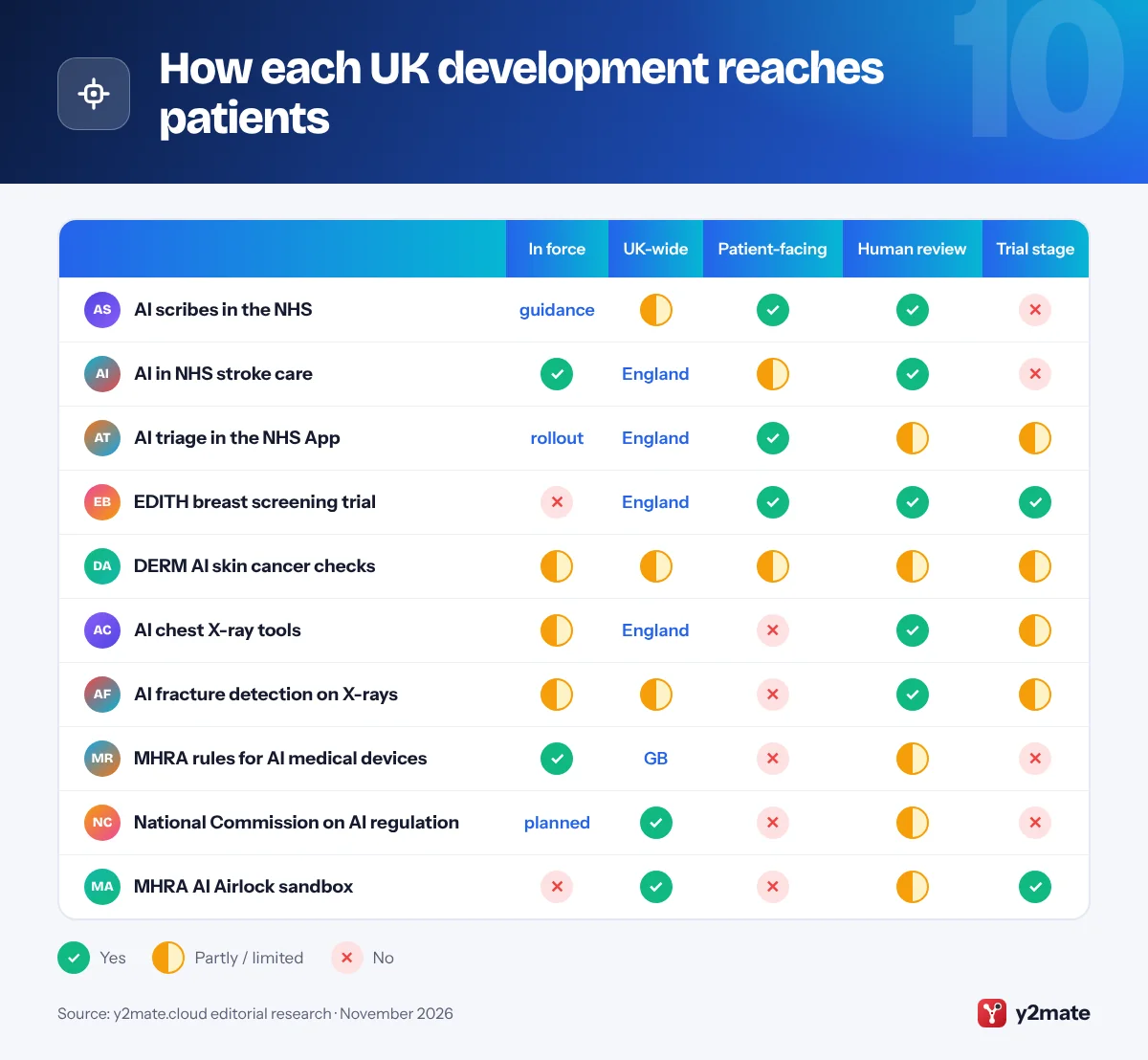
How each UK development reaches patients
AI in healthcare UK: what it means for you as a patient
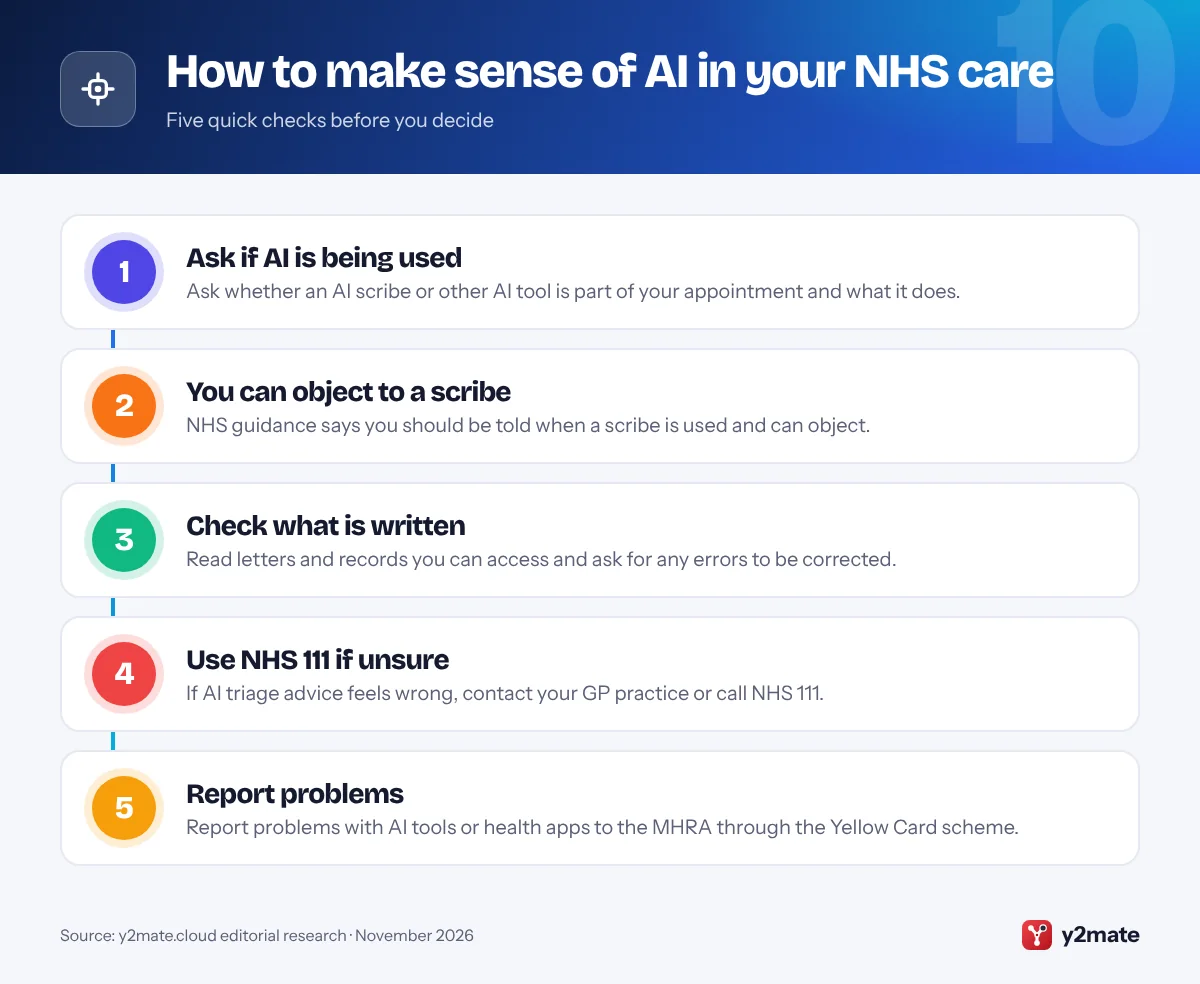
Most AI in NHS care works in the background, supporting clinicians rather than talking to you directly. These habits help you stay informed.
At appointments
- Expect to be told: if an AI scribe is used, NHS England guidance says you should be informed and can object.
- Check your records: you may be able to see your GP record and some letters in the NHS App, and under UK GDPR you can ask for inaccurate information to be corrected.
- Ask about scans and screening: if your X-ray is read with AI support or you are invited to the EDITH trial, ask how a clinician checks the result.
Using the NHS App and online tools
- Treat triage as guidance: AI triage points you to a service but does not diagnose you. Call 999 in an emergency and NHS 111 if you are unsure.
- Be wary of unregulated apps: apps that diagnose or monitor conditions should be regulated as medical devices, and general chatbots are no substitute for a clinician.
If something goes wrong
- Report it: use the MHRA Yellow Card scheme for problems with AI tools or medical apps, and raise concerns with the service involved.
- Remember the nations differ: health is devolved, so arrangements in Scotland, Wales and Northern Ireland can differ from England.
Frequently asked questions
Can my doctor use an AI scribe without telling me?
You should be told. NHS England guidance says patients should be informed when an ambient scribe is used and can object, although explicit consent is not usually required when it supports your individual care. If you object, your wishes should be respected. The guidance covers England; Wales has its own interim guidance.
Is AI used to read my NHS mammogram?
Not as part of routine NHS breast screening in England, where two specialists read each mammogram. The EDITH trial is testing whether approved AI tools can safely help, and women at participating sites may take part. The UK National Screening Committee has not yet recommended routine use of AI in breast screening and wants better evidence first.
Is the AI triage in the NHS App safe to use?
It is being rolled out after a pilot, and NHS England says it is designed to point you to the right service, from self-care to A&E. It gives guidance on where to go, not a diagnosis, and you can still contact your GP practice in the usual ways. If symptoms are serious, call 999; if you are unsure, call NHS 111.
Who regulates AI in the NHS?
Several bodies share the job. The MHRA regulates AI with a medical purpose as a medical device, NICE assesses whether tools offer value to the NHS, NHS England sets guidance on adopting them, and the ICO oversees data protection. In October 2026 the government accepted the National Commission's recommendations for a more joined-up, lifecycle approach.
Will AI replace my doctor in the NHS?
No. In the uses covered here, AI supports clinicians: NICE says stroke software should always be used with professional review, AI scribes produce drafts that clinicians check, and staff still review chest X-rays read with AI. One partial exception is DERM, which NICE allows to discharge some low-risk skin lesions without specialist review, with safeguards.
Final verdict
AI in healthcare in the UK is moving from pilots to everyday NHS use, led by AI scribes, stroke imaging software and AI triage in the NHS App, while EDITH tests whether AI can safely help with breast screening. Regulation is catching up: the MHRA has clarified the rules for AI scribes, and the government has accepted the National Commission’s plan for lifecycle oversight of AI.
This article is general information, not medical advice: talk to your GP or clinician about your own care.
Sources and further reading
- MHRA guidance on AI scribes: The MHRA's July 2026 guidance explaining when ambient voice technology products, including AI scribes, are regulated as medical devices.
- 10 Year Health Plan for England: The government's plan for the NHS in England, including its commitments on the NHS App, My NHS GP and AI scribes.
- Government response to the Commission: The October 2026 government response accepting the National Commission's recommendations on regulating AI in healthcare.
- What the recommendations mean for you: Plain-English explainers from the MHRA on what the National Commission's recommendations mean for patients, providers and industry.
- MHRA Yellow Card scheme: The official UK system for reporting problems with medicines, medical devices and health apps, including AI-enabled software.

Leave a Reply