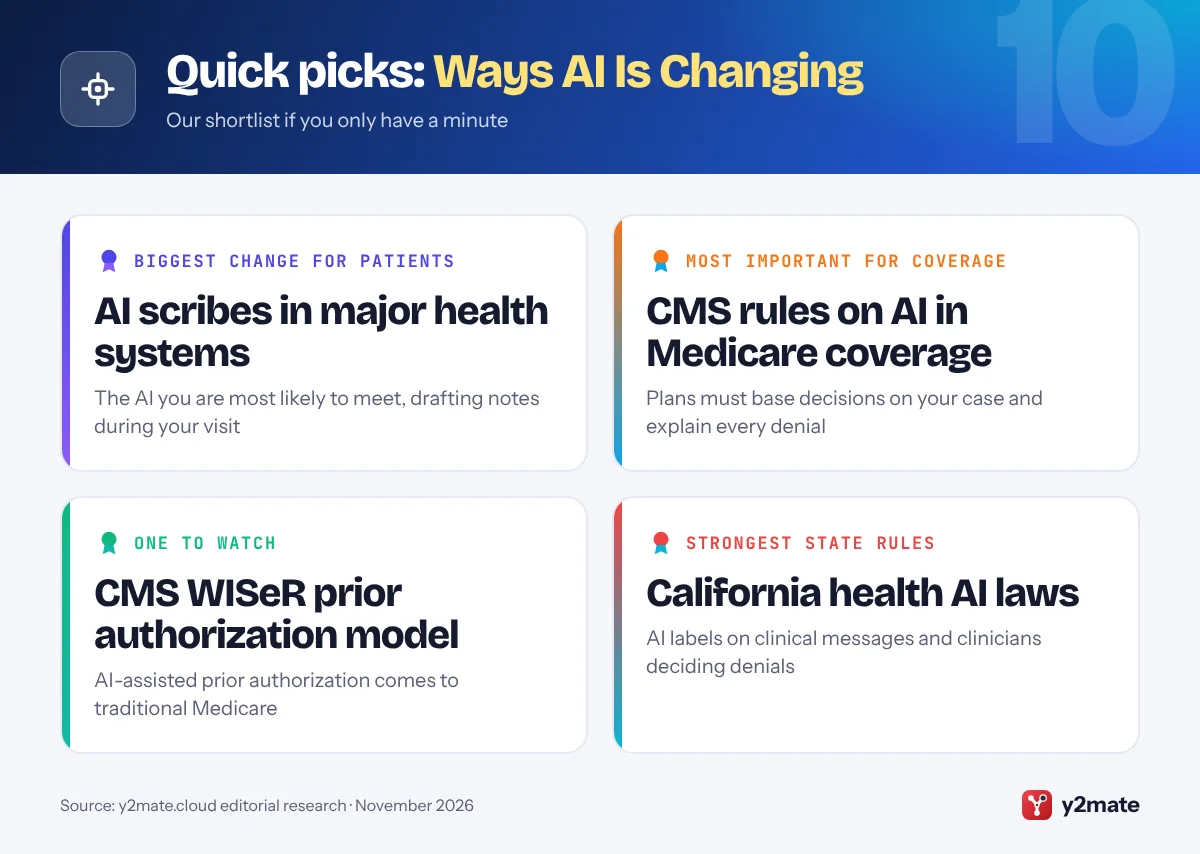
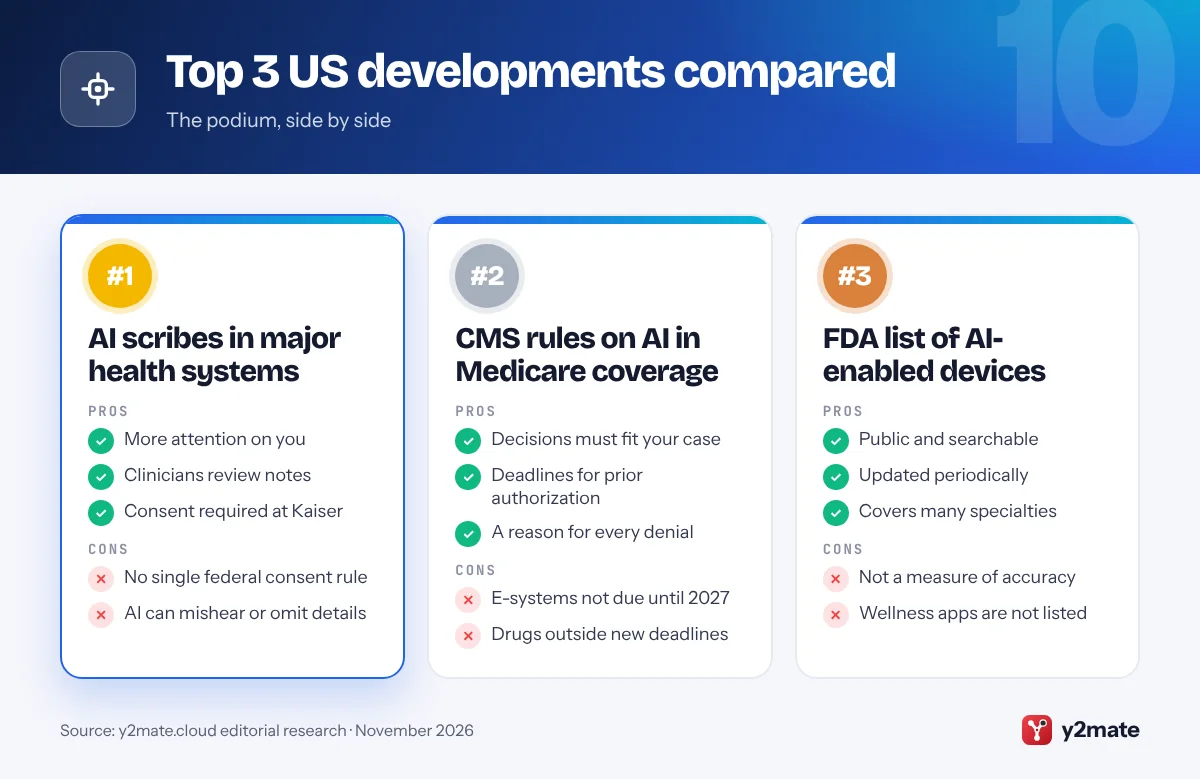
- Ambient AI scribes that draft clinical notes are used in large US health systems such as Kaiser Permanente, which says its tool requires patient consent and clinician review of every note.
- CMS says Medicare Advantage plans may use AI to help with coverage decisions but must base medical necessity decisions on each patient's individual circumstances.
- Since January 2026, Medicare Advantage, Medicaid and CHIP plans must meet set deadlines for prior authorization decisions and give a specific reason for denials.
- CMS's WISeR model uses AI-assisted prior authorization in traditional Medicare in six states from 2026 to 2031, with licensed clinicians deciding all non-payment recommendations.
- California, Texas, Illinois, Nevada and Utah have passed laws on AI in health care covering disclosure to patients, insurer decisions and AI therapy chatbots.
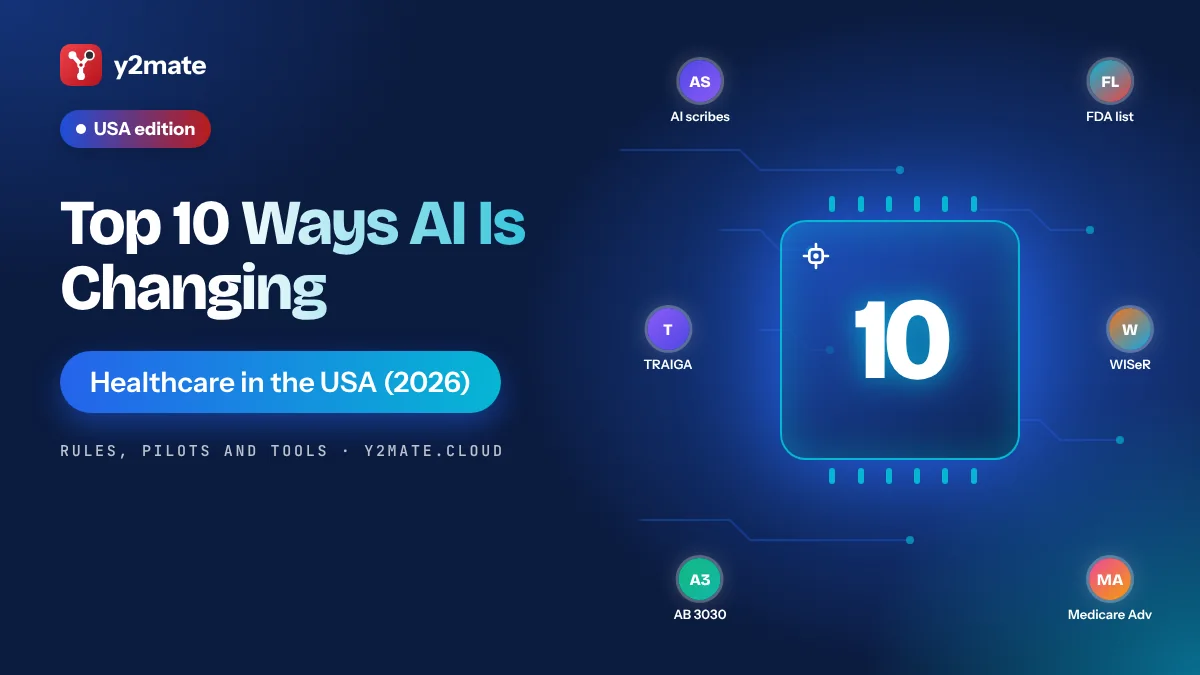
AI in healthcare in the USA is no longer a future idea: it already drafts doctors’ notes, helps read scans and supports insurers reviewing prior authorization requests, while federal agencies and states write the rules as they go. The ten developments below matter most for patients in November 2026, from ambient AI scribes and FDA oversight of AI-enabled medical devices to CMS limits on AI in Medicare coverage decisions and new state laws in California, Texas and Illinois.
Some plain definitions. An AI scribe, or ambient listening tool, listens to a visit and drafts the clinical note for the clinician to check. Prior authorization is when an insurer must approve a test or treatment before it will pay. An AI-enabled medical device uses AI for a medical purpose, such as spotting signs of disease on an image, and is regulated by the Food and Drug Administration (FDA).
This is a news explainer, not medical or legal advice, and each status is given as of November 2026.
How we ranked this list
We chose and ranked these items by how many patients they could affect, how far along they are (a rule in force, a system-wide rollout, or a pilot or trial), and how well documented they are by official sources such as fda.gov, cms.gov, healthit.gov, state legislatures and the health systems themselves.
We did not test any AI tools and make no claims about how accurate or effective any product is.
The Top 10 Ways AI Is Changing
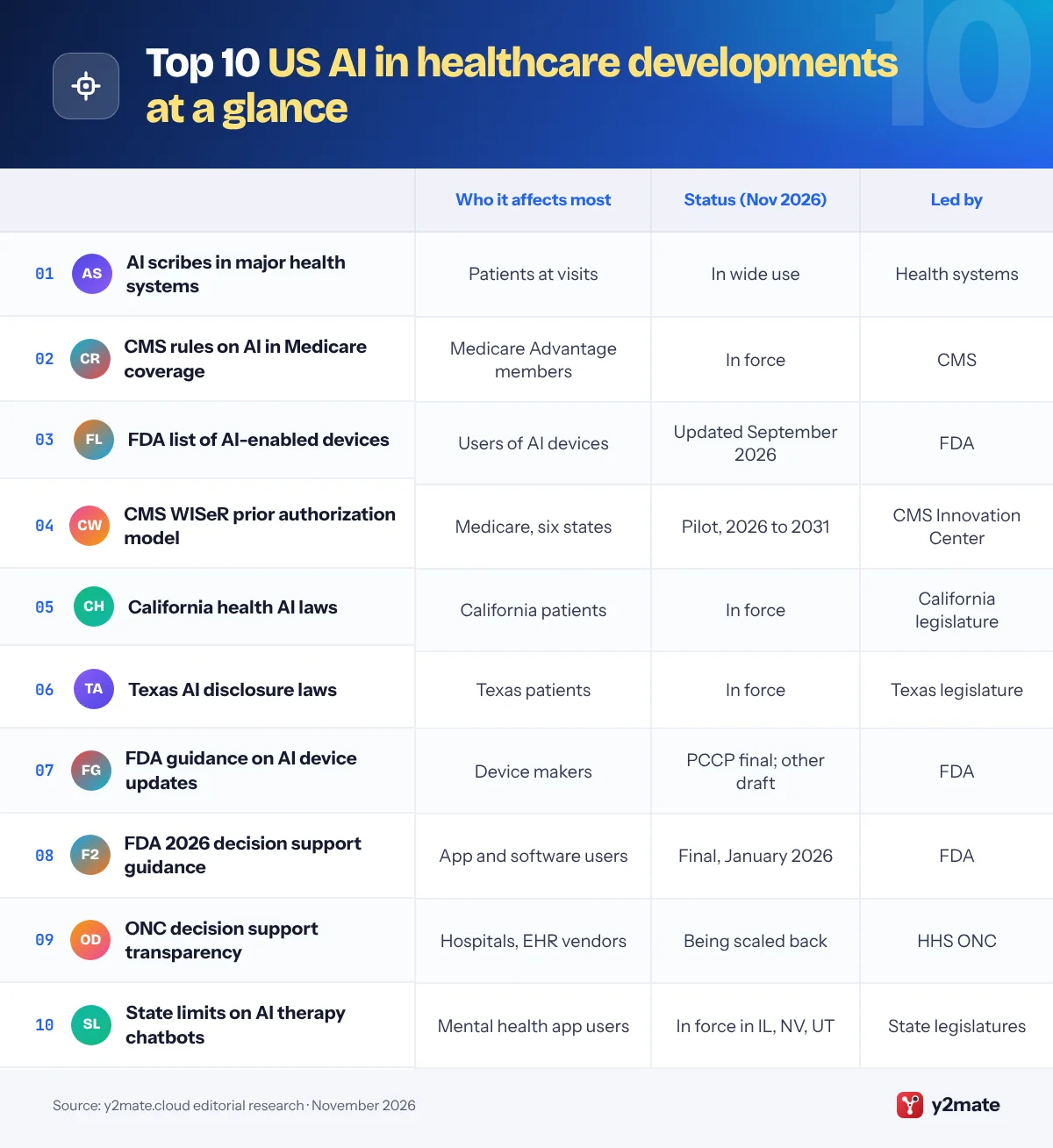
1. AI scribes in major health systems
Best for: patients at routine doctor visits
The AI most patients will meet first is the ambient AI scribe: software that listens to a visit and drafts the clinical note. Kaiser Permanente announced in August 2024 that it had made Abridge’s assisted clinical documentation tool available across its hospitals and medical offices, saying the tool requires patient consent and that clinicians review notes before they enter the medical record. The Department of Veterans Affairs has also been expanding ambient AI scribes after pilots, and many other health systems use similar products.
There is no single federal consent rule for AI scribes. Vendors that handle patient information for a provider work under HIPAA, usually as business associates, while state recording, privacy and AI disclosure laws vary.
The note remains your clinician’s responsibility. AI can mishear or leave things out, so read your visit summary in your patient portal and ask for a correction if something is wrong.
Official site: AI scribes in major health systems
- More attention on you, less on typing
- Clinicians review notes before filing
- Consent required at Kaiser Permanente
- No single federal consent rule
- AI can mishear or omit details
2. CMS rules on AI in Medicare coverage
Best for: Medicare Advantage and Medicaid patients
Health insurers increasingly use algorithms to help review prior authorization requests and other coverage decisions. In a February 2024 FAQ on its 2024 Medicare Advantage rule, the Centers for Medicare & Medicaid Services (CMS) said plans may use algorithms and AI to assist coverage decisions, but must base medical necessity decisions on the individual patient’s circumstances, such as their medical history, their doctor’s recommendations and clinical notes, not on predictions from a larger data set alone.
A separate CMS prior authorization rule started to apply in January 2026. Medicare Advantage plans and Medicaid and CHIP programs must decide urgent requests within 72 hours and standard requests within seven calendar days, and these payers, along with federal Marketplace plans, must give a specific reason for any denial. Electronic prior authorization systems are due from January 2027, and the rule does not apply to drugs.
If a plan denies care, you can appeal, and the stated reason should help you and your doctor respond.
Official site: CMS rules on AI in Medicare coverage
- Decisions must fit your own case
- Set deadlines for prior authorization
- A specific reason for every denial
- Electronic systems not due until 2027
- Drugs are outside the new deadlines
3. FDA list of AI-enabled devices
Best for: checking if an AI tool is FDA-authorized
Many AI tools used in US hospitals are regulated as medical devices by the FDA. The agency publishes a searchable list of AI-enabled medical devices authorized for marketing in the United States and updates it periodically; it was last refreshed in September 2026. The FDA stresses that it regulates medical devices that use AI, not AI as such, reviewing them through routes such as 510(k) clearance, De Novo classification and premarket approval.
Examples the FDA gives include imaging software that provides diagnostic information about skin cancer, systems that detect diabetic retinopathy from images of the retina, and algorithms that automate insulin dosing based on continuous glucose monitor readings.
For patients, the list is a practical check: if a company or app says a tool is FDA-cleared, you can look it up. Being listed is not a ranking of accuracy, and general wellness apps and most chatbots are not on it.
Official site: FDA list of AI-enabled devices
- Public and searchable
- Updated periodically
- Covers many medical specialties
- Not a measure of accuracy
- Wellness apps are not listed
4. CMS WISeR prior authorization model
Best for: Medicare patients in the six pilot states
WISeR, short for Wasteful and Inappropriate Service Reduction, is a CMS Innovation Center model that brings technology-assisted prior authorization to traditional Medicare. It runs from January 1, 2026 to December 31, 2031 in Arizona, New Jersey, Ohio, Oklahoma, Texas and Washington. Participating technology companies use AI and machine learning to help review requests for a set list of services CMS considers prone to overuse, such as knee arthroscopy for osteoarthritis.
CMS says coverage for people with Medicare does not change, emergency and inpatient-only services are excluded, and all recommendations for non-payment are decided by appropriately licensed clinicians, not by software alone. Providers who skip prior authorization for listed services face review before payment.
The model is controversial: physician groups and some members of Congress have raised concerns about delays, and a bill has been introduced to stop it. If you live in one of these states, ask your provider whether prior authorization applies to your treatment.
Official site: CMS WISeR prior authorization model
- Licensed clinicians decide denials
- Medicare coverage rules unchanged
- Emergency services excluded
- Adds prior authorization in six states
- Critics fear delays in care
5. California health AI laws
Best for: patients and plan members in California
California has passed several laws aimed squarely at AI in health care. AB 3030, in force since January 1, 2025, requires health facilities, clinics and physician practices that use generative AI to write patient communications about clinical information to include a disclaimer saying so, plus clear instructions for reaching a human provider. Messages that a licensed or certified provider has read and reviewed are exempt.
SB 1120, the Physicians Make Decisions Act, also took effect on January 1, 2025. It requires that health plan and disability insurer decisions to deny, delay or modify care on medical necessity grounds be made by a licensed physician or other qualified health professional, not an algorithm, and that AI tools draw on the patient’s own records.
AB 489, in force since January 1, 2026, bars AI systems from using terms or phrases suggesting that care or advice comes from a licensed health professional when it does not. Licensing boards can enforce it.
Official site: California health AI laws
- AI labels on clinical messages
- Clinicians decide necessity denials
- Bans AI posing as licensed staff
- Only applies in California
- Reviewed messages need no label
6. Texas AI disclosure laws
Best for: patients seeing providers in Texas
Texas now requires practitioners to tell patients when AI is used in their care. SB 1188, effective September 1, 2025, allows licensed practitioners to use AI for diagnostic purposes within the scope of their license, provided they review AI-generated content or recommendations before making a clinical decision and disclose the use of AI to patients. The law also requires electronic health records to be stored in the United States from January 1, 2026.
The Texas Responsible Artificial Intelligence Governance Act, HB 149, often called TRAIGA, took effect on January 1, 2026. Among other things, it requires health care providers to give patients, or their personal representatives, a clear written disclosure when AI is used in their diagnosis or treatment, before or at the time of service.
A December 2025 executive order directed federal officials to challenge some state AI laws, but it does not by itself cancel them.
Official site: Texas AI disclosure laws
- Written disclosure of AI use
- Practitioners must review AI output
- Covers diagnosis and treatment
- Only applies in Texas
- Notices can be easy to overlook
7. FDA guidance on AI device updates
Best for: understanding how AI devices get updated
AI software can be retrained and improved after it reaches the market. In December 2024 the FDA issued final guidance on predetermined change control plans (PCCPs) for AI-enabled device software functions. A PCCP lets a manufacturer describe in advance the changes it intends to make, how it will test them and how it will assess their impact. Changes made in line with an authorized plan do not need a new marketing submission.
In January 2025 the FDA also published draft guidance on managing AI-enabled device software across its whole life cycle, covering marketing submissions and monitoring once a device is in use. As of November 2026 it was still a draft, and the FDA has listed it among the final guidances it plans for fiscal year 2027.
For patients, the point is that an FDA-authorized AI tool may change over time, but only within limits the agency has agreed.
Official site: FDA guidance on AI device updates
- Lets tools improve within set limits
- Changes must be described upfront
- Supports monitoring after launch
- Life cycle guidance still a draft
- Hard for patients to track changes
8. FDA 2026 decision support guidance
Best for: users of wearables and clinical software
On January 6, 2026, the FDA issued updated final guidance on clinical decision support (CDS) software and on general wellness products, replacing earlier versions with immediate effect. CDS software suggests options to clinicians, such as flagging a possible drug interaction.
Under the updated CDS guidance, the FDA intends to use enforcement discretion for some software that gives a single recommendation, as long as it meets the other criteria for software not regulated as a device, chiefly that a clinician can independently review the basis for the recommendation. The wellness guidance gives consumer wearables more room to estimate measures such as blood pressure, provided they make wellness claims and do not diagnose disease.
Supporters say the changes cut red tape; some critics worry more AI tools will reach clinics and consumers without FDA review. Either way, some AI advice in apps, wearables and clinical software has not been reviewed by the FDA, so treat it as information to discuss with a clinician.
Official site: FDA 2026 decision support guidance
- Clearer line on what FDA reviews
- Clinicians must see the reasoning
- More room for wellness wearables
- More tools skip FDA review
- Wellness labels can confuse users
9. ONC decision support transparency
Best for: patients curious about hospital risk scores
Electronic health record (EHR) systems increasingly include predictive tools, for example alerts that estimate a patient’s risk of sepsis or readmission. Under the HTI-1 rule from the Office of the National Coordinator for Health Information Technology (ONC), part of HHS, certified EHR software had to support a new decision support interventions standard by the end of 2024. It required developers to let clinicians see plain-language source information about the predictive tools they supply, such as how a model was developed and tested.
That approach is now being scaled back. In October 2026 ONC finalized its deregulatory HTI-5 rule, which removes the detailed source-information requirements and related risk-management requirements for predictive tools from the certification criterion.
Hospitals can still ask vendors for this information, and other federal rules, including civil rights law, still apply. If you want to know whether a risk score shaped your care, ask your care team.
Official site: ONC decision support transparency
- Brought AI transparency into EHRs
- Plain-language model information
- Other federal rules still apply
- Key requirements being removed
- Little of it is visible to patients
10. State limits on AI therapy chatbots
Best for: anyone using mental health chatbots
Mental health is where states have moved fastest to restrict AI. Illinois enacted the Wellness and Oversight for Psychological Resources Act in August 2025. It bars anyone from offering therapy or psychotherapy, including through AI, unless a licensed professional provides it, and stops licensed professionals from letting AI make independent therapeutic decisions or communicate therapeutically with clients. AI can still help with administrative tasks such as scheduling and billing.
Nevada’s AB 406, in force since July 1, 2025, bars AI systems from providing, or claiming to provide, professional mental or behavioral health care. Utah’s HB 452 took a different approach in 2025, allowing mental health chatbots but requiring them to disclose that they are AI and follow rules on advertising and health data.
Federally, the FDA’s Digital Health Advisory Committee met in November 2025 to discuss generative AI mental health devices. A wellbeing chatbot is not a therapist: in a crisis, call or text 988.
Official site: State limits on AI therapy chatbots
- Stops AI posing as a therapist
- Admin uses still allowed
- Utah requires AI disclosure
- Only a few states have rules
- General chatbots remain widely used
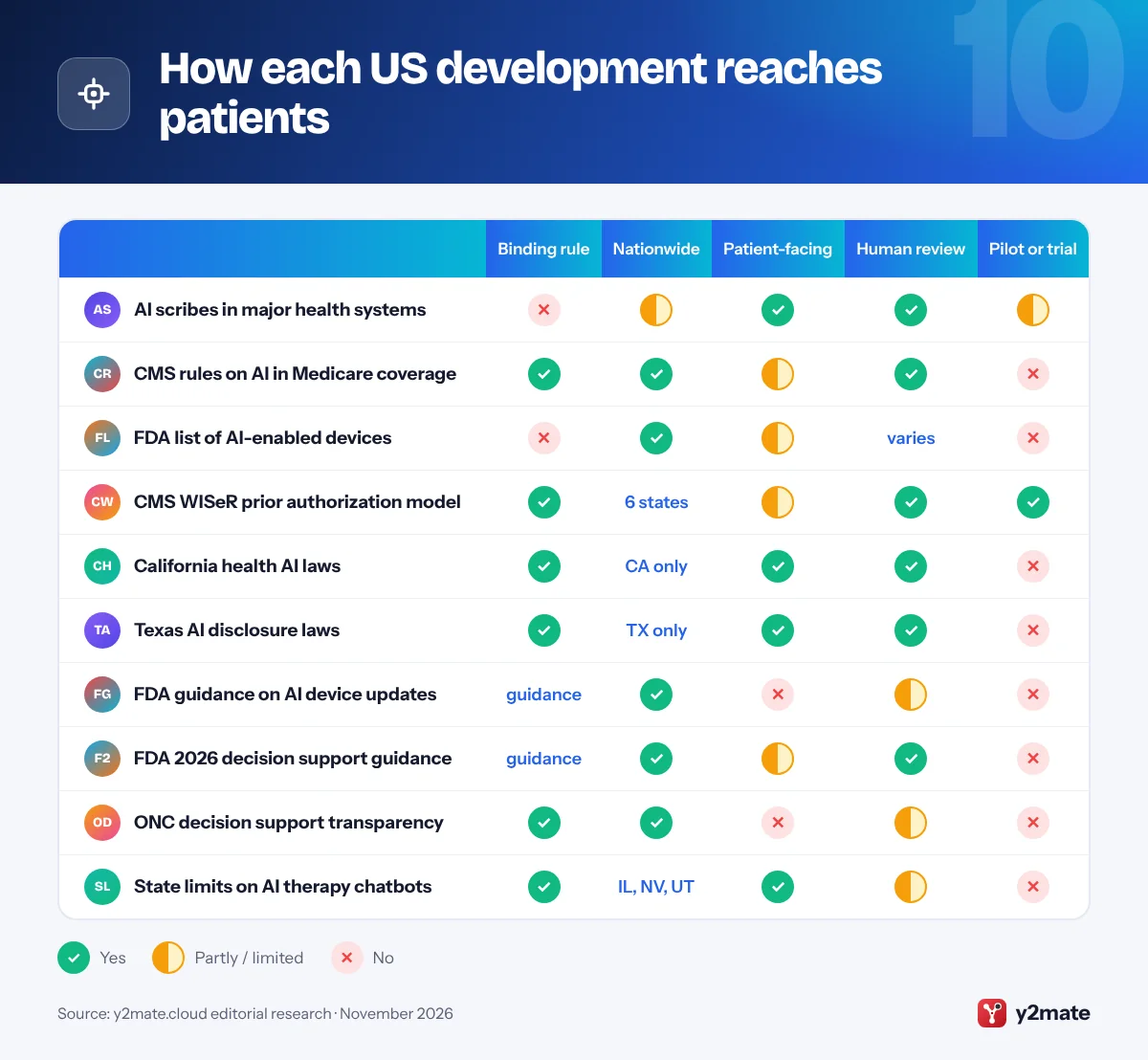
How each US development reaches patients
What AI in healthcare means for you as a patient
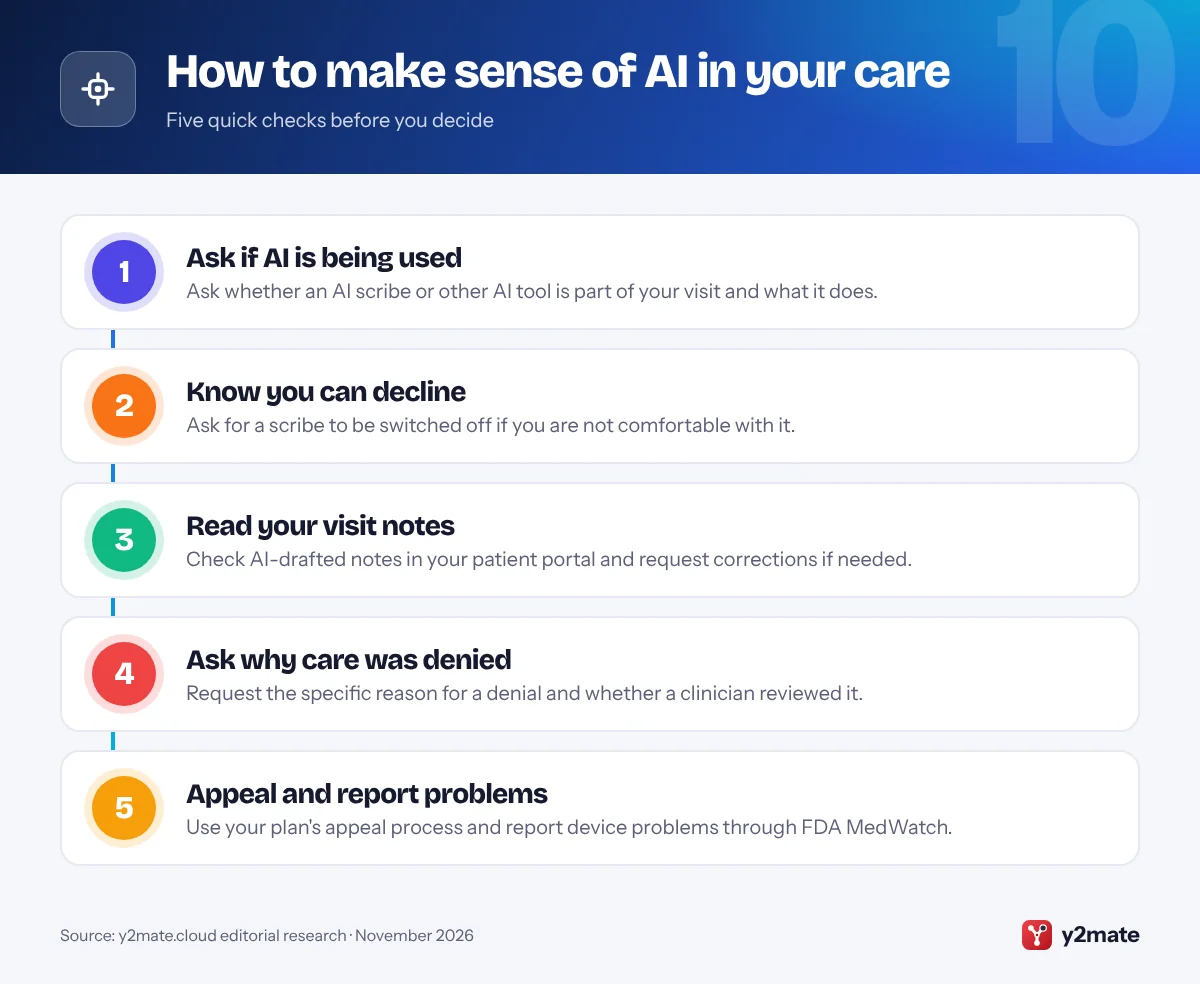
A few habits cover most of the places where AI in healthcare now touches your care.
At appointments
- Ask about scribes: if a phone or microphone is on, ask whether an AI scribe is listening, how the transcript is stored and whether you can say no.
- Check your notes: read visit summaries in your patient portal. Under HIPAA you can ask your provider to amend information you think is wrong.
- Look for disclosures: in California, AI-written clinical messages that a clinician has not reviewed must say so, and Texas providers must disclose AI used in your diagnosis or treatment.
With insurers
- Ask for the reason: Medicare Advantage, Medicaid and CHIP plans must now give a specific reason when they deny prior authorization.
- Appeal: Medicare Advantage coverage decisions must reflect your individual circumstances, not just an algorithm’s prediction, and denials can be appealed.
With apps and chatbots
- Check FDA status: if an app claims to diagnose a condition, search the FDA’s list of AI-enabled devices.
- Protect your data: many consumer health apps are not covered by HIPAA, so read the privacy policy before sharing symptoms.
- Get human help in a crisis: chatbots are not therapists; call or text 988.
To report a problem with a medical device, including AI software, use the FDA’s MedWatch program.
Frequently asked questions
Can my doctor use an AI scribe without telling me?
There is no single federal rule on AI scribes, so it depends on your state and provider. Kaiser Permanente says its scribe requires patient consent, some states require everyone's consent before a conversation is recorded, and Texas requires providers to disclose AI used in diagnosis or treatment. You can always ask whether a scribe is on and ask for it to be switched off.
Is AI deciding whether my insurance covers my treatment?
Insurers may use AI tools to help review requests, but rules limit how. CMS says Medicare Advantage plans must base medical necessity decisions on your individual circumstances, not an algorithm's prediction alone. In California, only a licensed physician or qualified health professional can deny care on medical necessity grounds. You can ask for the specific reason for a denial and appeal.
Does the FDA approve AI tools used in healthcare?
Only some. AI software intended to diagnose, treat or prevent disease is usually regulated as a medical device and needs FDA authorization, and the FDA publishes a list of AI-enabled devices. General wellness apps, most chatbots and some decision support tools that let clinicians check the reasoning fall outside FDA review, particularly after guidance updated in January 2026.
Are AI therapy chatbots legal in the US?
It depends on the state. Illinois and Nevada have banned AI from providing therapy or professional mental health care, while Utah allows mental health chatbots if they disclose that they are AI and follow data rules. A chatbot is not a licensed therapist; if you are in crisis, call or text 988.
How can I tell if a message from my doctor was written by AI?
In California, providers that send AI-generated messages about your clinical information must include a disclaimer and explain how to reach a human, unless a licensed clinician reviewed the message first. Texas requires written disclosure when AI is used in your diagnosis or treatment. Elsewhere there is no general rule, so ask your provider how AI is used in portal messages.
Final verdict
AI in healthcare in the USA is moving faster than the rules around it. For most patients, the changes that matter now are AI scribes in the exam room and AI-assisted coverage decisions, which federal rules say must reflect your individual circumstances and involve licensed clinicians when care is denied. FDA oversight, state disclosure laws and the WISeR pilot will shape what comes next.
This article is general information, not medical advice: talk to your clinician about your own care.
Sources and further reading
- FDA draft AI device guidance: The FDA's draft guidance on managing AI-enabled device software across its life cycle, including what makers should tell users.
- FDA MedWatch reporting: How patients and clinicians can report problems with medical devices, including AI-enabled software, to the FDA.
- Medicare appeals: Official Medicare guidance on how to appeal a coverage or payment decision, including in Medicare Advantage plans.
- HTI-1 final rule: ONC's page on the HTI-1 rule that introduced transparency requirements for AI and predictive decision support in certified health IT.
- 988 Suicide and Crisis Lifeline: Free, confidential support by call, text or chat in the US for anyone in emotional distress or a mental health crisis.

Leave a Reply