
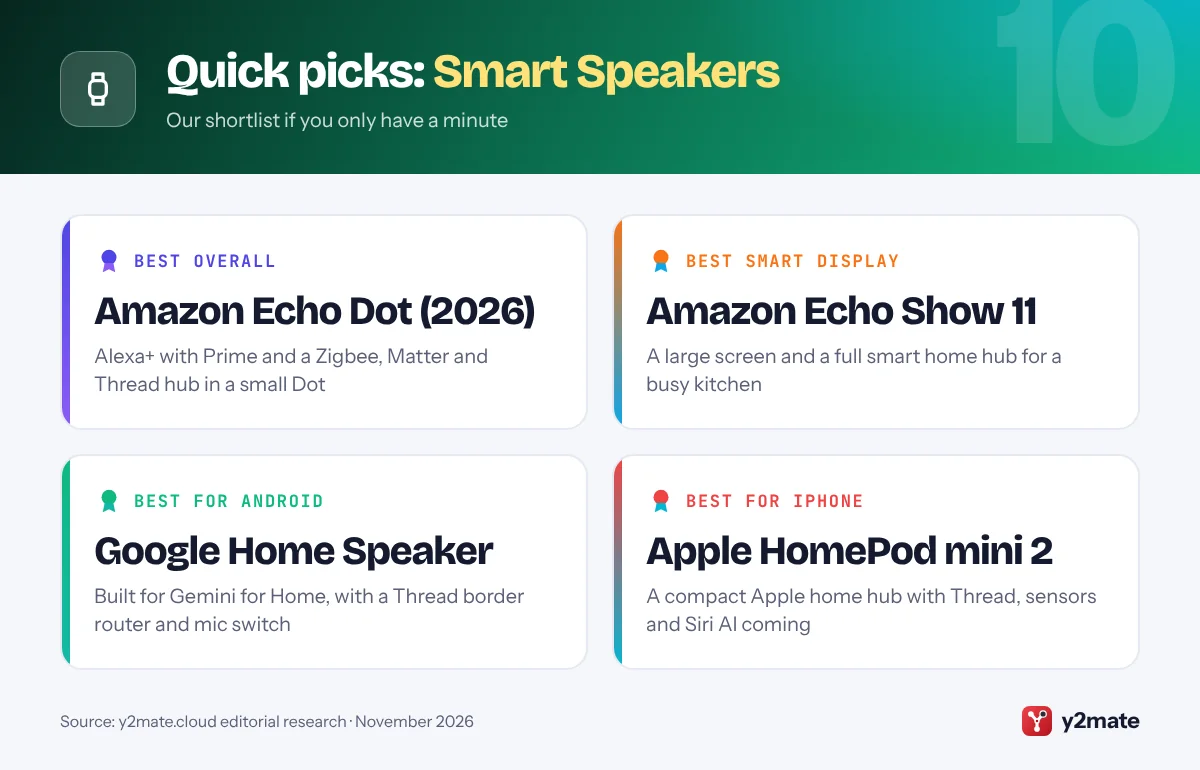
- The new Amazon Echo Dot, the Echo Show 11 and the Google Home Speaker are the strongest smart speakers in the USA for most homes in 2026, while HomePod mini 2 and HomeView lead for iPhone users.
- Alexa+ is available to all US customers and is included with Amazon Prime, while people without Prime can pay for a standalone subscription.
- Google is replacing Google Assistant with Gemini for Home on its speakers and displays, and a home that switches to Gemini cannot switch back.
- Smart speakers generally cannot dial 911 themselves, although HomePod can place the call through a linked iPhone and Amazon sells a paid Alexa Emergency Assist service.
- Since March 2025, Echo voice requests are always processed in Amazon's cloud, so the key privacy controls are the microphone button and the choice not to save recordings.
The best smart speakers in the USA in 2026 are the new Amazon Echo Dot for most homes, the Amazon Echo Show 11 if you want a screen, and the Google Home Speaker for Android households that want Gemini. Apple’s HomePod mini 2 and the new Apple HomeView display are the picks for iPhone homes, while the Echo Studio, Echo Dot Max, Google Nest Hub (2nd gen), Sonos Era 100 and HomePod (2nd generation) cover bigger sound, camera-free displays and music-first setups.
Some plain definitions first. A smart speaker is a Wi-Fi speaker with a built-in voice assistant that answers questions, plays audio and controls devices. A smart display adds a touchscreen, and often a camera, for recipes, video calls and camera feeds. The wake word is the phrase, such as “Alexa”, “Hey Google” or “Siri”, that tells the device to start sending your request. Matter is an open smart home standard that lets certified devices work across the Amazon, Google, Apple and Samsung apps, and Thread is a low-power mesh network used by many Matter sensors and locks. Thread devices need a Thread border router, often built into a speaker, to reach your Wi-Fi.
The biggest change this year is the assistant inside. In the US, Amazon’s Alexa+ is open to every customer and included with Prime, Google is moving its speakers from Google Assistant to Gemini for Home, and Apple’s new Siri AI is built into HomeView and promised for HomePod mini 2. This guide ranks ten models sold on the makers’ US stores in November 2026 and explains 911 calling, privacy settings and the FTC’s action over Alexa voice recordings.
How we ranked this list
To rank smart speakers in the USA, we compared only publicly documented information: which assistant each device runs and whether its newest version is available in the US today, the smart home features the maker lists (Matter controller, Thread border router, Zigbee hub), whether it has a screen or camera, privacy controls such as a microphone switch and voice history settings, and how the maker describes its sound. Devices that work as a full smart home hub ranked above those that rely on another hub.
We have not tested these speakers ourselves, and we leave out prices, ratings and audio specifications because they change often. Check the maker’s US store for current features before you buy.
The Top 10 Smart Speakers
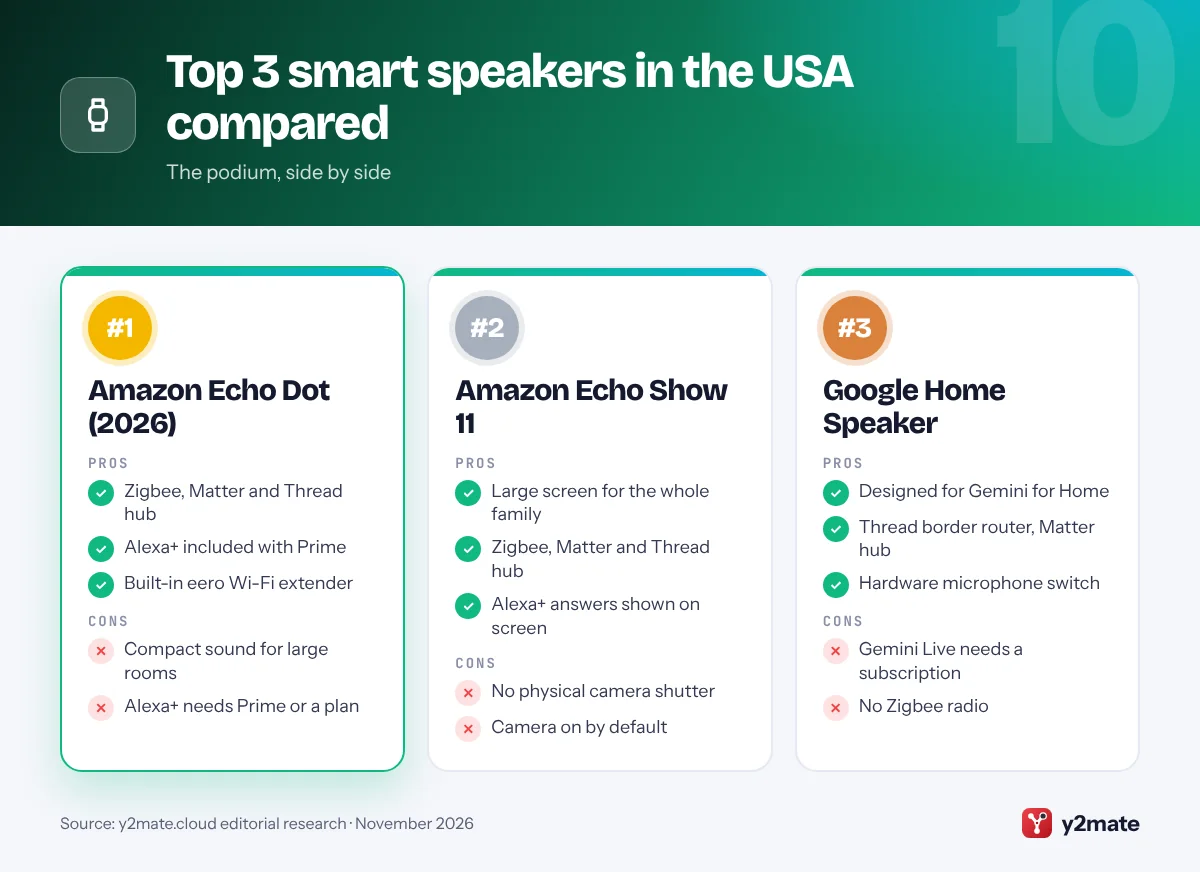
1. Amazon Echo Dot (2026)
Best for: most homes that want Alexa+ and a built-in hub
Amazon’s next-generation Echo Dot, launched on October 28, 2026, is the easiest recommendation for most American homes. It is the first Echo Dot with a full smart home hub inside, supporting Zigbee, Matter and Thread, so it can run lights, locks, plugs and battery sensors without a separate bridge. It also contains an eero Wi-Fi extender that adds coverage to an existing eero mesh network.
Amazon’s AZ3 chip handles more processing on the device for faster Alexa+ conversations, and an extra microphone helps Voice ID tell household members apart. Omnisense, Amazon’s sensor platform, detects room temperature and presence, so a routine can switch on lights when you walk in or nudge the thermostat when a room gets cold. Amazon describes the sound as clearer, with deeper bass than the previous Dot.
In the US, Alexa+ is open to every customer and included with Prime, which makes this the simplest way into Amazon’s new assistant. A dedicated button turns the microphones off, and kids editions come with a year of Amazon Kids+.
Official site: Amazon Echo Dot (2026)
- Zigbee, Matter and Thread hub
- Alexa+ included with Prime
- Built-in eero Wi-Fi extender
- Compact sound for large rooms
- Alexa+ needs Prime or a plan
2. Amazon Echo Show 11
Best for: a kitchen screen that runs the whole home
The Echo Show 11 is the best smart display for most US homes that already lean on Alexa. Released in late 2025 and designed for Alexa+, it pairs a large touchscreen with spatial audio, so it works as a recipe screen, family calendar, video-calling device and doorbell monitor in one. Alexa+ shows its answers on screen as visual cards.
It is also a complete smart home hub. Amazon lists Zigbee, Matter and a Thread border router, so it can connect older Zigbee bulbs and sensors as well as newer Matter devices, and its home screen gives everyone in the house tap controls for lights, locks and Ring cameras.
Privacy needs a little attention. The front camera supports video calls and presence features through Omnisense, and Amazon says the camera is switched on by default. There is no sliding shutter on this generation; instead, one button turns off both the microphones and the camera, and you can disable the camera in settings.
Official site: Amazon Echo Show 11
- Large screen for the whole family
- Zigbee, Matter and Thread hub
- Alexa+ answers shown on screen
- No physical camera shutter
- Camera on by default
3. Google Home Speaker
Best for: Android households that want Gemini
The Google Home Speaker, on sale in the US since June 25, 2026, is Google’s first speaker designed for Gemini for Home, the assistant that is replacing Google Assistant on its speakers and displays. Adding it to your home makes you eligible to switch your household to Gemini, which understands more natural, conversational requests.
Basic Gemini for Home features are free. Gemini Live, the mode for open-ended, back-and-forth conversation that you can interrupt, needs a Google Home Premium subscription, and Google includes a trial with the speaker. One caution: Google says that once a home switches to Gemini for Home, it cannot switch back to Google Assistant.
For the smart home, Google lists a Thread border router and says the speaker works as a hub for Matter with Google Home, though it has no Zigbee radio. It plays 360-degree sound, joins speaker groups and can pair with a Google TV Streamer for home theater audio. A physical switch mutes the microphones, a light ring shows when it is listening, and Google promises security updates for at least five years.
Official site: Google Home Speaker
- Designed for Gemini for Home
- Thread border router, Matter hub
- Hardware microphone switch
- Gemini Live needs a subscription
- No Zigbee radio
4. Apple HomePod mini 2
Best for: iPhone homes that want a compact home hub
Apple’s HomePod mini 2 went on sale on October 30, 2026, and it is the smart speaker to buy if everyone in your home uses an iPhone. It works as an Apple home hub and a Thread border router for Matter and HomeKit accessories. Built-in temperature and humidity sensors can trigger automations, and Sound Recognition can send an alert to your iPhone when it hears a smoke or carbon monoxide alarm, although Apple says not to rely on it in an emergency.
The headline feature is still on the way. Apple says Siri AI, its new conversational version of Siri, will reach HomePod mini 2 in a free software update, in English in the US and several other countries. Personal requests will need the home owner’s Apple Intelligence-enabled iPhone or iPad with Siri AI turned on. Until then it runs the current Siri.
Apple describes room-filling 360-degree sound. There is no Zigbee and no physical microphone switch; you turn off listening in the Home app.
Official site: Apple HomePod mini 2
- Apple home hub with Thread
- Temperature and humidity sensors
- Siri AI promised as free update
- Siri AI not available yet
- Best only with an iPhone
5. Apple HomeView
Best for: Apple homes that want a shared screen
Apple HomeView is Apple’s first smart display, on sale in the US since November 13, 2026, and it is the first Apple home device with Siri AI built in. Apple calls the assistant a beta in English, and it can answer broad questions, act on what is on screen and, when paired with an Apple Intelligence-enabled iPhone or iPad, draw on your calendar and messages.
HomeView is designed to be shared. It recognizes up to six household members by face and voice and shows each person’s messages, reminders and calendar only when they are recognized and their paired iPhone or iPad is nearby and recently unlocked. Apple says the A18 chip processes camera and microphone feeds in Secure Exclaves, a protected area that neither the operating system nor Apple can access. It comes in tabletop and wall-mounted versions.
As a home hub it supports Thread and Matter accessories, includes a temperature and humidity sensor and shows a Home app dashboard. FaceTime calls use a Center Stage camera. It needs an iPhone or iPad to set up, and it has no Zigbee radio.
Official site: Apple HomeView
- Siri AI built in (beta)
- Personal views for six people
- Tabletop or wall-mounted
- Needs an iPhone or iPad
- Siri AI still labeled beta
6. Amazon Echo Studio
Best for: room-filling music with Alexa+
The Echo Studio is Amazon’s best-sounding smart speaker, and the redesigned 2025 model is the one to buy for a living room. Amazon pairs a high-excursion woofer with several full-range drivers and supports Dolby Atmos and spatial audio, with automatic room adaptation tuning the sound to your space. It can also pair with a compatible Fire TV device as part of a home theater setup.
Like the smaller Echo speakers, it includes a full smart home hub with Zigbee, Matter and Thread, and Alexa+ is included with Prime in the US.
In October 2026, Amazon added the Echo Studio with Home Camera, which uses a built-in camera so Alexa+ can recognize objects you hold up and so you can check the room through Live View. A light shows when that camera is streaming, and one button turns off the microphones and camera. Amazon still sells the standard Echo Studio, which has no camera, and that is the version we suggest for most homes.
Official site: Amazon Echo Studio
- Dolby Atmos and spatial audio
- Zigbee, Matter and Thread hub
- Camera-free version still sold
- Large for small rooms
- Camera model needs privacy care
7. Amazon Echo Dot Max
Best for: bigger sound from a compact Echo
The Echo Dot Max, launched in 2025, sits between the Echo Dot and the Echo Studio. Amazon gave it a separate woofer and tweeter for fuller sound than the classic Dot, which makes it a better choice for a home office, a bedroom where you play music, or a kitchen counter where a display is not needed.
It runs on Amazon’s AZ3 chip, which Amazon says improves conversation detection and wake word accuracy for Alexa+. For the smart home, Amazon lists Zigbee, Matter and a Thread border router, so it can be the main hub in a smaller home or extend coverage in a larger one. It also supports Bluetooth streaming.
The newer 2026 Echo Dot now matches it on smart home features, so choose the Dot Max mainly for its sound. Privacy controls are the same as other Echo speakers: a microphone button, a light that shows when Alexa is listening, and voice history settings in the Alexa app.
Official site: Amazon Echo Dot Max
- Fuller sound than the Echo Dot
- Zigbee, Matter and Thread hub
- AZ3 chip for Alexa+
- No screen for visual answers
- Echo Studio sounds bigger
8. Google Nest Hub (2nd gen)
Best for: a camera-free bedside or kitchen display
Google’s Nest Hub (2nd gen) is still on sale on the US Google Store, and it remains the best smart display for people who do not want a camera in the room. It has a 7-inch touchscreen, a physical switch that turns the microphones off, and no camera at all.
It has been updated with Google’s newer assistant. Google lists the Nest Hub (2nd gen) among the devices that get the complete Gemini for Home experience, including Gemini Live with a Google Home Premium subscription, once your home is upgraded through early access or by adding a Google Home Speaker. It is also a Thread border router and a hub for Matter with Google Home, so it can run Thread sensors and locks.
Its Soli radar sensor powers Sleep Sensing, which can track sleep from the bedside without a wearable. The trade-offs are age and audio: this model dates from 2021, and its small speaker is fine for voices and podcasts but not a substitute for a music speaker.
Official site: Google Nest Hub (2nd gen)
- No camera, mic off switch
- Thread border router, Matter hub
- Gemini for Home supported
- Older 2021 hardware
- Small speaker for music
9. Sonos Era 100
Best for: music-first rooms with voice as an extra
The Sonos Era 100 is the pick for people who mainly want great-sounding music and treat voice control as a bonus. It is a compact stereo speaker that joins a wider Sonos system, and pairs with a second Era 100 for stereo. Trueplay tuning adjusts the sound to the room, and it supports AirPlay 2 and Bluetooth.
You can choose between Amazon Alexa and Sonos Voice Control. Sonos says its own assistant handles music requests without recording, transcribing or sending your voice to the cloud. A switch on the speaker disconnects power to the microphones. In September 2026, Sonos also announced limited, US-only early access to Sonos 27voice, a new natural-language assistant for its speakers, starting in fall 2026.
The Era 100 is not a smart home hub. It is not a Matter controller or Thread border router, so you will need an Echo, Google or Apple device to run Thread sensors and locks. Alexa on the Era 100 can still control devices linked to your Alexa account by voice.
Official site: Sonos Era 100
- Strong music focus
- Local Sonos Voice Control option
- Mic switch cuts power
- Not a smart home hub
- No Google or Siri assistant
10. Apple HomePod (2nd generation)
Best for: rich sound in an Apple home
The full-size HomePod (2nd generation) is Apple’s best-sounding speaker and still the right choice for iPhone owners who care most about music. Apple describes rich, room-filling sound with deep bass, and it supports spatial audio with compatible content. Two HomePods can be paired in stereo, and with an Apple TV 4K they can serve as home theater speakers.
Its smart home credentials match the HomePod mini 2. It is an Apple home hub and Thread border router, it controls Matter and HomeKit accessories, it has temperature and humidity sensors for automations, and Sound Recognition can alert your iPhone to smoke and carbon monoxide alarms.
The catch is the assistant. Apple’s HomePod (2nd generation) pages do not list Siri AI, which Apple has announced for HomeView and HomePod mini 2, so for now it runs the current Siri. If smarter conversations matter more than sound, choose HomePod mini 2 or HomeView instead. Like other HomePods, it can place a 911 call through your iPhone if you ask Siri.
Official site: Apple HomePod (2nd generation)
- Apple's best-sounding speaker
- Home hub with Thread
- Spatial audio support
- Siri AI not listed for it
- Large and best with iPhone
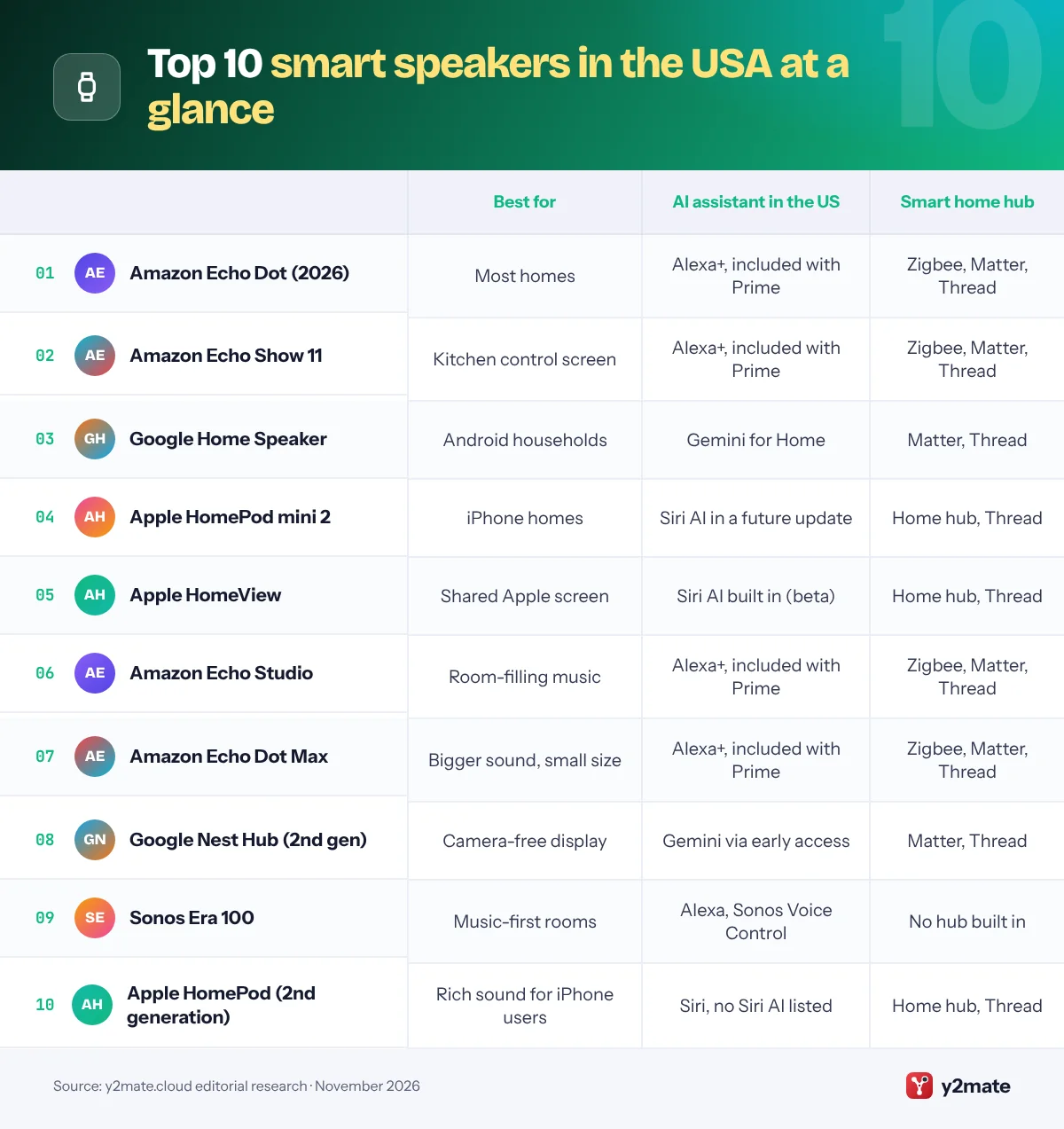
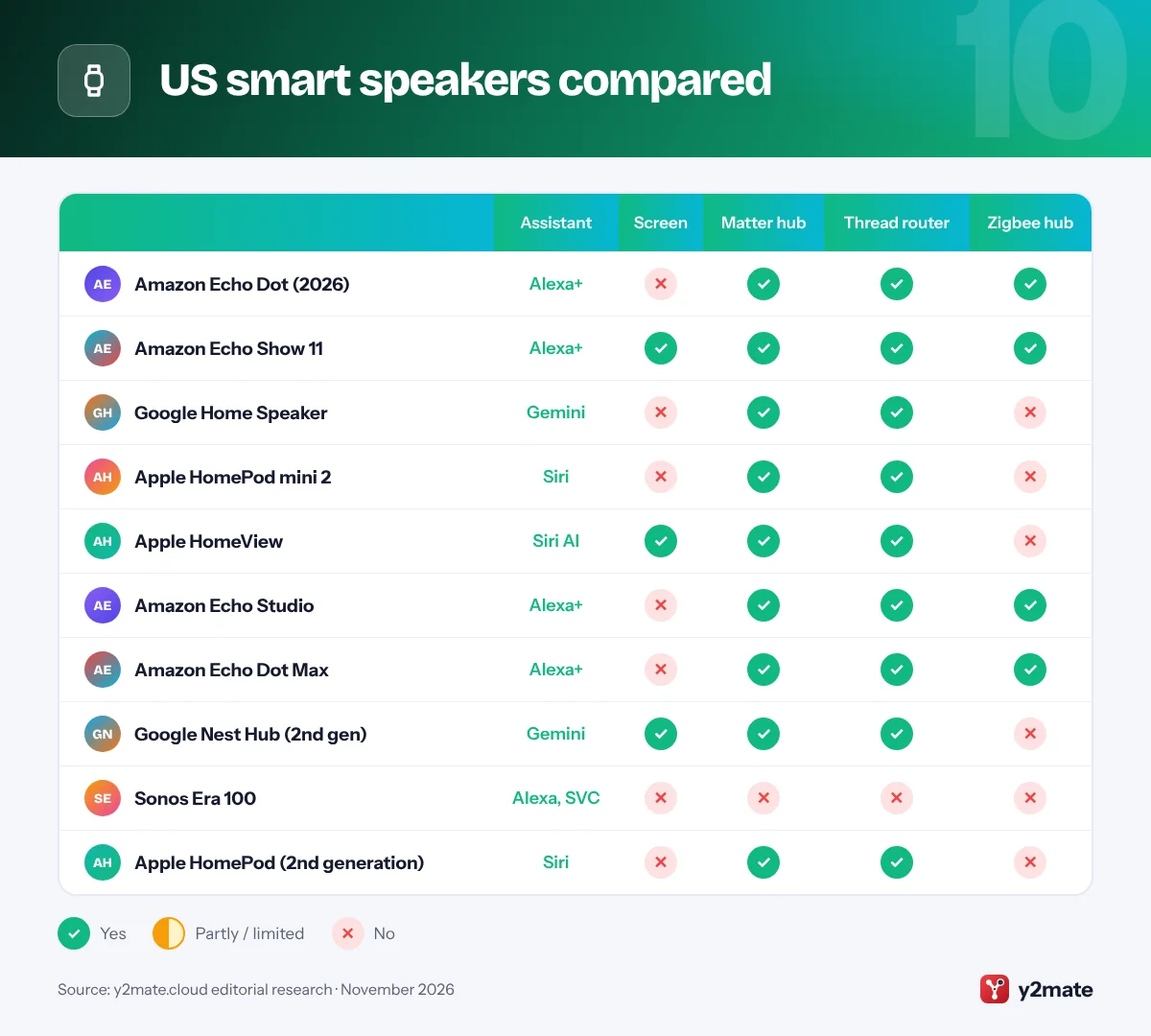
US smart speakers compared
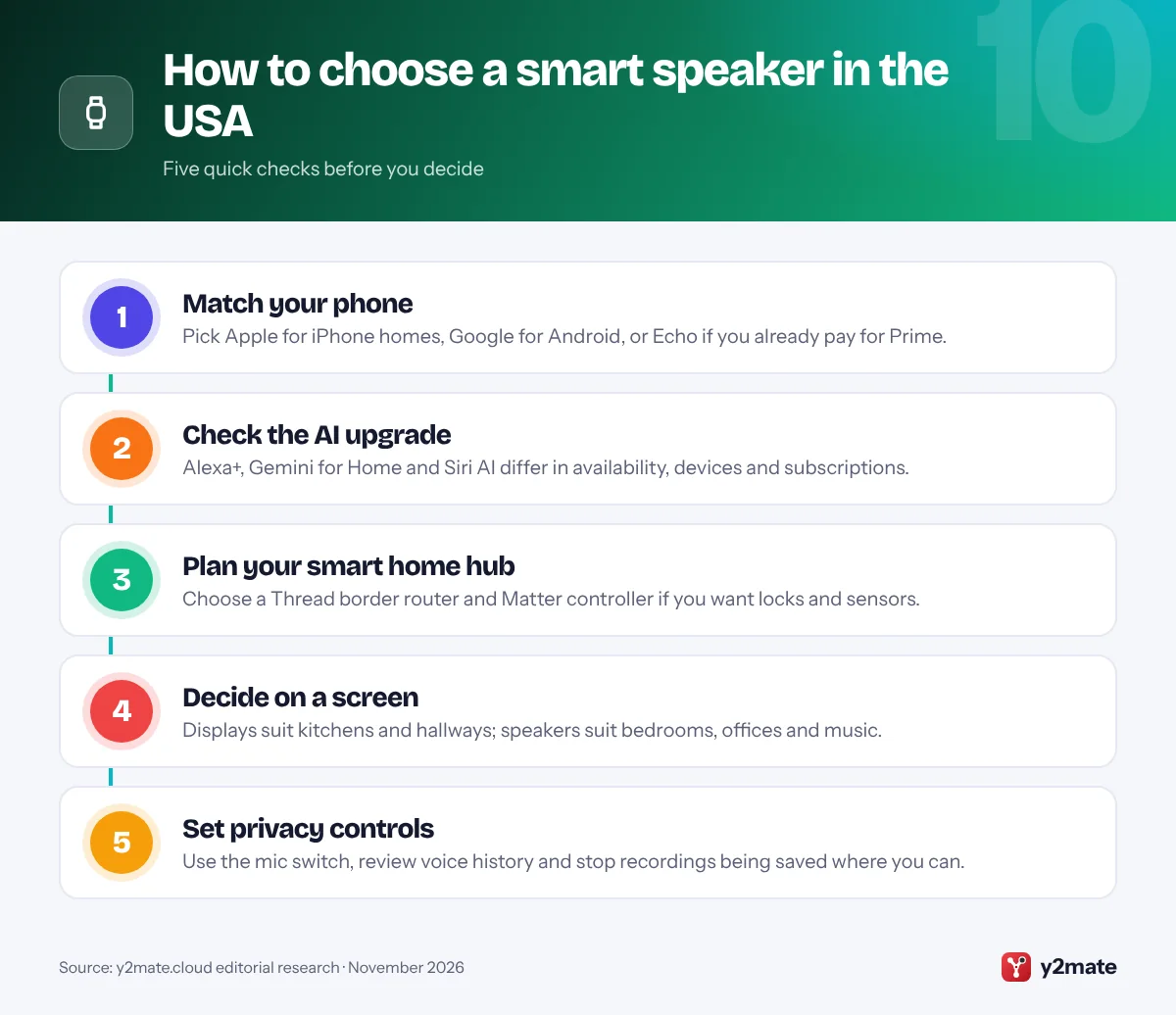
How to choose smart speakers in the USA
Start with the phones and services your household already uses. iPhone homes get the most from HomePod and HomeView, Android homes from Google, and Prime members from Echo, because Alexa+ is included with their membership. Then decide whether you want a screen: displays suit kitchens and hallways, while speakers are easier to place in bedrooms and offices.
Check the assistant, not just the speaker
Alexa+ is available to all US customers. Gemini for Home is rolling out through early access, and adding a Google Home Speaker makes your home eligible to switch, but Gemini Live needs a Google Home Premium subscription. Siri AI is built into HomeView as a beta and is coming to HomePod mini 2 in a software update.
Plan your smart home hub
If you want battery-powered sensors or locks, choose a speaker that is a Thread border router and Matter controller. Recent Echo models also include a Zigbee hub for many older bulbs and sensors. Sonos speakers do not act as hubs.
Emergencies, children and privacy
- 911: Alexa calling does not dial 911 by default. Amazon’s paid Alexa Emergency Assist connects you to an urgent response agent who can request help, Google says its speakers cannot call emergency services, and HomePod places 911 calls through your iPhone.
- Children: in 2023 the FTC and the Justice Department charged Amazon with keeping children’s Alexa voice recordings and undermining parents’ deletion requests. The settlement required deletions and barred Amazon from using that data to train its algorithms.
- Recordings: Echo requests are processed in the cloud, so use the microphone button and set recordings not to be saved if you do not need Voice ID.
Frequently asked questions
What is the best smart speaker in the USA in 2026?
For most US homes, the new Amazon Echo Dot is the best smart speaker because it includes Alexa+ with Prime and a built-in Zigbee, Matter and Thread hub. Choose the Echo Show 11 if you want a screen, the Google Home Speaker for Android and Gemini, and the HomePod mini 2 or Apple HomeView if your household uses iPhones.
Is Alexa+ free in the US?
Alexa+ is available to all US customers and is included at no extra cost with an Amazon Prime membership. People without Prime can pay for a standalone monthly subscription instead. It works on recent Echo speakers and displays, in the Alexa app and on the web at Alexa.com, although some features depend on the device you use.
Can a smart speaker call 911?
Usually not directly. Alexa calling does not support 911 by default, although Amazon's paid Alexa Emergency Assist connects you to an urgent response agent who can request emergency help. Google says its speakers and displays cannot call emergency services. A HomePod can place a 911 call through the iPhone linked to it. Always keep a phone within reach for emergencies.
Which smart speakers work with Matter and Thread?
Most current models from Amazon, Google and Apple do. Recent Echo speakers and displays act as Matter controllers and Thread border routers and add a Zigbee hub. The Google Home Speaker and Nest Hub (2nd gen) are Matter hubs and Thread border routers, and HomePod and HomeView work as Apple home hubs with Thread. Sonos speakers are not smart home hubs.
How do I stop a smart speaker saving my voice recordings?
Each brand has its own controls. In the Alexa app, Amazon lets you choose not to save recordings, although Voice ID then stops working. Google lets you review and delete activity in your Google Account, and Apple lets you delete Siri history and opt out of Improve Siri in settings. Every speaker here also lets you turn its microphones off.
Final verdict
The best smart speakers in the USA in 2026 are the new Amazon Echo Dot for most homes, the Echo Show 11 for a kitchen screen and the Google Home Speaker for Android households moving to Gemini. iPhone users should choose HomePod mini 2 for a compact hub or HomeView for a shared display, while the Echo Studio, HomePod (2nd generation) and Sonos Era 100 suit people who care most about music.
Before you buy, check which assistant upgrade the device gets and whether it needs Prime or a Google Home Premium subscription, make sure it can act as your Thread border router, set up privacy controls on day one and keep a phone nearby for 911.
Sources and further reading
- FTC action on Alexa voice data: The FTC explains its 2023 case against Amazon over children's Alexa voice recordings and parents' deletion requests.
- Gemini for Home availability: Google's help page lists the countries, devices and subscription features for its Gemini for Home voice assistant.
- Emergency calls on HomePod: Apple's HomePod guide explains how HomePod places emergency calls through a linked iPhone.
- Matter smart home standard: The Connectivity Standards Alliance's official overview of Matter, the standard that lets smart devices work across platforms.

Leave a Reply